Tracking the Pepper Weevil Anthonomus eugenii Cano Joseph
- Slides: 25
Tracking the Pepper Weevil (Anthonomus eugenii Cano) Joseph Ingerson-Mahar Bernadette Eichinger NJ-Acts 5 February 2013 6/7/2021 2
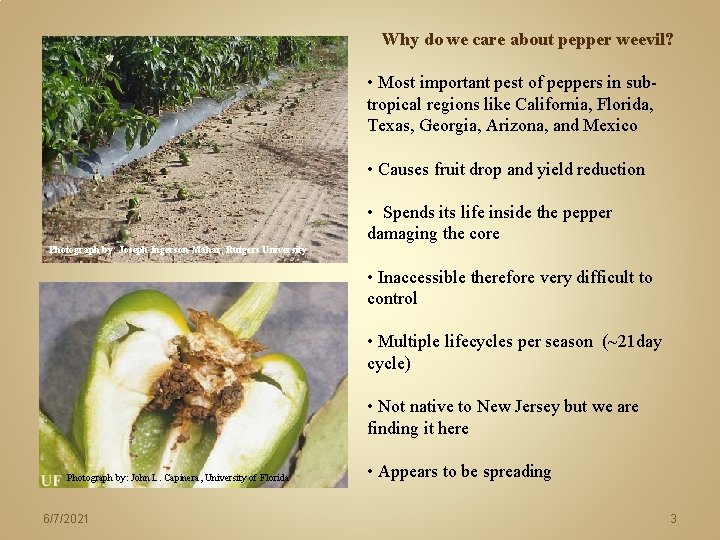
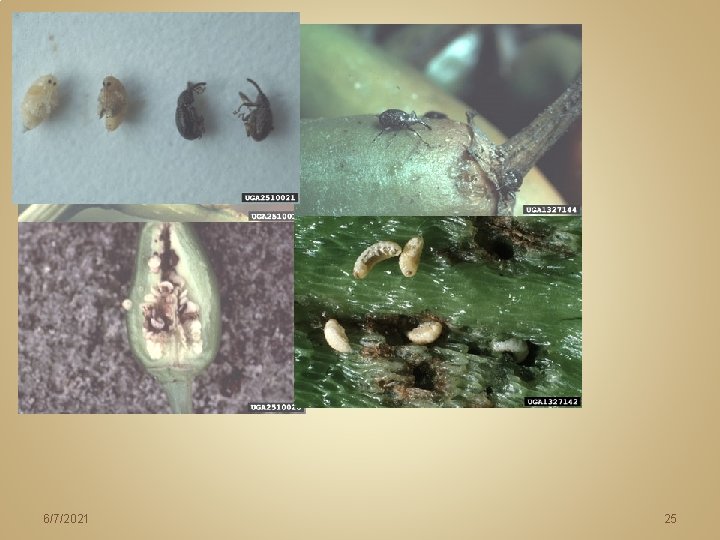
Why do we care about pepper weevil? • Most important pest of peppers in subtropical regions like California, Florida, Texas, Georgia, Arizona, and Mexico • Causes fruit drop and yield reduction • Spends its life inside the pepper damaging the core Photograph by: Joseph Ingerson-Mahar, Rutgers University • Inaccessible therefore very difficult to control • Multiple lifecycles per season (~21 day cycle) • Not native to New Jersey but we are finding it here Photograph by: John L. Capinera, University of Florida 6/7/2021 • Appears to be spreading 3
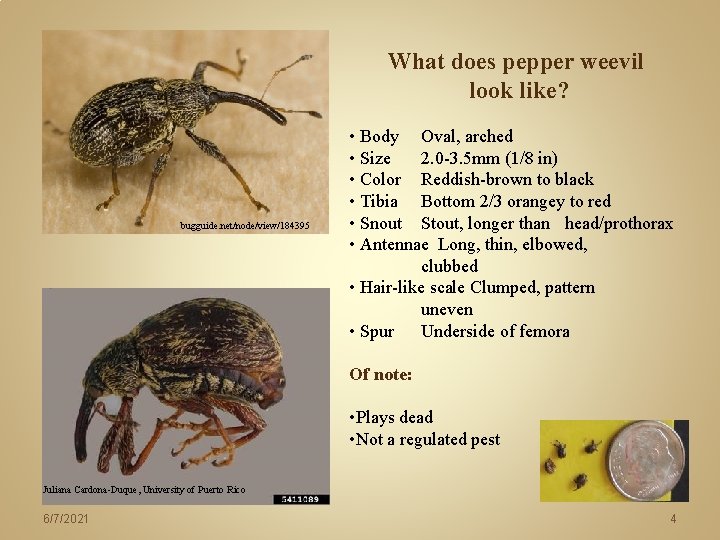
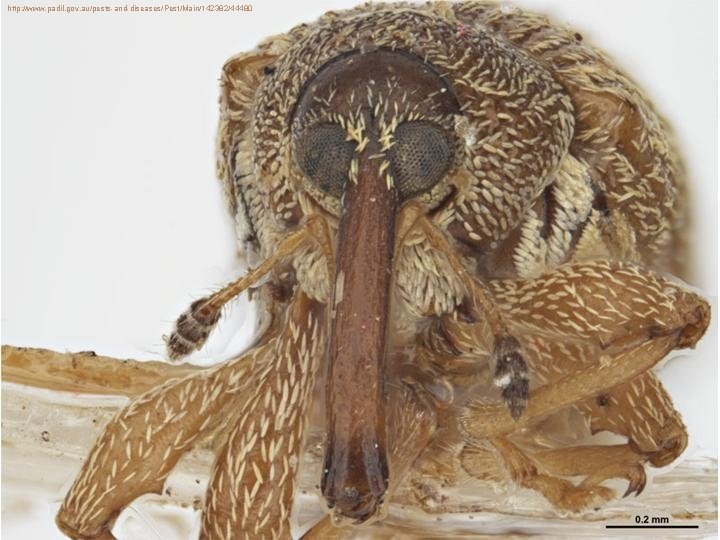
What does pepper weevil look like? bugguide. net/node/view/184395 • Body Oval, arched • Size 2. 0 -3. 5 mm (1/8 in) • Color Reddish-brown to black • Tibia Bottom 2/3 orangey to red • Snout Stout, longer than head/prothorax • Antennae Long, thin, elbowed, clubbed • Hair-like scale Clumped, pattern uneven • Spur Underside of femora Of note: • Plays dead • Not a regulated pest Juliana Cardona-Duque, University of Puerto Rico 6/7/2021 4
Recent History Pepper weevil (pw) found in 2004, 2006, 2007, 2008, 2009, 2010 2011 summer and winter In July mounted traps and found pw at two Atlantic County farms and a Gloucester County farm. Monitored fields at all three throughout the rest of 2011, including after fields plowed under. Then continued through the winter. Last pw found on 12/6/2011. 2012 spring Added an unaffected fourth farm in Salem County. Monitored all the greenhouses and the fields being readied for 2012 at all four. Requested and received partnership grant from NE SARE (Northeast Sustainable Agriculture Research and Education). 6/7/2021 5
PROGRAM GOALS Determine pathways of pepper weevil (pw) arrival into southern New Jersey. Determine scope of pest presence. Provide protocol for management. Part 1: Tracking and capturing the weevil. Part 2: Results and follow-up. 6/7/2021 6
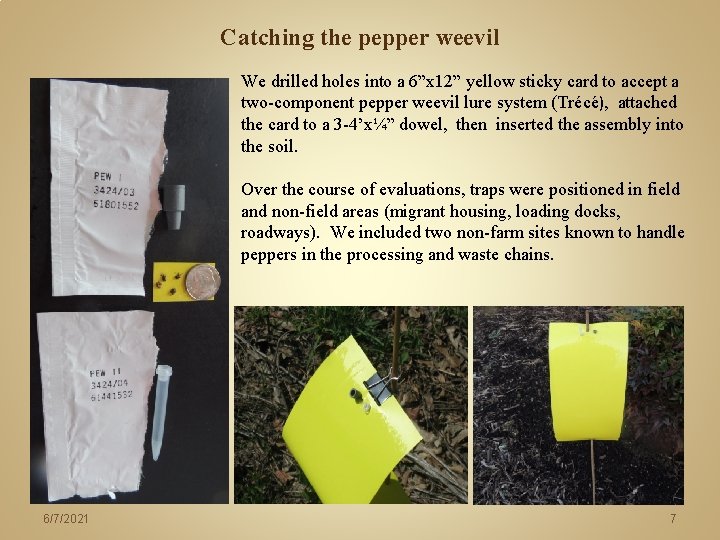
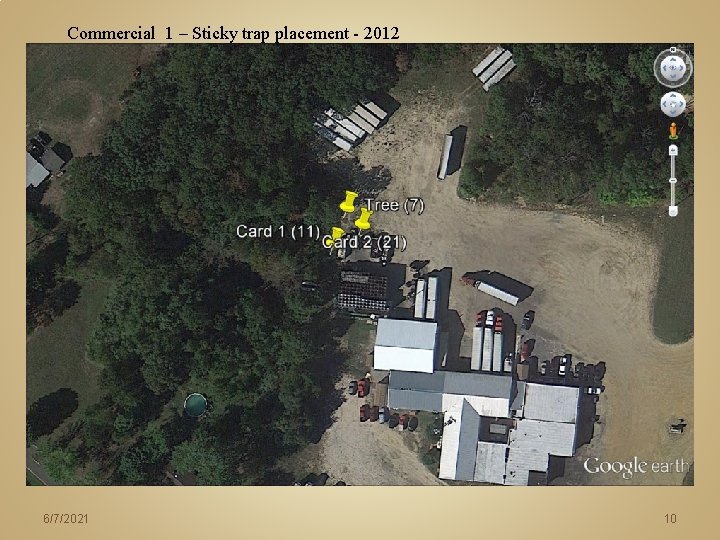
Catching the pepper weevil We drilled holes into a 6”x 12” yellow sticky card to accept a two-component pepper weevil lure system (Tre ce ), attached the card to a 3 -4’x¼” dowel, then inserted the assembly into the soil. Over the course of evaluations, traps were positioned in field and non-field areas (migrant housing, loading docks, roadways). We included two non-farm sites known to handle peppers in the processing and waste chains. 6/7/2021 7
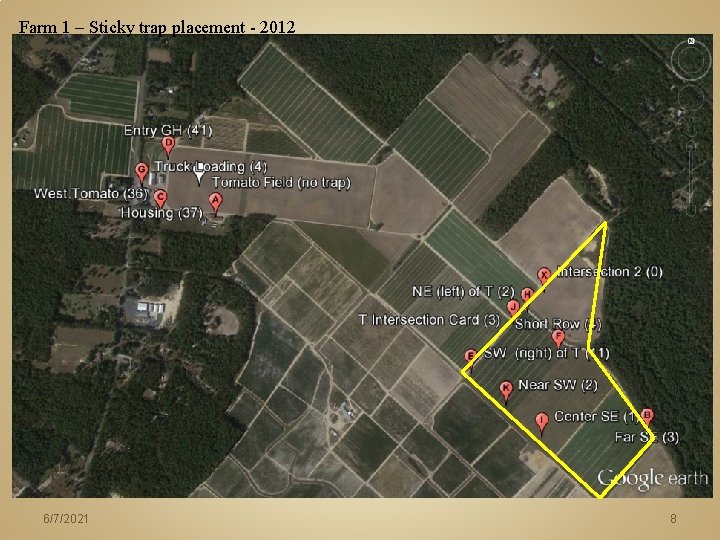
Farm 1 – Sticky trap placement - 2012 6/7/2021 8
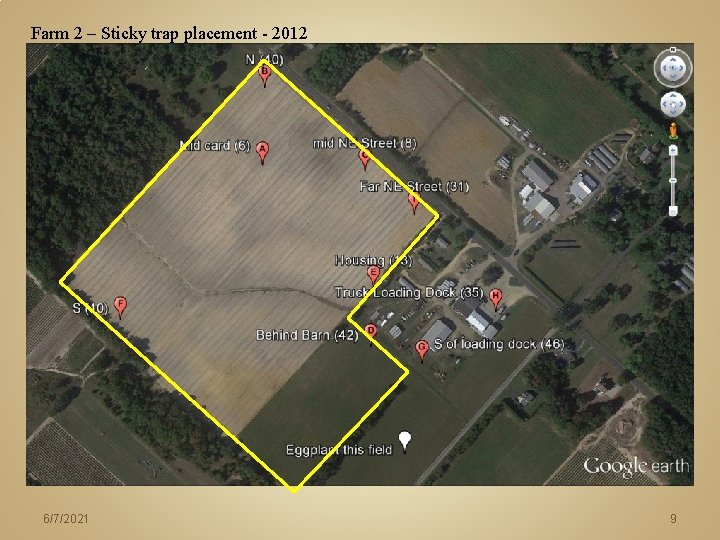
Farm 2 – Sticky trap placement - 2012 6/7/2021 9
Commercial 1 – Sticky trap placement - 2012 6/7/2021 10
Pepper Weevil Trap Placements and Catches Spring and Summer 2012 • Continuously monitored greenhouses and 2011 fields since prior year at four farms until transfer of transplants • Initial traps set in March at processing facility and waste user dump pile • Field traps for 2012 set at Atlantic, Salem, and Gloucester County farms in May as plants transferred to field • First 2 pw caught at an Atlantic County processing facility on 4/16/12 • Next 2 at the same facility on 5/16/12 • One at an Atlantic County field 5/28 • No more until 8/16 and 8/20 in Atlantic County including 3 farms and the pepperfree waste dump area. Gloucester County arrival was 8/23 6/7/2021 11
Pepper Weevil Trap Placements and Catches Spring and Summer 2012 (cont’d) From mid-August 2012 • Alerted to damaged field in Cumberland • Alerted to equipment exchange among Cumberland Atlantic farms • Added traps on 8/26 in Cumberland; first captures 8/28 • One on card in investigator truck on 9/6 • Added Salem County greenhouse and found weevils in fruit, but not on card. • Last 12/5 Gloucester County 6/7/2021 12
By season’s end we had placed traps at two commercial facilities, ten farms, two greenhouse areas not previously surveyed, and in our own vehicles. Four counties are known affected for 2012. In winter 2012 -2013 we continue to monitor the two non-farm facilities. 6/7/2021 13
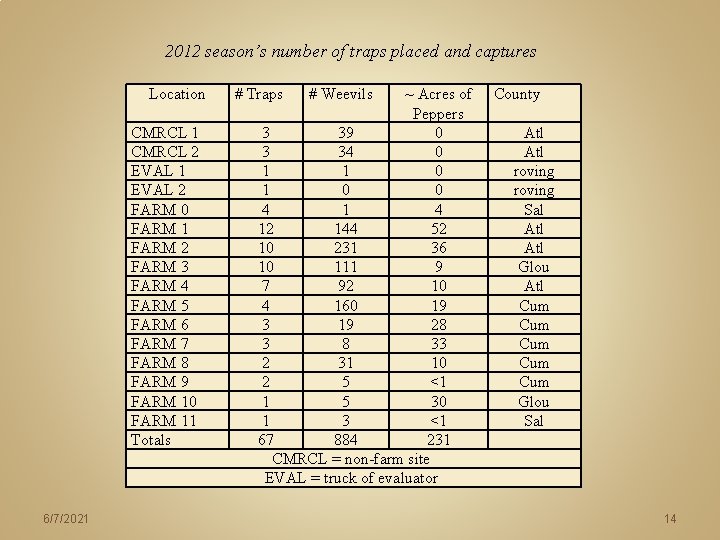
2012 season’s number of traps placed and captures Location CMRCL 1 CMRCL 2 EVAL 1 EVAL 2 FARM 0 FARM 1 FARM 2 FARM 3 FARM 4 FARM 5 FARM 6 FARM 7 FARM 8 FARM 9 FARM 10 FARM 11 Totals 6/7/2021 # Traps # Weevils ~ Acres of Peppers 3 39 0 3 34 0 1 1 0 0 4 12 144 52 10 231 36 10 111 9 7 92 10 4 160 19 3 19 28 3 8 33 2 31 10 2 5 <1 1 5 30 1 3 <1 67 884 231 CMRCL = non-farm site EVAL = truck of evaluator County Atl roving Sal Atl Glou Atl Cum Cum Cum Glou Sal 14
Observations on 2012 season’s captures There was an early arrival (April and May) of a few pests at a processing facility; and one on an Atlantic County farm in May. Rapid arrival of the pests was detected in the late season, between 8/16 and 8/24, in Atlantic and Gloucester counties then quickly confirmed in Salem and Cumberland counties. Arrival continued through early December. Most captures are associated with disturbed areas along roadways, near worker housing, and near equipment movement. 79% of pw at a farm in Atlantic County were attached to cards ½ mile away from pepper fields. The same is true for 48% of those caught at a second Atlantic County farm. Most cards erected (65 of 67) caught the weevil suggesting that the card system is effective. The weevil spreads rapidly. 6/7/2021 15
Observations on dual lures on sticky card system No consensus was discovered in the literature relating the number of pests on a card to field damage. Most Southern state guidelines for spray application focus on percentage of field damage (5%) or number of insects found per number of buds (1 per 200 buds). The card+lure system is useful as an indicator of presence of the pest. The card is easily damaged by field traffic movement and weather systems. Many other insects are trapped such as thrips, flies, moths, beetles, wasps. It takes a trained eye to locate pw. Cards usually were changed twice a week, a messy process. We changed lures monthly. Many weevils other than pepper weevil are trapped. We found about 10 other species. Positive ID of pepper weevil requires training. We found weevils inside fruit with no card indication. 6/7/2021 16
Continuing goals for sticky card use and placement • Devise a protocol for minimum card placement that maximizes early detection of arrival/presence. This will involve fewer cards throughout farm fields and more at disturbed areas and areas of potential introduction and transport. • Determine the extent of pest presence in other counties. • Determine source of first arrival into an area. Involves the need for cooperation from many entities in the distribution and marketing chains to allow survey cards at their sites. 6/7/2021 17
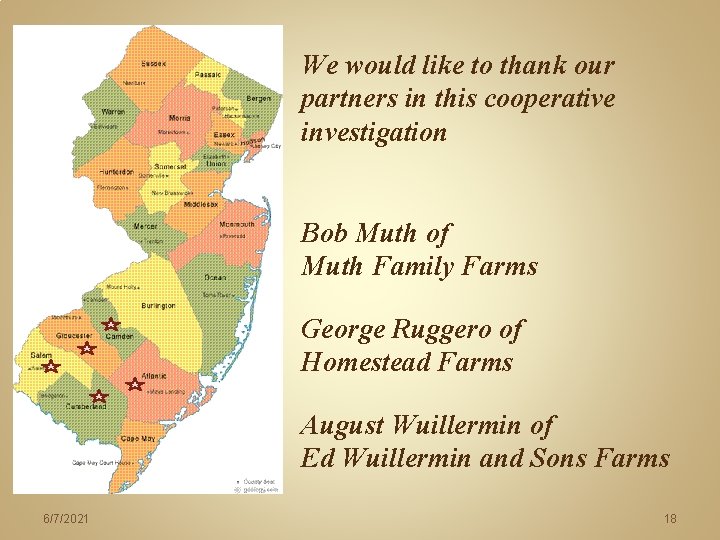
We would like to thank our partners in this cooperative investigation Bob Muth of Muth Family Farms George Ruggero of Homestead Farms August Wuillermin of Ed Wuillermin and Sons Farms 6/7/2021 18
http: //www. padil. gov. au/pests-and-diseases/Pest/Main/142382/44480 6/7/2021 19
Back up slides Serious infestations have occurred in New Jersey in the past 1957, 1967, 1985, 1988 and 1989 (Ghidiu and Rabin – ‘The Grower’, 1991) Ghidiu, G. M. , & Rabin, J. (1991). The Pepper Weevil in New Jersey. The New Jersey Grower, 14(1). There was a light infestation at Centerton Research Farm and a local farm in unsprayed pepper plots in 1999 6/7/2021 20
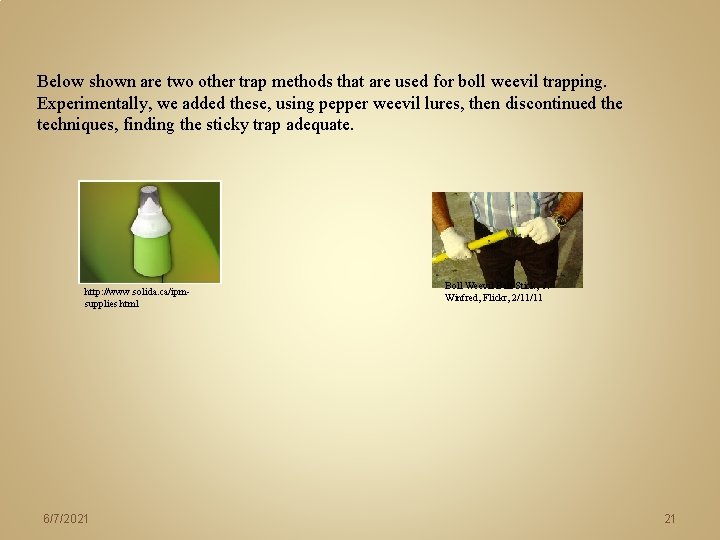
Below shown are two other trap methods that are used for boll weevil trapping. Experimentally, we added these, using pepper weevil lures, then discontinued the techniques, finding the sticky trap adequate. http: //www. solida. ca/ipmsupplies. html 6/7/2021 Boll Weevil Bait Stick, J. Winfred, Flickr, 2/11/11 21
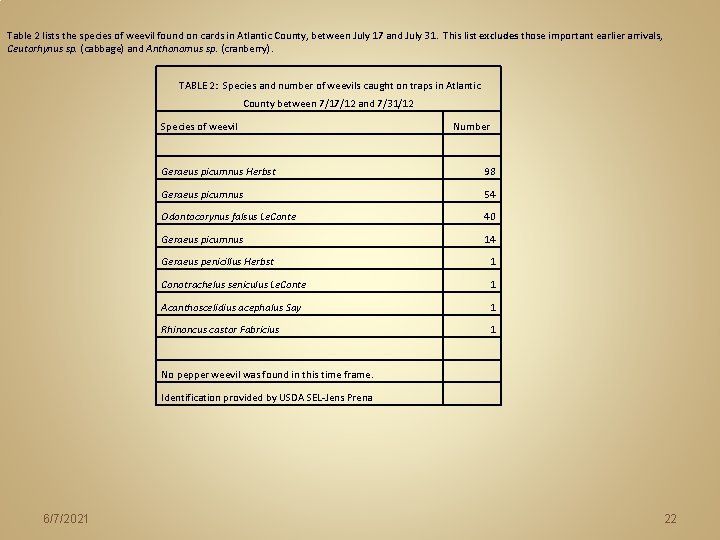
Table 2 lists the species of weevil found on cards in Atlantic County, between July 17 and July 31. This list excludes those important earlier arrivals, Ceutorhynus sp. (cabbage) and Anthonomus sp. (cranberry). TABLE 2: Species and number of weevils caught on traps in Atlantic County between 7/17/12 and 7/31/12 Species of weevil Number Geraeus picumnus Herbst 98 Geraeus picumnus 54 Odontocorynus falsus Le. Conte 40 Geraeus picumnus 14 Geraeus penicillus Herbst 1 Conotrachelus seniculus Le. Conte 1 Acanthoscelidius acephalus Say 1 Rhinoncus castor Fabricius 1 No pepper weevil was found in this time frame. Identification provided by USDA SEL-Jens Prena 6/7/2021 22
University of Georgia College of Agricultural and Environmental Sciences http: //www. ent. uga. edu/veg/solanaceous/pepperweevil. htm Prepared by Dr. Alton “Stormy” Sparks, Jr. and Dr. David G. Riley - University of Georgia http: //www. inspection. gc. ca/plants/plant-protection/directives/risk-management/rmd-1028/eng/1304792116992/1304821683305 E-mail Twitter Facebook Delicious Google Digg Stumble. Upon Reddit Newsvine Technorati RMD-10 -28: Anthonomus eugenii (pepper weevil) - Pest Risk Management Document Canadian Food Inspection Agency 59 Camelot Drive Ottawa, Ontario, Canada, K 1 A 0 Y 9 (Tel. : 613 -225 -2342; Fax: 613 -773 -7204) Date Issued: 2011 -02 -15 6/7/2021 23
http: //www. pestmanagement. rutgers. edu/ipm/Vegetable/ New: Pepper Weevil in New Jersey Description, biology and damage (J. Ingerson-Mahar http: //onvegetables. com/2011/05/13/pepper-weevil-and-field-peppers/ Pepper weevil and field peppers May 13, 2011 by Janice Le. Boeuf « Carrot Weevil How fast do weeds grow? » Pepper weevil and field peppers May 13, 2011 by Janice Le. Boeuf, OMAFRA Vegetable Crop Specialist, Ridgetow 6/7/2021 24
6/7/2021 25