Fertilizer CaNO 32 Ca SO 42 H 2
- Slides: 11
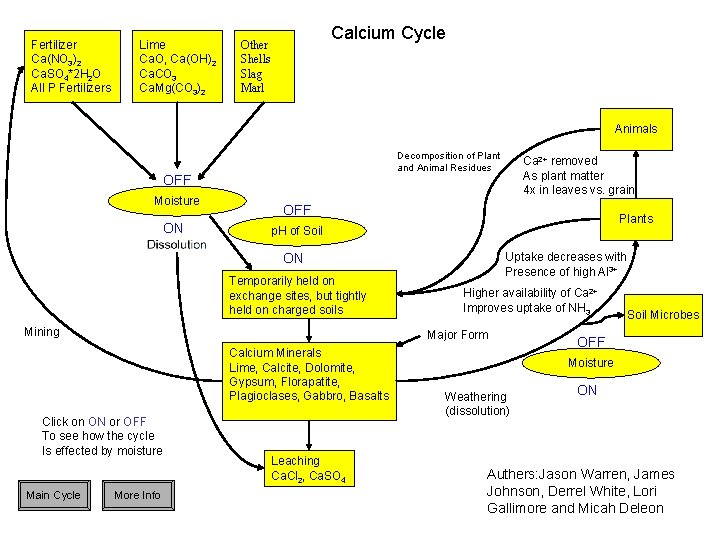
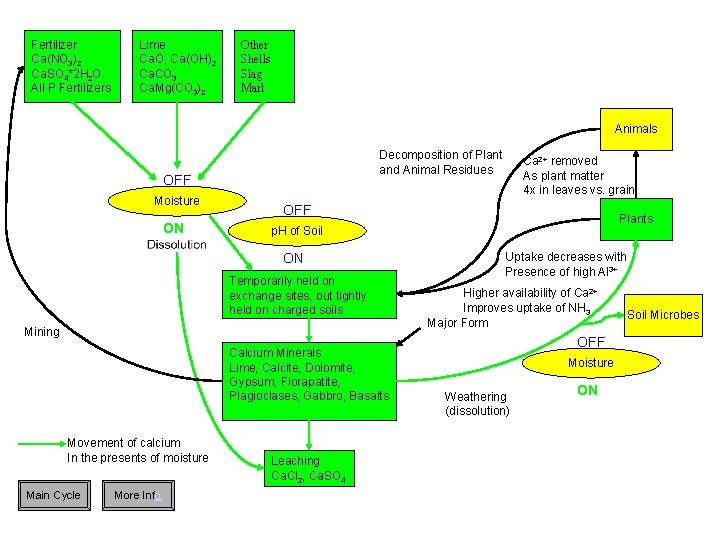
Fertilizer Ca(NO 3)2 Ca. SO 4*2 H 2 O All P Fertilizers Lime Ca. O, Ca(OH)2 Ca. CO 3 Ca. Mg(CO 3)2 Calcium Cycle Other Shells Slag Marl Animals Decomposition of Plant and Animal Residues OFF Moisture ON OFF Plants p. H of Soil Uptake decreases with Presence of high Al 3+ ON Temporarily held on exchange sites, but tightly held on charged soils Mining Higher availability of Ca 2+ Improves uptake of NH 3 Major Form Calcium Minerals Lime, Calcite, Dolomite, Gypsum, Florapatite, Plagioclases, Gabbro, Basalts Click on ON or OFF To see how the cycle Is effected by moisture Main Cycle Ca 2+ removed As plant matter 4 x in leaves vs. grain More Info Leaching Ca. Cl 2, Ca. SO 4 Soil Microbes OFF Moisture Weathering (dissolution) ON Authers: Jason Warren, James Johnson, Derrel White, Lori Gallimore and Micah Deleon
Fertilizer Ca(NO 3)2 Ca. SO 4*2 H 2 O All P Fertilizers Lime Ca. O, Ca(OH)2 Ca. CO 3 Ca. Mg(CO 3)2 Other Shells Slag Marl Animals Decomposition of Plant and Animal Residues OFF Moisture ON OFF Temporarily held on exchange sites, but tightly held on charged soils Mining Calcium Minerals Lime, Calcite, Dolomite, Gypsum, Florapatite, Plagioclases, Gabbro, Basalts Main Cycle More Info Plants p. H of Soil ON Movement of calcium In the presents of moisture Ca 2+ removed As plant matter 4 x in leaves vs. grain Leaching Ca. Cl 2, Ca. SO 4 Uptake decreases with Presence of high Al 3+ Higher availability of Ca 2+ Improves uptake of NH 3 Major Form OFF Moisture Weathering (dissolution) ON Soil Microbes
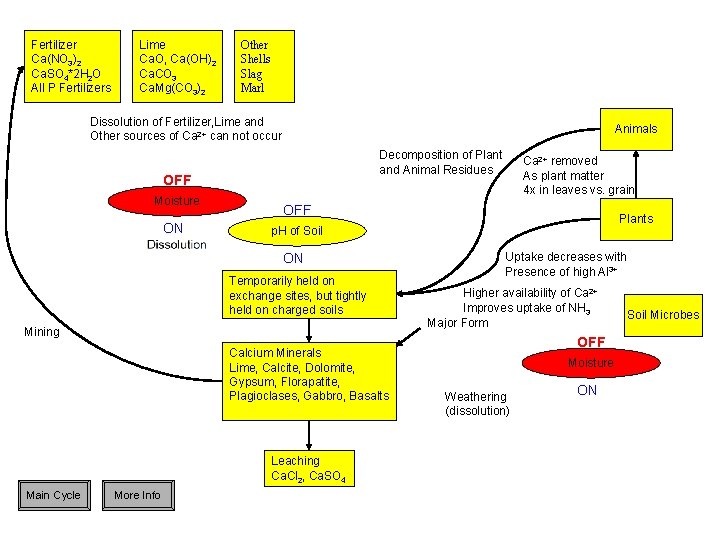
Fertilizer Ca(NO 3)2 Ca. SO 4*2 H 2 O All P Fertilizers Lime Ca. O, Ca(OH)2 Ca. CO 3 Ca. Mg(CO 3)2 Other Shells Slag Marl Dissolution of Fertilizer, Lime and Other sources of Ca 2+ can not occur Animals Decomposition of Plant and Animal Residues OFF Moisture ON OFF Temporarily held on exchange sites, but tightly held on charged soils Mining Calcium Minerals Lime, Calcite, Dolomite, Gypsum, Florapatite, Plagioclases, Gabbro, Basalts Leaching Ca. Cl 2, Ca. SO 4 More Info Plants p. H of Soil ON Main Cycle Ca 2+ removed As plant matter 4 x in leaves vs. grain Uptake decreases with Presence of high Al 3+ Higher availability of Ca 2+ Improves uptake of NH 3 Major Form OFF Moisture Weathering (dissolution) ON Soil Microbes
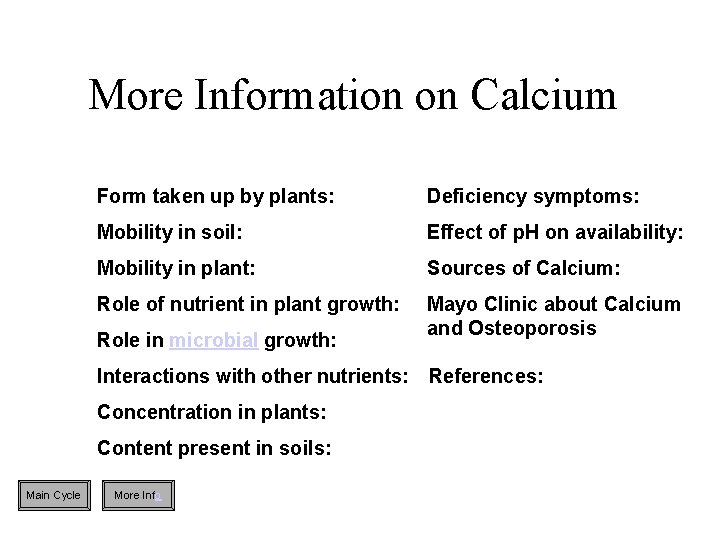
More Information on Calcium Form taken up by plants: Deficiency symptoms: Mobility in soil: Effect of p. H on availability: Mobility in plant: Sources of Calcium: Role of nutrient in plant growth: Mayo Clinic about Calcium and Osteoporosis Role in microbial growth: Interactions with other nutrients: References: Concentration in plants: Content present in soils: Main Cycle More Info
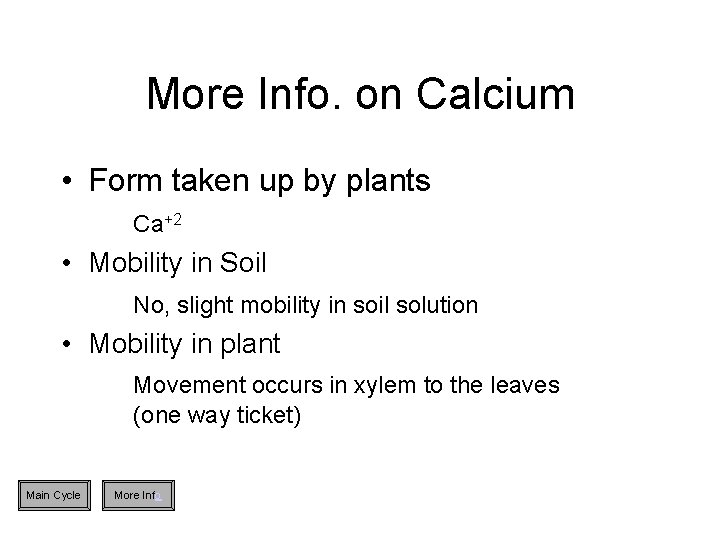
More Info. on Calcium • Form taken up by plants Ca+2 • Mobility in Soil No, slight mobility in soil solution • Mobility in plant Movement occurs in xylem to the leaves (one way ticket) Main Cycle More Info
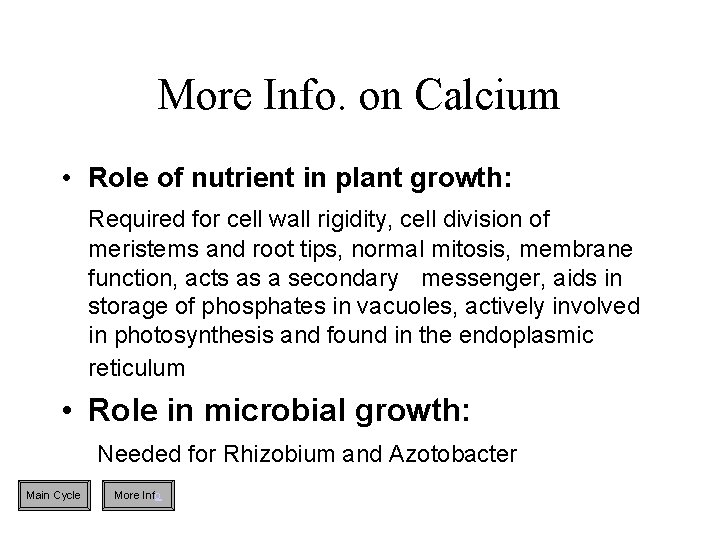
More Info. on Calcium • Role of nutrient in plant growth: Required for cell wall rigidity, cell division of meristems and root tips, normal mitosis, membrane function, acts as a secondary messenger, aids in storage of phosphates in vacuoles, actively involved in photosynthesis and found in the endoplasmic reticulum • Role in microbial growth: Needed for Rhizobium and Azotobacter Main Cycle More Info
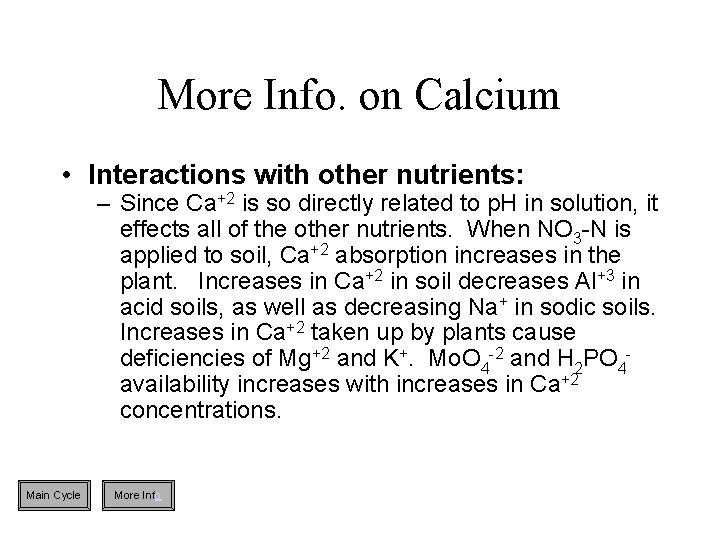
More Info. on Calcium • Interactions with other nutrients: – Since Ca+2 is so directly related to p. H in solution, it effects all of the other nutrients. When NO 3 -N is applied to soil, Ca+2 absorption increases in the plant. Increases in Ca+2 in soil decreases Al+3 in acid soils, as well as decreasing Na+ in sodic soils. Increases in Ca+2 taken up by plants cause deficiencies of Mg+2 and K+. Mo. O 4 -2 and H 2 PO 4 - availability increases with increases in Ca+2 concentrations. Main Cycle More Info
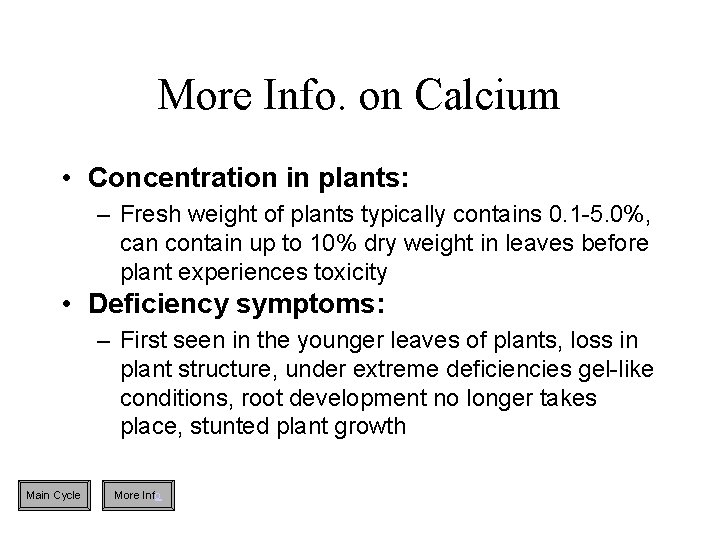
More Info. on Calcium • Concentration in plants: – Fresh weight of plants typically contains 0. 1 -5. 0%, can contain up to 10% dry weight in leaves before plant experiences toxicity • Deficiency symptoms: – First seen in the younger leaves of plants, loss in plant structure, under extreme deficiencies gel-like conditions, root development no longer takes place, stunted plant growth Main Cycle More Info
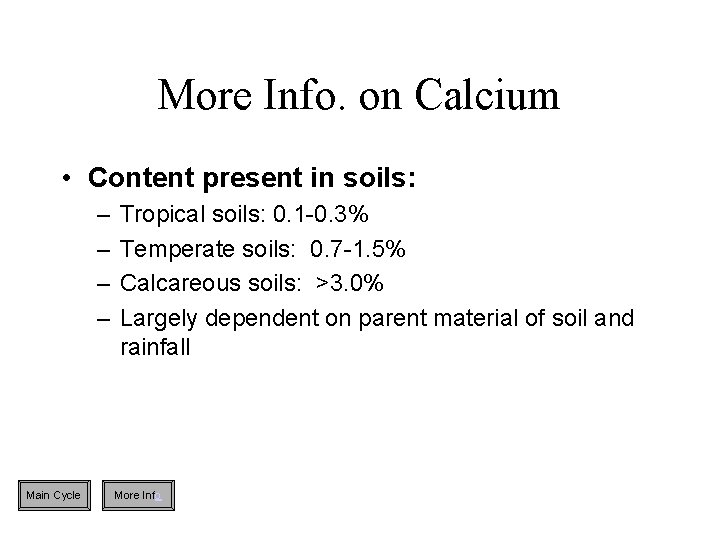
More Info. on Calcium • Content present in soils: – – Main Cycle Tropical soils: 0. 1 -0. 3% Temperate soils: 0. 7 -1. 5% Calcareous soils: >3. 0% Largely dependent on parent material of soil and rainfall More Info
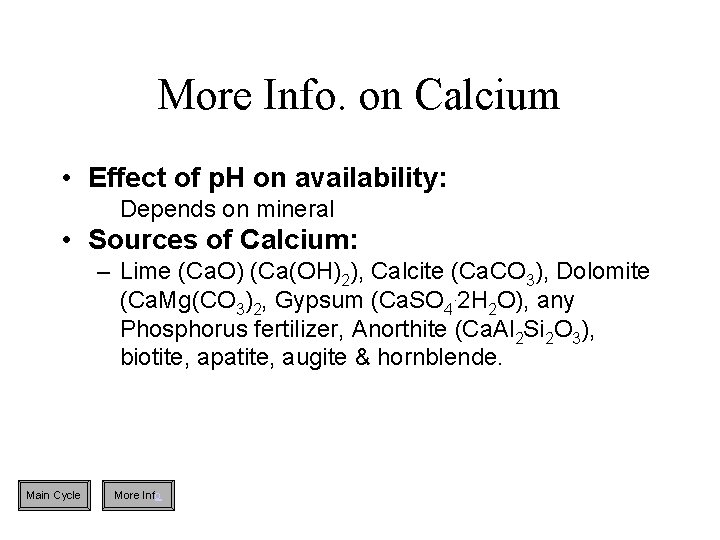
More Info. on Calcium • Effect of p. H on availability: Depends on mineral • Sources of Calcium: – Lime (Ca. O) (Ca(OH)2), Calcite (Ca. CO 3), Dolomite (Ca. Mg(CO 3)2, Gypsum (Ca. SO 4. 2 H 2 O), any Phosphorus fertilizer, Anorthite (Ca. Al 2 Si 2 O 3), biotite, apatite, augite & hornblende. Main Cycle More Info
More Info. On Calcium • References Amjad, Z. (ed. ) 1998. Calcium Phosphates in Biological and Industrial Systems. Klower Academic Press. Boston, MA. Lindsay, W. L. 1979. Chemical Equilibria in Soils. John Wiley & Sons. New York, NY. pp. 86 -102. Marschner, H. 1995. Mineral Nutrition of Higher Plants. Academic Press. New York, NY. pp. 285 -298. Tisdale, S. L. , Nelson, W. L. , Beaton, J. D. and Havlin, J. L. 1993. Soil Fertility and Fertilizers. Macmillan Publishing Company. pp. 289 -296. Main Cycle More Info