Topic 7 Strategy Formulation Asst Prof Dr Songporn


- Slides: 75
Topic 7 Strategy Formulation Asst Prof. Dr. Songporn Hansanti 1
Making Diversification Work • What businesses should a corporation compete in? • How should these businesses be managed to jointly create more value than if they were freestanging unit? 2
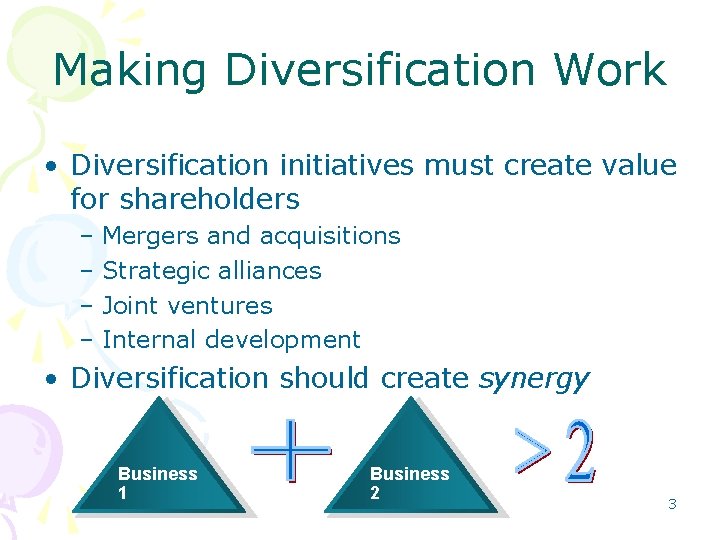
Making Diversification Work • Diversification initiatives must create value for shareholders – Mergers and acquisitions – Strategic alliances – Joint ventures – Internal development • Diversification should create synergy Business 1 Business 2 3
Synergy • Related businesses (horizontal relationships) – Sharing tangible resources – Sharing intangible resources • Unrelated businesses (hierarchical relationships) – Value creation derives from corporate office – Leveraging support activities 4
Related Diversification: Economies of Scope and Revenue Enhancement • Economies of scope – Cost savings from leveraging core competencies or sharing related activities among businesses in the corporation – Leverage or reuse key resources • Favorable reputation • Expert staff • Management skills • Efficient purchasing operations • Existing manufacturing facilities 5
Leveraging Core Competencies • Core competencies – The glue that binds existing businesses together – Engine that fuels new business growth – Collective learning in a firm – How to coordinate diverse production skills – How to integrate multiple streams of technologies – How to market diverse products and services
Three Criteria of Core Competencies • Three criteria (of core competencies) that lead to the creation of value and synergy – Different businesses in the firm must be similar in at least one important way related to the core competence – Not essential that products or services themselves be similar – Is essential that one or more elements in the value chain require similar essential skills – Brand image is an example
Sharing Activities • Corporations can also achieve synergy by sharing tangible and value-creating activities across their business units – Common manufacturing facilities – Distribution channels – Sales forces • Sharing activities provide two payoffs – Cost savings – Revenue enhancements
Related Diversification: Market Power • Two principal means to achieve synergy through market power – Pooled negotiating power – Vertical integration • Government regulations may restrict this power
Pooled Negotiating Power • Similar businesses working together can have stronger bargaining position relative to – Suppliers – Customers – Competitors • Abuse of bargaining power may affect relationships with customers, suppliers and competitors
Vertical Integration • In making decisions associated with vertical integration, six issues should be considered: 1. Are we satisfied with the quality of the value that our present suppliers and distributors are providing? 2. Are there activities in our industry value chain presently being outsourced or performed independently by others that are a viable source of future profits? 3. Is there a high level of stability in the demand for the organization’s products? 4. How high is the proportion of additional production capacity actually absorbed by existing products or by the prospects of new and similar products?
Vertical Integration (cont. ) • In making decisions associated with vertical integration, six issues should be considered: 5. Do we have the necessary competencies to execute the vertical integration strategies? 6. Will the vertical integration initiative have potential negative impacts on our stakeholders?
Unrelated Diversification: Financial Synergies and Parenting • Most benefits from unrelated diversification are gained from vertical (hierarchical) relationships – Parenting and restructuring of businesses – Allocate resources to optimize – Profitability – Cash flow – Growth – Appropriate human resources practices – Financial controls
Example • General Electric’s products and services include: – – – – Appliances Aviation Consumer Electronics Electrical Distribution Energy Finance – Business; Consumer Healthcare Lighting Media & Entertainment Oil & Gas Plastics Rail Security Water Source: www. ge. com
Corporate Parenting & Restructuring • Corporate Parenting – Parenting—creating value within business units • Experience of the corporate office • Support of the corporate office • Corporate Restructuring – Find poorly performing firms • With unrealized potential • On threshold of significant positive change
Corporate Restructuring (Cont. ) • Corporate management must – Have insight to detect undervalued companies or businesses with high potential for transformation – Have requisite skills and resources to turn the businesses around • Restructuring can involve changes in – Assets – Capital structure – Management
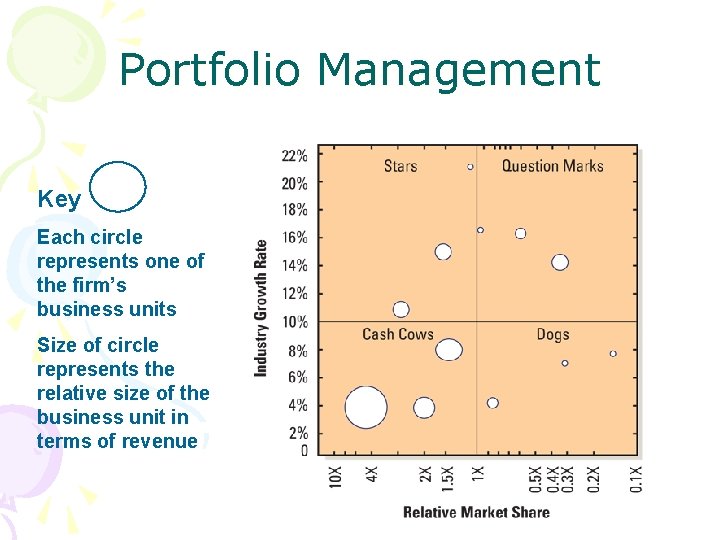
Portfolio Management Key Each circle represents one of the firm’s business units Size of circle represents the relative size of the business unit in terms of revenue
Portfolio Management (Cont. ) • Creation of synergies and shareholder value by portfolio management and the corporate office – Allocate resources (cash cows to stars and some question marks) – Expertise of corporate office in locating attractive firms to acquire • Creation of synergies and shareholder value by portfolio management and the corporate office – Provide financial resources to business units on favorable terms reflecting the corporation’s overall ability to raise funds – Provide high quality review and coaching for units – Provide a basis for developing strategic goals and reward/evaluation systems
Means to Achieve Diversification • Acquisitions or mergers • Pooling resources of other companies with a firm’s own resource base – Joint venture – Strategic alliance • Internal development – New products – New markets – New technology
Business Strategy Focuses on improving competitive position of company’s products or services within the specific industry or market segment 20
Porter’s Competitive Strategies Competitive Strategy - • Low cost • Differentiation • Direct competition • Focus on niche 21
Porter’s Competitive Strategies Generic Competitive Strategies - • Lower Cost strategy • Greater efficiencies than competitors • Differentiation strategy • Unique/superior value, quality, features, service 22
Porter’s Competitive Strategies Competitive Advantage - • Determined by Competitive Scope • Breadth of the target market 23
Porter’s Competitive Strategies Cost Leadership - • Low-cost competitive strategy • Broad mass market • Efficient-scale facilities • Cost reductions • Cost minimization 24
Porter’s Competitive Strategies Differentiation – • Broad mass market • Unique product/service • Premiums charged • Less price sensitivity 25
Porter’s Competitive Strategies Cost-Focus – • Low-cost competitive strategy • Focus on market segment • Niche focused • Cost advantage in market segment 26
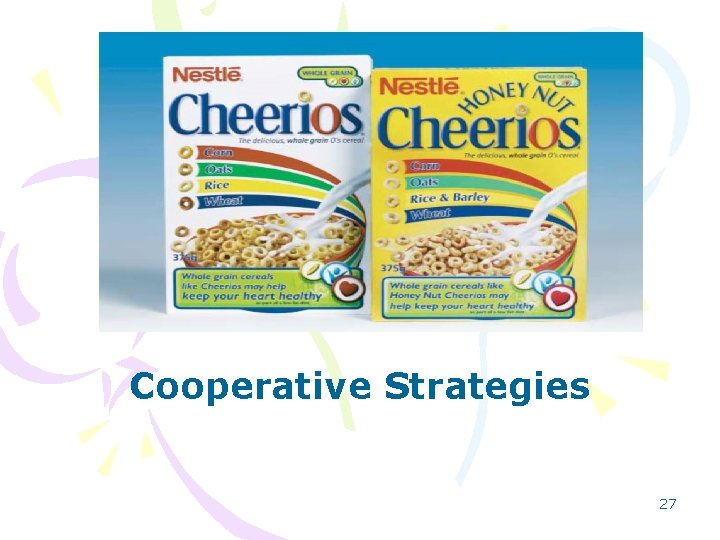
Cooperative Strategies 27
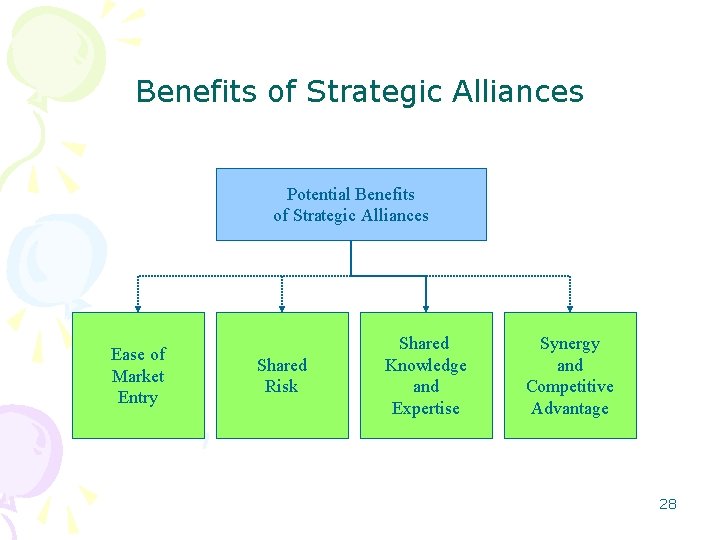
Benefits of Strategic Alliances Potential Benefits of Strategic Alliances Ease of Market Entry Shared Risk Shared Knowledge and Expertise Synergy and Competitive Advantage 28
Scope of Strategic Alliances • Significant variation – Comprehensive alliance – Narrowly defined alliance • Degree of collaboration depends upon basic goals of each partner 29
Types of Alliances • Comprehensive • Functional – Production – Marketing – Financial – Research and Development 30
Implementation of Strategic Alliances • Selection of partners • Compatibility • Nature of potential partner’s products or services • Relative safeness of the alliance • Learning potential of the alliance 31
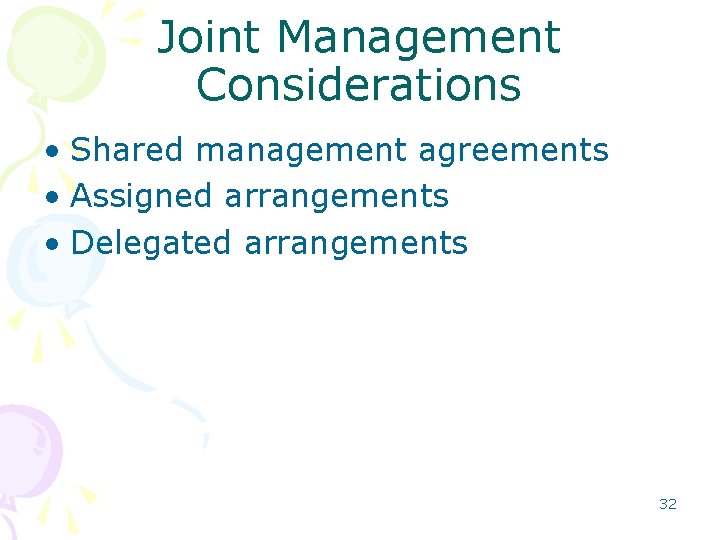
Joint Management Considerations • Shared management agreements • Assigned arrangements • Delegated arrangements 32
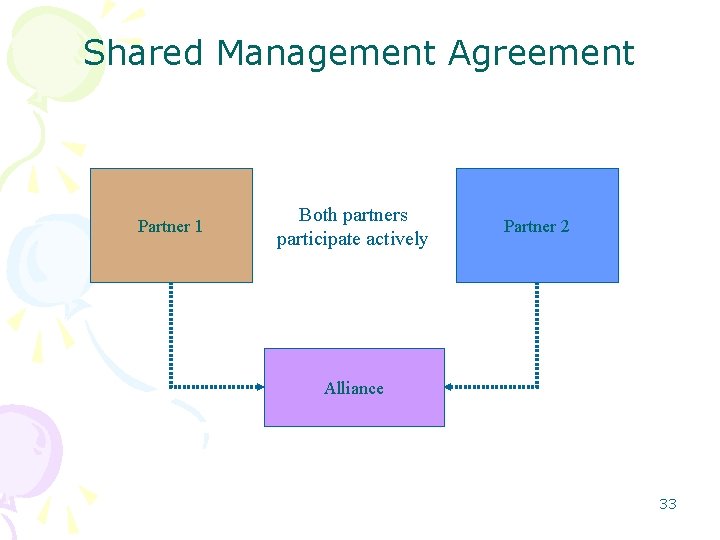
Shared Management Agreement Partner 1 Both partners participate actively Partner 2 Alliance 33
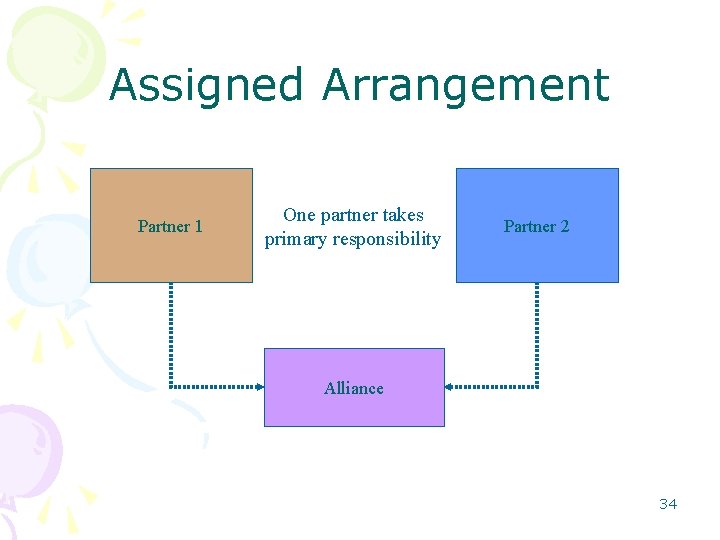
Assigned Arrangement Partner 1 One partner takes primary responsibility Partner 2 Alliance 34
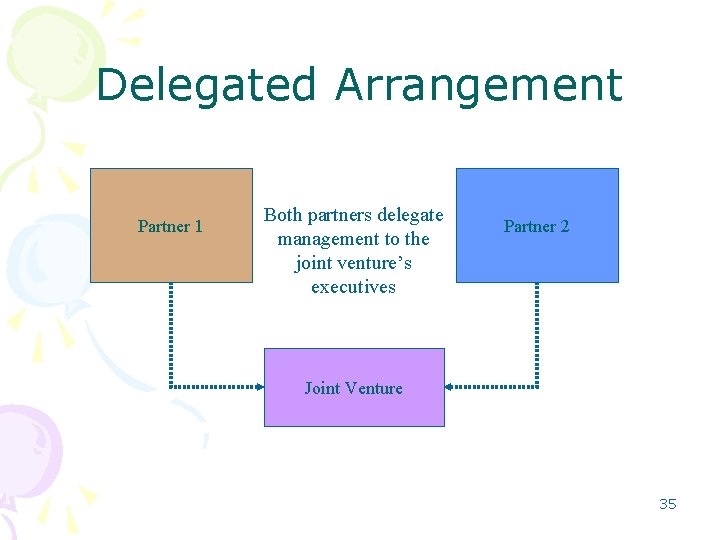
Delegated Arrangement Partner 1 Both partners delegate management to the joint venture’s executives Partner 2 Joint Venture 35
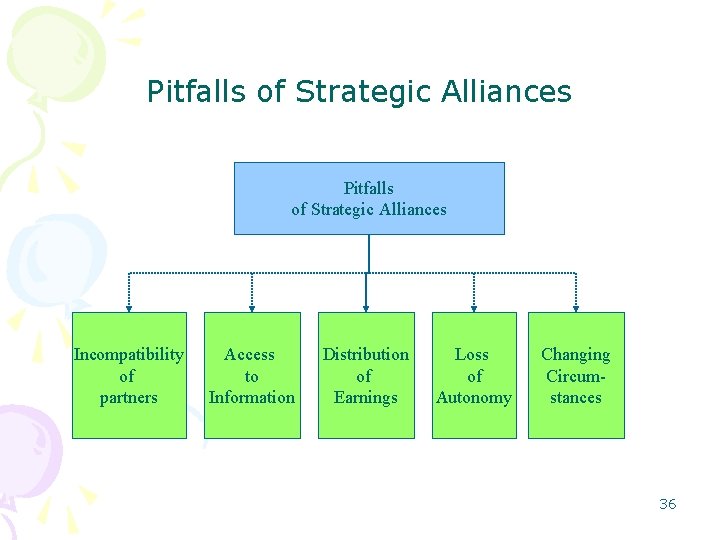
Pitfalls of Strategic Alliances Incompatibility of partners Access to Information Distribution of Earnings Loss of Autonomy Changing Circumstances 36
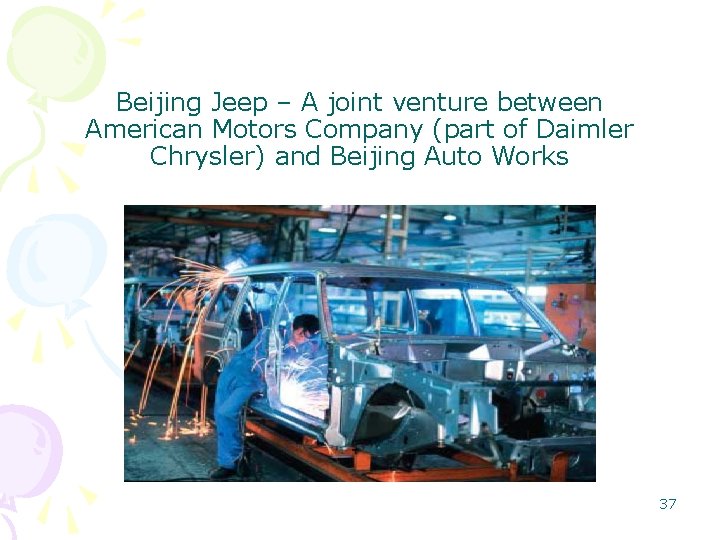
Beijing Jeep – A joint venture between American Motors Company (part of Daimler Chrysler) and Beijing Auto Works 37
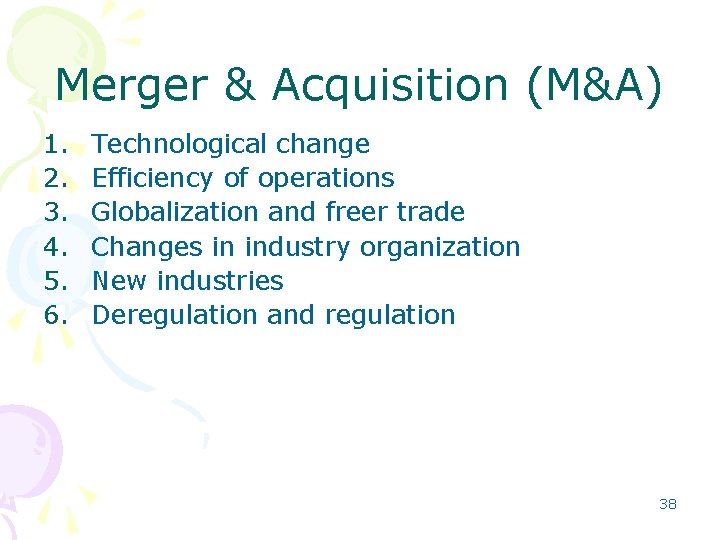
Merger & Acquisition (M&A) 1. 2. 3. 4. 5. 6. Technological change Efficiency of operations Globalization and freer trade Changes in industry organization New industries Deregulation and regulation 38
M&A Terminology • Merger – Negotiated deals – Mutuality of negotiations – Mostly friendly • Restructuring — changes to improve operations, policies, and strategies 42
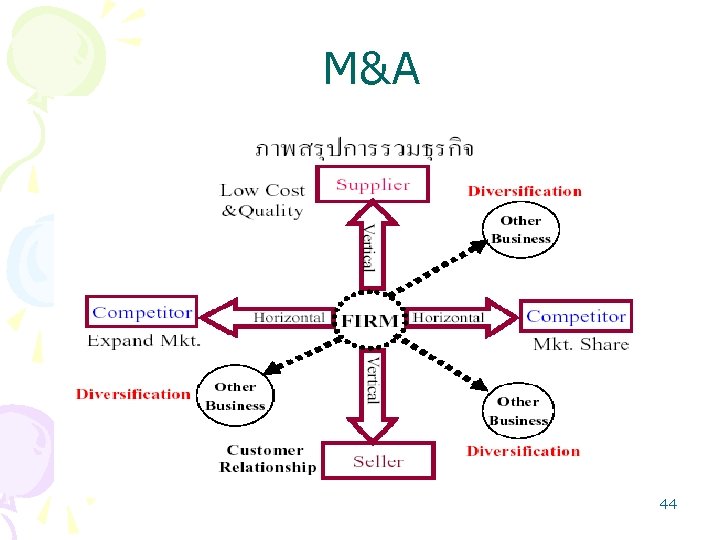
Types of Mergers • Horizontal mergers – Between firms in same business activity – Rationale • Economies of scale and scope • Synergies (ex. combining of best practices) – Government regulation due to potential anticompetitive effects • Vertical mergers – Combinations between firms at different stages – Goal is information and transaction efficiency 43
M&A 44
M&A Strategy • Defines the long-term plans, policies and culture of an organization • Strategic planning is a dynamic process that requires inputs from all segments of the organization • Acquisition and restructuring policies and decisions should be part of the company's overall strategic plans and processes • Ultimate responsibility for strategic planning resides in the top executive group 45
Alternative Strategy Methodologies • SWOT or WOTS UP – inventory and analysis of organizational strengths, weaknesses, environmental opportunities and threats • Top-down or Bottom-up – relate to company forecasts vs. aggregation segment forecasts • Computer models – allow detail and complexity • Logical incrementalism – well-supported moves from current bases • Comparative histories – learn from the experiences of others 46
Alternative Analytical Frameworks • Product life cycle – introduction, growth, maturity, decline stages with changing opportunities, threats • Learning curve – costs decline with cumulative volume experience (first mover advantage) • Competitive analysis – industry, suppliers, customers, complemetors, etc. • Value chain analysis – seek to add product characteristics valued by customers • Cost leadership – low-cost advantages 47
Strategy Formulation Approaches • Boston Consulting Group Approach – Historical emphasis: experience curve, product life cycle, product portfolio balance – Recent approaches • Impact of the Internet and other innovations • Performance measurements - cash flow return on investment (CFROI) • Michael Porter Approach (1980, 1985, 1987) – Select attractive industry using “Five Forces” – Develop competitive advantage through cost leadership, product differentiation, or focus – Develop attractive value chains 48
Formulating a Merger Strategy • Requires continuing reassessment – – – – – Industry analysis Competitor analysis Supplier analysis Customer analysis Substitute products Complementors Technology changes Societal factors Firm's strengths/weaknesses relative to present/future industry conditions 49
Formulating a Merger Strategy • Grove (1996) – Firm must adjust to six forces • • • Existing competitors Potential competitors Complementors Customers Suppliers Industry transformation – Eclectic adaptive processes approach to strategy 50
Formulating a Merger Strategy • Business goals - general or specific, but must be quantifiable to facilitate progress assessment – Size objectives • Large enough to use fixed factors effectively • Critical mass necessary to attain cost levels for profitable operation at market prices – Growth objectives - sales, assets, EPS, values • To get favorable P/E multiple for shares • To increase market to book value of shares 51
Formulating a Merger Strategy • Business goals – Stability objectives - two kinds of instability • Large erratic fluctuations in total size and abrupt program shifts (e. g. , defense industry) • Cyclical instability of durable goods industries – Flexibility objectives - ability to operate in variety of product markets and responsive to consumers • Breadth of capabilities, e. g. , research, manufacturing, marketing • Technological breadth • Stay close to customers 52
Formulating a Merger Strategy • Aligning firm to changing environments – Gap between objectives and potential based on current capabilities – Various approaches: • Choose products related to needs of customer that provide large markets • Focus on technological bottlenecks • Be at frontier of technology and aim for attractive product fallout • Emphasize economic criteria – ex. value 53
Formulating a Merger Strategy • Strategic planning and mergers – Diversification strategy may be necessary if firm must alter productmarket mix or capabilities to reduce or close strategic gap – Both involve evaluation of current capabilities relative to those needed to reach objectives – Related diversification involves lower risks 54
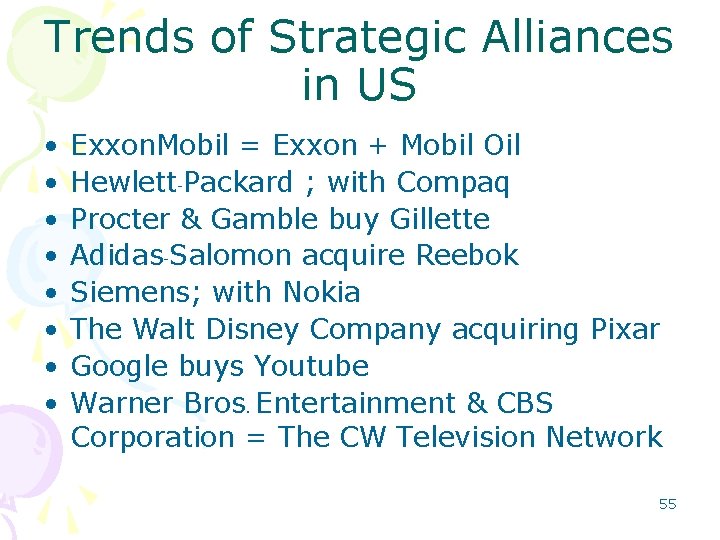
Trends of Strategic Alliances in US • • Exxon. Mobil = Exxon + Mobil Oil Hewlett-Packard ; with Compaq Procter & Gamble buy Gillette Adidas-Salomon acquire Reebok Siemens; with Nokia The Walt Disney Company acquiring Pixar Google buys Youtube Warner Bros. Entertainment & CBS Corporation = The CW Television Network 55
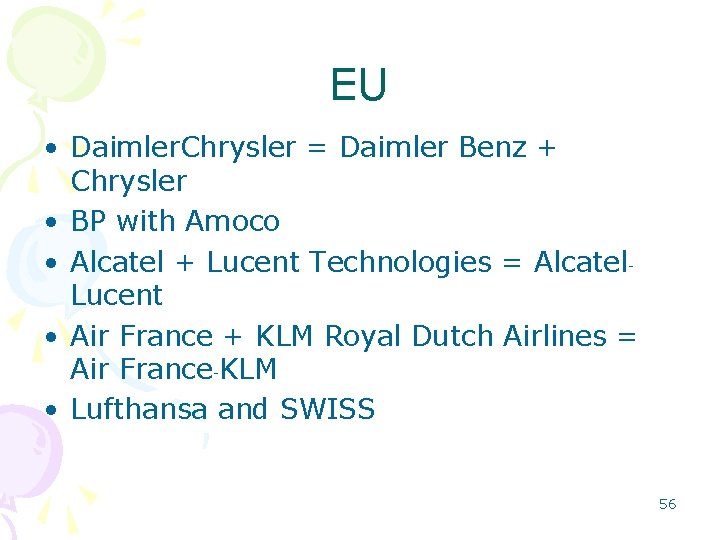
EU • Daimler. Chrysler = Daimler Benz + Chrysler • BP with Amoco • Alcatel + Lucent Technologies = Alcatel. Lucent • Air France + KLM Royal Dutch Airlines = Air France-KLM • Lufthansa and SWISS 56
Japan • Mitsubishi UFJ Financial Group • Konica Minolta = Konica + Minolta • Soft. Bank acquiring Vodafone Japan • Sumitomo Mitsui Banking Corporation = Sumitomo Bank + Sakura Bank 57
Thailand • EGV + Major = EGV-Major Cineplex • Bilsstel + TG Fone • Lox. Info + CS = CSLox. Info • GMM + True • TMB + IFCT + DTDB 58
Functional Strategy The approach a functional area takes to achieve corporate and business unit objectives and strategies by maximizing resource productivity 59
Functional Strategy Marketing Strategy – –Pricing –Selling –Distribution 60
Functional Strategy Marketing Strategy – –Product development • Line extension 61
Functional Strategy Marketing Strategy – –Advertising and promotion • Push strategy • Pull strategy 62
Functional Strategy Marketing Strategy – –Pricing • Skim pricing • Penetration pricing • Dynamic pricing 63
Functional Strategy Financial Strategy – –Leveraged buyout –Reversed stock split –Tracking stock 64
Functional Strategy R&D Strategy – –Technological leader –Technological follower –Open innovation 65
Functional Strategy Operations Strategy – –Job shop –Connected line batch flow –Flexible manufacturing systems –Dedicated transfer lines –Mass production –Continuous improvement system –Modular manufacturing 66
Functional Strategy Purchasing Strategy – –Multiple sourcing –Sole sourcing –Just-in-time (JIT) –Parallel sourcing 67
Functional Strategy Logistics Strategy – –Centralization –Outsourcing –Internet 68
Functional Strategy HRM Strategy – – 360 degree appraisal 69
Functional Strategy Outsourcing errors – –Activities that should not be outsourced –Wrong vendor selection –Writing poor contract –Overlooking personnel issues –Hidden costs of outsourcing –Failing to plan exit strategy 70
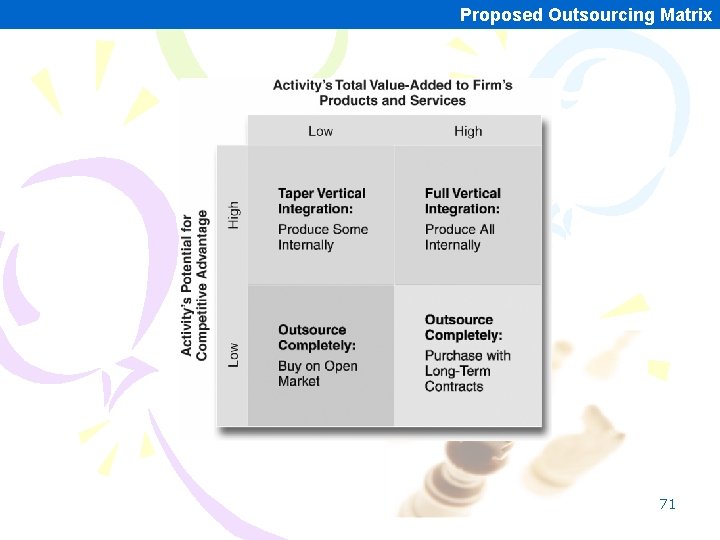
Proposed Outsourcing Matrix 71
Functional Strategy Strategies to Avoid – – 3 Follow the leader –Hit another home run –Arms race –Do everything –Losing hand 72
Functional Strategy Subjective Factors Affecting Decisions -–Management’s attitude toward risk –Pressures from stakeholders –Pressures from corporate culture –Needs and desires of key managers 73
Strategic Choice Avoiding the Consensus Trap -–Devil’s Advocate –Dialectical Inquiry 74
Strategic Choice Evaluation of Strategic Alternatives -–Mutual exclusivity –Success –Completeness –Internal consistency 75