
Introduction to the Question Formulation Technique QFT Foxborough
+ Introduction to the Question Formulation Technique (QFT) Foxborough, MA August 29, 2018 Sarah Westbrook Director of Professional Learning The Right Question Institute Access Today’s Materials: http: //rightquestion. org/educators/seminar-resources/
+ Acknowledgments We are deeply grateful to the John Templeton Foundation and The Hummingbird Fund for their generous support of the Right Question Institute’s Million Classrooms Campaign. Many thanks also to Alyssa Mocharnuk and Sue Carle for the invitation and for all their work behind the scenes to make it happen. #QFT
+ Who is in the room? #QFT
+ Today’s Agenda 1) Welcome Collaborative Learning with the Question Formulation Technique (QFT) 3) Classroom Examples 4) Lesson Planning and Exploring Resources 5) Lunch 2) #QFT
+ Access Today’s Materials: http: //rightquestion. org/educators/ seminar-resources/
+ We’re Tweeting… @Right. Question @Sarah. RQI #QFT
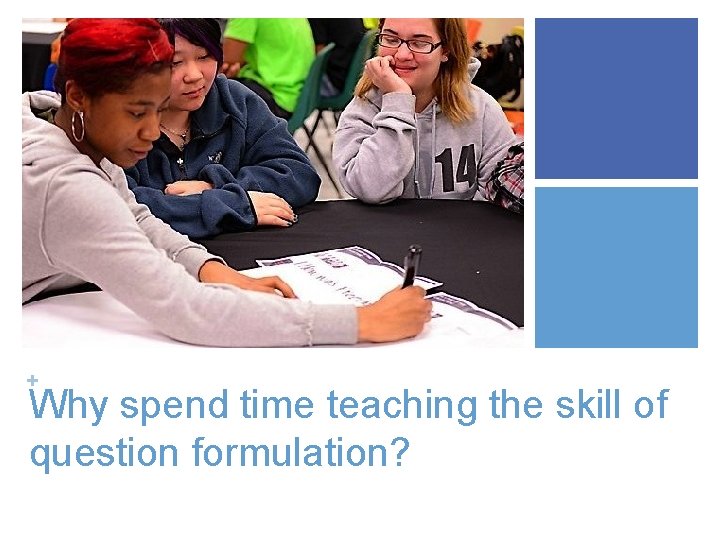
+ Why spend time teaching the skill of question formulation?
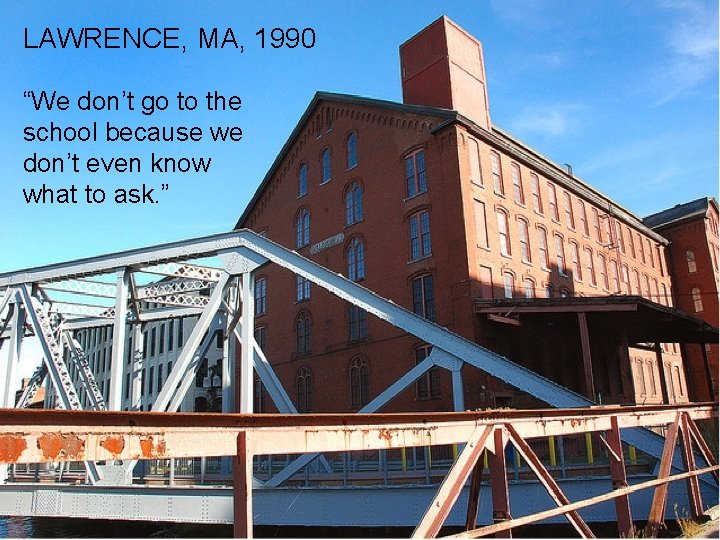
+ LAWRENCE, MA, 1990 “We don’t go to the school because we don’t even know what to ask. ”
+ "There is no learning without having to pose a question. " - Richard Feynman Nobel Prize-winning physicist
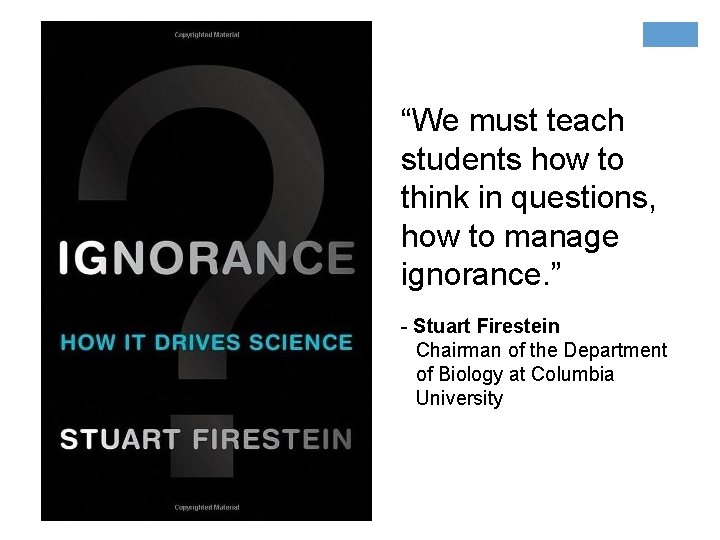
“We must teach students how to think in questions, how to manage ignorance. ” - Stuart Firestein Chairman of the Department of Biology at Columbia University
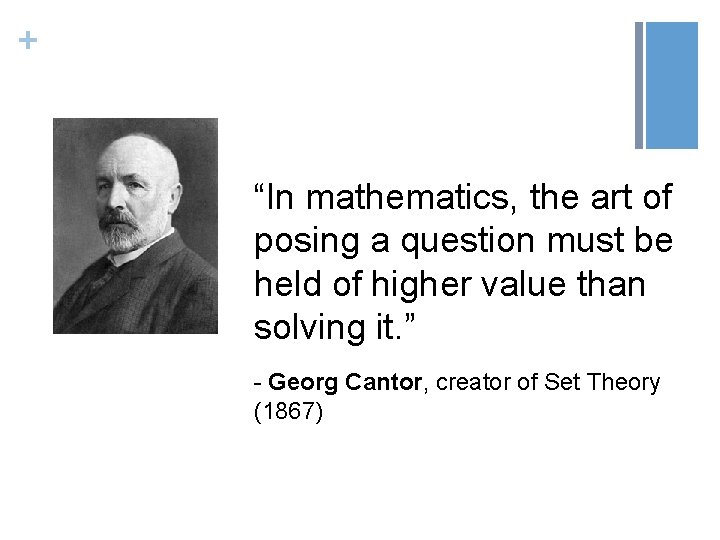
+ “In mathematics, the art of posing a question must be held of higher value than solving it. ” - Georg Cantor, creator of Set Theory (1867)
+ College Presidents on What Students Should Learn in College “The primary skills should be analytical skills of interpretation and inquiry. In other words, know how to frame a question. ” - Leon Botstein, President of Bard College “…the best we can do for students is have them ask the right questions. ” - Nancy Cantor, Chancellor of University of Illinois The New York Times, August 4, 2002
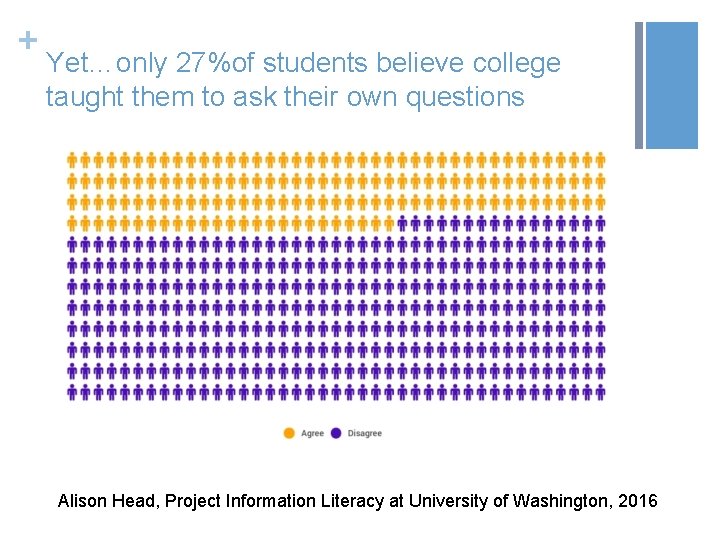
+ Yet…only 27%of students believe college taught them to ask their own questions Alison Head, Project Information Literacy at University of Washington, 2016

+ But, the problem begins long before college. . .
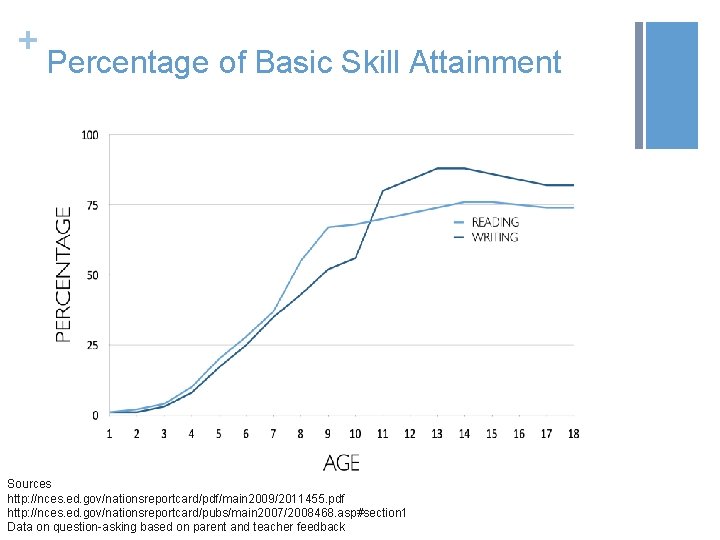
+ Percentage of Basic Skill Attainment Sources http: //nces. ed. gov/nationsreportcard/pdf/main 2009/2011455. pdf http: //nces. ed. gov/nationsreportcard/pubs/main 2007/2008468. asp#section 1 Data on question-asking based on parent and teacher feedback
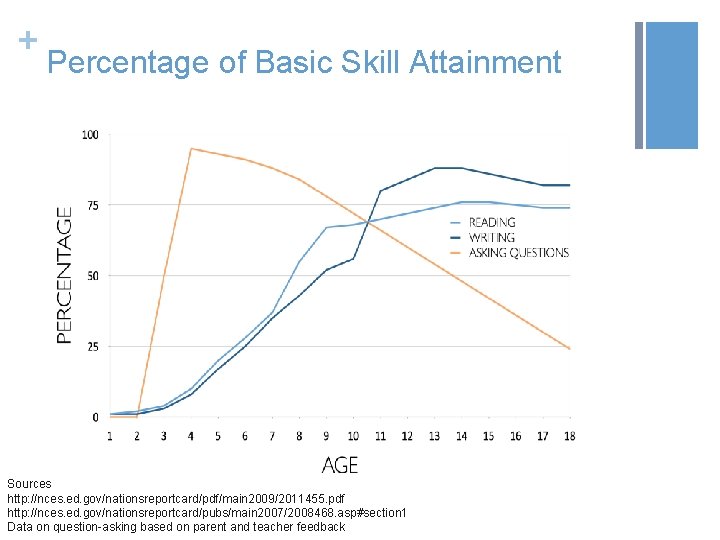
+ Percentage of Basic Skill Attainment Sources http: //nces. ed. gov/nationsreportcard/pdf/main 2009/2011455. pdf http: //nces. ed. gov/nationsreportcard/pubs/main 2007/2008468. asp#section 1 Data on question-asking based on parent and teacher feedback
+ We can work together on changing the direction of that slope.
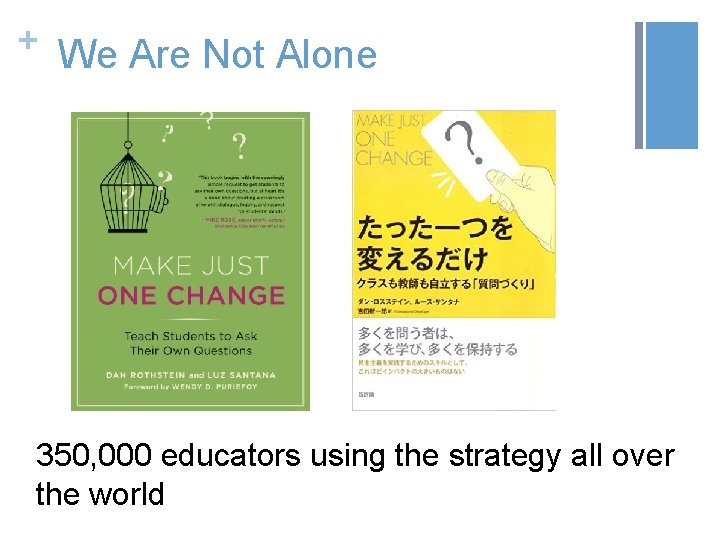
+ We Are Not Alone 350, 000 educators using the strategy all over the world
+ An Educator-Driven Movement The Right Question Institute offers materials through a Creative Commons License and we encourage you to make use of and/or share this resource. Please reference the Right Question Institute and rightquestion. org as the source on any materials you use.
+ What happens when students do learn to ask their own questions?
+ Research Confirms the Importance of Student Questioning Self-questioning (metacognitive strategy): n. Student formulation of their own questions is one of the most effective metacognitive strategies n. Engaging in pre-lesson self-questioning improved students rate of learning by nearly 50% (Hattie, p. 193) John Hattie Visible Learning: A Synthesis of Over 800 Meta-Analyses Relating to Achievement, 2008
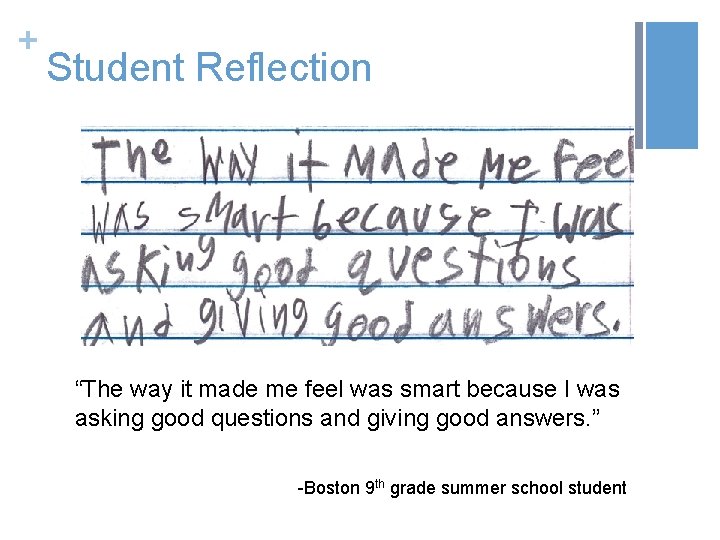
+ Student Reflection “The way it made me feel was smart because I was asking good questions and giving good answers. ” -Boston 9 th grade summer school student
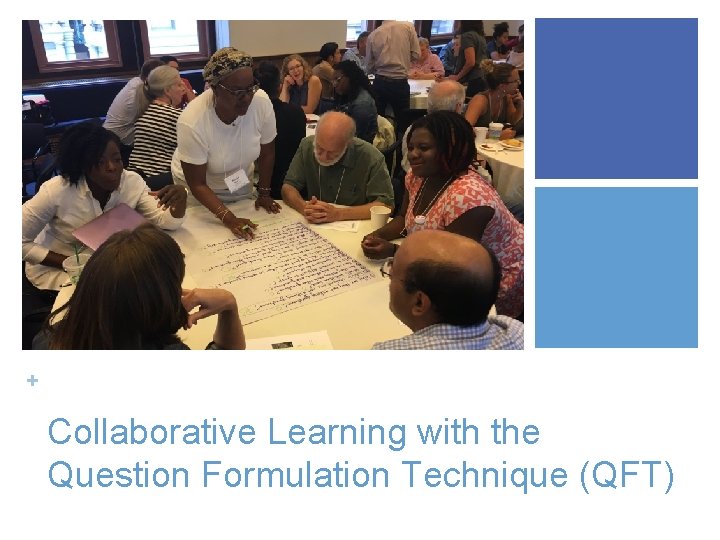
+ Collaborative Learning with the Question Formulation Technique (QFT)
+ The Question Formulation Technique (QFT) Students learn to: § Produce their own questions § Improve their questions § Strategize on how to use their questions § Reflect on what they have learned and how they learned it #QFT
+ Rules for Producing Questions 1. Ask as many questions as you can 2. Do not stop to answer, judge, or discuss 3. Write down every question exactly as stated 4. Change any statements into questions
+ Produce Questions 1. Ask Questions 2. Follow the Rules n Ask as many questions as you can. n Do not stop to answer, judge, or discuss. n Write down every question exactly as it was stated. n Change any statements into questions. 3. Number the Questions
+ Question Focus: Some students are not asking questions. Please write this statement at the top of your paper. Remember: Number the questions. Follow the rules.
+ Categorize Questions: Closed/ Open Definitions: n Closed-ended questions can be answered with a “yes” or “no” or with a one-word answer. n Open-ended questions require more explanation. Directions: Identify your questions as closedended or open-ended by marking them with a “C” or an “O. ”
+ Discussion Closed-ended Questions Advantages Disadvantages
+ Discussion Open-ended Questions Advantages Disadvantages
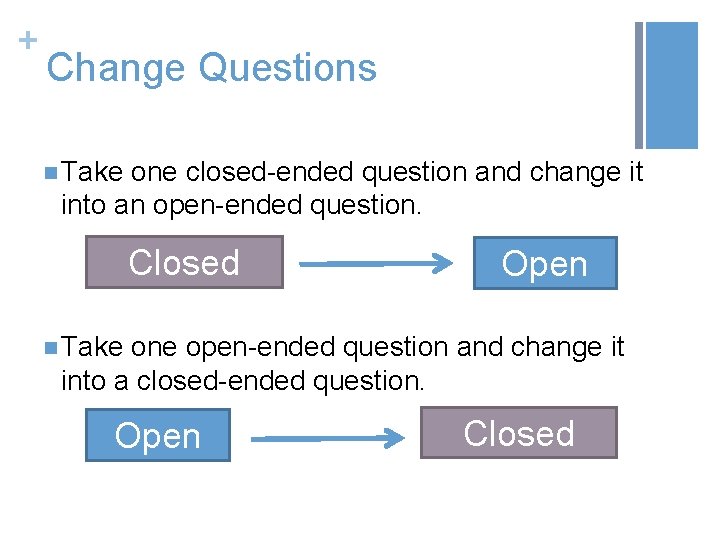
+ Change Questions n Take one closed-ended question and change it into an open-ended question. Closed Open n Take one open-ended question and change it into a closed-ended question. Open Closed
+ Prioritize Questions Review your list of questions n Choose three questions you consider most important. n While prioritizing, think about your Question Focus: Some students are not asking questions. After prioritizing consider… n Why did you choose three questions? n Where are your priority questions in the sequence of your entire list of questions?
+ Strategize on How to Use Questions From priority questions to action plan In order to answer your priority questions: n What do you need to know? Information n What do you need to do? Tasks
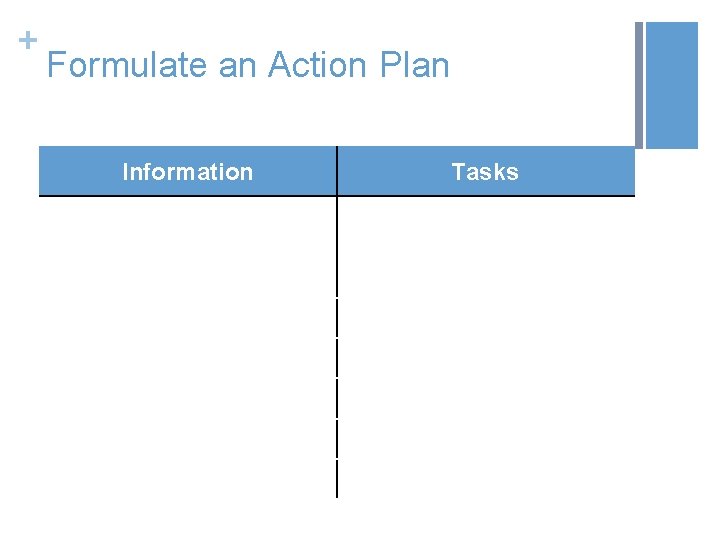
+ Formulate an Action Plan Information Tasks
+ Share 1. Questions you changed from open/closed 2. Your three priority questions and their numbers in your original sequence 3. Rationale for choosing priority questions 4. Action plan and ideas for next steps
+ Reflect n What did you learn? n How did you learn it? n What do you understand differently now about some students not asking questions?
+ A Look Inside the Process #QFT
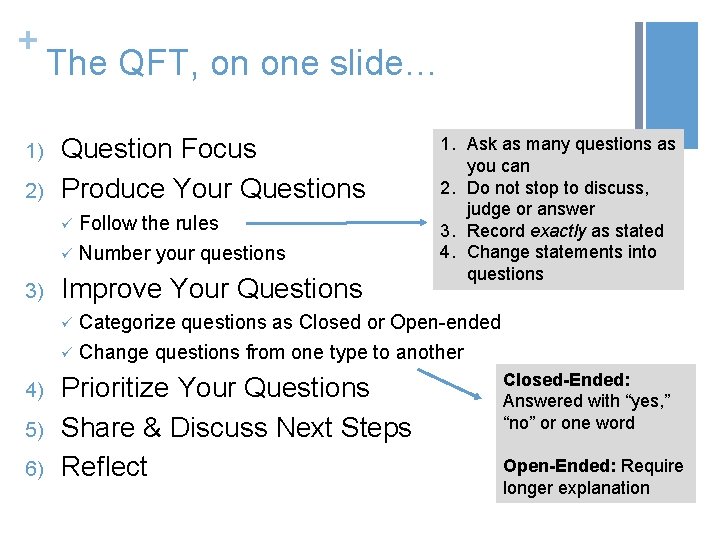
+ 1) 2) The QFT, on one slide… Question Focus Produce Your Questions Follow the rules ü Number your questions ü 3) Improve Your Questions 1. Ask as many questions as you can 2. Do not stop to discuss, judge or answer 3. Record exactly as stated 4. Change statements into questions Categorize questions as Closed or Open-ended ü Change questions from one type to another ü 4) 5) 6) Prioritize Your Questions Share & Discuss Next Steps Reflect Closed-Ended: Answered with “yes, ” “no” or one word Open-Ended: Require longer explanation
+ Curiosity and Rigor Three thinking abilities with one process
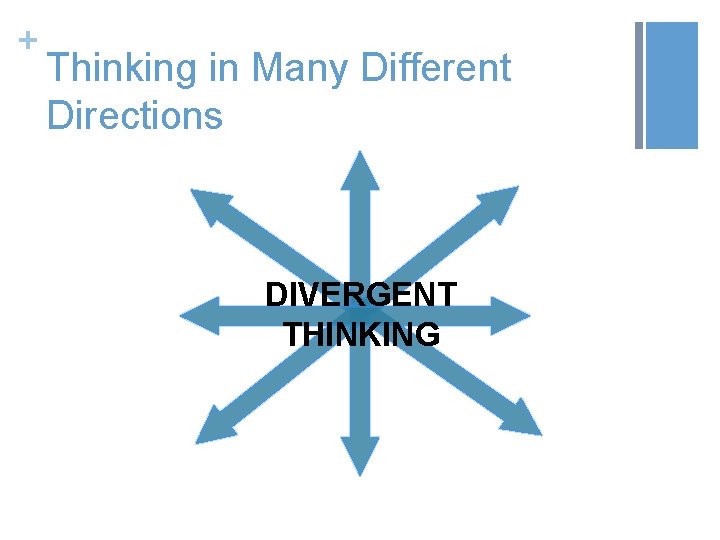
+ Thinking in Many Different Directions DIVERGENT THINKING
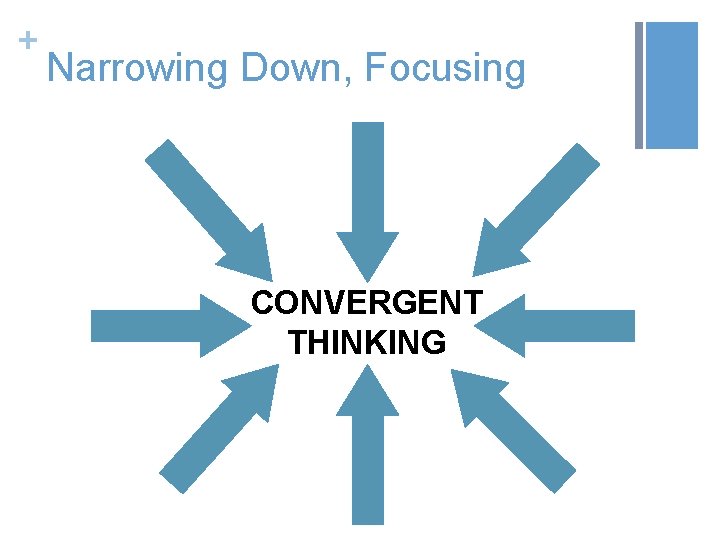
+ Narrowing Down, Focusing CONVERGENT THINKING
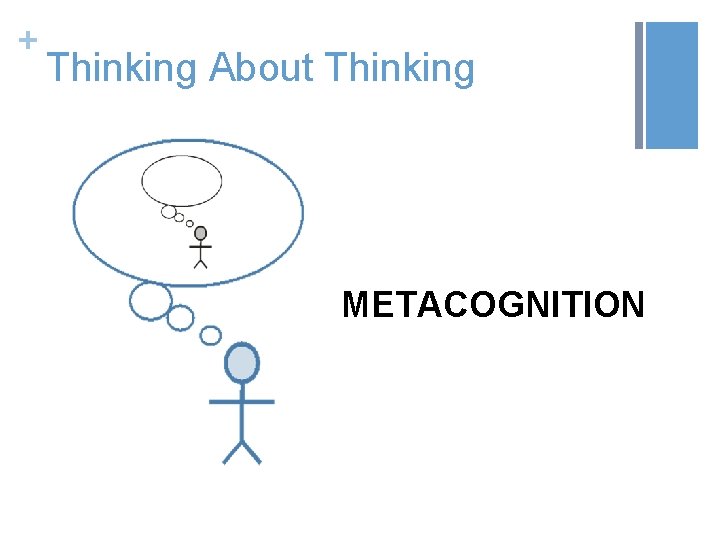
+ Thinking About Thinking METACOGNITION
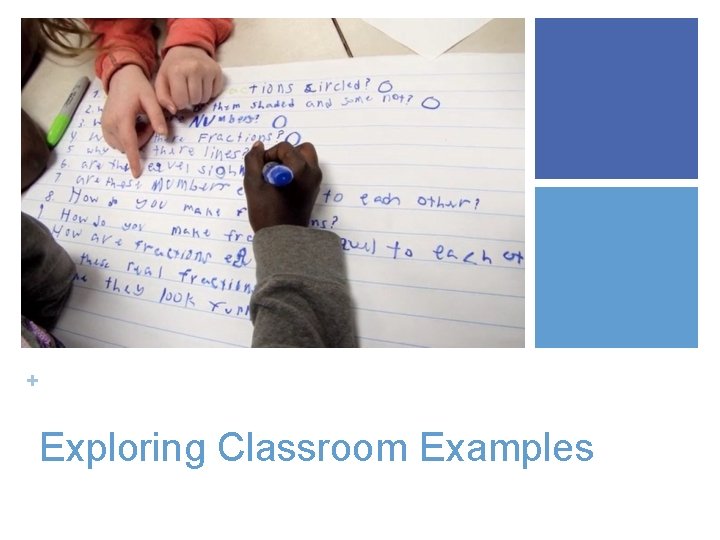
+ Exploring Classroom Examples
+ Classroom Example: High School Physics Teacher: David Meshoulam, Newton, MA Topic: Current and magnetism Purpose: Transition from unit on Electricity to unit on Electricity and Magnetism
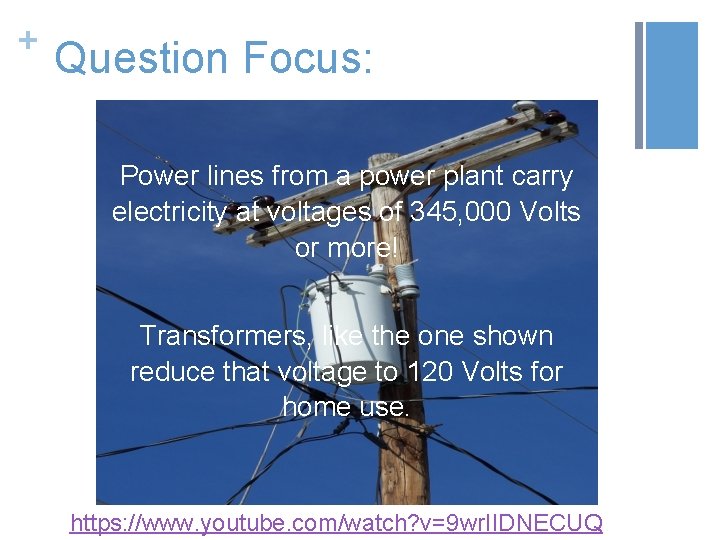
+ Question Focus: Power lines from a power plant carry electricity at voltages of 345, 000 Volts or more! Transformers, like the one shown reduce that voltage to 120 Volts for home use. https: //www. youtube. com/watch? v=9 wr. IIDNECUQ
+ Classroom Example: 4 th Grade Teacher: Deirdre Brotherson, Hooksett, NH Topic: Math unit on variables Purpose: To engage students at the start of a unit on variables
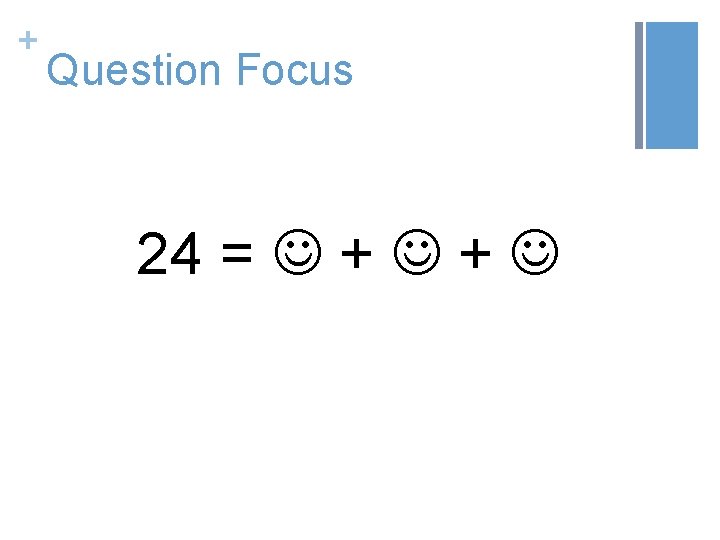
+ Question Focus 24 = + +
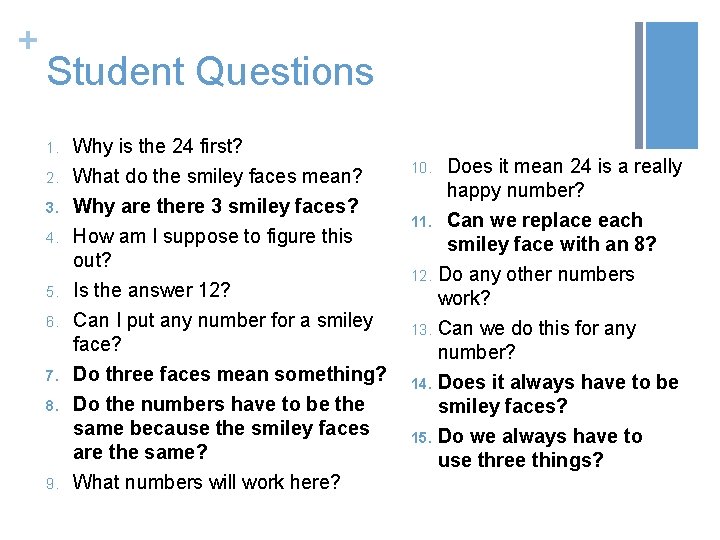
+ Student Questions 1. 2. 3. 4. 5. 6. 7. 8. 9. Why is the 24 first? What do the smiley faces mean? Why are there 3 smiley faces? How am I suppose to figure this out? Is the answer 12? Can I put any number for a smiley face? Do three faces mean something? Do the numbers have to be the same because the smiley faces are the same? What numbers will work here? 10. Does it mean 24 is a really happy number? Can we replace each smiley face with an 8? 12. Do any other numbers work? 13. Can we do this for any number? 14. Does it always have to be smiley faces? 15. Do we always have to use three things? 11.
+ Next Steps with Student Questions v Questions posted on classroom walls. v Students cross off the questions they answer during subsequent lessons. v Teacher returns to student questions at the end of the unit to discuss with students what they learned and what they still want to know.
+ Classroom Example: 7 th Grade Teacher: Nicole Bolduc, Ellington, CT Topic: “The Universe and Its Stars” Unit Purpose: To engage students in setting the learning agenda for the unit
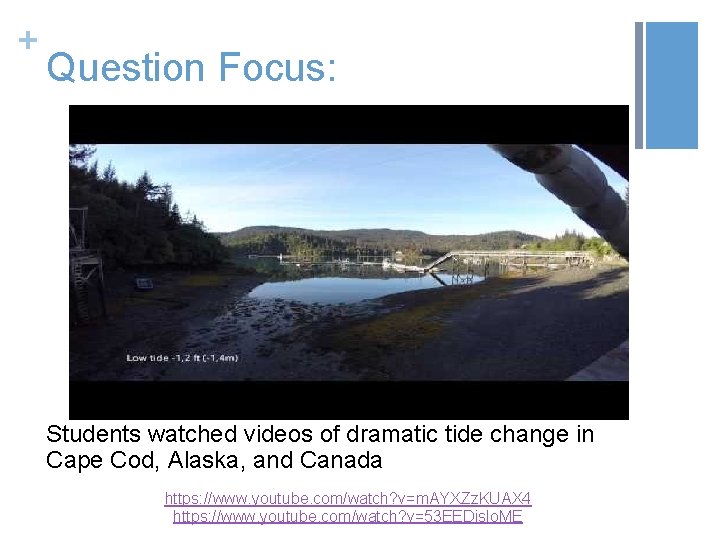
+ Question Focus: Students watched videos of dramatic tide change in Cape Cod, Alaska, and Canada https: //www. youtube. com/watch? v=m. AYXZz. KUAX 4 https: //www. youtube. com/watch? v=53 EEDislo. ME
+ Selected Student Questions 1. 2. 3. 4. 5. 6. 7. 8. 9. 10. 11. Why does tide change? How is tide created? How does earth’s rotation cause the 12. tide to change? Does the sun have any part in the rise 13. 14. and retreat of tides? 15. Do tides occur because of the gravitational pull of the moon? Do the phases of the moon come into 16. play with the tides? 17. How do other planets affect it? Are the tides opposite in Florida and Mexico? (b/c they share the Gulf of 18. Mexico) How come the tide changes greatly in 19. some places but not others? 20. How far can high tide go? How do tides affect people? Can tide change be a problem in the future? Does global warming affect tides? Where does the water go to? Does temperature have anything to do with tides? Does tilt have anything to do with tides? How do fish & wildlife survive when the tide is always changing? If the moon disappeared, would there be no tides? What would happen if the tide didn’t change? Why are tides important to the earth?
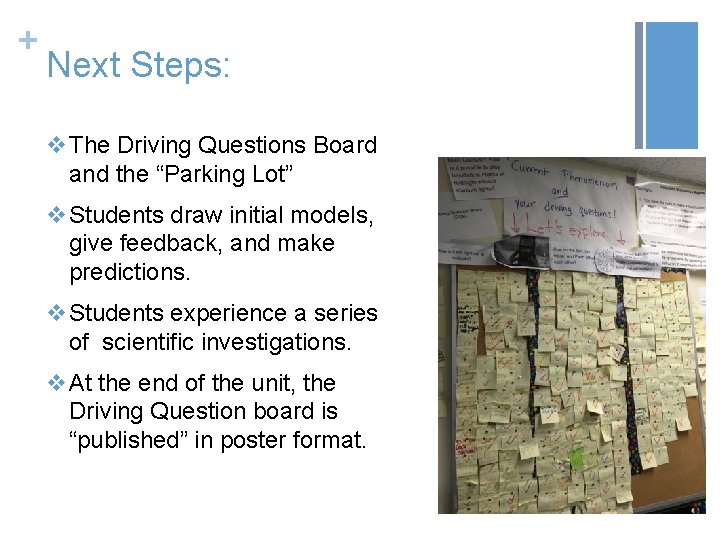
+ Next Steps: v. The Driving Questions Board and the “Parking Lot” v. Students draw initial models, give feedback, and make predictions. v. Students experience a series of scientific investigations. v. At the end of the unit, the Driving Question board is “published” in poster format.
+ Classroom Example: High School Teacher: Allison Gest, Park Ridge, IL Topic: A unit on “Running Water” Purpose: To give peer feedback and revise initial experiment designs
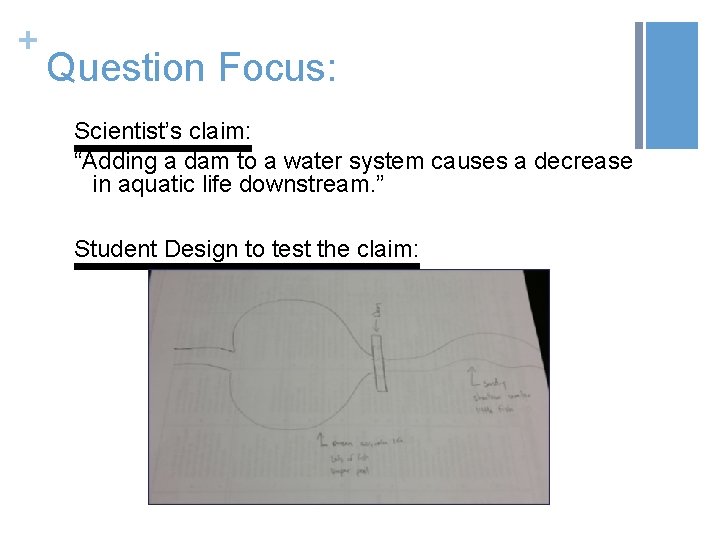
+ Question Focus: Scientist’s claim: “Adding a dam to a water system causes a decrease in aquatic life downstream. ” Student Design to test the claim:
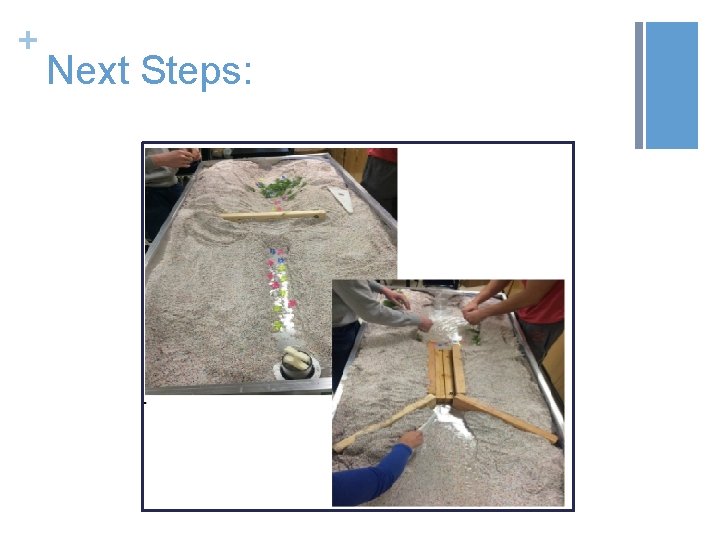
+ Next Steps:
+ Classroom Example: High School Teacher: Rick Barlow, San Jose, CA Topic: Algebra 1: Quadratics Purpose: To introduce the quadratics unit by having students explore modelling data with a function.
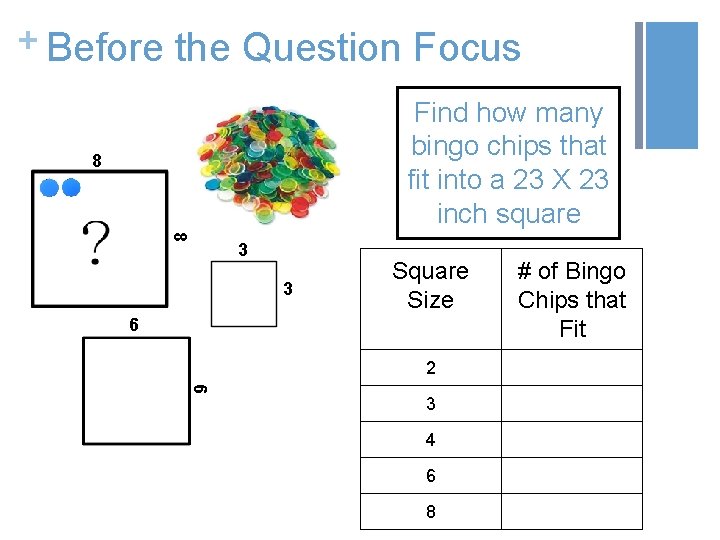
+ Before the Question Focus Find how many bingo chips that fit into a 23 X 23 inch square 8 8 3 3 Square Size 6 2 6 3 4 6 8 # of Bingo Chips that Fit
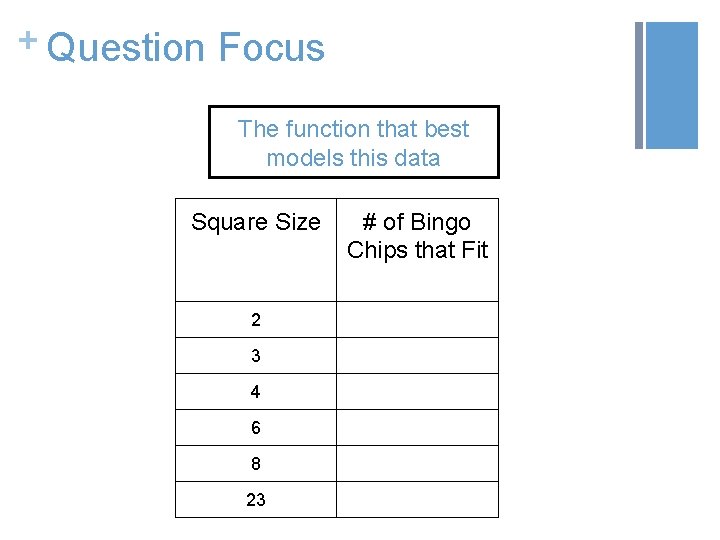
+ Question Focus The function that best models this data Square Size 2 3 4 6 8 23 # of Bingo Chips that Fit
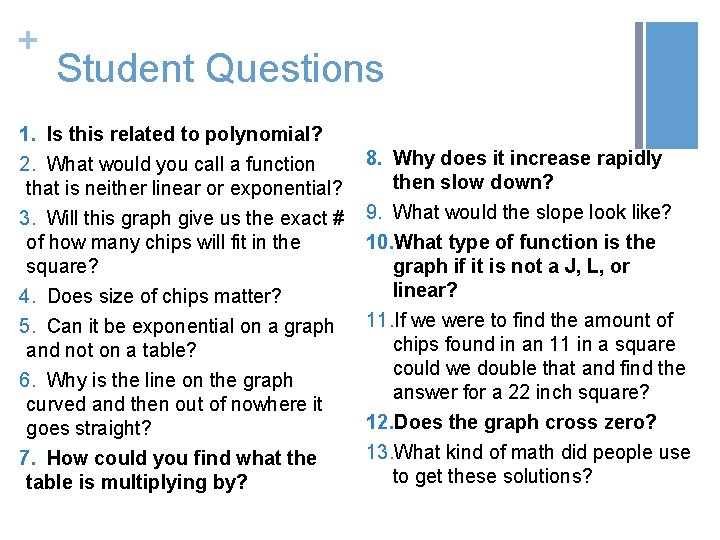
+ Student Questions 1. Is this related to polynomial? 2. What would you call a function that is neither linear or exponential? 3. Will this graph give us the exact # of how many chips will fit in the square? 4. Does size of chips matter? 5. Can it be exponential on a graph and not on a table? 6. Why is the line on the graph curved and then out of nowhere it goes straight? 7. How could you find what the table is multiplying by? 8. Why does it increase rapidly then slow down? 9. What would the slope look like? 10. What type of function is the graph if it is not a J, L, or linear? 11. If we were to find the amount of chips found in an 11 in a square could we double that and find the answer for a 22 inch square? 12. Does the graph cross zero? 13. What kind of math did people use to get these solutions?
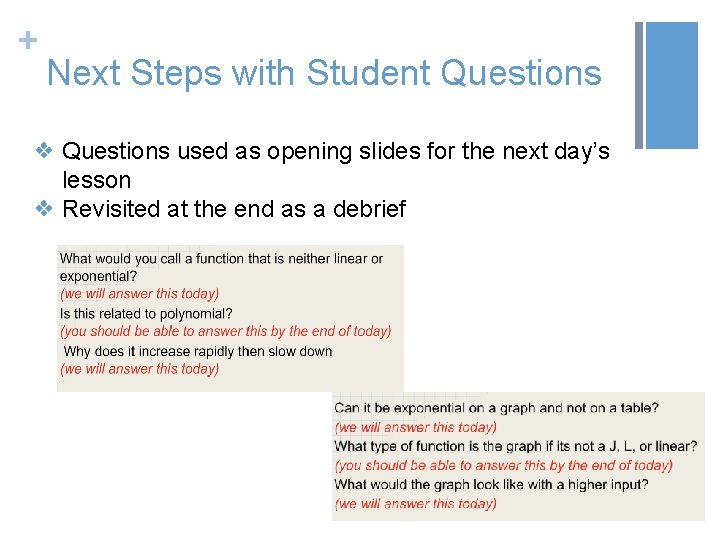
+ Next Steps with Student Questions ❖ Questions used as opening slides for the next day’s lesson ❖ Revisited at the end as a debrief
+ Teacher Reflection “QFT also pushes students to be curious. Sometimes learning can feel prescriptive or rigid. While the structure of QFT is somewhat prescriptive, the process creates a safe, encouraging space that supports students in the process of taking intellectual risks and asking really good questions. ”
+ Classroom Example: High School Teacher: Alyssa Mocharnuk, Foxborough, MA Topic: Circuits Purpose: To engage students in a new unit at the start of the year
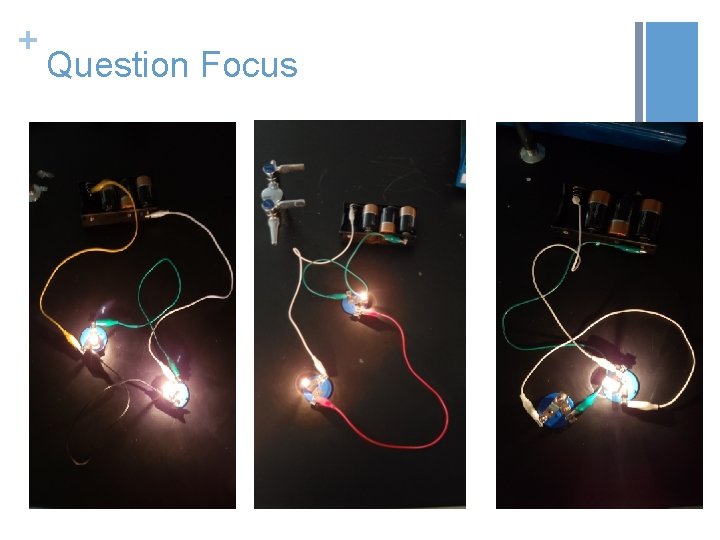
+ Question Focus
+ Classroom Example: University Teacher: Rachel Woodruff, Assistant Professor of Biology, Brandeis University, MA Topic: Molecular Biology Purpose: To build students’ research skills and prepare them to develop their own research proposal
+ Question Focus: (Students were assigned a complex molecular biology article) Ask as many questions as you can about the reading
+ Next Steps with Student Questions: v. Students generate questions for homework v. Students discuss key attributes of a good biological research question and compare to other types of questions v. Students form groups and improve their questions v. These questions are discarded or kept in notebooks (up to the student) v. Students apply this skill to designing their own research project later in the semester
+ Student Reflections “I learned the basics of science and why it exists. Scientists have to find answers to questions. Their entire lives are to ask questions that will solve the big problem. I also learned how reluctant students are to ask questions. In our society school environment, we shame asking questions. It felt good to openly ask. I also learned what type of questions scientists ask and the differences between closed questions and open questions, and what are their advantages and disadvantages too. ”
+ Student Reflections “I learned that questioning everything will produce unique answers, and gives you insight from people with different opinions and points of view. I also learned that we don’t have an answer that is 100%, and we only have the best answer. This experience also fueled my passion to become a scientist, I want to find the answer to the things that interested me for the longest time. I have learned more that I would have expected, because all we did was ask some questions. ”
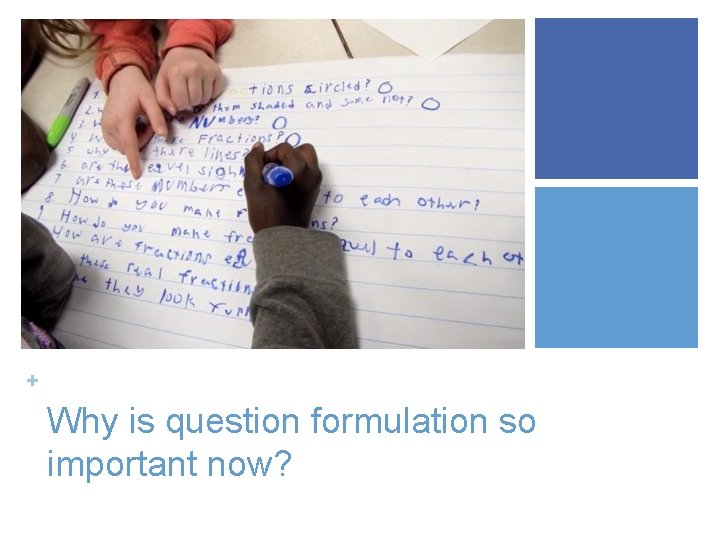
+ Why is question formulation so important now?
In the Age of Google… “How should you respond when you get powerful new tools for finding answers? Think of harder questions - Clive Thompson, Journalist and Technology Blogger
+ The Skill of Question Formulation n For reframing the perception of ignorance: not a weakness, but an opportunity n For arriving at better answers (and more questions) n For increasing engagement and ownership n. For a little more joy in a very demanding profession n And…
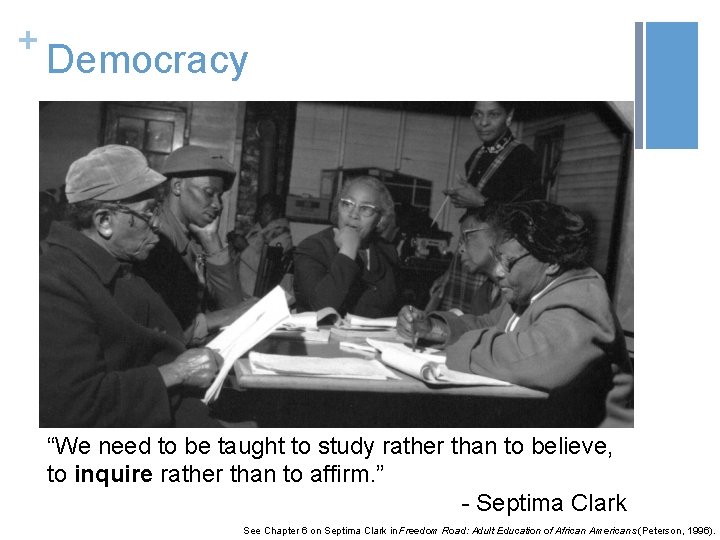
+ Democracy “We need to be taught to study rather than to believe, to inquire rather than to affirm. ” - Septima Clark See Chapter 6 on Septima Clark in Freedom Road: Adult Education of African Americans (Peterson, 1996).
+ Today’s Agenda 1) Welcome Collaborative Learning with the Question Formulation Technique (QFT) 3) Classroom Examples 4) Lesson Planning and Exploring Resources 5) Reflection and Q&A 6) Lunch 2) #QFT
+ 2 Keys to Beginning to Plan a Lesson with the QFT 1. Starting at the End 2. QFocus Design
+ The QFT , Not a Detour but a Shortcut
+ Various Teaching Purposes n Engagement n Knowledge acquisition n Formative assessment n Summative assessment n Peer review n Skill development
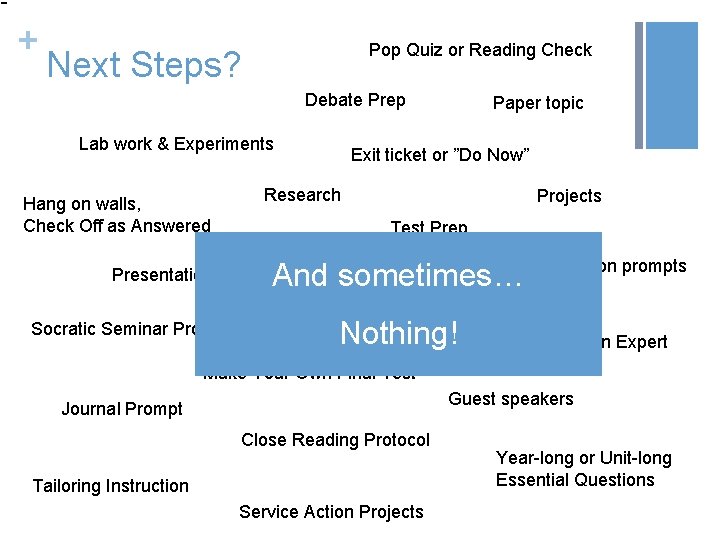
+ Pop Quiz or Reading Check Next Steps? Debate Prep Lab work & Experiments Paper topic Exit ticket or ”Do Now” Research Hang on walls, Check Off as Answered Projects Test Prep Homework Class discussion prompts And sometimes… Presentations Socratic Seminar Prompts Student Choice Projects Nothing! Interview an Expert Make Your Own Final Test Guest speakers Journal Prompt Close Reading Protocol Tailoring Instruction Service Action Projects Year-long or Unit-long Essential Questions
+ 2 Keys to Beginning to Plan a Lesson with the QFT 1. Starting at the End 2. QFocus Design
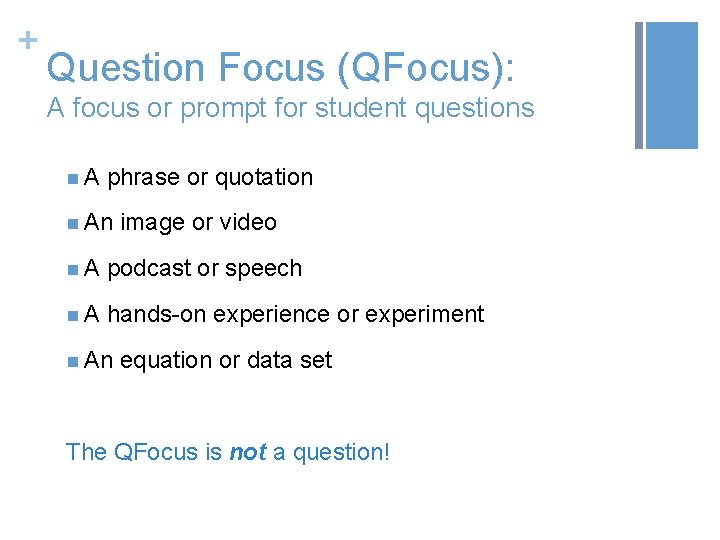
+ Question Focus (QFocus): A focus or prompt for student questions n A phrase or quotation n An image or video n A podcast or speech n A hands-on experience or experiment n An equation or data set The QFocus is not a question!
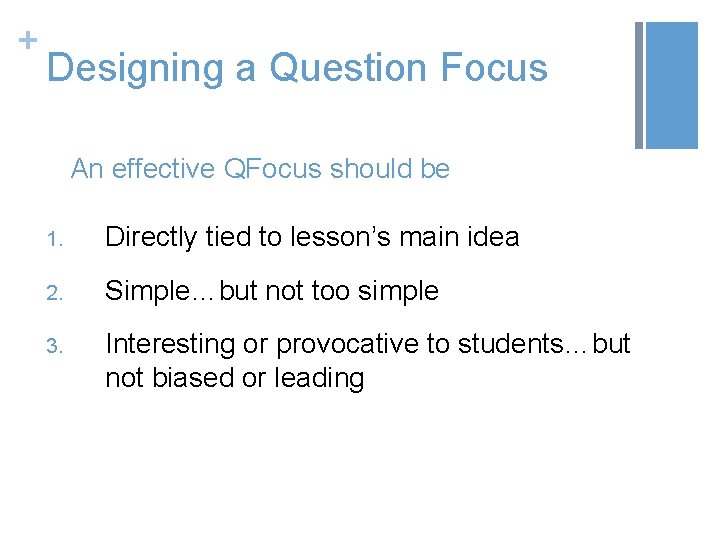
+ Designing a Question Focus An effective QFocus should be 1. Directly tied to lesson’s main idea 2. Simple…but not too simple 3. Interesting or provocative to students…but not biased or leading
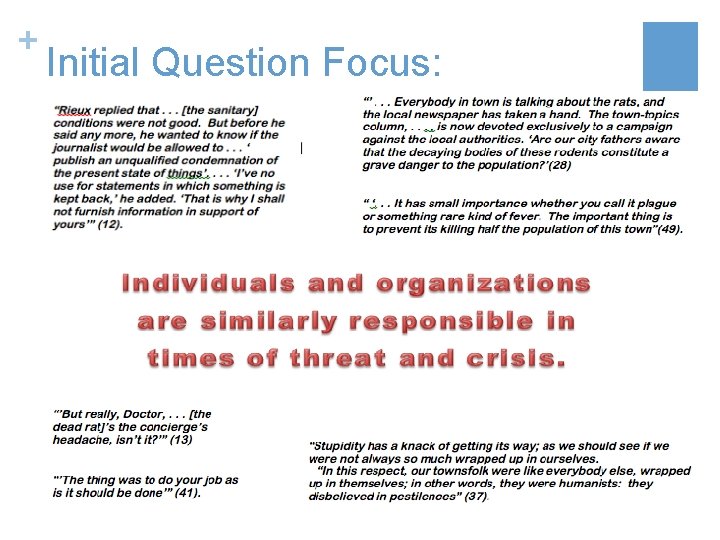
+ Initial Question Focus:
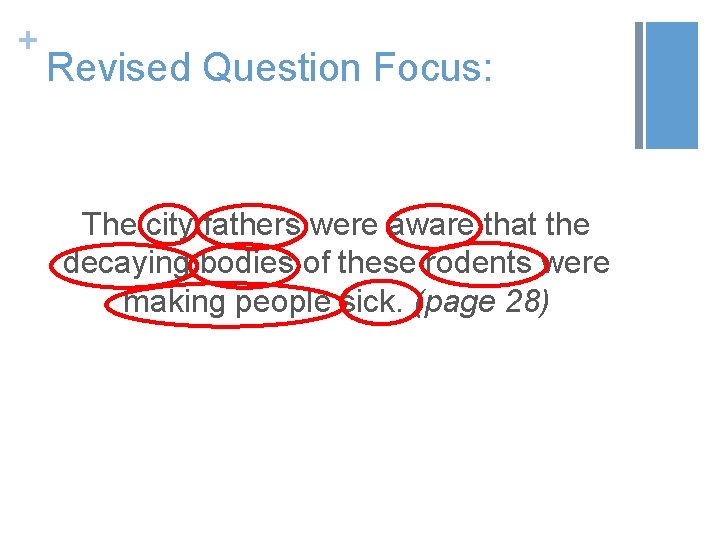
+ Revised Question Focus: The city fathers were aware that the decaying bodies of these rodents were making people sick. (page 28)
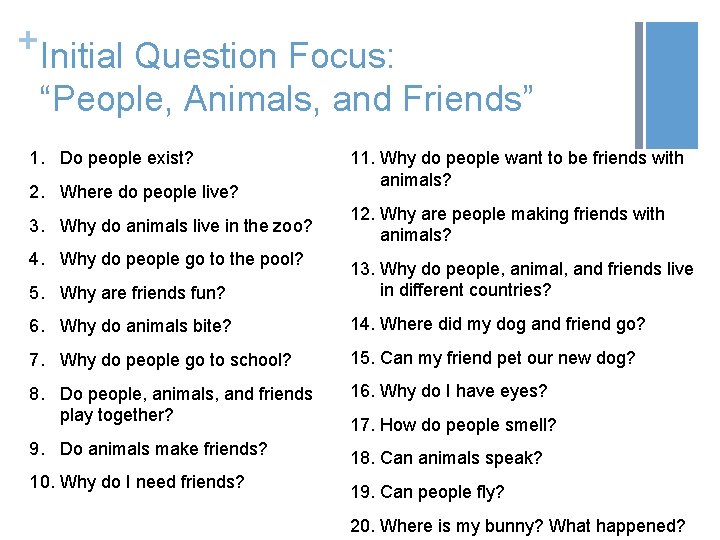
+ Initial Question Focus: “People, Animals, and Friends” 1. Do people exist? 2. Where do people live? 3. Why do animals live in the zoo? 4. Why do people go to the pool? 11. Why do people want to be friends with animals? 12. Why are people making friends with animals? 5. Why are friends fun? 13. Why do people, animal, and friends live in different countries? 6. Why do animals bite? 14. Where did my dog and friend go? 7. Why do people go to school? 15. Can my friend pet our new dog? 8. Do people, animals, and friends play together? 16. Why do I have eyes? 9. Do animals make friends? 10. Why do I need friends? 17. How do people smell? 18. Can animals speak? 19. Can people fly? 20. Where is my bunny? What happened?
+ Revising the Question Focus “People, Animals, and Friends” Your idea here!

+ The one quality all excellent QFT designers share? Thick Skin.
+ Putting it into Practice
+ Self-Organized Work Time Option 1: • Work on the lesson planning workbook through page 5. • Try creating your own QFocus. (It’s ok if it is a bit rough. )Write it on an index card. • Trade cards with a partner. • Generate questions about your partner’s QFocus. • Trade back and use their questions to guide revision of the QFocus.
+ Self-Organized Work Time Option 2: • Look through more math or science classroom examples: (available to download at http: //rightquestion. org/educators/seminar-resources/, and select “Math & Science Classroom Examples Power. Point”) • Read 3 key resources for math or science (available to download at http: //rightquestion. org/educators/seminar-resources/or pick up a hard copy handout) • Discuss what you’re learning and how you might use the QFT with a partner or group
+ WANTED: Q Focus Guinea Pigs Who is willing to share the QFocus you were working on?
+ Today’s Agenda 1) Welcome Collaborative Learning with the Question Formulation Technique (QFT) 3) Classroom Examples 4) Lesson Planning and Exploring Resources 5) Reflection and Q&A 6) Lunch 2) #QFT
+ Closing Reflections 1. What did you learn? 2. An “a-ha moment” or a meaningful take away from your experience today 3. A key question that will guide your work

+ Thank you! Have a great year!
+ Additional Math Resources Look through more math classroom examples: (available to download at http: //rightquestion. org/educators/seminar-resources/, and select “More STEM Examples Power. Point”) http: //rightquestion. org/qft-formative-assessment Watch a video of the QFT in action in a 4 th grade class learning about fractions. Teacher Lucy Canotas explains why she finds the QFT to be one of the most effective forms of formative assessment in math instruction. http: //kindlingfires. blogspot. com/2018/01/immigration-project-launch. html A fantastic blog written by a high school math teacher in Freemont, CA. If you search the blog, you’ll find several of Rick Barlow’s QFT lessons with all levels of students—from ELL immersion classes to AP classes. This particular link takes you to an incredible project Rick did with ELL students, using statistics to challenge immigration claims. https: //kengreenfield. wordpress. com/2017/12/04/artifact-1 -google-suiteassignment/ A post from a high school math teacher about using the QFT and google suite tools in a lesson about linear regression.
+ Additional Science Resources Look through more science classroom examples: (available to download at http: //rightquestion. org/educators/seminar-resources/, and select “More STEM Examples Power. Point”) http: //rightquestion. org/high-school-science. Watch a video of the QFT in action in a 9 th Grade Physics class in Newton, MA. https: //www. ebsco. com/blog/article/build-stem-skills-with-the-questionformulation-technique A short article that details several different science applications, pre-k through higher education and builds a larger argument about why curiosity is so critical to science and innovation. https: //goo. gl/Wx 6 VNF Fabulous curated resources from former Science Department Chair, now assistant Superintendent of Teaching and Learning, Alison Gest from Maine Township, IL. She lists 8 of her own QFT lessons (linking out to worksheets, student work, examples of final projects, etc. ) and then offers many additional QFocus ideas.

+ To Learn A LOT More About How to Use the QFT Check out our online course hosted by the Harvard Graduate School of Education: https: //www. gse. harvard. edu/ppe/program/teachingstudents-ask-their-own-questions-best-practicesquestion-formulation-technique October 15, 2018 – November 2, 2018
- Slides: 96