Top 10 Takeaways Hemant Elhence CEO Vinayak Joglekar
- Slides: 44
Top 10 Takeaways Hemant Elhence, CEO Vinayak Joglekar, CTO @Hemant. Elhence @vinayakj
Conference Overview • August 3 -7, in Washington, D. C. • Approx 2200 participants from 40 countries, 17 tracks, w/ approx 300 sessions, plus Open Jam sessions and Lightening Talks of 5 min each • Inspiring Keynotes – Luke Hohmann: Awesome Superproblems – Jessie Shternshus: Individuals, Interactions and Improvisation – Jim Tamm: Want Better Collaboration? Don’t be so Defensive • 5 th year of 1 -day Executive Forum, with invited senior executives, ~125 Confidential – August 2015 http: //synerzip. com
17 Tracks • Agile Bootcamp • Coaching and Mentoring • Collaboration, Culture & Teams • Development Practices & Craftsmanship • Dev. Ops • Enterprise Agile • Experience Reports • Leadership • Learning Confidential – August 2015 • Lightening Talks • Project, Program and Portfolio Management • Research • Stalwarts • Testing & Quality • User Experience • Working with Customers • Government (New) http: //synerzip. com
Synerzip’s Top “ 10” Takeaways Note: 40+ sessions were attended by Hemant Elhence and Vinayak Joglekar. Where possible, the presenter’s name and other reference are listed. Confidential – August 2015 http: //synerzip. com
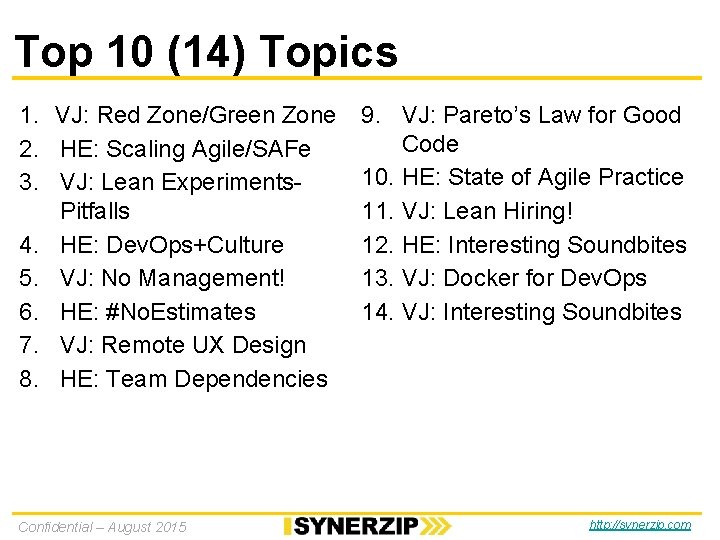
Top 10 (14) Topics 1. VJ: Red Zone/Green Zone 2. HE: Scaling Agile/SAFe 3. VJ: Lean Experiments. Pitfalls 4. HE: Dev. Ops+Culture 5. VJ: No Management! 6. HE: #No. Estimates 7. VJ: Remote UX Design 8. HE: Team Dependencies Confidential – August 2015 9. VJ: Pareto’s Law for Good Code 10. HE: State of Agile Practice 11. VJ: Lean Hiring! 12. HE: Interesting Soundbites 13. VJ: Docker for Dev. Ops 14. VJ: Interesting Soundbites http: //synerzip. com
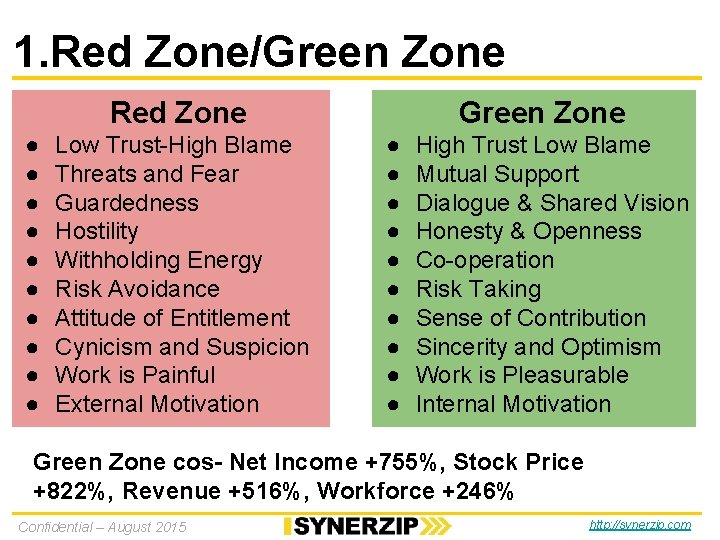
1. Red Zone/Green Zone Red Zone ● ● ● ● ● Low Trust-High Blame Threats and Fear Guardedness Hostility Withholding Energy Risk Avoidance Attitude of Entitlement Cynicism and Suspicion Work is Painful External Motivation Green Zone ● ● ● ● ● High Trust Low Blame Mutual Support Dialogue & Shared Vision Honesty & Openness Co-operation Risk Taking Sense of Contribution Sincerity and Optimism Work is Pleasurable Internal Motivation Green Zone cos- Net Income +755%, Stock Price +822%, Revenue +516%, Workforce +246% Confidential – August 2015 http: //synerzip. com
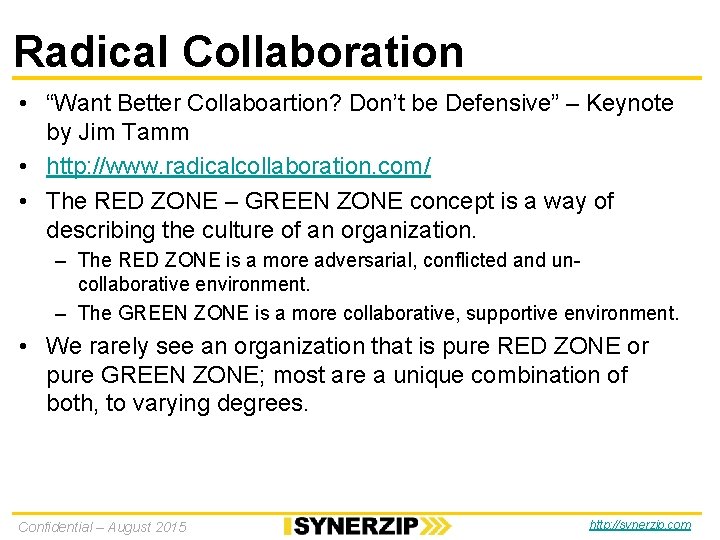
Radical Collaboration • “Want Better Collaboartion? Don’t be Defensive” – Keynote by Jim Tamm • http: //www. radicalcollaboration. com/ • The RED ZONE – GREEN ZONE concept is a way of describing the culture of an organization. – The RED ZONE is a more adversarial, conflicted and uncollaborative environment. – The GREEN ZONE is a more collaborative, supportive environment. • We rarely see an organization that is pure RED ZONE or pure GREEN ZONE; most are a unique combination of both, to varying degrees. Confidential – August 2015 http: //synerzip. com
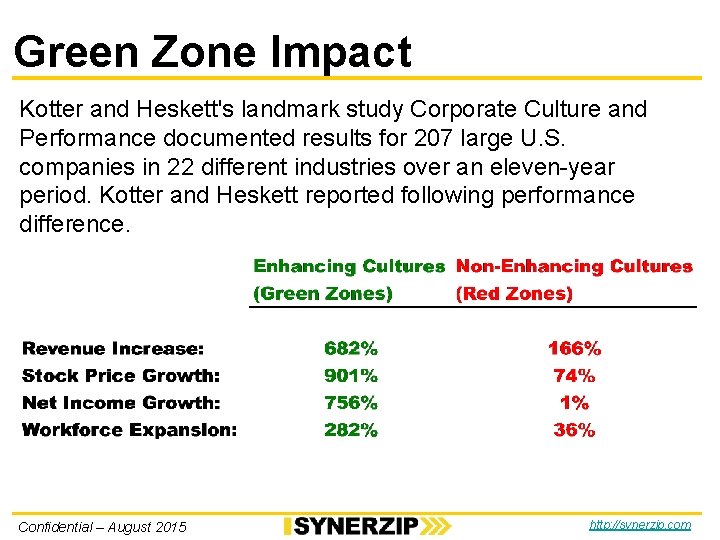
Green Zone Impact Kotter and Heskett's landmark study Corporate Culture and Performance documented results for 207 large U. S. companies in 22 different industries over an eleven-year period. Kotter and Heskett reported following performance difference. Confidential – August 2015 http: //synerzip. com
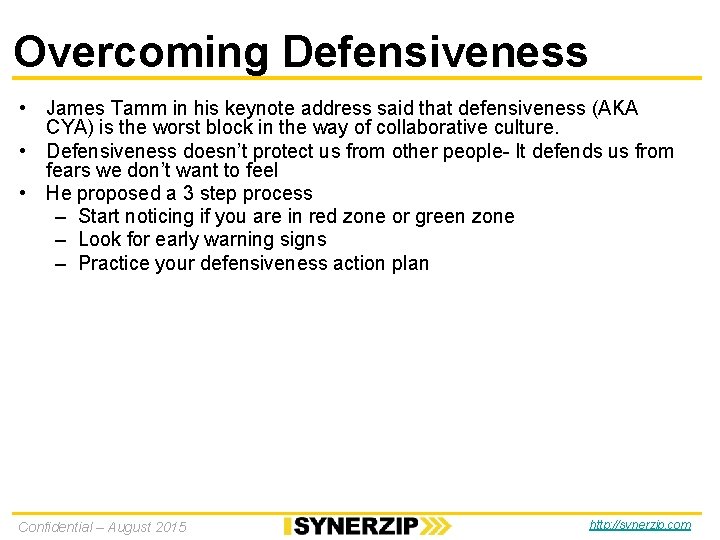
Overcoming Defensiveness • James Tamm in his keynote address said that defensiveness (AKA CYA) is the worst block in the way of collaborative culture. • Defensiveness doesn’t protect us from other people- It defends us from fears we don’t want to feel • He proposed a 3 step process – Start noticing if you are in red zone or green zone – Look for early warning signs – Practice your defensiveness action plan Confidential – August 2015 http: //synerzip. com
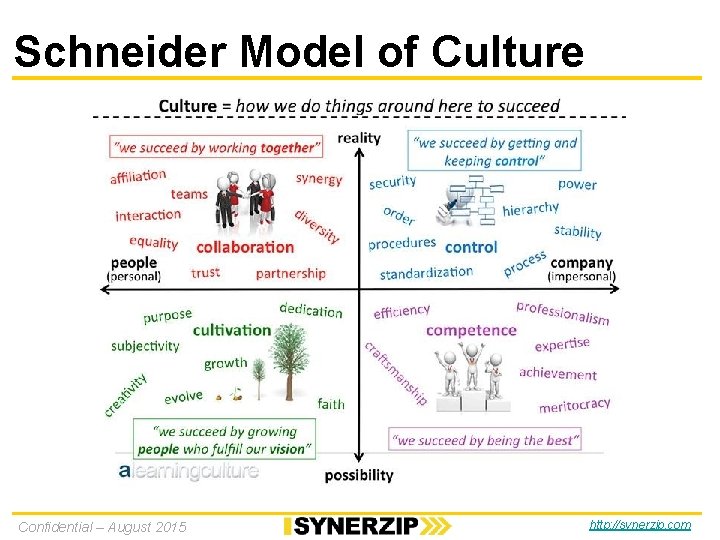
Schneider Model of Culture Confidential – August 2015 http: //synerzip. com
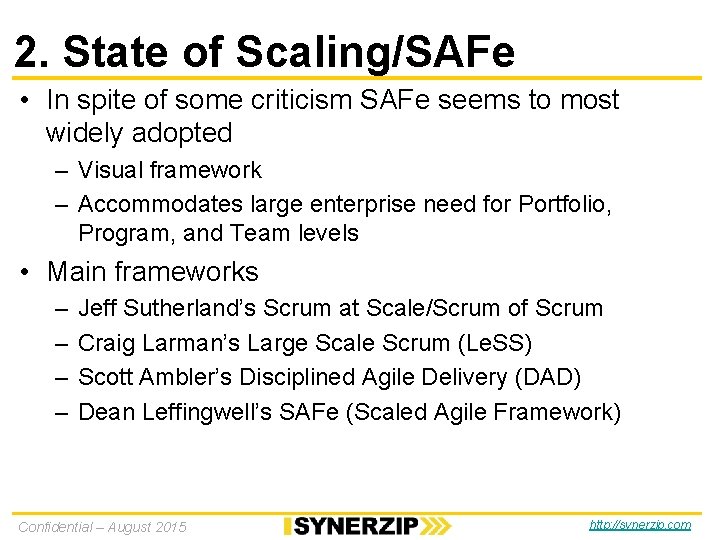
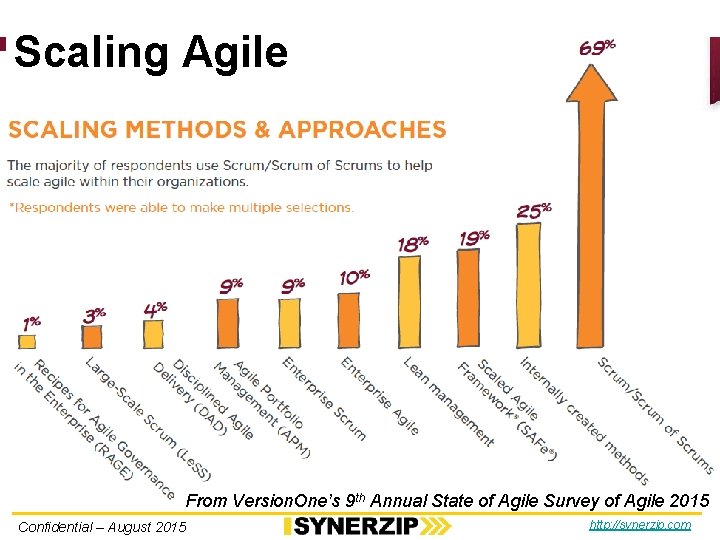
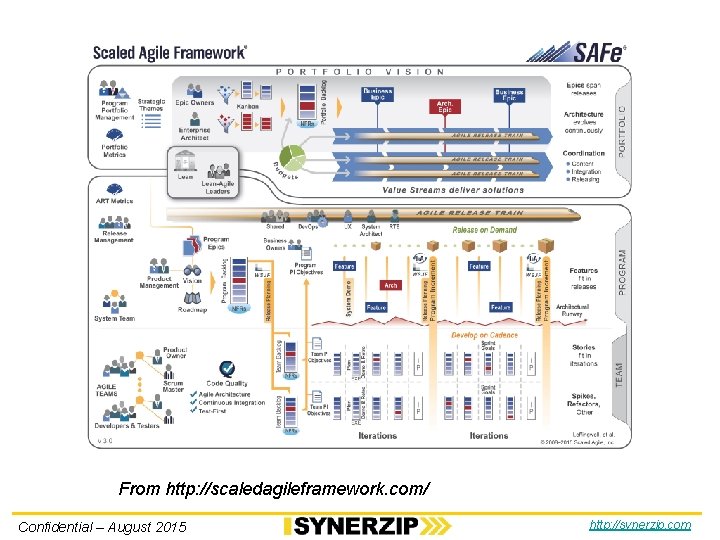
2. State of Scaling/SAFe • In spite of some criticism SAFe seems to most widely adopted – Visual framework – Accommodates large enterprise need for Portfolio, Program, and Team levels • Main frameworks – – Jeff Sutherland’s Scrum at Scale/Scrum of Scrum Craig Larman’s Large Scale Scrum (Le. SS) Scott Ambler’s Disciplined Agile Delivery (DAD) Dean Leffingwell’s SAFe (Scaled Agile Framework) Confidential – August 2015 http: //synerzip. com
Scaling Agile From Version. One’s 9 th Annual State of Agile Survey of Agile 2015 Confidential – August 2015 http: //synerzip. com
From http: //scaledagileframework. com/ Confidential – August 2015 http: //synerzip. com
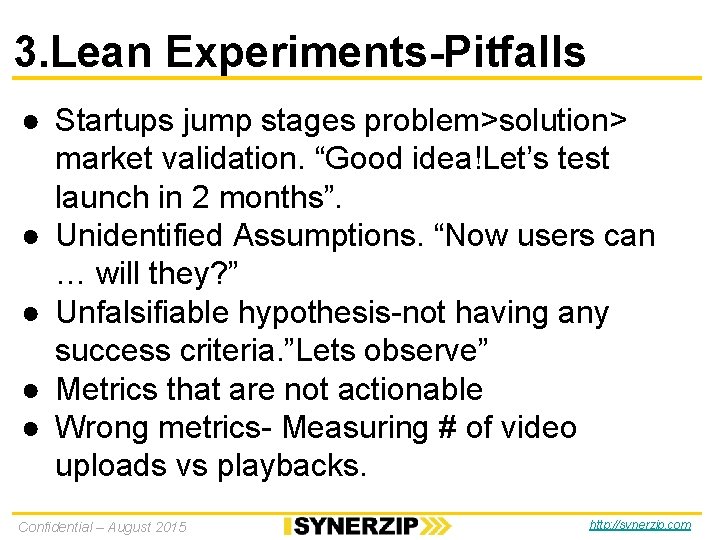
3. Lean Experiments-Pitfalls ● Startups jump stages problem>solution> market validation. “Good idea!Let’s test launch in 2 months”. ● Unidentified Assumptions. “Now users can … will they? ” ● Unfalsifiable hypothesis-not having any success criteria. ”Lets observe” ● Metrics that are not actionable ● Wrong metrics- Measuring # of video uploads vs playbacks. Confidential – August 2015 http: //synerzip. com
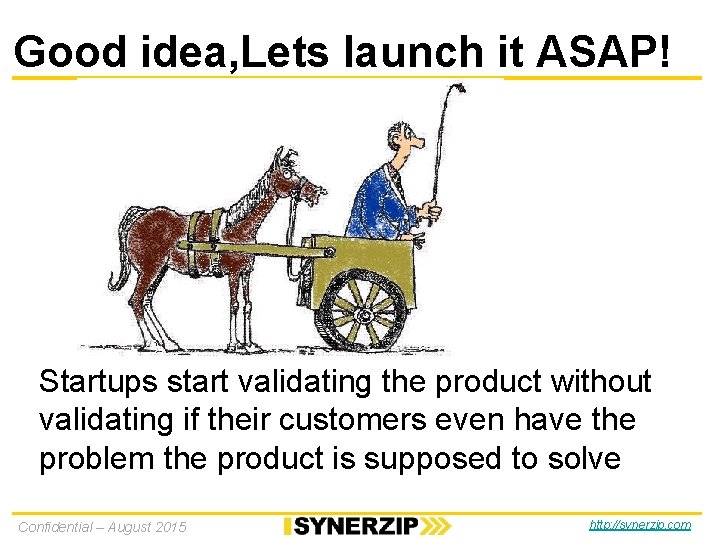
Good idea, Lets launch it ASAP! Startups start validating the product without validating if their customers even have the problem the product is supposed to solve Confidential – August 2015 http: //synerzip. com
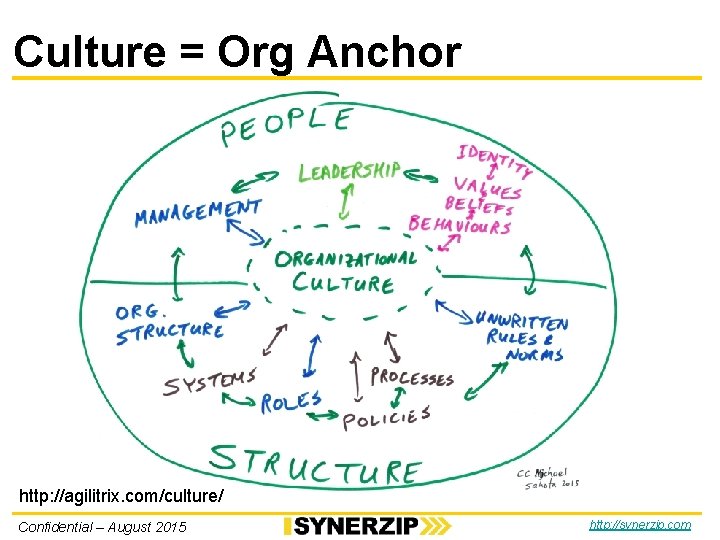
4. Dev. Ops+Culture • The core requirements for successful Agile transformation is – Dev. Ops, i. e. CI & CD – Org culture + Agile mindset • The essence of Agile is – Inspect & Adapt – All practices are optional – Being Agile vs. Doing Agile • Org culture drives org performance – Org culture follows org structure – “Culture eats strategy for breakfast” • Separate Dev. Ops session in Exec Forum Confidential – August 2015 http: //synerzip. com
Confidential – August 2015 http: //synerzip. com
Culture = Org Anchor http: //agilitrix. com/culture/ Confidential – August 2015 http: //synerzip. com
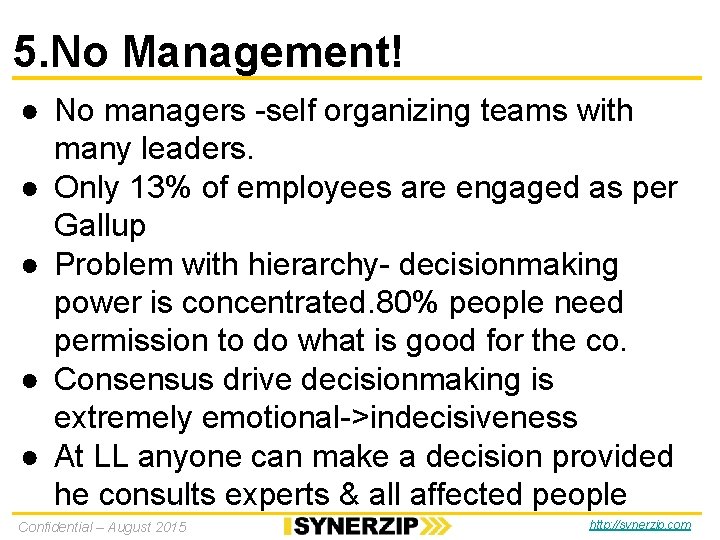
5. No Management! ● No managers -self organizing teams with many leaders. ● Only 13% of employees are engaged as per Gallup ● Problem with hierarchy- decisionmaking power is concentrated. 80% people need permission to do what is good for the co. ● Consensus drive decisionmaking is extremely emotional->indecisiveness ● At LL anyone can make a decision provided he consults experts & all affected people Confidential – August 2015 http: //synerzip. com
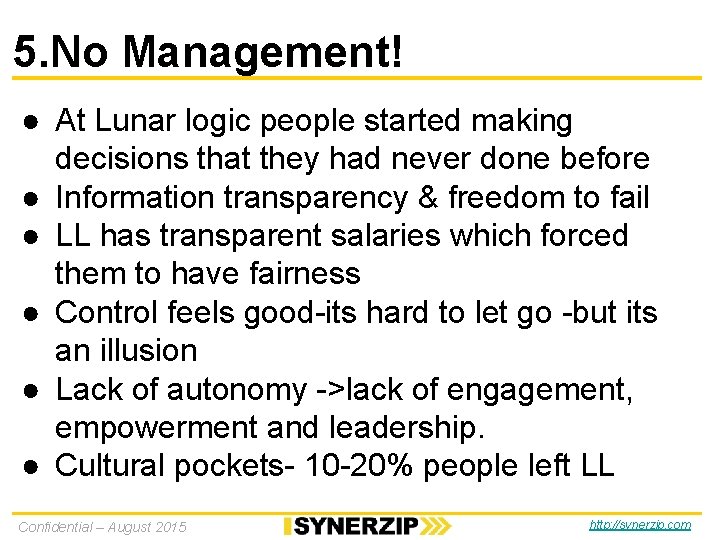
5. No Management! ● At Lunar logic people started making decisions that they had never done before ● Information transparency & freedom to fail ● LL has transparent salaries which forced them to have fairness ● Control feels good-its hard to let go -but its an illusion ● Lack of autonomy ->lack of engagement, empowerment and leadership. ● Cultural pockets- 10 -20% people left LL Confidential – August 2015 http: //synerzip. com
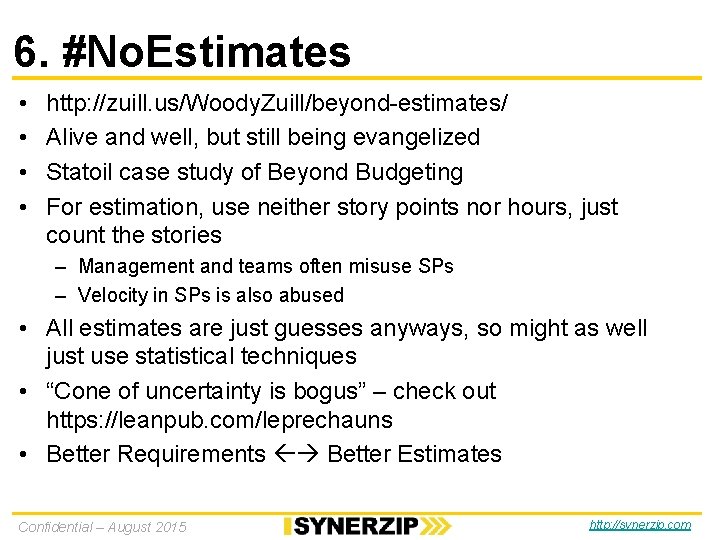
6. #No. Estimates • • http: //zuill. us/Woody. Zuill/beyond-estimates/ Alive and well, but still being evangelized Statoil case study of Beyond Budgeting For estimation, use neither story points nor hours, just count the stories – Management and teams often misuse SPs – Velocity in SPs is also abused • All estimates are just guesses anyways, so might as well just use statistical techniques • “Cone of uncertainty is bogus” – check out https: //leanpub. com/leprechauns • Better Requirements Better Estimates Confidential – August 2015 http: //synerzip. com
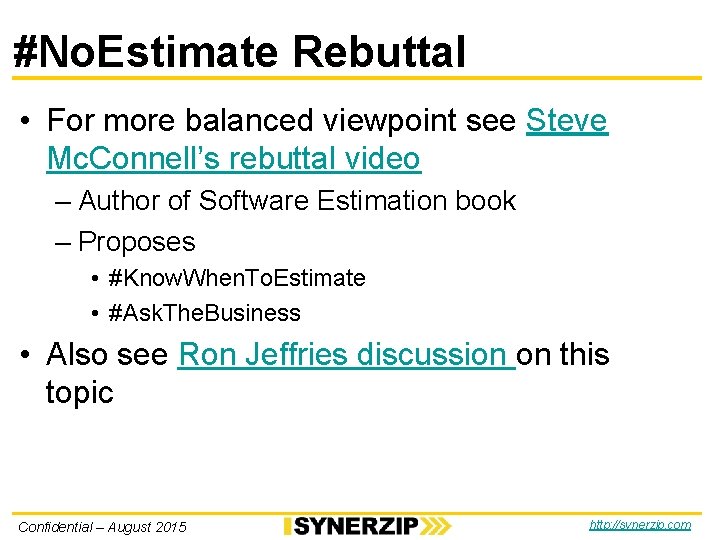
#No. Estimate Rebuttal • For more balanced viewpoint see Steve Mc. Connell’s rebuttal video – Author of Software Estimation book – Proposes • #Know. When. To. Estimate • #Ask. The. Business • Also see Ron Jeffries discussion on this topic Confidential – August 2015 http: //synerzip. com
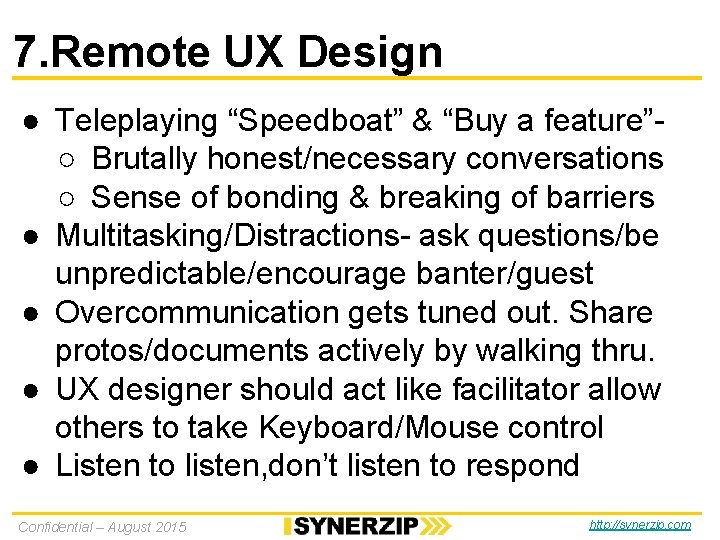
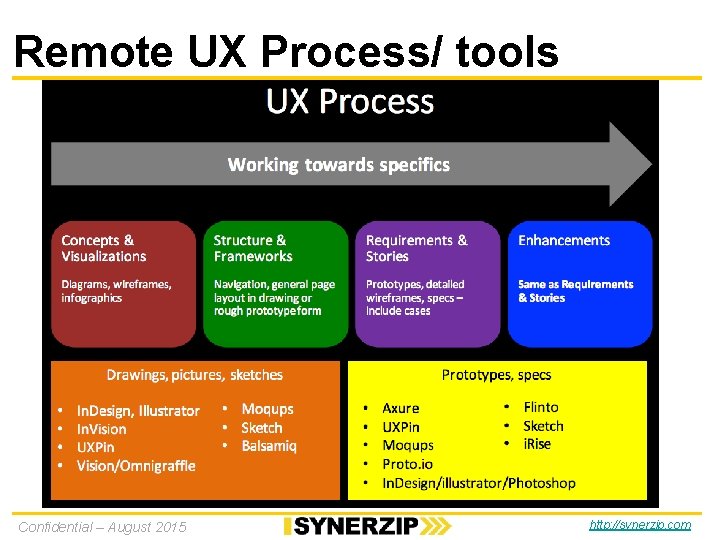
7. Remote UX Design ● Teleplaying “Speedboat” & “Buy a feature”○ Brutally honest/necessary conversations ○ Sense of bonding & breaking of barriers ● Multitasking/Distractions- ask questions/be unpredictable/encourage banter/guest ● Overcommunication gets tuned out. Share protos/documents actively by walking thru. ● UX designer should act like facilitator allow others to take Keyboard/Mouse control ● Listen to listen, don’t listen to respond Confidential – August 2015 http: //synerzip. com
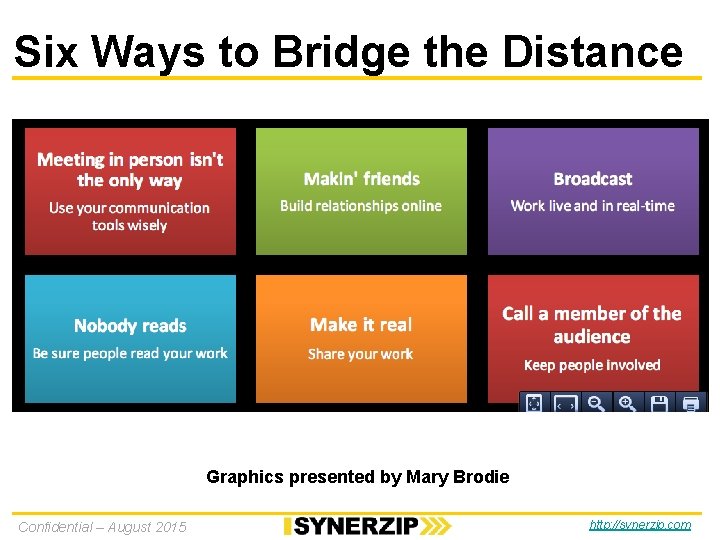
Six Ways to Bridge the Distance Graphics presented by Mary Brodie Confidential – August 2015 http: //synerzip. com
Remote UX Process/ tools Confidential – August 2015 http: //synerzip. com
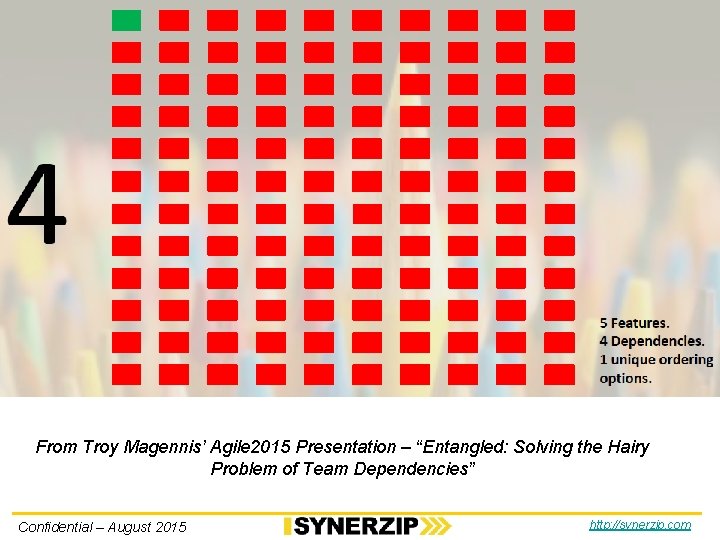
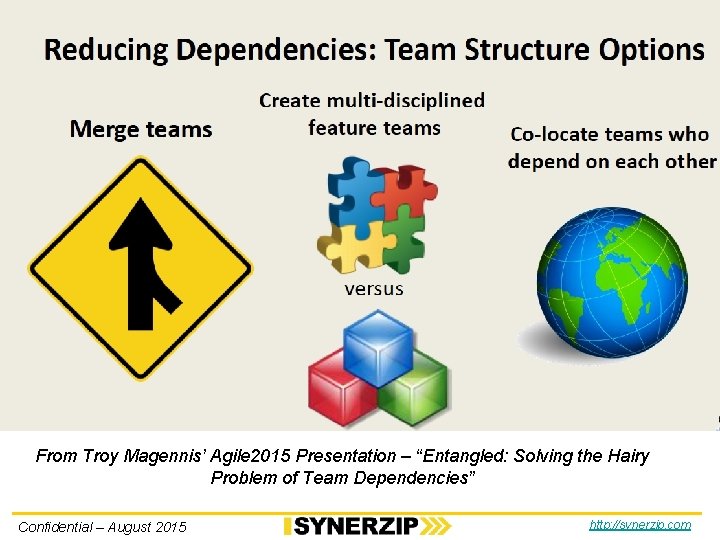
8. Team Dependencies • Entangled: Solving the Hairy Problem of Team Dependencies by Troy Magennis • Balancing # of teams vs. size of each team • Be aware of the impact of dependencies – A single dependency reduce order options 50%, < 1% with 4 – Every dependency removed double your chance of on-time delivery • Don’t be afraid to have teams of up to 15 people – If it avoids even a single dependency – Otherwise, 7 +/- 2 is still a good rule of thumb for optimal team size • Visualize your dependencies – co-locate/merge teams based on that • Manage your team skill balance to avoid constraints, but keep new hires on a team to less than 30% • Get cookies aligned between teams and dependents Confidential – August 2015 http: //synerzip. com
From Troy Magennis’ Agile 2015 Presentation – “Entangled: Solving the Hairy Problem of Team Dependencies” Confidential – August 2015 http: //synerzip. com
From Troy Magennis’ Agile 2015 Presentation – “Entangled: Solving the Hairy Problem of Team Dependencies” Confidential – August 2015 http: //synerzip. com
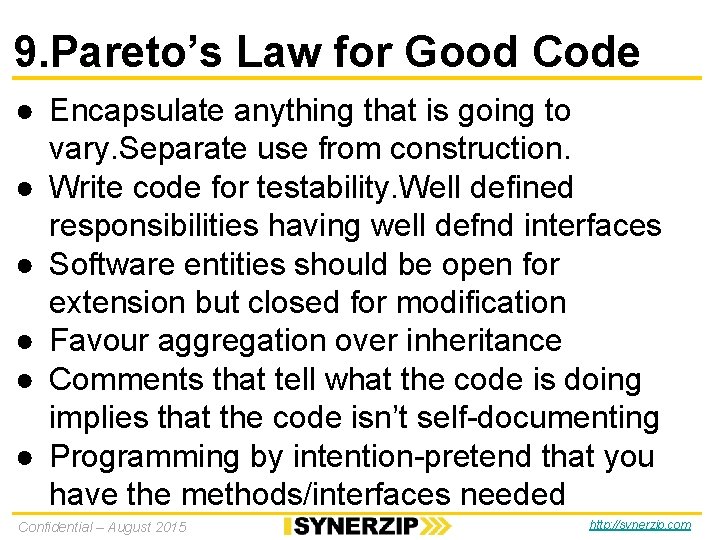
9. Pareto’s Law for Good Code ● Encapsulate anything that is going to vary. Separate use from construction. ● Write code for testability. Well defined responsibilities having well defnd interfaces ● Software entities should be open for extension but closed for modification ● Favour aggregation over inheritance ● Comments that tell what the code is doing implies that the code isn’t self-documenting ● Programming by intention-pretend that you have the methods/interfaces needed Confidential – August 2015 http: //synerzip. com
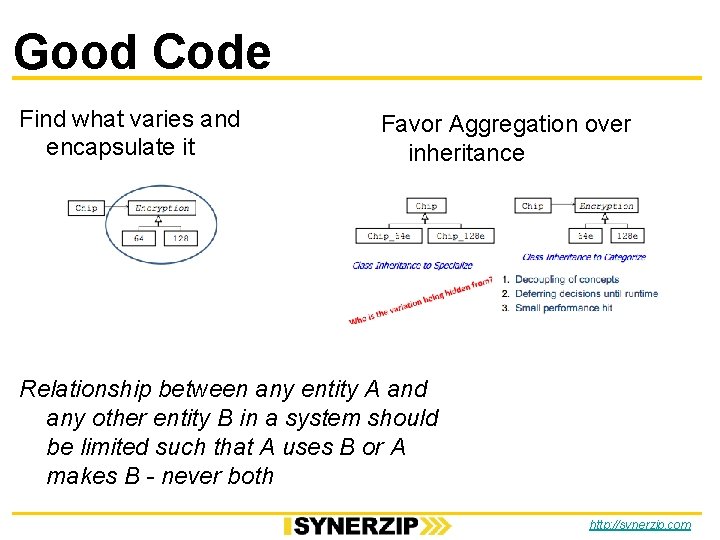
Good Code Find what varies and encapsulate it Favor Aggregation over inheritance Relationship between any entity A and any other entity B in a system should be limited such that A uses B or A makes B - never both http: //synerzip. com
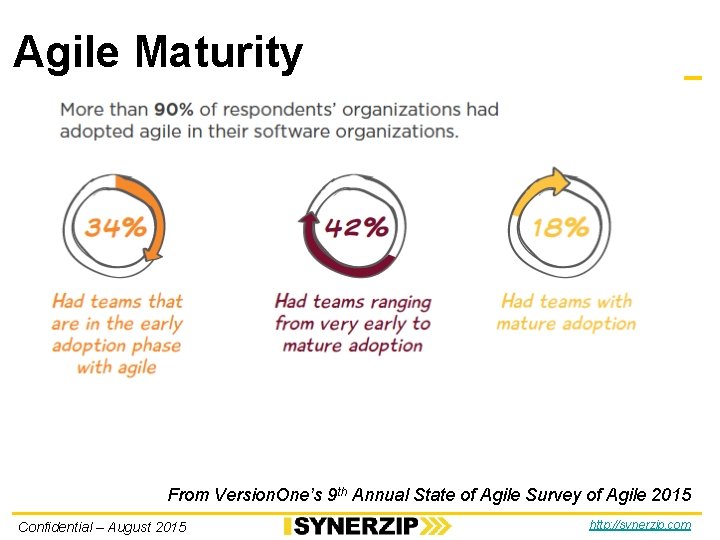
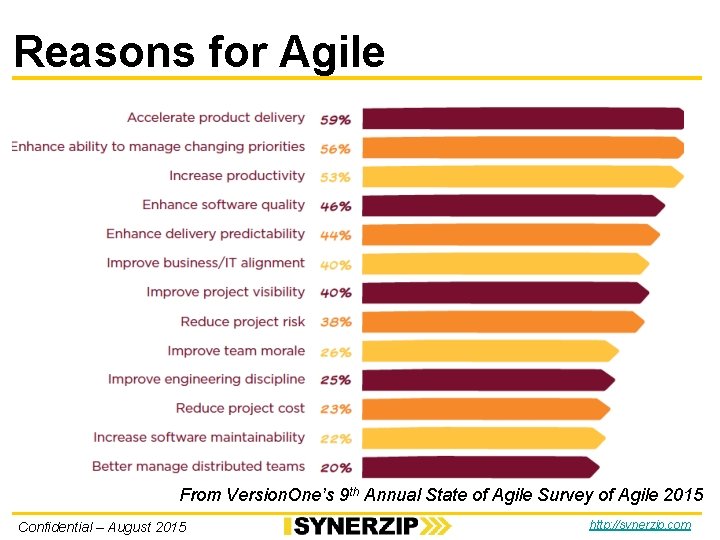
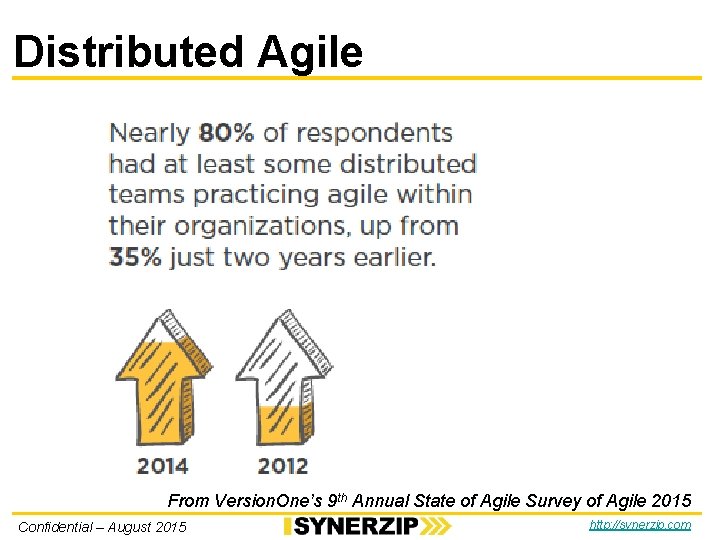
10. State of Agile Practice • Here are highlights from 9 th Annual State of Agile Survey conducted in Jul-Oct 2014 • Sponsored by Version. One, conducted by Analysis. Net Research, an independent survey consultancy • 3, 925 responses across industries in global software development community From Version. One’s 9 th Annual State of Agile Survey of Agile 2015 Confidential – August 2015 http: //synerzip. com
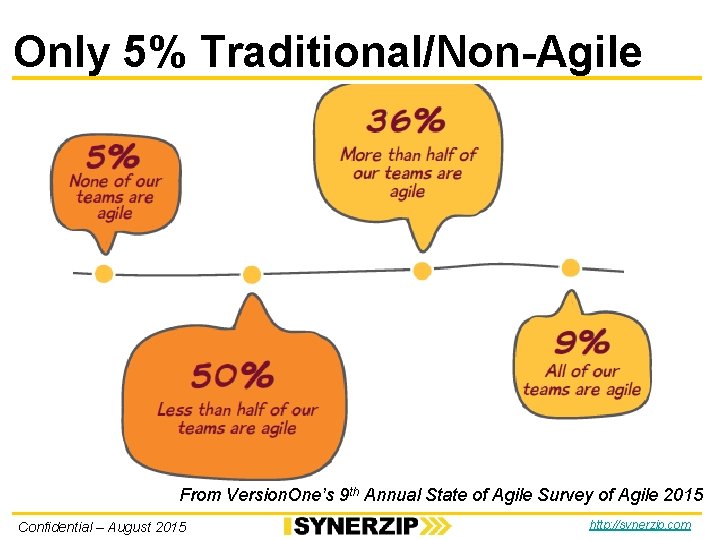
Only 5% Traditional/Non-Agile From Version. One’s 9 th Annual State of Agile Survey of Agile 2015 Confidential – August 2015 http: //synerzip. com
Agile Maturity From Version. One’s 9 th Annual State of Agile Survey of Agile 2015 Confidential – August 2015 http: //synerzip. com
Reasons for Agile From Version. One’s 9 th Annual State of Agile Survey of Agile 2015 Confidential – August 2015 http: //synerzip. com
Distributed Agile From Version. One’s 9 th Annual State of Agile Survey of Agile 2015 Confidential – August 2015 http: //synerzip. com
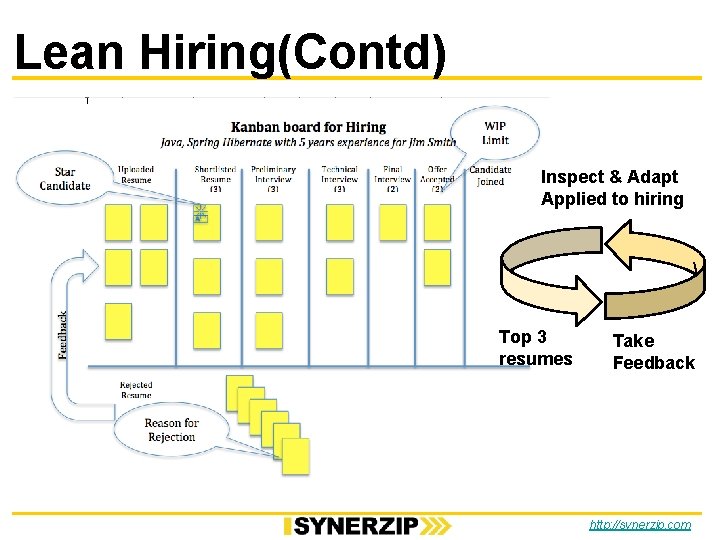
11. Lean Hiring! ● Auditioning should be relevant. If you pair on the job; you should pair in the interview. ● Filtering on tools/technology is irrelevantnew tools/technology can always be learnt ● Look for behaviours not practices ● Screen resumes in a group and classify in Yes/No/Maybe -discuss conflicting cases ● Ask Open ended questions - “Tell me about the time when. . ”, ”What would you do if. . ” ● Test adaptability. ”When were you surprised? ● Cultural misfits result in frustration Confidential – August 2015 http: //synerzip. com
Lean Hiring(Contd) Inspect & Adapt Applied to hiring Top 3 resumes Take Feedback http: //synerzip. com
12. Interesting Soundbites-HE • Don’t break scrum teams at time-zone/geography boundary – “you do scrum, where you can do scrum” • Companies doing Dev. Ops are 50% more productive • “Individual performance management is still a $64 B question” – Jim Benson • “Software shapes business, so the shape of your software matters” – Michael Feathers • There is carrying costs of (dead) code, so teams should have planned obsolescence of code/features • “There is no correlation between effort and value in knowledge work. Your management practices need to acknowledge that. ” @Kevin. Trethewey Confidential – August 2015 http: //synerzip. com
12. Soundbites (Cont’d) • "People are always awesome, in all ways and always. Address the system. " - Daniel Roux (SPINE Model) • Problem w/ middle management - “We are naturally collaborative individuals, but punative managers” – Jim Benson • Technical Debt – Resist the urge to quantify technical debt – Technical debt should not be incurred by doing some thing quick & dirty (to go fast) – To go fast, reduce the feature scope Confidential – August 2015 http: //synerzip. com
13. Docker for Dev. Ops ● Docker is a container having a slice of kernel Vs Full OS virtualization. ● Docker eases co-ordination between Dev, QA and Dev. Ops ● Offers. com halved their AWS spend but did face some issues while scaling ● Its still early for Dev. Ops automation needed to use Docker in production ● Scaling up is easy, knowing when to scale down is tough Confidential – August 2015 http: //synerzip. com
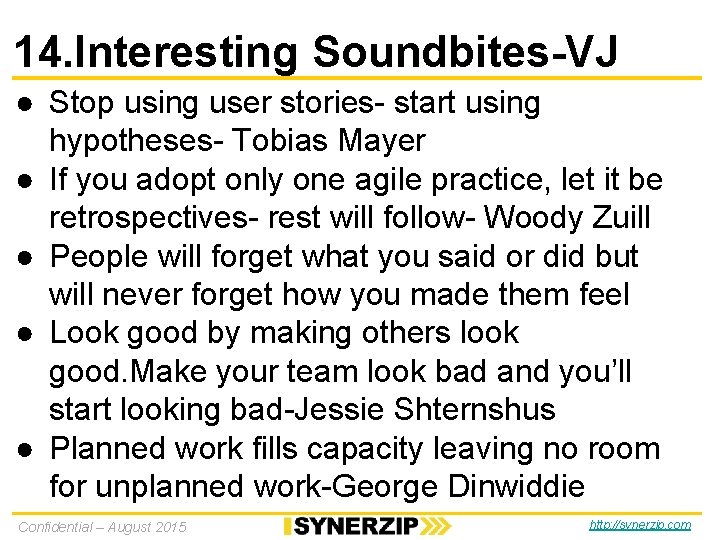
14. Interesting Soundbites-VJ ● Stop using user stories- start using hypotheses- Tobias Mayer ● If you adopt only one agile practice, let it be retrospectives- rest will follow- Woody Zuill ● People will forget what you said or did but will never forget how you made them feel ● Look good by making others look good. Make your team look bad and you’ll start looking bad-Jessie Shternshus ● Planned work fills capacity leaving no room for unplanned work-George Dinwiddie Confidential – August 2015 http: //synerzip. com
Questions? Confidential – August 2015 http: //synerzip. com
www. synerzip. com Confidential – August 2015 http: //synerzip. com
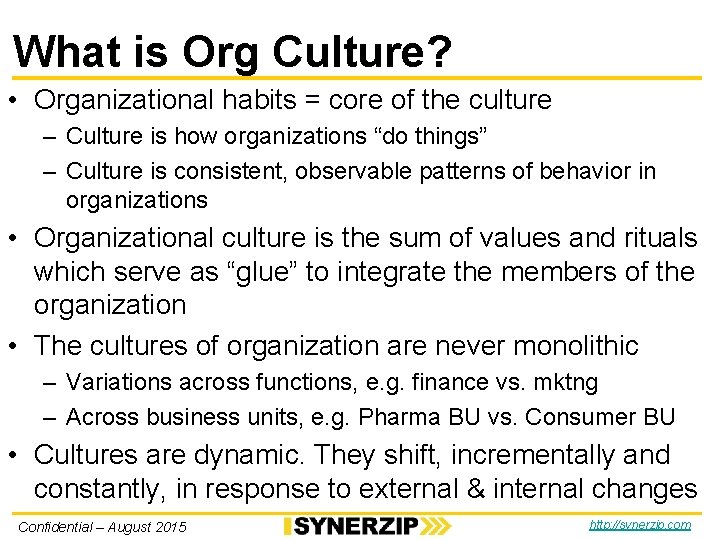
What is Org Culture? • Organizational habits = core of the culture – Culture is how organizations “do things” – Culture is consistent, observable patterns of behavior in organizations • Organizational culture is the sum of values and rituals which serve as “glue” to integrate the members of the organization • The cultures of organization are never monolithic – Variations across functions, e. g. finance vs. mktng – Across business units, e. g. Pharma BU vs. Consumer BU • Cultures are dynamic. They shift, incrementally and constantly, in response to external & internal changes Confidential – August 2015 http: //synerzip. com