
Global CEO Leadership Program If you can dream
동국대학교 행정대학원 Global CEO Leadership Program
If you can dream it, you can do it.
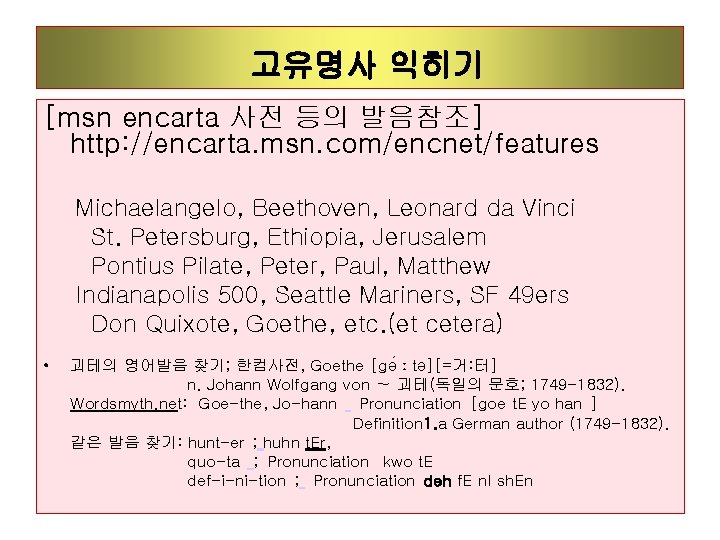
고유명사 익히기 [msn encarta 사전 등의 발음참조] http: //encarta. msn. com/encnet/features Michaelangelo, Beethoven, Leonard da Vinci St. Petersburg, Ethiopia, Jerusalem Pontius Pilate, Peter, Paul, Matthew Indianapolis 500, Seattle Mariners, SF 49 ers Don Quixote, Goethe, etc. (et cetera) • 괴테의 영어발음 찾기; 한컴사전, Goethe [gə ːtə][=거: 터] n. Johann Wolfgang von ∼ 괴테(독일의 문호; 1749 -1832). Wordsmyth. net: Goe-the, Jo-hann Pronunciation [goe t. E yo han ] Definition 1. a German author (1749 -1832). 같은 발음 찾기: hunt-er ; huhn t. Er, quo-ta ; Pronunciation kwo t. E def-i-ni-tion ; Pronunciation deh f. E n. I sh. En
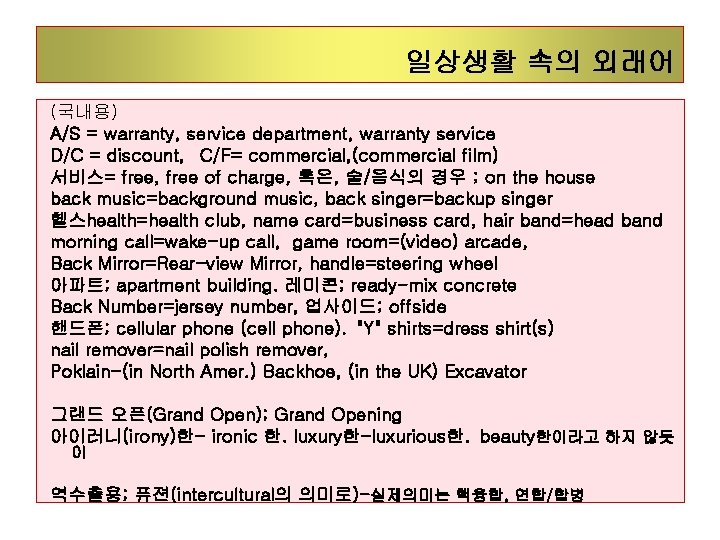
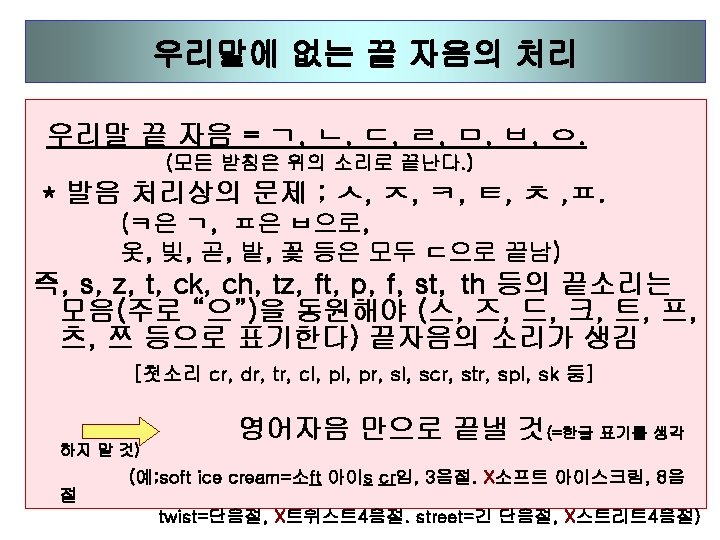
일상생활 속의 외래어 (국내용) A/S = warranty, service department, warranty service D/C = discount, C/F= commercial, (commercial film) 서비스= free, free of charge, 혹은, 술/음식의 경우 ; on the house back music=background music, back singer=backup singer 헬스health=health club, name card=business card, hair band=head band morning call=wake-up call, game room=(video) arcade, Back Mirror=Rear-view Mirror, handle=steering wheel 아파트; apartment building. 레미콘; ready-mix concrete Back Number=jersey number, 업사이드; offside 핸드폰; cellular phone (cell phone). "Y" shirts=dress shirt(s) nail remover=nail polish remover, Poklain-(in North Amer. ) Backhoe, (in the UK) Excavator 그랜드 오픈(Grand Open); Grand Opening 아이러니(irony)한- ironic 한. luxury한-luxurious한. beauty한이라고 하지 않듯 이 역수출용; 퓨젼(intercultural의 의미로)-실제의미는 핵융합, 연합/합병
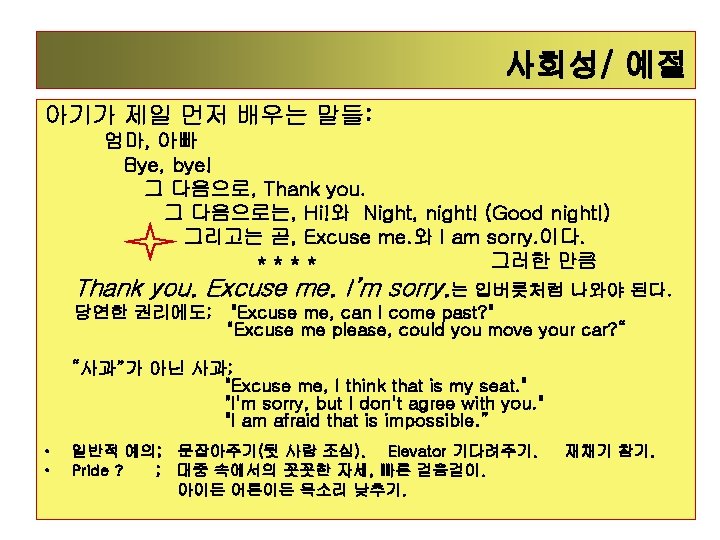
첫 인사와 First Impression How do you do? 의 어투. (또는, I'm Steve. Nice to meet you. ) I'm glad to meet you. 또는 I am pleased to meet you. 가 충분한 (친근감? 정중함? ) 마음을 표시하지 못한다고 생각될 때; I'm so glad to meet you. I am pleased to meet you, indeed. I’ve always wanted to meet you. I’ve been looking forward to meeting you. I’ve heard a lot about you. I’ve often heard of you from Mr. Kim. 등 사용. ☺드문 편이지만, I am pleased to make your acquaintance. ☼평범한 첫 인사; -Nice to meet you. ☼ 헤어질 때 - 소개나 만남에는 반드시 헤어지는 말이 있어야 된다. Nice meeting you. It has been nice to meet you. (Nice been meeting you. ) A: Nice talking with you. It was nice seeing you. B: It was nice talking with you as well. Bye. 등
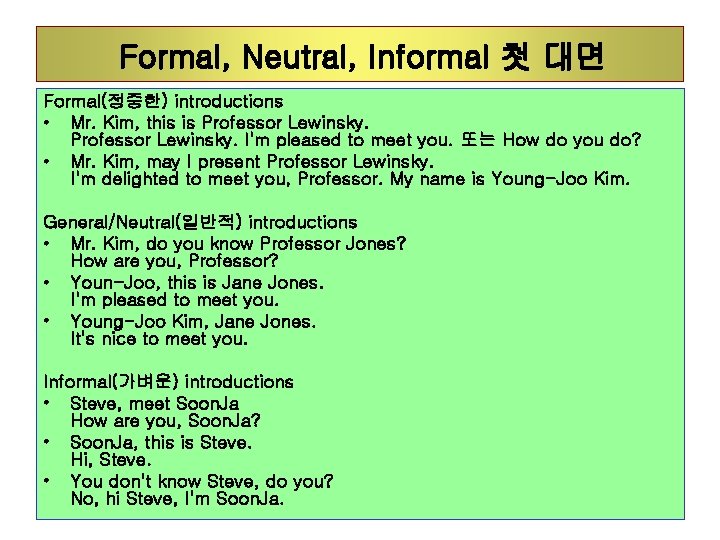
Formal, Neutral, Informal 첫 대면 Formal(정중한) introductions • Mr. Kim, this is Professor Lewinsky. I'm pleased to meet you. 또는 How do you do? • Mr. Kim, may I present Professor Lewinsky. I'm delighted to meet you, Professor. My name is Young-Joo Kim. General/Neutral(일반적) introductions • Mr. Kim, do you know Professor Jones? How are you, Professor? • Youn-Joo, this is Jane Jones. I'm pleased to meet you. • Young-Joo Kim, Jane Jones. It's nice to meet you. Informal(가벼운) introductions • Steve, meet Soon. Ja How are you, Soon. Ja? • Soon. Ja, this is Steve. Hi, Steve. • You don't know Steve, do you? No, hi Steve, I'm Soon. Ja.
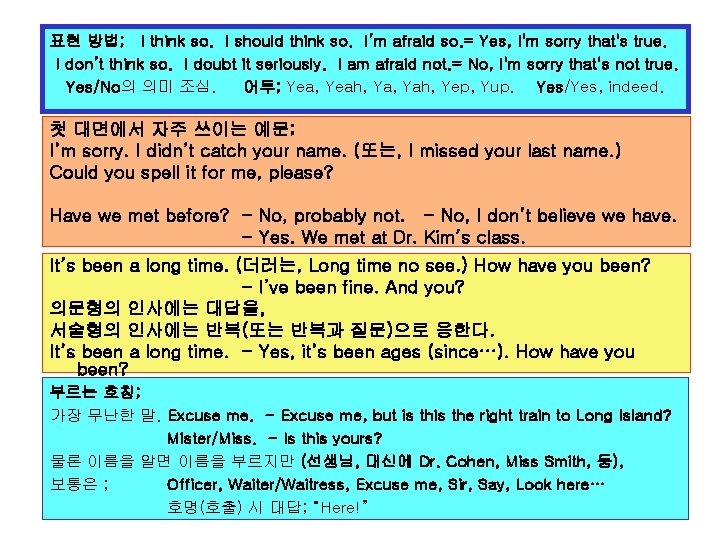
표현 방법; I think so. I should think so. I’m afraid so. = Yes, I'm sorry that's true. I don’t think so. I doubt it seriously. I am afraid not. = No, I'm sorry that's not true. Yes/No의 의미 조심. 어투; Yea, Yeah, Yah, Yep, Yup. Yes/Yes, indeed. 첫 대면에서 자주 쓰이는 예문; I’m sorry. I didn’t catch your name. (또는, I missed your last name. ) Could you spell it for me, please? Have we met before? - No, probably not. - No, I don’t believe we have. - Yes. We met at Dr. Kim’s class. It’s been a long time. (더러는, Long time no see. ) How have you been? - I’ve been fine. And you? 의문형의 인사에는 대답을, 서술형의 인사에는 반복(또는 반복과 질문)으로 응한다. It’s been a long time. - Yes, it’s been ages (since…). How have you been? 부르는 호칭; 가장 무난한 말. Excuse me. - Excuse me, but is the right train to Long Island? Mister/Miss. - Is this yours? 물론 이름을 알면 이름을 부르지만 (선생님, 대신에 Dr. Cohen, Miss Smith, 등), 보통은 ; Officer, Waiter/Waitress, Excuse me, Sir, Say, Look here… 호명(호출) 시 대답; “Here!”
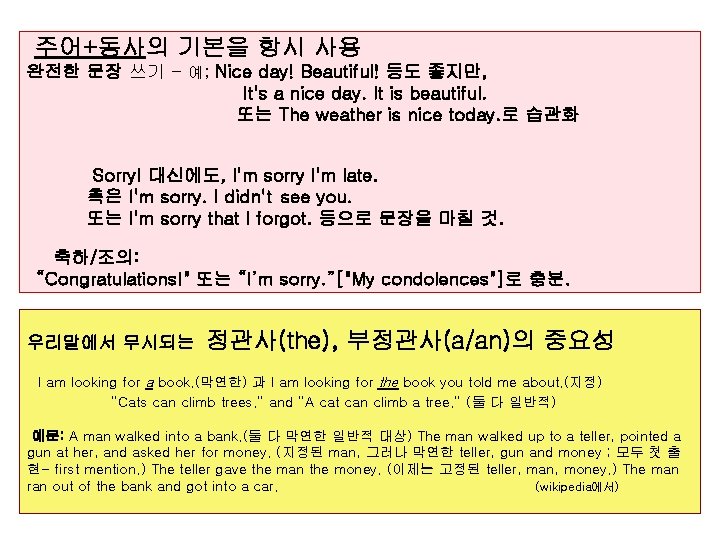
주어+동사의 기본을 항시 사용 완전한 문장 쓰기 - 예; Nice day! Beautiful! 등도 좋지만, It's a nice day. It is beautiful. 또는 The weather is nice today. 로 습관화 Sorry! 대신에도, I'm sorry I'm late. 혹은 I'm sorry. I didn't see you. 또는 I'm sorry that I forgot. 등으로 문장을 마칠 것. 축하/조의: “Congratulations!" 또는 “I’m sorry. ”["My condolences"]로 충분. 우리말에서 무시되는 정관사(the), 부정관사(a/an)의 중요성 I am looking for a book. (막연한) 과 I am looking for the book you told me about. (지정) “Cats can climb trees. ” and “A cat can climb a tree. ” (둘 다 일반적) 예문: A man walked into a bank. (둘 다 막연한 일반적 대상) The man walked up to a teller, pointed a gun at her, and asked her for money. (지정된 man, 그러나 막연한 teller, gun and money ; 모두 첫 출 현- first mention. ) The teller gave the man the money. (이제는 고정된 teller, man, money. ) The man ran out of the bank and got into a car. (wikipedia에서)
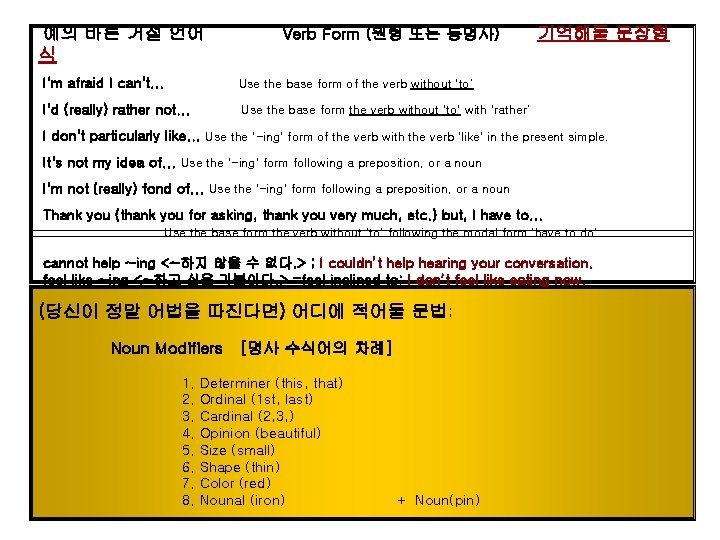
예의 바른 거절 언어 식 Verb Form (원형 또는 동명사) I'm afraid I can't. . . Use the base form of the verb without 'to‘ I'd (really) rather not. . . Use the base form the verb without 'to' with 'rather‘ 기억해둘 문장형 I don't particularly like. . . Use the '-ing' form of the verb with the verb 'like' in the present simple. It's not my idea of. . . Use the '-ing' form following a preposition, or a noun I'm not (really) fond of. . . Use the '-ing' form following a preposition, or a noun Thank you (thank you for asking, thank you very much, etc. ) but, I have to. . . Use the base form the verb without 'to' following the modal form 'have to do‘ cannot help ~ing <~하지 않을 수 없다. > ; I couldn’t help hearing your conversation. feel like ~ing <~하고 싶은 기분이다. > =feel inclined to; I don’t feel like eating now. (당신이 정말 어법을 따진다면) 어디에 적어둘 문법; Noun Modifiers [명사 수식어의 차례] 1. 2. 3. 4. 5. 6. 7. 8. Determiner (this, that) Ordinal (1 st, last) Cardinal (2, 3, ) Opinion (beautiful) Size (small) Shape (thin) Color (red) Nounal (iron) + Noun(pin)
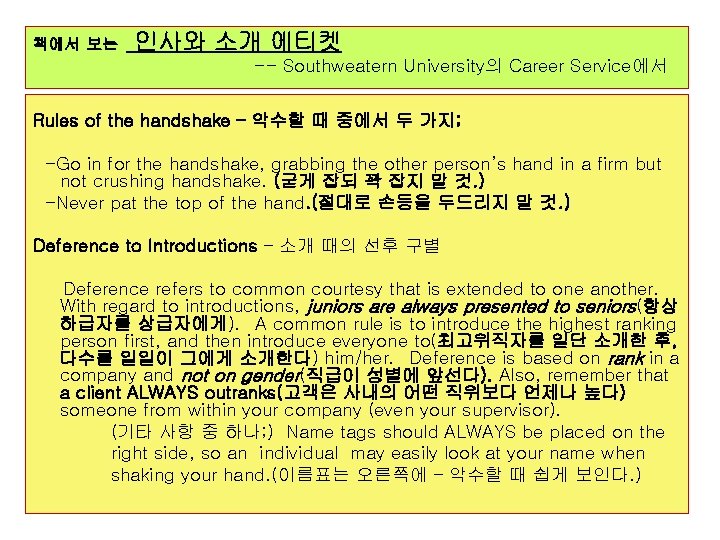
책에서 보는 인사와 소개 에티켓 -- Southweatern University의 Career Service에서 Rules of the handshake – 악수할 때 중에서 두 가지; -Go in for the handshake, grabbing the other person’s hand in a firm but not crushing handshake. (굳게 잡되 꽉 잡지 말 것. ) -Never pat the top of the hand. (절대로 손등을 두드리지 말 것. ) Deference to Introductions – 소개 때의 선후 구별 Deference refers to common courtesy that is extended to one another. With regard to introductions, juniors are always presented to seniors(항상 하급자를 상급자에게). A common rule is to introduce the highest ranking person first, and then introduce everyone to(최고위직자를 일단 소개한 후, 다수를 일일이 그에게 소개한다) him/her. Deference is based on rank in a company and not on gender(직급이 성별에 앞선다). Also, remember that a client ALWAYS outranks(고객은 사내의 어떤 직위보다 언제나 높다) someone from within your company (even your supervisor). (기타 사항 중 하나; ) Name tags should ALWAYS be placed on the right side, so an individual may easily look at your name when shaking your hand. (이름표는 오른쪽에 – 악수할 때 쉽게 보인다. )
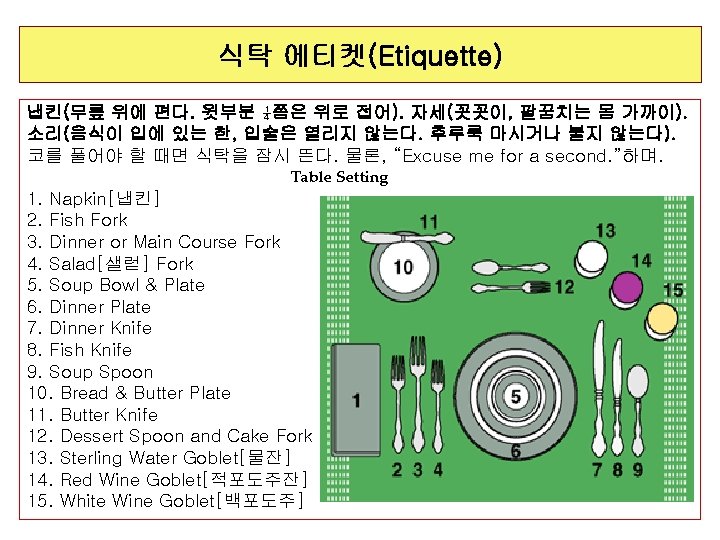
식탁 에티켓(Etiquette) 냅킨(무릎 위에 편다. 윗부분 ¼쯤은 위로 접어). 자세(꼿꼿이, 팔꿈치는 몸 가까이). 소리(음식이 입에 있는 한, 입술은 열리지 않는다. 후루룩 마시거나 불지 않는다). 코를 풀어야 할 때면 식탁을 잠시 뜬다. 물론, “Excuse me for a second. ”하며. Table Setting 1. Napkin[냅킨] 2. Fish Fork 3. Dinner or Main Course Fork 4. Salad[샐럳] Fork 5. Soup Bowl & Plate 6. Dinner Plate 7. Dinner Knife 8. Fish Knife 9. Soup Spoon 10. Bread & Butter Plate 11. Butter Knife 12. Dessert Spoon and Cake Fork 13. Sterling Water Goblet[물잔] 14. Red Wine Goblet[적포도주잔] 15. White Wine Goblet[백포도주]
Let's Start With The Soup [수~ㅍ 부터 시작합시다] by Lydia Ramsey Many a business meal starts with a soup course. Unless you have already begun by munching on the bread, this is your first opportunity to demonstrate your table manners-to impress or un-impress-your dining companions. (수~ㅍ. ; 테이블 메너의 첫 관문) With soup spoon in hand, spoon the soup away from you towards the opposite side of the bowl. If a bit of the liquid should fall from the spoon this will ensure that it will drop into the bowl and not on the front of your nice business attire. Sip your soup quietly from the side of the spoon. Slurping is never acceptable. (수~ㅍ. 을 뜰 때는 안쪽에서 바깥 쪽으로, 스푼의 사이드 쪽으로 조용히 마신다. 후루룩은 절대금물. ) No matter how hot the soup, at no point should you blow on it to cool it off. You may lift a spoonful slightly level with the bowl and hold it for a few seconds while it cools off. (뜨거워도 불지는 마라. 떠서 들고 몇 초 기다리는 것은 좋다. ) If you want the last drop of soup, you may tip the bowl away from you to spoon this last bit. Just try to avoid looking as if you are not sure where your next meal is coming from. (마지막 남는 것까지 끝내려면 그릇을 바깥 쪽으로 기우려 뜬다. ) If oyster crackers come with your soup, as they do with chowder, you can put them in your bowl. However, larger crackers are to be eaten with your fingers and never crumbled into the soup. That's only okay when eating in private. Between mouthfuls, rest the spoon in the bowl. When you have finished, place it on the under plate on the right hand side. That is a signal to the server that you have finished. (입 안에 크렉커 등이 있어 시간이 걸릴 경우는 숫가락을 보울 속에 둔다. 먹기를 마쳤을 때는 보울 오른쪽에 놓는 다. 보통은 숲보울 받침접시가 있어 받침접시 위에 놓는다. ) If you'd like to have a piece of bread with your soup, put your spoon on the under plate and use the same hand that held your spoon for the bread. Never go at your meal two-fisted. (빵을 숲과 함께 먹을 경우, 숫가락은 받침접시 위에 둔다. 한 손에 빵, 한 손에 숫가락은 금물. ) Every detail of the business meal, including how you eat your soup, contributes to your overall professional image. (식탁에서는 세심한 동작 하나 하나가 당신의 이미지에 결정적 역할을 한다. ) 참고; 식사 중 만약 뼈나 씨 등 입에서 도루 나와야 되는 것이 있을 때는 꼭 사용중인 스푼이나 포~ㅋ. 으로 받아낸다.
손으로 먹는 음식 중, Bread [빵] 예절 찾아보기 Bread must always be broken, never cut with a knife. (빵은 칼을 쓰지 않고 떼 어 먹는다. ) Tear off a piece that is no bigger than two bites worth and eat that before tearing off another. (두 번 쯤에 다 먹을 수 있는 크기로 뜯어, 다 먹 은 후 또 뗀다. ) If butter is provided (and at formal events it customarily is not), butter the small piece just before eating it. (버터는 입에 들어갈 조각에 만 바른다. ) There is an exception to this rule: if you are served a hot roll, it is permissible to tear (not cut) the whole roll lengthwise down the middle and place a pat of butter inside to melt. (따뜻한 빵인 경우에는 손으로 갈라, 안 쪽에다 미리 버터를 발라 놓을 수 있다. ) ] - Southwestern Univ. [사우스웨스턴 대학교 예절지침서에서 Napkin Etiquette [냅킨 에티켓] Place the napkin in your lap immediately after the last person has been seated at your table. (마지막 사람이 도착하면 즉시 무릎에) Do not shake it open. (털어 열지 말 것) If the napkin is large put the fold toward your waist. If you must leave the table during the meal be sure to put the napkin on your chair. (잠시 일어설 때는 의자에 두라) When you are finished eating, place the napkin to the right of the plate. (모든 식사가 끝났으면, 접시 오른쪽에 올려둔다)
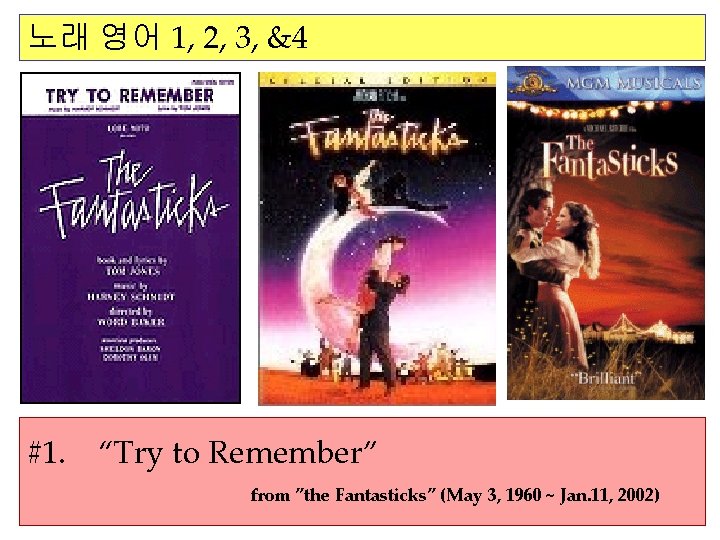
노래 영어 1, 2, 3, &4 #1. “Try to Remember” from ”the Fantasticks” (May 3, 1960 ~ Jan. 11, 2002)
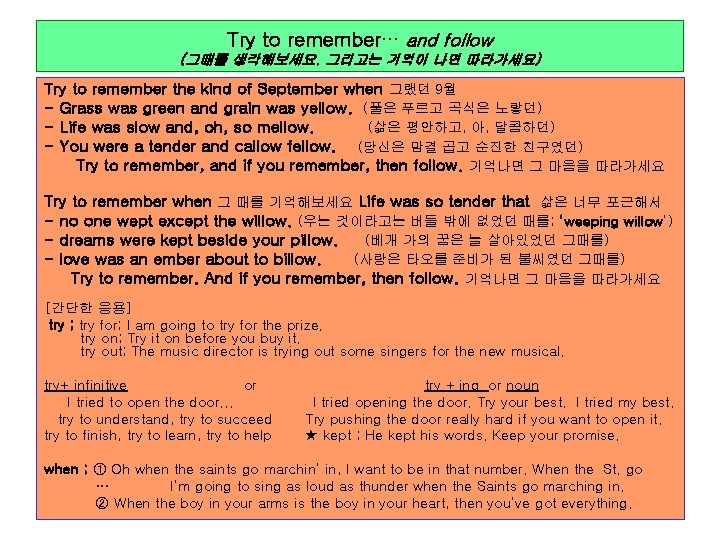
Try to remember… and follow (그때를 생각해보세요. 그리고는 기억이 나면 따라가세요) Try to remember the kind of September when 그랬던 9월 - Grass was green and grain was yellow. (풀은 푸르고 곡식은 노랗던) - Life was slow and, oh, so mellow. (삶은 평안하고, 아, 달콤하던) - You were a tender and callow fellow. (당신은 맘결 곱고 순진한 친구였던) Try to remember, and if you remember, then follow. 기억나면 그 마음을 따라가세요 Try to remember when 그 때를 기억해보세요 Life was so tender that 삶은 너무 포근해서 - no one wept except the willow. (우는 것이라고는 버들 밖에 없었던 때를; ‘weeping willow’) - dreams were kept beside your pillow. (베개 가의 꿈은 늘 살아있었던 그때를) - love was an ember about to billow. (사랑은 타오를 준비가 된 불씨였던 그때를) Try to remember. And if you remember, then follow. 기억나면 그 마음을 따라가세요 [간단한 응용] try ; try for; I am going to try for the prize. try on; Try it on before you buy it. try out; The music director is trying out some singers for the new musical. try+ infinitive or I tried to open the door. . . try to understand, try to succeed try to finish, try to learn, try to help try + ing or noun I tried opening the door. Try your best. I tried my best. Try pushing the door really hard if you want to open it. ★ kept ; He kept his words. Keep your promise. when ; ① Oh when the saints go marchin’ in, I want to be in that number. When the St. go … I’m going to sing as loud as thunder when the Saints go marching in. ② When the boy in your arms is the boy in your heart, then you’ve got everything.
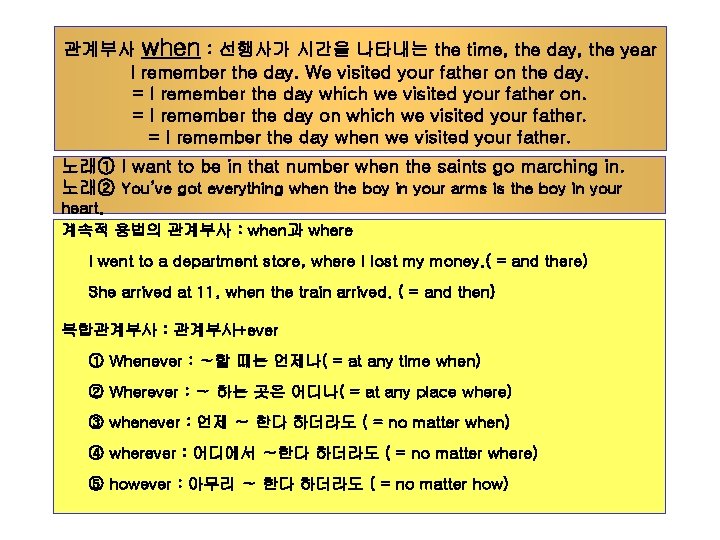
관계부사 when : 선행사가 시간을 나타내는 the time, the day, the year I remember the day. We visited your father on the day. = I remember the day which we visited your father on. = I remember the day on which we visited your father. = I remember the day when we visited your father. 노래① I want to be in that number when the saints go marching in. 노래② You’ve got everything when the boy in your arms is the boy in your heart. 계속적 용법의 관계부사 : when과 where I went to a department store, where I lost my money. ( = and there) She arrived at 11, when the train arrived. ( = and then) 복합관계부사 : 관계부사+ever ① Whenever : ∼할 때는 언제나( = at any time when) ② Wherever : ∼ 하는 곳은 어디나( = at any place where) ③ whenever : 언제 ∼ 한다 하더라도 ( = no matter when) ④ wherever : 어디에서 ∼한다 하더라도 ( = no matter where) ⑤ however : 아무리 ∼ 한다 하더라도 ( = no matter how)
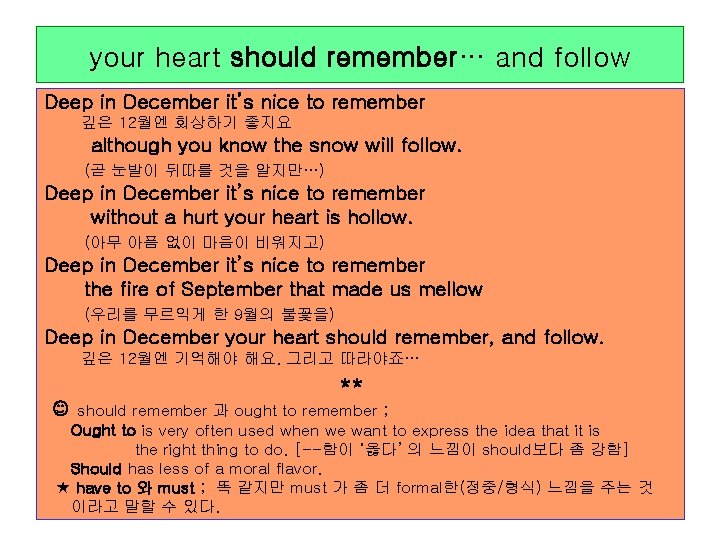
your heart should remember… and follow Deep in December it’s nice to remember 깊은 12월엔 회상하기 좋지요 although you know the snow will follow. (곧 눈발이 뒤따를 것을 알지만…) Deep in December it’s nice to remember without a hurt your heart is hollow. (아무 아픔 없이 마음이 비워지고) Deep in December it’s nice to remember the fire of September that made us mellow (우리를 무르익게 한 9월의 불꽃을) Deep in December your heart should remember, and follow. 깊은 12월엔 기억해야 해요. 그리고 따라야죠… ** ☺ should remember 과 ought to remember ; Ought to is very often used when we want to express the idea that it is the right thing to do. [--함이 ‘옳다’ 의 느낌이 should보다 좀 강함] Should has less of a moral flavor. ★ have to 와 must ; 똑 같지만 must 가 좀 더 formal한(정중/형식) 느낌을 주는 것 이라고 말할 수 있다.
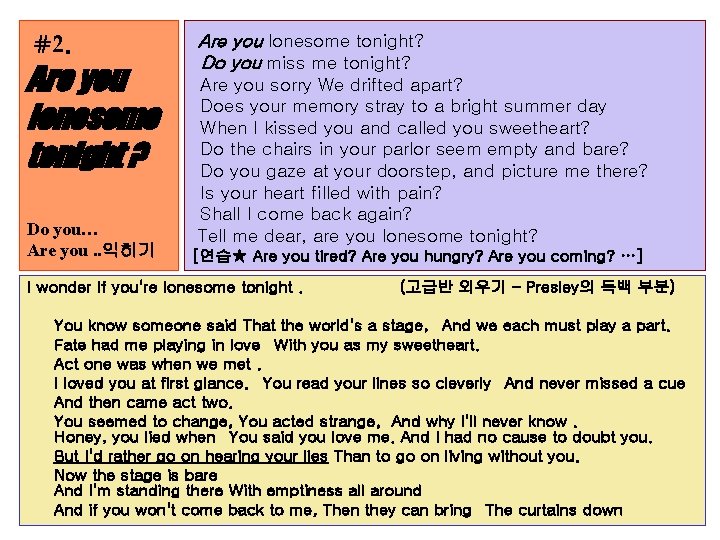
#2. Are you lonesome tonight ? Do you… Are you. . 익히기 Are you lonesome tonight? Do you miss me tonight? Are you sorry We drifted apart? Does your memory stray to a bright summer day When I kissed you and called you sweetheart? Do the chairs in your parlor seem empty and bare? Do you gaze at your doorstep, and picture me there? Is your heart filled with pain? Shall I come back again? Tell me dear, are you lonesome tonight? [연습★ Are you tired? Are you hungry? Are you coming? …] I wonder If you're lonesome tonight. (고급반 외우기 – Presley의 독백 부분) You know someone said That the world's a stage, And we each must play a part. Fate had me playing in love With you as my sweetheart. Act one was when we met. I loved you at first glance. You read your lines so cleverly And never missed a cue And then came act two. You seemed to change, You acted strange, And why I'll never know. Honey, you lied when You said you love me. And I had no cause to doubt you. But I'd rather go on hearing your lies Than to go on living without you. Now the stage is bare And I'm standing there With emptiness all around And if you won't come back to me, Then they can bring The curtains down
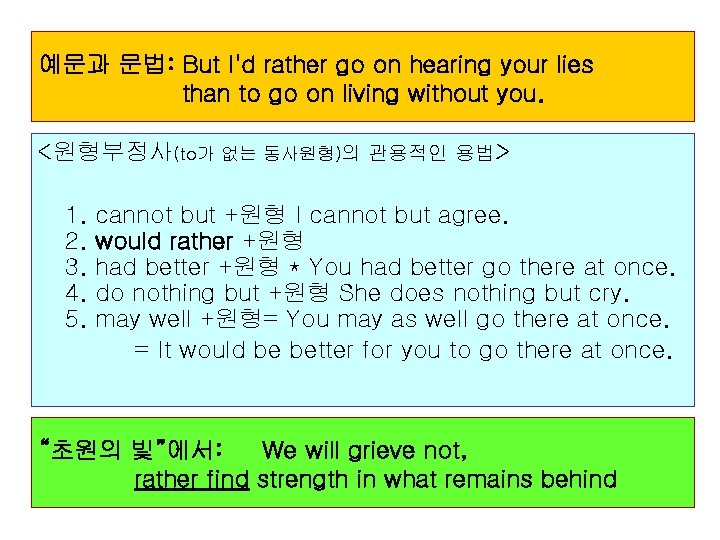
예문과 문법: But I'd rather go on hearing your lies than to go on living without you. <원형부정사(to가 없는 동사원형)의 관용적인 용법> 1. 2. 3. 4. 5. cannot but +원형 I cannot but agree. would rather +원형 had better +원형 * You had better go there at once. do nothing but +원형 She does nothing but cry. may well +원형= You may as well go there at once. = It would be better for you to go there at once. “초원의 빛”에서: We will grieve not, rather find strength in what remains behind
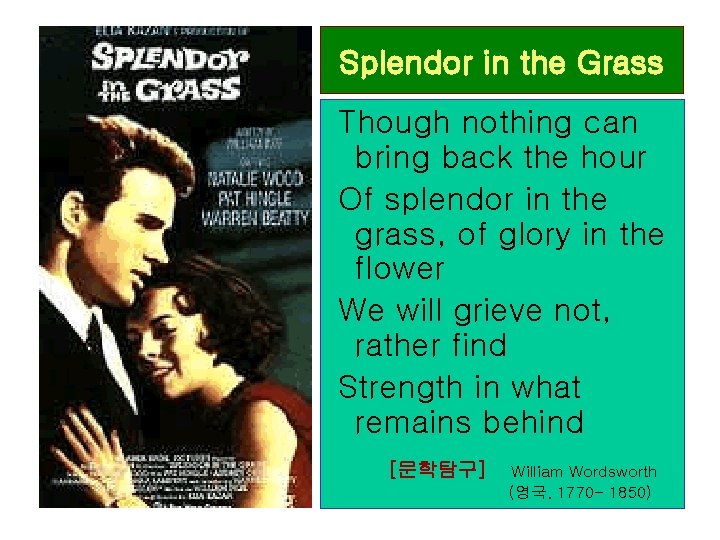
Splendor in the Grass Though nothing can bring back the hour Of splendor in the grass, of glory in the flower We will grieve not, rather find Strength in what remains behind [문학탐구] William Wordsworth (영국. 1770 - 1850)
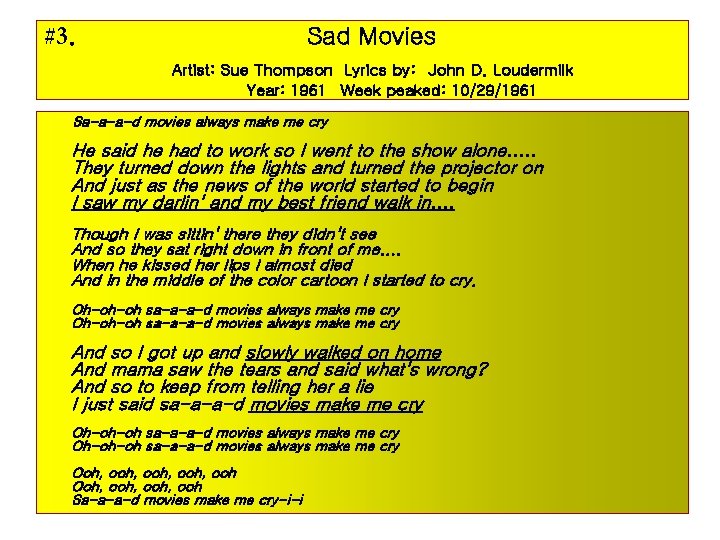
#3. Sad Movies Artist: Sue Thompson Lyrics by: John D. Loudermilk Year: 1961 Week peaked: 10/29/1961 Sa-a-a-d movies always make me cry He said he had to work so I went to the show alone. . . They turned down the lights and turned the projector on And just as the news of the world started to begin I saw my darlin' and my best friend walk in. . Though I was sittin' there they didn't see And so they sat right down in front of me. . When he kissed her lips I almost died And in the middle of the color cartoon I started to cry. Oh-oh-oh sa-a-a-d movies always make me cry And so I got up and slowly walked on home And mama saw the tears and said what's wrong? And so to keep from telling her a lie I just said sa-a-a-d movies make me cry Oh-oh-oh sa-a-a-d movies always make me cry Ooh, ooh, ooh Sa-a-a-d movies make me cry-i-i
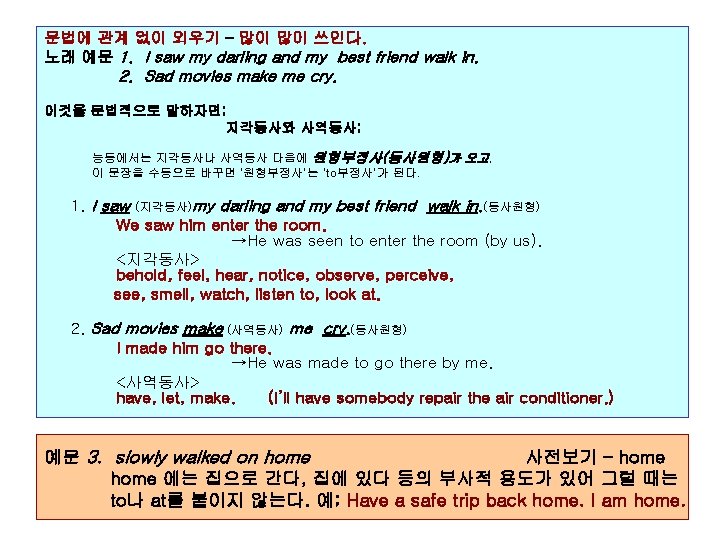
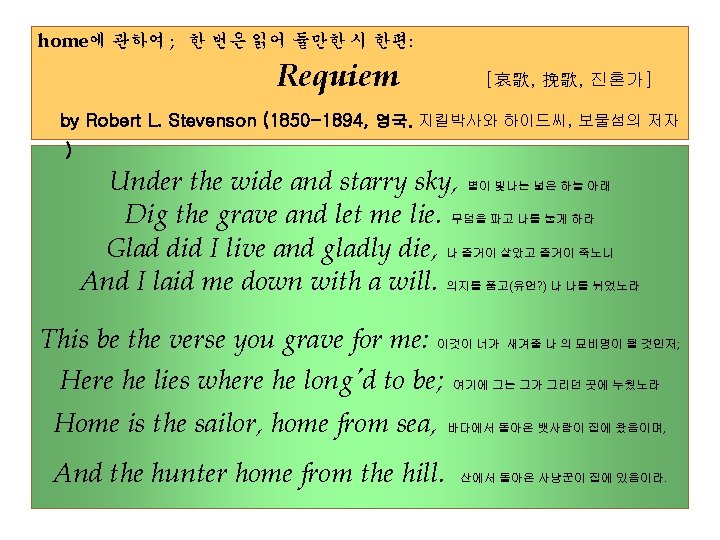
문법에 관계 없이 외우기 – 많이 많이 쓰인다. 노래 예문 1. I saw my darling and my best friend walk in. 2. Sad movies make me cry. 이것을 문법적으로 말하자면; 지각동사와 사역동사; 능동에서는 지각동사나 사역동사 다음에 원형부정사(동사원형)가 오고, 이 문장을 수동으로 바꾸면 '원형부정사'는 'to부정사'가 된다. 1. I saw (지각동사)my darling and my best friend walk in. (동사원형) We saw him enter the room. →He was seen to enter the room (by us). <지각동사> behold, feel, hear, notice, observe, perceive, see, smell, watch, listen to, look at. 2. Sad movies make (사역동사) me cry. (동사원형) I made him go there. →He was made to go there by me. <사역동사> have, let, make. (I’ll have somebody repair the air conditioner. ) 예문 3. slowly walked on home 사전보기 – home 에는 집으로 간다, 집에 있다 등의 부사적 용도가 있어 그럴 때는 to나 at를 붙이지 않는다. 예; Have a safe trip back home. I am home.
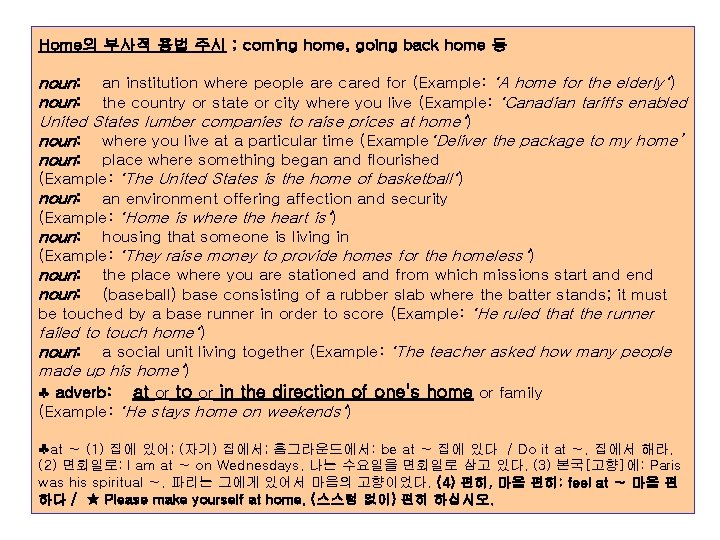
Home의 부사적 용법 주시 ; coming home, going back home 등 noun: an institution where people are cared for (Example: "A home for the elderly") noun: the country or state or city where you live (Example: "Canadian tariffs enabled United States lumber companies to raise prices at home") noun: where you live at a particular time (Example"Deliver the package to my home’ noun: place where something began and flourished (Example: "The United States is the home of basketball") noun: an environment offering affection and security (Example: "Home is where the heart is") noun: housing that someone is living in (Example: "They raise money to provide homes for the homeless") noun: the place where you are stationed and from which missions start and end noun: (baseball) base consisting of a rubber slab where the batter stands; it must be touched by a base runner in order to score (Example: "He ruled that the runner failed to touch home") noun: a social unit living together (Example: "The teacher asked how many people made up his home") ♣ adverb: at or to or in the direction of one's home or family (Example: "He stays home on weekends") ♣at ∼ (1) 집에 있어; (자기) 집에서; 홈그라운드에서: be at ∼ 집에 있다 / Do it at ∼. 집에서 해라. (2) 면회일로: I am at ∼ on Wednesdays. 나는 수요일을 면회일로 삼고 있다. (3) 본국[고향]에: Paris was his spiritual ∼. 파리는 그에게 있어서 마음의 고향이었다. (4) 편히, 마음 편히: feel at ∼ 마음 편 하다 / ★ Please make yourself at home. (스스럼 없이) 편히 하십시오.
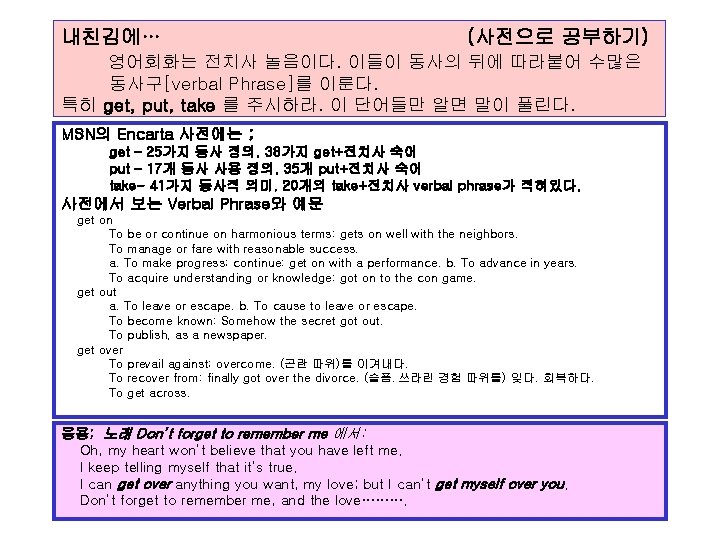
내친김에… (사전으로 공부하기) 영어회화는 전치사 놀음이다. 이들이 동사의 뒤에 따라붙어 수많은 동사구[verbal Phrase]를 이룬다. 특히 get, put, take 를 주시하라. 이 단어들만 알면 말이 풀린다. MSN의 Encarta 사전에는 ; get – 25가지 동사 정의. 38가지 get+전치사 숙어 put – 17개 동사 사용 정의. 35개 put+전치사 숙어 take- 41가지 동사적 의미. 20개의 take+전치사 verbal phrase가 적혀있다. 사전에서 보는 Verbal Phrase와 예문 get on To be or continue on harmonious terms: gets on well with the neighbors. To manage or fare with reasonable success. a. To make progress; continue: get on with a performance. b. To advance in years. To acquire understanding or knowledge: got on to the con game. get out a. To leave or escape. b. To cause to leave or escape. To become known: Somehow the secret got out. To publish, as a newspaper. get over To prevail against; overcome. (곤란 따위)를 이겨내다. To recover from: finally got over the divorce. (슬픔․쓰라린 경험 따위를) 잊다. 회복하다. To get across. 응용; 노래 Don’t forget to remember me 에서; Oh, my heart won’t believe that you have left me. I keep telling myself that it’s true. I can get over anything you want, my love; but I can’t get myself over you. Don’t forget to remember me, and the love……….
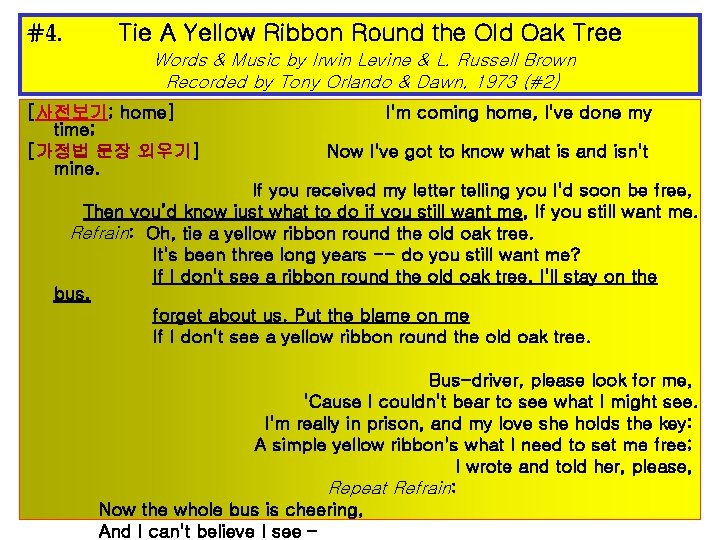
#4. Tie A Yellow Ribbon Round the Old Oak Tree Words & Music by Irwin Levine & L. Russell Brown Recorded by Tony Orlando & Dawn, 1973 (#2) [사전보기; home] time; [가정법 문장 외우기] mine. I'm coming home, I've done my Now I've got to know what is and isn't If you received my letter telling you I'd soon be free, Then you’d know just what to do if you still want me, If you still want me. Refrain: Oh, tie a yellow ribbon round the old oak tree. It's been three long years -- do you still want me? If I don't see a ribbon round the old oak tree, I'll stay on the bus, forget about us, Put the blame on me If I don't see a yellow ribbon round the old oak tree. Bus-driver, please look for me, 'Cause I couldn't bear to see what I might see. I'm really in prison, and my love she holds the key: A simple yellow ribbon's what I need to set me free; I wrote and told her, please, Repeat Refrain: Now the whole bus is cheering, And I can't believe I see –
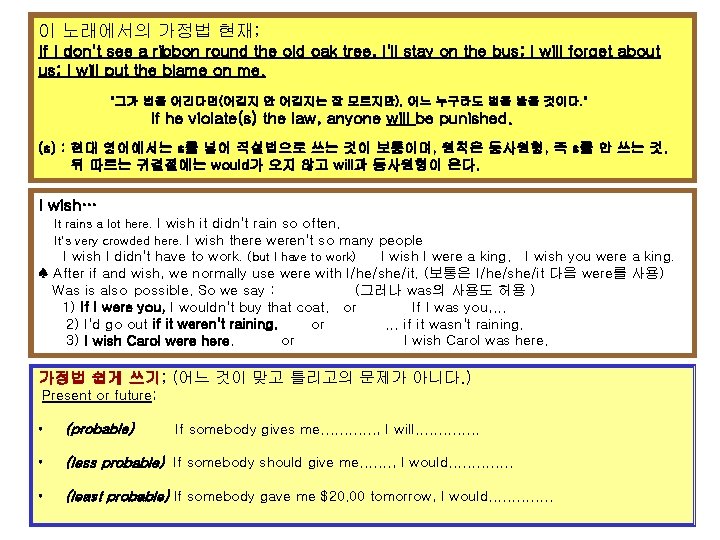
이 노래에서의 가정법 현재; If I don't see a ribbon round the old oak tree, I'll stay on the bus; I will forget about us; I will put the blame on me. "그가 법을 어긴다면(어길지 안 어길지는 잘 모르지만), 어느 누구라도 벌을 받을 것이다. " If he violate(s) the law, anyone will be punished. (s) : 현대 영어에서는 s를 넣어 직설법으로 쓰는 것이 보통이며, 원칙은 동사원형, 즉 s를 안 쓰는 것. 뒤 따르는 귀결절에는 would가 오지 않고 will과 동사원형이 온다. I wish… It rains a lot here. I wish it didn't rain so often. It's very crowded here. I wish there weren't so many people I wish I didn't have to work. (but I have to work) I wish I were a king. I wish you were a king. ♠ After if and wish, we normally use were with I/he/she/it. (보통은 I/he/she/it 다음 were를 사용) Was is also possible. So we say : (그러나 was의 사용도 허용 ) 1) If I were you, I wouldn't buy that coat. or If I was you, . . . 2) I'd go out if it weren't raining. or . . . if it wasn't raining. 3) I wish Carol were here. or I wish Carol was here. 가정법 쉽게 쓰기; (어느 것이 맞고 틀리고의 문제가 아니다. ) Present or future; • (probable) • (less probable) If somebody should give me. . . . , I would. . . • (least probable) If somebody gave me $20. 00 tomorrow, I would. . . If somebody gives me. . . , I will. . .
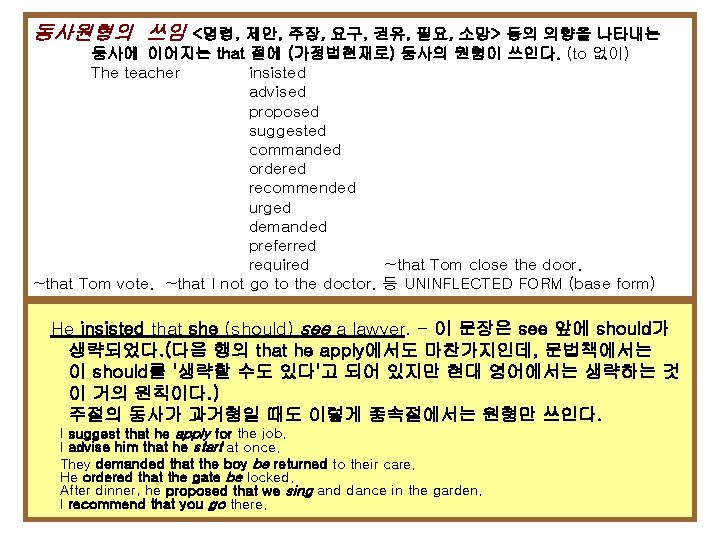
동사원형의 쓰임 <명령, 제안, 주장, 요구, 권유, 필요, 소망> 등의 의향을 나타내는 동사에 이어지는 that 절에 (가정법현재로) 동사의 원형이 쓰인다. (to 없이) The teacher insisted advised proposed suggested commanded ordered recommended urged demanded preferred required ~that Tom close the door. ~that Tom vote. ~that I not go to the doctor. 등 UNINFLECTED FORM (base form) He insisted that she (should) see a lawyer. - 이 문장은 see 앞에 should가 생략되었다. (다음 행의 that he apply에서도 마찬가지인데, 문법책에서는 이 should를 '생략할 수도 있다'고 되어 있지만 현대 영어에서는 생략하는 것 이 거의 원칙이다. ) 주절의 동사가 과거형일 때도 이렇게 종속절에서는 원형만 쓰인다. I suggest that he apply for the job. I advise him that he start at once. They demanded that the boy be returned to their care. He ordered that the gate be locked. After dinner, he proposed that we sing and dance in the garden. I recommend that you go there.
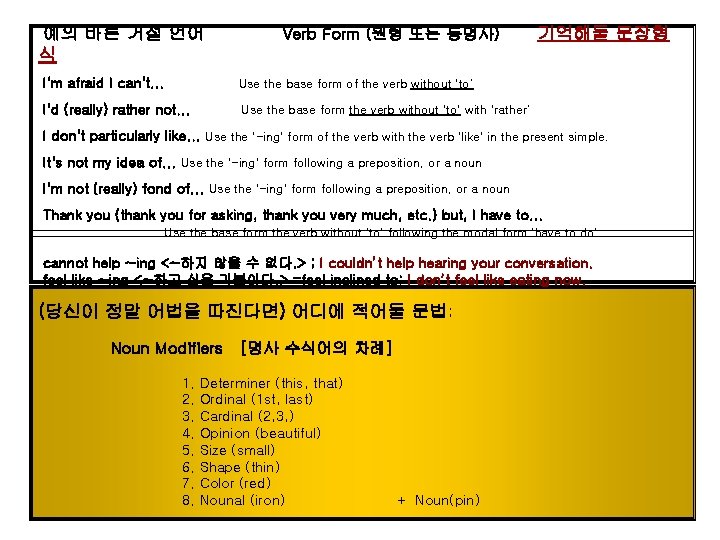
예의 바른 거절 언어 식 Verb Form (원형 또는 동명사) I'm afraid I can't. . . Use the base form of the verb without 'to‘ I'd (really) rather not. . . Use the base form the verb without 'to' with 'rather‘ 기억해둘 문장형 I don't particularly like. . . Use the '-ing' form of the verb with the verb 'like' in the present simple. It's not my idea of. . . Use the '-ing' form following a preposition, or a noun I'm not (really) fond of. . . Use the '-ing' form following a preposition, or a noun Thank you (thank you for asking, thank you very much, etc. ) but, I have to. . . Use the base form the verb without 'to' following the modal form 'have to do‘ cannot help ~ing <~하지 않을 수 없다. > ; I couldn’t help hearing your conversation. feel like ~ing <~하고 싶은 기분이다. > =feel inclined to; I don’t feel like eating now. (당신이 정말 어법을 따진다면) 어디에 적어둘 문법; Noun Modifiers [명사 수식어의 차례] 1. 2. 3. 4. 5. 6. 7. 8. Determiner (this, that) Ordinal (1 st, last) Cardinal (2, 3, ) Opinion (beautiful) Size (small) Shape (thin) Color (red) Nounal (iron) + Noun(pin)
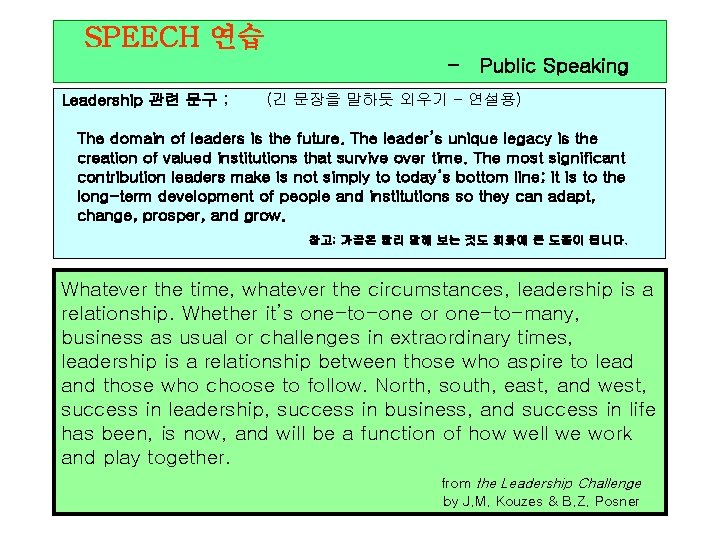
SPEECH 연습 - Public Speaking Leadership 관련 문구 ; (긴 문장을 말하듯 외우기 - 연설용) The domain of leaders is the future. The leader’s unique legacy is the creation of valued institutions that survive over time. The most significant contribution leaders make is not simply to today’s bottom line; it is to the long-term development of people and institutions so they can adapt, change, prosper, and grow. 참고; 가끔은 빨리 말해 보는 것도 회화에 큰 도움이 됩니다. Whatever the time, whatever the circumstances, leadership is a relationship. Whether it’s one-to-one or one-to-many, business as usual or challenges in extraordinary times, leadership is a relationship between those who aspire to lead and those who choose to follow. North, south, east, and west, success in leadership, success in business, and success in life has been, is now, and will be a function of how well we work and play together. from the Leadership Challenge by J. M. Kouzes & B. Z. Posner
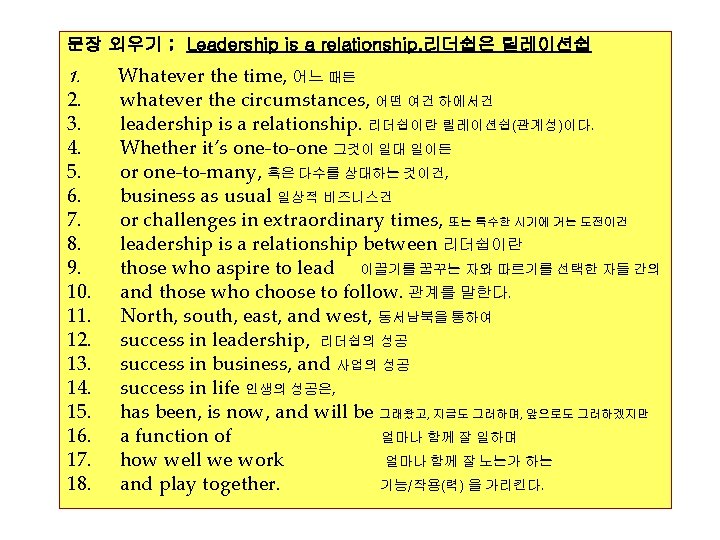
문장 외우기 ; Leadership is a relationship. 리더쉽은 릴레이션쉽 1. 2. 3. 4. 5. 6. 7. 8. 9. 10. 11. 12. 13. 14. 15. 16. 17. 18. Whatever the time, 어느 때든 whatever the circumstances, 어떤 여건 하에서건 leadership is a relationship. 리더쉽이란 릴레이션쉽(관계성)이다. Whether it’s one-to-one 그것이 일대 일이든 or one-to-many, 혹은 다수를 상대하는 것이건, business as usual 일상적 비즈니스건 or challenges in extraordinary times, 또는 특수한 시기에 거는 도전이건 leadership is a relationship between 리더쉽이란 those who aspire to lead 이끌기를 꿈꾸는 자와 따르기를 선택한 자들 간의 and those who choose to follow. 관계를 말한다. North, south, east, and west, 동서남북을 통하여 success in leadership, 리더쉽의 성공 success in business, and 사업의 성공 success in life 인생의 성공은, has been, is now, and will be 그래왔고, 지금도 그러하며, 앞으로도 그러하겠지만 a function of 얼마나 함께 잘 일하며 how well we work 얼마나 함께 잘 노는가 하는 and play together. 기능/작용(력) 을 가리킨다.
LEADERSHIP = vision, conviction, courage and perseverance 사람 1 ; Heir of the kingdom ‘neath the sky Often he falls, yet falls to rise Stunned, bleeding, beaten back Holding still to the upward track Playing his part in Creation’s Plan; God-like in image - this is man. - anonymous
Martin Luther King, Jr. 의 꿈; 절망의 계곡에서 허우적거리지 말자… I have a Dream Let us not wallow in the valley of despair. I say to you today, my friends, that in spite of the difficulties and frustrations of the moment, I still have a dream. It is a dream deeply rooted in the American dream. I have a dream that one day this nation will rise up and live out the true meaning of its creed: "We hold these truths to be self-evident: that all men are created equal. " I have a dream that one day on the red hills of Georgia the sons of former slaves and the sons of former slaveowners will be able to sit down together at a table of brotherhood. I have a dream that one day even the state of Mississippi, a desert state, sweltering with the heat of injustice and oppression, will be transformed into an oasis of freedom and justice. I have a dream that my four children will one day live in a nation where they will not be judged by the color of their skin but by the content of their character. I have a dream today. I have a dream that one day the state of Alabama, whose governor's lips are presently dripping with the words of interposition and nullification, will be transformed into a situation where little black boys and black girls will be able to join hands with little white boys and white girls and walk together as sisters and brothers. I have a dream today. I have a dream that one day every valley shall be exalted, every hill and mountain shall be made low, the rough places will be made plain, and the crooked places will be made straight, and the glory of the Lord shall be revealed, and all flesh shall see it together. This is our hope. This is the faith which I return to the South. With this faith we will be able to hew out of the mountain of despair a stone of hope. With this faith we will be able to transform the jangling discords of our nation into a beautiful symphony of brotherhood. With this faith we will be able to work together, to pray together, to struggle together, to go to jail together, to stand up for freedom together, knowing that we will be free one day. This will be the day when all of God's children will be able to sing with a new meaning, "My country, 'tis of thee, sweet land of liberty, of thee I sing. Land where my fathers died, land of the pilgrim's pride, from every mountainside, let freedom ring. " And if America is to be a great nation, this must become true. So let freedom ring from the prodigious hilltops of New Hampshire. Let freedom ring from the mighty mountains of New York. Let freedom ring from the heightening Alleghenies of Pennsylvania! Let freedom ring from the snowcapped Rockies of Colorado! Let freedom ring from the curvaceous peaks of California! But not only that; let freedom ring from Stone Mountain of Georgia! Let freedom ring from Lookout Mountain of Tennessee! Let freedom ring from every hill and every molehill of Mississippi. From every mountainside, let freedom ring.
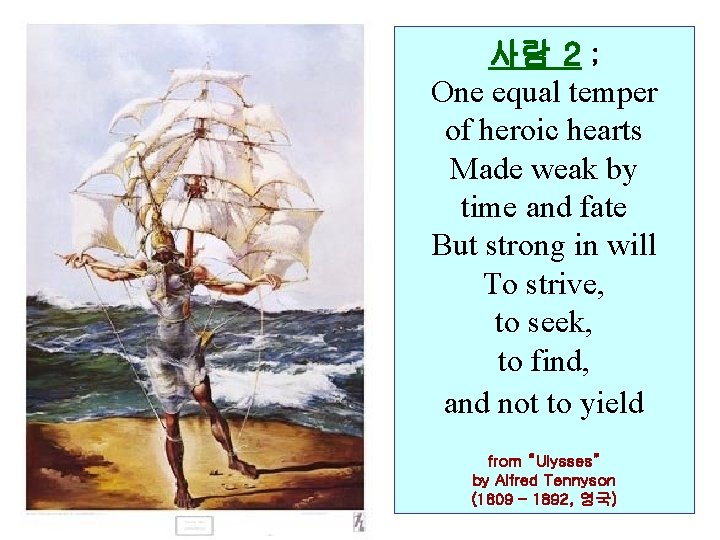
사람 2 ; One equal temper of heroic hearts Made weak by time and fate But strong in will To strive, to seek, to find, and not to yield from “Ulysses” by Alfred Tennyson (1809 – 1892, 영국)
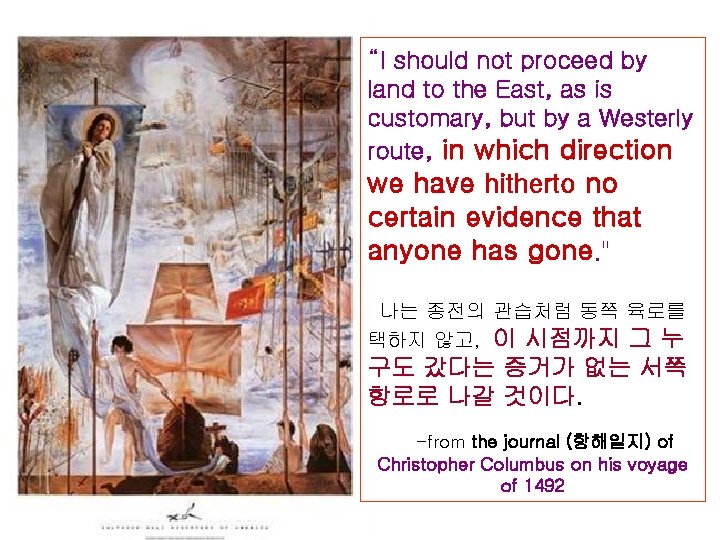
“I should not proceed by land to the East, as is customary, but by a Westerly route, in which direction we have hitherto no certain evidence that anyone has gone. " 나는 종전의 관습처럼 동쪽 육로를 택하지 않고, 이 시점까지 그 누 구도 갔다는 증거가 없는 서쪽 항로로 나갈 것이다. -from the journal (항해일지) of Christopher Columbus on his voyage of 1492
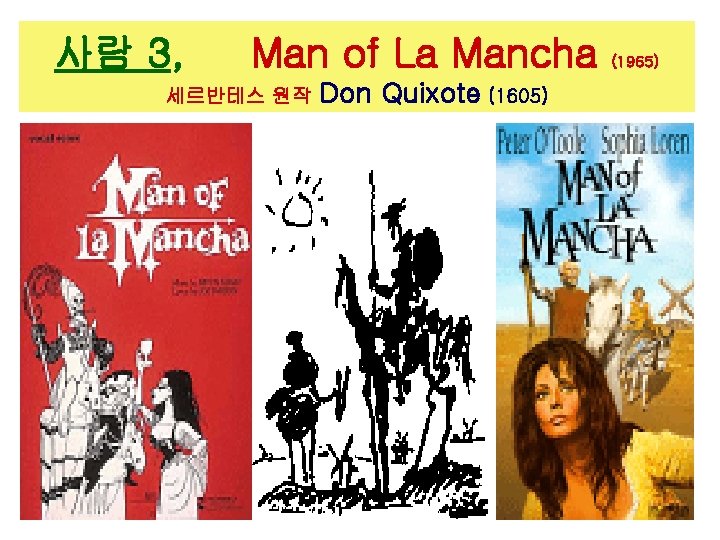
사람 3, Man of La Mancha 세르반테스 원작 Don Quixote (1605) (1965)
"The Impossible Dream" Music by: Mitch Leigh. Written by: Joe Darion To Dream the Impossible Dream To Fight the Unbeatable Foe To Bear with Unbearable Sorrow To Run where the Braves dare not go… To Reach the Unreachable Star This is my Quest To follow that star No matter how hopeless
If you can dream it, you can do it. ★ Sunhi Synn
- Slides: 40