THE PLAGUE Common Core Standards for Literacy in








- Slides: 31
THE PLAGUE
§ Common Core Standards for Literacy in Social Studies, Science, and Technical Subjects; § # 2 - Determine the central ideas or conclusions of a text; summarize complex concepts, processes or information presented in a text by paraphrasing them in simpler but still accurate terms. § #9 – Synthesize information from a range of sources into a coherent understanding of a process, phenomenon or concept, resolving conflicting information when possible. § Living Environment Standards - #4 § Key Idea; Living things are both similar to and different from each other and non-living things § Key Idea; Organisms maintain a dynamic equilibrium that sustains life
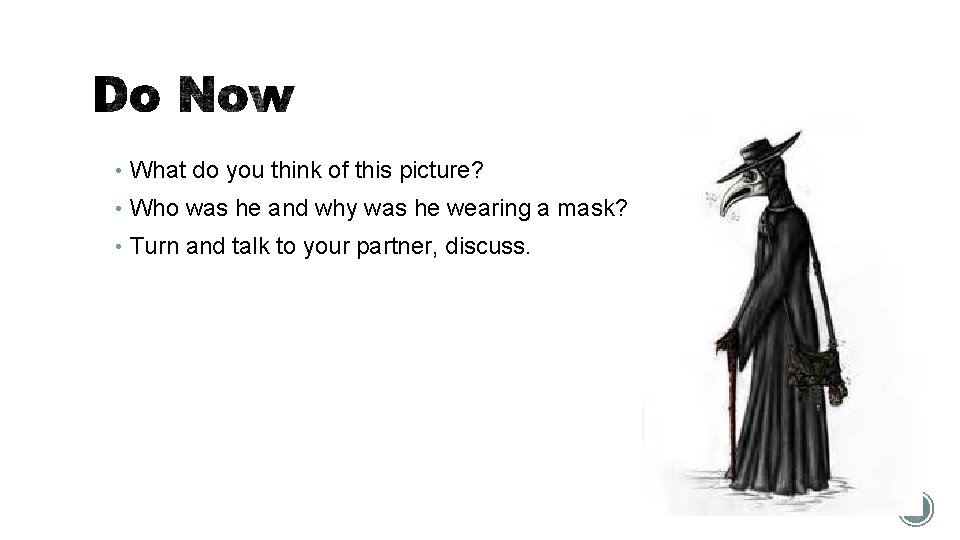
• What do you think of this picture? • Who was he and why was he wearing a mask? • Turn and talk to your partner, discuss.
§ A plague doctor was a medical physician who treated those who had the plague. § They were specifically hired by towns that had many plague victims in times of epidemics. § Since the city was paying their salary, they treated everyone: both the rich and the poor. § However, some plague doctors were known for charging patients and their families extra for special treatments and/or false cures. § They were not normally professionally trained experienced physicians or surgeons, and often were second-rate doctors unable to otherwise run a successful medical business or young physicians trying to establish themselves. • Aim – What was a Plague doctor?
§ Plague doctors by their covenant treated plague patients and were known as municipal or "community plague doctors", whereas "general practitioners" were separate doctors and both might be in the same European city or town at the same time. § In France and the Netherlands plague doctors often lacked medical training and were referred to as "empirics". § In one case a plague doctor had been a fruit salesman before his employment as a physician. • Aim – What was a Plague doctor?
§ In the seventeenth and eighteenth centuries, some doctors wore a beak -like mask which was filled with aromatic items. § The masks were designed to protect them from putrid air, which (according to the miasmatic theory of disease) was seen as the cause of infection. § The design of these costumes has been attributed to Charles de Lorme, the chief physician to Louis XIII. • Aim – What was a Plague doctor?
§ Poultices of onion and butter, sprinklings of dried frog, arsenic, floral compounds and even a generous bloodletting or two were no match for this killing machine. § The closer the patient was to dying, the more desperate the cures became. § Accounts exist of coating sufferers in mercury and baking them for a while in the oven!
§ Bloodletting was popular all over Europe during this time, and it was used to cure everything from gout to goiter. § If you were lucky, you could afford to have leeches do all the hard work for you. § Leeches were actually a fairly painless method of blood-letting. But most people could not afford them, and had to go with the age-old method of cutting the skin open. § A blade would be pushed into a vein, and blood would be drained into a bowl. Without painkillers this procedure would have been agony—and with sanitation levels leaving much to be desired, gruesome infections were common.
Cold calling – what was a Plague doctor? Name one method they used to try and cure patients.
THE PLAGUE
§ Common Core Standards for Literacy in Social Studies, Science, and Technical Subjects; § # 2 - Determine the central ideas or conclusions of a text; summarize complex concepts, processes or information presented in a text by paraphrasing them in simpler but still accurate terms. § #9 – Synthesize information from a range of sources into a coherent understanding of a process, phenomenon or concept, resolving conflicting information when possible. § Living Environment Standards - #4 § Key Idea; Living things are both similar to and different from each other and non-living things § Key Idea; Organisms maintain a dynamic equilibrium that sustains life
§ Handout – What would you do? . § In groups of 4 you must come up with ONE answer, and tell me why you came together as a group to choose that answer. § Aim – What are the 2 types of the Plague.
§ Plague is an acute, severe infectious disease caused by the bacterium Yersinia pestis. § The bacterium is found in fleas and wild rodents such as rats, squirrels, chipmunks or prairie dogs. § Plague is a zoonotic disease, which means it can be transmitted to humans through animals, most often through the bites of fleas or through direct contact with infected animal tissue. § Aim – What are the 2 types of the Plague .
§ There are 2 main manifestations of Plague; § 1. Bubonic Plague § 2. Pneumonic Plague § The disease is most common in parts of Africa and Asia but it also occurs in some areas of the western United States. § Symptoms can include an abrupt onset of chills, fever, and enlarged, painful lymph nodes (buboes). § Aim – What are the 2 types of the Plague.
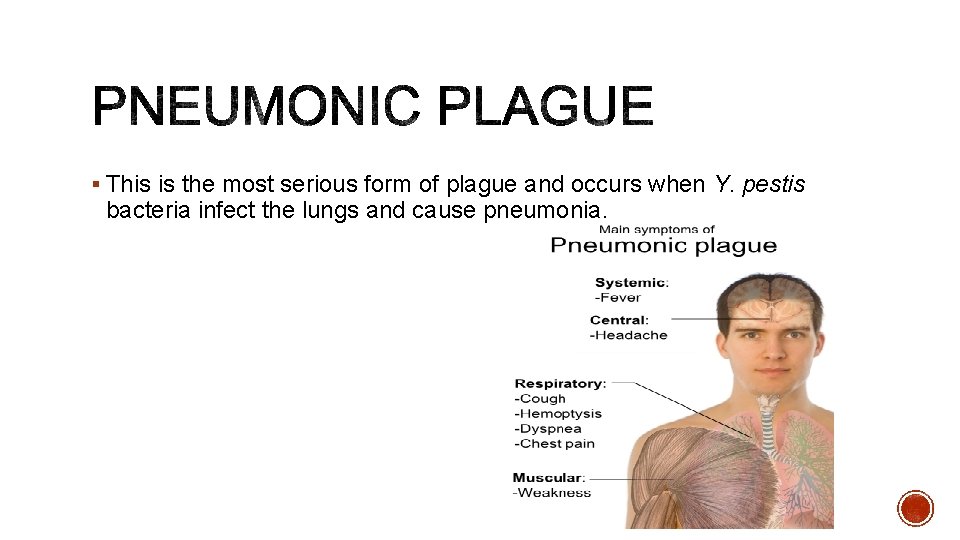
§ This is the most serious form of plague and occurs when Y. pestis bacteria infect the lungs and cause pneumonia.
§ How do you get it? You get primary pneumonic plague when you inhale plague bacteria from an infected person or animal. § You usually have to be in direct or close contact with § ill person or animal. § You get secondary pneumonic plague if you have untreated bubonic or septicemic plague that spreads to your lungs. § Aim – What are the 2 types of the Plague.
§ What are the symptoms? Symptoms usually develop within one to three days after being exposed to airborne droplets containing plague bacteria. § Pneumonia begins quickly, § with shortness of breath, § chest pain, § cough, and sometimes bloody or watery sputum. § Other symptoms include fever, headache, and weakness. § Aim – What are the 2 types of the Plague.
§ Bubonic plague is a potentially fatal bacterial infection called "Yersina pestis. " Symptoms of infection include: § In bubonic plague, the most common form, bacteria infect the lymph system and causes it to become inflamed. § (The lymph or lymphatic system is a major component of your body's immune system. The organs within the lymphatic system are the tonsils, adenoids, spleen, and thymus. ) § Aim – What are the 2 types of the Plague.
§ How do you get it? Usually, you get bubonic plague from the bite of an infected flea or rodent. § In some cases, Y. pestis bacteria can enter the body (through an opening in the skin) from a piece of contaminated material used by a person with plague. § Aim – What are the 2 types of the Plague.
§ What are the symptoms? § Bubonic plague affects the lymph nodes (another part of the lymph system). § Within three to seven days of exposure to plague bacteria, you will develop flu -like symptoms such as § fever, § headache, § chills, § weakness, and swollen, tender lymph glands (called buboes—hence the name bubonic). § Aim – What are the 2 types of the Plague.
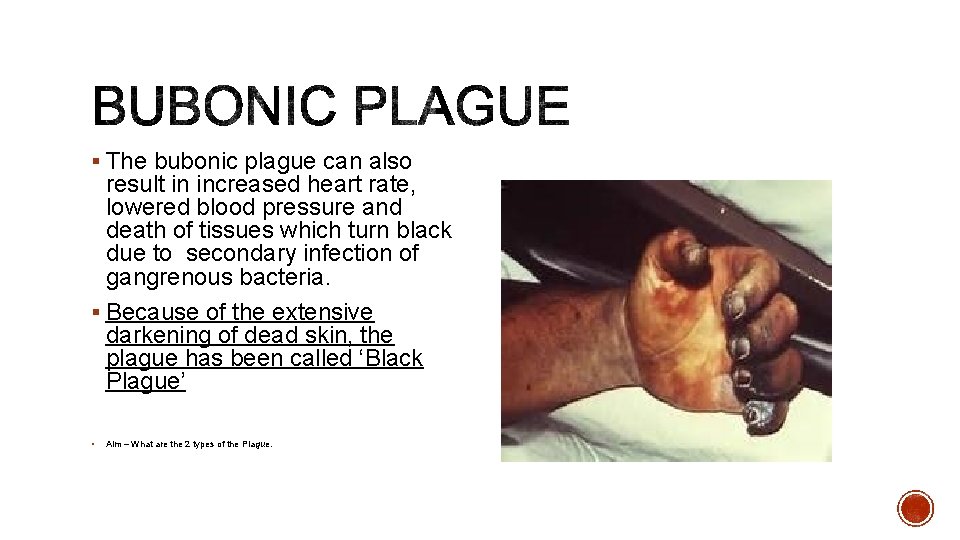
§ The bubonic plague can also result in increased heart rate, lowered blood pressure and death of tissues which turn black due to secondary infection of gangrenous bacteria. § Because of the extensive darkening of dead skin, the plague has been called ‘Black Plague’ § Aim – What are the 2 types of the Plague.
§ Because the plague is deadly, it often progresses rapidly and can spread among people, it is a potential bioterrorism disease. § Diagnosis and treatment must be rapid. § The characteristic symptoms especially in patients who have travelled in areas where plague is endemic are usually sufficient for diagnosis § Aim – What are the 2 types of the Plague.
§ No one knew exactly how the Black Death was transmitted from one patient to another –according to one doctor, for example, “instantaneous death occurs when the aerial spirit escaping from the eyes of the sick man strikes the healthy person standing near and looking at the sick”–and no one knew how to prevent or treat it. Physicians relied on crude and unsophisticated techniques such as bloodletting and boil-lancing (practices that were dangerous as well as unsanitary) and superstitious practices such as burning aromatic herbs and bathing in rosewater or vinegar. § Look up the black death/plague and tell me one thing doctors used to do to try and ‘cure’ people
MICROBIAL CARDIOVASCULAR AND SYSTEMIC DISEASES THE PLAGUE
Common core and Standards ■ Common Core Standards for Literacy in Social Studies, Science, and Technical Subjects; – # 2 - Determine the central ideas or conclusions of a text; summarize complex concepts, processes or information presented in a text by paraphrasing them in simpler but still accurate terms. – #9 – Synthesize information from a range of sources into a coherent understanding of a process, phenomenon or concept, resolving conflicting information when possible. ■ Living Environment Standards - #4 – Key Idea; Living things are both similar to and different from each other and non-living things – Key Idea; Organisms maintain a dynamic equilibrium that sustains life
Do now ■ Have students come up and read out what they have researched on bloodletting and boil-lancing
Bubonic Plague ■ Bubonic plague is not usually spread from person to person. Small rodents, such as rats, mice and squirrels, carry the infection. ■ Fleas that live on these animals act as "vectors" and carry the infection from the rodent to humans. ■ People may get exposed to the bacteria from flea bites or from direct contact with an infected animal. During the "Black Death, " many people became sick with pneumonia from Yersinia pestis (called "pneumonic plague") and spread the disease bacteria to each other by coughing and sneezing.
Treatment ■ Treatment of bubonic plague should begin as soon as the disease is diagnosed. ■ Antibiotics are given and symptoms are treated. ■ There is also a vaccination available for people working in or traveling to plague-affected areas of the world.
Prevention ■ The "Black Death" of the Middle Ages was due to large numbers of flea-ridden rats infesting homes and workplaces. ■ In most developed countries, cities and towns have successfully controlled their rat populations, but rural and urban areas of developing countries often have problems with rat infestation, and thus are at risk of bubonic plague epidemics. ■ Therefore, reducing the risk of plague outbreaks in these areas would require: – Controlling the rat population – Watching for plague cases in both rats and humans in the area – Using insecticide to reduce the number of fleas – Treating pets for fleas
Does it still occur in the world? ■ According to the World Health Organization, there are 1, 000 to 3, 000 cases of bubonic plague worldwide each year. ■ There are no known cases in Australia or Europe. ■ Areas where cases occur are in Russia, the Middle East, China, Southwest and Southeast Asia, Madagascar, southern and eastern Africa, the Andes mountains and Brazil. ■ The U. S Centers for Disease Control and Prevention (CDC) reports that there are 10 to 15 cases of bubonic plague in the United States each year. ■ These cases tend to occur in two regions: northern New Mexico, northern Arizona and southern Colorado; California, southern Oregon and far western Nevada.
Formative Assessment ■ 321 Checklist