
The Black Death EXPLAIN THIS Plague Vocabulary from
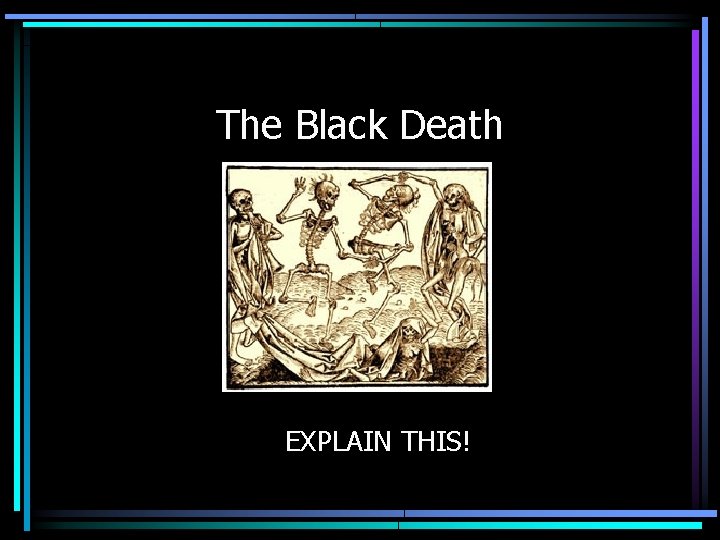
The Black Death EXPLAIN THIS!

Plague Vocabulary (from video) • Black Death, also called Bubonic Plague, The Pestilence, or The Plague • Pandemic • Yersinia Pestis • Mongols, Genovese • Buboes and acral necrosis • Boccaccio • Flagellant • Amelioration of the peasants
YOUTUBE: The Black Death History Teachers use Gwen Stefani’s Hollaback Girl to explain this pandemic: Oo-oo Fleas on Rats! A longer documentary: History’s Turning Points: AD 1347 The Black Death
What was the Black Death? Synonyms (for research purposes) • The Plague • The Bubonic Plague • The Pestilence ______________ Reading from Source 1: Bishop, Morris. The Horizon Book of the Middle Ages. Toronto: Mc. Clelland Stewart, 1968.
BIG Questions: How have people explained this pandemic? How did it spread so fast and so far, so quickly?
YOUR QUESTIONS: • How did people of the Medieval Times explain it? What were some of the medieval accounts? • How do Scientists explain it? • How does Social Studies (that is, Geographers and Historians) explain it? • How can Mathematicians help us to understand it?
What was the Black Death? • October 1347 • 12 Italian ships returned to Messina from Russian Crimea • Sailors were dying on board • Townspeople ordered ships to leave • Residents fled, spreading Plague • Spread through Sicily to Italy & France Source 1
What was the Black Death? • Bacilli in fleas’ stomachs blocks normal feeding • Tries to feed on black rats • Infects rat with bacilli • Also feeds on humans Source 1, continued
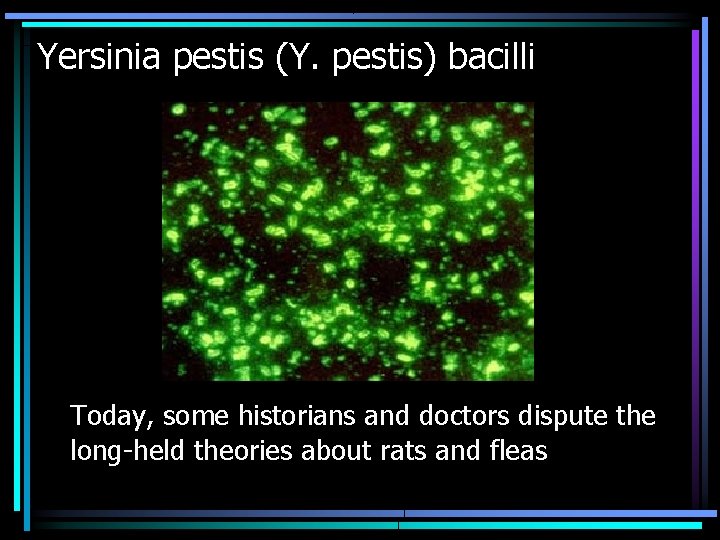
Yersinia pestis (Y. pestis) bacilli Today, some historians and doctors dispute the long-held theories about rats and fleas
What is the Black Death? • Plague bacilli in human bloodstream settle in lymph glands • Result in hemorrhages in blood vessel walls • Dark patches on the skin • Tongue turns black • Swellings (buboes) under arms, in groin • Death usually in 3 days Source 1, continued
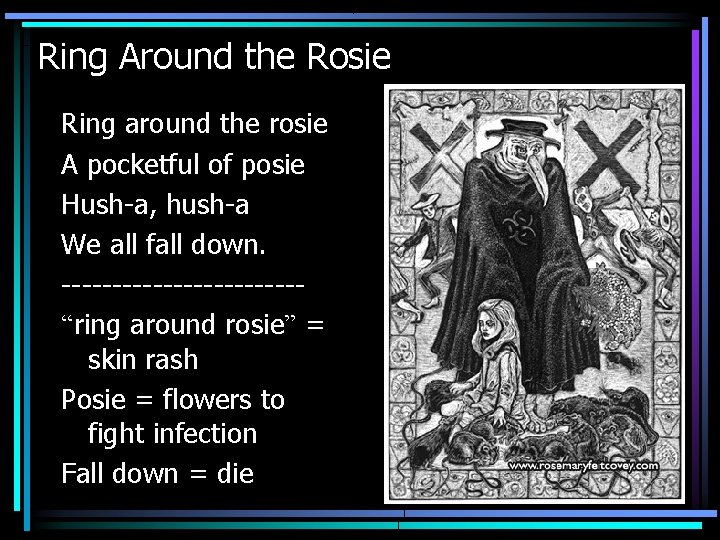
Ring Around the Rosie Ring around the rosie A pocketful of posie Hush-a, hush-a We all fall down. ------------“ring around rosie” = skin rash Posie = flowers to fight infection Fall down = die
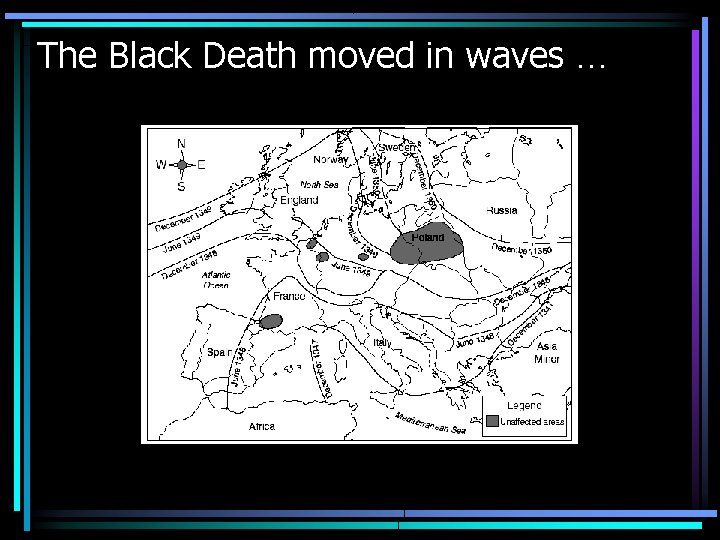
The Black Death moved in waves …
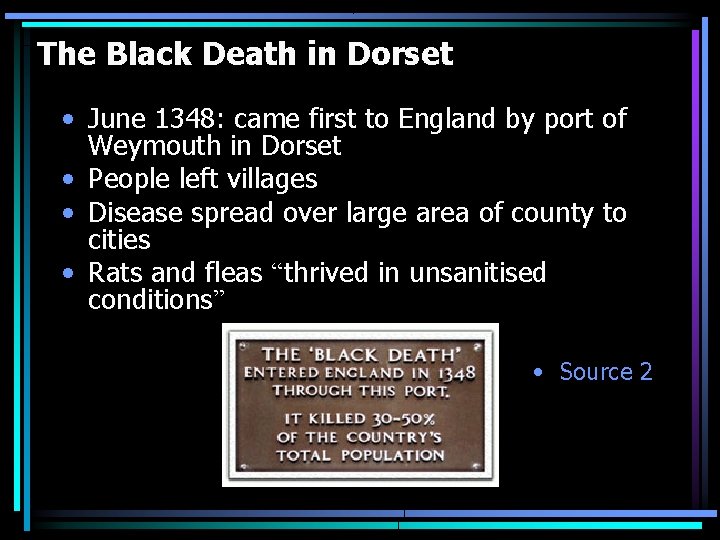
The Black Death in Dorset • June 1348: came first to England by port of Weymouth in Dorset • People left villages • Disease spread over large area of county to cities • Rats and fleas “thrived in unsanitised conditions” • Source 2
What is the Black Death? • Dirty towns with rats got the worst of it • Doctors and priests couldn’t do anything • Animals got sick too • Society changed as people left their friends, family, work, homes Source 1, continued
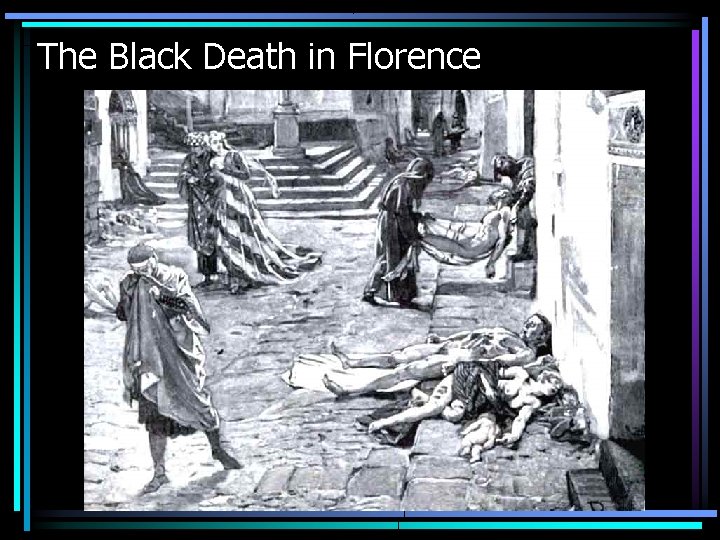
The Black Death in Florence
Life in the Towns • Crowded with people and houses • Animals roamed streets and lived with families in winter • Streets had no room, poor lighting, and sewage running down them • Animal manure and garbage were common sights – smelly • Flies, rodents, etc. • Source 3
Epidemic: The Black Death • People blamed many things: • Foul air • A look from someone who was sick • God’s anger • Lungs infected – bacteria spread with sneezing • Finally, millions died of the Black Death • Source 3: Peters
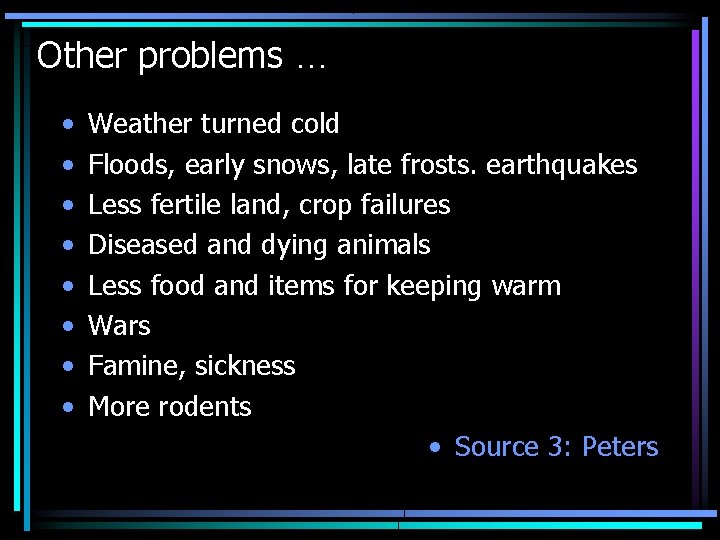
Other problems … • • Weather turned cold Floods, early snows, late frosts. earthquakes Less fertile land, crop failures Diseased and dying animals Less food and items for keeping warm Wars Famine, sickness More rodents • Source 3: Peters
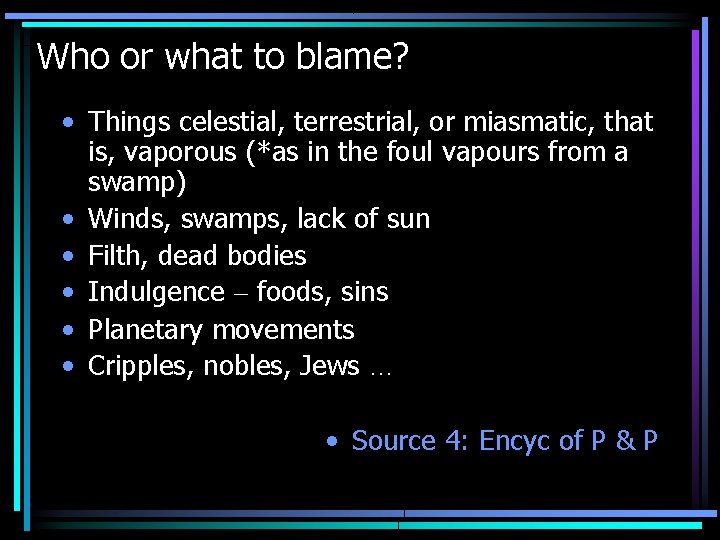
Who or what to blame? • Things celestial, terrestrial, or miasmatic, that is, vaporous (*as in the foul vapours from a swamp) • Winds, swamps, lack of sun • Filth, dead bodies • Indulgence – foods, sins • Planetary movements • Cripples, nobles, Jews … • Source 4: Encyc of P & P
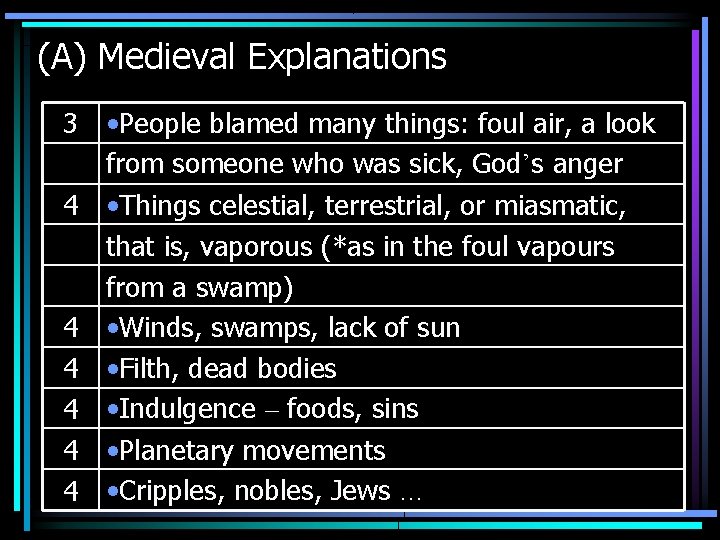
(A) Medieval Explanations 3 • People blamed many things: foul air, a look from someone who was sick, God’s anger 4 • Things celestial, terrestrial, or miasmatic, that is, vaporous (*as in the foul vapours from a swamp) 4 • Winds, swamps, lack of sun 4 • Filth, dead bodies 4 • Indulgence – foods, sins 4 • Planetary movements 4 • Cripples, nobles, Jews …
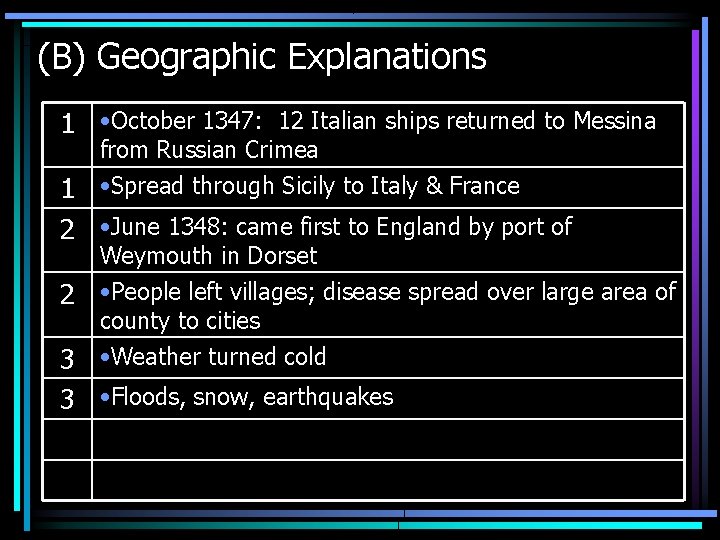
(B) Geographic Explanations 1 • October 1347: 12 Italian ships returned to Messina from Russian Crimea • Spread through Sicily to Italy & France 1 2 • June 1348: came first to England by port of 2 Weymouth in Dorset • People left villages; disease spread over large area of county to cities • Weather turned cold 3 3 • Floods, snow, earthquakes
(C) Factors of sanitation and hygeine 3 Towns were crowded 3 Sewage ran down streets; manure piled …
Sources 1. 2. Bishop, Morris. The Horizon Book of the Middle Ages. Toronto: Mc. Clelland Stewart, 1968. “The Black Death in Weymouth & Portland, Dorset. ” Weymouth & Portland Borough Council. 2005. 12 Nov 2006. www. weymouth. gov. uk/main. asp? svid=769 3. 4. Peters, Stephanie True. Epidemic! The Black Death. Tarrytown, NY: Benchmark, 2005. “Black Death. ” Encyclopedia of Plague and Pestilence: From Ancient Times to the Present. George Childs Kohn, Ed. New York: Checkmark, 2001.
Works Cited Bishop, Morris. The Horizon Book of the Middle Ages. Toronto: Mc. Clelland Stewart, 1968. “Black Death. ” Encyclopedia of Plague and Pestilence: From Ancient Times to the Present. George Childs Kohn, Ed. New York: Checkmark, 2001. “The Black Death in Weymouth & Portland, Dorset. ” Weymouth & Portland Borough Council. 2005. 12 Nov 2006. www. weymouth. gov. uk/main. asp? svid=769 Peters, Stephanie True. Epidemic! The Black Death. Tarrytown, NY: Benchmark, 2005.

THE END
- Slides: 25