The Nature of the Stars Chapter 19 Parallax



- Slides: 41
The Nature of the Stars Chapter 19
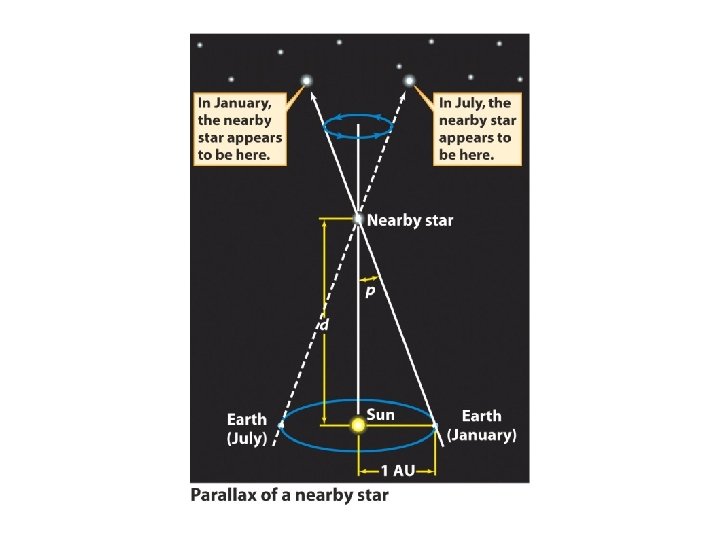
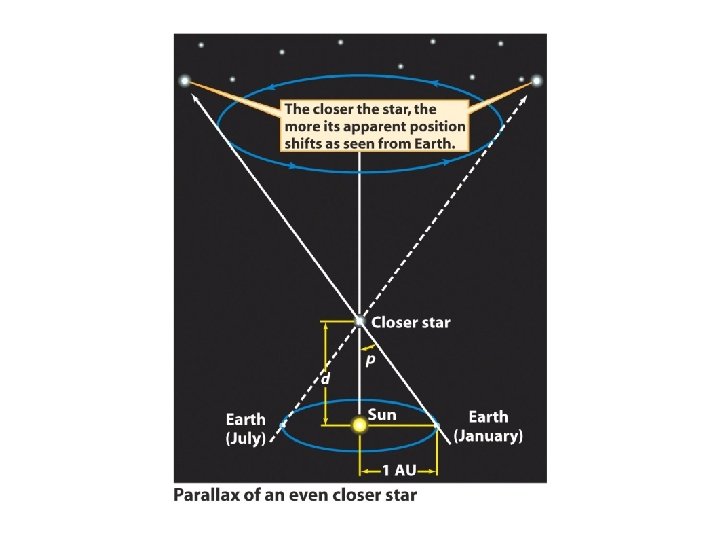
Parallax
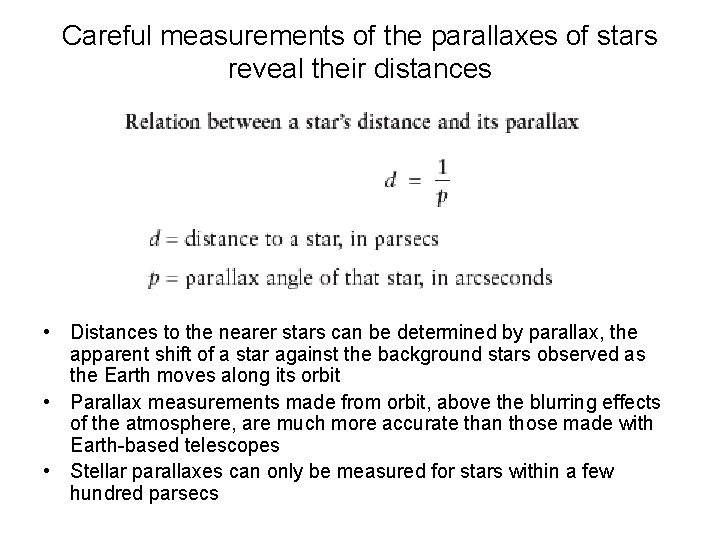
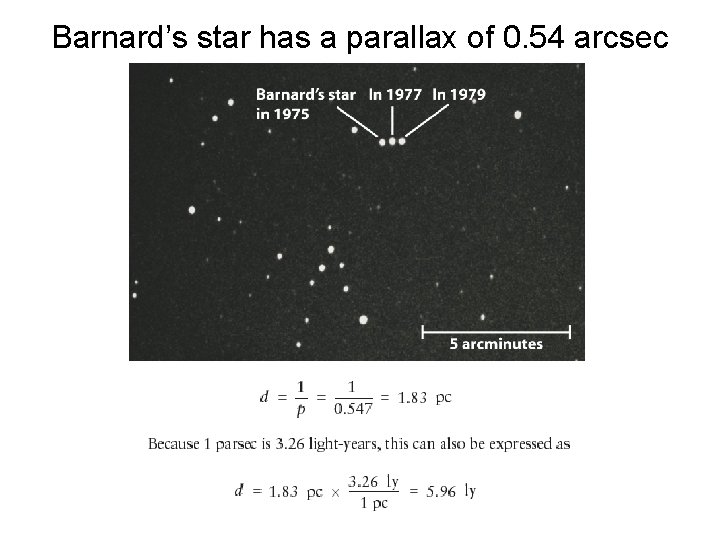
Careful measurements of the parallaxes of stars reveal their distances • Distances to the nearer stars can be determined by parallax, the apparent shift of a star against the background stars observed as the Earth moves along its orbit • Parallax measurements made from orbit, above the blurring effects of the atmosphere, are much more accurate than those made with Earth-based telescopes • Stellar parallaxes can only be measured for stars within a few hundred parsecs
Barnard’s star has a parallax of 0. 54 arcsec
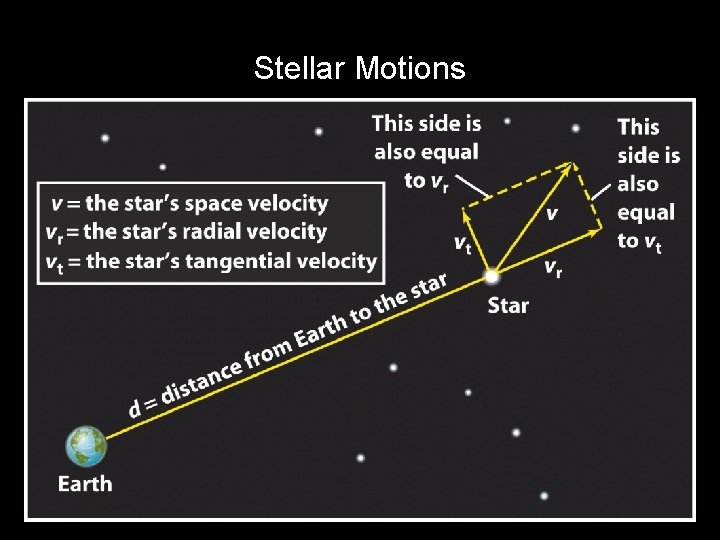
Stellar Motions
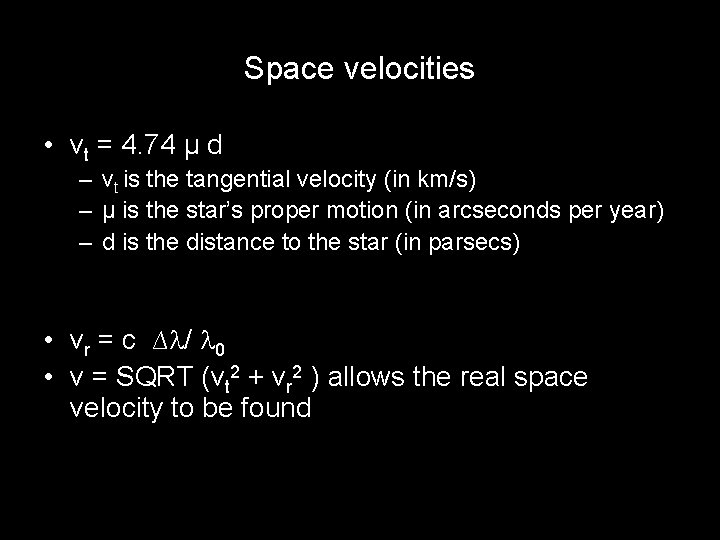
Space velocities • vt = 4. 74 μ d – vt is the tangential velocity (in km/s) – μ is the star’s proper motion (in arcseconds per year) – d is the distance to the star (in parsecs) • vr = c ∆ / 0 • v = SQRT (vt 2 + vr 2 ) allows the real space velocity to be found
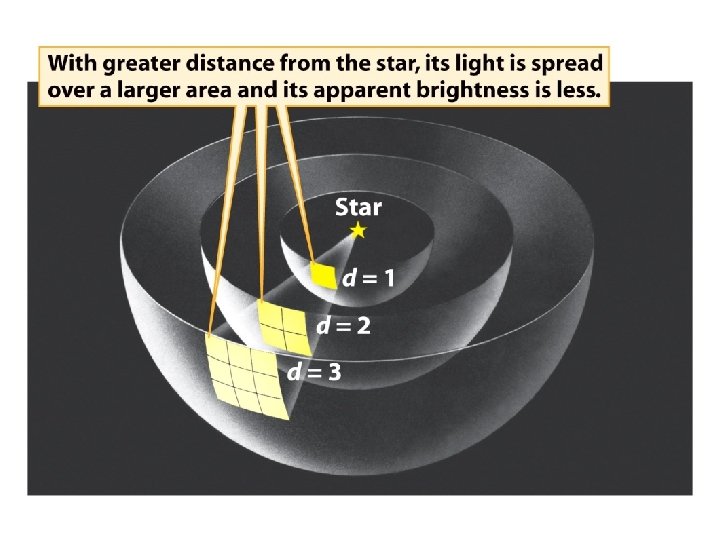
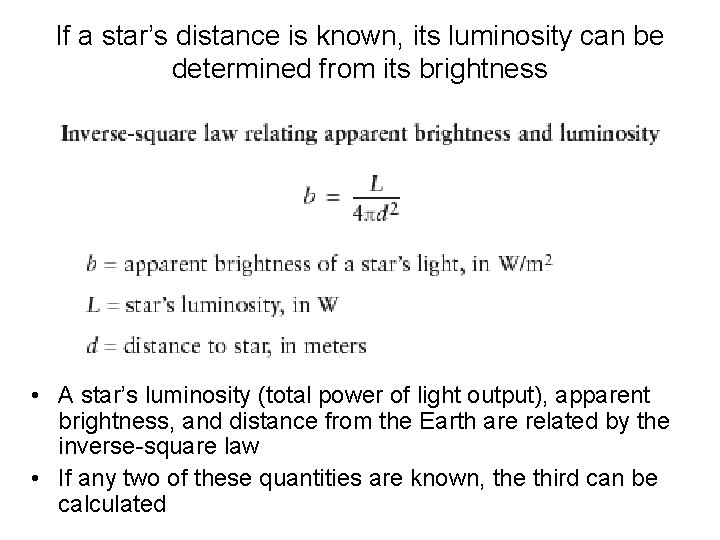
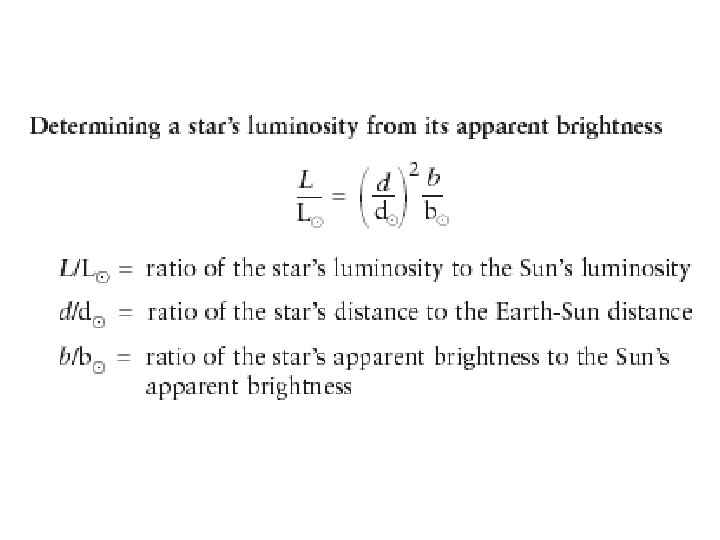
If a star’s distance is known, its luminosity can be determined from its brightness • A star’s luminosity (total power of light output), apparent brightness, and distance from the Earth are related by the inverse-square law • If any two of these quantities are known, the third can be calculated
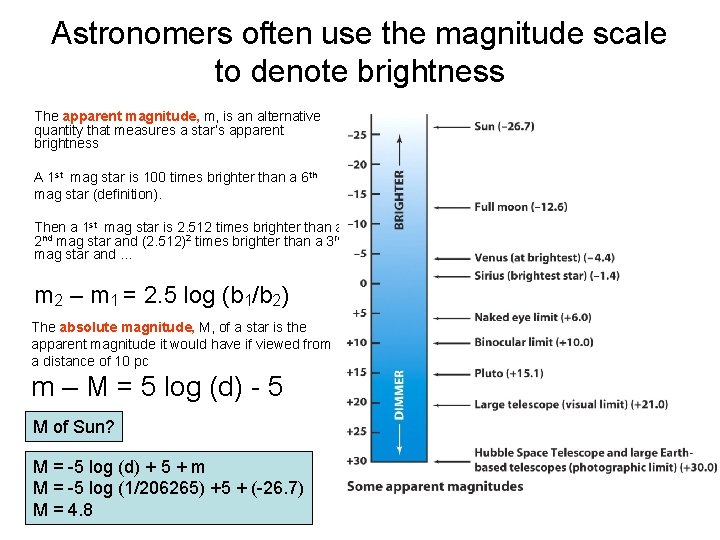
Astronomers often use the magnitude scale to denote brightness The apparent magnitude, m, is an alternative quantity that measures a star’s apparent brightness A 1 st mag star is 100 times brighter than a 6 th mag star (definition). Then a 1 st mag star is 2. 512 times brighter than a 2 nd mag star and (2. 512)2 times brighter than a 3 rd mag star and … m 2 – m 1 = 2. 5 log (b 1/b 2) The absolute magnitude, M, of a star is the apparent magnitude it would have if viewed from a distance of 10 pc m – M = 5 log (d) - 5 M of Sun? M = -5 log (d) + 5 + m M = -5 log (1/206265) +5 + (-26. 7) M = 4. 8
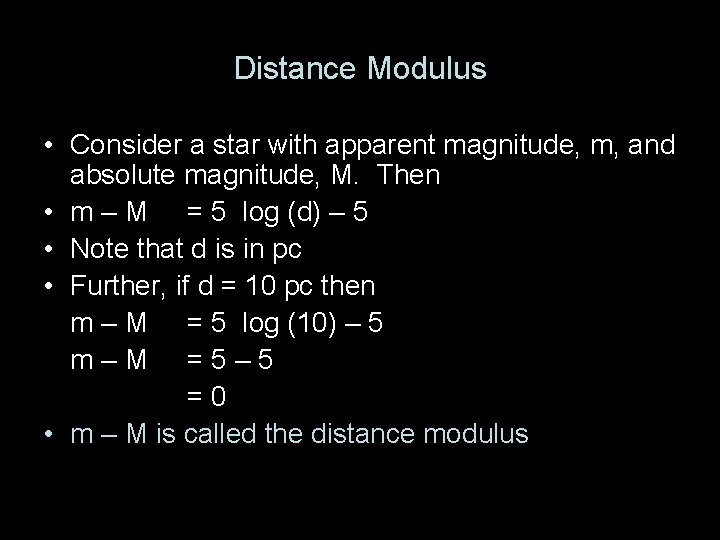
Distance Modulus • Consider a star with apparent magnitude, m, and absolute magnitude, M. Then • m – M = 5 log (d) – 5 • Note that d is in pc • Further, if d = 10 pc then m – M = 5 log (10) – 5 m–M =5– 5 =0 • m – M is called the distance modulus
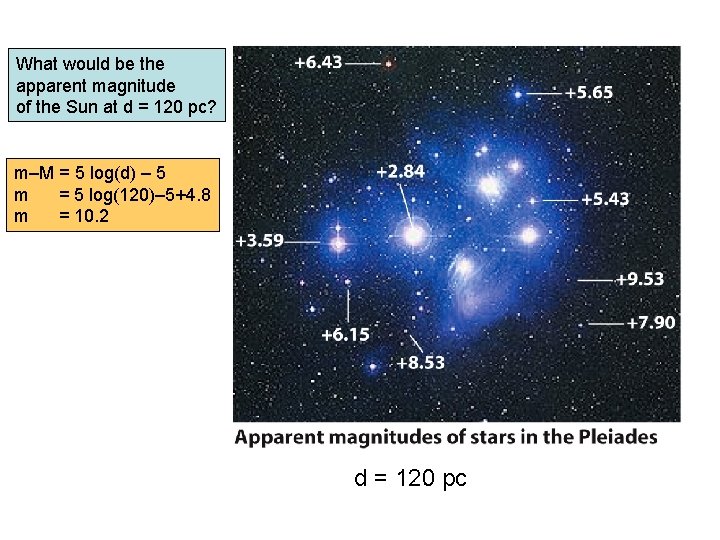
What would be the apparent magnitude of the Sun at d = 120 pc? m–M = 5 log(d) – 5 m = 5 log(120)– 5+4. 8 m = 10. 2 d = 120 pc
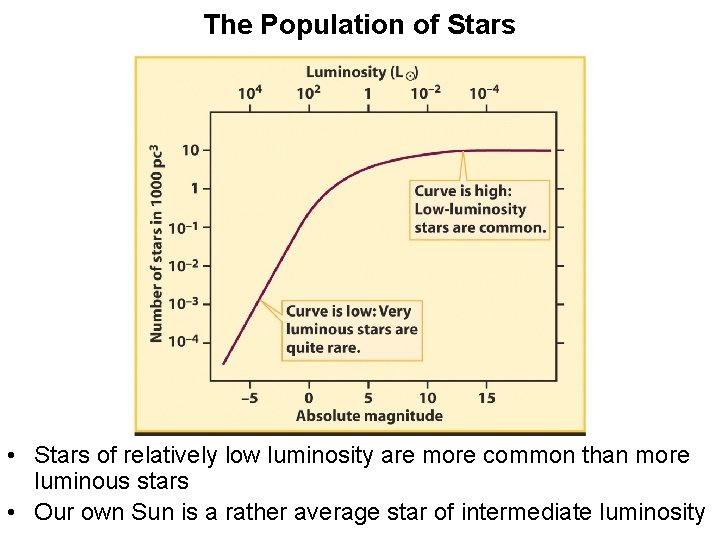
The Population of Stars • Stars of relatively low luminosity are more common than more luminous stars • Our own Sun is a rather average star of intermediate luminosity
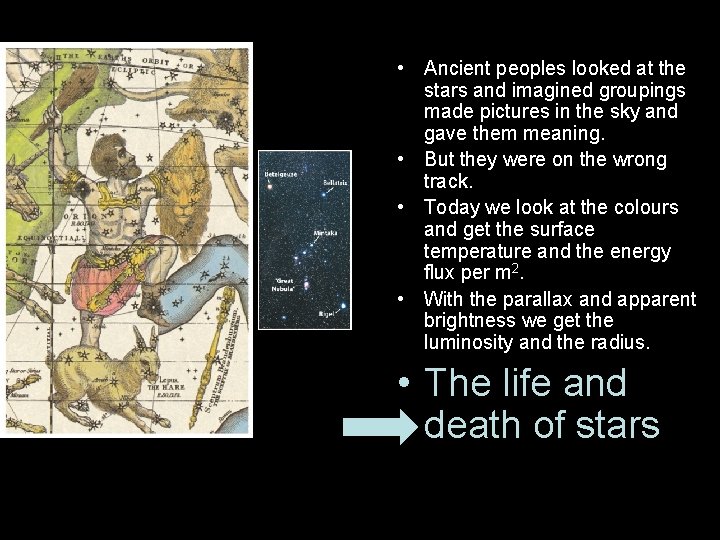
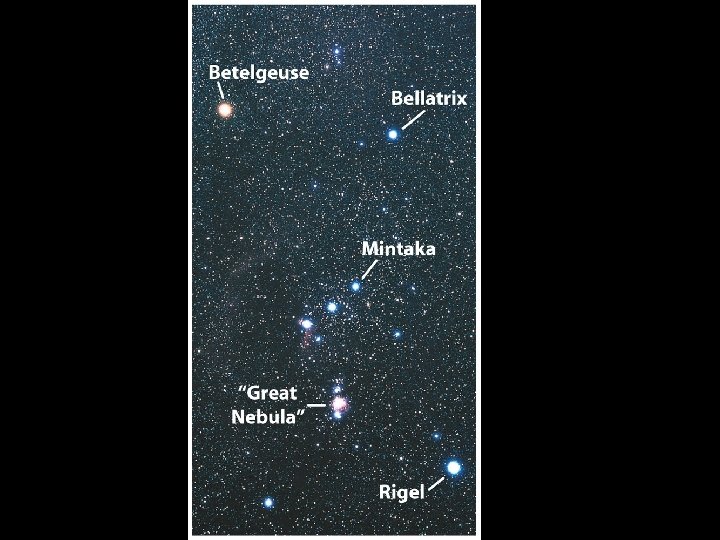
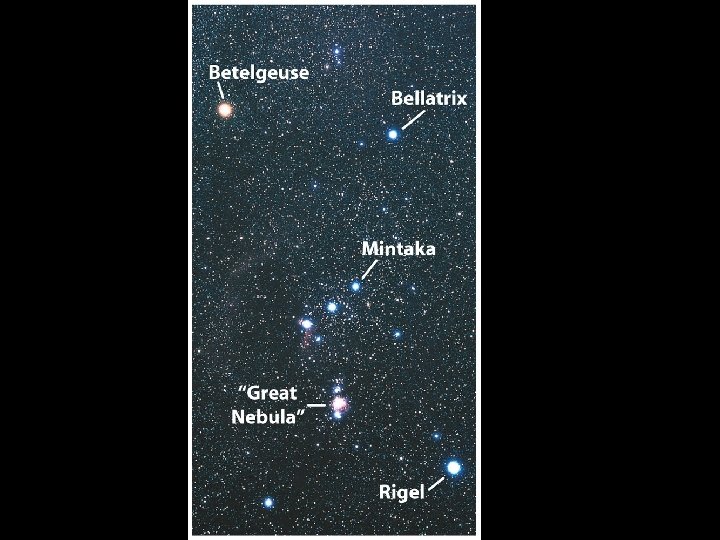
• Ancient peoples looked at the stars and imagined groupings made pictures in the sky and gave them meaning. • But they were on the wrong track. • Today we look at the colours and get the surface temperature and the energy flux per m 2. • With the parallax and apparent brightness we get the luminosity and the radius. • The life and death of stars
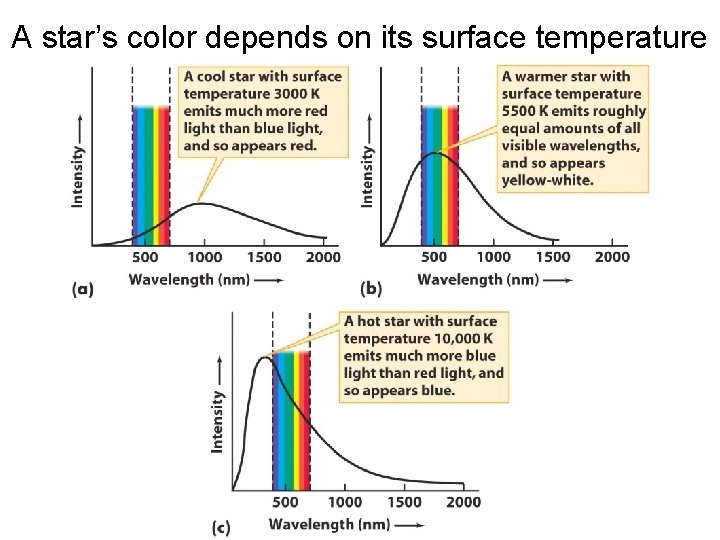
A star’s color depends on its surface temperature
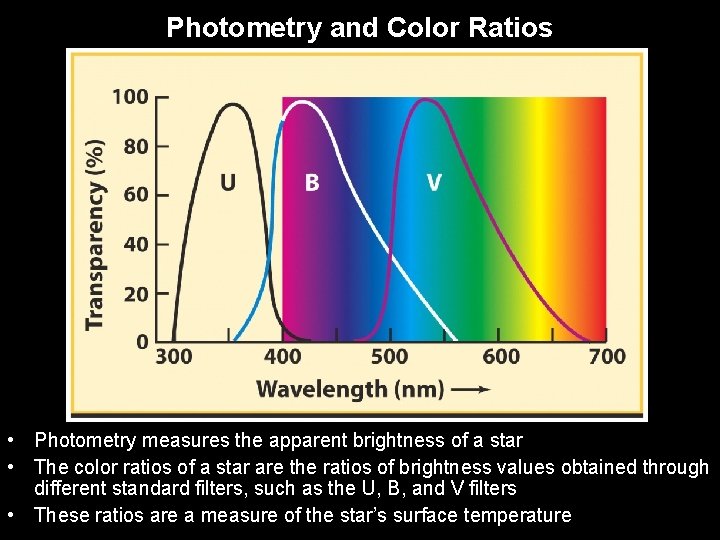
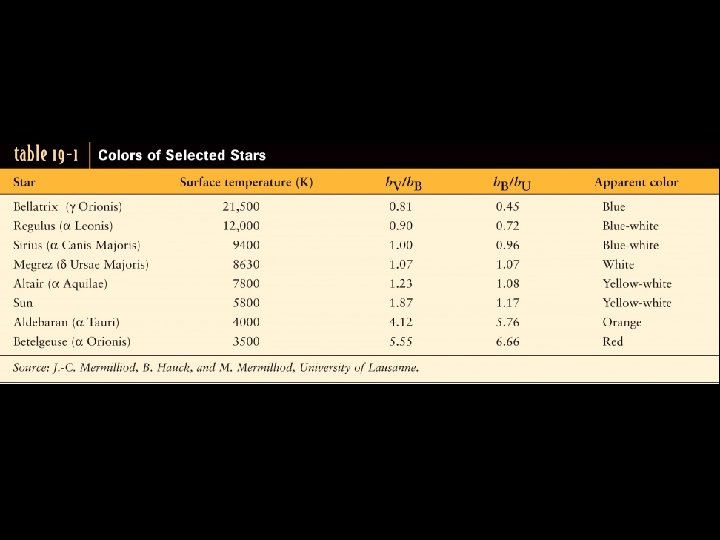
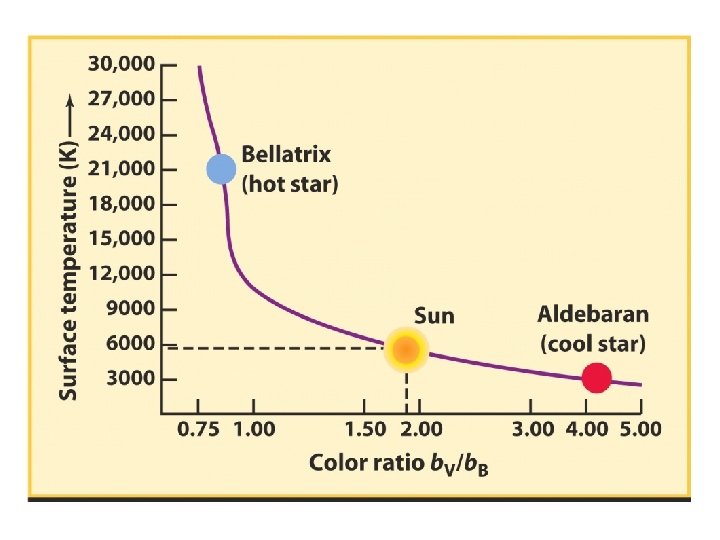
Photometry and Color Ratios • Photometry measures the apparent brightness of a star • The color ratios of a star are the ratios of brightness values obtained through different standard filters, such as the U, B, and V filters • These ratios are a measure of the star’s surface temperature
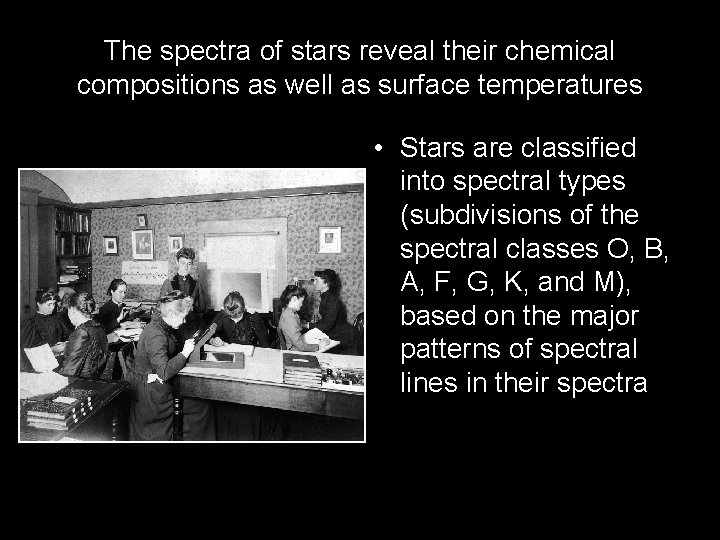
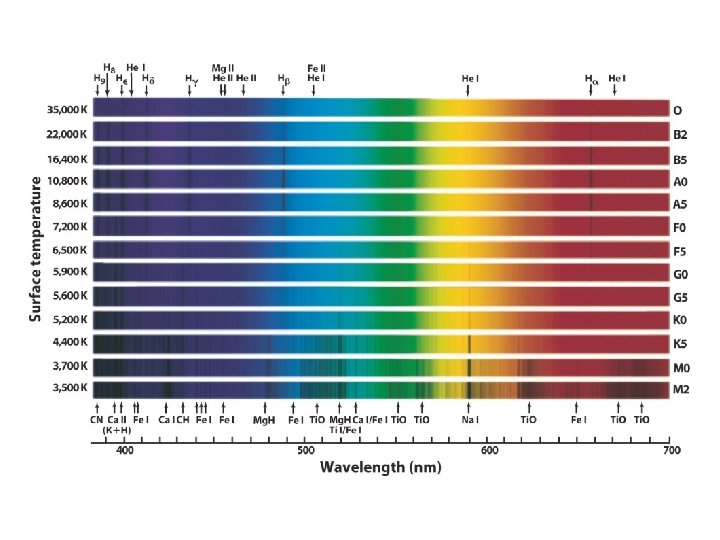
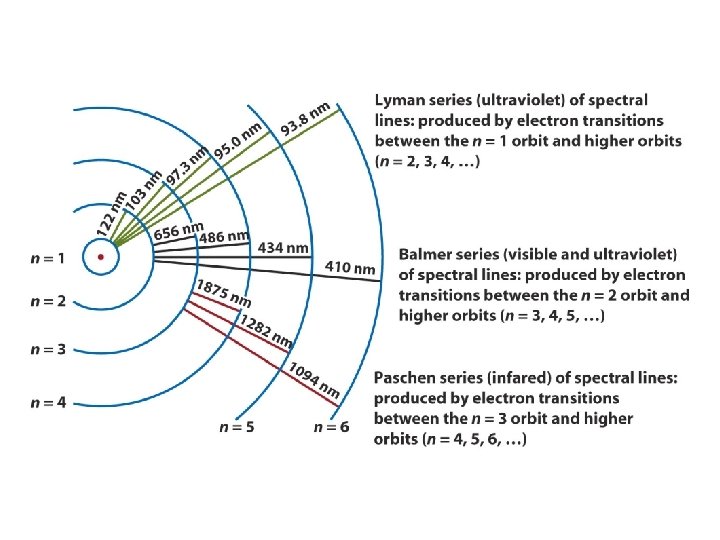
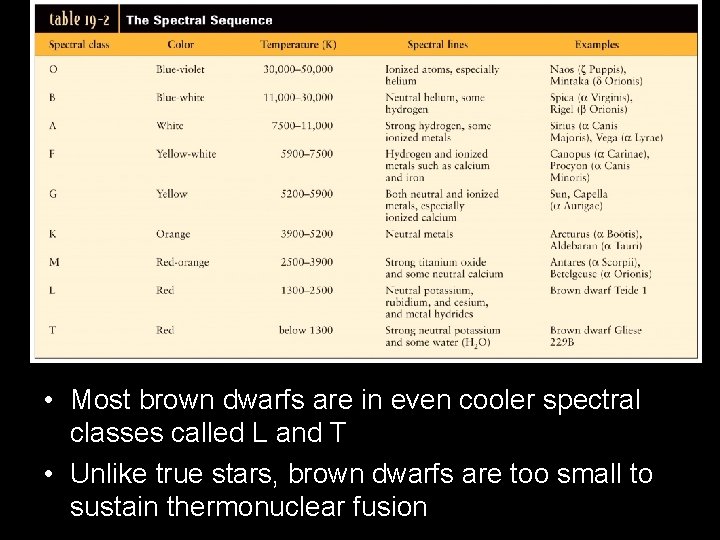
The spectra of stars reveal their chemical compositions as well as surface temperatures • Stars are classified into spectral types (subdivisions of the spectral classes O, B, A, F, G, K, and M), based on the major patterns of spectral lines in their spectra
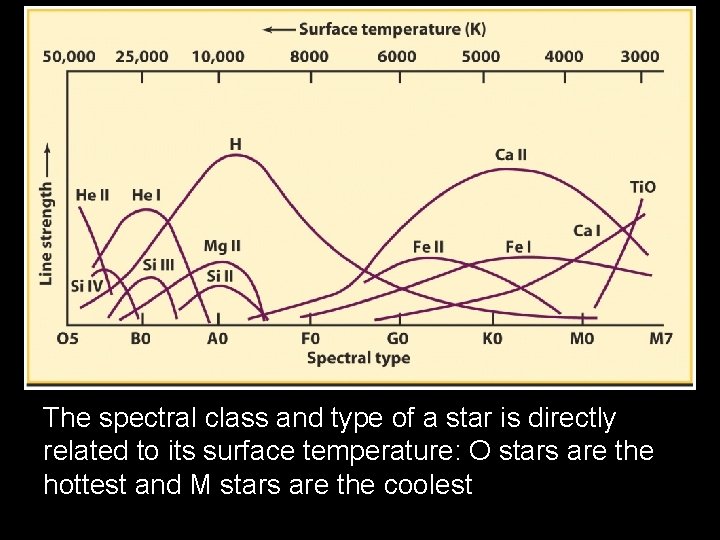
The spectral class and type of a star is directly related to its surface temperature: O stars are the hottest and M stars are the coolest
• Most brown dwarfs are in even cooler spectral classes called L and T • Unlike true stars, brown dwarfs are too small to sustain thermonuclear fusion
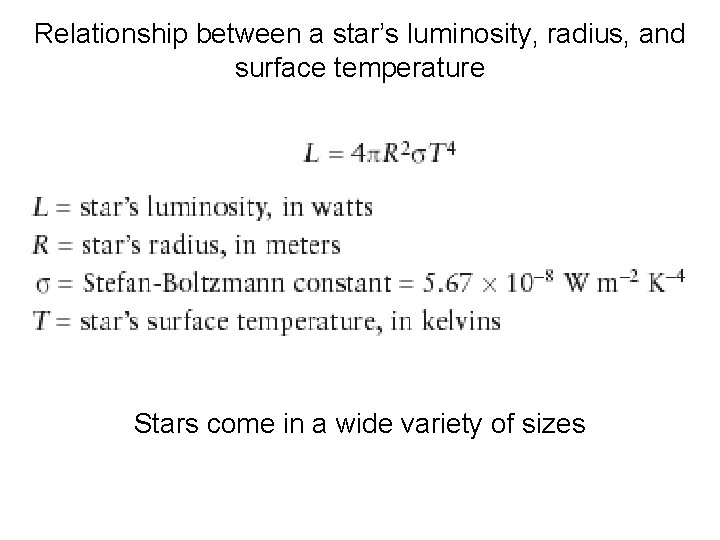
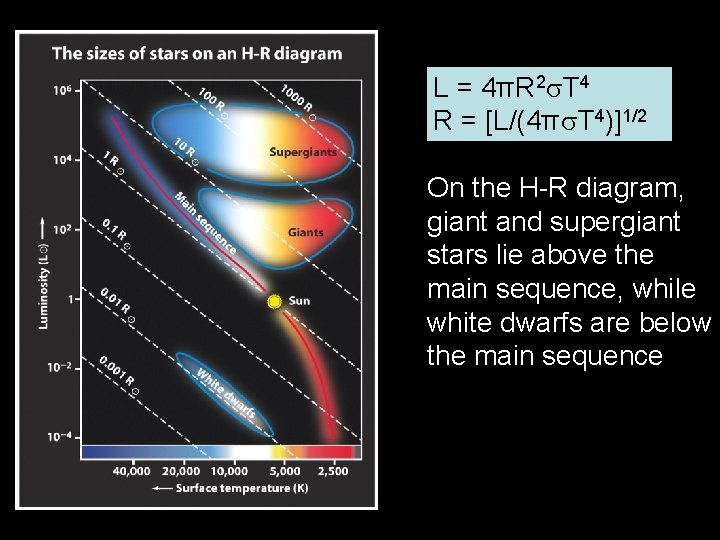
Relationship between a star’s luminosity, radius, and surface temperature Stars come in a wide variety of sizes
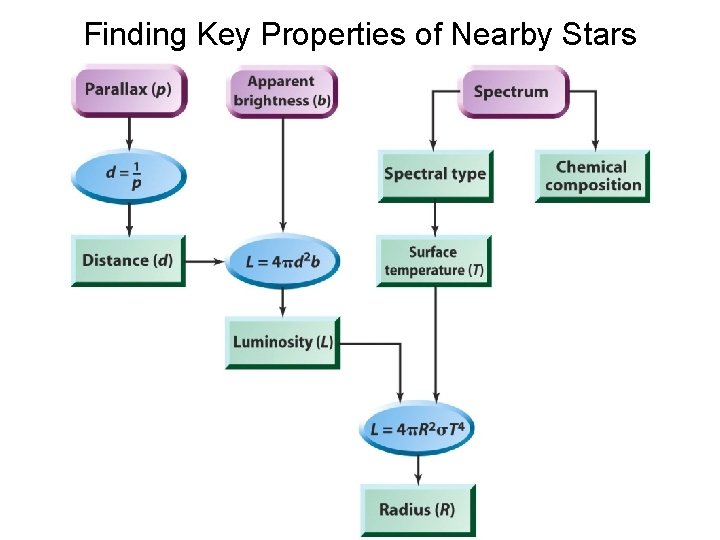
Finding Key Properties of Nearby Stars
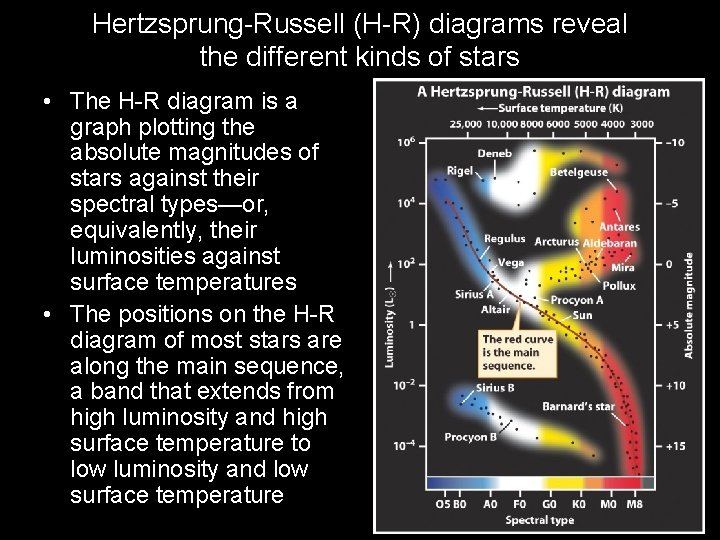
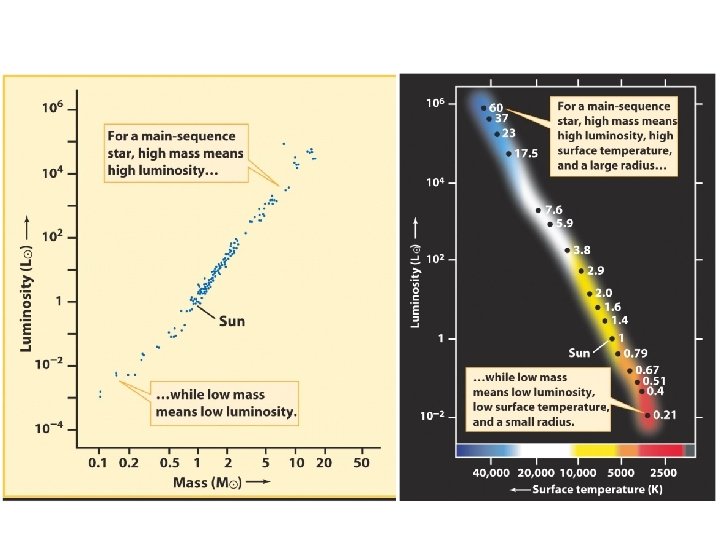
Hertzsprung-Russell (H-R) diagrams reveal the different kinds of stars • The H-R diagram is a graph plotting the absolute magnitudes of stars against their spectral types—or, equivalently, their luminosities against surface temperatures • The positions on the H-R diagram of most stars are along the main sequence, a band that extends from high luminosity and high surface temperature to low luminosity and low surface temperature
L = 4πR 2 T 4 R = [L/(4π T 4)]1/2 On the H-R diagram, giant and supergiant stars lie above the main sequence, while white dwarfs are below the main sequence
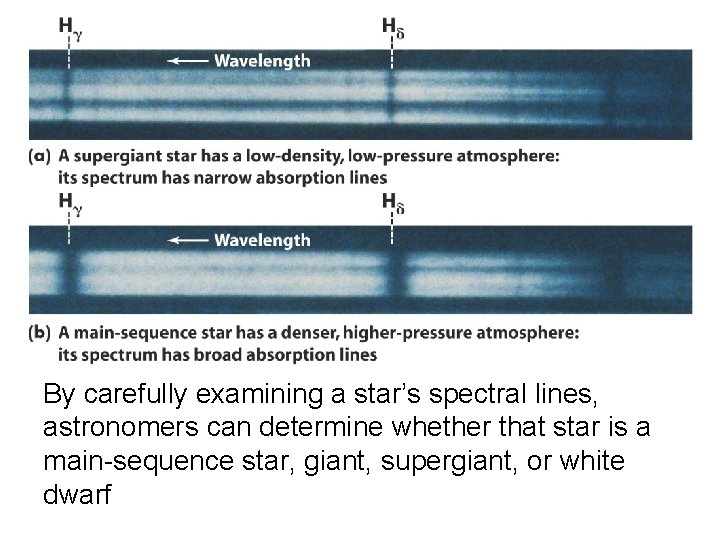
By carefully examining a star’s spectral lines, astronomers can determine whether that star is a main-sequence star, giant, supergiant, or white dwarf
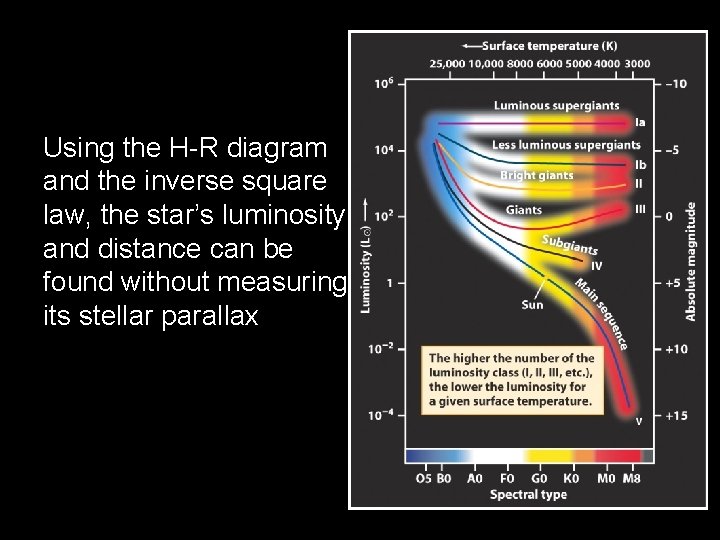
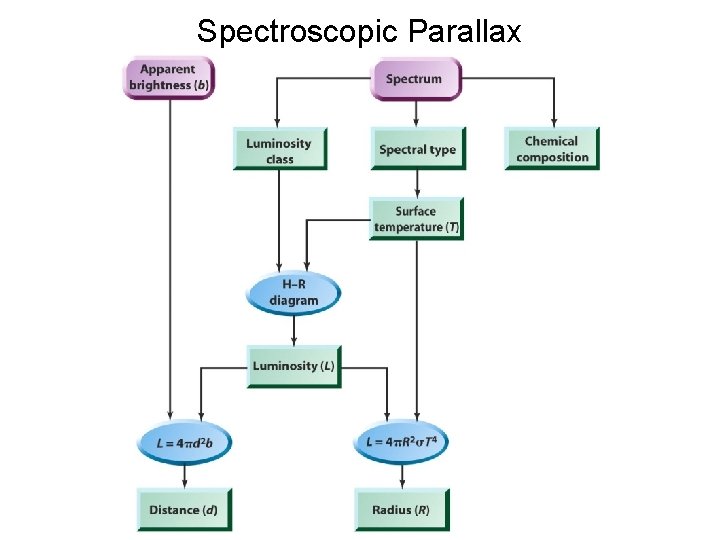
Using the H-R diagram and the inverse square law, the star’s luminosity and distance can be found without measuring its stellar parallax
Spectroscopic Parallax
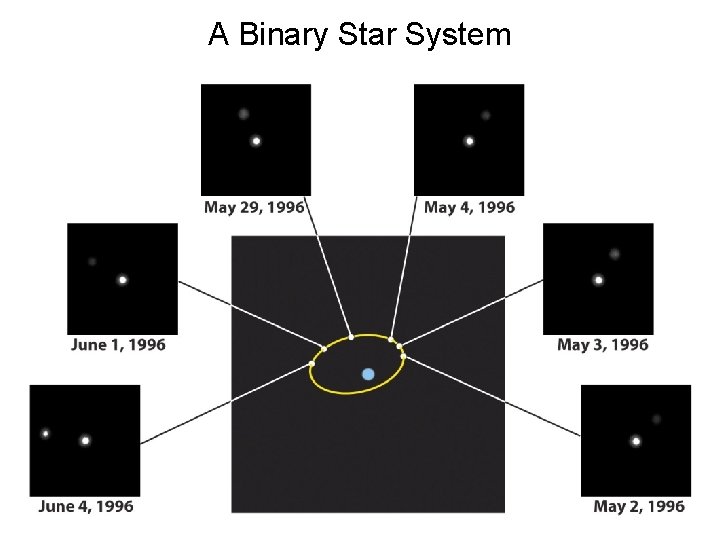
A Binary Star System
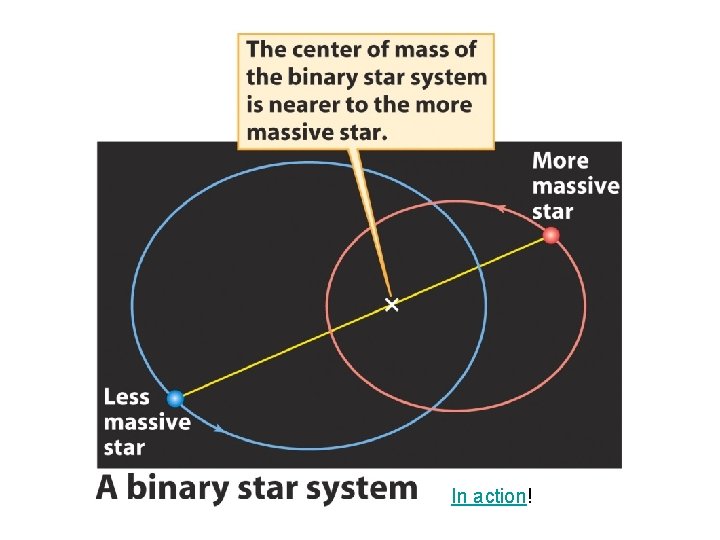
Binary Stars • Binary stars, in which two stars are held in orbit around each other by their mutual gravitational attraction, are surprisingly common • Those that can be resolved into two distinct star images by an Earth-based telescope are called visual binaries • Each of the two stars in a binary system moves in an elliptical orbit about the center of mass of the system
In action!
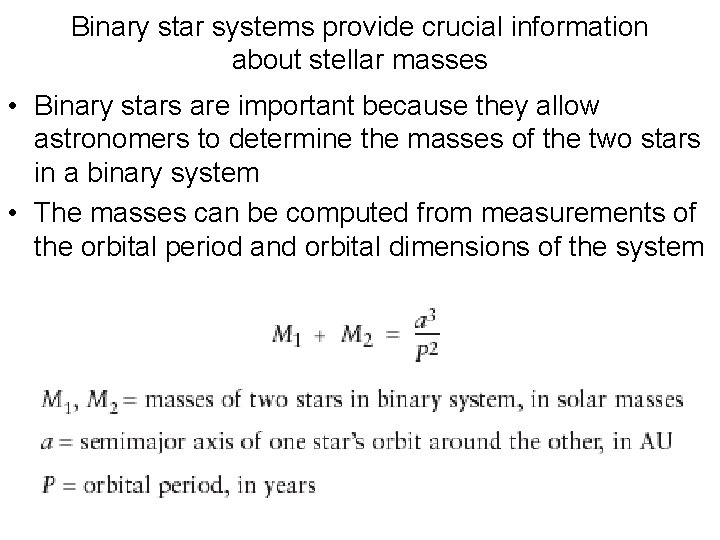
Binary star systems provide crucial information about stellar masses • Binary stars are important because they allow astronomers to determine the masses of the two stars in a binary system • The masses can be computed from measurements of the orbital period and orbital dimensions of the system
The End