The greatest happiness is to scatter your enemy







- Slides: 44
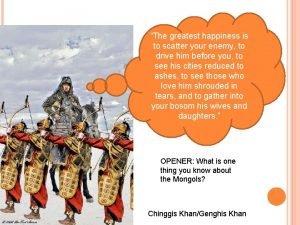
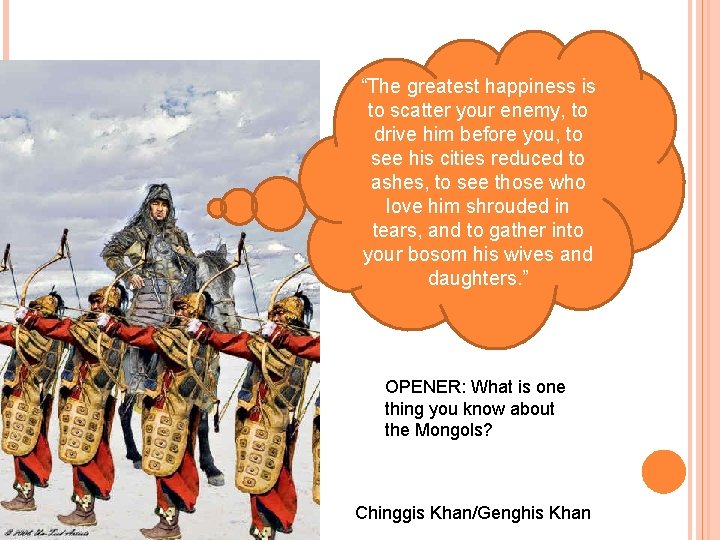
“The greatest happiness is to scatter your enemy, to drive him before you, to see his cities reduced to ashes, to see those who love him shrouded in tears, and to gather into your bosom his wives and daughters. ” OPENER: What is one thing you know about the Mongols? Chinggis Khan/Genghis Khan
QUESTIONS TO KNOW- THE WORLD OF PASTORAL SOCIETIES What are pastoral nomads (or pastoralists)? What caused people groups to become pastoralists instead of farmers? Why do we not see pastoral nomadic groups in the Americas? Describe some ways pastoral societies were different than agricultural societies in all of the following categories: Population size: � Political organization: � Treatment of women: � Explain why pastoralists have to be nomadic. How did pastoralists interact with their agricultural neighbors? Why was it difficult to organize a large unified state (government) within pastoral societies? Why did pastoralist groups often have a military advantage over agriculturalists? List some of the new technologies invented by pastoralist groups that agricultural societies would one day adopt as well.
BEFORE THE MONGOLS: PASTORALISTS IN HISTORY What impact did the Arabs make on world history? What impact did the Turks make on world history? What impact did the Almoravids make on world history?
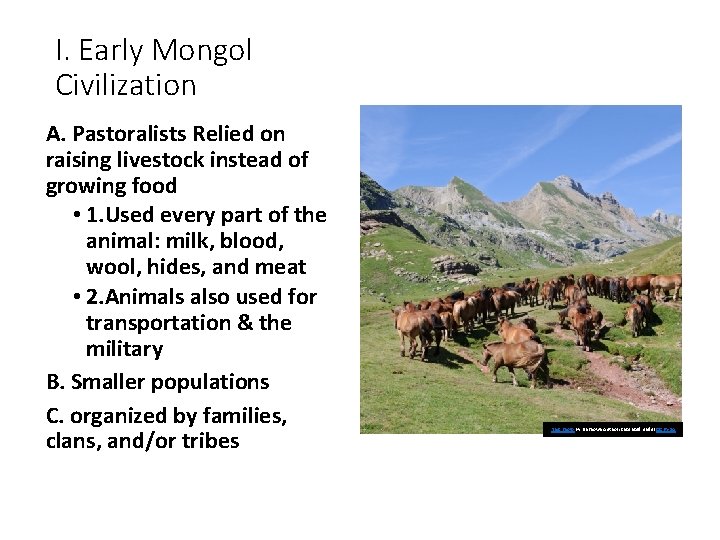
I. Early Mongol Civilization A. Pastoralists Relied on raising livestock instead of growing food • 1. Used every part of the animal: milk, blood, wool, hides, and meat • 2. Animals also used for transportation & the military B. Smaller populations C. organized by families, clans, and/or tribes This Photo by Unknown Author is licensed under CC BY-SA
D. Pastoralists offered women a higher status in society 1. Fewer restrictions 2. Greater role in public life 3. Involved in productive labor E. Mongol women: 1. Could initiate divorce 2. Could remarry if widowed 3. Served as political advisors 4. Active in the military This Photo by Unknown Author is licensed under CC BY-SA
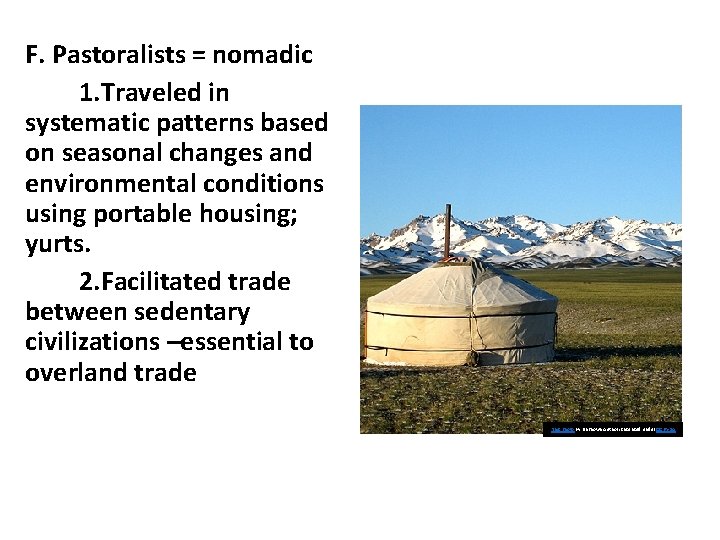
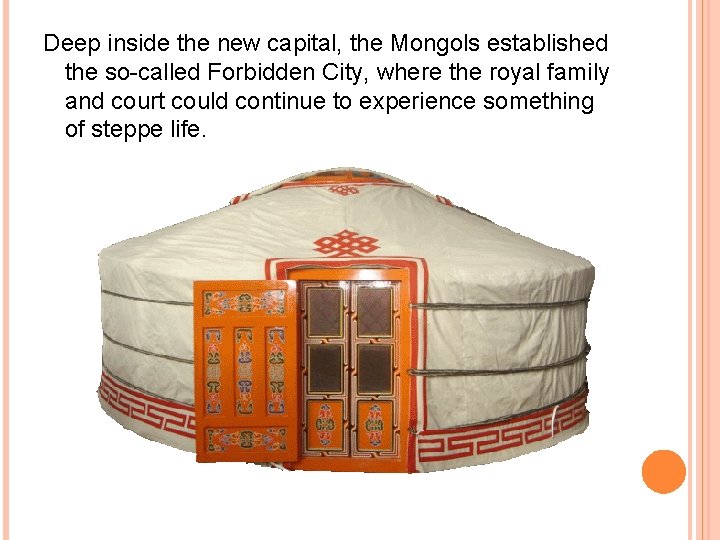
F. Pastoralists = nomadic 1. Traveled in systematic patterns based on seasonal changes and environmental conditions using portable housing; yurts. 2. Facilitated trade between sedentary civilizations –essential to overland trade This Photo by Unknown Author is licensed under CC BY-SA
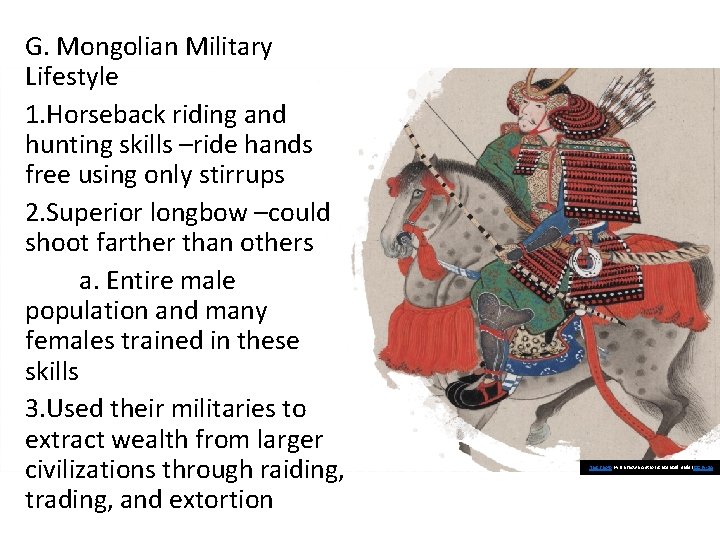
G. Mongolian Military Lifestyle 1. Horseback riding and hunting skills –ride hands free using only stirrups 2. Superior longbow –could shoot farther than others a. Entire male population and many females trained in these skills 3. Used their militaries to extract wealth from larger civilizations through raiding, trading, and extortion This Photo by Unknown Author is licensed under CC BY-SA
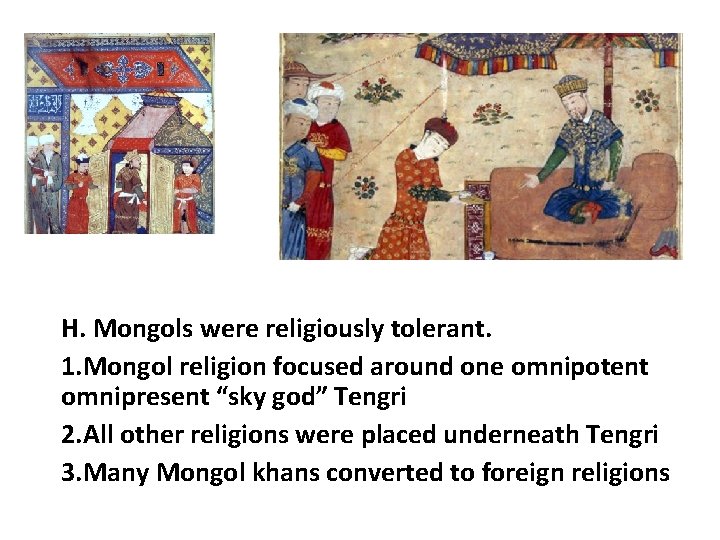
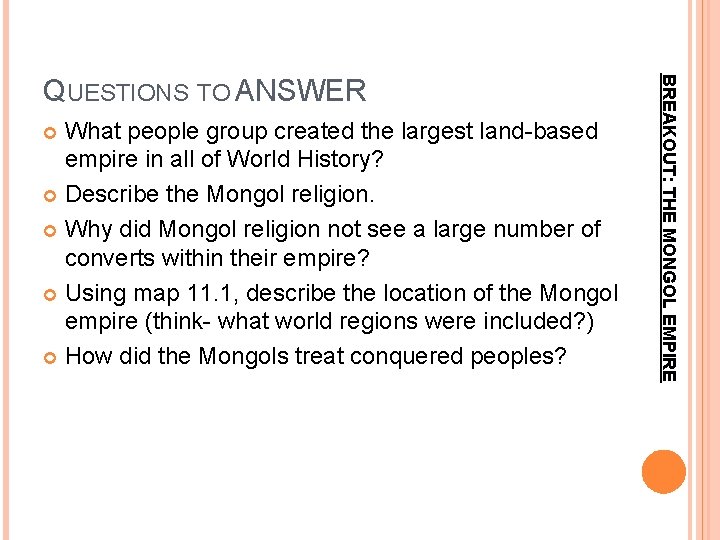
H. Mongols were religiously tolerant. 1. Mongol religion focused around one omnipotent omnipresent “sky god” Tengri 2. All other religions were placed underneath Tengri 3. Many Mongol khans converted to foreign religions
“THERE IS NO GOOD IN ANYTHING UNTIL IT IS FINISHED. ” AND ANOTHER GREAT ONE“AN ACTION COMMITTED IN ANGER IS AN ACTION DOOMED TO FAILURE. ” ― GENGHIS KHAN OPENER- 10 MIN. -NOT ABOUT PENMANSHIP BUT CONTENT Take your poster outside and your question sheet with your group. Take 10 sticky notes- to write a note as a group to the poster maker � Good aspects of the poster Claim- This was good because_______. � Needs to improve on the poster Claim- However, this may have been important to add/change because_____
GROUPS- PERIOD 2 Kenneth Vy Mercy Art Se. Koiya Alexis Draven Kyle Nissan Akness Taylia Robert Lainy Hannah Mya
PERIOD 5 Nikkita Rowan Clarissa Kaitlynne Tony Paiton Khagendra Manuel Alexis Toby Estella Connor Jayda Alex Katelyn F Shawn Bree Ethan Leanne Kali Mia
What people group created the largest land-based empire in all of World History? Describe the Mongol religion. Why did Mongol religion not see a large number of converts within their empire? Using map 11. 1, describe the location of the Mongol empire (think- what world regions were included? ) How did the Mongols treat conquered peoples? BREAKOUT: THE MONGOL EMPIRE QUESTIONS TO ANSWER
How did Temujin rise to power and become known as “Chinggis Khan- universal ruler? ” What caused Chinggis Khan to decide to start expanding his empire through conquest? What regions of the world could the Mongols NOT conquer? FROM TEMUJIN TO CHINGGIS KHAN: THE RISE OF THE MONGOL EMPIRE Describe Temujin’s early life.
LEQ #1: In the period 1200– 1450 C. E. , new states and empires demonstrated continuity, innovation, and diversity as they developed throughout Afro. Eurasia. Develop an argument that analyzes similarities and differences in how one or more new states or empires established their political and religious authority in this time period. LET'S LOOK AT A RUBRIC
THE MONGOL MOMENT What disadvantages did empires like Song China and the Abbasid Caliphate have when trying to hold off the Mongols? What advantage did the Mongols have in conquest? Why were Mongol military forces so loyal to their leaders and to Chinggis Khan in particular? How did the Mongols use conquered peoples to their advantage? How did the Mongols encourage people to surrender to them without a fight? List some ways the Mongols mobilized resources within their empire. How did the Mongols facilitate trade? How did the Mongols treat those of different religions form their own?
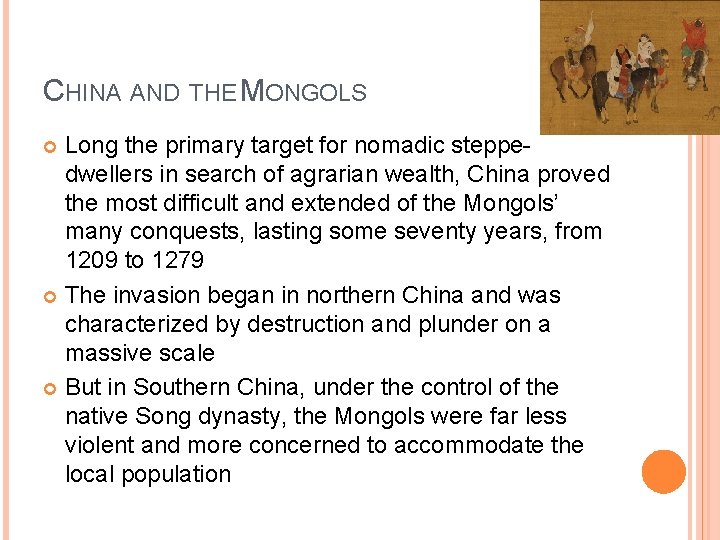
CHINA AND THE MONGOLS Long the primary target for nomadic steppedwellers in search of agrarian wealth, China proved the most difficult and extended of the Mongols’ many conquests, lasting some seventy years, from 1209 to 1279 The invasion began in northern China and was characterized by destruction and plunder on a massive scale But in Southern China, under the control of the native Song dynasty, the Mongols were far less violent and more concerned to accommodate the local population
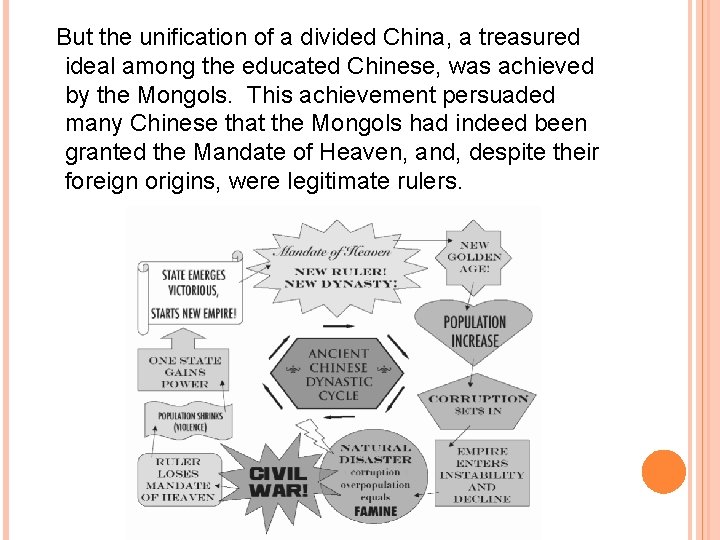
But the unification of a divided China, a treasured ideal among the educated Chinese, was achieved by the Mongols. This achievement persuaded many Chinese that the Mongols had indeed been granted the Mandate of Heaven, and, despite their foreign origins, were legitimate rulers.
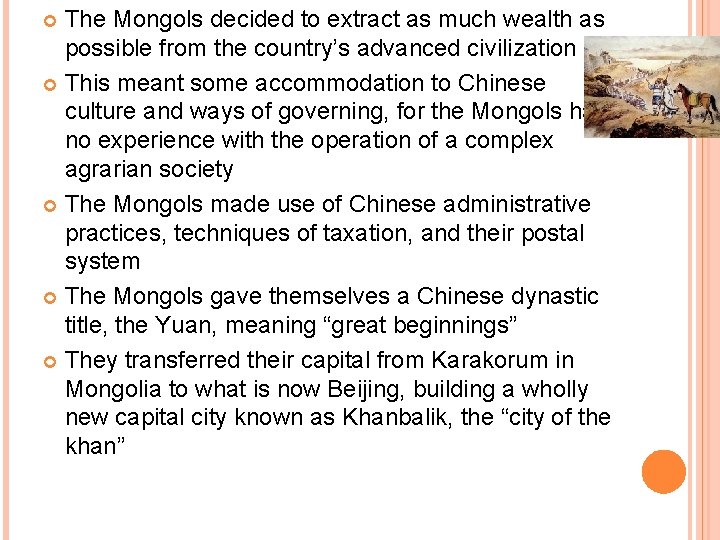
The Mongols decided to extract as much wealth as possible from the country’s advanced civilization This meant some accommodation to Chinese culture and ways of governing, for the Mongols had no experience with the operation of a complex agrarian society The Mongols made use of Chinese administrative practices, techniques of taxation, and their postal system The Mongols gave themselves a Chinese dynastic title, the Yuan, meaning “great beginnings” They transferred their capital from Karakorum in Mongolia to what is now Beijing, building a wholly new capital city known as Khanbalik, the “city of the khan”
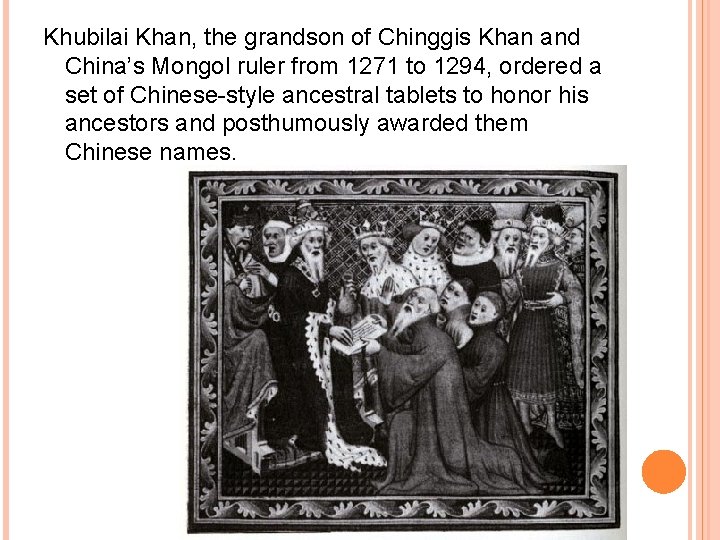
Khubilai Khan, the grandson of Chinggis Khan and China’s Mongol ruler from 1271 to 1294, ordered a set of Chinese-style ancestral tablets to honor his ancestors and posthumously awarded them Chinese names.
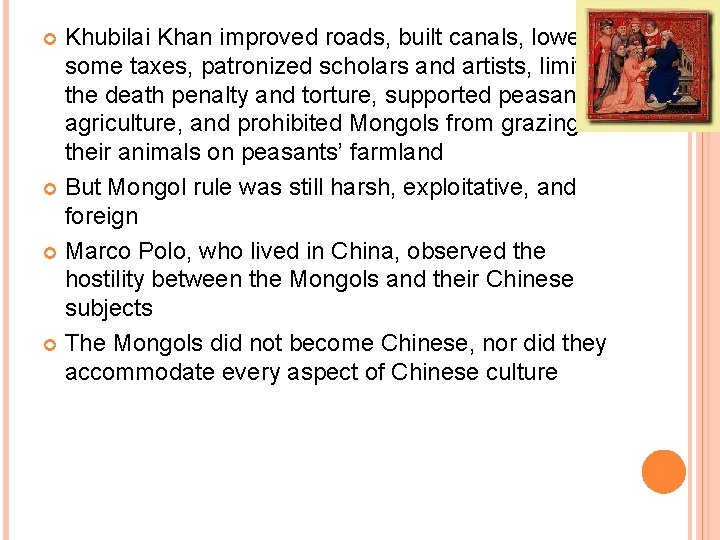
Khubilai Khan improved roads, built canals, lowered some taxes, patronized scholars and artists, limited the death penalty and torture, supported peasant agriculture, and prohibited Mongols from grazing their animals on peasants’ farmland But Mongol rule was still harsh, exploitative, and foreign Marco Polo, who lived in China, observed the hostility between the Mongols and their Chinese subjects The Mongols did not become Chinese, nor did they accommodate every aspect of Chinese culture
Deep inside the new capital, the Mongols established the so-called Forbidden City, where the royal family and court could continue to experience something of steppe life.
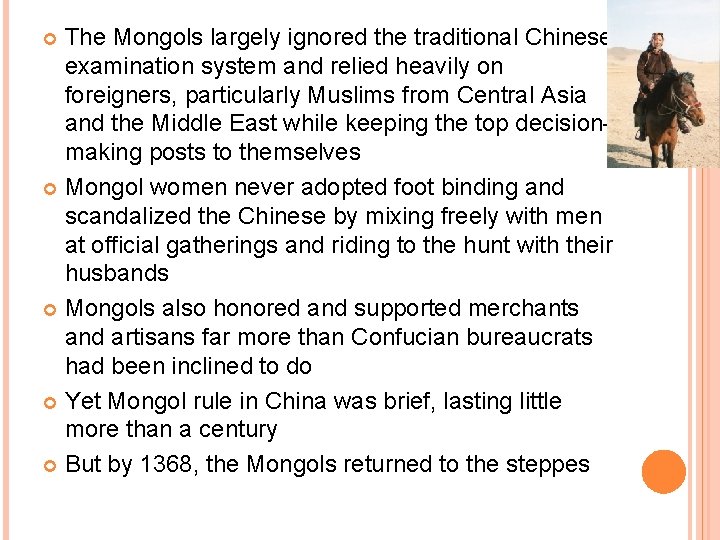
The Mongols largely ignored the traditional Chinese examination system and relied heavily on foreigners, particularly Muslims from Central Asia and the Middle East while keeping the top decisionmaking posts to themselves Mongol women never adopted foot binding and scandalized the Chinese by mixing freely with men at official gatherings and riding to the hunt with their husbands Mongols also honored and supported merchants and artisans far more than Confucian bureaucrats had been inclined to do Yet Mongol rule in China was brief, lasting little more than a century But by 1368, the Mongols returned to the steppes
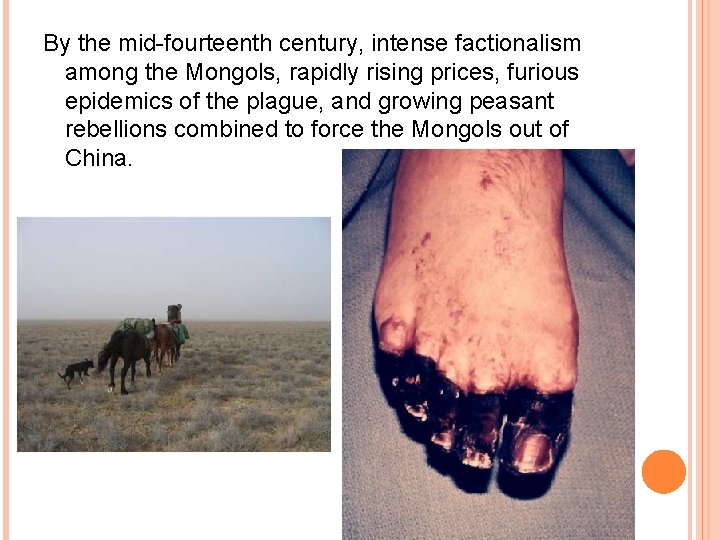
By the mid-fourteenth century, intense factionalism among the Mongols, rapidly rising prices, furious epidemics of the plague, and growing peasant rebellions combined to force the Mongols out of China.
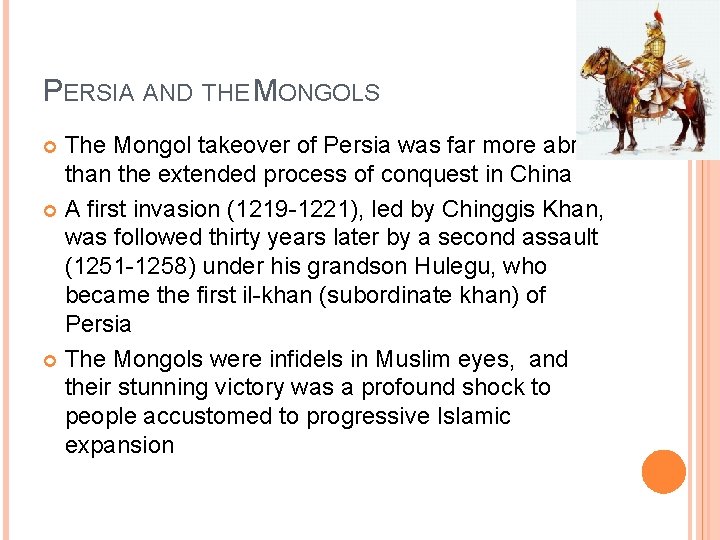
PERSIA AND THE MONGOLS The Mongol takeover of Persia was far more abrupt than the extended process of conquest in China A first invasion (1219 -1221), led by Chinggis Khan, was followed thirty years later by a second assault (1251 -1258) under his grandson Hulegu, who became the first il-khan (subordinate khan) of Persia The Mongols were infidels in Muslim eyes, and their stunning victory was a profound shock to people accustomed to progressive Islamic expansion
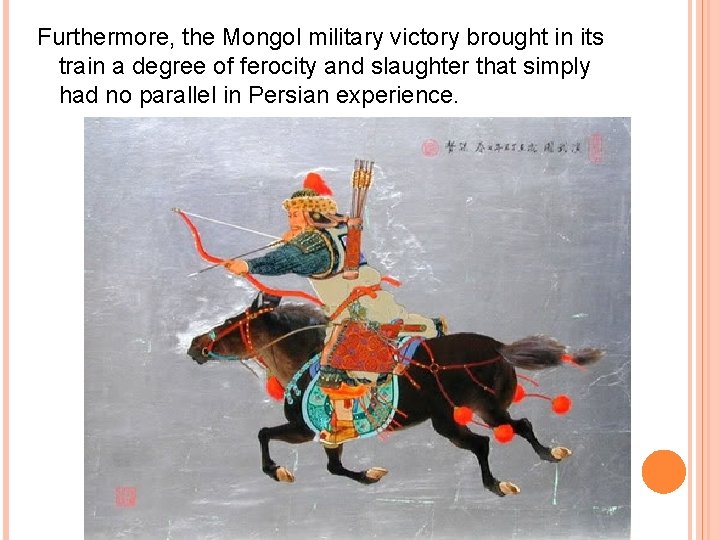
Furthermore, the Mongol military victory brought in its train a degree of ferocity and slaughter that simply had no parallel in Persian experience.
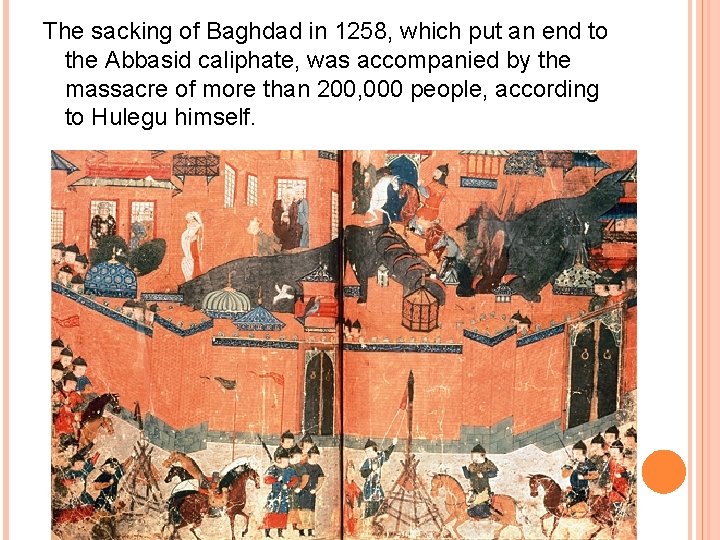
The sacking of Baghdad in 1258, which put an end to the Abbasid caliphate, was accompanied by the massacre of more than 200, 000 people, according to Hulegu himself.
Heavy taxes, sometimes collected twenty or thirty times a year and often under torture or whipping, pushed large numbers of peasants off their land The in-migration of nomadic Mongols, together with their immense herds, turned much agricultural land into pasture and sometimes into desert Yet wine production increased because the Mongols were fond of alcohol and the Persian silk industry benefited from close contact with a Mongolruled China Even more so than in China, Mongol rule in Persia represented “disaster on a grand unparalleled scale”
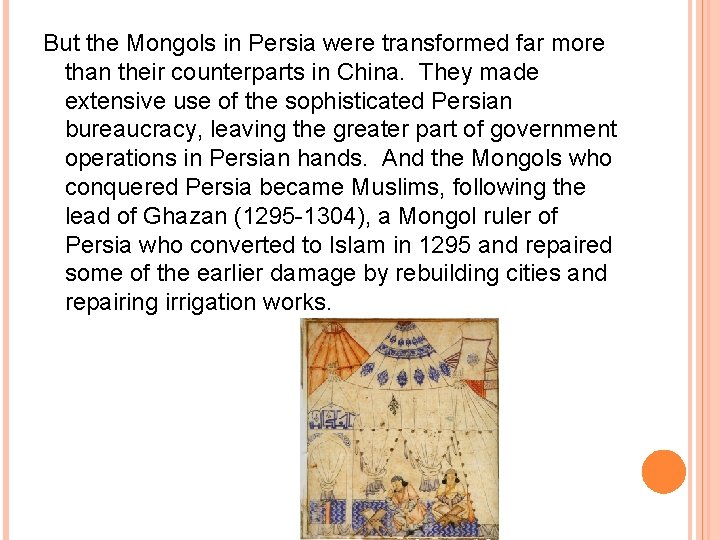
But the Mongols in Persia were transformed far more than their counterparts in China. They made extensive use of the sophisticated Persian bureaucracy, leaving the greater part of government operations in Persian hands. And the Mongols who conquered Persia became Muslims, following the lead of Ghazan (1295 -1304), a Mongol ruler of Persia who converted to Islam in 1295 and repaired some of the earlier damage by rebuilding cities and repairing irrigation works.
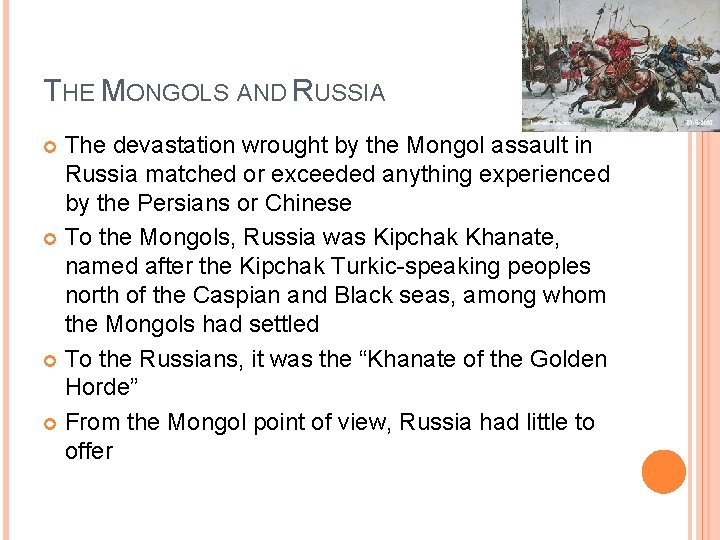
THE MONGOLS AND RUSSIA The devastation wrought by the Mongol assault in Russia matched or exceeded anything experienced by the Persians or Chinese To the Mongols, Russia was Kipchak Khanate, named after the Kipchak Turkic-speaking peoples north of the Caspian and Black seas, among whom the Mongols had settled To the Russians, it was the “Khanate of the Golden Horde” From the Mongol point of view, Russia had little to offer
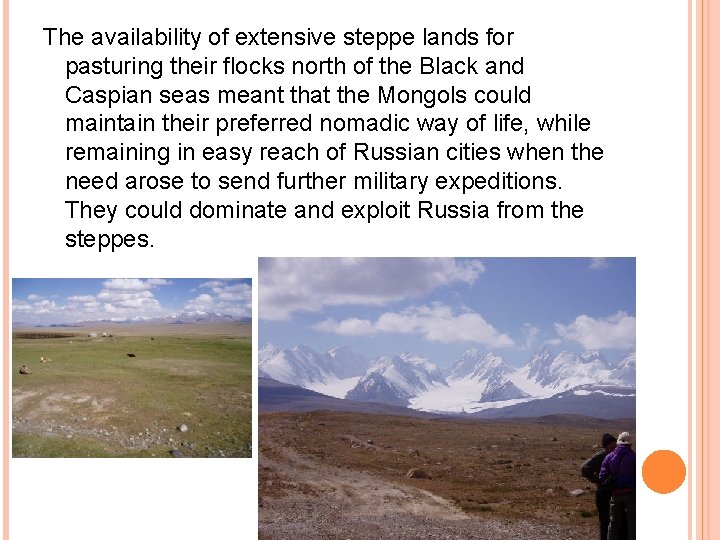
The availability of extensive steppe lands for pasturing their flocks north of the Black and Caspian seas meant that the Mongols could maintain their preferred nomadic way of life, while remaining in easy reach of Russian cities when the need arose to send further military expeditions. They could dominate and exploit Russia from the steppes.
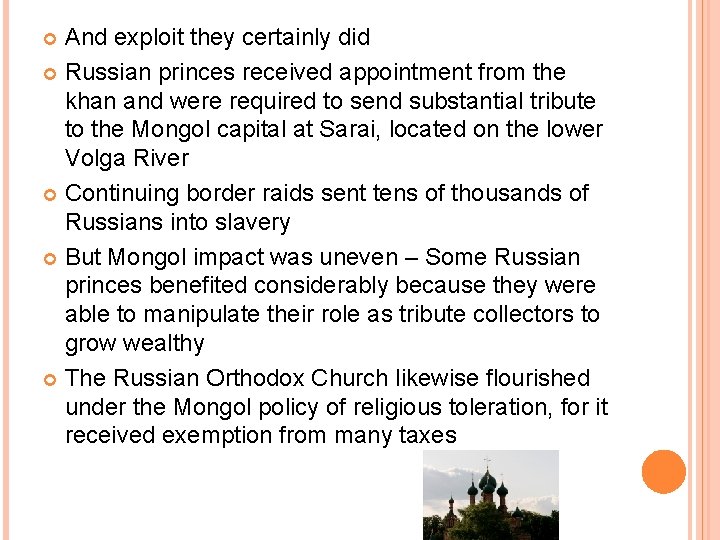
And exploit they certainly did Russian princes received appointment from the khan and were required to send substantial tribute to the Mongol capital at Sarai, located on the lower Volga River Continuing border raids sent tens of thousands of Russians into slavery But Mongol impact was uneven – Some Russian princes benefited considerably because they were able to manipulate their role as tribute collectors to grow wealthy The Russian Orthodox Church likewise flourished under the Mongol policy of religious toleration, for it received exemption from many taxes
Some cities, such as Kiev, resisted the Mongols and were devastated, while others collaborated and were left undamaged. Moscow in particular emerged as the primary collector of tribute from the Mongols, and its princes parlayed this position into a leading role as the nucleus of a renewed Russian state when Mongol domination receded in the fifteenth century.
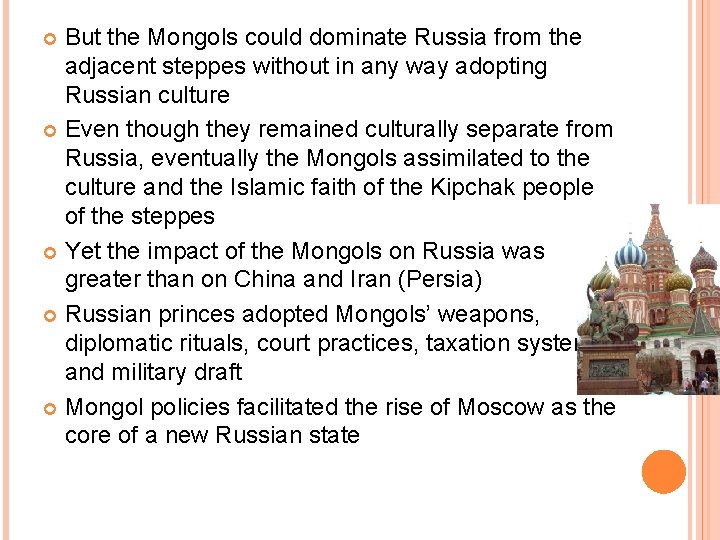
But the Mongols could dominate Russia from the adjacent steppes without in any way adopting Russian culture Even though they remained culturally separate from Russia, eventually the Mongols assimilated to the culture and the Islamic faith of the Kipchak people of the steppes Yet the impact of the Mongols on Russia was greater than on China and Iran (Persia) Russian princes adopted Mongols’ weapons, diplomatic rituals, court practices, taxation system, and military draft Mongol policies facilitated the rise of Moscow as the core of a new Russian state
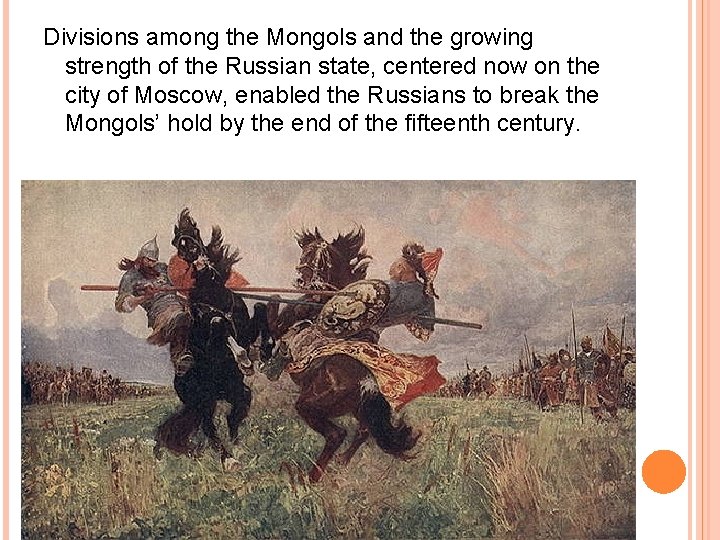
Divisions among the Mongols and the growing strength of the Russian state, centered now on the city of Moscow, enabled the Russians to break the Mongols’ hold by the end of the fifteenth century.
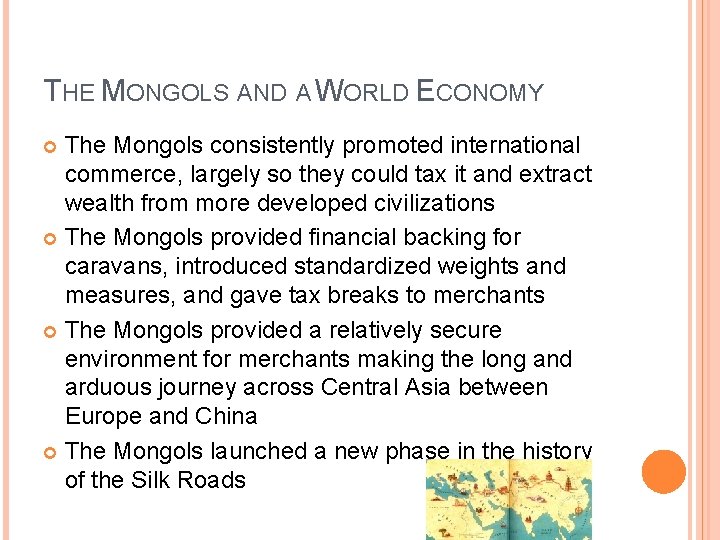
THE MONGOLS AND A WORLD ECONOMY The Mongols consistently promoted international commerce, largely so they could tax it and extract wealth from more developed civilizations The Mongols provided financial backing for caravans, introduced standardized weights and measures, and gave tax breaks to merchants The Mongols provided a relatively secure environment for merchants making the long and arduous journey across Central Asia between Europe and China The Mongols launched a new phase in the history of the Silk Roads
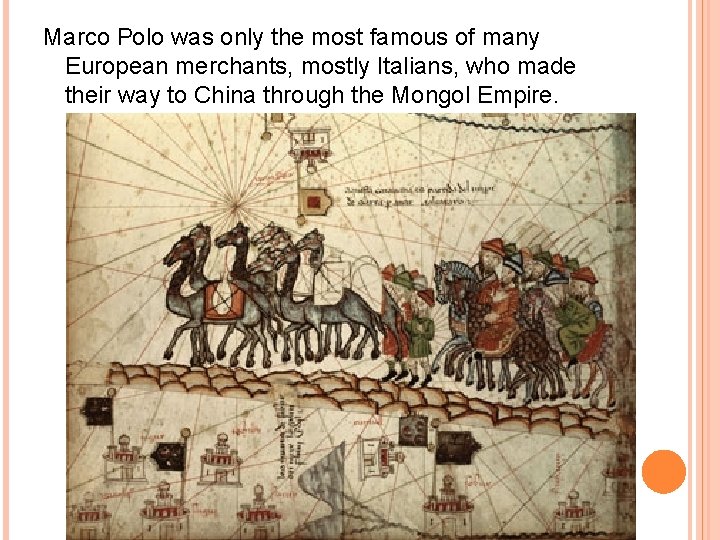
Marco Polo was only the most famous of many European merchants, mostly Italians, who made their way to China through the Mongol Empire.
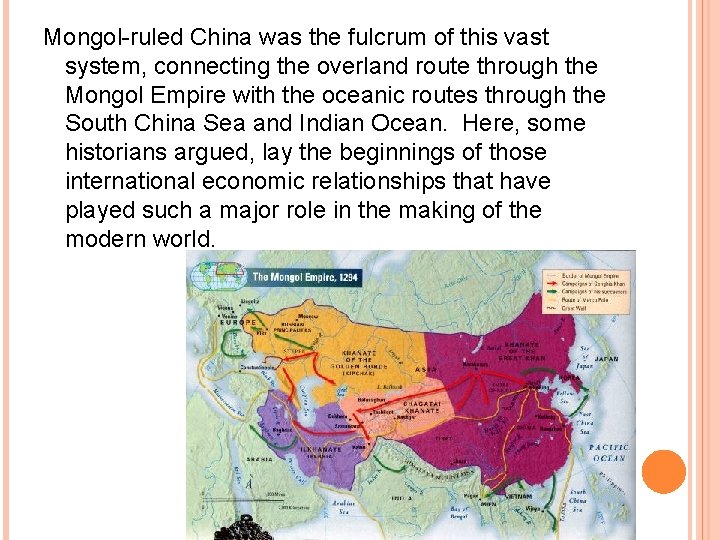
Mongol-ruled China was the fulcrum of this vast system, connecting the overland route through the Mongol Empire with the oceanic routes through the South China Sea and Indian Ocean. Here, some historians argued, lay the beginnings of those international economic relationships that have played such a major role in the making of the modern world.
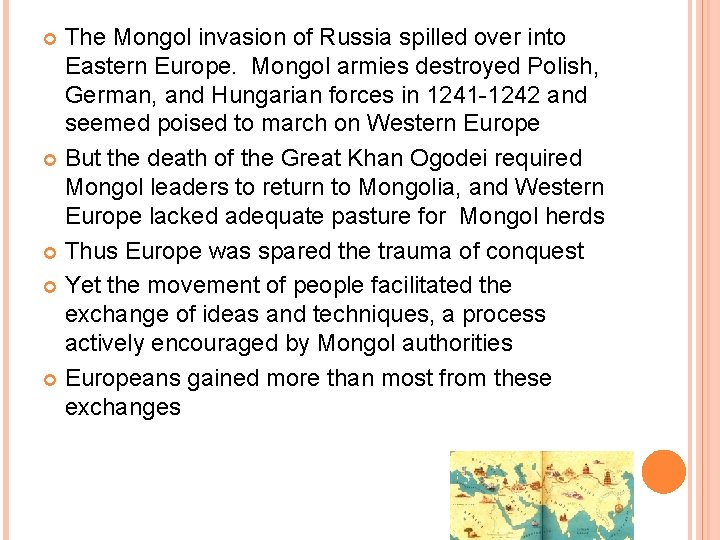
The Mongol invasion of Russia spilled over into Eastern Europe. Mongol armies destroyed Polish, German, and Hungarian forces in 1241 -1242 and seemed poised to march on Western Europe But the death of the Great Khan Ogodei required Mongol leaders to return to Mongolia, and Western Europe lacked adequate pasture for Mongol herds Thus Europe was spared the trauma of conquest Yet the movement of people facilitated the exchange of ideas and techniques, a process actively encouraged by Mongol authorities Europeans gained more than most from these exchanges
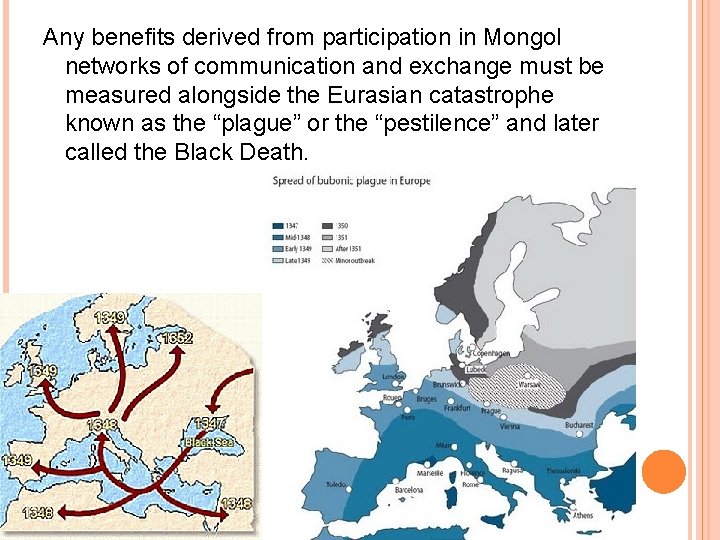
Any benefits derived from participation in Mongol networks of communication and exchange must be measured alongside the Eurasian catastrophe known as the “plague” or the “pestilence” and later called the Black Death.
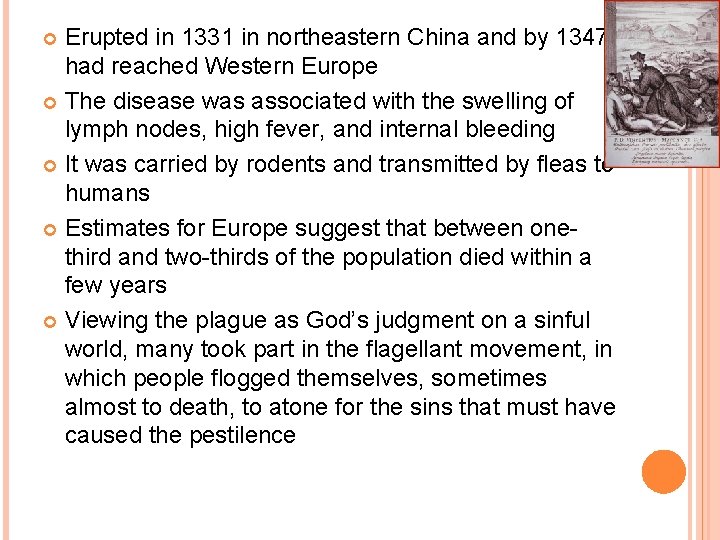
Erupted in 1331 in northeastern China and by 1347 had reached Western Europe The disease was associated with the swelling of lymph nodes, high fever, and internal bleeding It was carried by rodents and transmitted by fleas to humans Estimates for Europe suggest that between onethird and two-thirds of the population died within a few years Viewing the plague as God’s judgment on a sinful world, many took part in the flagellant movement, in which people flogged themselves, sometimes almost to death, to atone for the sins that must have caused the pestilence
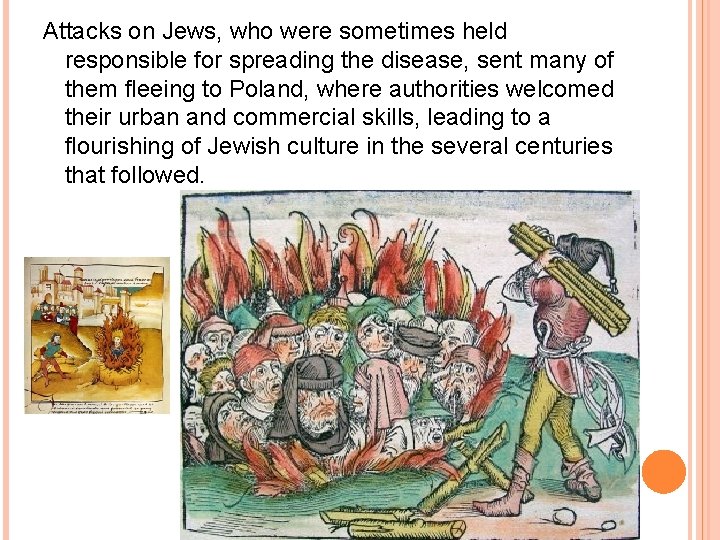
Attacks on Jews, who were sometimes held responsible for spreading the disease, sent many of them fleeing to Poland, where authorities welcomed their urban and commercial skills, leading to a flourishing of Jewish culture in the several centuries that followed.
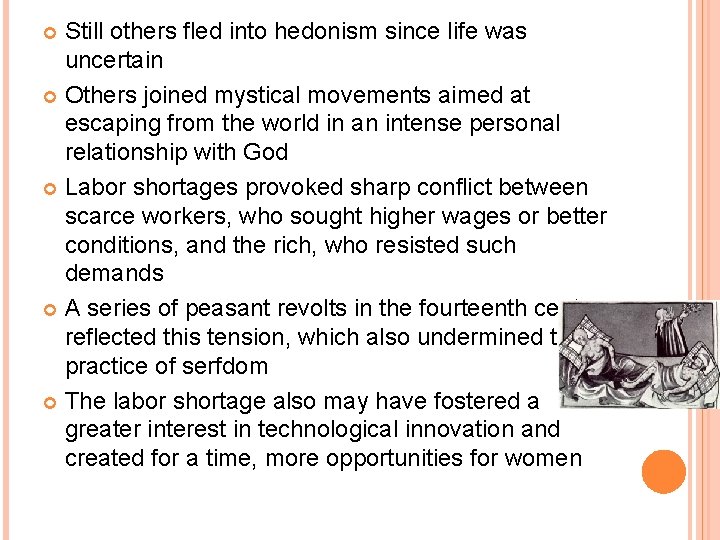
Still others fled into hedonism since life was uncertain Others joined mystical movements aimed at escaping from the world in an intense personal relationship with God Labor shortages provoked sharp conflict between scarce workers, who sought higher wages or better conditions, and the rich, who resisted such demands A series of peasant revolts in the fourteenth century reflected this tension, which also undermined the practice of serfdom The labor shortage also may have fostered a greater interest in technological innovation and created for a time, more opportunities for women
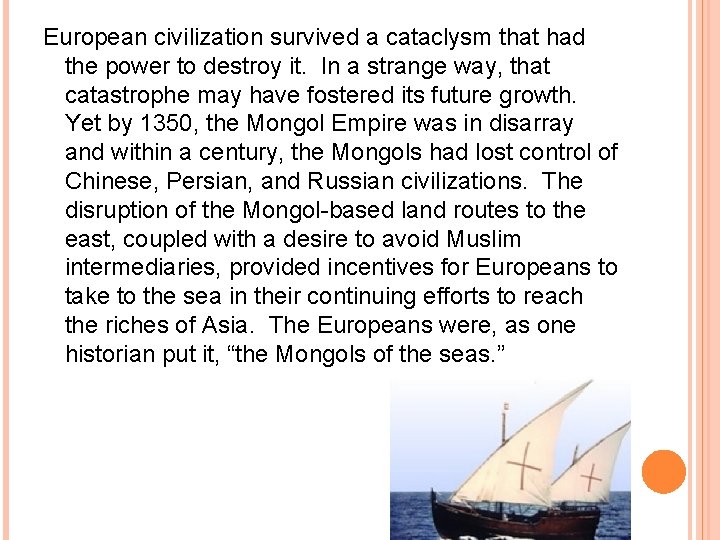
European civilization survived a cataclysm that had the power to destroy it. In a strange way, that catastrophe may have fostered its future growth. Yet by 1350, the Mongol Empire was in disarray and within a century, the Mongols had lost control of Chinese, Persian, and Russian civilizations. The disruption of the Mongol-based land routes to the east, coupled with a desire to avoid Muslim intermediaries, provided incentives for Europeans to take to the sea in their continuing efforts to reach the riches of Asia. The Europeans were, as one historian put it, “the Mongols of the seas. ”
STRAYER QUESTIONS How did Mongol rule change China? In what ways were the Mongols changed by China? How was Mongol rule in Persia different from that in China? In what ways did the Mongol Empire contribute to the globalization of the Eurasian world? Disease changes societies. How might this argument apply to the plague? How was the Russian experience of Mongol domination different from that of Persia or China?