THE FIRST INDUSTRIAL REVOLUTION Historical Significance of the



- Slides: 44
THE FIRST INDUSTRIAL REVOLUTION
Historical Significance of the Industrial Revolution in 1700 an ancient Greek or Roman would have been just as comfortable in Europe or America because daily life was not much different – agriculture and technology had not changed significantly in 2000+ years The Industrial Revolution changed human life drastically More has created in the last 250+ years than in the previous 2500+ years of known human history
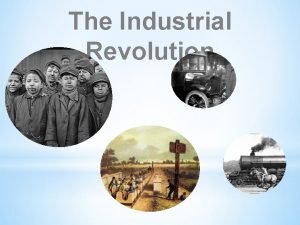
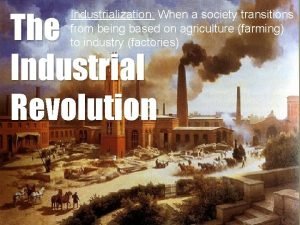
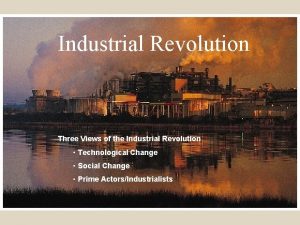
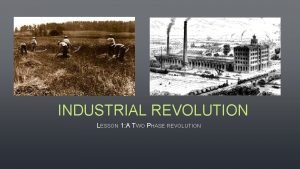
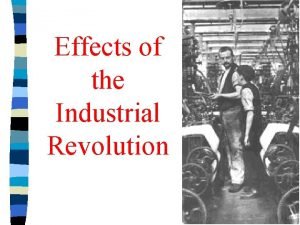
What was the Industrial Revolution? The Industrial Revolution was a fundamental change in the way goods were produced, from human labor to machines The more efficient means of production and higher levels of production triggered far-reaching changes to industrialized societies
England: Birthplace of the Industrial Revolution No concrete start date for the Industrial Revolution Marked by gradual, slow changes After 1750 – these changes were noticeable first in England
The Industrial Revolution Machines were invented which replaced human labor � Labor demands as well as the method of supplying labor changed. � Transportation improved � �Ships ○ Wooden ships → Iron ships → Steel ships ○ Wind-powered sails → Steam-powered boilers �Trains � Communication improved �Telegraph
Note From here on out the Industrial Revolution will be abbreviated as IR
Background of the Industrial Revolution Prior to the IR, which began in Britain in the mid 1700 s, most people in Europe and the United States were farmers. manufacturing was often done in people’s homes, using hand tools or basic machines. This was known as the Domestic System
Development of the Domestic System of Production (1600 -1749) � Domestic system of production – �Families manufactured goods from raw materials in their homes (typically articles of clothing) �Businesspeople picked up finished goods �workers paid based on number of items � By the mid 1700’s changes in GB led to greater demand for manufactured goods � Improved roads, agricultural improvements, population growth � Domestic system could not keep up with demand
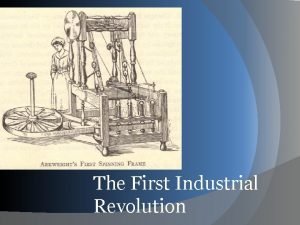
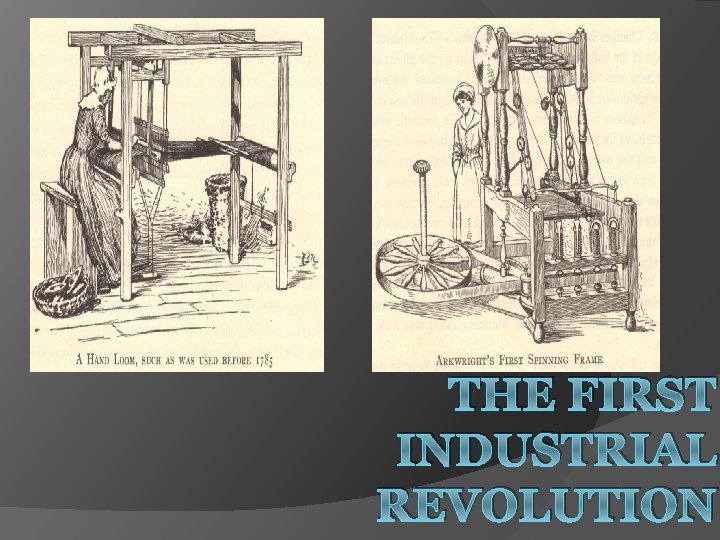
Important Developments Textiles Before IR, several workers had to spin enough thread to make cloth. In 1769, Richard Arkwright invented the water frame Allowed GB to produce cloth faster and cheaper than other countries.
Textiles in America To protect its investments, GB made it illegal for skilled mechanics or machine plans to leave the country. Samuel Slater, a skilled mechanic, ignored parliament and immigrated to the United States after memorizing the plans for the textile machine By 1793 Slater had opened a textile mill in the US
Changes in Manufacturing Despite Slater’s success, most manufacturing in the United States was still done by hand prior to 1800. In 1798 Eli Whitney attempted to solve some of the issues that made mass production of goods too difficult. Develops idea for interchangeable parts ○ Identical parts made mass production possible
American Manufacturing Despite the best efforts of men like Samuel Slater and Eli Whitney, manufacturing in the United States still grew slowly Lower British prices made competition difficult American investors would rather buy directly from GB than spend the necessary money to build new factories and machinery
Industrial Revolution Spark manufacturing growth in the late 1700’s and early 1800’s began to change around the time of the War of 1812. Americans began to realize that the United States was too reliant on foreign goods. The nationalistic pride that followed the end of the war allowed the United States to pursue manufacturing growth.
INDUSTRIAL REVOLUTION: CHANGES IN WORKING LIFE
Changes to the Domestic System The end of the War of 1812 created a desire to manufacture goods within the US on a greater scale. New machines and interchangeable parts increase the demand for goods. Domestic system simply could not meet the new demand for goods.
Rhode Island System � Developed to replace the domestic system of production � Faster method of production � Developed by Samuel Slater � Slater brought entire families to his mills to work. � Women and children could be paid less do simple but time consuming tasks. � Increased profits
The Lowell System Based on water powered textile mills Employed young unmarried women from local farms Women earned between $2 -$4 a week Had to pay for room and board at the mill
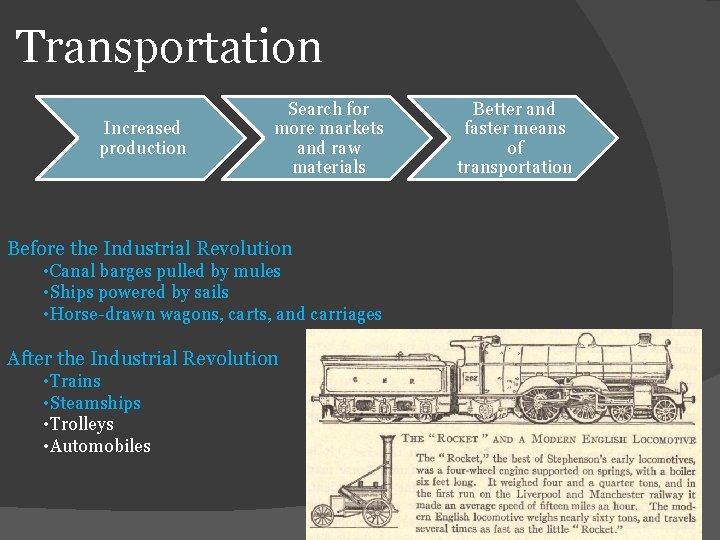
Transportation Increased production Search for more markets and raw materials Before the Industrial Revolution • Canal barges pulled by mules • Ships powered by sails • Horse-drawn wagons, carts, and carriages After the Industrial Revolution • Trains • Steamships • Trolleys • Automobiles Better and faster means of transportation
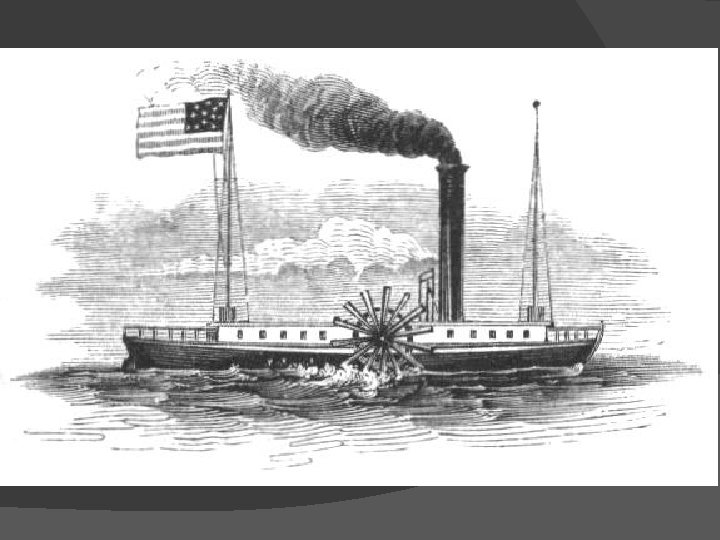
Steamboats � Robert Fulton invented the steamboat in 1807 � The Clermont operated the first regular steamboat route, running between Albany and New York City � 1838 – the Great Western first ship to sail across the Atlantic on steam power alone, completing the trip in 15 days
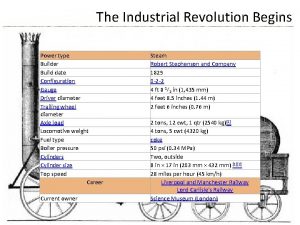
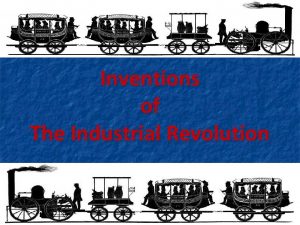
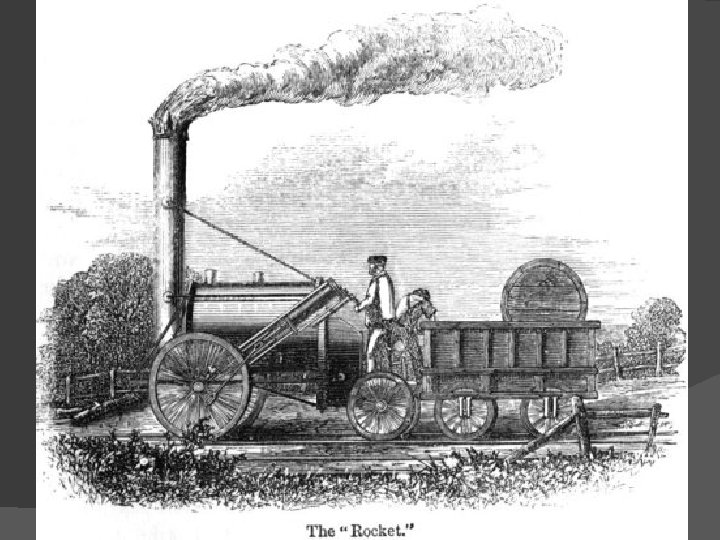
Development of Steam Locomotive The development of railroads was one of the most important events of the Industrial Revolution. George Stephenson had introduced the first successful steam locomotive in England. By the late 1820’s, several of his locomotives had been shipped to the United States.
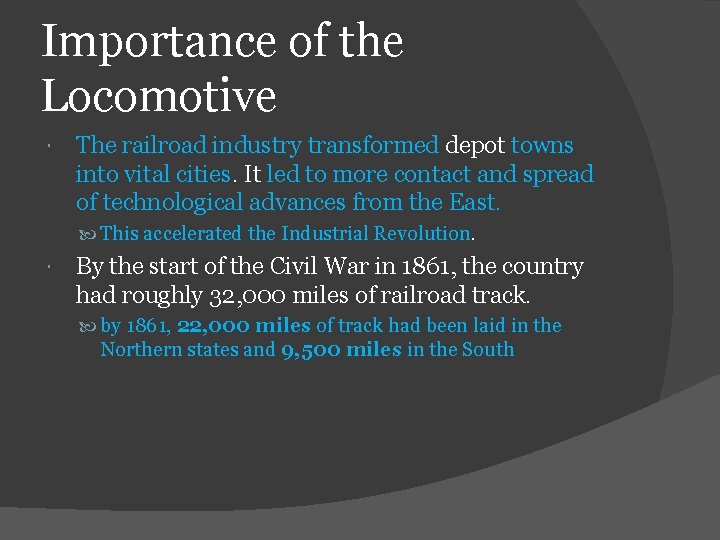
Importance of the Locomotive The railroad industry transformed depot towns into vital cities. It led to more contact and spread of technological advances from the East. This accelerated the Industrial Revolution. By the start of the Civil War in 1861, the country had roughly 32, 000 miles of railroad track. by 1861, 22, 000 miles of track had been laid in the Northern states and 9, 500 miles in the South
THE RESULTS OF THE INDUSTRIAL REVOLUTION
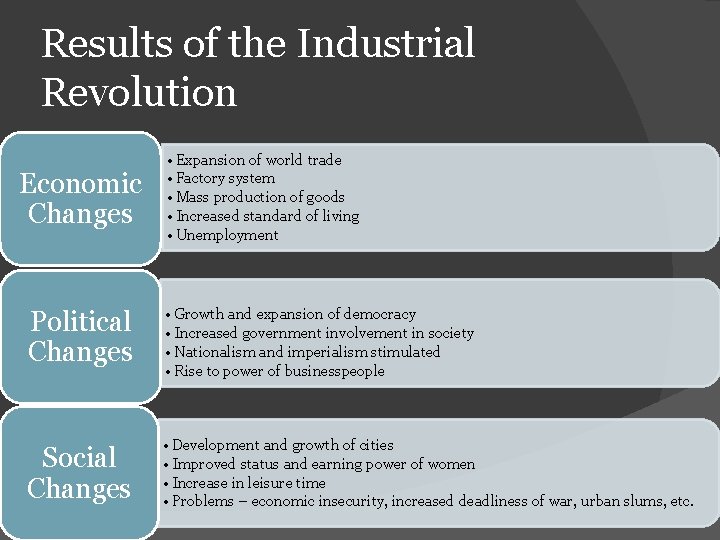
Results of the Industrial Revolution Economic Changes • Expansion of world trade • Factory system • Mass production of goods • Increased standard of living • Unemployment Political Changes • Growth and expansion of democracy • Increased government involvement in society • Nationalism and imperialism stimulated • Rise to power of businesspeople Social Changes • Development and growth of cities • Improved status and earning power of women • Increase in leisure time • Problems – economic insecurity, increased deadliness of war, urban slums, etc.
Reform Movements Labor Reform Abolition Women’s Rights Prison Reform Public Education
Causes Reaction to the Industrial Revolution Opposition to slavery Treatment of Mentally Ill Women’s Rights
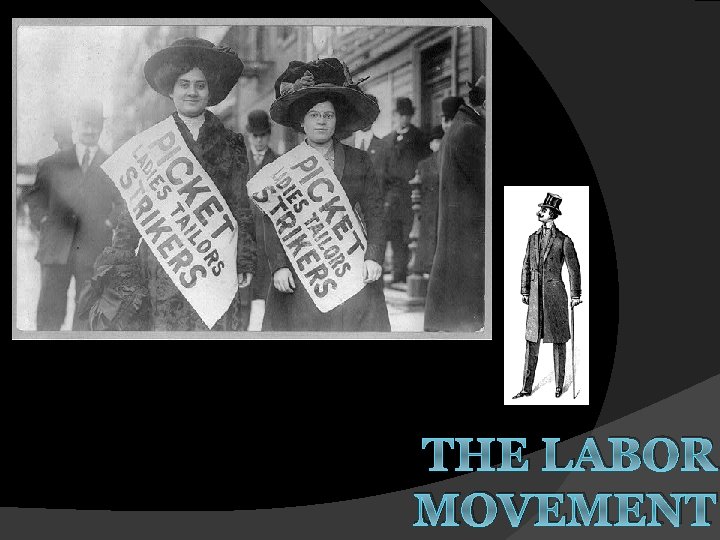
THE LABOR MOVEMENT
Changing Employee-Employer Relationships � Domestic system �Workers and employers knew each other personally �Workers could aspire to become employers � Factory system �Workers no longer owned the means of production (machinery) �Employers no longer knew workers personally ○ Factories often run by managers paid by the corporation �Relationships between employers and employees grew strained
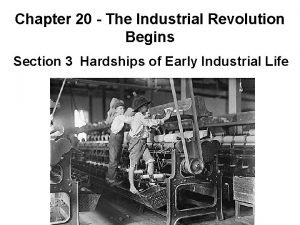
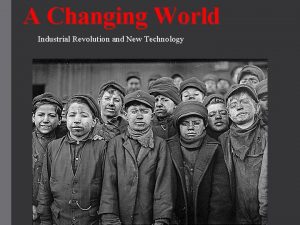
Problems of the Factory System � Factories were crowded, dark, and dirty � Workers toiled from dawn to dusk � Young children worked with dangerous machinery
Poor Living Conditions � Factories driven solely by profit � Factory (also company or mill) towns �Towns built by employers around factories to house workers �Workers charged higher prices than normal for rent, groceries, etc.
Slum Living Conditions � Factory towns – often built and owned by factories �Full of crowded tenements �Few amenities � Tenements – buildings with rented multiple dwellings �Apartment buildings with a more negative connotation �Overcrowded and unsanitary � Workers were unsatisfied both inside and outside the factories
Rise of Labor Unions � Before labor unions, workers bargained individually – “individual bargaining” �Before factories, a worker could bargain for better wages and working conditions by arguing his or her particular skills �But in factories, work is routine and one worker can easily replace another � With labor unions, workers bargained together as a group, or collective – “collective bargaining” �Organized groups of workers elected leaders to bargain on their behalf �Used tools (such as strikes) to gain rights
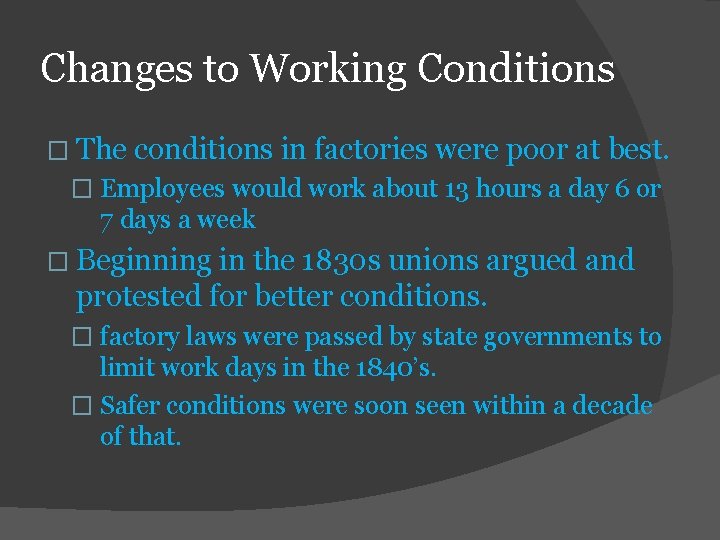
Changes to Working Conditions � The conditions in factories were poor at best. � Employees would work about 13 hours a day 6 or 7 days a week � Beginning in the 1830 s unions argued and protested for better conditions. � factory laws were passed by state governments to limit work days in the 1840’s. � Safer conditions were soon seen within a decade of that.
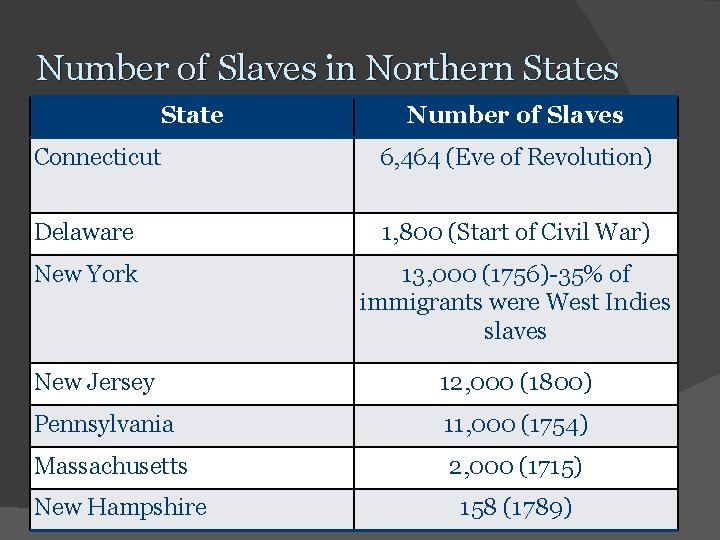
Number of Slaves in Northern States State Number of Slaves Connecticut 6, 464 (Eve of Revolution) Delaware 1, 800 (Start of Civil War) New York 13, 000 (1756)-35% of immigrants were West Indies slaves New Jersey 12, 000 (1800) Pennsylvania 11, 000 (1754) Massachusetts 2, 000 (1715) New Hampshire 158 (1789)
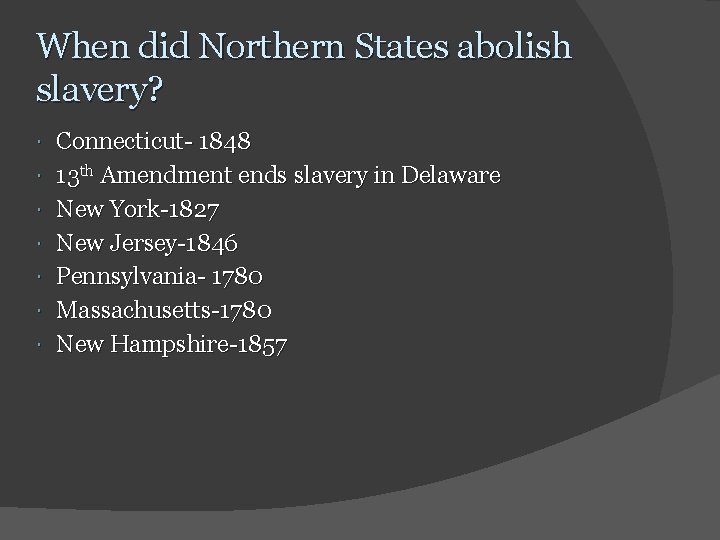
When did Northern States abolish slavery? Connecticut- 1848 13 th Amendment ends slavery in Delaware New York-1827 New Jersey-1846 Pennsylvania- 1780 Massachusetts-1780 New Hampshire-1857
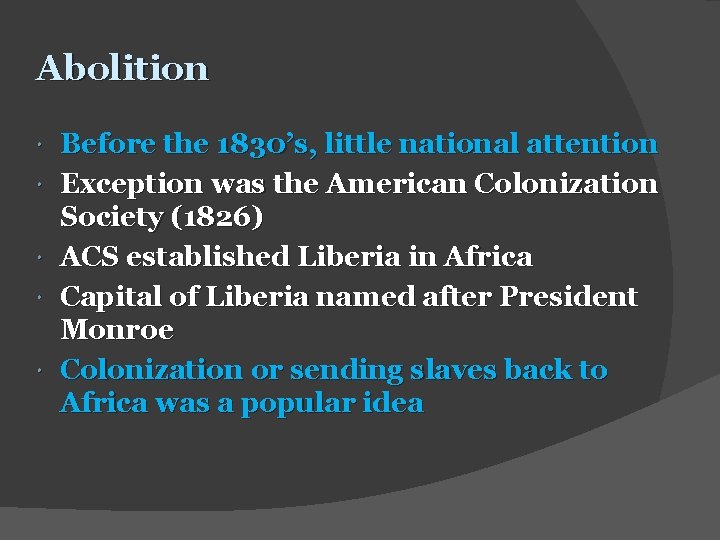
Abolition Before the 1830’s, little national attention Exception was the American Colonization Society (1826) ACS established Liberia in Africa Capital of Liberia named after President Monroe Colonization or sending slaves back to Africa was a popular idea
Militant Abolitionism Militant Abolitionists believed slavery was a sin Slavery contradicted Declaration of Independence MA wanted an immediate end of slavery Key leader of the movement was William Lloyd Garrison The Liberator-Newspaper Started in 1831
Garrison’s word angered many Southerners Garrison’s call to dissolve the Union met little support His message became very popular among other abolitionists Newspaper and pamphlets Public Arena Non Violence “Moral Suasion”
Nat Turner’s Rebellion Born into slavery in Virginia in 1800 Visions from God to lead a revolt August 22, Turner and 80 of his followers march from farm to farm assaulting white inhabitants 60 whites were killed Turner is captured and ordered to be executed Importance of revolt-first major slave resistance Many laws in the South further restrict the rights of black both slave and free
Frederick Douglas One person who symbolized both slave resistance and abolition was Frederick Douglas Son of a slave mother/unidentified white man Grew up in Maryland Taught himself to read and write Sent to a “slave breaker” at age 15 -whipped repeatedly In 1838 escaped to the North
Dorothea Dix “A voice for the mad” Massachusetts school teacher (1802 -1887) In 1841, starts her work to improve the lives of the mentally ill Most mentally ill in jail with criminals Treatment was inhumane Before the Civil War, 28 states constructed mental hospitals
Why were women upset? Couldn’t vote Denied access to education and employment Husbands had control over their wives’ property and wages Husbands retained custody of children after a divorce Denied jobs created by market revolution Private freedom
Why Seneca Falls? Residence of Elizabeth Cady Stanton In 1840, Stanton and Mott travelled to London as delegates of the World Anti. Slavery Convention Barred from participating because they were women