Teacher Excellence Support System TESS Leader Excellence and







- Slides: 59
Teacher Excellence Support System (TESS) Leader Excellence and Development System (LEADS) Law and Process for Administrators 2016 -17 1
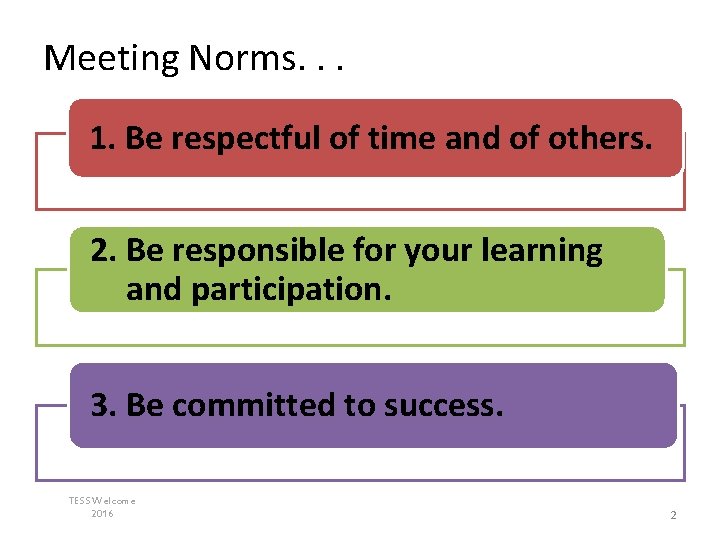
Meeting Norms. . . 1. Be respectful of time and of others. 2. Be responsible for your learning and participation. 3. Be committed to success. TESS Welcome 2016 2
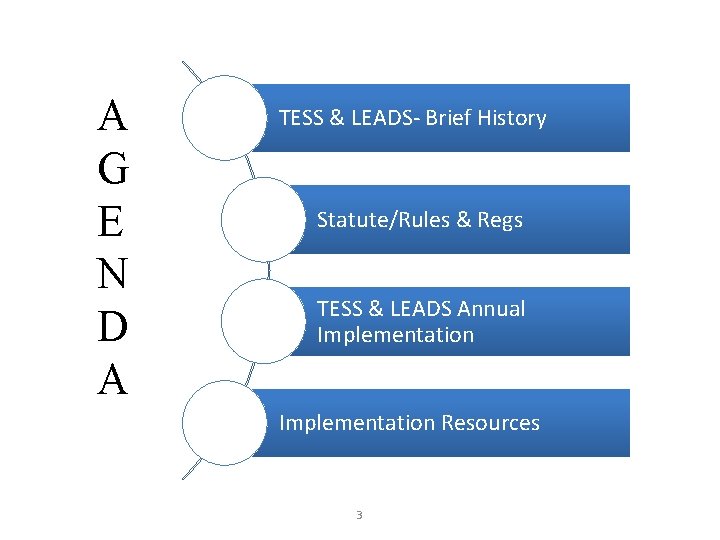
A G E N D A TESS & LEADS- Brief History Statute/Rules & Regs TESS & LEADS Annual Implementation Resources 3
Ø Develop a working knowledge of TESS & LEADS Ø Become familiar with the responsibilities of implementation Ø Identify personal nextsteps Learning Outcomes 4
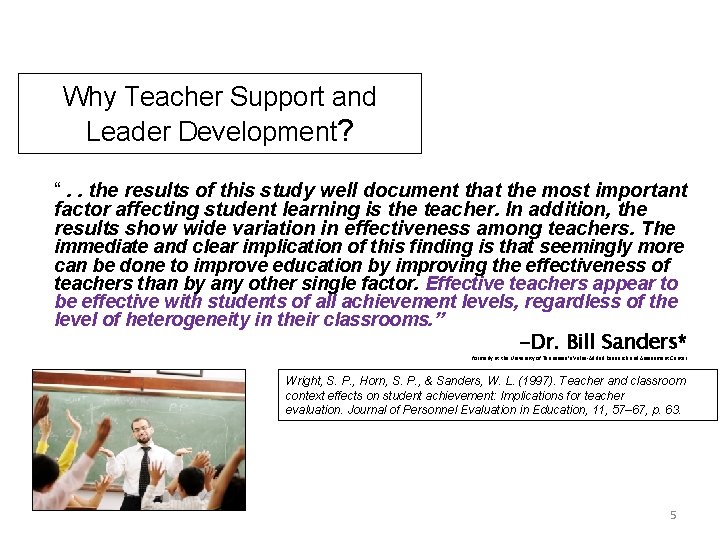
Why Teacher Support and Leader Development? “. . the results of this study well document that the most important factor affecting student learning is the teacher. In addition, the results show wide variation in effectiveness among teachers. The immediate and clear implication of this finding is that seemingly more can be done to improve education by improving the effectiveness of teachers than by any other single factor. Effective teachers appear to be effective with students of all achievement levels, regardless of the level of heterogeneity in their classrooms. ” -Dr. Bill Sanders* formerly at the University of Tennessee's Value-Added Research and Assessment Center Wright, S. P. , Horn, S. P. , & Sanders, W. L. (1997). Teacher and classroom context effects on student achievement: Implications for teacher evaluation. Journal of Personnel Evaluation in Education, 11, 57– 67, p. 63. 5
Every Student Succeeds Act (ESSA) Signed into Law, December 2015 Elements of ESSA • • States submit Accountability Plans include Accountability Goals Plans include Indicators Low-performing schools must be identified • Tests & Standards are required – but involve choice • Attention to English Language Learners and Special Education 6
TESS Rules §ADE promulgates Rules and Regulations - Written to clarify requirements for implementation - A time of public comment and Arkansas State Board approval TESS Foundation 2014 7
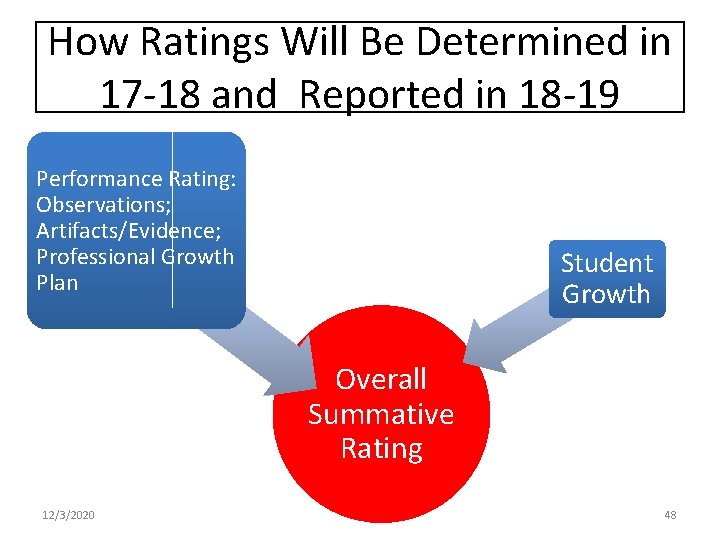
Annual Overall Rating • 6. 01 Annually in a summative evaluation year or an interim appraisal year, a public school shall assign each teacher employed by the school an annual overall rating that is based on: – 6. 01. 1 The teacher’s professional practice, as evidenced by the performance rating for a summative evaluation or for an interim appraisal; and – 6. 01. 2 Student growth, as determined by rules promulgated by the State Board. http: //www. arkansased. gov/public/userfiles/rules/Current/TESS_Final_Rule_for_SBOE_2015_11_12. pdf
TESS Composite Data: Arkansas School Performance Reports 2018 -2019 TESS Foundation 2014 9
TESS for Classroom Teachers and Specialty Teachers Gifted Coordinators Instructional Specialists Library Media Specialists School Counselors School Psychologists Speech-Language Pathologists TESS Foundation 2014 Notes: ‘Teacher’ = non-licensed classroom teacher working at public charter schools. Pre-school teachers are not required to attend, but districts/co-ops may include them. 10
Specialty Area Rubrics • Rubrics for the following specialty areas are available – School Counselor – Library Media Specialist – School Psychologist – Gifted Coordinator – Instructional Specialist – Speech Language Pathologist • Based on Danielson’s Framework for Teaching 11
TESS & LEADS Handbook Ø http: //www. arkansased. gov/divisio ns/human-resources-educatoreffectiveness-and-licensure/officeof-educator-effectiveness/teacherevaluation-system On the ADE Website. . . 14
TESS Objectives Arkansas Code 6 -17 -2802 • Provide a transparent and consistent teacher evaluation system that ensures effective teaching and promotes professional learning • Provide feedback and a support system supporting teachers improvement in professional knowledge and skills, as well as improving student learning • Provide a basis for making teacher employment decisions • Provide links between evaluation procedures and curricular standards, professional development, targeted instructional support • Inform policymakers on benefits of a consistent evaluation and support system in regard to improving student achievement • Increase the awareness of parents and guardians of students concerning the effectiveness of teachers 13
Track 1 Probationary/ Novice* AR-TESS Teacher Tracks 2 A: SUMMATIVE EVALUATION Year 3: SUMMATIVE EVALUATION Ø FORMAL OBSERVATION –Pre and Post Conference Ø INFORMAL OBSERVATIONS - may be included; may focus on PGP growth components Ø COLLABORATIVE PGP – review and/or revise Ø SUMMATIVE EVALUATION MEETING - summative rating results over all components Year 2: SUMMATIVE EVALUATION Ø FORMAL OBSERVATION –Pre and Post Conference Ø INFORMAL OBSERVATIONS - may be included: may focus on PGP growth components Ø COLLABORATIVE PGP – review and/or revise Ø SUMMATIVE EVALUATION MEETING - summative rating results over all components Year 1: SUMMATIVE EVALUATION Ø FORMAL OBSERVATION –Pre and Post Conference Ø INFORMAL OBSERVATIONS - may be included; may focus on PGP growth components Ø COLLABORATIVE PGP – Develop PGP Ø SUMMATIVE EVALUATION MEETING - summative rating results over all components Track 2 Interim Teacher Appraisal Process Track 3 Intensive SUMMATIVE EVALUATION Support Status Ø COLLABORATIVE INTENSIVE PGP – review and/or revise often Ø MAY INCLUDE INFORMAL AND FORMAL OBSERVATIONS Ø INFORMAL OBSERVATIONS - may be included; may focus on PGP growth components Ø COLLABORATIVE PGP – review and/or revise Ø SUMMATIVE EVALUATION MEETING - summative rating results over all components 2 B 3: INTERIM APPRAISAL Ø INFORMAL OBSERVATIONS - may be included; may focus on PGP growth components Ø COLLABORATIVE PGP – review and/or revise Ø END OF YEAR REVIEW - performance rating results based on PGP goals Ø FREQUENT TEACHER & EVALUATOR CONFERENCES Ø INFORMAL OBSERVATIONS - may be ü Note: Teacher may remain in this track for two semesters; and two additional semesters may be added if improvement is observed. included; may focus on PGP growth components Ø COLLABORATIVE PGP – review and/or revise Ø END OF YEAR REVIEW - performance rating results based on PGP goals Student growth will be a component of the educator’s overall rating. Student growth data will be available after the performance rating is established each year, in both summative and interim appraisal tracks. *1) A first year teacher is both a novice and probationary teacher. 2)"Probationary teacher" means a teacher who has not completed three (3) successive years of employment in the school district in which the teacher is currently employed. A teacher employed in a school district in this state for three (3) years or a teacher who has been given credit for a prior service in another school district shall be deemed to have completed the probationary period; however, an employing school district may, by a majority vote of the directors, provide for one (1) additional year of probationary status. Arkansas Code: § 6 -17 -1502 2 B 2: INTERIM APPRAISAL 2 B 1: INTERIM APPRAISAL Ø INFORMAL OBSERVATIONS - may be included; may focus on PGP growth components Ø COLLABORATIVE PGP – review and/or revise Ø END OF YEAR REVIEW - performance rating results based on PGP goals TESS does not conflict with, nor replace the Arkansas Teacher Fair Dismissal Act (ATFDA). Revised 7/15/15 15
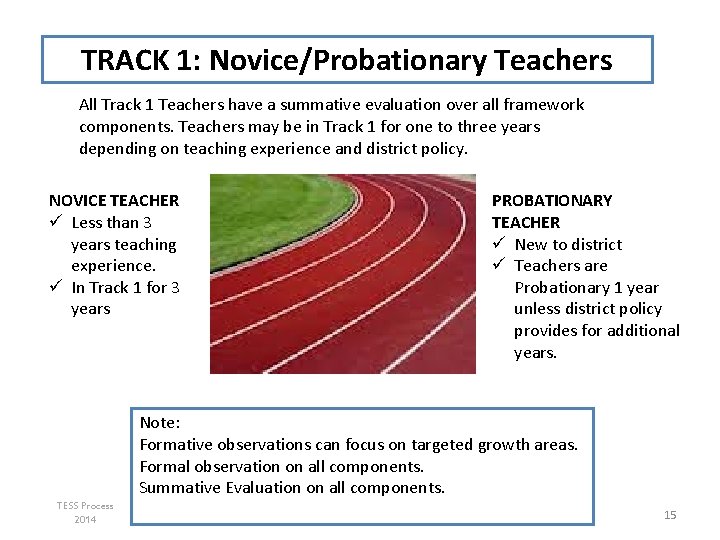
TRACK 1: Novice/Probationary Teachers All Track 1 Teachers have a summative evaluation over all framework components. Teachers may be in Track 1 for one to three years depending on teaching experience and district policy. NOVICE TEACHER ü Less than 3 years teaching experience. ü In Track 1 for 3 years PROBATIONARY TEACHER ü New to district ü Teachers are Probationary 1 year unless district policy provides for additional years. Note: Formative observations can focus on targeted growth areas. Formal observation on all components. Summative Evaluation on all components. TESS Process 2014 15
TRACK 2: Interim Teachers Appraisal Track 2 Teachers are in a 4 -year cycle which means one of four years is a Summative Evaluation year. The other three years are focused on the teacher’s Professional Growth Plan Goals. 2 A: SUMMATIVE EVALUATION YEAR ü Multiple informal ü observations ü Formal observation on all components TESS Process 2014 2 B 1, 2 B 2 & 2 B 3: INTERIM APPRAISAL YEARS ü Evaluated on PGP Components ü Teachers move from 2 B 2 to 2 B 1, then 2 A Note: Teachers may be moved from an Interim Appraisal Track to 2 A: Summative Evaluation Track by administrative decision following consideration of evidence collected and/or PGP work. 16
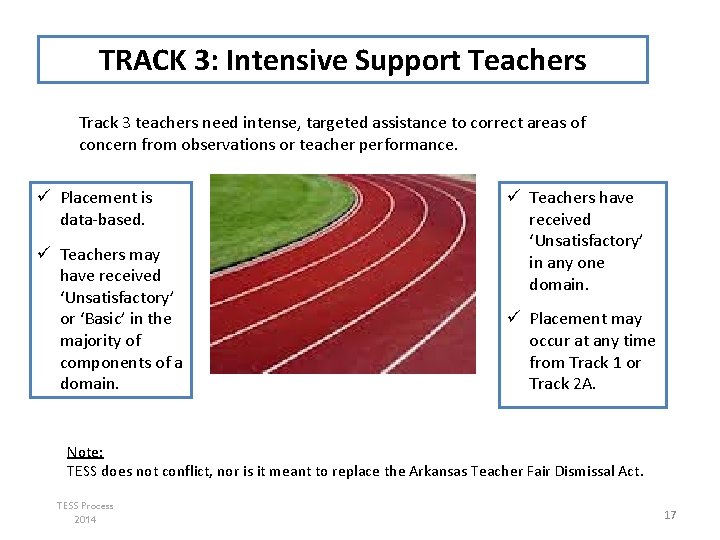
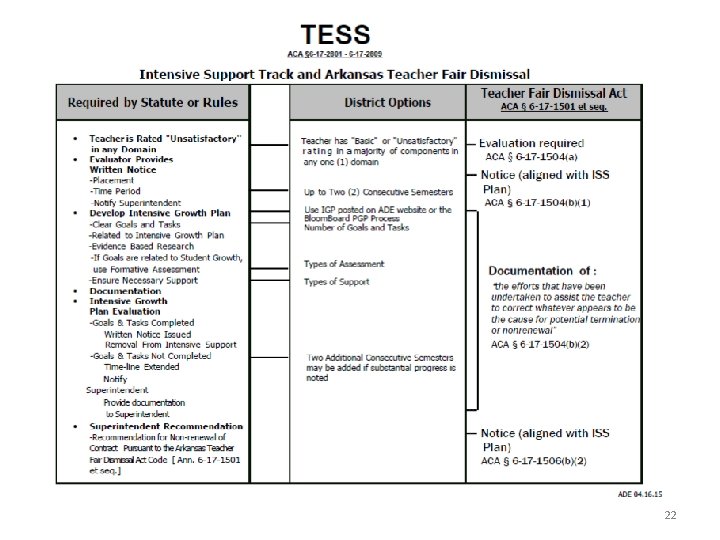
TRACK 3: Intensive Support Teachers Track 3 teachers need intense, targeted assistance to correct areas of concern from observations or teacher performance. ü Placement is data-based. ü Teachers may have received ‘Unsatisfactory’ or ‘Basic’ in the majority of components of a domain. ü Teachers have received ‘Unsatisfactory’ in any one domain. ü Placement may occur at any time from Track 1 or Track 2 A. Note: TESS does not conflict, nor is it meant to replace the Arkansas Teacher Fair Dismissal Act. TESS Process 2014 17
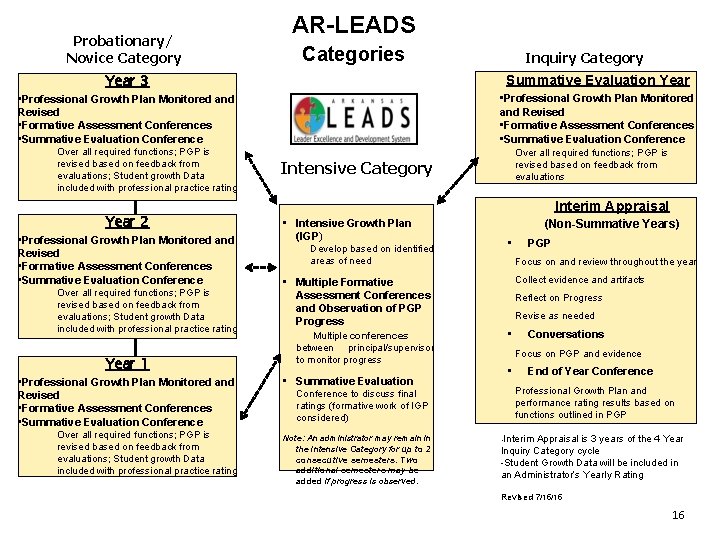
Probationary/ Novice Category AR-LEADS Categories Inquiry Category Year 3 Summative Evaluation Year • Professional Growth Plan Monitored and Revised • Formative Assessment Conferences • Summative Evaluation Conference Over all required functions; PGP is revised based on feedback from evaluations; Student growth Data included with professional practice rating Year 2 • Professional Growth Plan Monitored and Revised • Formative Assessment Conferences • Summative Evaluation Conference Over all required functions; PGP is revised based on feedback from evaluations; Student growth Data included with professional practice rating Year 1 • Professional Growth Plan Monitored and Revised • Formative Assessment Conferences • Summative Evaluation Conference Over all required functions; PGP is revised based on feedback from evaluations; Student growth Data included with professional practice rating Over all required functions; PGP is revised based on feedback from evaluations Intensive Category Interim Appraisal • Intensive Growth Plan (IGP) Develop based on identified areas of need • Multiple Formative Assessment Conferences and Observation of PGP Progress Multiple conferences (Non-Summative Years) • Focus on and review throughout the year Collect evidence and artifacts Reflect on Progress Revise as needed • between principal/supervisor to monitor progress • Summative Evaluation Conference to discuss final ratings (formative work of IGP considered) Note: An administrator may remain in the Intensive Category for up to 2 consecutive semesters. Two additional semesters may be added if progress is observed. PGP Conversations Focus on PGP and evidence • End of Year Conference Professional Growth Plan and performance rating results based on functions outlined in PGP -Interim Appraisal is 3 years of the 4 Year Inquiry Category cycle -Student Growth Data will be included in an Administrator’s Yearly Rating Revised 7/15/15 16
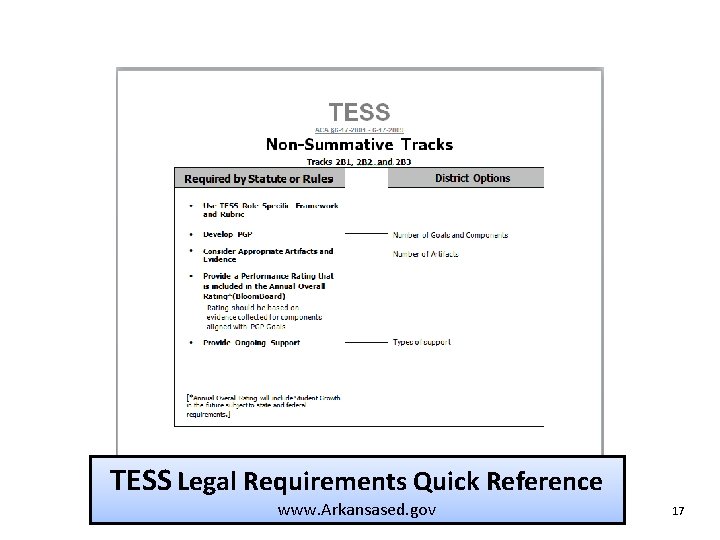
TESS Legal Requirements Quick Reference www. Arkansased. gov 19 17
20
21
22
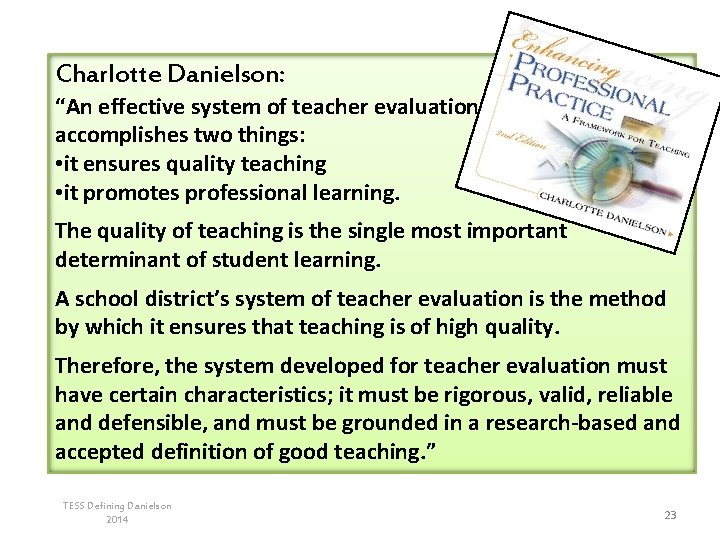
Charlotte Danielson: “An effective system of teacher evaluation accomplishes two things: • it ensures quality teaching • it promotes professional learning. The quality of teaching is the single most important determinant of student learning. A school district’s system of teacher evaluation is the method by which it ensures that teaching is of high quality. Therefore, the system developed for teacher evaluation must have certain characteristics; it must be rigorous, valid, reliable and defensible, and must be grounded in a research-based and accepted definition of good teaching. ” TESS Defining Danielson 2014 23
TESS Teacher Training • Requirements for teacher training in the Danielson Framework for Teachers are established at the school/district level. • Decisions about on-going training should be based on previous evaluations, professional learning, and/or a needs assessment. • Remember – New teachers must be trained in the evaluation system to be used. Use care in omitting component training. TESS Process 2014 24
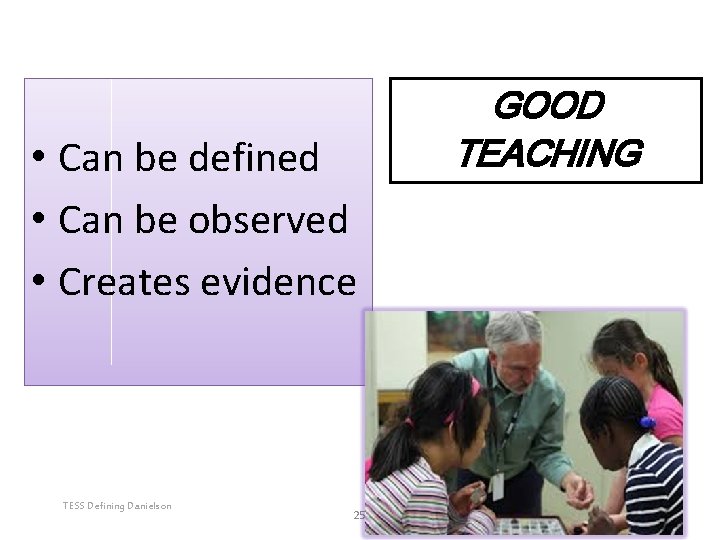
• Can be defined • Can be observed • Creates evidence TESS Defining Danielson 25 GOOD TEACHING
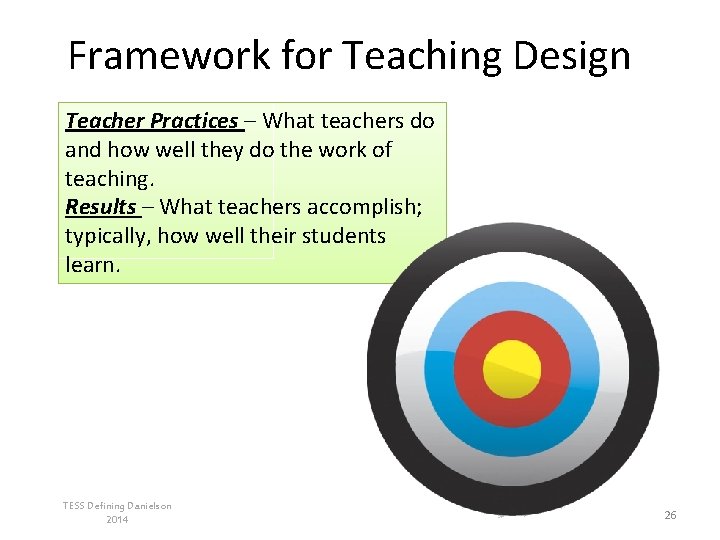
Framework for Teaching Design Teacher Practices – What teachers do and how well they do the work of teaching. Results – What teachers accomplish; typically, how well their students learn. TESS Defining Danielson 2014 26
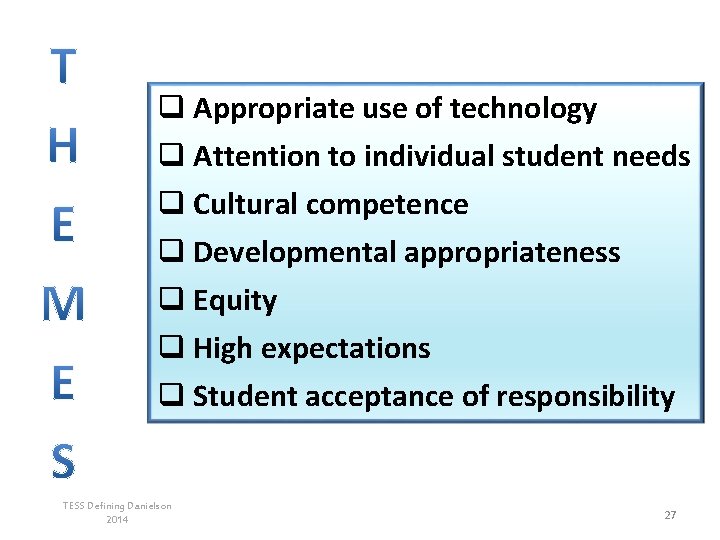
q Appropriate use of technology q Attention to individual student needs q Cultural competence q Developmental appropriateness q Equity q High expectations q Student acceptance of responsibility TESS Defining Danielson 2014 27
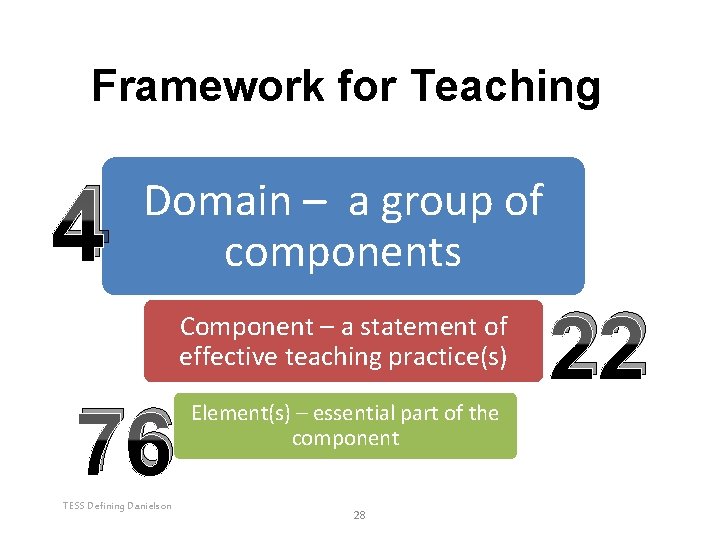
Framework for Teaching 4 Domain – a group of components Component – a statement of effective teaching practice(s) 76 TESS Defining Danielson Element(s) – essential part of the component 28 22
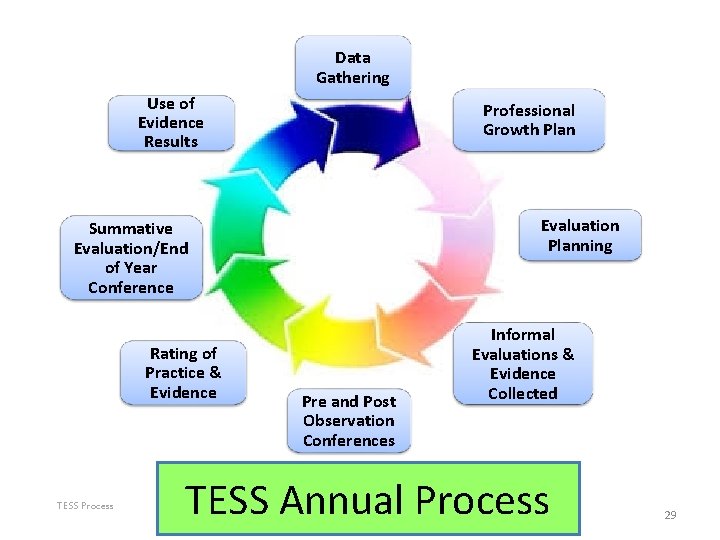
Data Gathering Use of Evidence Results Professional Growth Plan Evaluation Planning Summative Evaluation/End of Year Conference Rating of Practice & Evidence TESS Process Pre and Post Observation Conferences Informal Evaluations & Evidence Collected TESS Annual Process 29
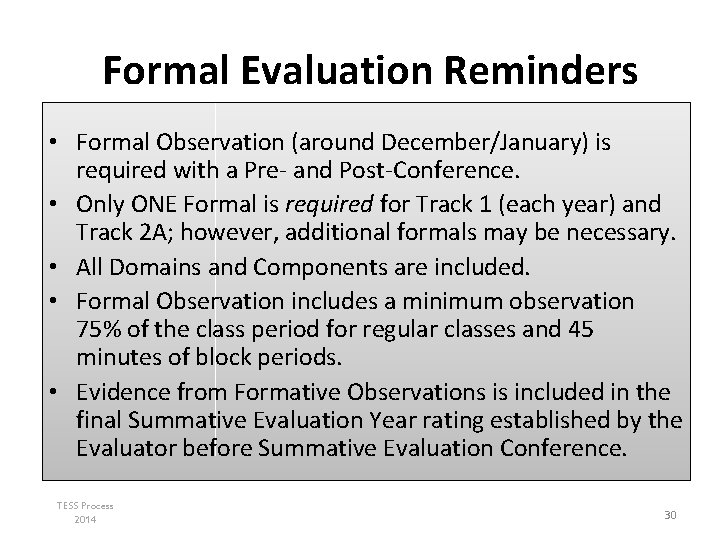
Formal Evaluation Reminders • Formal Observation (around December/January) is required with a Pre- and Post-Conference. • Only ONE Formal is required for Track 1 (each year) and Track 2 A; however, additional formals may be necessary. • All Domains and Components are included. • Formal Observation includes a minimum observation 75% of the class period for regular classes and 45 minutes of block periods. • Evidence from Formative Observations is included in the final Summative Evaluation Year rating established by the Evaluator before Summative Evaluation Conference. TESS Process 2014 30
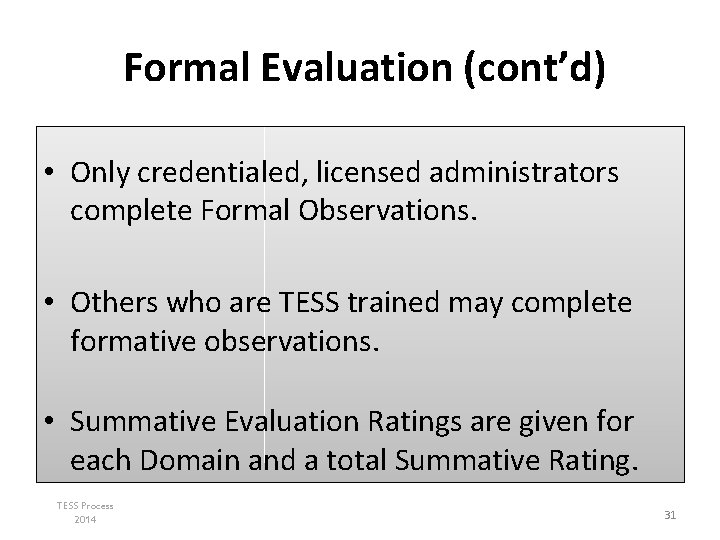
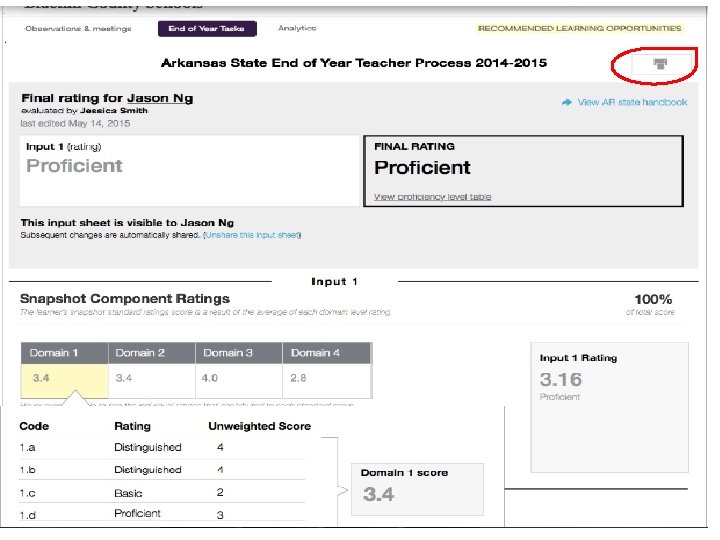
Formal Evaluation (cont’d) • Only credentialed, licensed administrators complete Formal Observations. • Others who are TESS trained may complete formative observations. • Summative Evaluation Ratings are given for each Domain and a total Summative Rating. TESS Process 2014 31
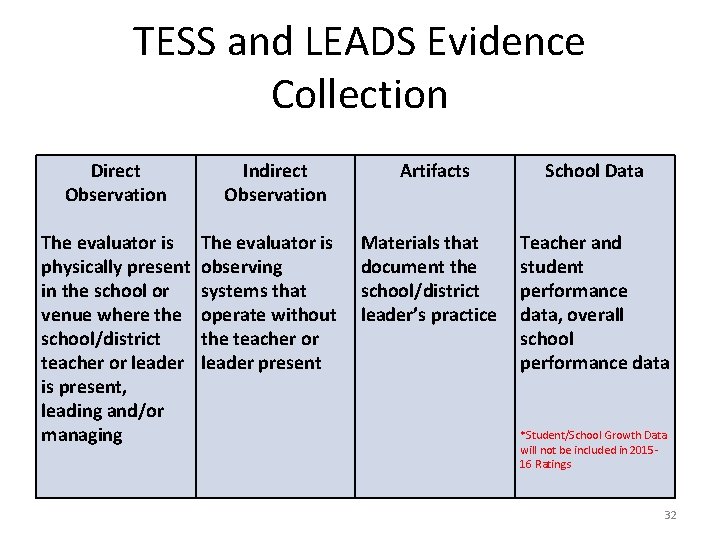
TESS and LEADS Evidence Collection Direct Observation The evaluator is physically present in the school or venue where the school/district teacher or leader is present, leading and/or managing Indirect Observation The evaluator is observing systems that operate without the teacher or leader present Artifacts Materials that document the school/district leader’s practice School Data Teacher and student performance data, overall school performance data *Student/School Growth Data will not be included in 201516 Ratings 32
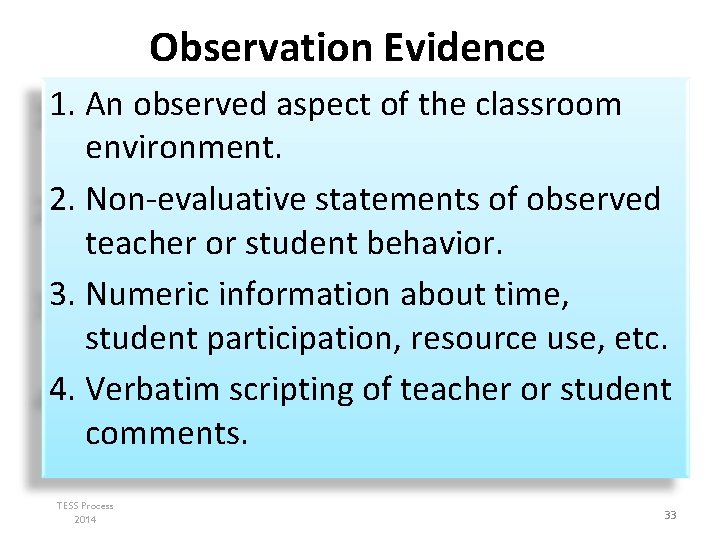
Observation Evidence 1. An observed aspect of the classroom environment. 2. Non-evaluative statements of observed teacher or student behavior. 3. Numeric information about time, student participation, resource use, etc. 4. Verbatim scripting of teacher or student comments. TESS Process 2014 33
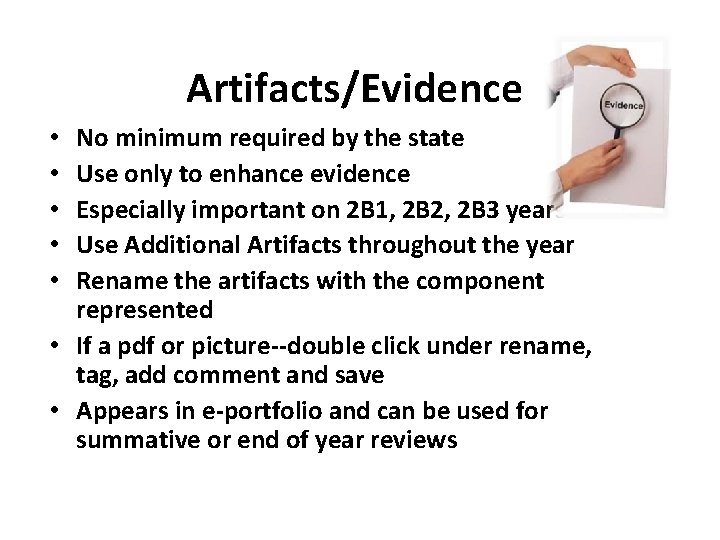
Artifacts/Evidence No minimum required by the state Use only to enhance evidence Especially important on 2 B 1, 2 B 2, 2 B 3 years Use Additional Artifacts throughout the year Rename the artifacts with the component represented • If a pdf or picture--double click under rename, tag, add comment and save • Appears in e-portfolio and can be used for summative or end of year reviews • • •
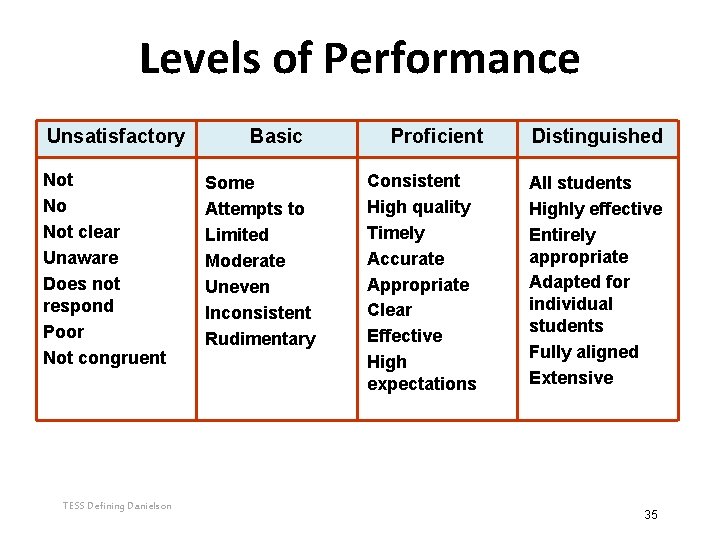
Levels of Performance Unsatisfactory Not No Not clear Unaware Does not respond Poor Not congruent TESS Defining Danielson Basic Some Attempts to Limited Moderate Uneven Inconsistent Rudimentary Proficient Consistent High quality Timely Accurate Appropriate Clear Effective High expectations Distinguished All students Highly effective Entirely appropriate Adapted for individual students Fully aligned Extensive 35
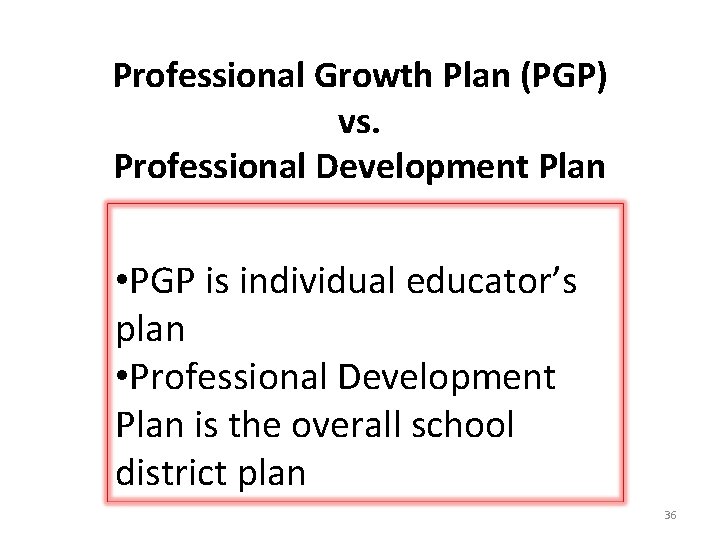
Professional Growth Plan (PGP) vs. Professional Development Plan • PGP is individual educator’s plan • Professional Development Plan is the overall school district plan 36
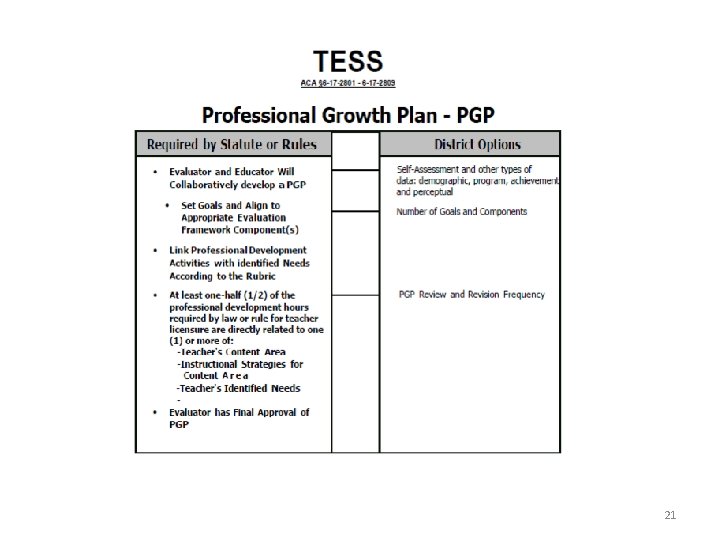
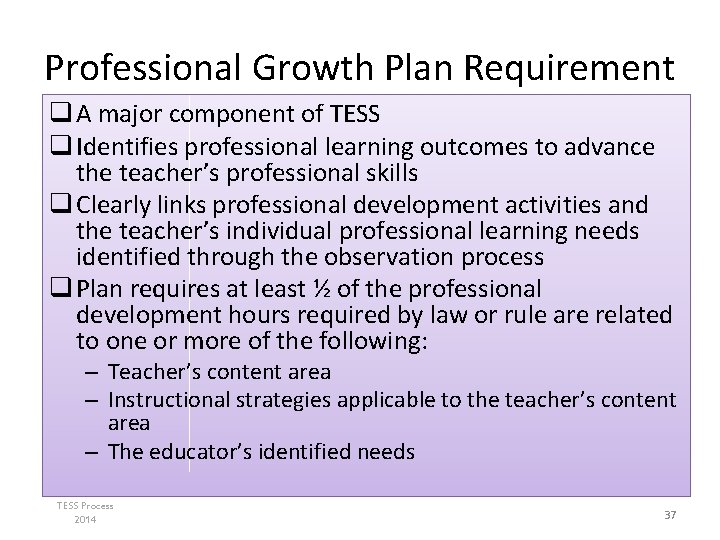
Professional Growth Plan Requirement q A major component of TESS q Identifies professional learning outcomes to advance the teacher’s professional skills q Clearly links professional development activities and the teacher’s individual professional learning needs identified through the observation process q Plan requires at least ½ of the professional development hours required by law or rule are related to one or more of the following: – Teacher’s content area – Instructional strategies applicable to the teacher’s content area – The educator’s identified needs TESS Process 2014 37
• PGP developed based on data • Providing data, both qualitative and quantitative, in a variety of forms supports group members in constructing shared understanding from their work • Data have no meaning beyond that which we make of them • Shared meaning develops from collaboratively exploring, analyzing, and interpreting data Provide Data
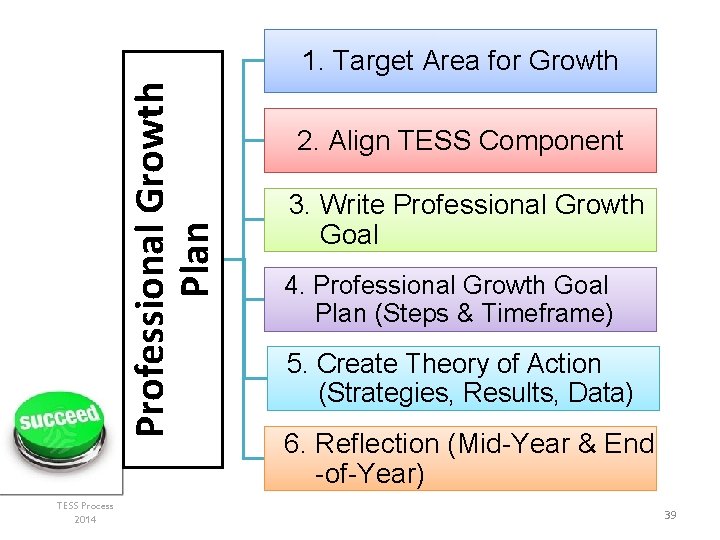
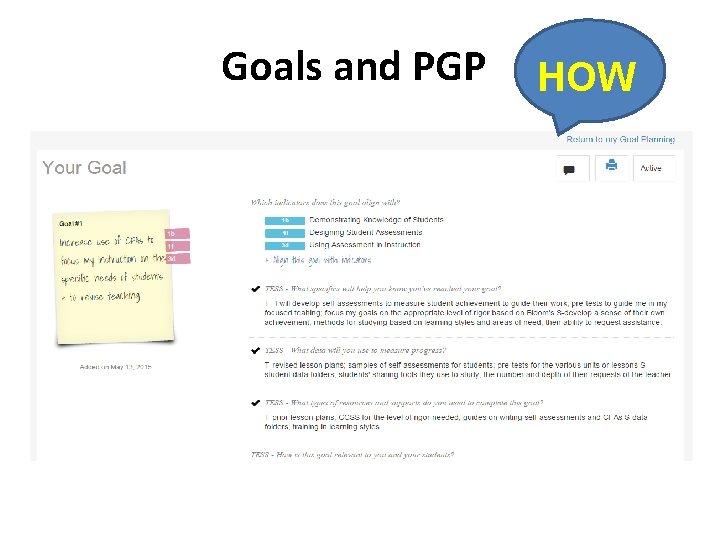
Professional Growth Plan 1. Target Area for Growth TESS Process 2014 2. Align TESS Component 3. Write Professional Growth Goal 4. Professional Growth Goal Plan (Steps & Timeframe) 5. Create Theory of Action (Strategies, Results, Data) 6. Reflection (Mid-Year & End -of-Year) 39
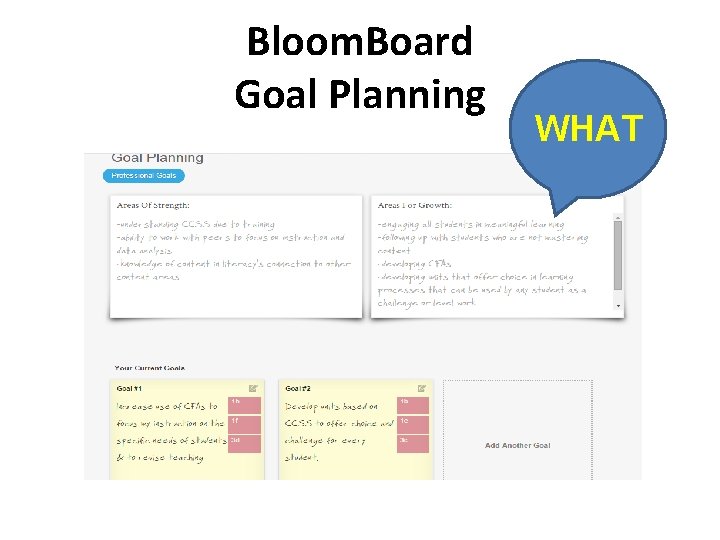
Bloom. Board Goal Planning WHAT
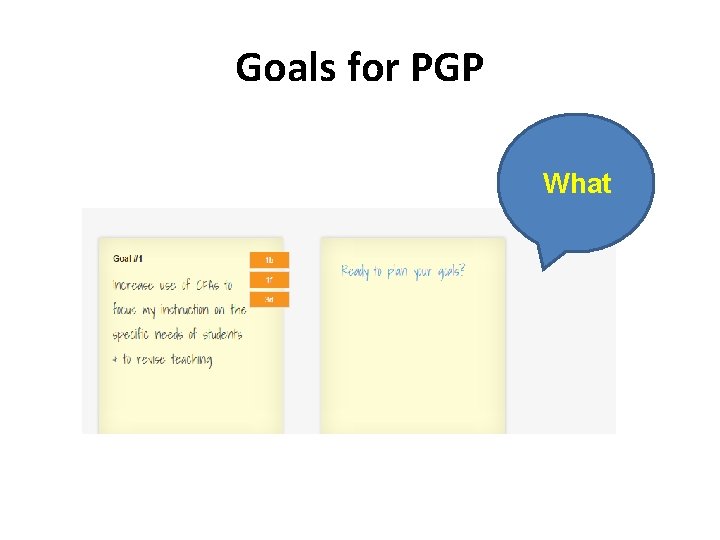
Goals for PGP What
Goals and PGP HOW
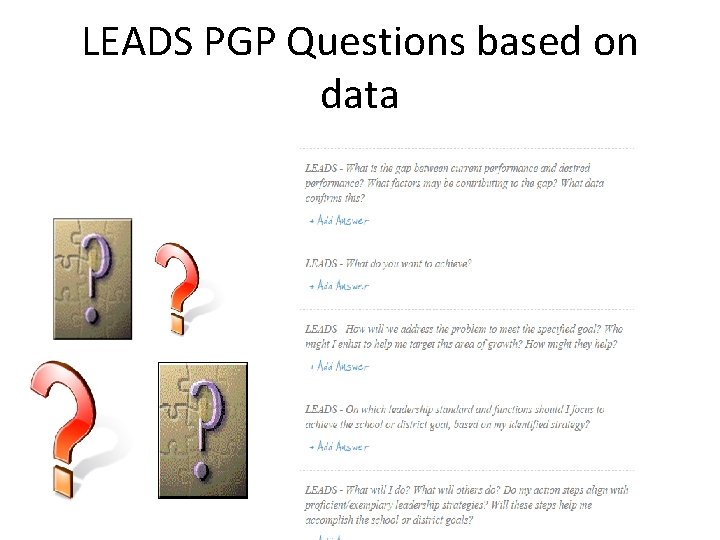
LEADS PGP Questions based on data
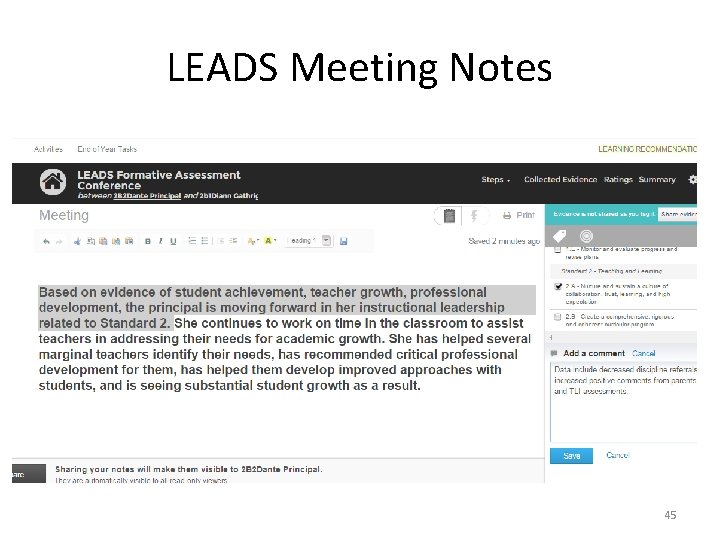
LEADS Meeting Notes 45
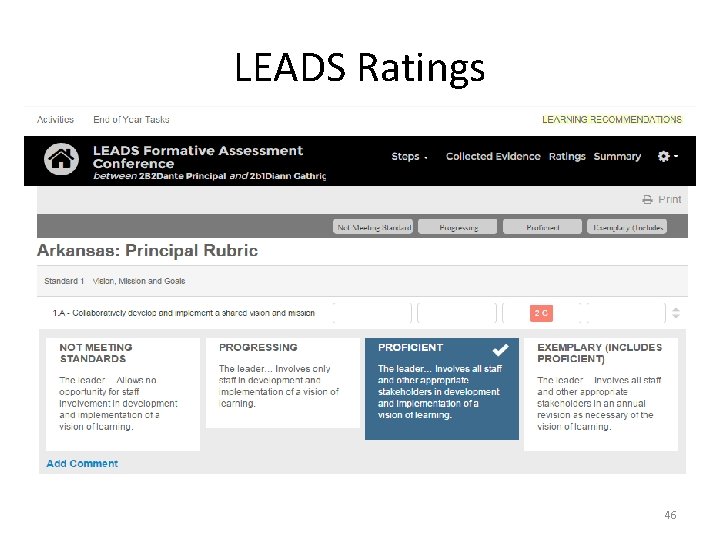
LEADS Ratings 46
Of all the approaches available to educators to promote teacher learning, the most powerful is that of professional conversation. Talk About Teaching! Charlotte Danielson 2009, Corwin Press TESS Defining Danielson 2014 47
How Ratings Will Be Determined in 17 -18 and Reported in 18 -19 Performance Rating: Observations; Artifacts/Evidence; Professional Growth Plan Student Growth Overall Summative Rating 12/3/2020 48
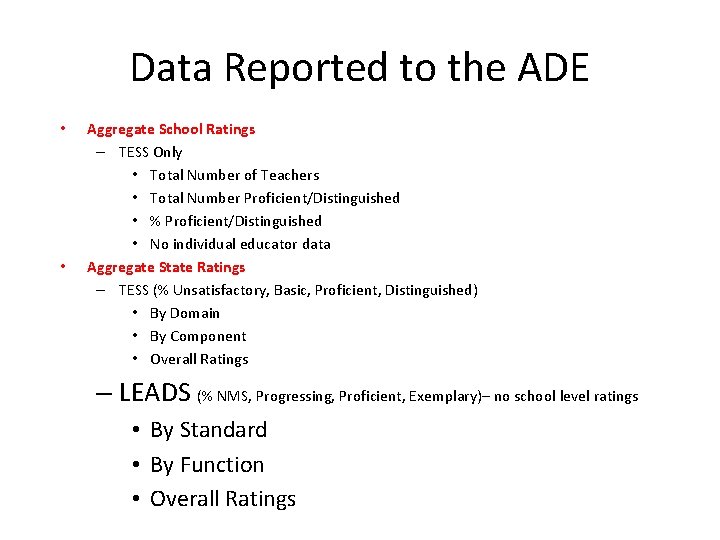
Data Reported to the ADE • • Aggregate School Ratings – TESS Only • Total Number of Teachers • Total Number Proficient/Distinguished • % Proficient/Distinguished • No individual educator data Aggregate State Ratings – TESS (% Unsatisfactory, Basic, Proficient, Distinguished) • By Domain • By Component • Overall Ratings – LEADS (% NMS, Progressing, Proficient, Exemplary)– no school level ratings • By Standard • By Function • Overall Ratings
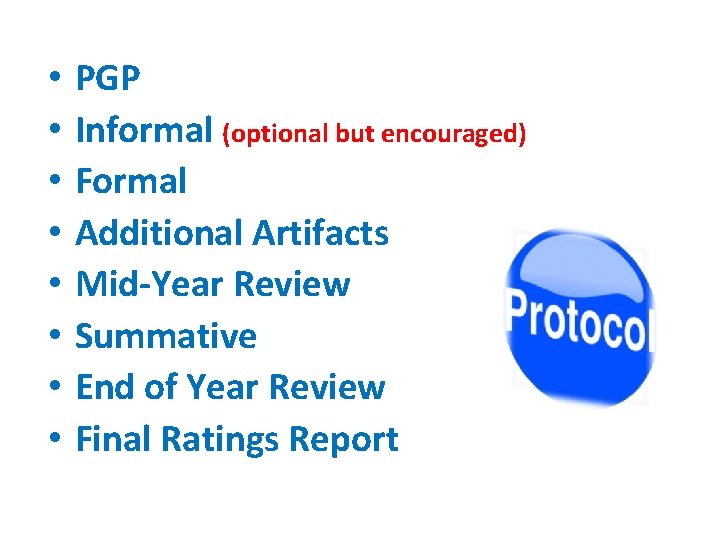
• • PGP Informal (optional but encouraged) Formal Additional Artifacts Mid-Year Review Summative End of Year Review Final Ratings Report
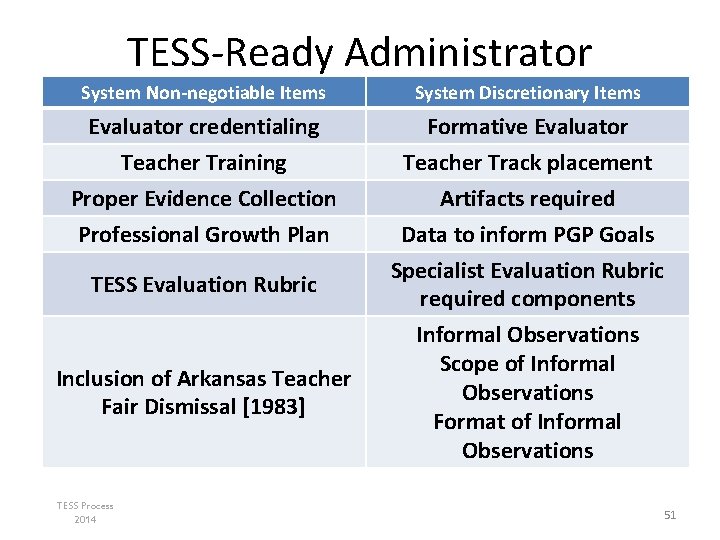
TESS-Ready Administrator System Non-negotiable Items System Discretionary Items Evaluator credentialing Formative Evaluator Teacher Training Teacher Track placement Proper Evidence Collection Artifacts required Professional Growth Plan Data to inform PGP Goals TESS Evaluation Rubric Specialist Evaluation Rubric required components Inclusion of Arkansas Teacher Fair Dismissal [1983] Informal Observations Scope of Informal Observations Format of Informal Observations TESS Process 2014 51
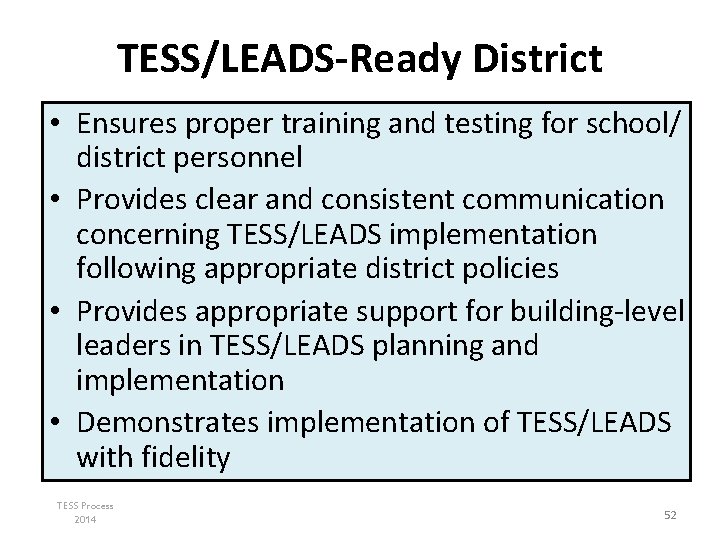
TESS/LEADS-Ready District • Ensures proper training and testing for school/ district personnel • Provides clear and consistent communication concerning TESS/LEADS implementation following appropriate district policies • Provides appropriate support for building-level leaders in TESS/LEADS planning and implementation • Demonstrates implementation of TESS/LEADS with fidelity TESS Process 2014 52
The Arkansas Department of Education will post a video on TESS for viewing by all teachers and administrators on Arkansased. gov 53
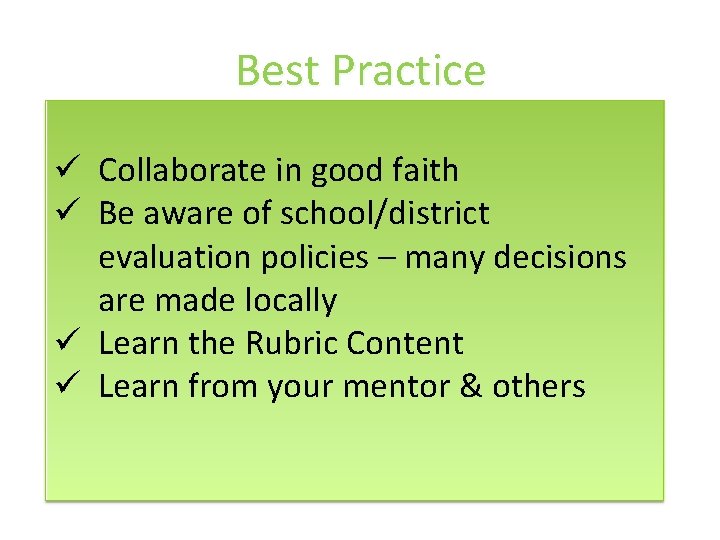
Best Practice ü Collaborate in good faith ü Be aware of school/district evaluation policies – many decisions are made locally ü Learn the Rubric Content ü Learn from your mentor & others
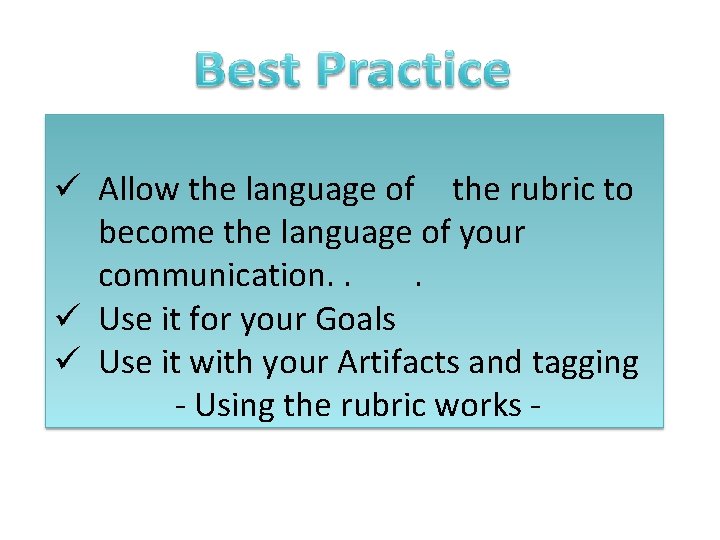
ü Allow the language of the rubric to become the language of your communication. . . ü Use it for your Goals ü Use it with your Artifacts and tagging - Using the rubric works -
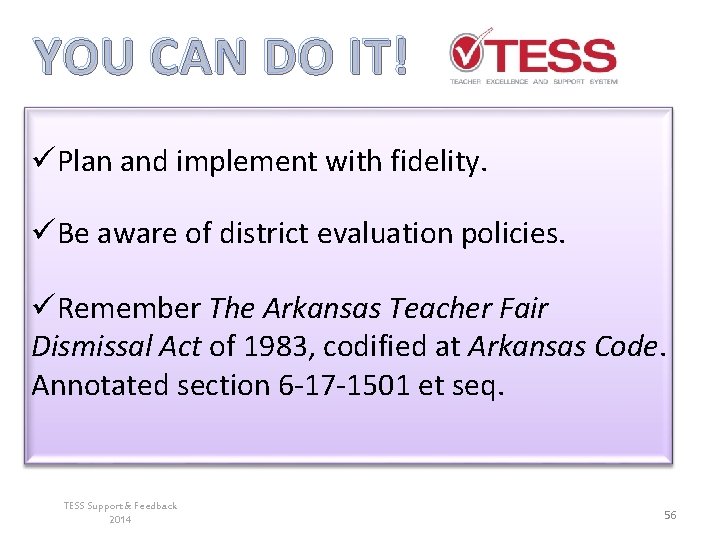
YOU CAN DO IT! üPlan and implement with fidelity. üBe aware of district evaluation policies. üRemember The Arkansas Teacher Fair Dismissal Act of 1983, codified at Arkansas Code. Annotated section 6 -17 -1501 et seq. TESS Support & Feedback 2014 56
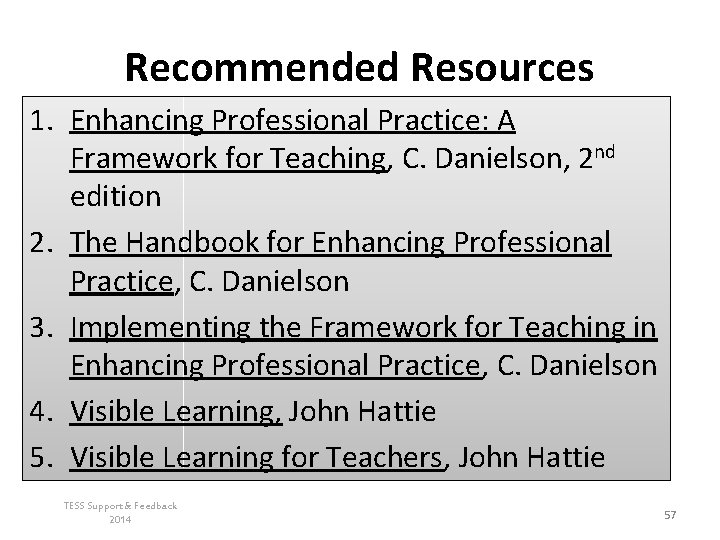
Recommended Resources 1. Enhancing Professional Practice: A Framework for Teaching, C. Danielson, 2 nd edition 2. The Handbook for Enhancing Professional Practice, C. Danielson 3. Implementing the Framework for Teaching in Enhancing Professional Practice, C. Danielson 4. Visible Learning, John Hattie 5. Visible Learning for Teachers, John Hattie TESS Support & Feedback 2014 57
Recommended Resource Principalcenter. com for Justin Baeder of The Principal Center subscribe to his newsletter for Frameworkcentered learning TESS Support & Feedback 2014 58
Sandra Hurst, Director of Educator Evaluation Sandra. Hurst@Arkansas. gov Renee Nelson, Program Advisor Renee. Nelson@Arkansas. gov Becky Gibson, Program Advisor Becky. Gibson@Arkansas. gov Diann Gathright, State Trainer Diann_Gathright@yahoo. com Jim Johnson, State Trainer Jim. Johnson 629@yahoo. com 59