
TESS 2 0 Arkansas Teacher Effectiveness Created for



- Slides: 31
TESS 2. 0 Arkansas Teacher Effectiveness Created for Arkansas Novice Teachers Created by The Office of Educator Support & Development Little Rock AR
T O P I C S Welcome & Introductions About Teacher Effectiveness Guiding Improvement: The Rubric Closing & Response
T O P I C S Welcome & Introductions About Teacher Effectiveness Guiding Improvement: The Rubric Closing & Response
EFFECTIVE [IH-FEK-TIV] ADJECTIVE 1. ADEQUATE TO ACCOMPLISH A PURPOSE; PRODUCIN G THE INTENDED OR EXPECTED RESULT: EFFECTIVE TEACHING METHODS; EFFECTIVE STEPS TOWARD PEACE. www. dictionary. com
ESSA DEFINES EFFECTIVE TEACHERS Properly plans for all students Creates the best environment for student learning Uses the most effective instructional procedures Communicates & Collaborates effectively Continually grows
TEACHER EXCELLENCE & SUPPORT SYSTEM State Statute – Act 1209 of 2011 Arkansas’ ESEA Flexibility Plan: Federal waiver from NCLB (2012) TESS Law Amended– Act 709 & 1091 of 2013 & 2015 Federal Every Student Succeeds Act (ESSA)– December 2015 Arkansas Law ESSA – Act 295 of 2017 eff. 8/1/2017; Rules – estimated final by 12/31/2017
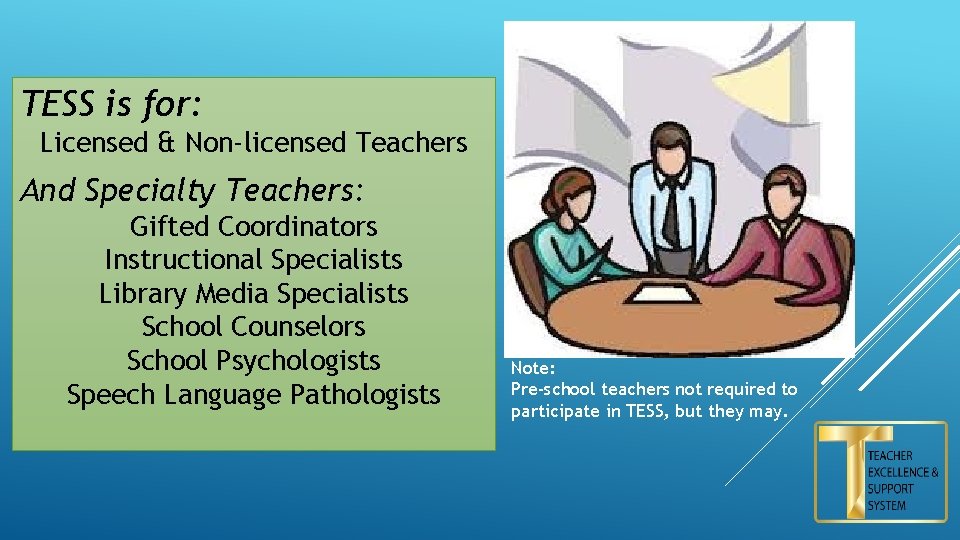
TESS is for: Licensed & Non-licensed Teachers And Specialty Teachers: Gifted Coordinators Instructional Specialists Library Media Specialists School Counselors School Psychologists Speech Language Pathologists Note: Pre-school teachers not required to participate in TESS, but they may.
TESS & THE NOVICE TEACHER The Focus of TESS is: v Effective teaching practice v The impact of quality teaching on positive student outcomes v Continuous v Student v. A improvement for teachers growth is embedded in the TESS Rubric Summative Evaluation for Novice teachers is not required by the state (Novice = 3 years)
TESS & THE NOVICE TEACHER The Focus of TESS is: v Teacher Learning & Growth is guided by a Professional Growth Plan (PGP) The Learning formats for teachers may be collaboration, self-directed research, or micro-credentialing v Novice Teacher mentoring will be through Educational Co-Ops. Mentoring will be done as a coaching model.
TESS & THE NOVICE TEACHER These are local decisions: v The use of physical documentation, or ‘artifacts’ v The number and format of observations & ratings v Evidence v How of student growth to use the online system for TESS: Bloom. Board
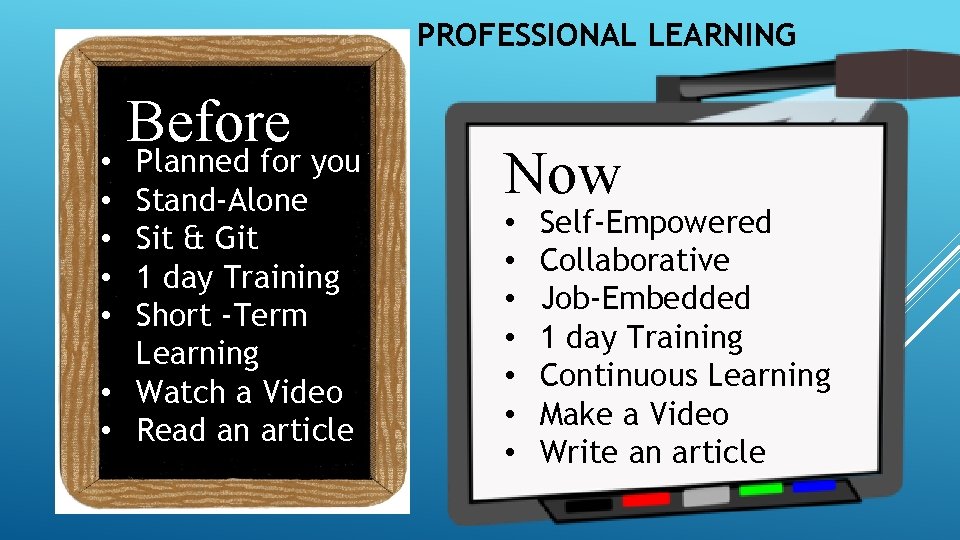
PROFESSIONAL LEARNING Before Planned for you Stand-Alone Sit & Git 1 day Training Short -Term Learning • Watch a Video • Read an article • • • Now • • Self-Empowered Collaborative Job-Embedded 1 day Training Continuous Learning Make a Video Write an article
T O P I C S Welcome & Introductions About Teacher Effectiveness Guiding Improvement: The Rubric Closing & Response
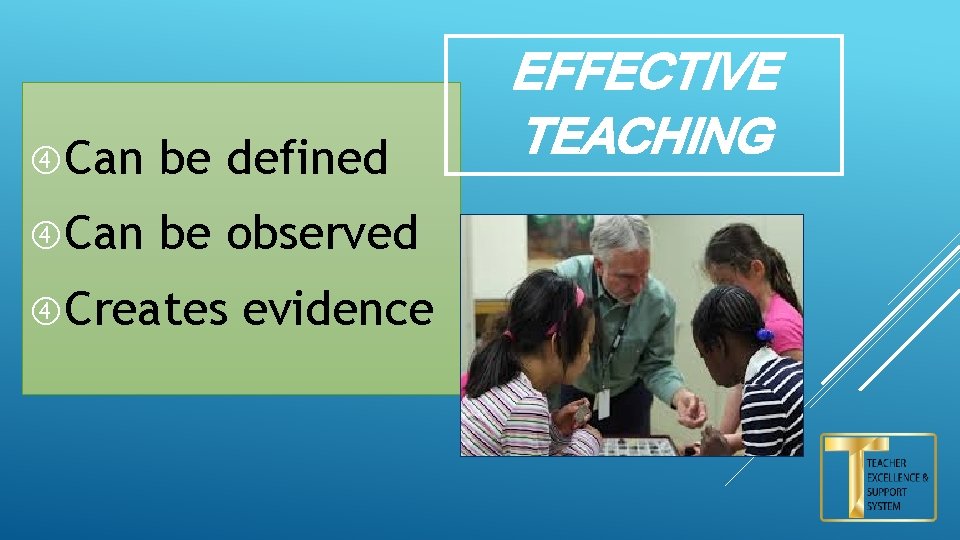
Can be defined Can be observed Creates evidence EFFECTIVE TEACHING
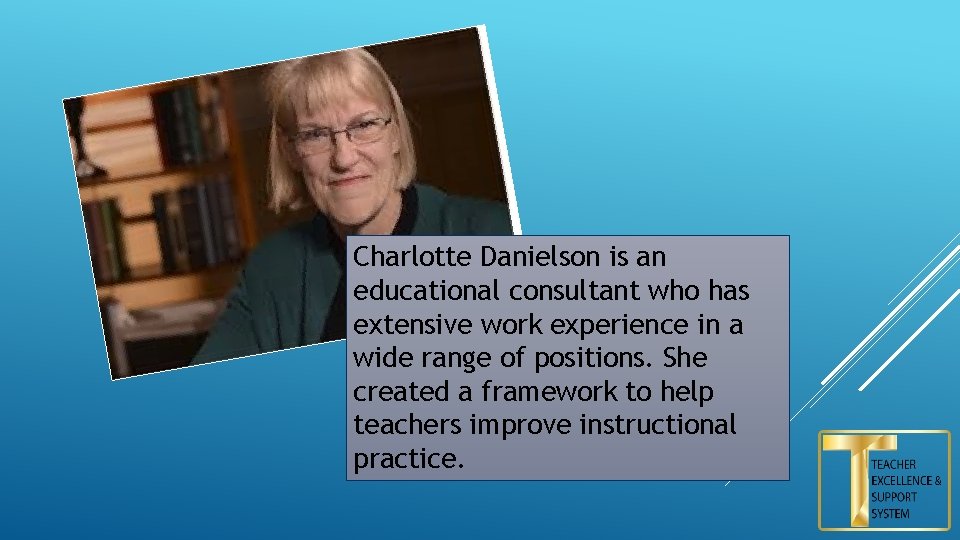
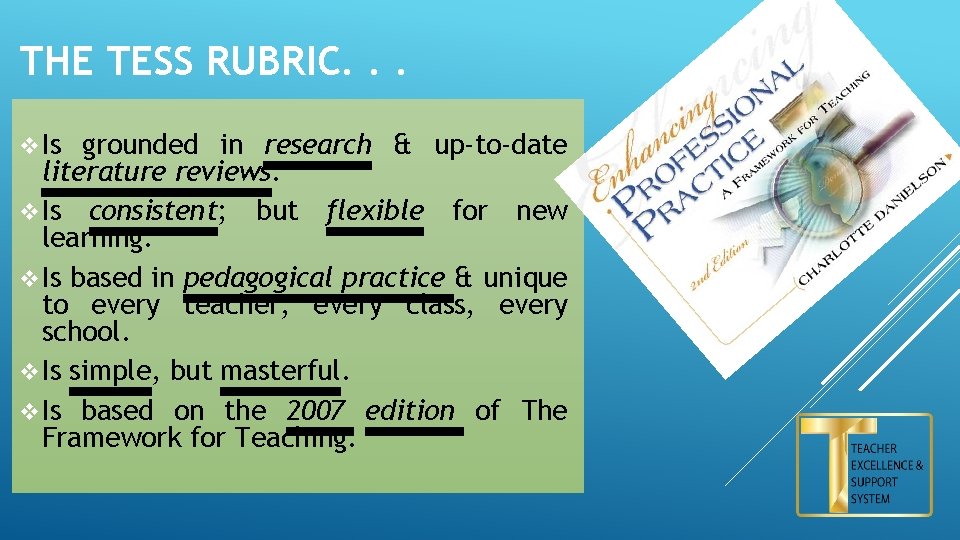
Charlotte Danielson is an educational consultant who has extensive work experience in a wide range of positions. She created a framework to help teachers improve instructional practice.
THE TESS RUBRIC. . . v Is grounded in research & up-to-date literature reviews. v Is consistent; but flexible for new learning. v Is based in pedagogical practice & unique to every teacher, every class, every school. v Is simple, but masterful. v Is based on the 2007 edition of The Framework for Teaching.
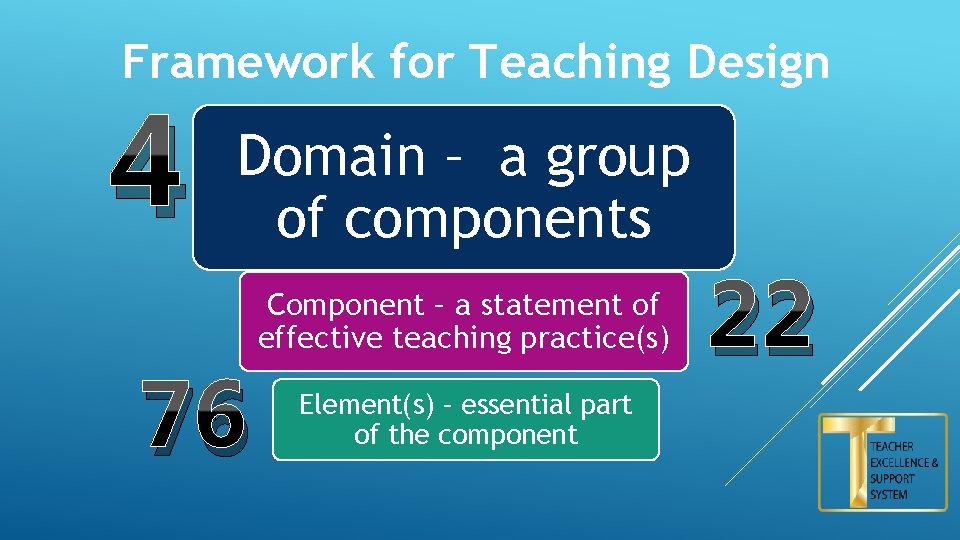
Framework for Teaching Design 4 Domain – a group of components Component – a statement of effective teaching practice(s) 76 Element(s) – essential part of the component 22
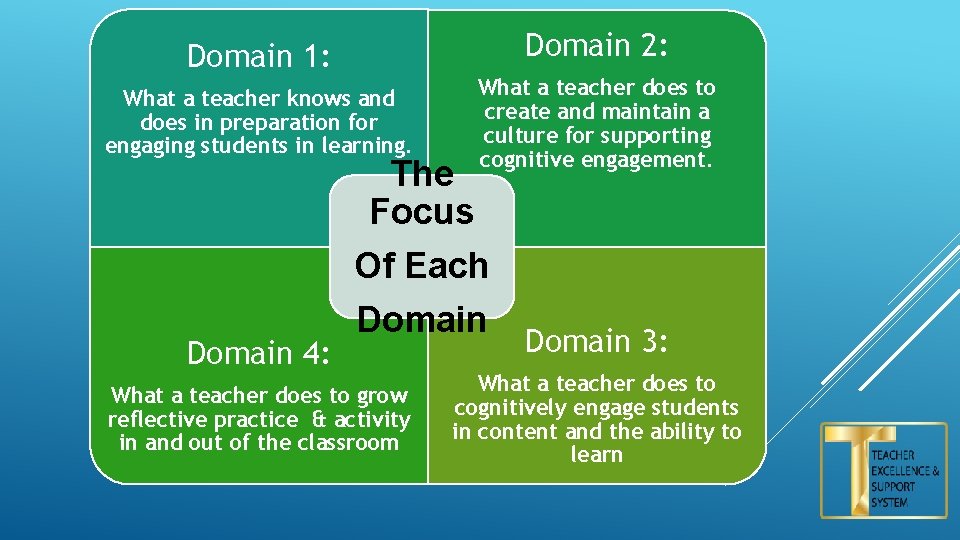
Domain 1: Domain 2: What a teacher knows and does in preparation for engaging students in learning. What a teacher does to create and maintain a culture for supporting cognitive engagement. The Focus Domain 4: Of Each Domain What a teacher does to grow reflective practice & activity in and out of the classroom Domain 3: What a teacher does to cognitively engage students in content and the ability to learn
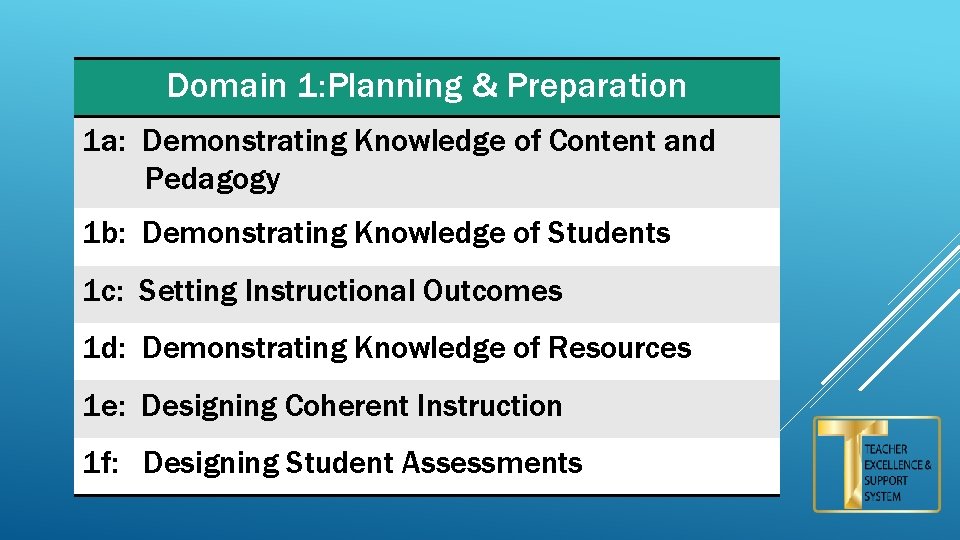
Domain 1: Planning & Preparation 1 a: Demonstrating Knowledge of Content and Pedagogy 1 b: Demonstrating Knowledge of Students 1 c: Setting Instructional Outcomes 1 d: Demonstrating Knowledge of Resources 1 e: Designing Coherent Instruction 1 f: Designing Student Assessments
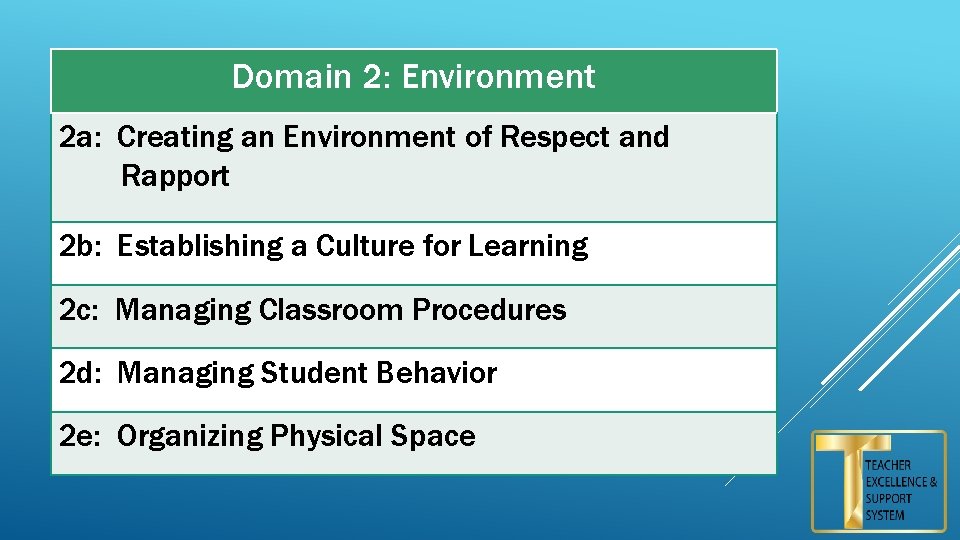
Domain 2: Environment 2 a: Creating an Environment of Respect and Rapport 2 b: Establishing a Culture for Learning 2 c: Managing Classroom Procedures 2 d: Managing Student Behavior 2 e: Organizing Physical Space
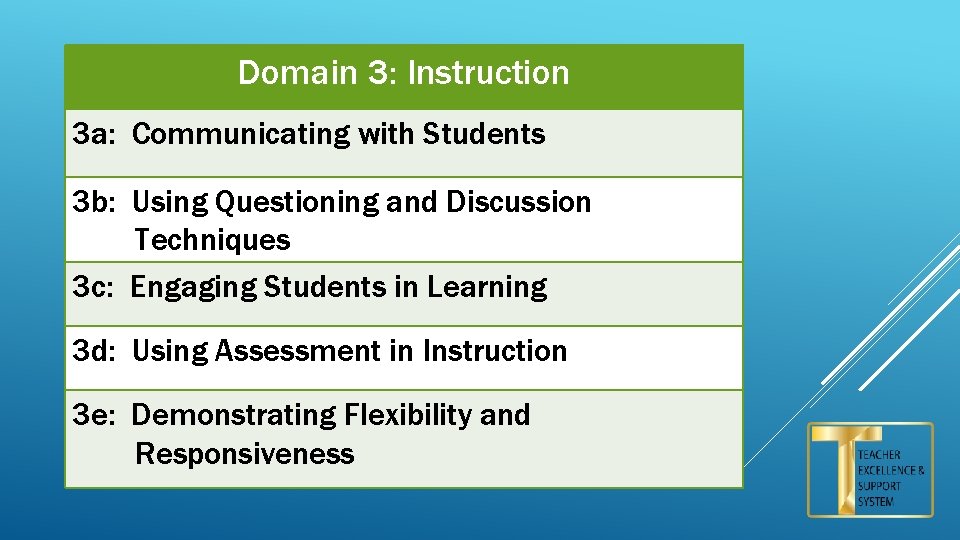
Domain 3: Instruction 3 a: Communicating with Students 3 b: Using Questioning and Discussion Techniques 3 c: Engaging Students in Learning 3 d: Using Assessment in Instruction 3 e: Demonstrating Flexibility and Responsiveness
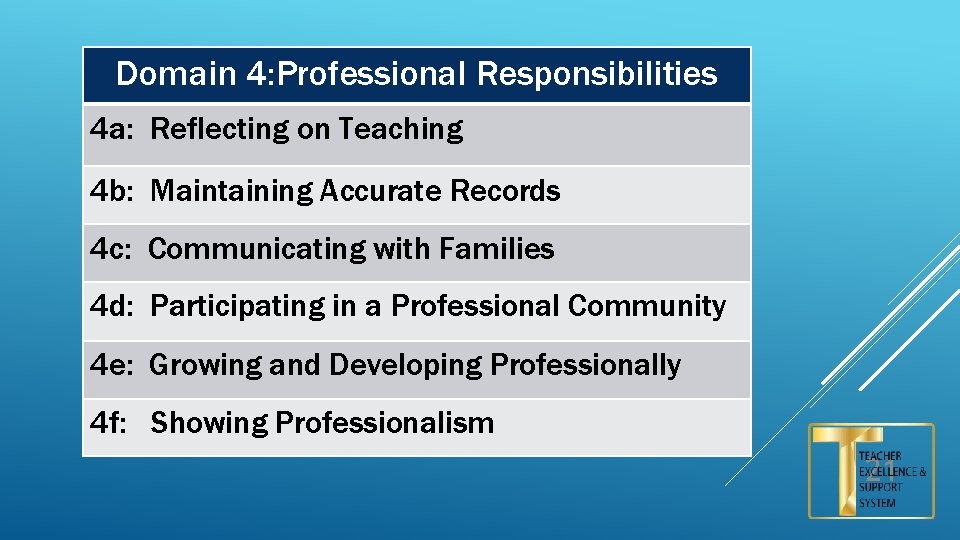
Domain 4: Professional Responsibilities 4 a: Reflecting on Teaching 4 b: Maintaining Accurate Records 4 c: Communicating with Families 4 d: Participating in a Professional Community 4 e: Growing and Developing Professionally 4 f: Showing Professionalism 21
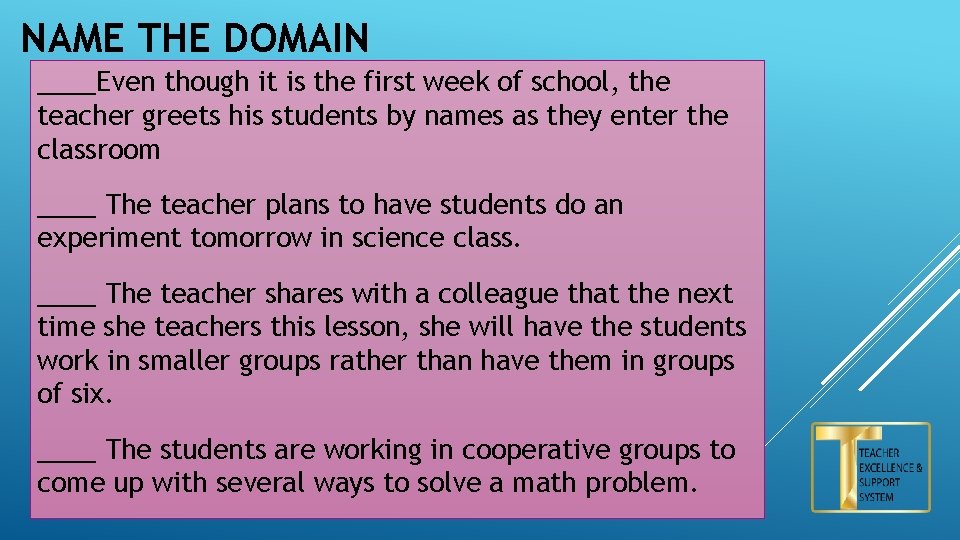
NAME THE DOMAIN ____Even though it is the first week of school, the teacher greets his students by names as they enter the classroom ____ The teacher plans to have students do an experiment tomorrow in science class. ____ The teacher shares with a colleague that the next time she teachers this lesson, she will have the students work in smaller groups rather than have them in groups of six. ____ The students are working in cooperative groups to come up with several ways to solve a math problem.
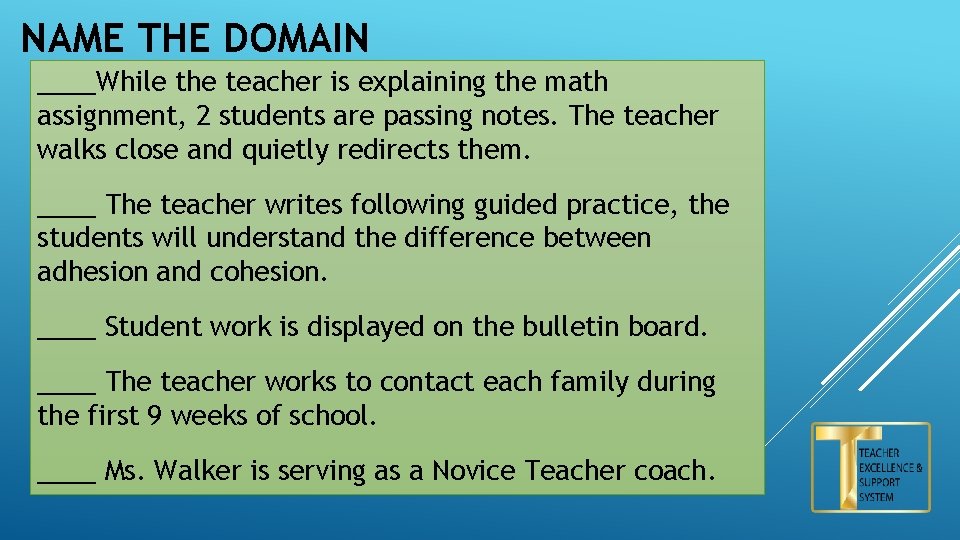
NAME THE DOMAIN ____While the teacher is explaining the math assignment, 2 students are passing notes. The teacher walks close and quietly redirects them. ____ The teacher writes following guided practice, the students will understand the difference between adhesion and cohesion. ____ Student work is displayed on the bulletin board. ____ The teacher works to contact each family during the first 9 weeks of school. ____ Ms. Walker is serving as a Novice Teacher coach.
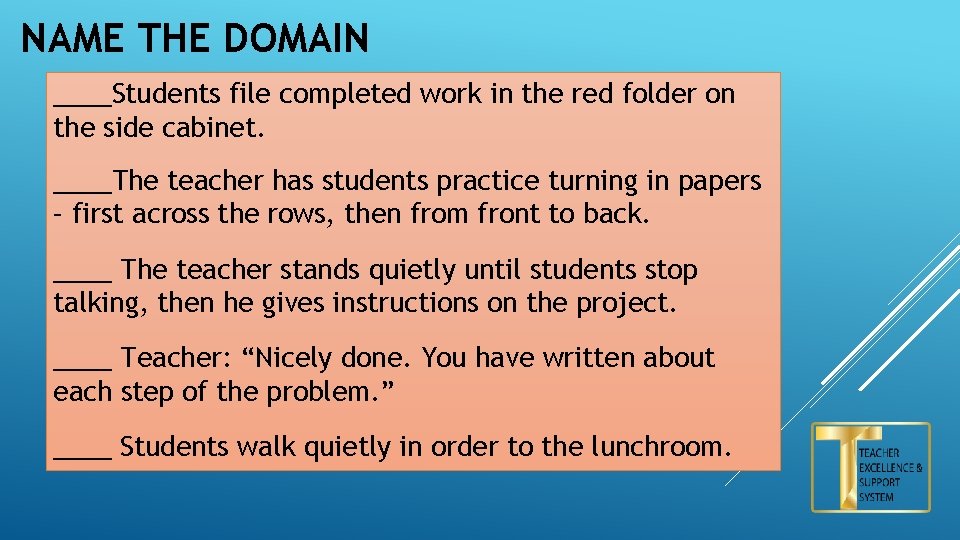
NAME THE DOMAIN ____Students file completed work in the red folder on the side cabinet. ____The teacher has students practice turning in papers – first across the rows, then from front to back. ____ The teacher stands quietly until students stop talking, then he gives instructions on the project. ____ Teacher: “Nicely done. You have written about each step of the problem. ” ____ Students walk quietly in order to the lunchroom.
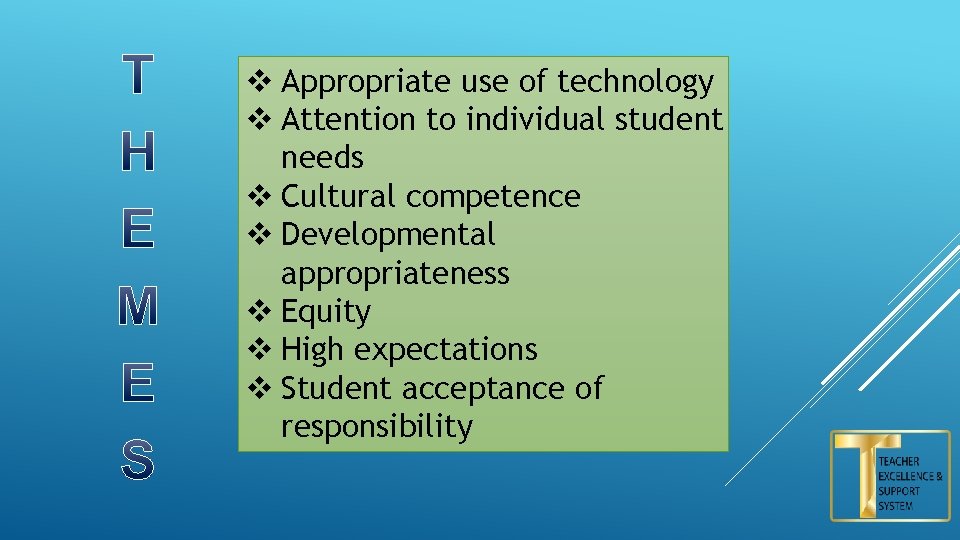
v Appropriate use of technology v Attention to individual student needs v Cultural competence v Developmental appropriateness v Equity v High expectations v Student acceptance of responsibility
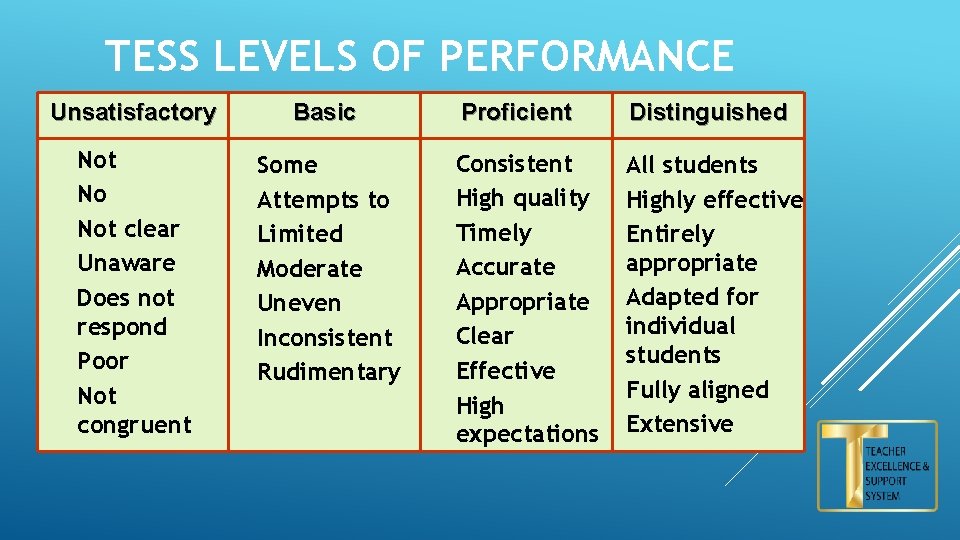
TESS LEVELS OF PERFORMANCE Unsatisfactory Basic Not No Not clear Unaware Does not respond Poor Not congruent Some Attempts to Limited Moderate Uneven Inconsistent Rudimentary Proficient Distinguished Consistent High quality Timely Accurate Appropriate Clear Effective High expectations All students Highly effective Entirely appropriate Adapted for individual students Fully aligned Extensive
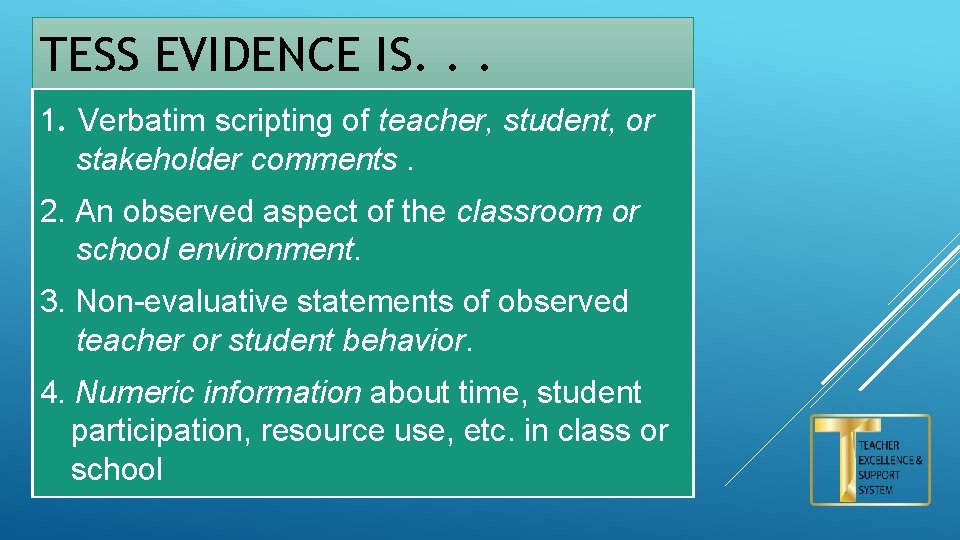
TESS EVIDENCE IS. . . 1. Verbatim scripting of teacher, student, or stakeholder comments. 2. An observed aspect of the classroom or school environment. 3. Non-evaluative statements of observed teacher or student behavior. 4. Numeric information about time, student participation, resource use, etc. in class or school
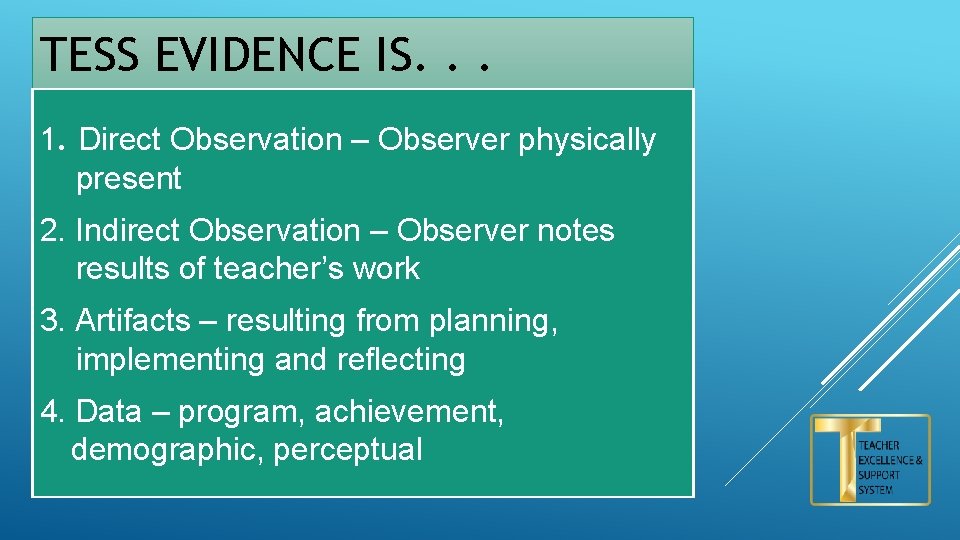
TESS EVIDENCE IS. . . 1. Direct Observation – Observer physically present 2. Indirect Observation – Observer notes results of teacher’s work 3. Artifacts – resulting from planning, implementing and reflecting 4. Data – program, achievement, demographic, perceptual
T O P I C S Welcome & Introductions About Teacher Effectiveness Guiding Improvement: The Rubric Closing & Response
3, 2, 1. . . 3 things you recall as important from this learning. 2 ah-ha’s you’ve had today. 1 questions that is still running around in your head.
We Welcome: Dr. Jeremy Owoh, Assistant Commissioner Division of Educator Effectiveness Jeremy. Owoh@Arkansas. gov Office of Educator Support & Development Sandra Hurst, Director Sandra. Hurst@Arkansas. gov Becky Gibson, Educator Support & Development Advisor Becky. Gibson@Arkansas. gov Maureen Harness, Educator Support & Development Advisor Maureen. Harness@Arkansas. gov Renee Nelson, Educator Support & Development Advisor Renee. Nelson@Arkansas. gov