
Evidencing Documentation Expertise in teachers resource system Case


- Slides: 42
Evidencing Documentation Expertise in teacher’s resource system: Case of a Chinese teacher Chongyang Wang, chongyang. wang@ens-lyon. fr East China Normal University, China Ecole Normale Supérieure de Lyon, France Supervised by: Binyan Xu & Luc Trouche Crossing views on mathematics teachers' resources in China and France Jo. RISS French-Chinese seminar, December 2018, ENS de Lyon
Outlines 1) Conceptual model of Documentation Expertise (DE) (P. 9 & P. 14) and Methodology(P. 17) 2) Features of resource system of Gao & Anna: Structure and components 3) Schemes (suggestions or habits) for resource system management evidenced in interviews 4) Discussion and questions
A Ph. D project (2015 -2019) Title: An investigation of mathematics teachers’ documentation expertise and its development in collectives: two contrasting contexts in China and France Facing with an immensity of potentially suitable resources, teachers need some relevant expertise allowing the successful integration (Ruthven, 2014). Research questions: (1) What DE could be found in mathematics teachers’ documentation work? What are the components of DE and the corresponding performances of the expert teachers? (2) How DE could get developed through teachers’ collective work? What are the factors that could be supportive for DE development? (3) Through two contrasting cases, is there any similarities of DE in both cases? What could be borrowed and adapted for a mutual beneficiation? To be addressed in this presentation: What DE can be evidenced in teachers’ resource system? How to situated the features of the resource system into the framework of DE?
A conceptual DE model Why we choose the term of expertise? Base: pilot study in 2016 & Literature review Terms choice: documentation expertise • Teaching is inherently a cultural activity (Stigler & Hiebert, 1999), and culturally shaped (Bishop, 2002). • Resources also bear some cultural and contextual imprints as Adler’s (2000) social-cultural resources or Brown’s (2002) conception of resources as cultural artifacts (cultural tools) • Expertise is often considered as “highly contextualized” (Berliner, 1988, p. 6), “culture-bound” (Schoenfeld, 2011, p. 328), and needs to be understood in terms of socio-cultural contexts and education systems (Li & Kaiser, 2011) Two steps efforts: a first model of DE based on the literature reviews and reflections on a pilot study in China (Pepin et al. , 2016); a refined model through two contrasting cases studies.
A conceptual DE model Why we need a new term of DE? Distinguish DE with Pedagogical design capacity (PDC) and Teacher Design Capacity (TDC) • PDC is the capacity that individual teachers exhibit to “craft” episodes to achieve their instructional goals (Brown, 2002), through perceiving and mobilizing the existing resources. Perceiving refers to the ability to notice and recognize potential resources (Remillard, 2005). PDC “is not what a teacher ‘has’, like knowledge” (Leshota & Adler, 2018, p. 92), and each teacher’s PDC has its own specificity, reflecting her preferences, contexts and own understanding of different features of the resources. • TDC (Pepin et al. , 2013) is based on the notion of design by Brown, regarding the practice of designing in both phases of lesson preparation and teaching (design-in-use). It was initially dedicated to (digital) curriculum resources use, with three essential components: goal/s of the design activity; a set of principles (robust and flexibility); reflection-inaction (Pepin et al. , 2017).
A conceptual DE model Why we need a new term of DE? Distinguish DE with Pedagogical design capacity (PDC) and Teacher Design Capacity (TDC) • DE is distinguished from the other two capacities by three aspects: (1) As the expertise of documentation work, DE is evidenced also in the whole teacher- resources interactions inside and outside of class, it covers more than the phases of designing resources (perceiving and mobilizing) and design-in-use, and also maintaining and management of the resources; (2) DE concerns teachers’ views on resources, which makes the resource (both the scale and category) diverse and extends it beyond instructional resources (Brown, 2002), curriculum materials (Remillard, 2005) or digital curriculum resources (Pepin et al. , 2017); (3) DE is linked with the individual teachers’ multi-roles work at school, and the value of expertise in their cultural/institutional contexts. • DE is not a uniform standard or ideal state for teachers to achieve, but a framework to reflect on teacher expertise in taking profit of resources
What are the enter points of evidencing DE? Resource System “The set of resources accumulated and organized (over time) by a teacher in line with his/her regular teaching activity. ” (Trouche et al. , online first). “The word ‘system’ is purposefully chosen to emphasize that this system is highly structured, the structure being linked, more or less explicitly, to teacher activity. ” (Gueudet et al. , 2013, p. 1004). The resource system expands both the notion of textbook (into a systematic curriculum scheme combining diverse resources into a coherent program), and the notion of library (into a resource repository organized systematically to make contents readily searchable and usable) (Ruthven, 2018) * Assumption: It is a structured, systematical and functioning repository consist of resources; it is formed and organized with personal preferences of the teachers; and it is dynamically developed along with teacher’s documentation work and professional development.
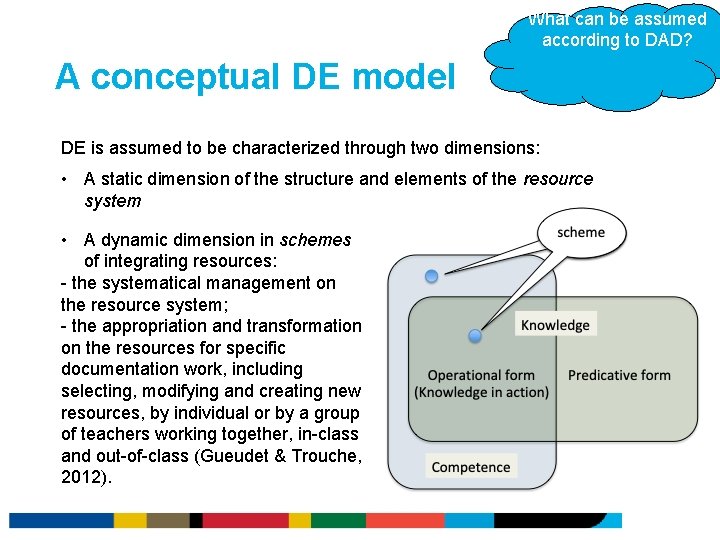
Scheme What are the enter points of evidencing DE? “The invariant organization of activity for a certain class of situations” (Vergnaud, 2009, p. 88) with four components: (1) Goal/sub-goals, which is connected to the target of specific situations; (2) Rules of action, for transforming reality, searching information and controlling the results; (3) Operational invariants, the conceptual basis for selecting the appropriate information and identifying the most appropriate rules of action; (4) Possibilities of inferences, which allow the subject to think and compute the activities in different situations. “Competences are composed of schemes aimed at facing situations” (Vergnaud, 1998, p. 230); scheme is the operational side of knowledge (knowledge in action). (Vergnaud, 1998). Schemes get developed by being adapted to the situations, while situations work as a key to understand analyze schemes, they are so intricate that we can use an expression concerning situations to refer to a scheme, or an expression concerning schemes to refer to a situation (Vergnaud, 2009).
What can be assumed according to DAD? A conceptual DE model DE is assumed to be characterized through two dimensions: • A static dimension of the structure and elements of the resource system • A dynamic dimension in schemes of integrating resources: - the systematical management on the resource system; - the appropriation and transformation on the resources for specific documentation work, including selecting, modifying and creating new resources, by individual or by a group of teachers working together, in-class and out-of-class (Gueudet & Trouche, 2012).
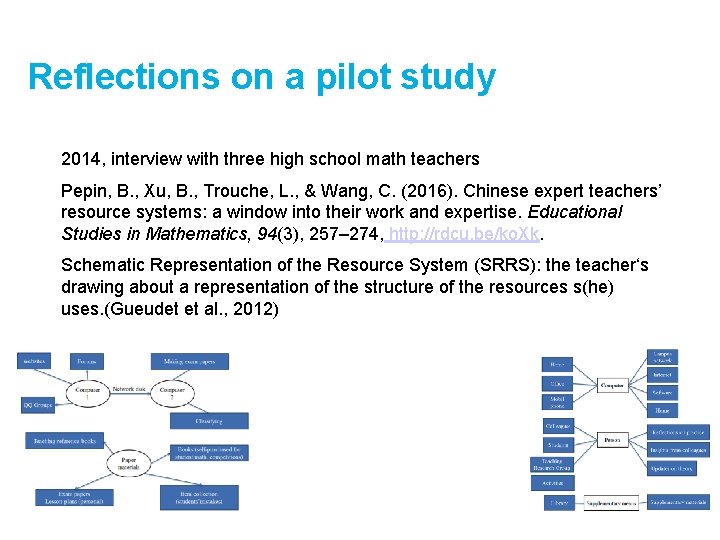
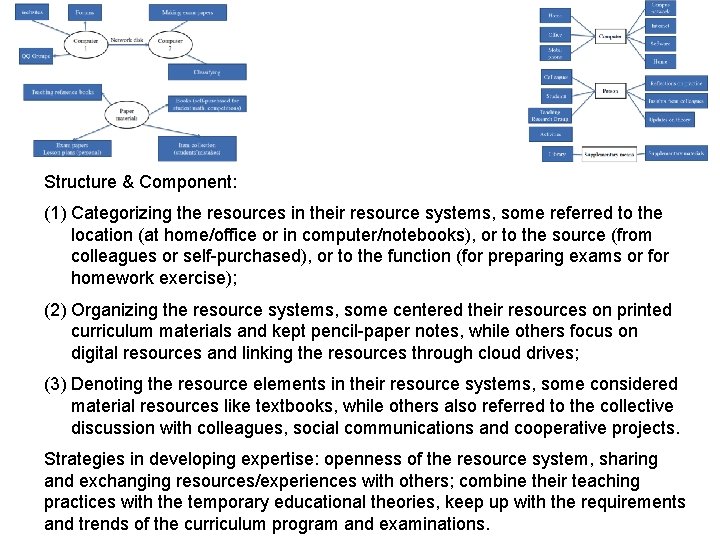
Reflections on a pilot study 2014, interview with three high school math teachers Pepin, B. , Xu, B. , Trouche, L. , & Wang, C. (2016). Chinese expert teachers’ resource systems: a window into their work and expertise. Educational Studies in Mathematics, 94(3), 257– 274, http: //rdcu. be/ko. Xk. Schematic Representation of the Resource System (SRRS): the teacher‘s drawing about a representation of the structure of the resources s(he) uses. (Gueudet et al. , 2012)
Structure & Component: (1) Categorizing the resources in their resource systems, some referred to the location (at home/office or in computer/notebooks), or to the source (from colleagues or self-purchased), or to the function (for preparing exams or for homework exercise); (2) Organizing the resource systems, some centered their resources on printed curriculum materials and kept pencil-paper notes, while others focus on digital resources and linking the resources through cloud drives; (3) Denoting the resource elements in their resource systems, some considered material resources like textbooks, while others also referred to the collective discussion with colleagues, social communications and cooperative projects. Strategies in developing expertise: openness of the resource system, sharing and exchanging resources/experiences with others; combine their teaching practices with the temporary educational theories, keep up with the requirements and trends of the curriculum program and examinations.
Reflections on a pilot study What inspirations from it to DE? Inspirations on components of DE: (1) the collective aspect, especially those with cultural and institutional characters, such as the Chinese Teaching Research Group (Wang, 2018); (2) the student aspect, which was emphasized by a Chinese teachers in the pilot study as important to get teaching effects feedbacks for better adjusting their following lessons; (3) the design aspect, which reflects to what extent the resources were proceed, forming teachers’ personal resources. DE could differ in terms of these aspects in different teachers. Inspirations on methodology: (1) be careful about researchers’ own orientations on expertise when studying teacher expertise (Schoenfeld, 2011) (2) the principle of “confronting teachers’ view” in DAD (Trouche et al. , online first) “Inferred Mapping of Resource System (IMRS)” “Reflective Mapping of Resource System (RMRS)” “Documentation-working Mate” (Wang, 2018)
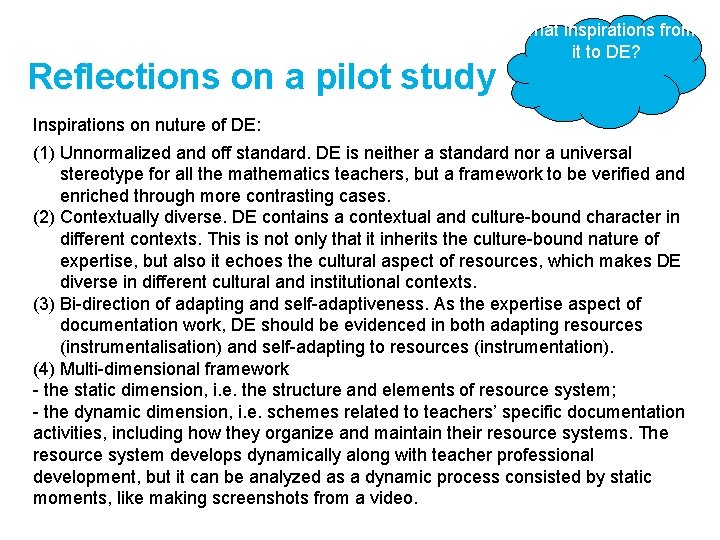
Reflections on a pilot study What inspirations from it to DE? Inspirations on nuture of DE: (1) Unnormalized and off standard. DE is neither a standard nor a universal stereotype for all the mathematics teachers, but a framework to be verified and enriched through more contrasting cases. (2) Contextually diverse. DE contains a contextual and culture-bound character in different contexts. This is not only that it inherits the culture-bound nature of expertise, but also it echoes the cultural aspect of resources, which makes DE diverse in different cultural and institutional contexts. (3) Bi-direction of adapting and self-adaptiveness. As the expertise aspect of documentation work, DE should be evidenced in both adapting resources (instrumentalisation) and self-adapting to resources (instrumentation). (4) Multi-dimensional framework - the static dimension, i. e. the structure and elements of resource system; - the dynamic dimension, i. e. schemes related to teachers’ specific documentation activities, including how they organize and maintain their resource systems. The resource system develops dynamically along with teacher professional development, but it can be analyzed as a dynamic process consisted by static moments, like making screenshots from a video.
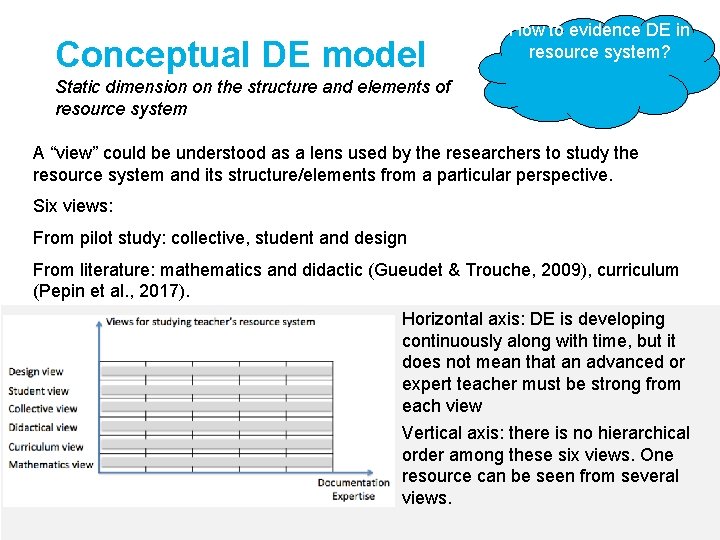
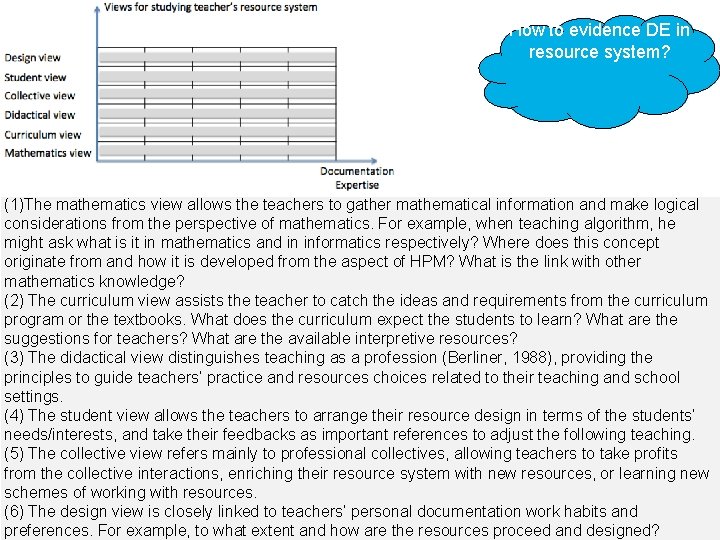
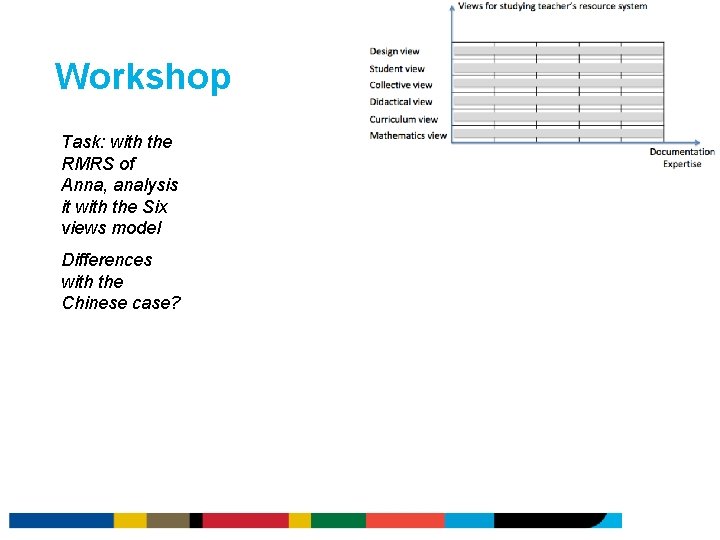
Conceptual DE model How to evidence DE in resource system? Static dimension on the structure and elements of resource system A “view” could be understood as a lens used by the researchers to study the resource system and its structure/elements from a particular perspective. Six views: From pilot study: collective, student and design From literature: mathematics and didactic (Gueudet & Trouche, 2009), curriculum (Pepin et al. , 2017). Horizontal axis: DE is developing continuously along with time, but it does not mean that an advanced or expert teacher must be strong from each view Vertical axis: there is no hierarchical order among these six views. One resource can be seen from several views.
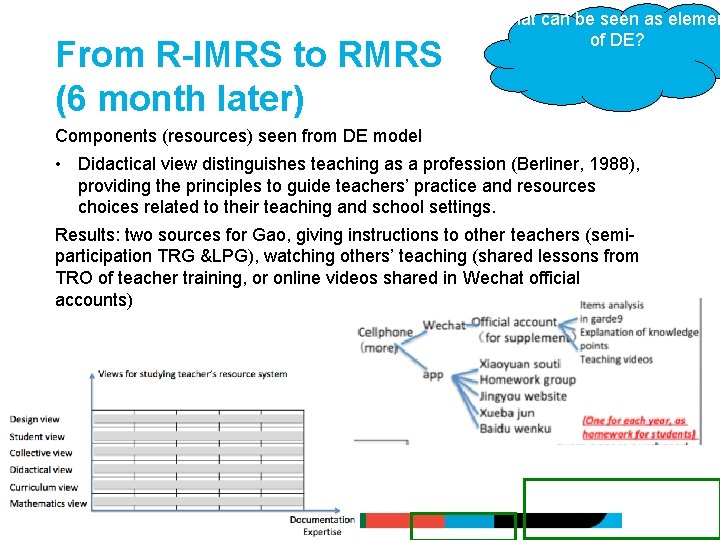
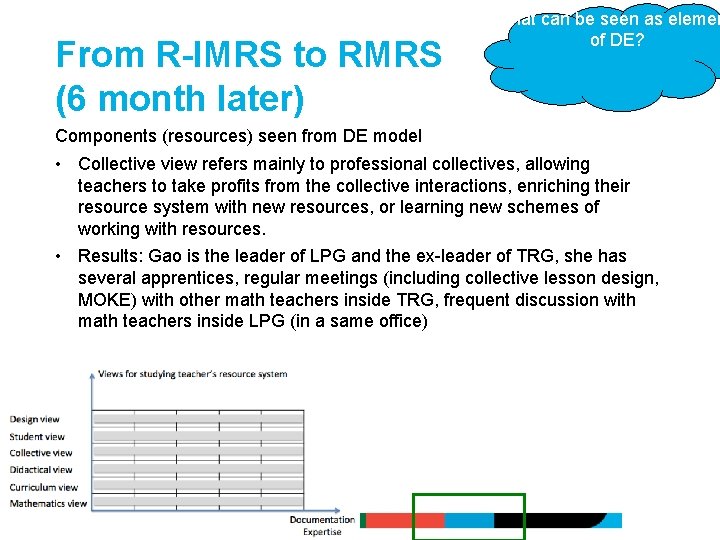
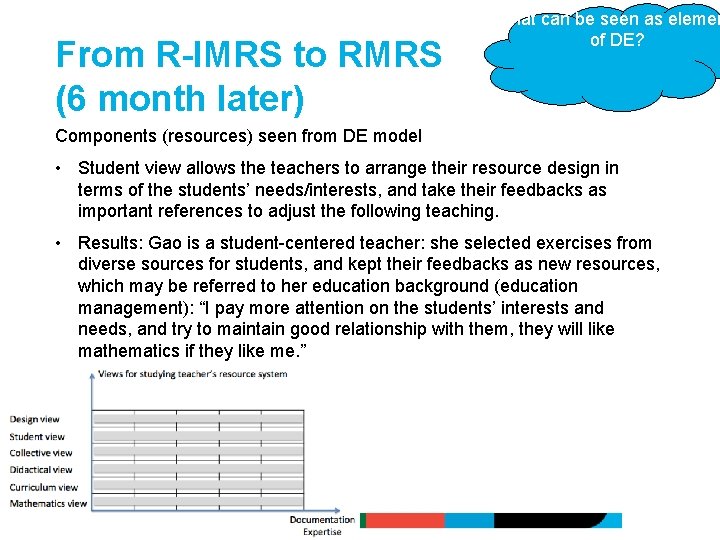
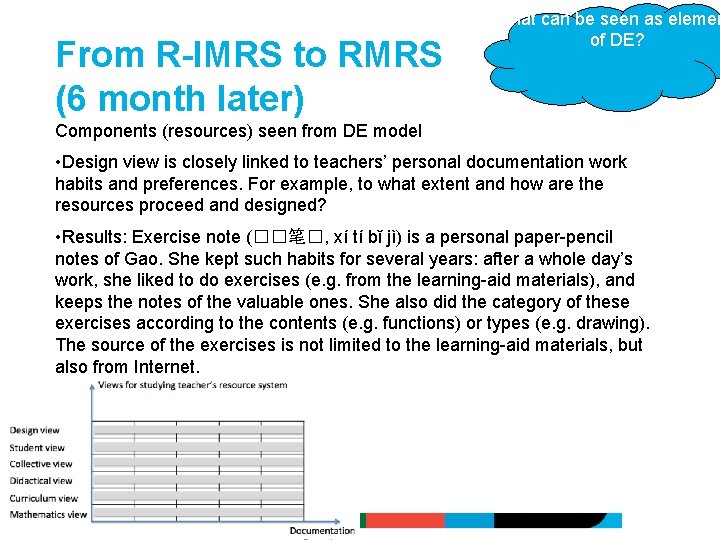
How to evidence DE in resource system? (1)The mathematics view allows the teachers to gather mathematical information and make logical considerations from the perspective of mathematics. For example, when teaching algorithm, he might ask what is it in mathematics and in informatics respectively? Where does this concept originate from and how it is developed from the aspect of HPM? What is the link with other mathematics knowledge? (2) The curriculum view assists the teacher to catch the ideas and requirements from the curriculum program or the textbooks. What does the curriculum expect the students to learn? What are the suggestions for teachers? What are the available interpretive resources? (3) The didactical view distinguishes teaching as a profession (Berliner, 1988), providing the principles to guide teachers’ practice and resources choices related to their teaching and school settings. (4) The student view allows the teachers to arrange their resource design in terms of the students’ needs/interests, and take their feedbacks as important references to adjust the following teaching. (5) The collective view refers mainly to professional collectives, allowing teachers to take profits from the collective interactions, enriching their resource system with new resources, or learning new schemes of working with resources. (6) The design view is closely linked to teachers’ personal documentation work habits and preferences. For example, to what extent and how are the resources proceed and designed?
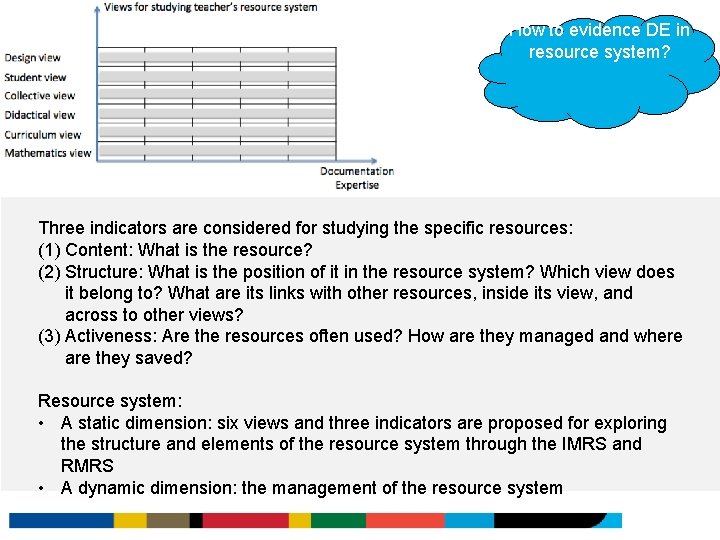
How to evidence DE in resource system? Three indicators are considered for studying the specific resources: (1) Content: What is the resource? (2) Structure: What is the position of it in the resource system? Which view does it belong to? What are its links with other resources, inside its view, and across to other views? (3) Activeness: Are the resources often used? How are they managed and where are they saved? Resource system: • A static dimension: six views and three indicators are proposed for exploring the structure and elements of the resource system through the IMRS and RMRS • A dynamic dimension: the management of the resource system
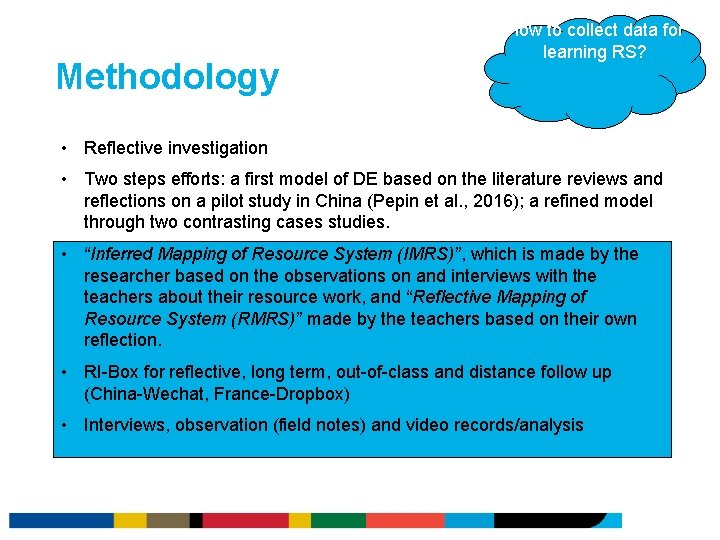
Methodology How to collect data for learning RS? • Reflective investigation • Two steps efforts: a first model of DE based on the literature reviews and reflections on a pilot study in China (Pepin et al. , 2016); a refined model through two contrasting cases studies. • “Inferred Mapping of Resource System (IMRS)”, which is made by the researcher based on the observations on and interviews with the teachers about their resource work, and “Reflective Mapping of Resource System (RMRS)” made by the teachers based on their own reflection. • RI-Box for reflective, long term, out-of-class and distance follow up (China-Wechat, France-Dropbox) • Interviews, observation (field notes) and video records/analysis
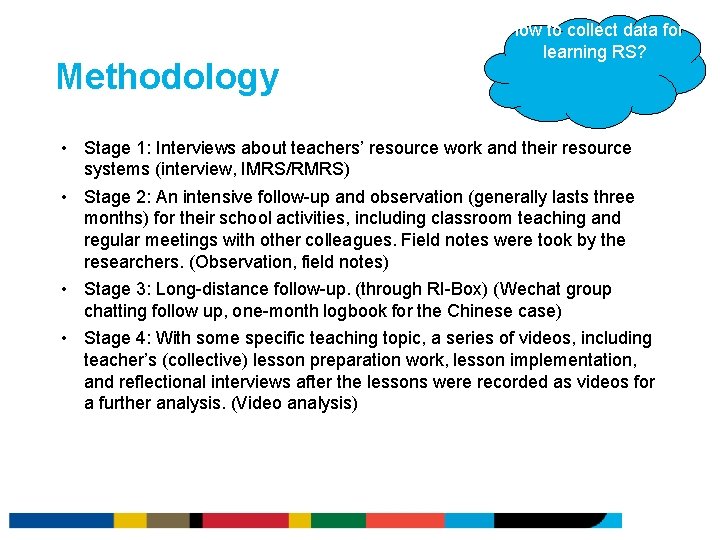
Methodology How to collect data for learning RS? • Stage 1: Interviews about teachers’ resource work and their resource systems (interview, IMRS/RMRS) • Stage 2: An intensive follow-up and observation (generally lasts three months) for their school activities, including classroom teaching and regular meetings with other colleagues. Field notes were took by the researchers. (Observation, field notes) • Stage 3: Long-distance follow-up. (through RI-Box) (Wechat group chatting follow up, one-month logbook for the Chinese case) • Stage 4: With some specific teaching topic, a series of videos, including teacher’s (collective) lesson preparation work, lesson implementation, and reflectional interviews after the lessons were recorded as videos for a further analysis. (Video analysis)
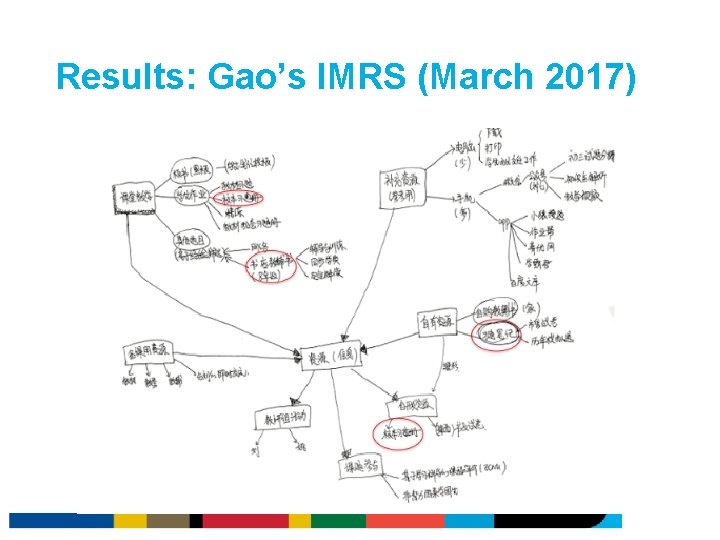
Results: Gao’s IMRS (March 2017)
Results: Gao’s IMRS (March 2017)
Results: Gao
Results: Gao’s R-IMRS (March 2017)
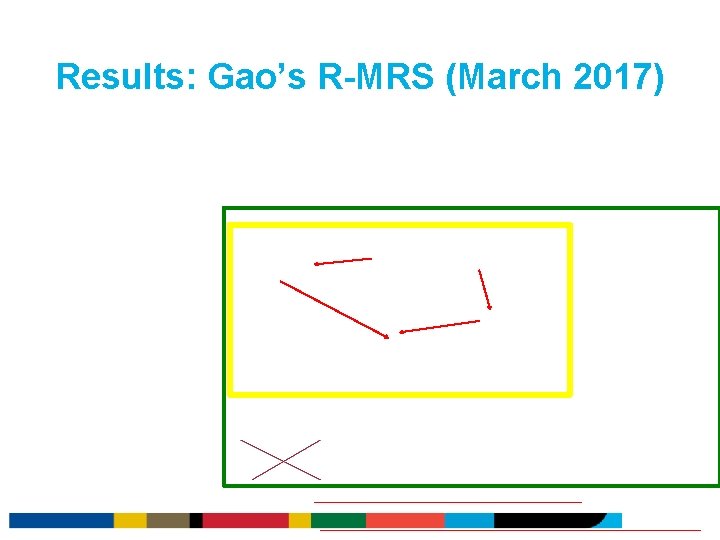
Results: Gao’s R-MRS (March 2017)
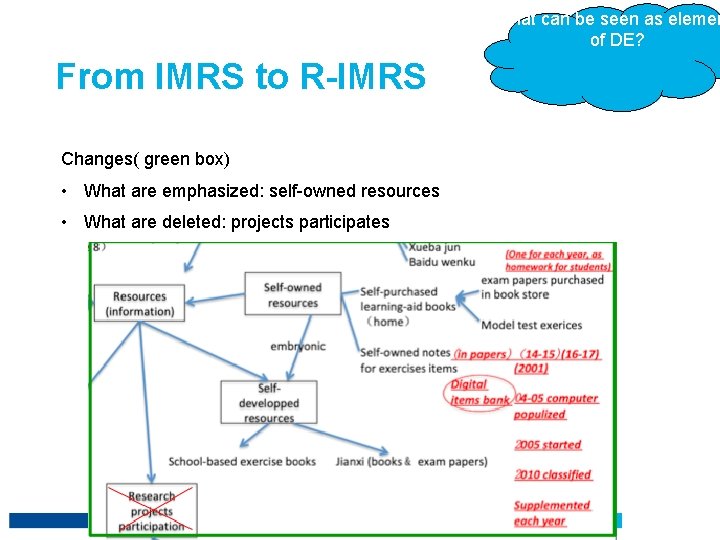
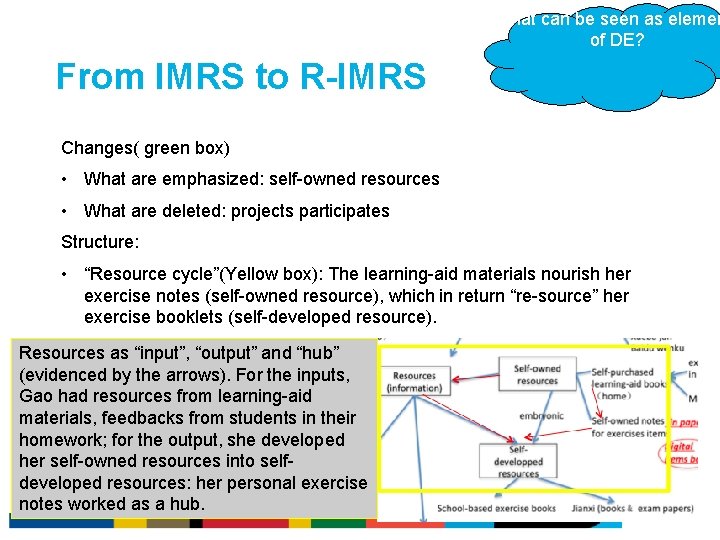
What can be seen as elemen of DE? From IMRS to R-IMRS Changes( green box) • What are emphasized: self-owned resources • What are deleted: projects participates
Results: Gao’s R-MRS (March 2017)
What can be seen as elemen of DE? From IMRS to R-IMRS Changes( green box) • What are emphasized: self-owned resources • What are deleted: projects participates Structure: • “Resource cycle”(Yellow box): The learning-aid materials nourish her exercise notes (self-owned resource), which in return “re-source” her exercise booklets (self-developed resource). Resources as “input”, “output” and “hub” (evidenced by the arrows). For the inputs, Gao had resources from learning-aid materials, feedbacks from students in their homework; for the output, she developed her self-owned resources into selfdeveloped resources: her personal exercise notes worked as a hub.
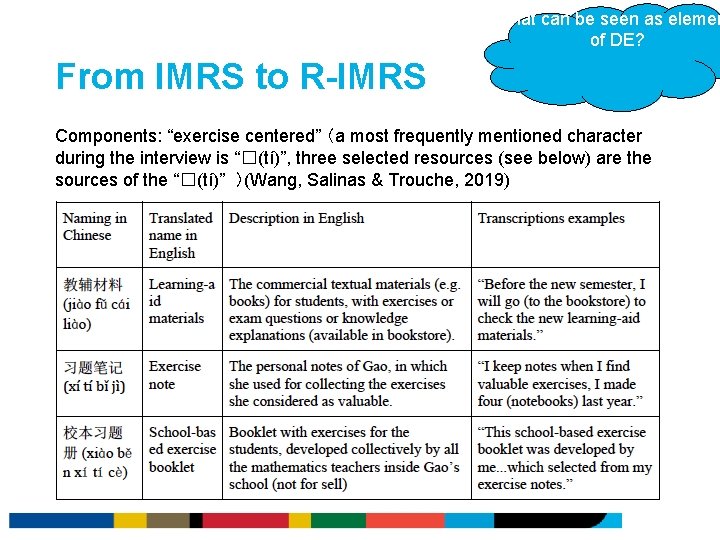
What can be seen as elemen of DE? From IMRS to R-IMRS Components: “exercise centered” (a most frequently mentioned character during the interview is “�(tí)”, three selected resources (see below) are the sources of the “�(tí)” )(Wang, Salinas & Trouche, 2019)
Results: Gao’s R-MRS (March 2017)
Results: Gao’s RMRS (October 2017)
Results: Gao’s RMRS (October 2017)
From R-IMRS to RMRS (6 month later) What can be seen as elemen of DE? Changes: A resource category (structure) from teachers’ view: student, colleagues, integrated resources, curricular resources, online resources, teacher training (TRO activities) Internal relationship: coincident resources (for students)
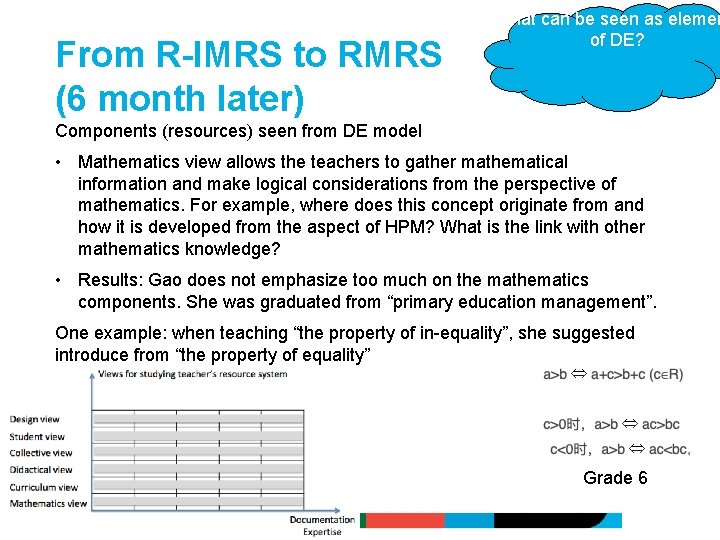
From R-IMRS to RMRS (6 month later) What can be seen as elemen of DE? Components (resources) seen from DE model • Mathematics view allows the teachers to gather mathematical information and make logical considerations from the perspective of mathematics. For example, where does this concept originate from and how it is developed from the aspect of HPM? What is the link with other mathematics knowledge? • Results: Gao does not emphasize too much on the mathematics components. She was graduated from “primary education management”. One example: when teaching “the property of in-equality”, she suggested introduce from “the property of equality” Grade 6
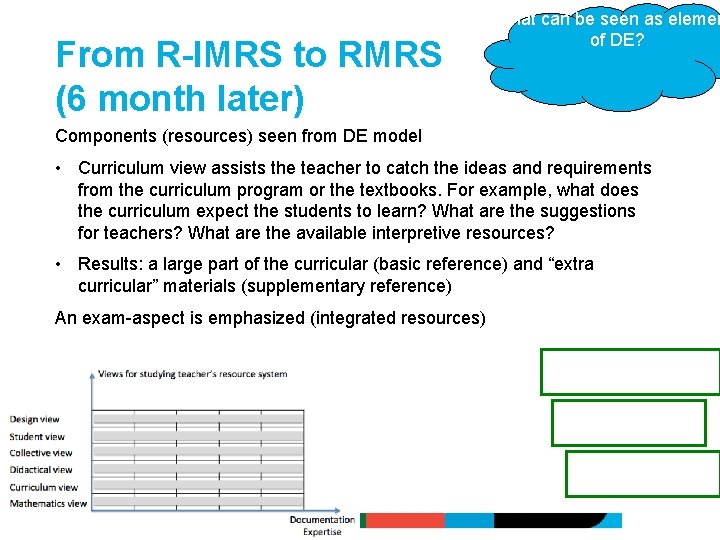
From R-IMRS to RMRS (6 month later) What can be seen as elemen of DE? Components (resources) seen from DE model • Curriculum view assists the teacher to catch the ideas and requirements from the curriculum program or the textbooks. For example, what does the curriculum expect the students to learn? What are the suggestions for teachers? What are the available interpretive resources? • Results: a large part of the curricular (basic reference) and “extra curricular” materials (supplementary reference) An exam-aspect is emphasized (integrated resources)
From R-IMRS to RMRS (6 month later) What can be seen as elemen of DE? Components (resources) seen from DE model • Didactical view distinguishes teaching as a profession (Berliner, 1988), providing the principles to guide teachers’ practice and resources choices related to their teaching and school settings. Results: two sources for Gao, giving instructions to other teachers (semiparticipation TRG &LPG), watching others’ teaching (shared lessons from TRO of teacher training, or online videos shared in Wechat official accounts)
From R-IMRS to RMRS (6 month later) What can be seen as elemen of DE? Components (resources) seen from DE model • Collective view refers mainly to professional collectives, allowing teachers to take profits from the collective interactions, enriching their resource system with new resources, or learning new schemes of working with resources. • Results: Gao is the leader of LPG and the ex-leader of TRG, she has several apprentices, regular meetings (including collective lesson design, MOKE) with other math teachers inside TRG, frequent discussion with math teachers inside LPG (in a same office)
From R-IMRS to RMRS (6 month later) What can be seen as elemen of DE? Components (resources) seen from DE model • Student view allows the teachers to arrange their resource design in terms of the students’ needs/interests, and take their feedbacks as important references to adjust the following teaching. • Results: Gao is a student-centered teacher: she selected exercises from diverse sources for students, and kept their feedbacks as new resources, which may be referred to her education background (education management): “I pay more attention on the students’ interests and needs, and try to maintain good relationship with them, they will like mathematics if they like me. ”
From R-IMRS to RMRS (6 month later) What can be seen as elemen of DE? Components (resources) seen from DE model • Design view is closely linked to teachers’ personal documentation work habits and preferences. For example, to what extent and how are the resources proceed and designed? • Results: Exercise note (��笔�, xí tí bǐ jì) is a personal paper-pencil notes of Gao. She kept such habits for several years: after a whole day’s work, she liked to do exercises (e. g. from the learning-aid materials), and keeps the notes of the valuable ones. She also did the category of these exercises according to the contents (e. g. functions) or types (e. g. drawing). The source of the exercises is not limited to the learning-aid materials, but also from Internet.
Reflections and questions Seeing from the conceptual DE model: Is it necessary to proposed a model? The difference between model and list? How to situate the characters seen from resource system into DE? I mean what characters could be considered as expertise? How to follow teachers’ documentation work in distance? ( for example, Wechat gourp chatting, or group emails)
References • • • Adler, J. (2000). Conceptualising resources as a theme for teacher education. Journal of Mathematics Teacher Education, 3, 205 -224. Berliner, D. C. (1988). The development of expertise in pedagogy. Charles W. Hunt Memorial Lecture presented at the annual meeting of the American Association of Colleges for Teacher Education, New Orleans, Louisiana. Bishop, A. J. (2002). Critical challenges in researching cultural issues in mathematics education. Journal of Intercultural studies, 23(2), 119 -131. Brown, M. (2002). Teaching by design: Understanding the intersection between teacher practice and the design of curricular innovations (Doctoral thesis). Northwestern University, Evanston, IL. Gueudet, G. , Pepin, B. , & Trouche, L. (2013). Collective work with resources : an essential dimension for teacher documentation. ZDM - The International Journal on Mathematics Education 45(7), 1003 -1016. Gueudet, G. , & Trouche, L. (2012). Communities, documents and professional geneses: interrelated stories. In G. Gueudet, B. Pepin, & L. Trouche (Eds. ), From Text to ‘Lived’ Resources: Mathematics Curriculum Materials and Teacher Development (pp. 305 -322), NY: Springer. Gueudet, G. , & Trouche, L. (2009). Towards new documentation systems for mathematics teachers? Educational Studies in Mathematics, 71(3), 199 -218. Leshota, M. , & Adler, J. (2018). Disaggregating a Mathematics Teacher’s Pedagogical Design Capacity. In L. Fan, L. Trouche, S. Rezat, C. Qi, & J. Visnovska (Eds. ), Research on Mathematics Textbooks and Teachers’ Resources: Advances and issues (pp. 89 -117). Cham: Springer. Li, Y. , & Kaiser, G. (2011). Expertise in mathematics instruction: Advancing research and practice from an international perspective. In Y. Li & G. Kaiser (Eds. ), Expertise in mathematics instruction: An international perspective (pp. 3 -15). New York: Springer. Pepin, B. , Gueudet, G. , & Trouche, L. (2013). Re-sourcing teachers’ work and interactions: a collective perspective on resources, their use and transformations. ZDM - Mathematics Education, 45(7), 929– 944. Pepin, B. , Gueudet, G. , & Trouche, L. (2017). Refining teacher design capacity: Mathematics teachers’ interactions with digital curriculum resources, ZDM - Mathematics Education, 49(5), 799 -812, http: //rdcu. be/tm. Xb
References • • • Pepin, B. , Xu, B. , Trouche, L. , & Wang, C. (2016). Chinese expert teachers’ resource systems: a window into their work and expertise. Educational Studies in Mathematics, 94(3), 257– 274, http: //rdcu. be/ko. Xk. Remillard, J. T. (2005). Examining key concepts in research on teachers’ use of mathematics curricula. Review of Educational Research, 75(2), 211– 246. doi: 10. 3102/00346543075002211 Ruthven, K. (2014). Frameworks for Analysing the Expertise That Underpins Successful Integration of Digital Technologies into Everyday Teaching Practice. In: Clark-Wilson A. , Robutti O. , Sinclair N. (Eds. ), The Mathematics Teacher in the Digital Era (pp. 373 -393). , Dordrecht: Springer. Schoenfeld, A. H. (2011). Reflections on Teacher Expertise. In Li Y. , Kaiser G. (Eds. ), Expertise in Mathematics Instruction (pp. 327 -341). Boston, MA: Springer Stigler, J. W. , & Hiebert, J. W. (1999). The teaching gap: Best ideas from the world’s teachers for improving education in the classroom. New York: Free Press. Trouche, L. (to be published). Evidencing missing resources of the documentational approach to didactics. Towards ten programs of research and development for enriching this approach. In L. Trouche, G. Gueudet, & B. Pepin (Eds. ). Resources in Mathematics Teachers’ Professional Activity. xxx: Springer. Trouche, L. , Gueudet, G. , & Pepin, B. (online first). The documentational approach to didactics. In S. Lerman (Ed. ), Encyclopedia of Mathematics Education. N. Y. : Springer. doi: 10. 1007/978 -3 -319 -774879_100011 -1 Vergnaud, G. (1998). Toward a cognitive theory of practice. In A. Sierpinska, & J. Kilpatrick (Eds. ), Mathematics education as a research domain: A search for identity (pp. 227 -241). Dordrecht: Kluwer. Vergnaud, G. (2009). Theory of Conceptual Field. Human Development, 52, 83 -94. doi: 10. 1159/000202727. Wang, C. (2018). Mathematics teachers’ expertise in resources work and its development in collectives. A French and a Chinese Cases. In L. Fan, L. , Trouche, C. Qi, S. Rezat, & J. Visnovska (Eds. ), Research on Mathematics Textbooks and Teachers’ Resources: Advances and issues (pp. 193 -213). Springer. Wang, C. , Salinas, U. , & Trouche, L. (2019). From teachers’ naming system of resources to teachers’ resource system: Contrasting a Chinese and a Mexican case. In **** (Eds. ), Proceedings of the Eleventh Congress of the European Society for Research in Mathematics Education (CERME 11, February , 2019). (pp. ***–***). Utrecht, Netherlands: DCU Institute of Education & ERME
Workshop Task: with the RMRS of Anna, analysis it with the Six views model Differences with the Chinese case?