Taking Charge of Yield Revenue Risk Management on
- Slides: 38
Taking Charge of Yield & Revenue Risk Management on Your Farm Elliot Alfredson Spartan Crop Insurance $
Objective for Today’s Workshop v “Frame” approaches to managing risk v What’s new in 2002? v Review types of crop insurance v Discuss how crop insurance can be used to: v o Limit financial risk exposure o Substitute for balance sheet liquidly o Facilitate pre-harvest pricing Develop a crop insurance plan $
What’s New In 2002? v Subsidy level and structure has changed: – Subsidy increased – More favorable to higher coverage's than previously – Revenue products treated more favorably compared to MPCI than previously. v Authority to facilitate livestock insurance (e. g. , facilitate options on futures “equivalent” across all months; subsidize) $
Alternative Approaches to Managing Risk v Manage sources of risk you face to reduce risk exposure v Retain risk using your equity / net worth v Choose farm plans which avoid risk v Shift risk to someone else o Insurance o Options on futures contracts $
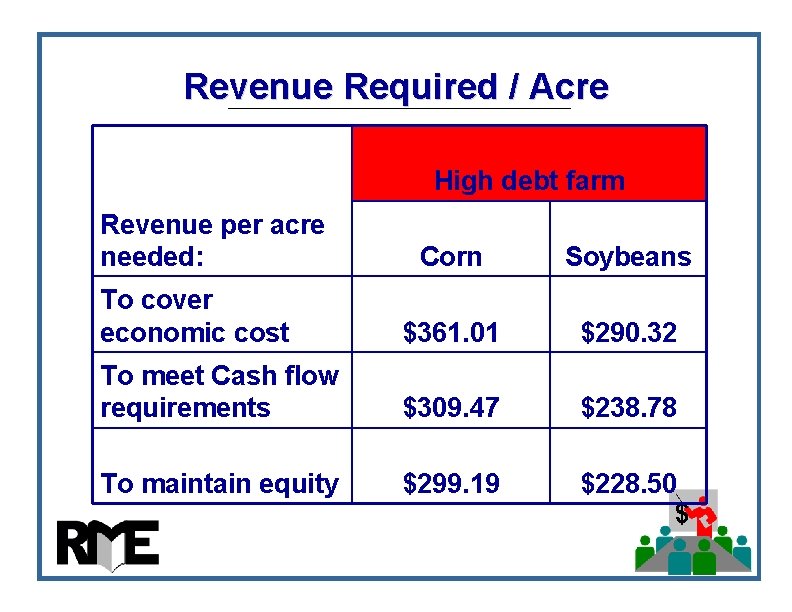
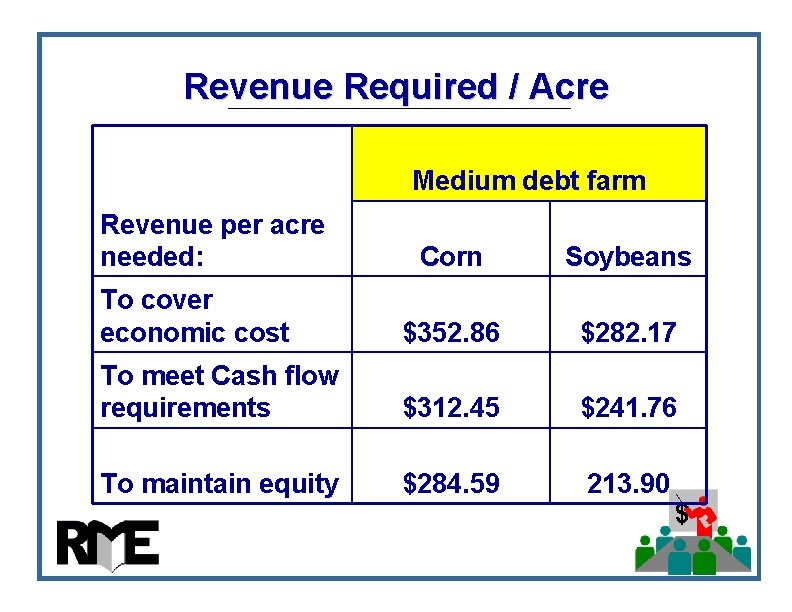
What lessons do we take from the financial risk management module? v How much equity are you willing to risk? v Balance management of financial risk through: m Maintenance of equity m Plans and action that avoid risk m v Tools such as insurance and options that shift risk. How much revenue do you have to generate to cover alternative “cost of production” targets? $
Revenue Required / Acre High debt farm Revenue per acre needed: Corn Soybeans To cover economic cost $361. 01 $290. 32 To meet Cash flow requirements $309. 47 $238. 78 To maintain equity $299. 19 $228. 50 $
Revenue Required / Acre Medium debt farm Revenue per acre needed: Corn Soybeans To cover economic cost $352. 86 $282. 17 To meet Cash flow requirements $312. 45 $241. 76 To maintain equity $284. 59 213. 90 $
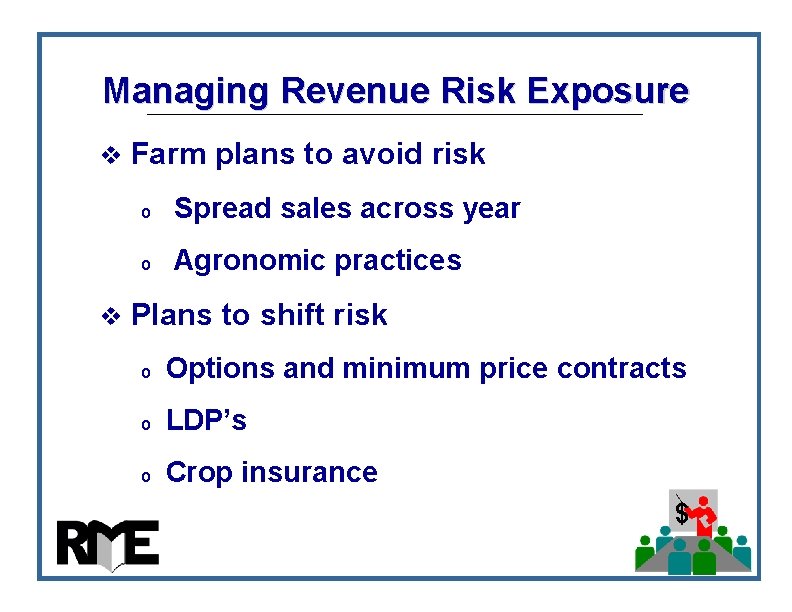
Managing Revenue Risk Exposure v Farm plans to avoid risk o Spread sales across year o Agronomic practices v Plans to shift risk o Options and minimum price contracts o LDP’s o Crop insurance $
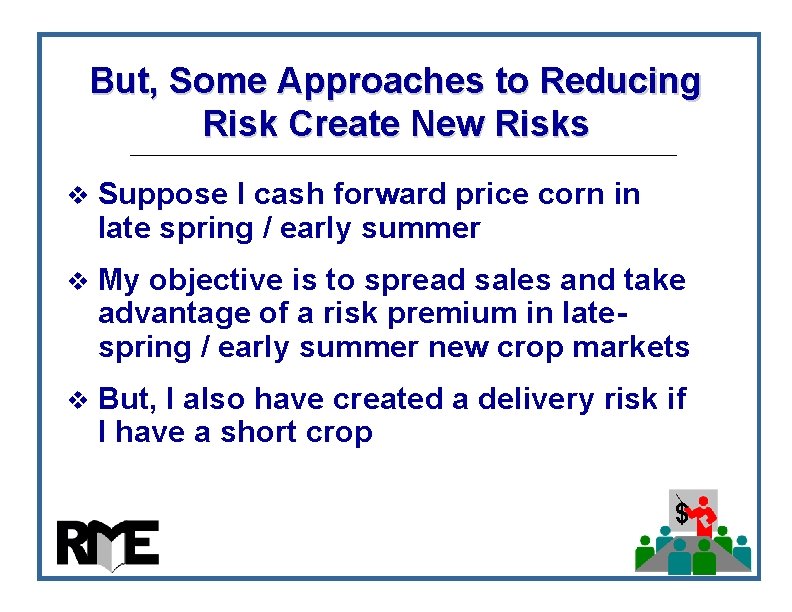
But, Some Approaches to Reducing Risk Create New Risks v Suppose I cash forward price corn in late spring / early summer v My objective is to spread sales and take advantage of a risk premium in latespring / early summer new crop markets v But, I also have created a delivery risk if I have a short crop $
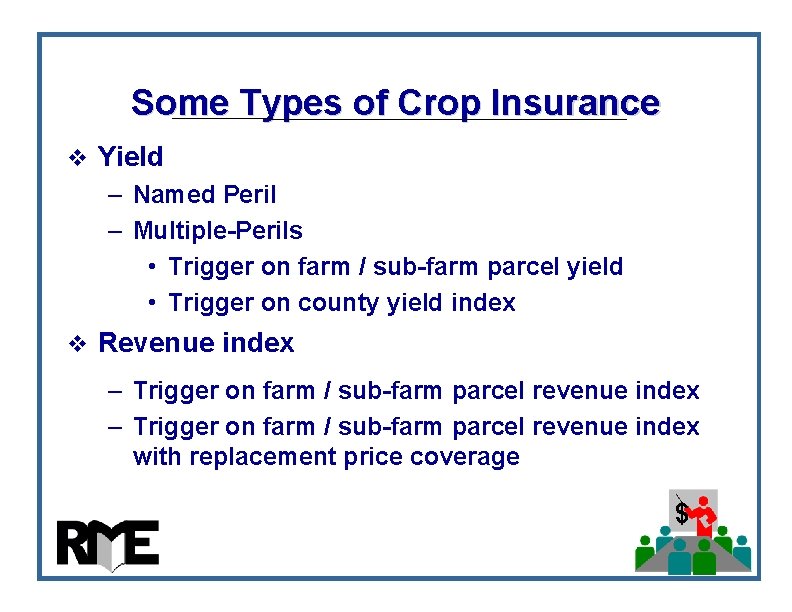
Some Types of Crop Insurance v Yield – Named Peril – Multiple-Perils • Trigger on farm / sub-farm parcel yield • Trigger on county yield index v Revenue index – Trigger on farm / sub-farm parcel revenue index with replacement price coverage $
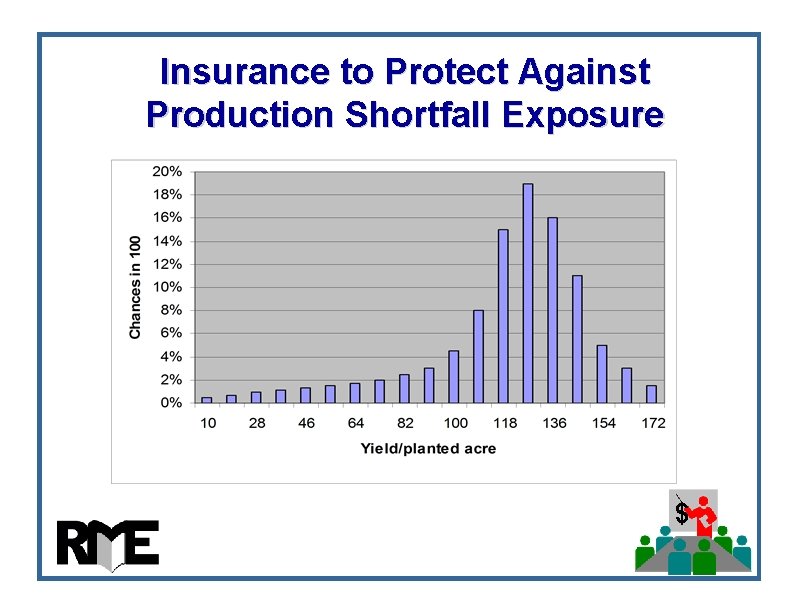
Insurance to Protect Against Production Shortfall Exposure $
Crop Insurance To directly protect against revenue risk exposure $
Crop Insurance Tailored to protect against revenue risk exposure and reduce delivery risk associated with pre-harvest pricing $
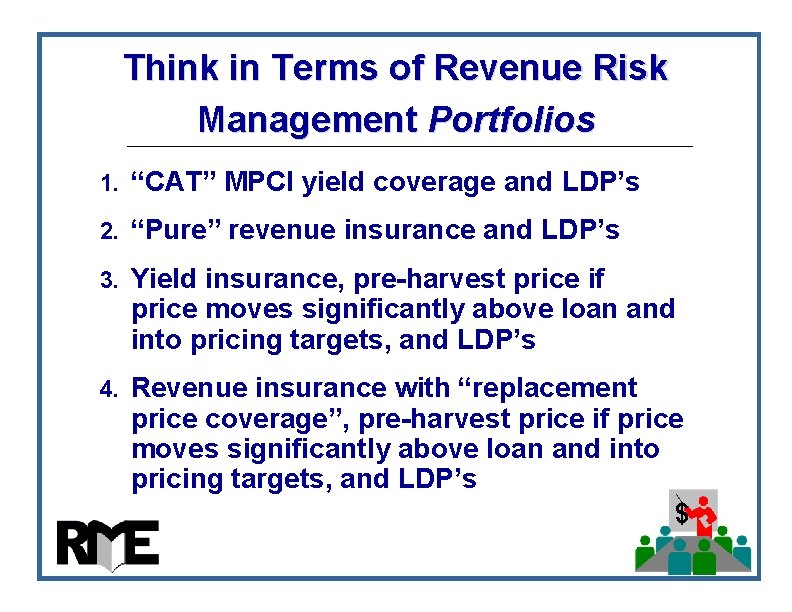
Think in Terms of Revenue Risk Management Portfolios 1. “CAT” MPCI yield coverage and LDP’s 2. “Pure” revenue insurance and LDP’s 3. Yield insurance, pre-harvest price if price moves significantly above loan and into pricing targets, and LDP’s 4. Revenue insurance with “replacement price coverage”, pre-harvest price if price moves significantly above loan and into pricing targets, and LDP’s $
Let’s Review Some Specific Policies $
Multiple-Peril (MPCI) $
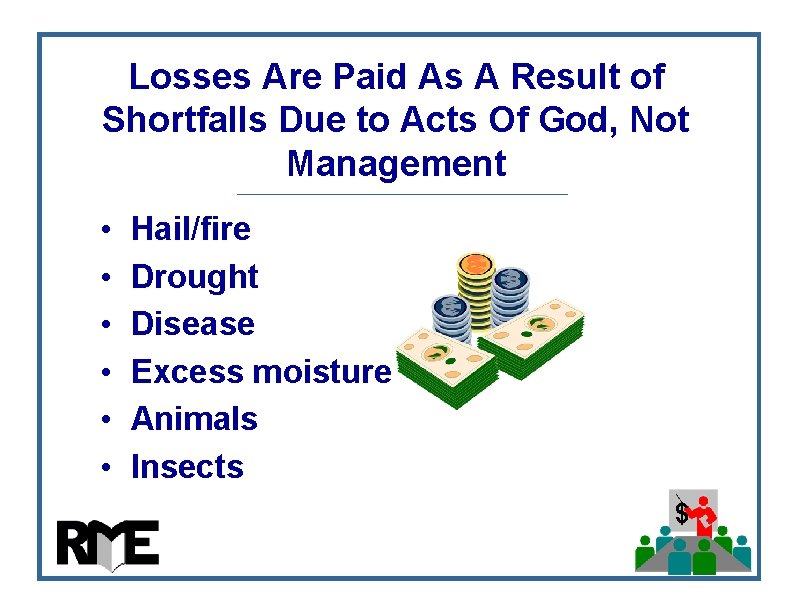
Losses Are Paid As A Result of Shortfalls Due to Acts Of God, Not Management • • • Hail/fire Drought Disease Excess moisture Animals Insects $
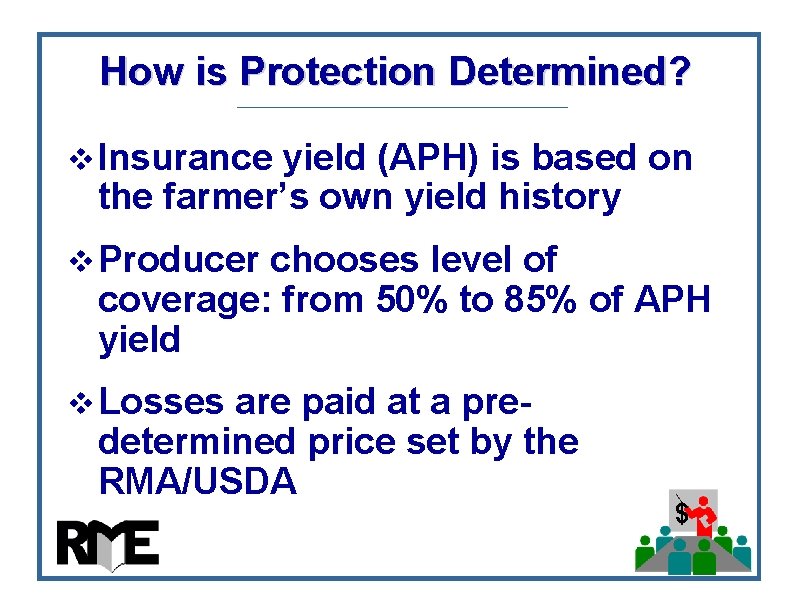
How is Protection Determined? v Insurance yield (APH) is based on the farmer’s own yield history v Producer chooses level of coverage: from 50% to 85% of APH yield v Losses are paid at a predetermined price set by the RMA/USDA $
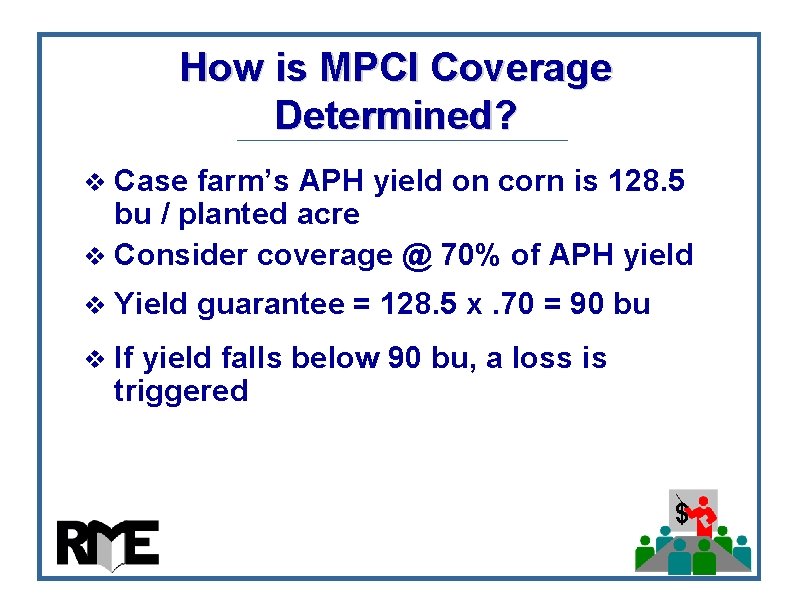
How is MPCI Coverage Determined? v Case farm’s APH yield on corn is 128. 5 bu / planted acre v Consider coverage @ 70% of APH yield v Yield guarantee = 128. 5 x. 70 = 90 bu v If yield falls below 90 bu, a loss is triggered $
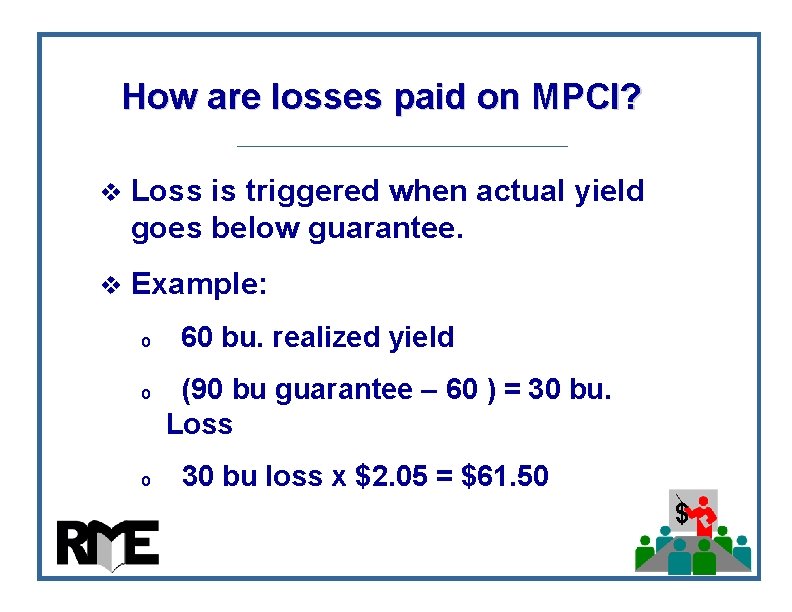
How are losses paid on MPCI? v Loss is triggered when actual yield goes below guarantee. v Example: o o o 60 bu. realized yield (90 bu guarantee – 60 ) = 30 bu. Loss 30 bu loss x $2. 05 = $61. 50 $
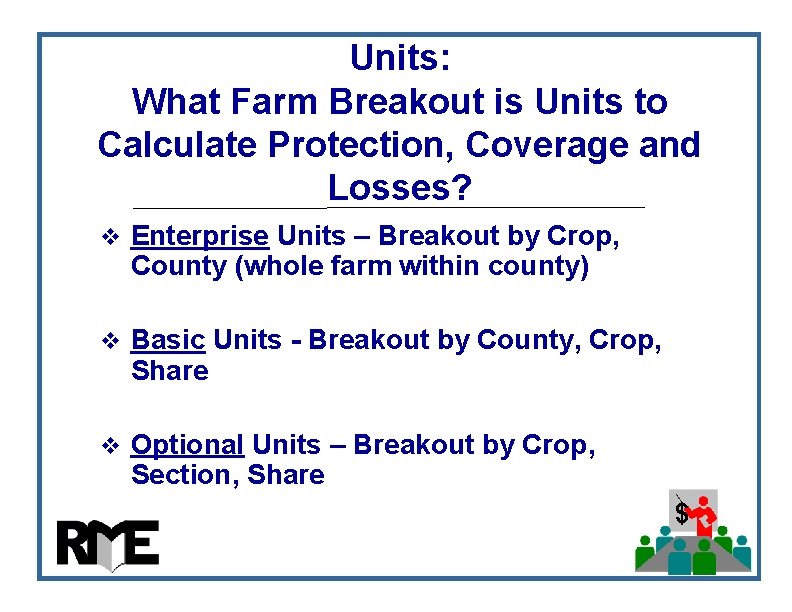
Units: What Farm Breakout is Units to Calculate Protection, Coverage and Losses? v Enterprise Units – Breakout by Crop, County (whole farm within county) v Basic Units - Breakout by County, Crop, Share v Optional Units – Breakout by Crop, Section, Share $
MPCI Review v Available on most crops v Guarantees can be determined at a sub-farm level (section) which increases “effective” coverage from a whole farm yield perspective v Rates & Prices are established by the RMA/USDA and vary by county and your yield relative to “peers” v Subsidized by the RMA/USDA $
“Catastrophic” Yield Coverage v 50 % yield coverage v Losses are paid at 55% of MPCI indemnity price v Optional v $100 units are not permitted / crop / county $
Selected Revenue Insurances v “Pure” o Revenue Insurance RA v Revenue Insurance With Replacement Price Coverage o CRC o RA w/ RPC option $
CROP REVENUE COVERAGE v CRC is a Revenue index contract with replacement price coverage v CRC is Designed to facilitate preharvest pricing v CRC is an index contract because the futures price is used to calculate “farm revenue” , not the local cash price $
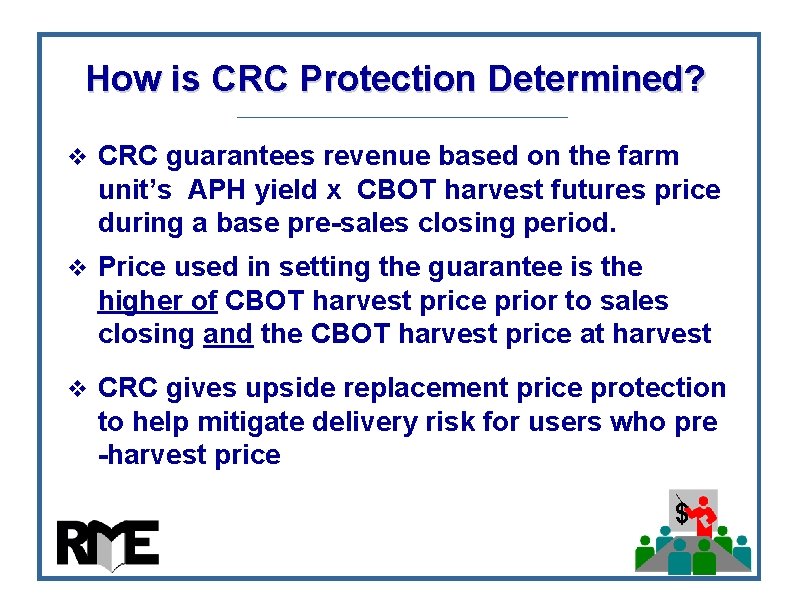
How is CRC Protection Determined? v CRC guarantees revenue based on the farm unit’s APH yield x CBOT harvest futures price during a base pre-sales closing period. v Price used in setting the guarantee is the higher of CBOT harvest price prior to sales closing and the CBOT harvest price at harvest v CRC gives upside replacement price protection to help mitigate delivery risk for users who pre -harvest price $
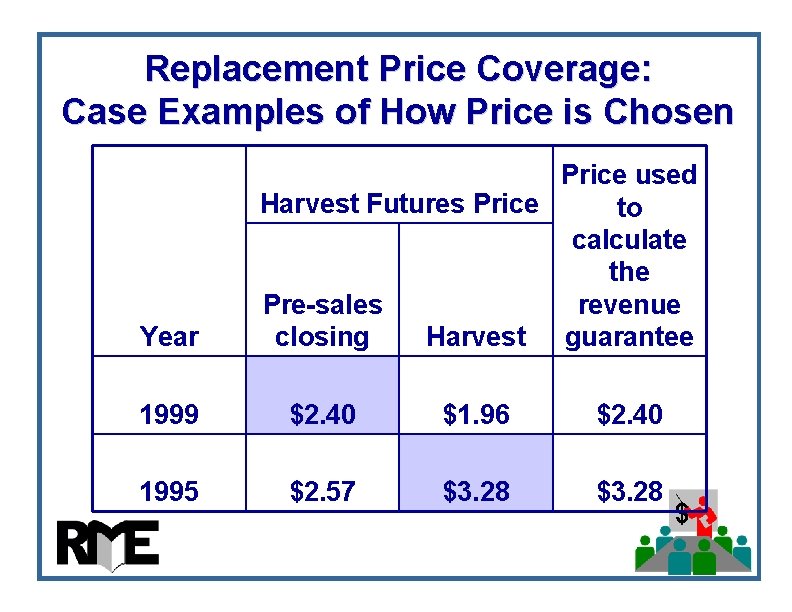
Replacement Price Coverage: Case Examples of How Price is Chosen Year Price used Harvest Futures Price to calculate the Pre-sales revenue closing Harvest guarantee 1999 $2. 40 $1. 96 $2. 40 1995 $2. 57 $3. 28 $
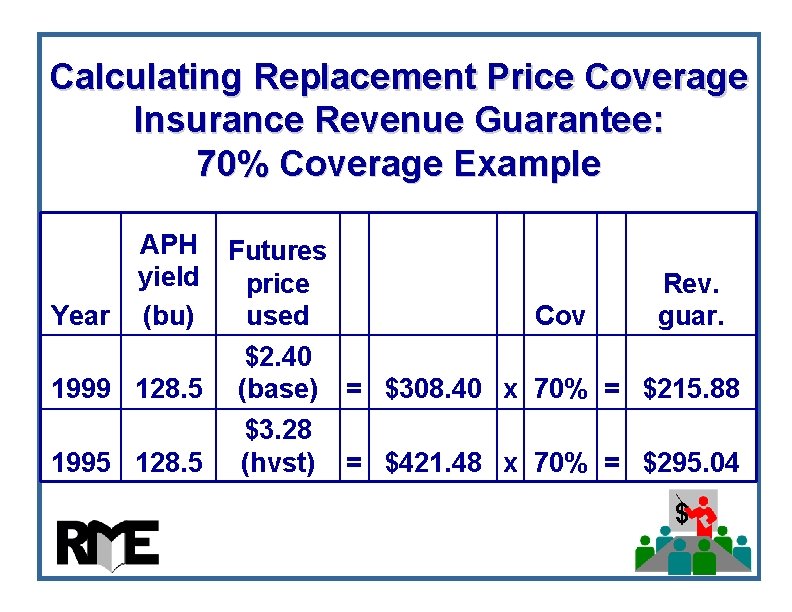
Calculating Replacement Price Coverage Insurance Revenue Guarantee: 70% Coverage Example Year APH yield (bu) Futures price used Cov Rev. guar. 1999 128. 5 $2. 40 (base) = $308. 40 x 70% = $215. 88 1995 128. 5 $3. 28 (hvst) = $421. 48 x 70% = $295. 04 $
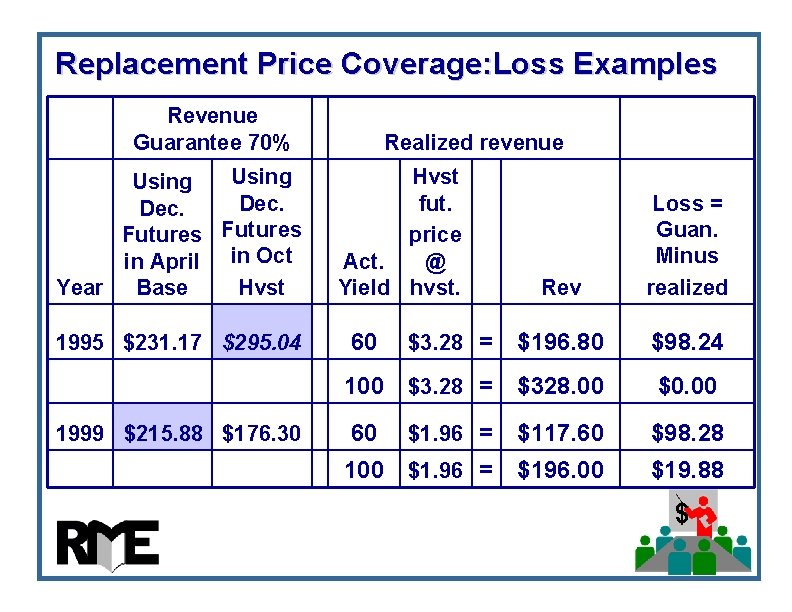
Replacement Price Coverage: Loss Examples Revenue Guarantee 70% Using Dec. Futures in April in Oct Year Base Hvst 1995 $231. 17 $295. 04 1999 $215. 88 $176. 30 Realized revenue Hvst fut. price Act. @ Yield hvst. Rev Loss = Guan. Minus realized 60 $3. 28 = $196. 80 $98. 24 100 $3. 28 = $328. 00 $0. 00 60 $1. 96 = $117. 60 $98. 28 100 $1. 96 = $196. 00 $19. 88 $
How is RA Protection Under the No Replacement Price Option Determined? v RA guarantees revenue based on farm unit’s APH yield x CBOT harvest futures price prior to sales closing. $
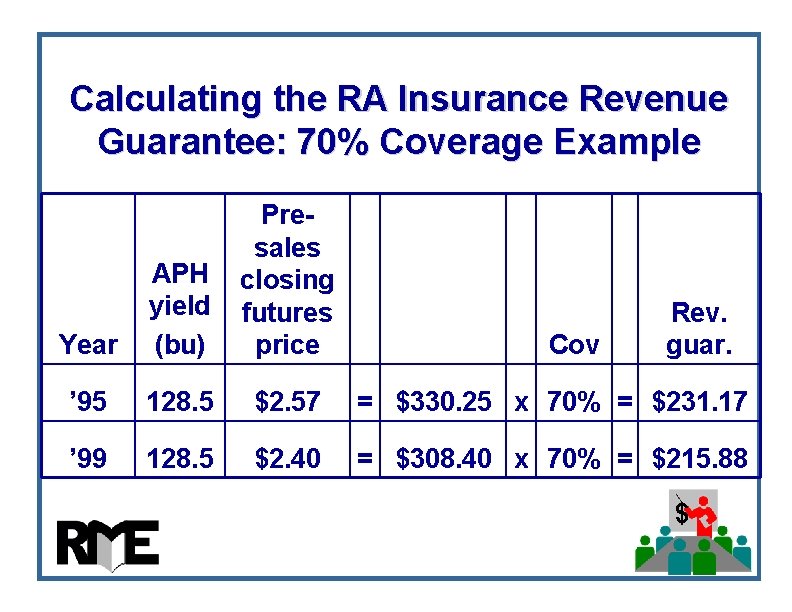
Calculating the RA Insurance Revenue Guarantee: 70% Coverage Example Year APH yield (bu) Presales closing futures price ’ 95 128. 5 $2. 57 = $330. 25 x 70% = $231. 17 ’ 99 128. 5 $2. 40 = $308. 40 x 70% = $215. 88 Cov Rev. guar. $
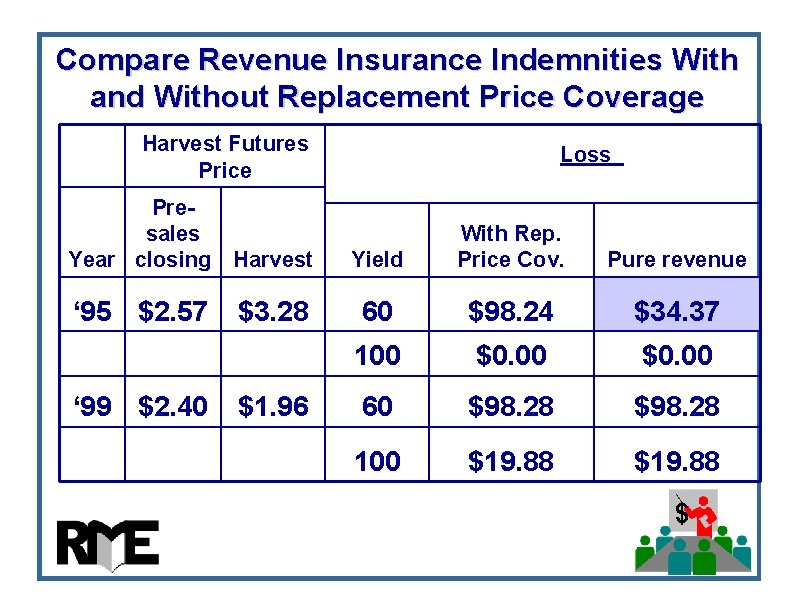
Compare Revenue Insurance Indemnities With and Without Replacement Price Coverage Harvest Futures Price Presales Year closing Harvest ‘ 95 $2. 57 ‘ 99 $2. 40 $3. 28 $1. 96 Loss Yield With Rep. Price Cov. Pure revenue 60 $98. 24 $34. 37 100 $0. 00 60 $98. 28 100 $19. 88 $
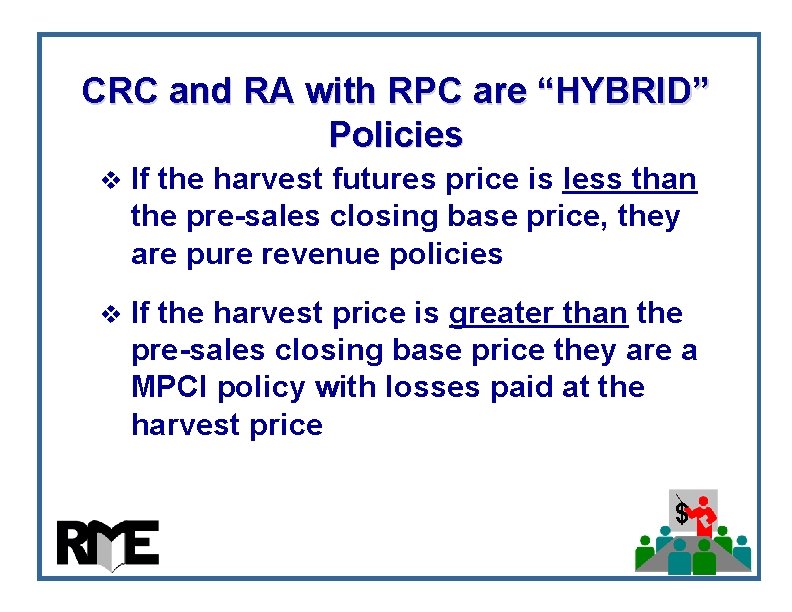
CRC and RA with RPC are “HYBRID” Policies v If the harvest futures price is less than the pre-sales closing base price, they are pure revenue policies v If the harvest price is greater than the pre-sales closing base price they are a MPCI policy with losses paid at the harvest price $
CRC Features v Yield procedures are the same as MPCI including units; enterprise discounts are available v Available on only corn, soybeans and wheat v Rates are based on MPCI rates with an adjustment for the price risk component v Rates vary by historical county experience and farm’s APH yield relative to peers $
RA Features v Yield procedures are …. v Available on only corn, soybeans and wheat v Rates are based on MPCI rates with an adjustment for the price risk component v Rates vary by historical county experience and farm’s APH yield relative to peers $
Revenue Insurances: Where do They Fit? v Pure revenue insurance makes sense if farm does little pre-harvest pricing. v Revenue insurance with replacement price coverage fits when farm does significant preharvest pricing. v If the farm uses pre-harvest pricing, Revenue insurance with replacement price coverage typically outperforms MPCI and preharvest pricing … particularly, if farm yield and market price are correlated. $
STOP! • Fill out Crop Insurance Decision Worksheets! $
Tasks: v Calculate protection for each policy to help you in your decision of whether or not to purchase and, if so, which coverage (deductible). v Start to lay out your objectives and assess whether crop insurance plays a potential role in meeting those objectives. $