StudentLed IEP Meetings John R Johnson Ph D







- Slides: 57
Student-Led IEP Meetings John R. Johnson, Ph. D. Director of Research and Development Center for Disabilities 1400 W. 22 nd St. Sioux Falls SD 57105 Phone: 619 -778 -4580 Fax: 605 -357 -1438 Email: john. r. johnson@usd. edu Webpage: www. usd. edu/cd
Additional Acknowledgement & Credit James Martin, Ph. D. Zarrow Professor of Educational Psychology University of Oklahoma Zarrow Center 338 Cate Center Dr, Rm 190 Norman, OK 73019 405 -325 -8951 jemartin@ou. edu Webpage: zarrowcenter. ou. edu
Agenda �Rationale �Building the Student-Led IEP as an effective practice �Student-Led IEP Lessons �Resources & Templates
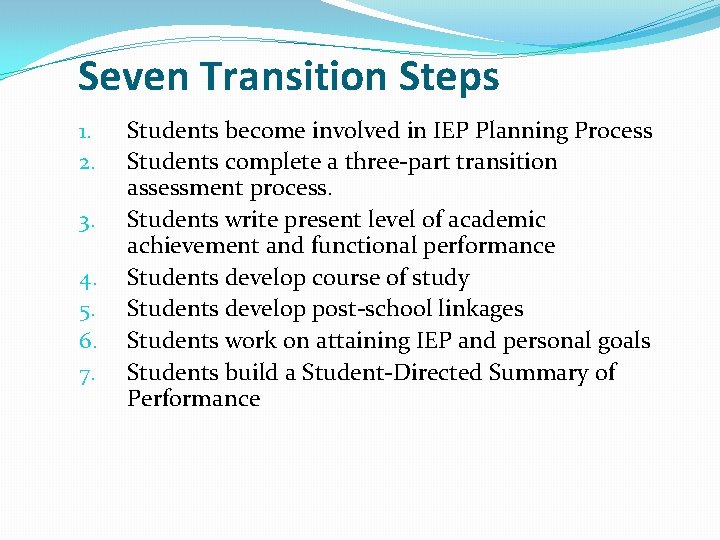
Seven Transition Steps 1. 2. 3. 4. 5. 6. 7. Students become involved in IEP Planning Process Students complete a three-part transition assessment process. Students write present level of academic achievement and functional performance Students develop course of study Students develop post-school linkages Students work on attaining IEP and personal goals Students build a Student-Directed Summary of Performance
Step 1: Involve Student in IEP Planning Process �Teach students to become active participants in own IEP meeting �Learn terms and process �Students write script of what to say and when �Practice �Provide opportunities for students to speak at IEP meetings �Involve and educate IEP Team in facilitating student involvement
Composite of Self-Determination Skills Learned �Goal Setting �Choice-making �Decision-making �Self-management/evaluation
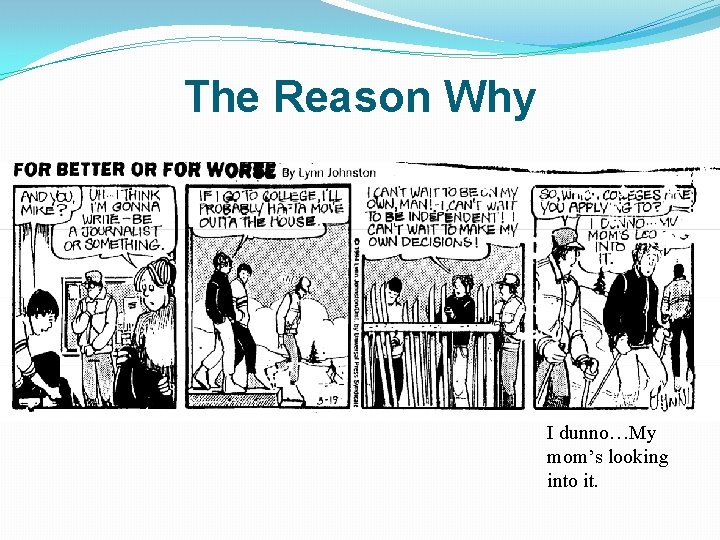
The Reason Why I dunno…My mom’s looking into it.
Invitation Does Not Equal Participation We are mandated to invite students to attend their IEP meetings when transition issues are discussed. This invitation does not guarantee meaningful student involvement in the meeting, nor does it equal meeting participation on behalf of the student.
IEP Engagement Who Attends • Approximately 80% of students • Family Member(s) • Special Educator(s) • General Educator(s) • Support Staff • Administrator(s) Who Talks • Special Educator(s): 51% • General Educator(s)/ Administrator(s): 18% • Family Member(s): 15% • Support Staff: 6% • Student: 3%
Study of Educator-Directed IEP Meetings � 3 -year study of IEP meetings �Almost 1, 700 IEP team members across 393 IEP meetings � 389 IEP meetings over three years Martin, J. E. , Huber Marshall, L. , & Sale, P. (2004). A 3 -year study of middle, junior high, and high school IEP meetings. Exceptional Children, 70, 285 -297.
I Knew the Reason for Meeting � Students knew the reason for IEP meeting less than all other participants. � General educators knew the reasons for the meeting less than everyone except the student � Gen Education Teachers reported helping to make decisions less all other team members, followed by student. � Additional studies follow in next slides (FYI) � Go to 18
More Student Findings �Students knew what to do at the meetings less than everyone else, followed by parents, and then general educators. �Students talked less than everyone & sped teachers talked the most �Students felt uncomfortable in saying what they thought more so than anyone else. �Students reported that they helped make decisions less than anyone else. �Students understood less than anyone else in what was said. �Students reported feeling less good about the meeting than anyone else.
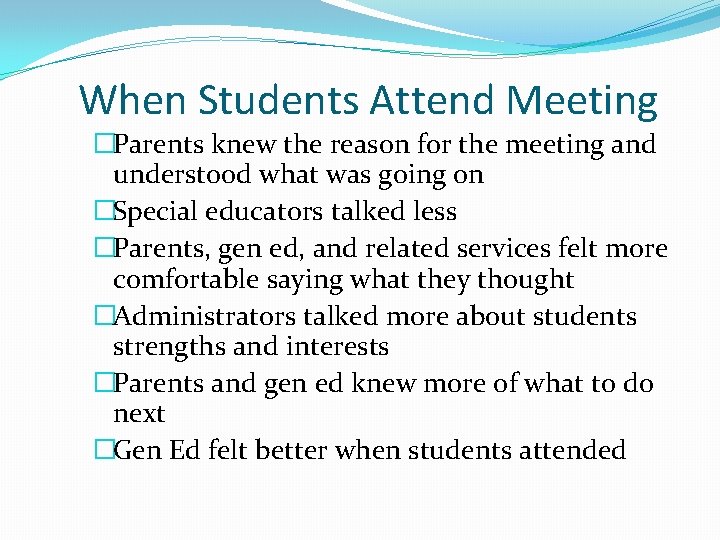
When Students Attend Meeting �Parents knew the reason for the meeting and understood what was going on �Special educators talked less �Parents, gen ed, and related services felt more comfortable saying what they thought �Administrators talked more about students strengths and interests �Parents and gen ed knew more of what to do next �Gen Ed felt better when students attended
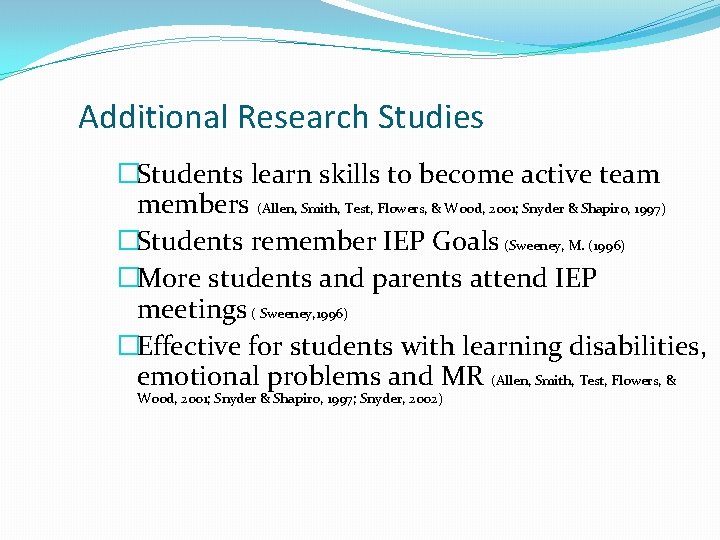
Additional Research Studies �Students learn skills to become active team members (Allen, Smith, Test, Flowers, & Wood, 2001; Snyder & Shapiro, 1997) �Students remember IEP Goals (Sweeney, M. (1996) �More students and parents attend IEP meetings ( Sweeney, 1996) �Effective for students with learning disabilities, emotional problems and MR (Allen, Smith, Test, Flowers, & Wood, 2001; Snyder & Shapiro, 1997; Snyder, 2002)
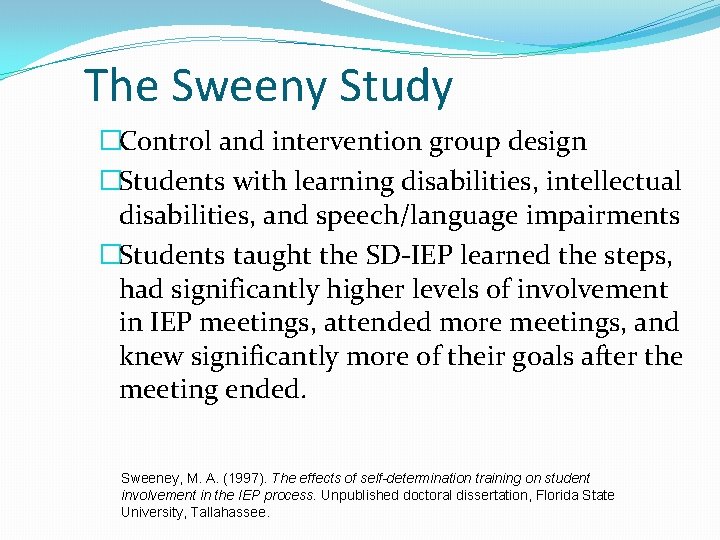
The Sweeny Study �Control and intervention group design �Students with learning disabilities, intellectual disabilities, and speech/language impairments �Students taught the SD-IEP learned the steps, had significantly higher levels of involvement in IEP meetings, attended more meetings, and knew significantly more of their goals after the meeting ended. Sweeney, M. A. (1997). The effects of self-determination training on student involvement in the IEP process. Unpublished doctoral dissertation, Florida State University, Tallahassee.
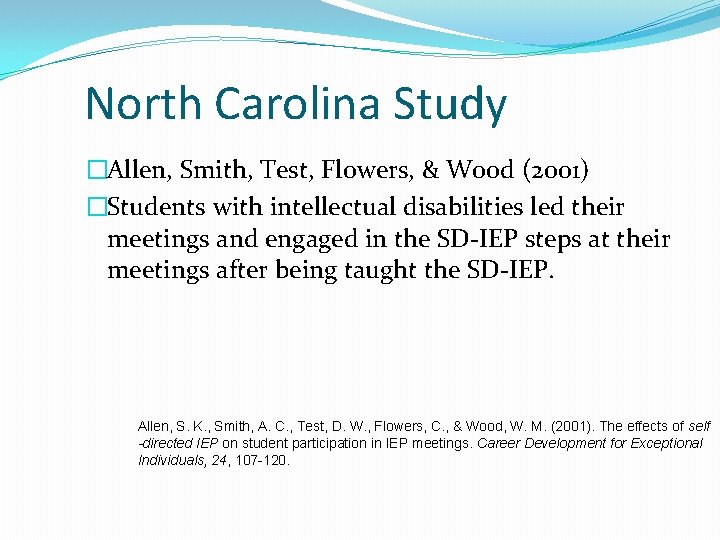
North Carolina Study �Allen, Smith, Test, Flowers, & Wood (2001) �Students with intellectual disabilities led their meetings and engaged in the SD-IEP steps at their meetings after being taught the SD-IEP. Allen, S. K. , Smith, A. C. , Test, D. W. , Flowers, C. , & Wood, W. M. (2001). The effects of self -directed IEP on student participation in IEP meetings. Career Development for Exceptional Individuals, 24, 107 -120.
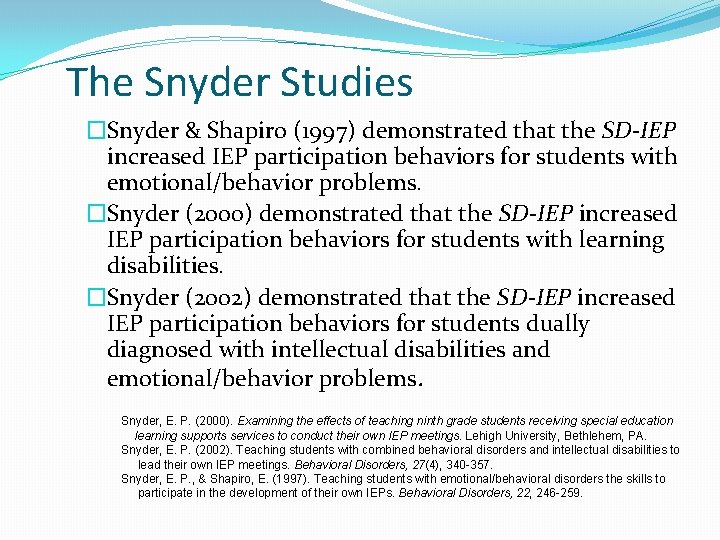
The Snyder Studies �Snyder & Shapiro (1997) demonstrated that the SD-IEP increased IEP participation behaviors for students with emotional/behavior problems. �Snyder (2000) demonstrated that the SD-IEP increased IEP participation behaviors for students with learning disabilities. �Snyder (2002) demonstrated that the SD-IEP increased IEP participation behaviors for students dually diagnosed with intellectual disabilities and emotional/behavior problems. Snyder, E. P. (2000). Examining the effects of teaching ninth grade students receiving special education learning supports services to conduct their own IEP meetings. Lehigh University, Bethlehem, PA. Snyder, E. P. (2002). Teaching students with combined behavioral disorders and intellectual disabilities to lead their own IEP meetings. Behavioral Disorders, 27(4), 340 -357. Snyder, E. P. , & Shapiro, E. (1997). Teaching students with emotional/behavioral disorders the skills to participate in the development of their own IEPs. Behavioral Disorders, 22, 246 -259.
Van Dycke Study Van Dycke (2005) found that the written IEP documents of students who received SD-IEP instruction had more comprehensive postschool goal/vision statements than those who attended teacher-directed IEP meetings. Van Dycke, J. L. (2005). Determining the Impact of Self-Directed IEP Instruction on Secondary IEP Transition Documents. Unpublished doctoral dissertation, University of Oklahoma, Norman.
Student-Led IEP The small-n, experimental, and quasiexperimental studies demonstrate SD-IEP as an evidence-based practice.
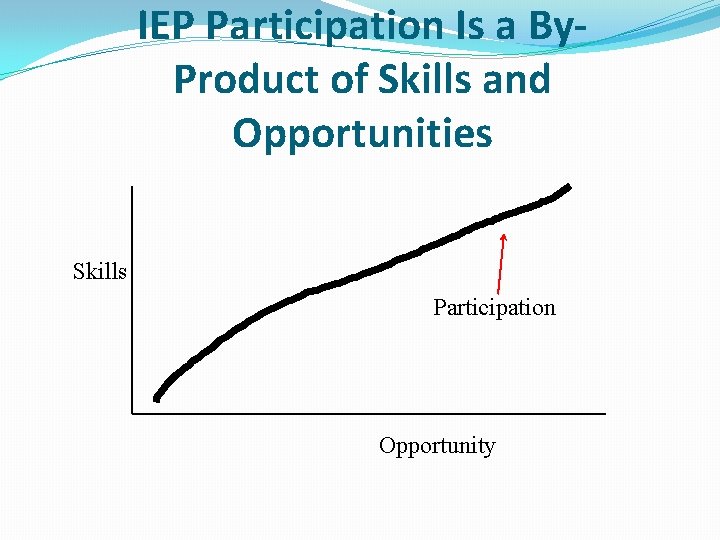
IEP Participation Is a By. Product of Skills and Opportunities Skills Participation Opportunity
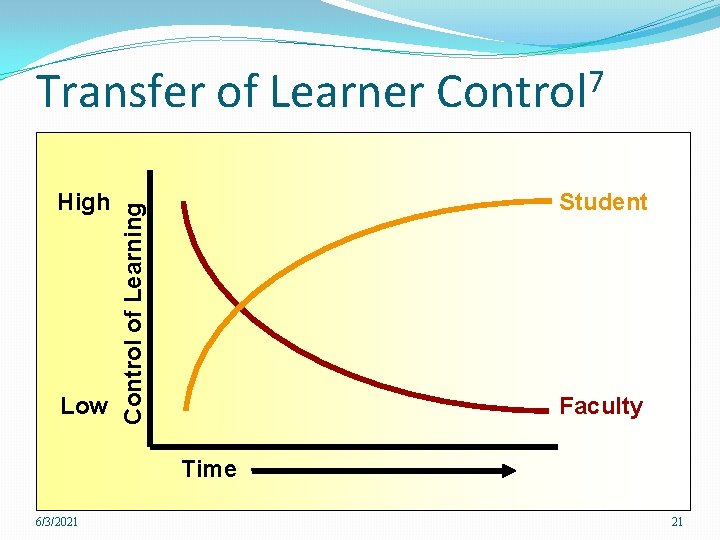
Transfer of Learner Low Student Control of Learning High 7 Control Faculty Time 6/3/2021 21
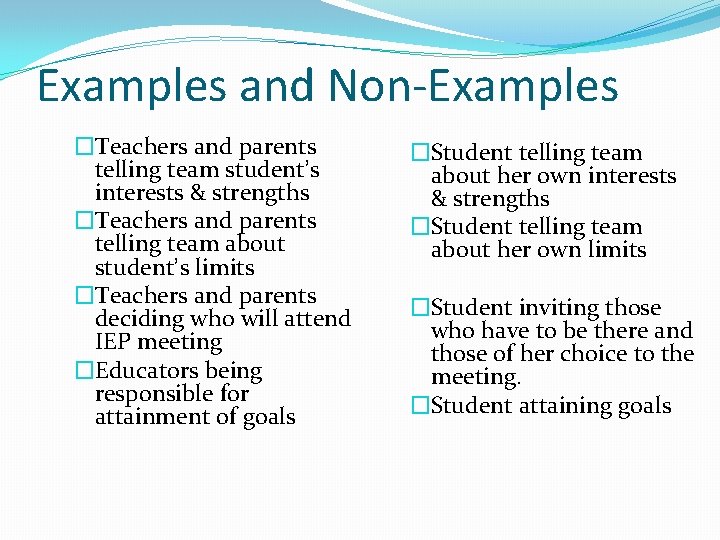
Examples and Non-Examples �Teachers and parents telling team student’s interests & strengths �Teachers and parents telling team about student’s limits �Teachers and parents deciding who will attend IEP meeting �Educators being responsible for attainment of goals �Student telling team about her own interests & strengths �Student telling team about her own limits �Student inviting those who have to be there and those of her choice to the meeting. �Student attaining goals
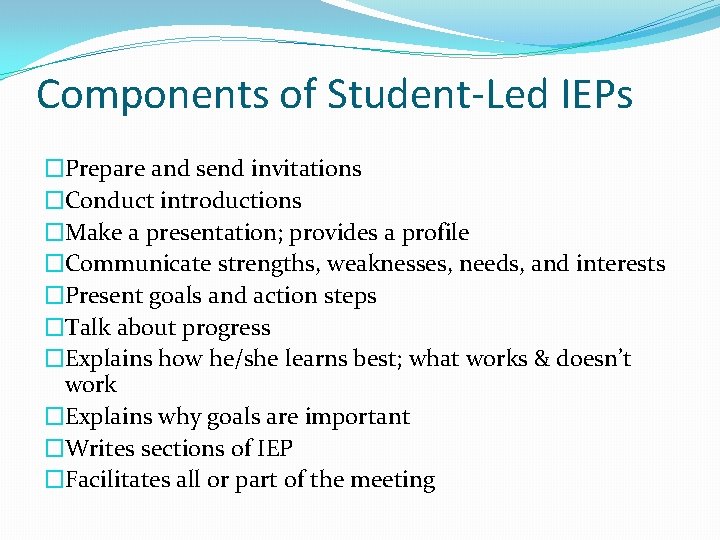
Components of Student-Led IEPs �Prepare and send invitations �Conduct introductions �Make a presentation; provides a profile �Communicate strengths, weaknesses, needs, and interests �Present goals and action steps �Talk about progress �Explains how he/she learns best; what works & doesn’t work �Explains why goals are important �Writes sections of IEP �Facilitates all or part of the meeting
Levels of Engagement Rubric Score Level of Engagement 0 IEP takes place without student present 1 Student present – minimal participation or preparation 2 3 4 5 Student present – some participation (presents information, gives input into goals, answers questions) Student present and actively participates Student present and takes responsibility for most of the process Student leads and directs IEP process
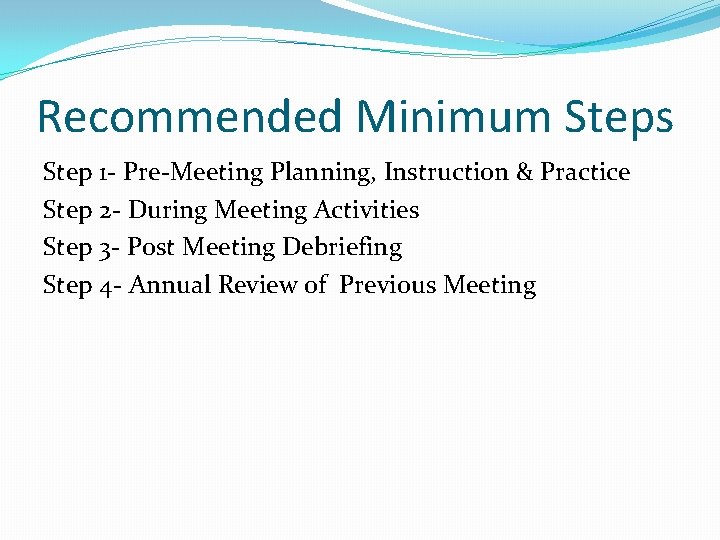
Recommended Minimum Steps Step 1 - Pre-Meeting Planning, Instruction & Practice Step 2 - During Meeting Activities Step 3 - Post Meeting Debriefing Step 4 - Annual Review of Previous Meeting
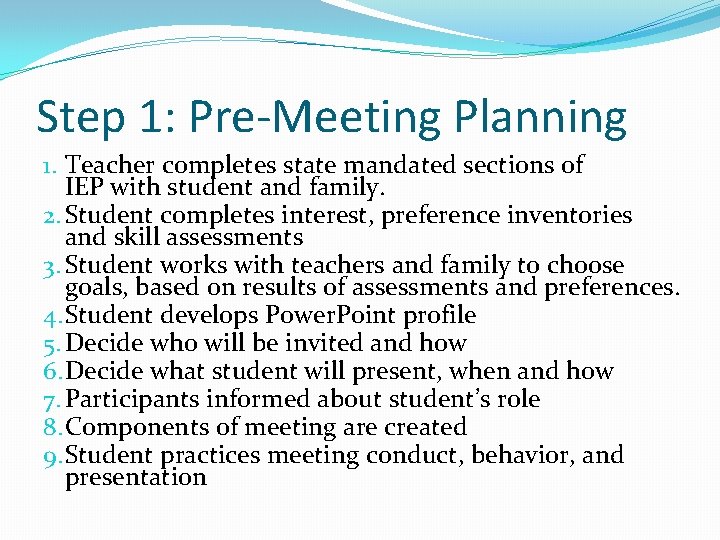
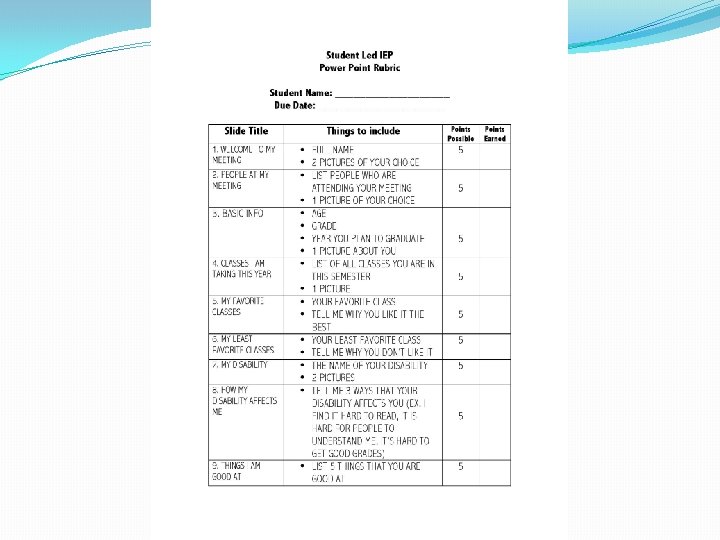
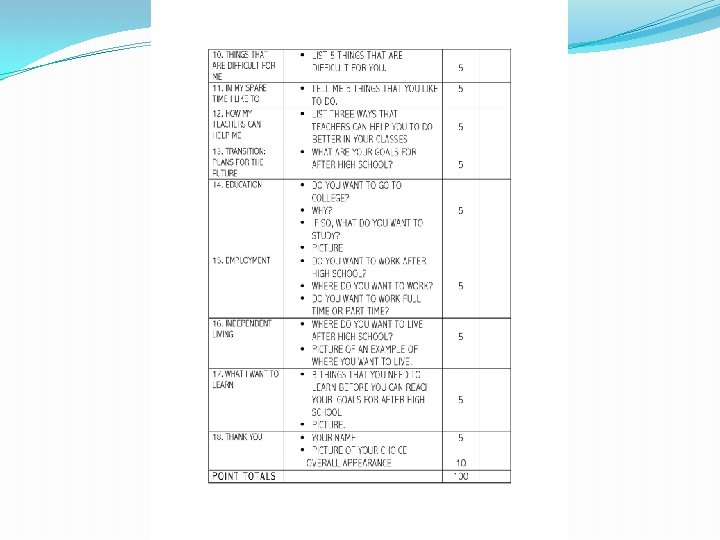
Step 1: Pre-Meeting Planning 1. Teacher completes state mandated sections of IEP with student and family. 2. Student completes interest, preference inventories and skill assessments 3. Student works with teachers and family to choose goals, based on results of assessments and preferences. 4. Student develops Power. Point profile 5. Decide who will be invited and how 6. Decide what student will present, when and how 7. Participants informed about student’s role 8. Components of meeting are created 9. Student practices meeting conduct, behavior, and presentation
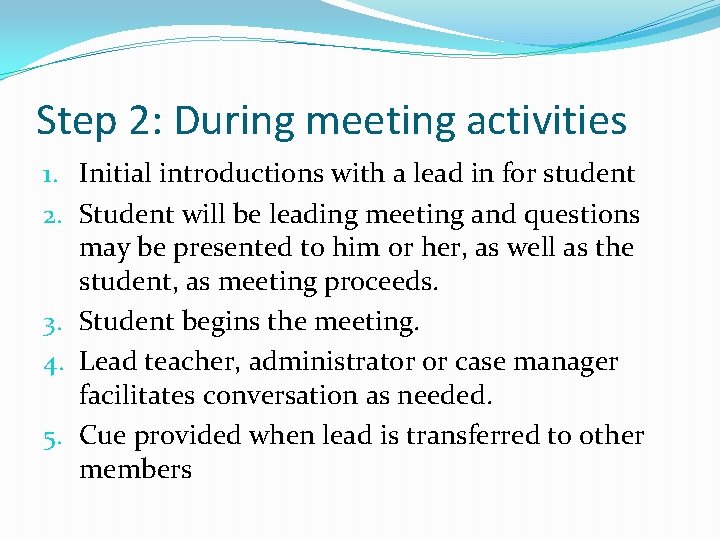
Step 2: During meeting activities 1. Initial introductions with a lead in for student 2. Student will be leading meeting and questions may be presented to him or her, as well as the student, as meeting proceeds. 3. Student begins the meeting. 4. Lead teacher, administrator or case manager facilitates conversation as needed. 5. Cue provided when lead is transferred to other members
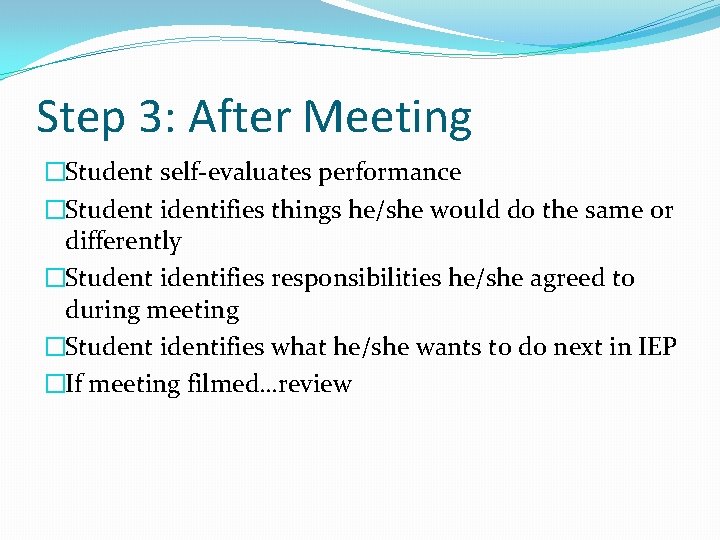
Step 3: After Meeting �Student self-evaluates performance �Student identifies things he/she would do the same or differently �Student identifies responsibilities he/she agreed to during meeting �Student identifies what he/she wants to do next in IEP �If meeting filmed…review
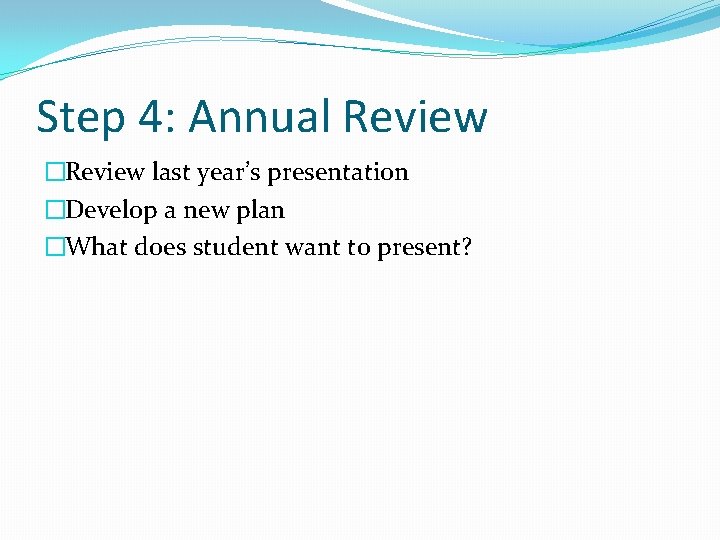
Step 4: Annual Review �Review last year’s presentation �Develop a new plan �What does student want to present?
Templates/Examples
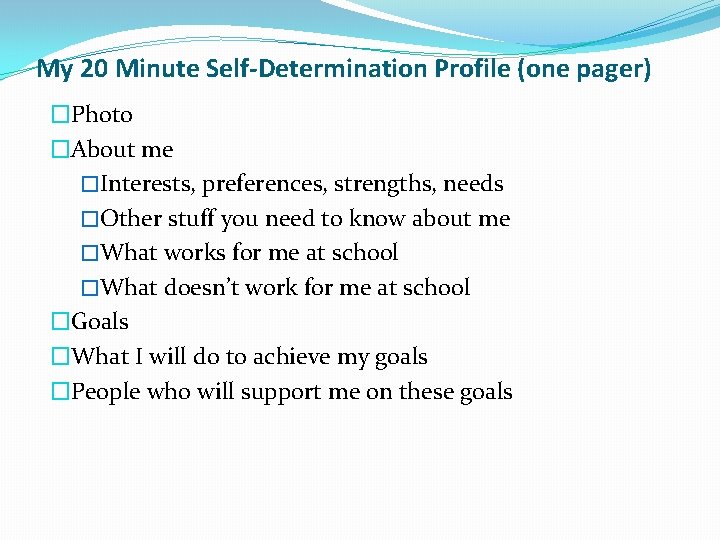
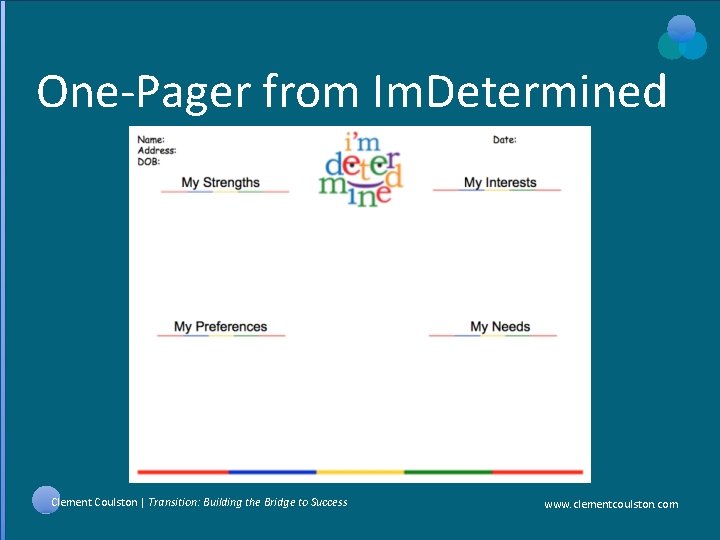
My 20 Minute Self-Determination Profile (one pager) �Photo �About me �Interests, preferences, strengths, needs �Other stuff you need to know about me �What works for me at school �What doesn’t work for me at school �Goals �What I will do to achieve my goals �People who will support me on these goals
Tips �Use a Power. Point that uses visual and auditory cues (visual and auditory reminders) �Develop and role play questions and participation in advance �Provide opportunities for practice (role play with other students and staff) �Create a cue for a graceful exit if needed
One-Pager from Im. Determined Clement Coulston | Transition: Building the Bridge to Success www. clementcoulston. com
Strengths �Friendly �Good at math �Drawing �Working with people �Music/Art �Enjoy working with kids Clement Coulston | Transition: Building the Bridge to Success www. clementcoulston. com
My Preferences �Working inside �Going to a tutor �Listening to books on tape �Using AT (Assistive Technology) Clement Coulston | Transition: Building the Bridge to Success www. clementcoulston. com
My Interests �Boy Scouts / Girl Scouts �Watching movies �Pet �Exercising �Hanging out �Clubs/intramural sports Clement Coulston | Transition: Building the Bridge to Success www. clementcoulston. com
My Needs �Smaller classes �Notice on tests/quizzes �Working with teachers to problem-solve �Hard copy vs. computerized assessments Clement Coulston | Transition: Building the Bridge to Success www. clementcoulston. com
Resources
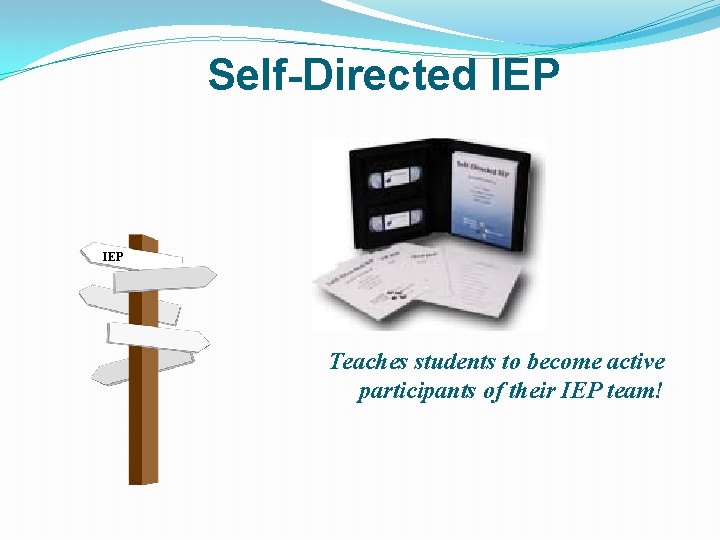
Self-Directed IEP Teaches students to become active participants of their IEP team!
Student-Directed Transition Planning �Available from: OU Zarrow Center for Learning Enrichment �http: //www. ou. edu/content/education/centers-andpartnerships/zarrow/trasition-educationmaterials/student-directed-transition-planning. html
Self-Directed IEP �Strand of The Choice. Maker Self-Determination Curriculum (Martin & Marshall, 1995) �Purpose: teach students to participate in and lead their own IEP meetings �Content: Multimedia package; includes a Teacher’s Manual, Student Workbook, and two videos that present 11 steps necessary for students to lead their own IEPs
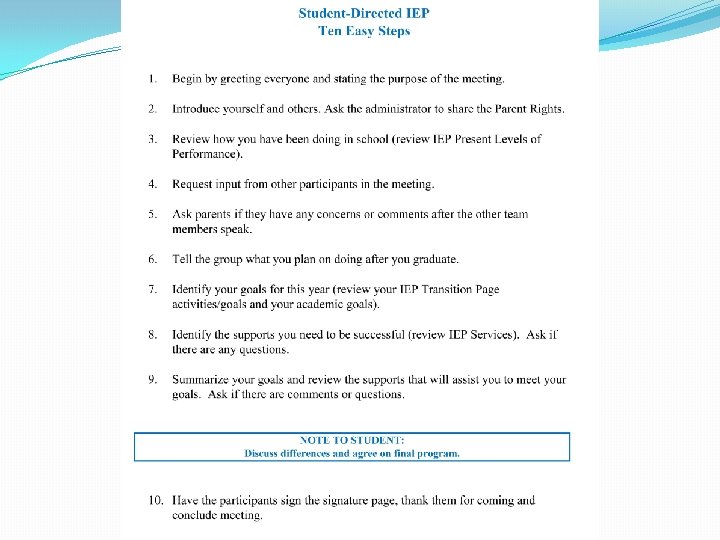
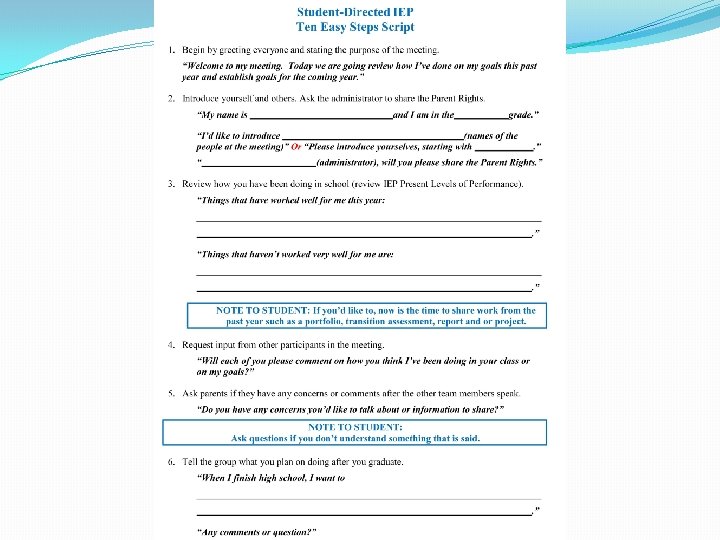
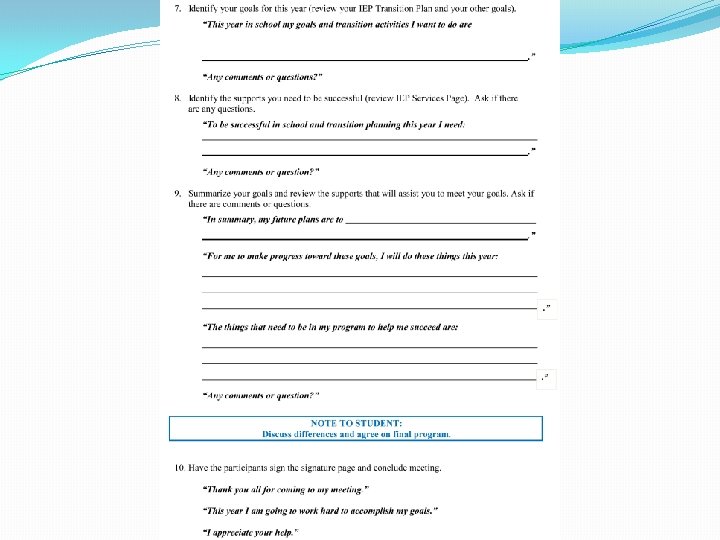
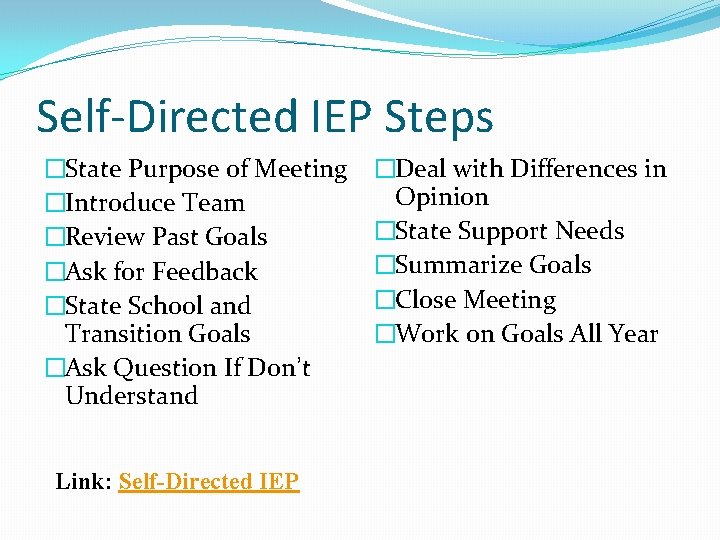
Self-Directed IEP Steps �State Purpose of Meeting �Introduce Team �Review Past Goals �Ask for Feedback �State School and Transition Goals �Ask Question If Don’t Understand Link: Self-Directed IEP �Deal with Differences in Opinion �State Support Needs �Summarize Goals �Close Meeting �Work on Goals All Year
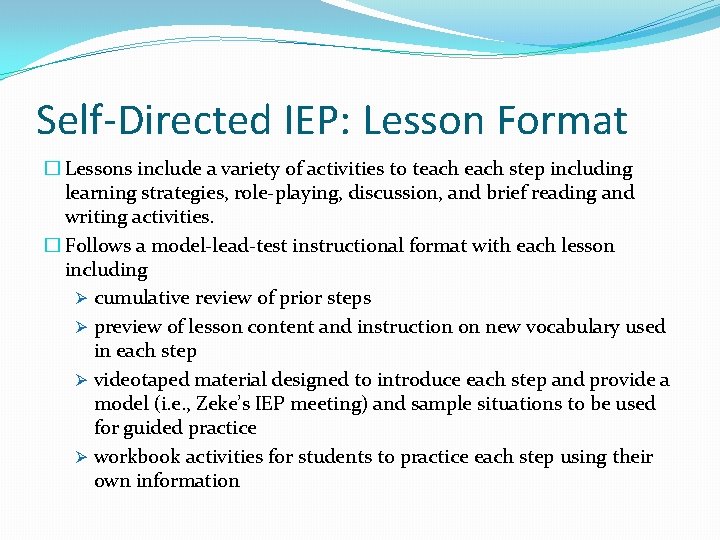
Self-Directed IEP: Lesson Format � Lessons include a variety of activities to teach step including learning strategies, role-playing, discussion, and brief reading and writing activities. � Follows a model-lead-test instructional format with each lesson including Ø cumulative review of prior steps Ø preview of lesson content and instruction on new vocabulary used in each step Ø videotaped material designed to introduce each step and provide a model (i. e. , Zeke’s IEP meeting) and sample situations to be used for guided practice Ø workbook activities for students to practice each step using their own information
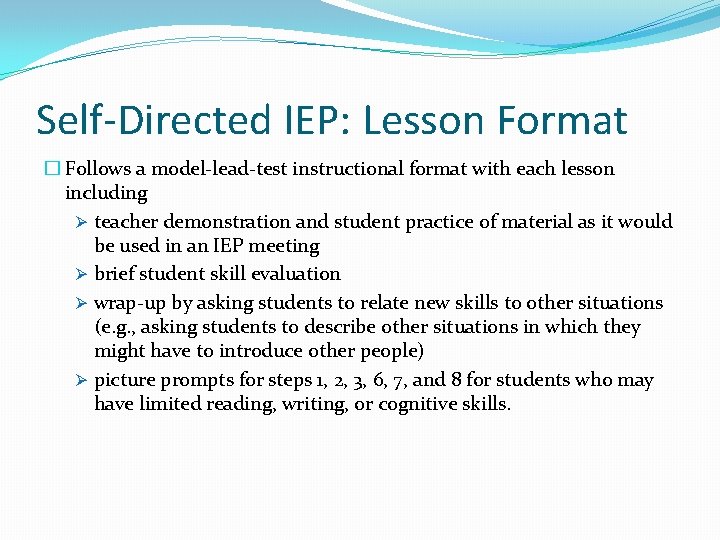
Self-Directed IEP: Lesson Format � Follows a model-lead-test instructional format with each lesson including Ø teacher demonstration and student practice of material as it would be used in an IEP meeting Ø brief student skill evaluation Ø wrap-up by asking students to relate new skills to other situations (e. g. , asking students to describe other situations in which they might have to introduce other people) Ø picture prompts for steps 1, 2, 3, 6, 7, and 8 for students who may have limited reading, writing, or cognitive skills.
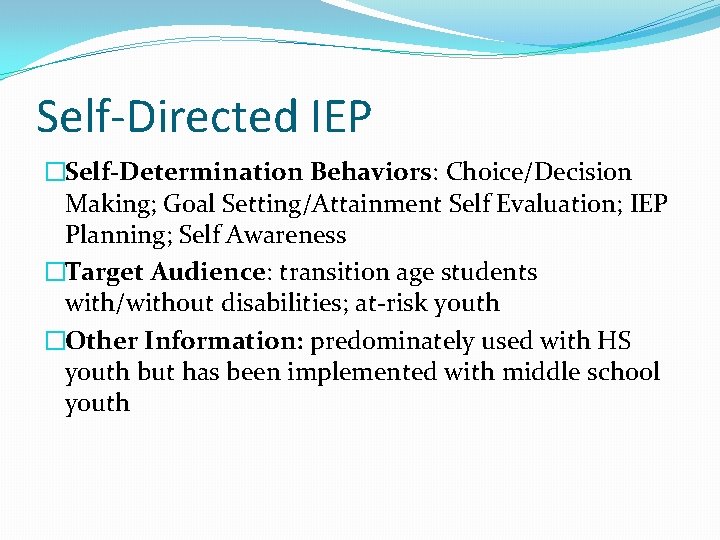
Self-Directed IEP �Self-Determination Behaviors: Choice/Decision Making; Goal Setting/Attainment Self Evaluation; IEP Planning; Self Awareness �Target Audience: transition age students with/without disabilities; at-risk youth �Other Information: predominately used with HS youth but has been implemented with middle school youth
Student-Directed Transition Planning � SDTP uses the Student-Directed Summary of Performance as a means for students to learn, organize and present transition information (Martin, Van Dycke, D'Ottavio, & Nickerson, 2007). � Lessons delivered using Power. Point files � Detailed Teacher's Guide provides step-by-step instructional suggestions. � Students can complete activities on-line � Results automatically transfer to their Summary of Performance Script. � Summary of Performance Script may be used by students during their IEP meetings to facilitate transition discussions and decisionmaking. � Student knowledge gains can be measured using pre/post exams available in true/false or multiple choice formats.
Student-Directed Transition Planning Lessons and Materials �Lesson 1 Awareness �Lesson 2 Terms and Concepts of Transition �Lesson 3 Vision for Employment �Lesson 4 Vision for Postsecondary Education �Lesson 5 Vision for Adult Living �Lesson 6 Course of Study �Lesson 7 Connecting Services �Lesson 8 Summary of Performance
Student-Directed Transition Planning �Pre-Post Measurement Tools �Transition Knowledge Test Ø Ø Ø Pre-Post Measurement Tools: Multiple-Choice (doc) Pre-Post Measurement Tools: True False (doc) Pre-Post Measurement Tools: Answer Key (doc) �Self-Efficacy Scale Ø Pre-Post Measurement Tools: Student (doc) Ø Pre-Post Measurement Tools: Parent (doc) Ø Pre-Post Measurement Tools: Teacher (doc)
My Future My Plan � Population: for students and families � Purpose: to help facilitate planning during the early transition stages � Materials: � Video and video discussion guide � Planning and resource book for students � Guide to the book for family members and teachers
My Future My Plan � Content: � � Self-advocacy Legal rights IEP and transition team Career options � For further Information: � Publisher: State of the Art http: //store. nea. org/NEABookstore/control/productdet ails? item_id=202860 S � $44. 95 (non-NEA members); $39. 95 (NEA members)
Lesson Structure �Cumulative Review �Lesson Preview �Vocabulary Instruction �Video / Example �Sample Situations �Workbook / Written Notes �Evaluation �Relate to Personal Experience
For More Information Contact John R. Johnson, Ph. D. Director of Research and Development Center for Disabilities 1400 W. 22 nd St. Sioux Falls SD 57105 Phone: 619 -778 -4580 Fax: 605 -357 -1438 Email: john. r. johnson@usd. edu Webpage: www. usd. edu/cd