
College and Career Ready IEPs CCRIEPs Improving Outcomes




- Slides: 125
College and Career Ready IEPs (CCR-IEPs) Improving Outcomes for Students 3 through 21 Training Day Presenters: Date:
Learning Expectations By the end of the day you will: • increase your understanding of the CCR IEP 5 Step Process and how to use it • build your capacity to apply Steps 1, 2, and 3 so you can help develop IEPs designed to improve access, engagement, and progress for students with IEPs • identify strategies for preparing for and participating in IEP team meetings • increase your awareness of CCR IEP resources available to support the development of CCR-IEPs April 2018 2
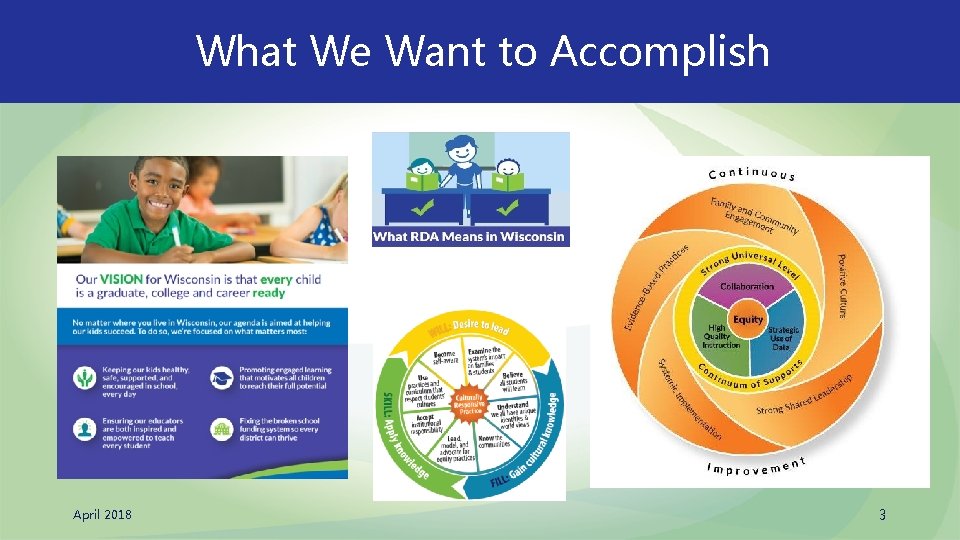
What We Want to Accomplish April 2018 3
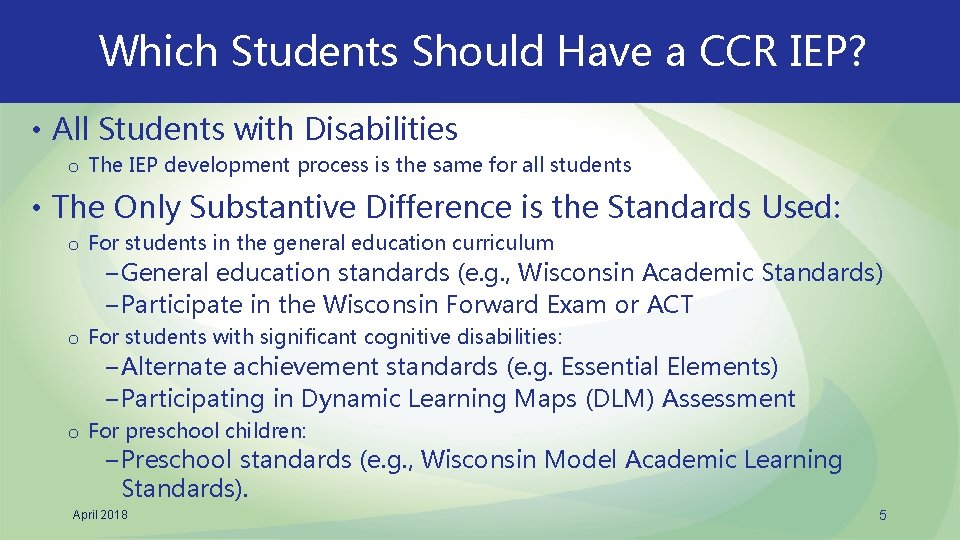
What is a CCR IEP? CCR IEP = College and Career Ready IEP An Individualized Education Program (IEP) developed to : • meet the unique disability-related needs of a student and • help ensure the student graduates ready for further education, work, and living in the community April 2018 4
Which Students Should Have a CCR IEP? • All Students with Disabilities o The IEP development process is the same for all students • The Only Substantive Difference is the Standards Used: o For students in the general education curriculum −General education standards (e. g. , Wisconsin Academic Standards) −Participate in the Wisconsin Forward Exam or ACT o For students with significant cognitive disabilities: −Alternate achievement standards (e. g. Essential Elements) −Participating in Dynamic Learning Maps (DLM) Assessment o For preschool children: −Preschool standards (e. g. , Wisconsin Model Academic Learning Standards). April 2018 5
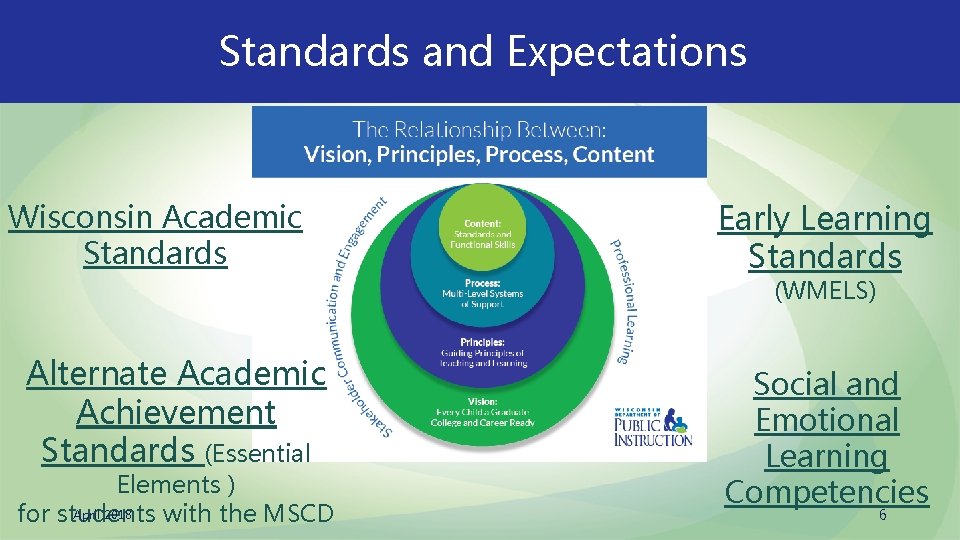
Standards and Expectations Wisconsin Academic Standards Early Learning Standards (WMELS) Alternate Academic Achievement Standards (Essential Elements ) April 2018 for students with the MSCD Social and Emotional Learning Competencies 6
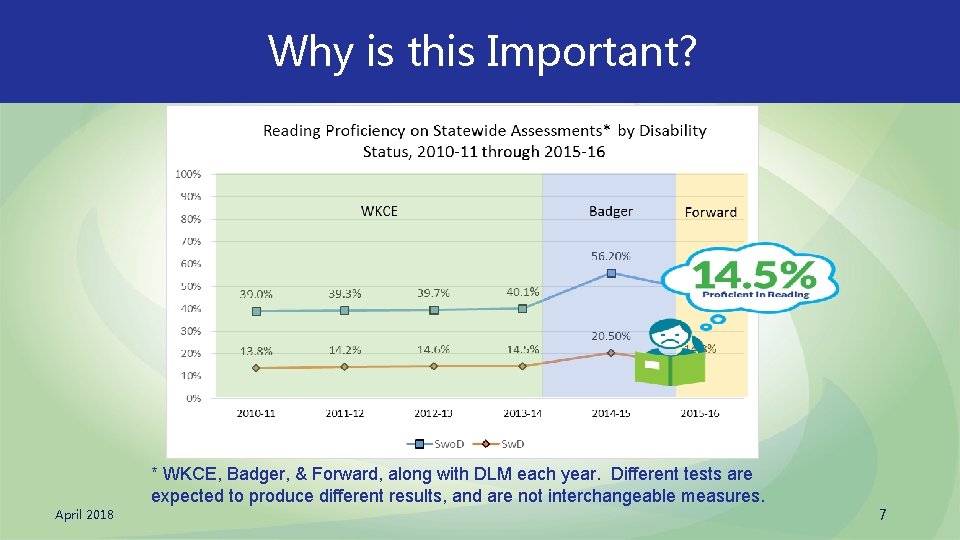
Why is this Important? * WKCE, Badger, & Forward, along with DLM each year. Different tests are expected to produce different results, and are not interchangeable measures. April 2018 7
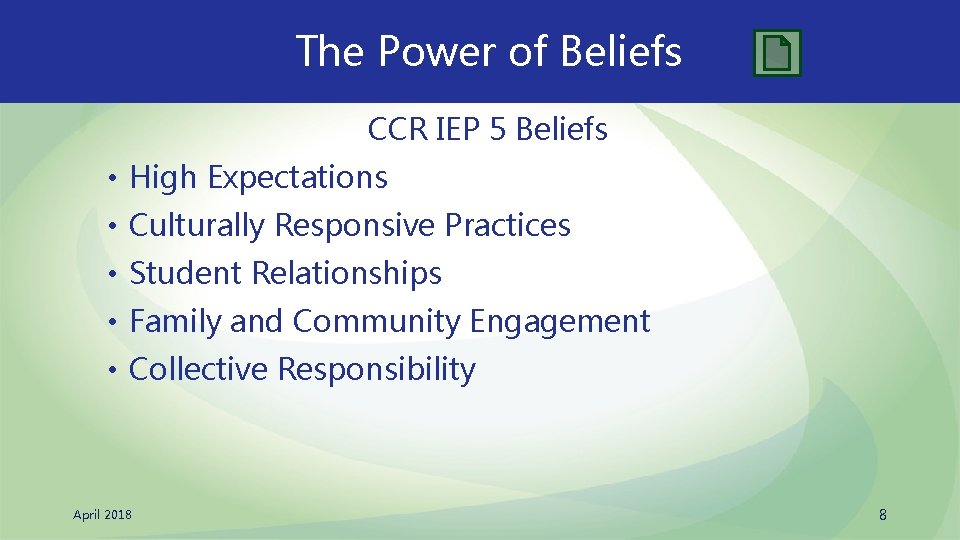
The Power of Beliefs CCR IEP 5 Beliefs • High Expectations • Culturally Responsive Practices • Student Relationships • Family and Community Engagement • Collective Responsibility April 2018 8
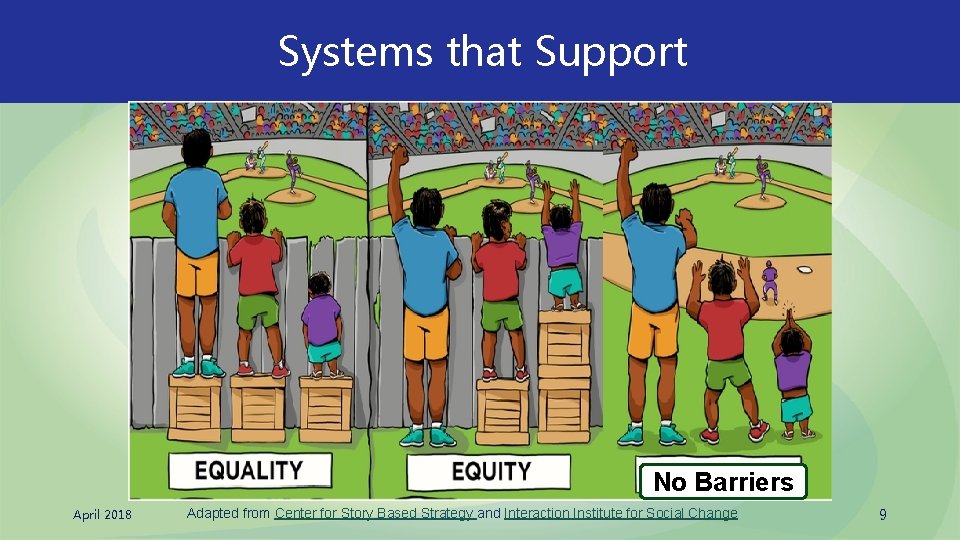
Systems that Support No Barriers April 2018 Adapted from Center for Story Based Strategy and Interaction Institute for Social Change 9
April 2018
Engaging Families • “Achievement gap” is “opportunity gap” • Definitions of terms used • Clear explanation of the step discussion and linkages • Family contribution is valued and essential • Active listening helps to address concerns, answer questions, and elicit input April 2018 11
Engaging Students Have a system in place to engage students in the IEP process o Explain purpose of the IEP and IEP development process −Consider using the 5 Step Process graphic organizer o Explain IEP terminology using language the student understands o Encourage student to share input/give examples appropriate to each step o Provide participation options April 2018 −Consider student led IEPs −Encourage Principle of Partial Participation (as 12
April 2018
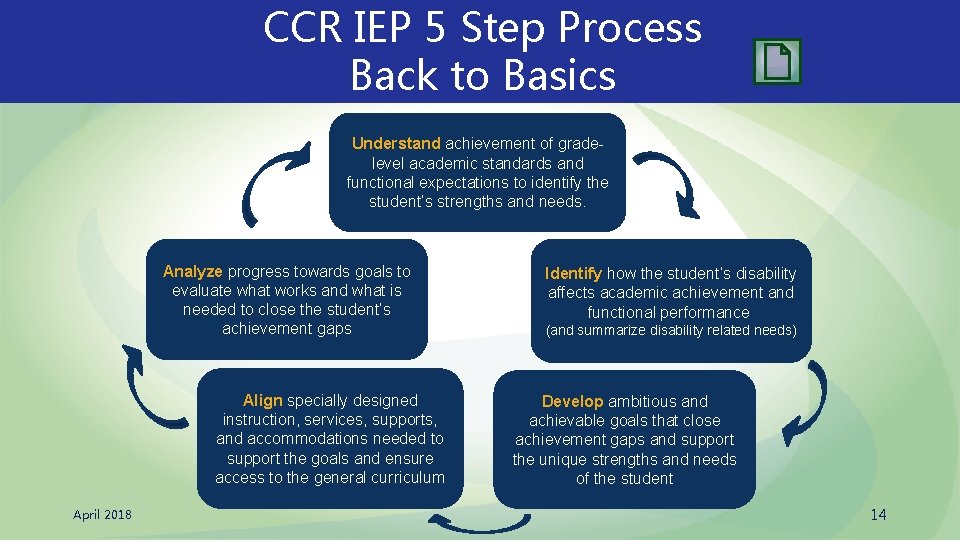
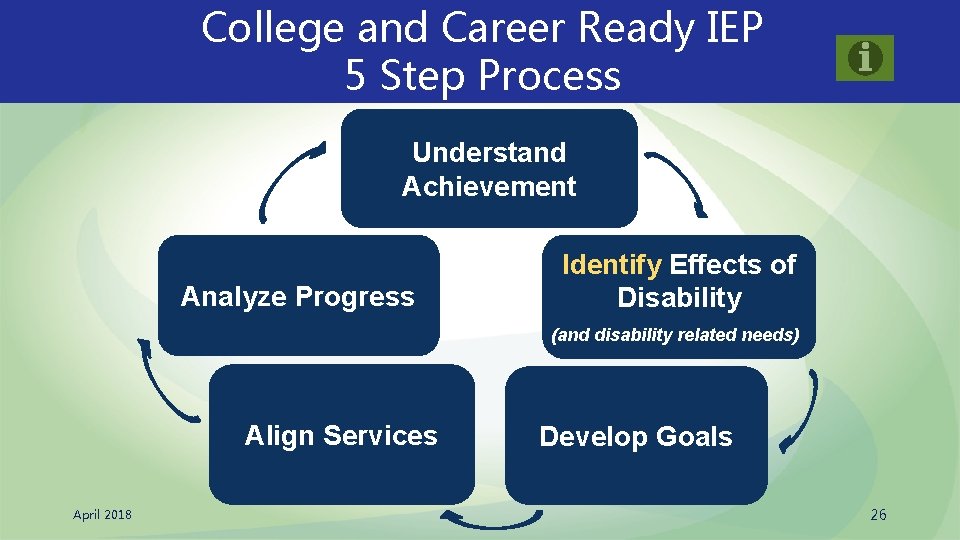
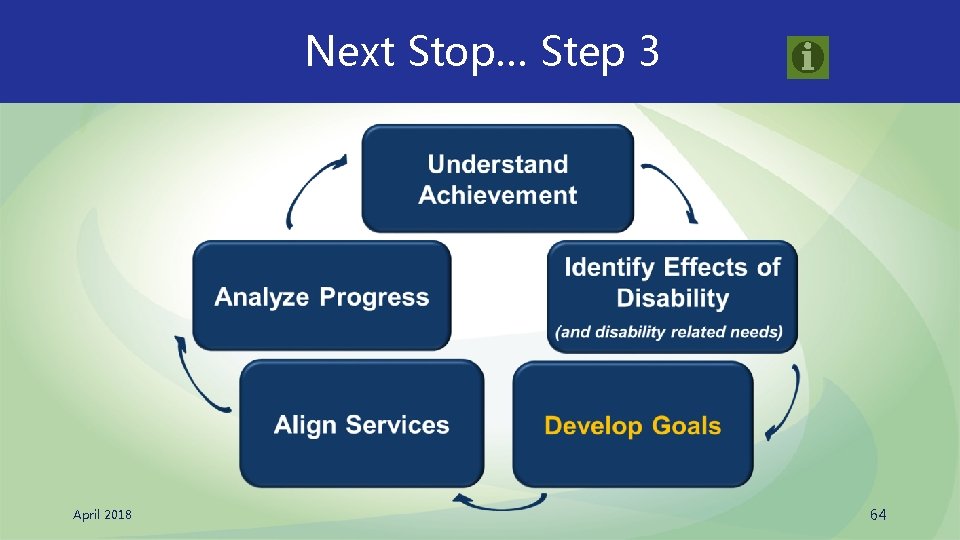
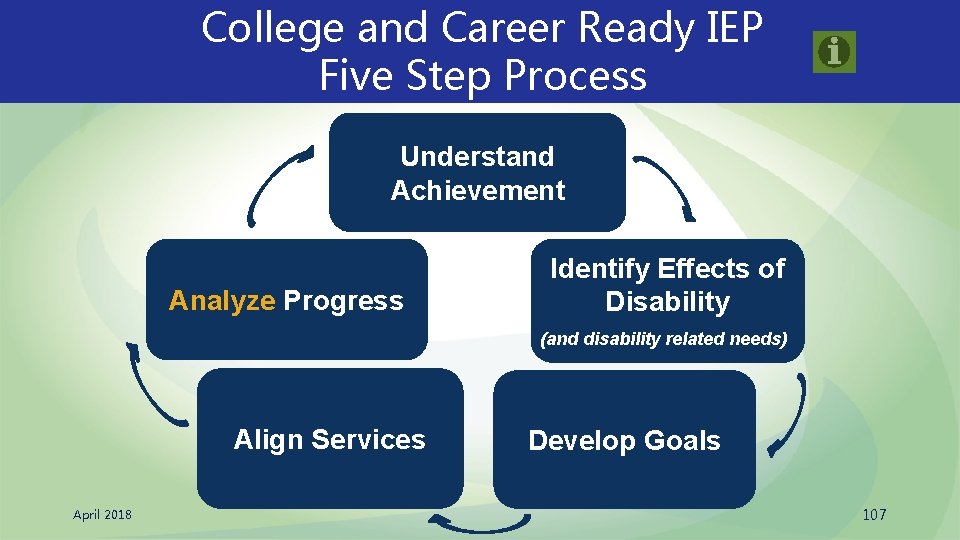
CCR IEP 5 Step Process Back to Basics Understand achievement of gradelevel academic standards and functional expectations to identify the student’s strengths and needs. Analyze progress towards goals to evaluate what works and what is needed to close the student’s achievement gaps Align specially designed instruction, services, supports, and accommodations needed to support the goals and ensure access to the general curriculum April 2018 Identify how the student’s disability affects academic achievement and functional performance (and summarize disability related needs) Develop ambitious and achievable goals that close achievement gaps and support the unique strengths and needs of the student 14
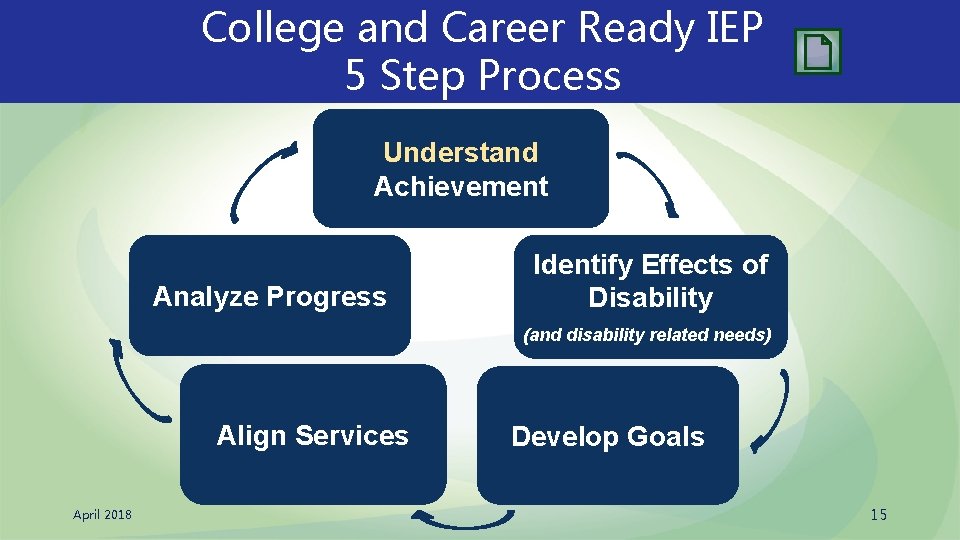
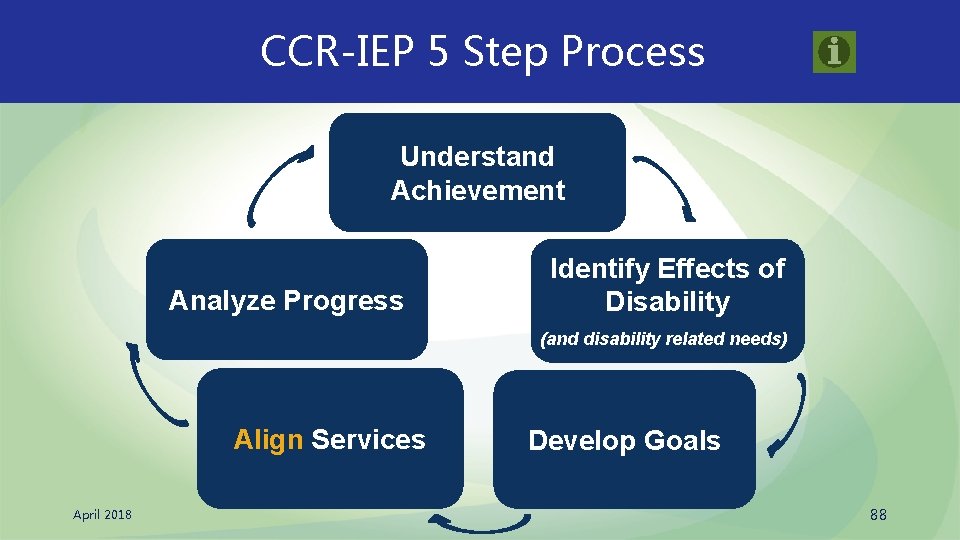
College and Career Ready IEP 5 Step Process Understand Achievement Analyze Progress Identify Effects of Disability (and disability related needs) Align Services April 2018 Develop Goals 15
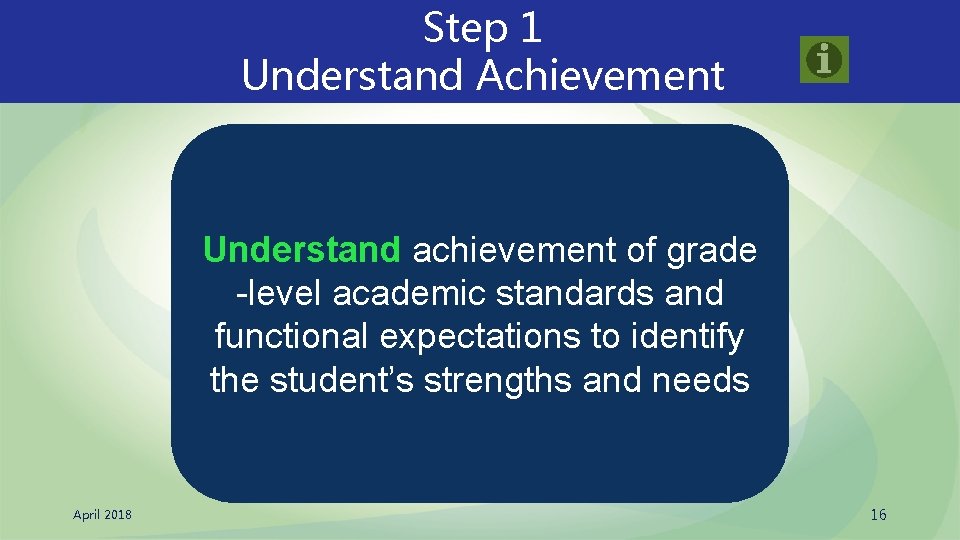
Step 1 Understand Achievement Understand achievement of grade -level academic standards and functional expectations to identify the student’s strengths and needs April 2018 16
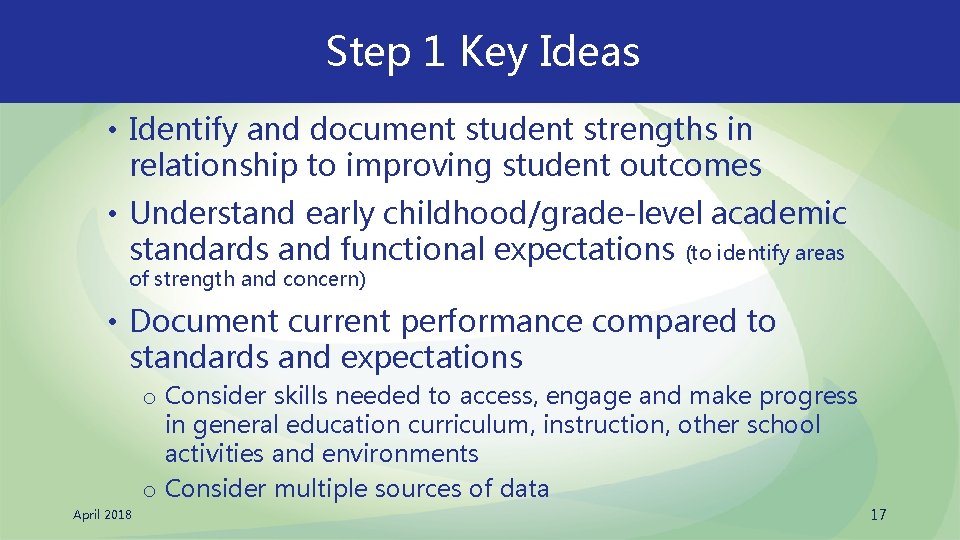
Step 1 Key Ideas • Identify and document student strengths in relationship to improving student outcomes • Understand early childhood/grade-level academic standards and functional expectations (to identify areas of strength and concern) • Document current performance compared to standards and expectations o Consider skills needed to access, engage and make progress in general education curriculum, instruction, other school activities and environments o Consider multiple sources of data April 2018 17
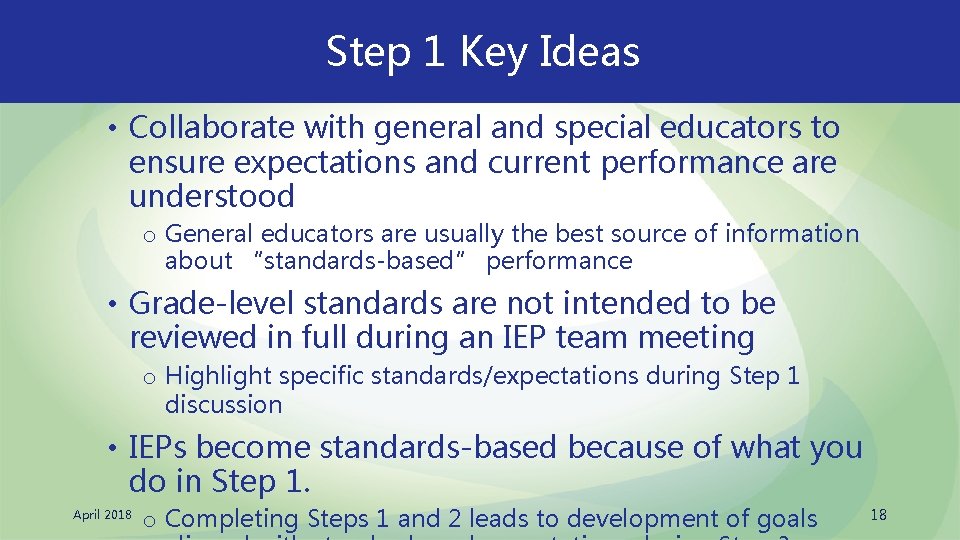
Step 1 Key Ideas • Collaborate with general and special educators to ensure expectations and current performance are understood o General educators are usually the best source of information about “standards-based” performance • Grade-level standards are not intended to be reviewed in full during an IEP team meeting o Highlight specific standards/expectations during Step 1 discussion • IEPs become standards-based because of what you do in Step 1. April 2018 o Completing Steps 1 and 2 leads to development of goals 18
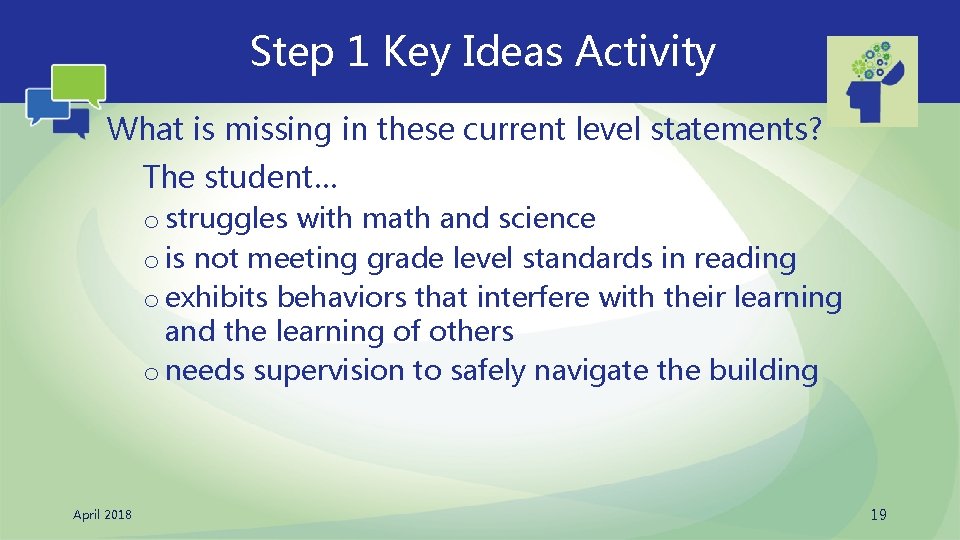
Step 1 Key Ideas Activity What is missing in these current level statements? The student… o struggles with math and science o is not meeting grade level standards in reading o exhibits behaviors that interfere with their learning and the learning of others o needs supervision to safely navigate the building April 2018 19
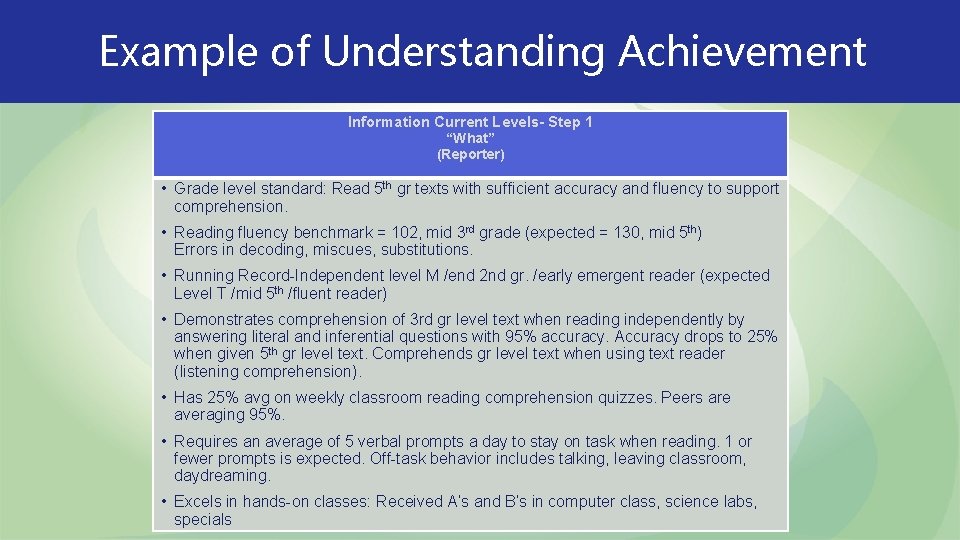
Example of Understanding Achievement Information Current Levels- Step 1 “What” (Reporter) • Grade level standard: Read 5 th gr texts with sufficient accuracy and fluency to support comprehension. • Reading fluency benchmark = 102, mid 3 rd grade (expected = 130, mid 5 th) Errors in decoding, miscues, substitutions. • Running Record-Independent level M /end 2 nd gr. /early emergent reader (expected Level T /mid 5 th /fluent reader) • Demonstrates comprehension of 3 rd gr level text when reading independently by answering literal and inferential questions with 95% accuracy. Accuracy drops to 25% when given 5 th gr level text. Comprehends gr level text when using text reader (listening comprehension). • Has 25% avg on weekly classroom reading comprehension quizzes. Peers are averaging 95%. • Requires an average of 5 verbal prompts a day to stay on task when reading. 1 or fewer prompts is expected. Off-task behavior includes talking, leaving classroom, daydreaming. • Excels in hands-on classes: Received A’s and B’s in computer class, science labs, specials
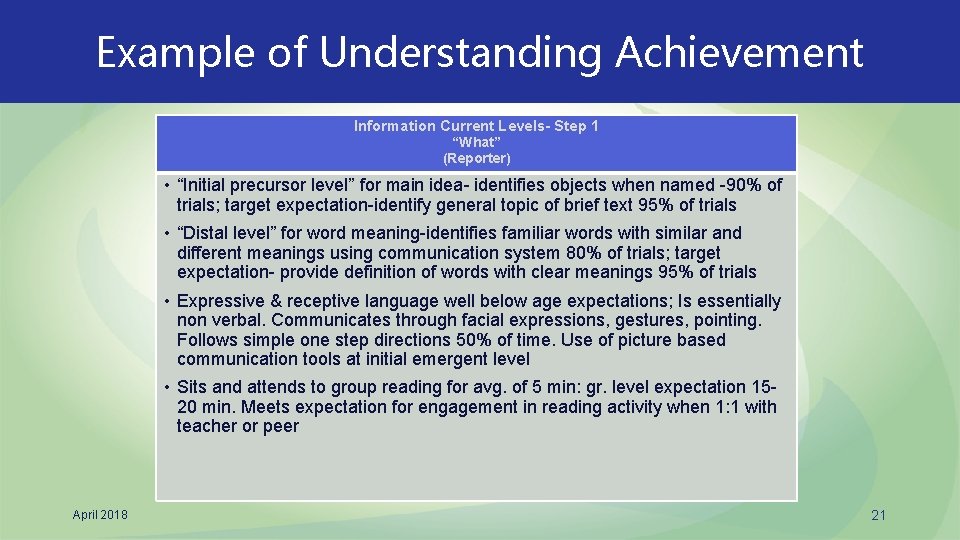
Example of Understanding Achievement Information Current Levels- Step 1 “What” (Reporter) • “Initial precursor level” for main idea- identifies objects when named -90% of trials; target expectation-identify general topic of brief text 95% of trials • “Distal level” for word meaning-identifies familiar words with similar and different meanings using communication system 80% of trials; target expectation- provide definition of words with clear meanings 95% of trials • Expressive & receptive language well below age expectations; Is essentially non verbal. Communicates through facial expressions, gestures, pointing. Follows simple one step directions 50% of time. Use of picture based communication tools at initial emergent level • Sits and attends to group reading for avg. of 5 min: gr. level expectation 1520 min. Meets expectation for engagement in reading activity when 1: 1 with teacher or peer April 2018 21
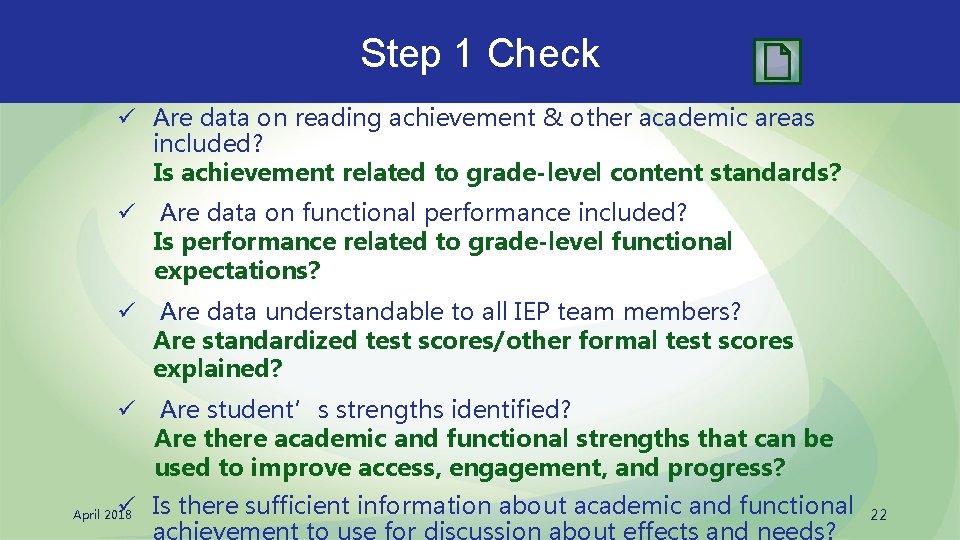
Step 1 Check ü Are data on reading achievement & other academic areas included? Is achievement related to grade-level content standards? ü Are data on functional performance included? Is performance related to grade-level functional expectations? ü Are data understandable to all IEP team members? Are standardized test scores/other formal test scores explained? ü Are student’s strengths identified? Are there academic and functional strengths that can be used to improve access, engagement, and progress? ü Is there sufficient information about academic and functional April 2018 22
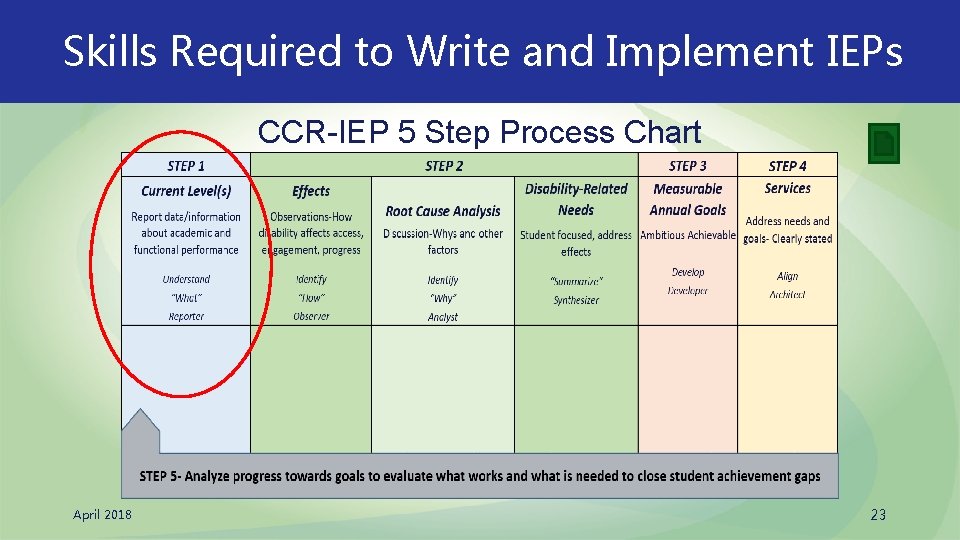
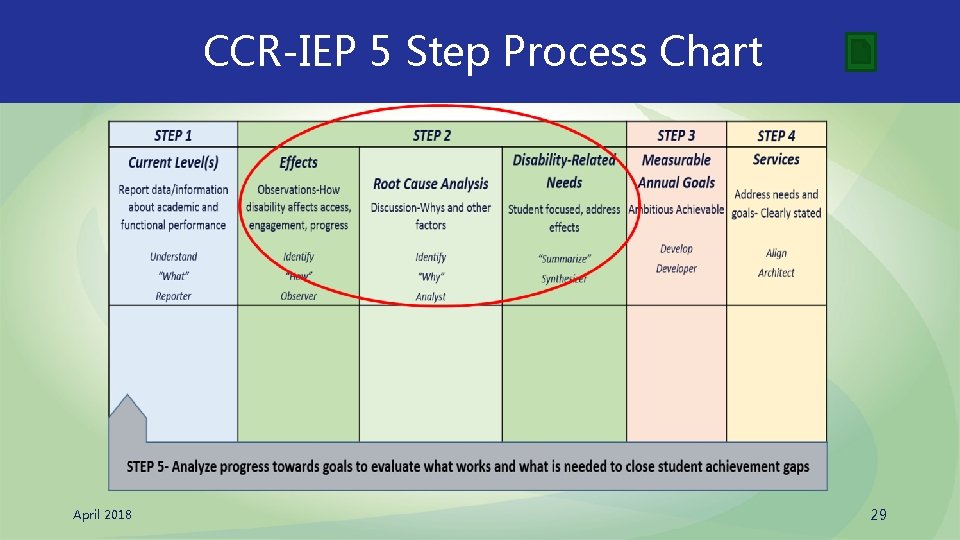
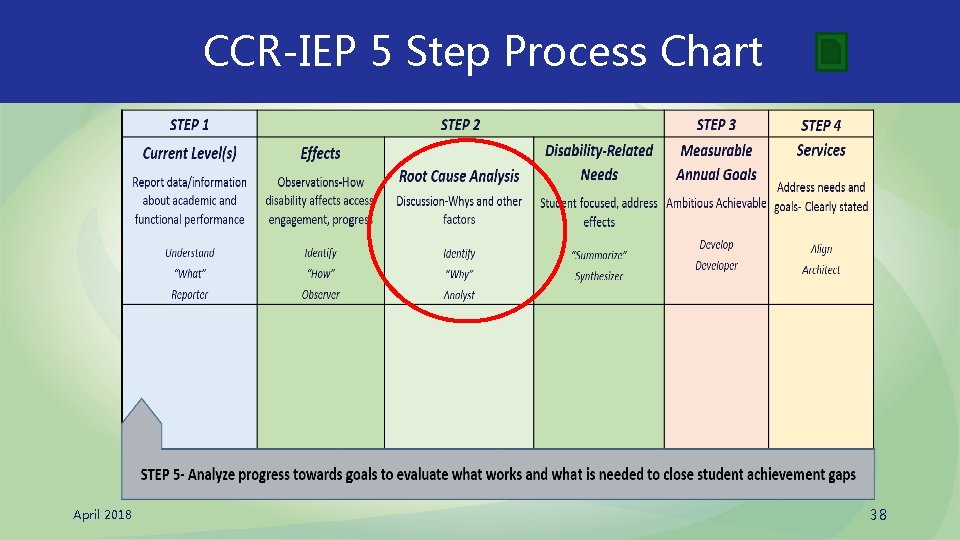
Skills Required to Write and Implement IEPs CCR-IEP 5 Step Process Chart April 2018 23
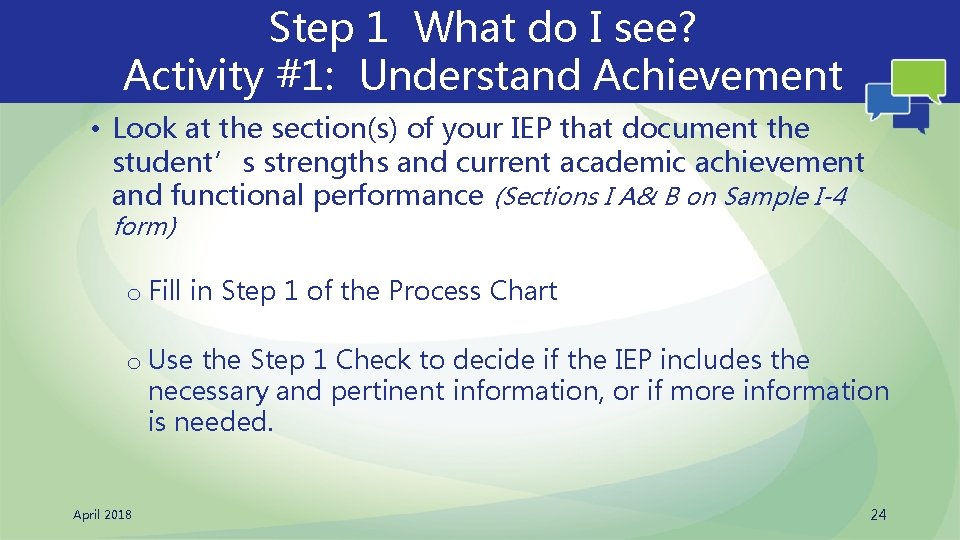
Step 1 What do I see? Activity #1: Understand Achievement • Look at the section(s) of your IEP that document the student’s strengths and current academic achievement and functional performance (Sections I A& B on Sample I-4 form) o Fill in Step 1 of the Process Chart o Use the Step 1 Check to decide if the IEP includes the necessary and pertinent information, or if more information is needed. April 2018 24
Step 1 - Understand Achievement What Do you See? • Reflect on the present levels of performance data and information in your IEP. • If you were having this IEP team meeting next week, what data or information would you gather in advance of the meeting so that you could talk about the student’s access, engagement and progress in your class? • How might you help other IEP team members come prepared to the meeting? April 2018 25
College and Career Ready IEP 5 Step Process Understand Achievement Analyze Progress Identify Effects of Disability (and disability related needs) Align Services April 2018 Develop Goals 26
Step 2: Identify Effects of Disability Identify how the student’s disability affects academic achievement and functional performance April 2018 27
Step 2 Burning Questions? Greatest Challenges? April 2018 28
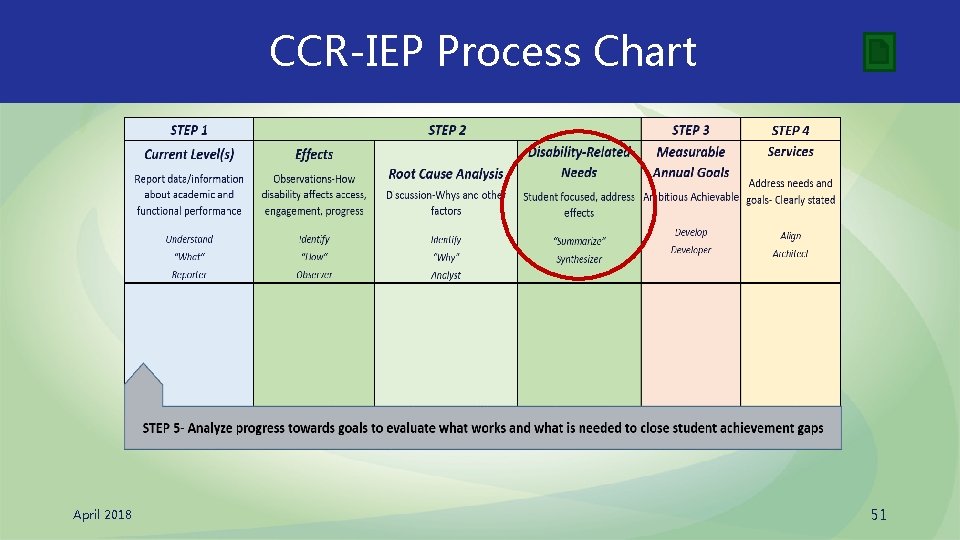
CCR-IEP 5 Step Process Chart April 2018 29
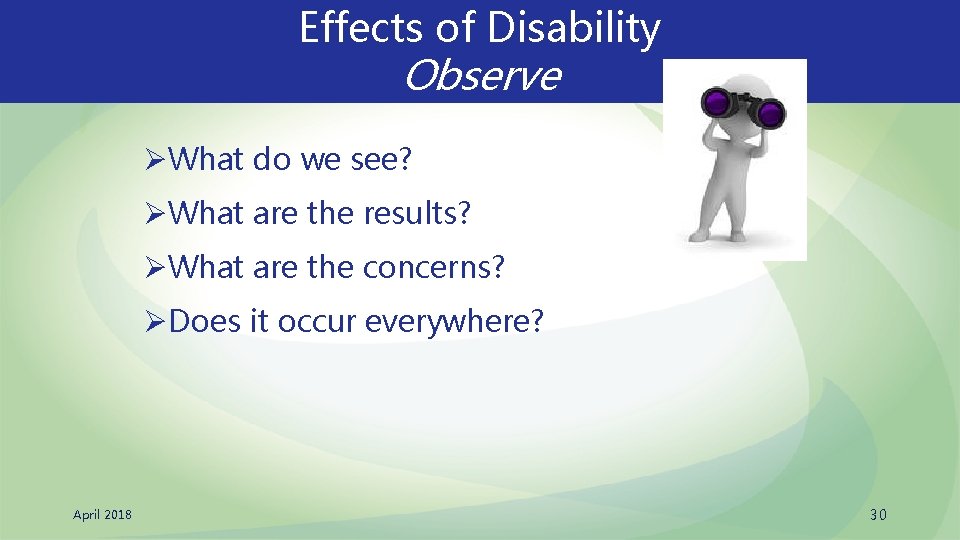
Effects of Disability Observe ØWhat do we see? ØWhat are the results? ØWhat are the concerns? ØDoes it occur everywhere? April 2018 30
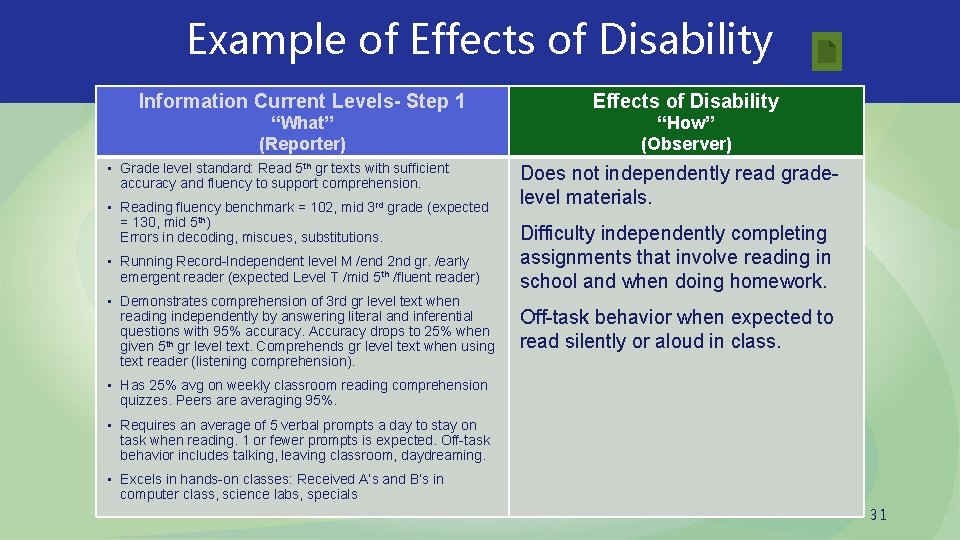
Example of Effects of Disability Information Current Levels- Step 1 Effects of Disability “What” (Reporter) “How” (Observer) • Grade level standard: Read 5 th gr texts with sufficient accuracy and fluency to support comprehension. • Reading fluency benchmark = 102, mid 3 rd grade (expected = 130, mid 5 th) Errors in decoding, miscues, substitutions. • Running Record-Independent level M /end 2 nd gr. /early emergent reader (expected Level T /mid 5 th /fluent reader) • Demonstrates comprehension of 3 rd gr level text when reading independently by answering literal and inferential questions with 95% accuracy. Accuracy drops to 25% when given 5 th gr level text. Comprehends gr level text when using text reader (listening comprehension). Does not independently read gradelevel materials. Difficulty independently completing assignments that involve reading in school and when doing homework. Off-task behavior when expected to read silently or aloud in class. • Has 25% avg on weekly classroom reading comprehension quizzes. Peers are averaging 95%. • Requires an average of 5 verbal prompts a day to stay on task when reading. 1 or fewer prompts is expected. Off-task behavior includes talking, leaving classroom, daydreaming. • Excels in hands-on classes: Received A’s and B’s in computer class, science labs, specials 31
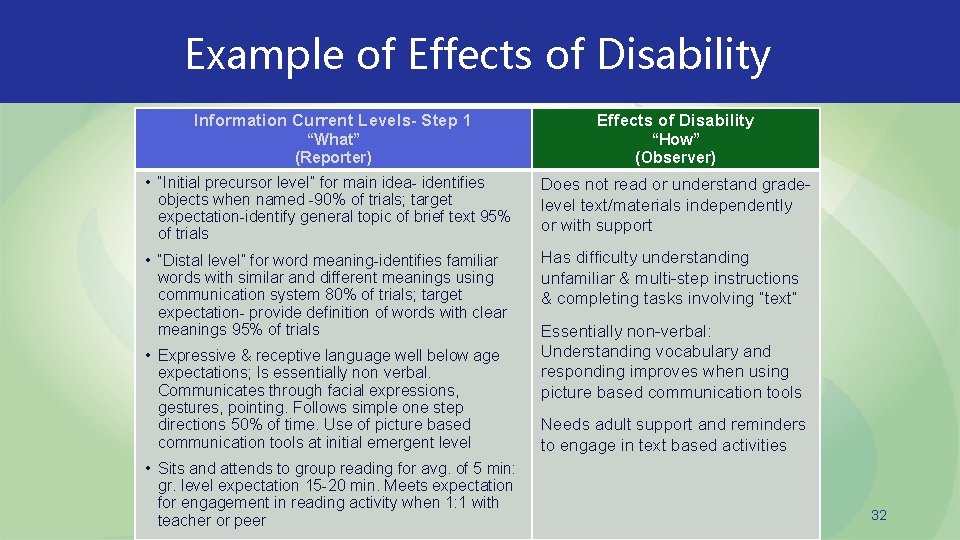
Example of Effects of Disability Information Current Levels- Step 1 Effects of Disability “What” (Reporter) “How” (Observer) • “Initial precursor level” for main idea- identifies objects when named -90% of trials; target expectation-identify general topic of brief text 95% of trials Does not read or understand gradelevel text/materials independently or with support • “Distal level” for word meaning-identifies familiar words with similar and different meanings using communication system 80% of trials; target expectation- provide definition of words with clear meanings 95% of trials Has difficulty understanding unfamiliar & multi-step instructions & completing tasks involving “text” • Expressive & receptive language well below age expectations; Is essentially non verbal. Communicates through facial expressions, gestures, pointing. Follows simple one step directions 50% of time. Use of picture based communication tools at initial emergent level • Sits and attends to group reading for avg. of 5 min: gr. level expectation 15 -20 min. Meets expectation for engagement in reading activity when 1: 1 with teacher or peer Essentially non-verbal: Understanding vocabulary and responding improves when using picture based communication tools Needs adult support and reminders to engage in text based activities 32
Step 2 - Effects of Disability Step-Check ü Do the effects of the student’s disability directly relate to the areas in which the student is not meeting early childhood/grade-level standards or expectations? ü Do the effects statements describe what one can see or hear as a result (effect) of the student’s disability on access, engagement, and progress in general education? ü Have special factors been considered? ü Have the observations and concerns of the family and student been considered? April 2018 33
Step 2 Effects of Disability Activity • Look at the section(s) of your IEP that documents how the student’s disability affects access, engagement and progress in the general education curriculum. (Section I E on Sample I-4 form) o Use the Step Check to determine if the IEP includes the necessary information. o Fill in Step 2 – Effects on the Process Chart April 2018 34
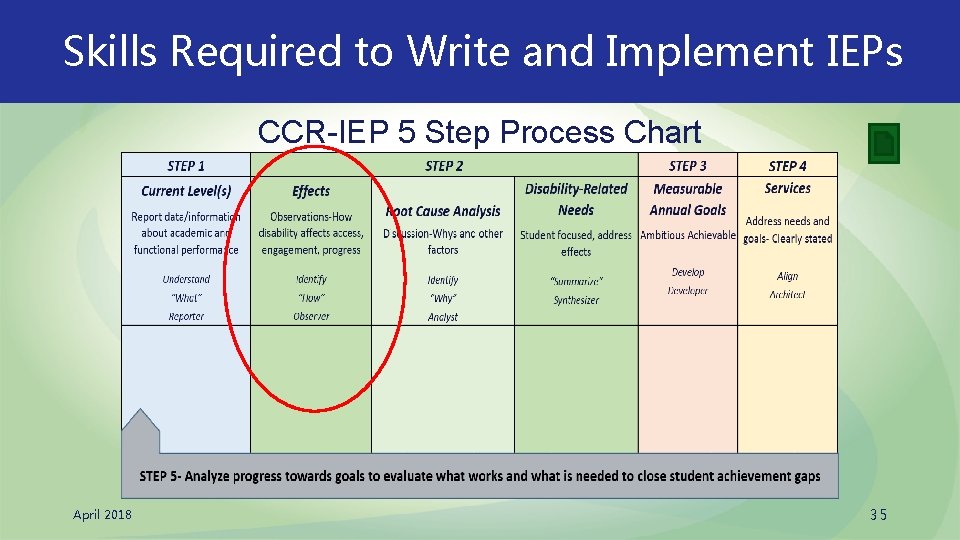
Skills Required to Write and Implement IEPs CCR-IEP 5 Step Process Chart April 2018 35
Step 1 Check ü Are data on reading achievement & other academic areas included? Is achievement related to grade-level content standards? ü Are data on functional performance included? Is performance related to grade-level functional expectations? ü Are data understandable to all IEP team members? Are standardized test scores/other formal test scores explained? ü Are student’s strengths identified? Are there academic and functional strengths that can be used to improve access, engagement, and progress? ü Is there sufficient information about academic and functional achievement to use for discussion about effects and needs? April 2018 In what areas is the student performing at, above, or below grade-level 36
Step 2 - Effects What Do you See? • Reflect on the effect statements in your IEP • If you were having this IEP team meeting next week, what one thing would you do to be prepared to talk about the effects of this student’s disability on accessing, engaging, and making progress to meet early childhood/grade level standards and expectations? • What questions might you ask to help the team focus on the effects of the student’s disability? April 2018 37
CCR-IEP 5 Step Process Chart April 2018 38
Root Cause Analysis Step 2 Part 2 How does asking “Why” multiple times help drill down from higher-level symptoms to the underlying root cause(s)? April 2018 39
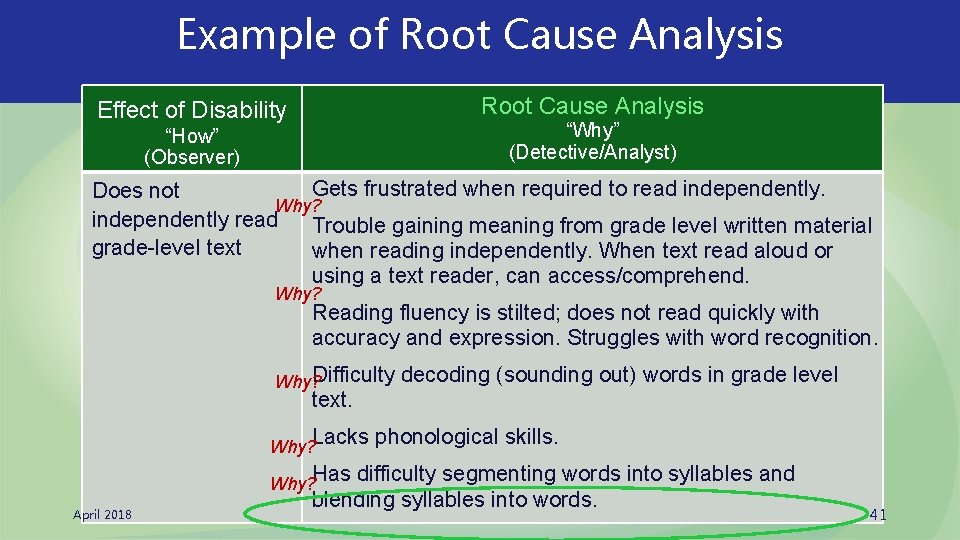
Root Cause Analysis • State the concern selected from the discussion about effects (e. g. The student has difficulty understanding written instructions) • Check for consensus that this is a concern • Seek information and data that illustrate the concern • Ask “Why” is this happening? (e. g. Why is the student having difficulty understanding written directions? ) • Generate possible reasons. . . • Ask the second “Why” is this happening? • Continue asking “Why” until root cause(s) (vs. April 2018 40
Example of Root Cause Analysis Effect of Disability “Why” (Detective/Analyst) “How” (Observer) Gets frustrated when required to read independently. Does not Why? independently read Trouble gaining meaning from grade level written material grade-level text when reading independently. When text read aloud or using a text reader, can access/comprehend. Why? Reading fluency is stilted; does not read quickly with accuracy and expression. Struggles with word recognition. Why? Difficulty decoding (sounding out) words in grade level text. Why? Lacks phonological skills. Why? Has difficulty segmenting words into syllables and April 2018 blending syllables into words. 41
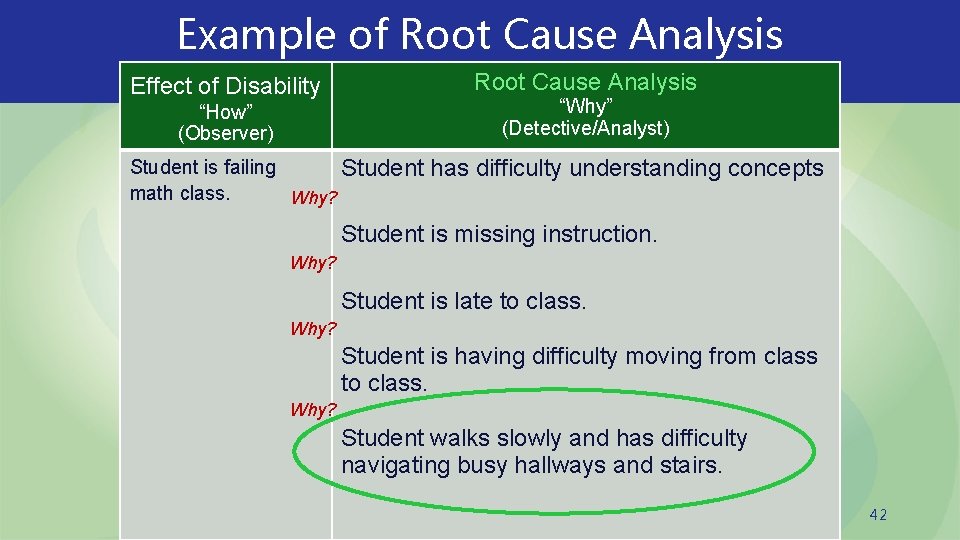
Example of Root Cause Analysis Effect of Disability “How” (Observer) Root Cause Analysis “Why” (Detective/Analyst) Student is failing Student has difficulty understanding concepts math class. Why? Student is missing instruction. Why? Student is late to class. Why? Student is having difficulty moving from class to class. Why? Student walks slowly and has difficulty navigating busy hallways and stairs. 42
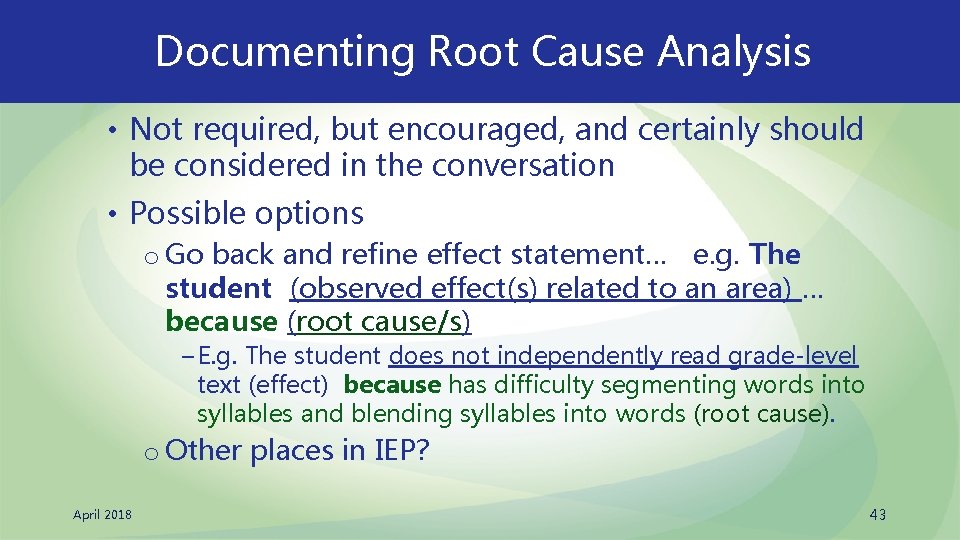
Documenting Root Cause Analysis • Not required, but encouraged, and certainly should be considered in the conversation • Possible options o Go back and refine effect statement… e. g. The student (observed effect(s) related to an area) … because (root cause/s) −E. g. The student does not independently read grade-level text (effect) because has difficulty segmenting words into syllables and blending syllables into words (root cause). o Other places in IEP? April 2018 43
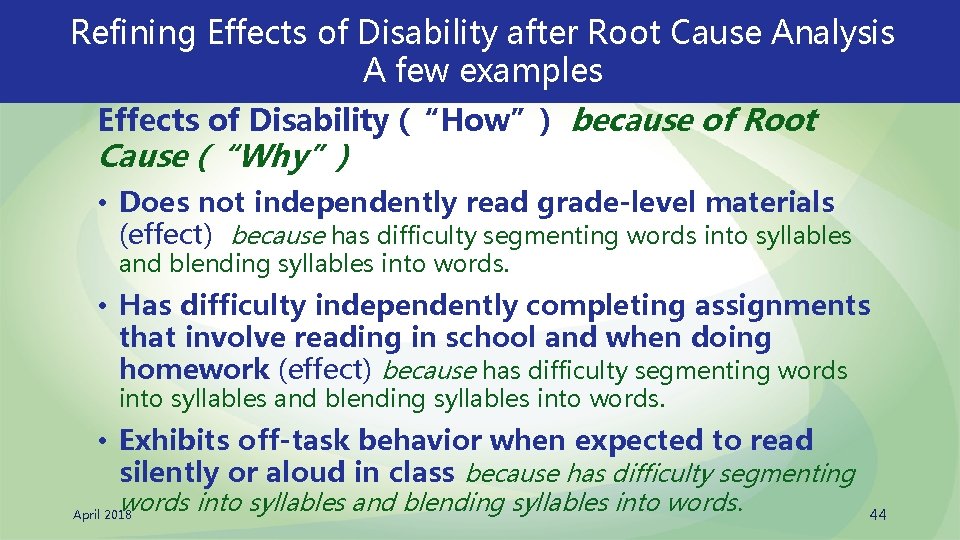
Refining Effects of Disability after Root Cause Analysis A few examples Effects of Disability (“How”) because of Root Cause (“Why”) • Does not independently read grade-level materials (effect) because has difficulty segmenting words into syllables and blending syllables into words. • Has difficulty independently completing assignments that involve reading in school and when doing homework (effect) because has difficulty segmenting words into syllables and blending syllables into words. • Exhibits off-task behavior when expected to read silently or aloud in class because has difficulty segmenting words into syllables and blending syllables into words. April 2018 44
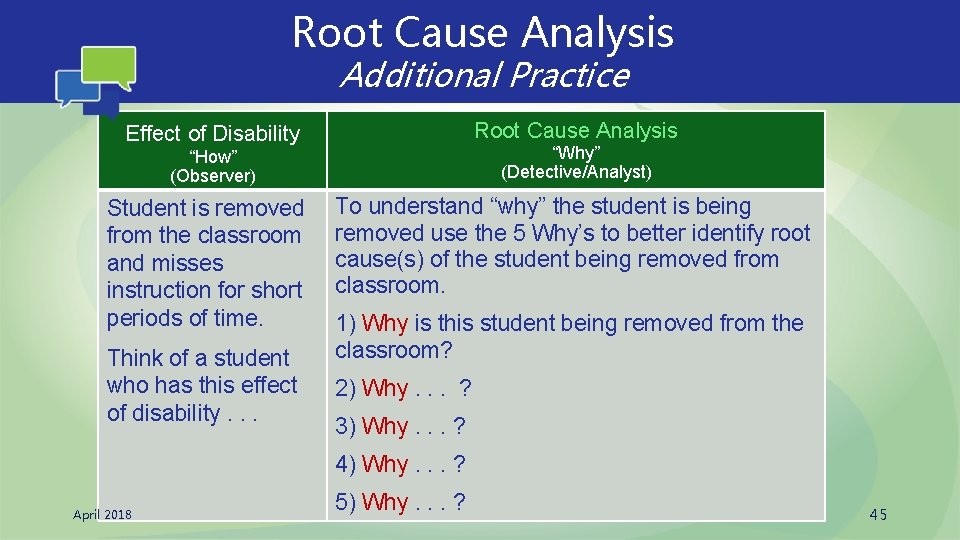
Root Cause Analysis Additional Practice Root Cause Analysis Effect of Disability “How” (Observer) “Why” (Detective/Analyst) Student is removed from the classroom and misses instruction for short periods of time. To understand “why” the student is being removed use the 5 Why’s to better identify root cause(s) of the student being removed from classroom. Think of a student who has this effect of disability. . . 1) Why is this student being removed from the classroom? 2) Why. . . ? 3) Why. . . ? 4) Why. . . ? April 2018 5) Why. . . ? 45
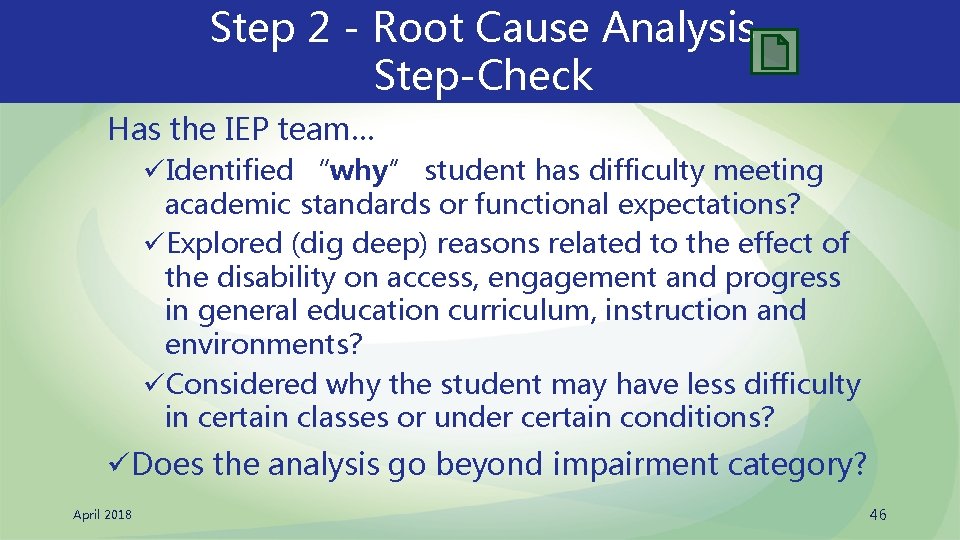
Step 2 - Root Cause Analysis Step-Check Has the IEP team… üIdentified “why” student has difficulty meeting academic standards or functional expectations? üExplored (dig deep) reasons related to the effect of the disability on access, engagement and progress in general education curriculum, instruction and environments? üConsidered why the student may have less difficulty in certain classes or under certain conditions? üDoes the analysis go beyond impairment category? April 2018 46
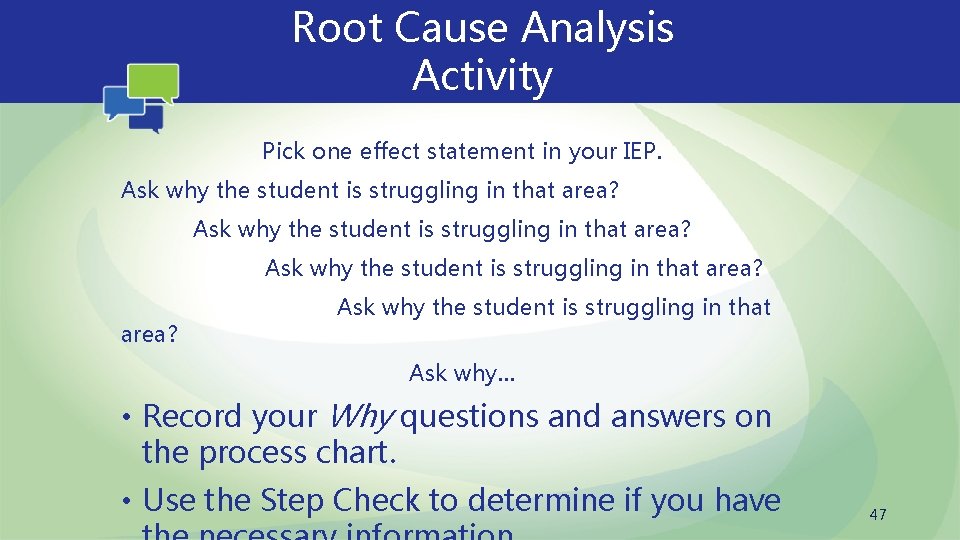
Root Cause Analysis Activity Pick one effect statement in your IEP. Ask why the student is struggling in that area? Ask why the student is struggling in that Ask why… • Record your Why questions and answers on the process chart. • Use the Step Check to determine if you have 47
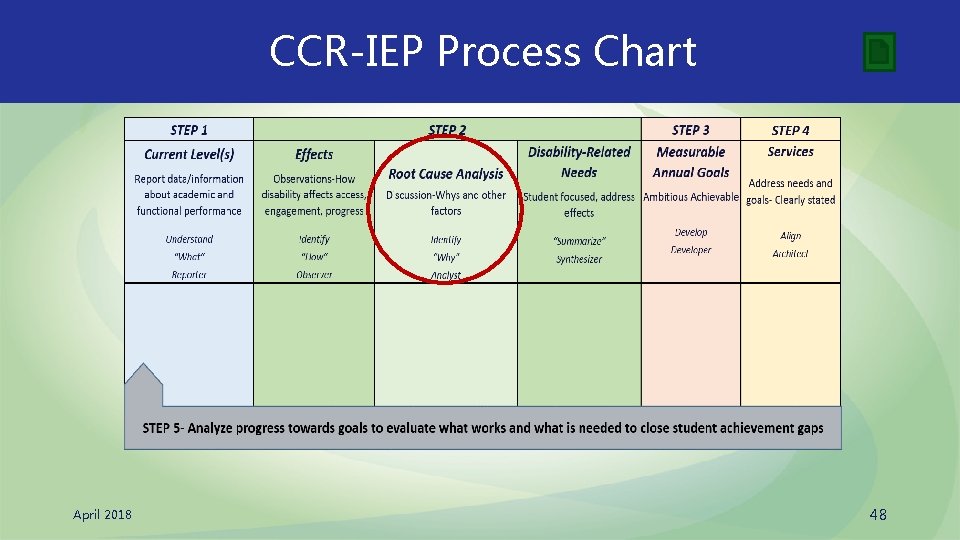
CCR-IEP Process Chart April 2018 48
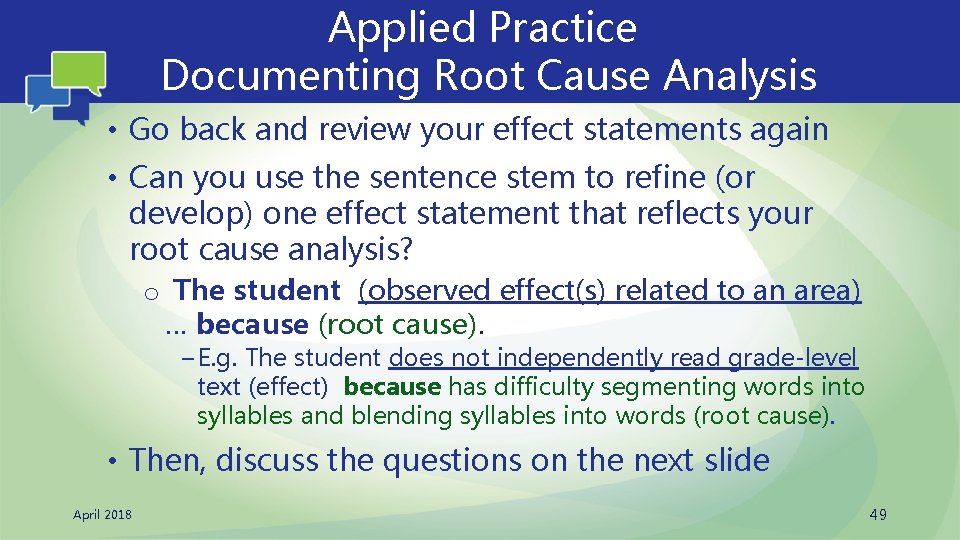
Applied Practice Documenting Root Cause Analysis • Go back and review your effect statements again • Can you use the sentence stem to refine (or develop) one effect statement that reflects your root cause analysis? o The student (observed effect(s) related to an area) … because (root cause). −E. g. The student does not independently read grade-level text (effect) because has difficulty segmenting words into syllables and blending syllables into words (root cause). • Then, discuss the questions on the next slide April 2018 49
For Discussion What do you see as the most challenging aspects of root cause analysis? What questions might you ask to help prompt all IEP team participants to address the key ideas of this step during an IEP team meeting? o How would you engage the family and student? April 2018 50
CCR-IEP Process Chart April 2018 51
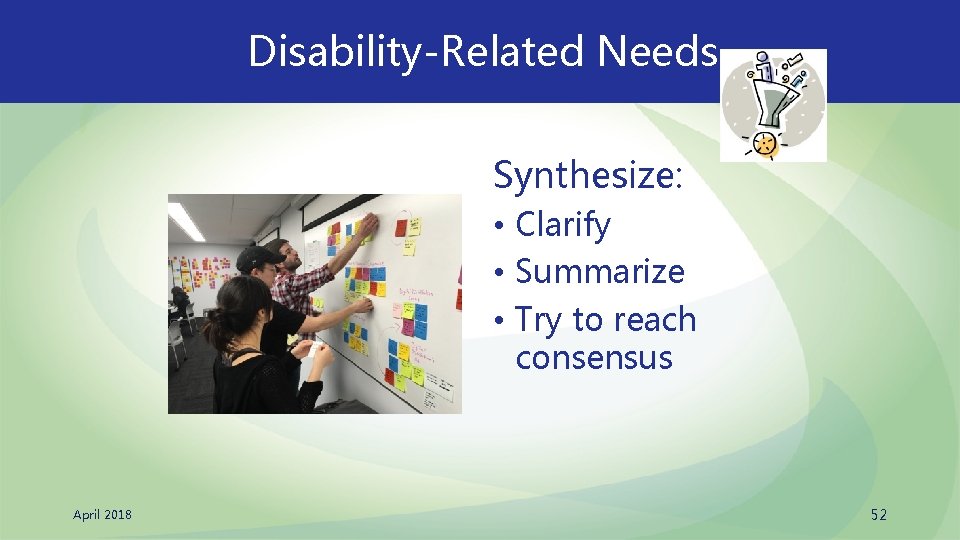
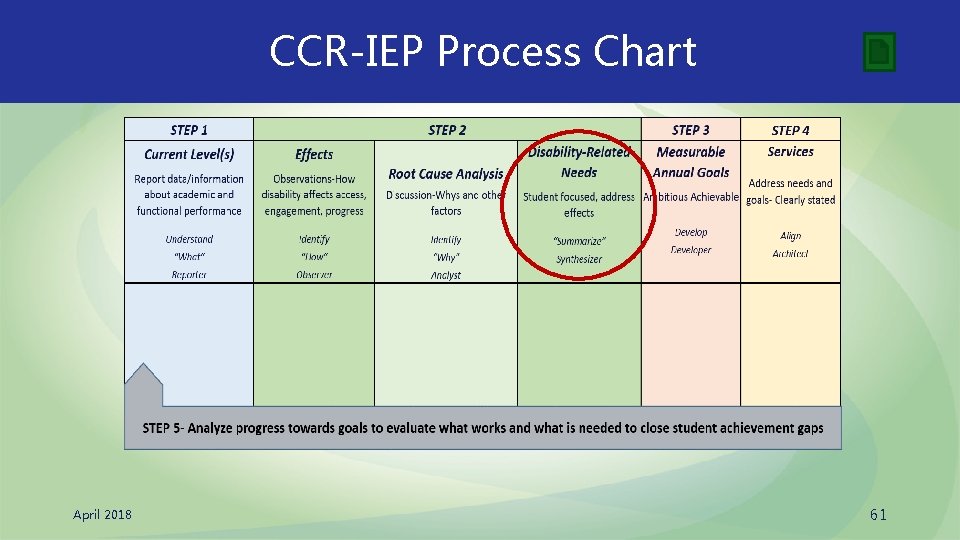
Disability-Related Needs Synthesize: • Clarify • Summarize • Try to reach consensus April 2018 52
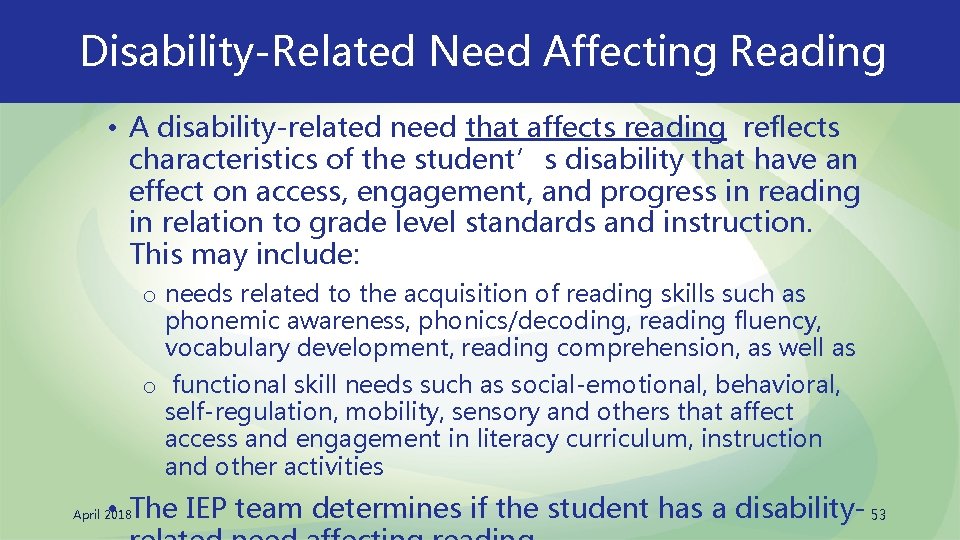
Disability-Related Need Affecting Reading • A disability-related need that affects reading reflects characteristics of the student’s disability that have an effect on access, engagement, and progress in reading in relation to grade level standards and instruction. This may include: o needs related to the acquisition of reading skills such as phonemic awareness, phonics/decoding, reading fluency, vocabulary development, reading comprehension, as well as o functional skill needs such as social-emotional, behavioral, self-regulation, mobility, sensory and others that affect access and engagement in literacy curriculum, instruction and other activities • The IEP team determines if the student has a disability- 53 April 2018
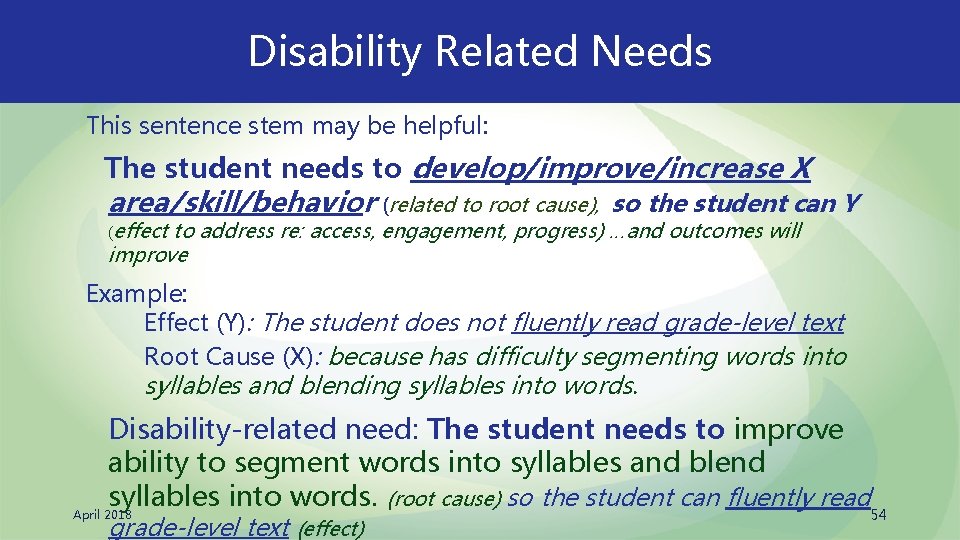
Disability Related Needs This sentence stem may be helpful: The student needs to develop/improve/increase X area/skill/behavior (related to root cause), so the student can Y (effect to address re: access, engagement, progress) …and outcomes will improve Example: Effect (Y): The student does not fluently read grade-level text Root Cause (X): because has difficulty segmenting words into syllables and blending syllables into words. Disability-related need: The student needs to improve ability to segment words into syllables and blend syllables into words. (root cause) so the student can fluently read 54 April 2018 grade-level text (effect)
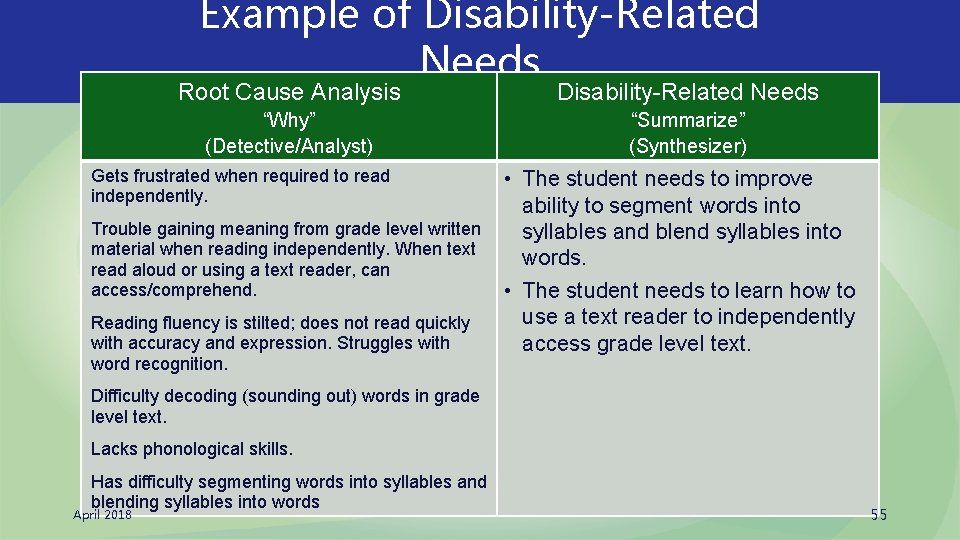
Example of Disability-Related Needs Root Cause Analysis Disability-Related Needs “Why” (Detective/Analyst) “Summarize” (Synthesizer) Gets frustrated when required to read independently. Trouble gaining meaning from grade level written material when reading independently. When text read aloud or using a text reader, can access/comprehend. Reading fluency is stilted; does not read quickly with accuracy and expression. Struggles with word recognition. • The student needs to improve ability to segment words into syllables and blend syllables into words. • The student needs to learn how to use a text reader to independently access grade level text. Difficulty decoding (sounding out) words in grade level text. Lacks phonological skills. Has difficulty segmenting words into syllables and blending syllables into words April 2018 55
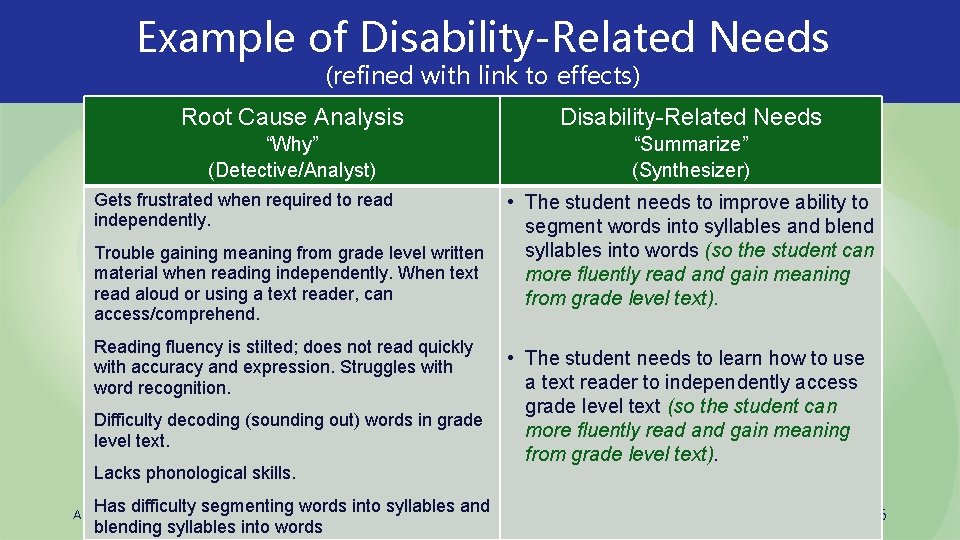
Example of Disability-Related Needs (refined with link to effects) Root Cause Analysis Disability-Related Needs “Why” (Detective/Analyst) “Summarize” (Synthesizer) Gets frustrated when required to read independently. • The student needs to improve ability to segment words into syllables and blend syllables into words (so the student can Trouble gaining meaning from grade level written material when reading independently. When text more fluently read and gain meaning read aloud or using a text reader, can from grade level text). access/comprehend. Reading fluency is stilted; does not read quickly with accuracy and expression. Struggles with word recognition. • The student needs to learn how to use a text reader to independently access grade level text (so the student can Difficulty decoding (sounding out) words in grade more fluently read and gain meaning level text. from grade level text). Lacks phonological skills. Has difficulty segmenting words into syllables and blending syllables into words April 2018 56
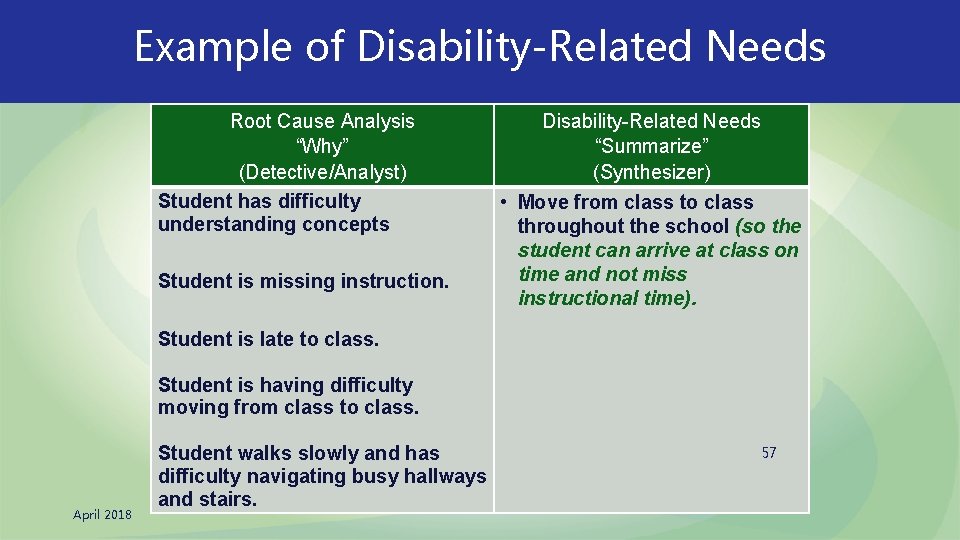
Example of Disability-Related Needs Root Cause Analysis “Why” (Detective/Analyst) Student has difficulty understanding concepts Student is missing instruction. Disability-Related Needs “Summarize” (Synthesizer) • Move from class to class throughout the school (so the student can arrive at class on time and not miss instructional time). Student is late to class. Student is having difficulty moving from class to class. April 2018 Student walks slowly and has difficulty navigating busy hallways and stairs. 57
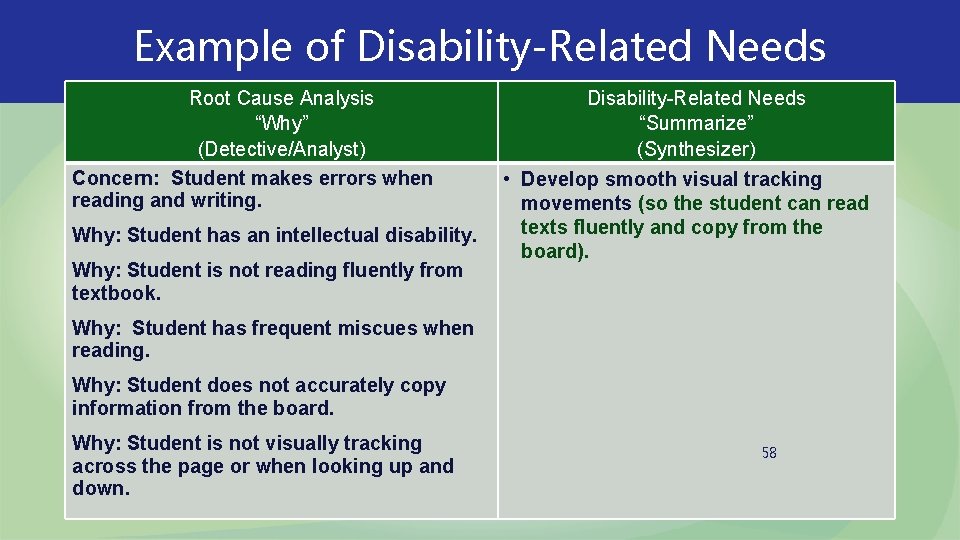
Example of Disability-Related Needs Root Cause Analysis “Why” (Detective/Analyst) Concern: Student makes errors when reading and writing. Why: Student has an intellectual disability. Why: Student is not reading fluently from textbook. Disability-Related Needs “Summarize” (Synthesizer) • Develop smooth visual tracking movements (so the student can read texts fluently and copy from the board). Why: Student has frequent miscues when reading. Why: Student does not accurately copy information from the board. Why: Student is not visually tracking across the page or when looking up and down. 58
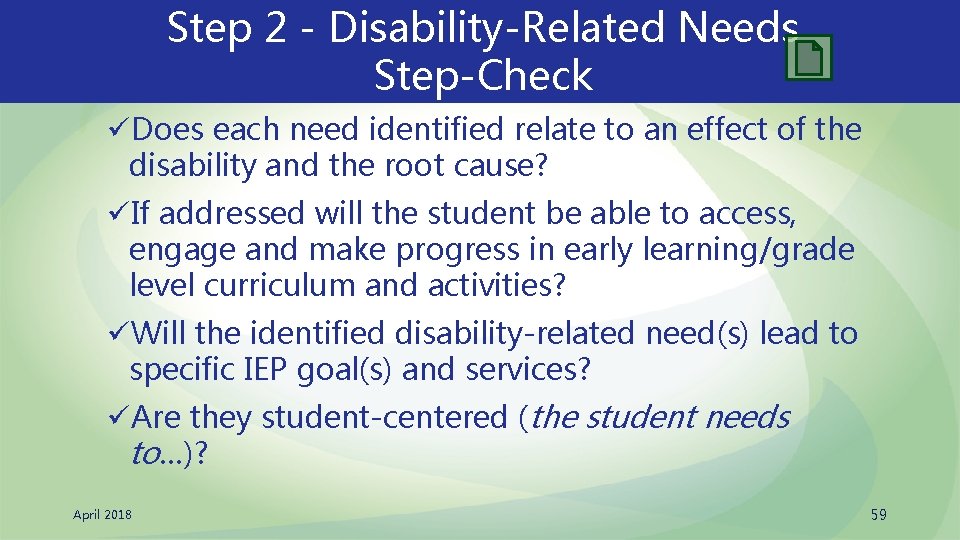
Step 2 - Disability‐Related Needs Step-Check üDoes each need identified relate to an effect of the disability and the root cause? üIf addressed will the student be able to access, engage and make progress in early learning/grade level curriculum and activities? üWill the identified disability‐related need(s) lead to specific IEP goal(s) and services? üAre they student-centered (the student needs to…)? April 2018 59
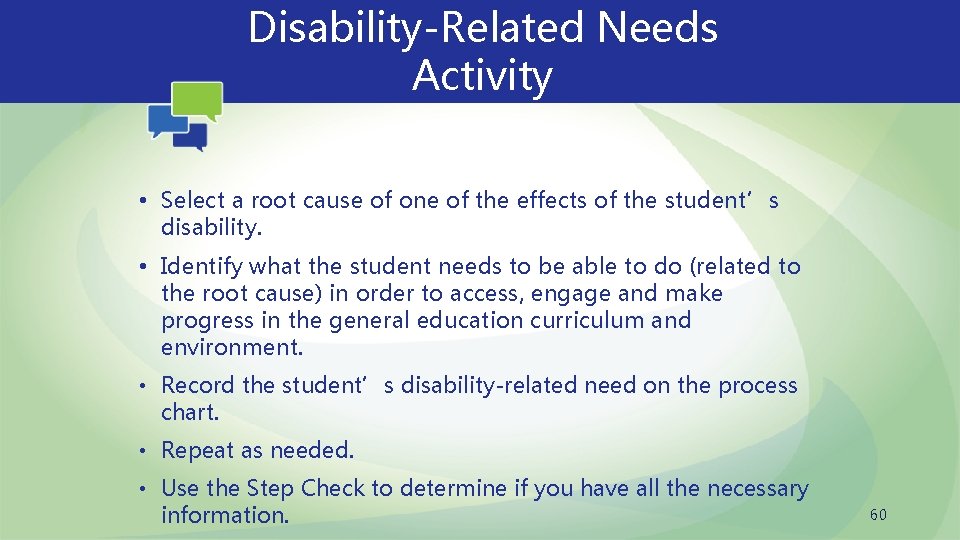
Disability-Related Needs Activity • Select a root cause of one of the effects of the student’s disability. • Identify what the student needs to be able to do (related to the root cause) in order to access, engage and make progress in the general education curriculum and environment. • Record the student’s disability-related need on the process chart. • Repeat as needed. • Use the Step Check to determine if you have all the necessary information. 60
CCR-IEP Process Chart April 2018 61
Step 2 - Disability-Related Needs Reflect and Discuss • What do you see as the most challenging aspects of this step? • Knowing what you know now, might you make any changes? o Try to refine or develop one DRN statement using the sentence stem: The student needs to develop/improve/ increase area/skill/behavior (related to root causes), so the student can Y (effect to address re: access, engagement, progress) …and outcomes will improve • What questions might you ask to help prompt all IEP April 2018 62
IEP Team Meeting Scenario The team just reviewed data about the student’s current reading achievement and determined the student’s reading skills are well below grade level standards. One of the team members says, “Ok, now let’s write a reading goal”. • What would you do to facilitate the meeting at this point? • What questions would you ask to keep the IEP team on track? April 2018 63
Next Stop… Step 3 April 2018 64
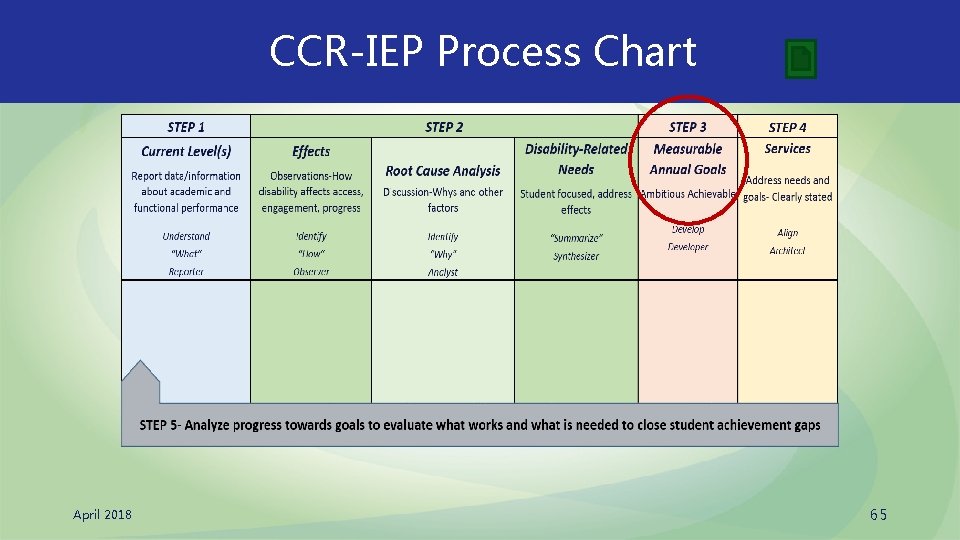
CCR-IEP Process Chart April 2018 65
Step 3: Develop Ambitious and Achievable Goals Develop ambitious and achievable goals that close achievement gaps and support the unique strengths and needs of the student. April 2018 66
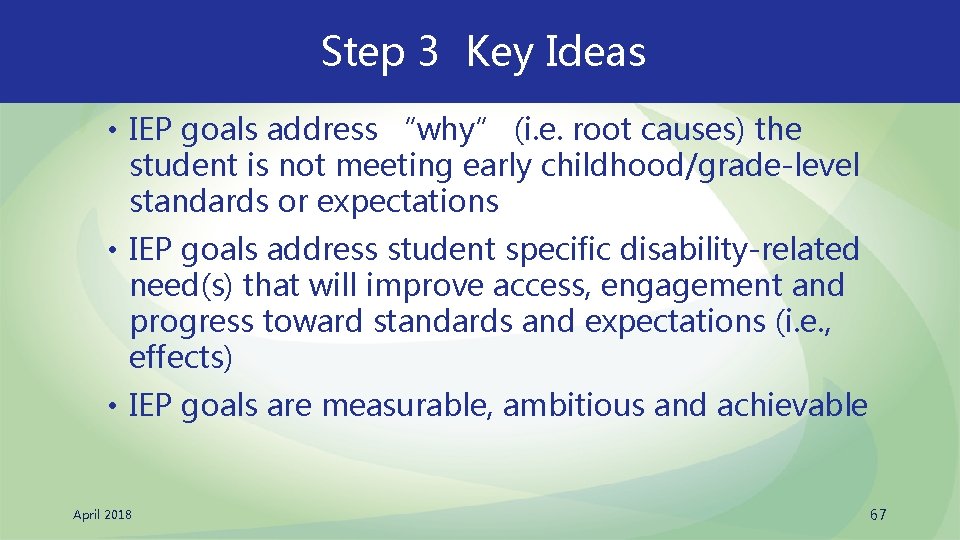
Step 3 Key Ideas • IEP goals address “why” (i. e. root causes) the student is not meeting early childhood/grade-level standards or expectations • IEP goals address student specific disability-related need(s) that will improve access, engagement and progress toward standards and expectations (i. e. , effects) • IEP goals are measurable, ambitious and achievable April 2018 67
Step 3 Key Ideas How do we know when a goal is needed to address a disability related need? Ask, “Does the student need to develop or improve a skill or just use a skill that is already mastered”? This question is also relevant when linking services to needs in Step 4 April 2018 68
Standards-Based IEPs Completing Steps 1 and 2 of the 5 Step Process with fidelity will lead to the development of goals aligned with grade-level standards and expectations during Step 3 o Identify student’s current performance related to early childhood/ grade-level standards. o Identify how the disability affects access, engagement and progress (effects) o Discuss why (root causes) the student is not meeting gradelevel standards and summarize disability-related needs. o If goals address the whys and needs, the goal will be aligned with the standards April 2018 69
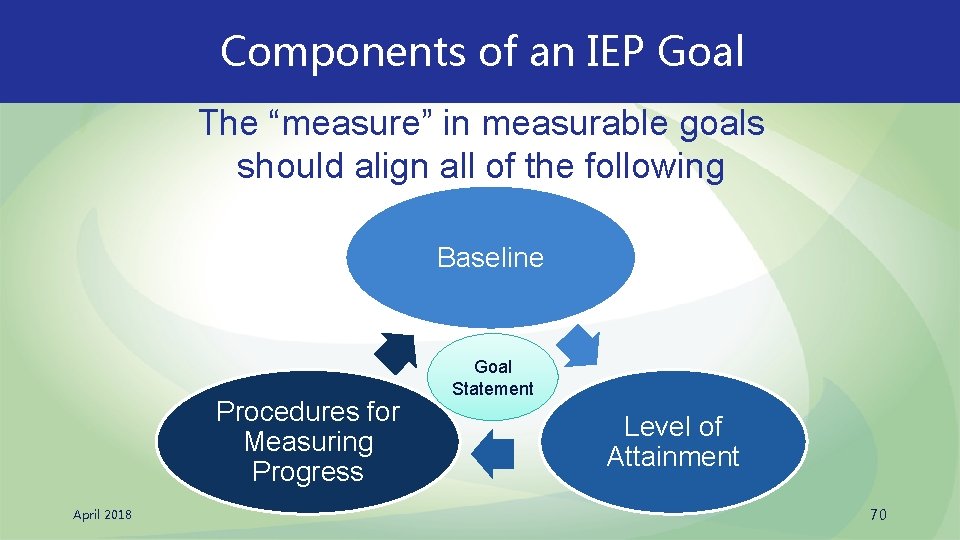
Components of an IEP Goal The “measure” in measurable goals should align all of the following Baseline Procedures for Measuring Progress April 2018 Goal Statement Level of Attainment 70
Goal Statement Reflects the disability-related need(s) and. . . • Must include a skill(s) that is measurable • Achieving the goal will improve the student’s access, engagement, and progress in general education curriculum and environment (ambitious/achievable) • May include baseline and level of attainment in the goal statement OR under the goal statement o Sample form I-4 has prompts for each under the goal statement • May include condition statements April 2018 71
Condition Statements (not required) Condition statements describe the circumstances under which a goal, benchmark, or STO is expected (may address access, engagement, environment) o Context (when, where, how) −During small group reading instruction. . . −When given access to a word processor. . . o Define complexity of task −When reading a 4 th grade text. . . o Link accommodations to goals −Given a choice of self-regulation techniques. . . o Provide for student choice −When given a choice of text. . . April 2018 72
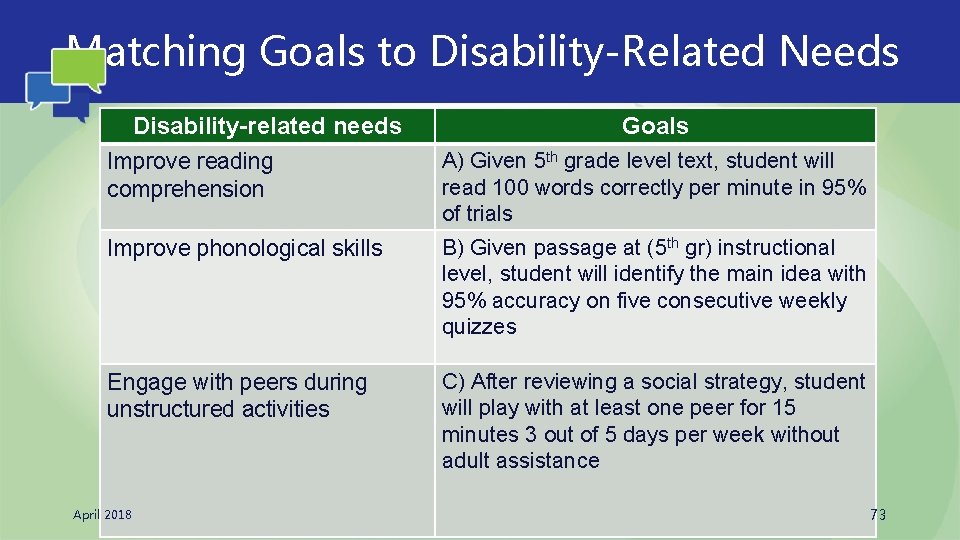
Matching Goals to Disability-Related Needs Disability-related needs Improve reading comprehension Goals A) Given 5 th grade level text, student will read 100 words correctly per minute in 95% of trials Improve phonological skills B) Given passage at (5 th gr) instructional level, student will identify the main idea with 95% accuracy on five consecutive weekly quizzes Engage with peers during unstructured activities C) After reviewing a social strategy, student will play with at least one peer for 15 minutes 3 out of 5 days per week without adult assistance April 2018 73
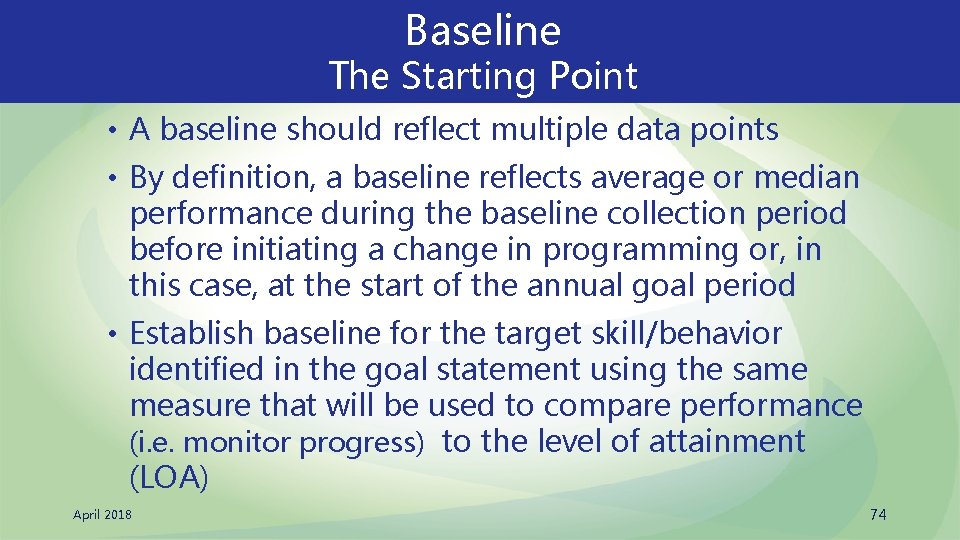
Baseline The Starting Point • A baseline should reflect multiple data points • By definition, a baseline reflects average or median performance during the baseline collection period before initiating a change in programming or, in this case, at the start of the annual goal period • Establish baseline for the target skill/behavior identified in the goal statement using the same measure that will be used to compare performance (i. e. monitor progress) to the level of attainment (LOA) April 2018 74
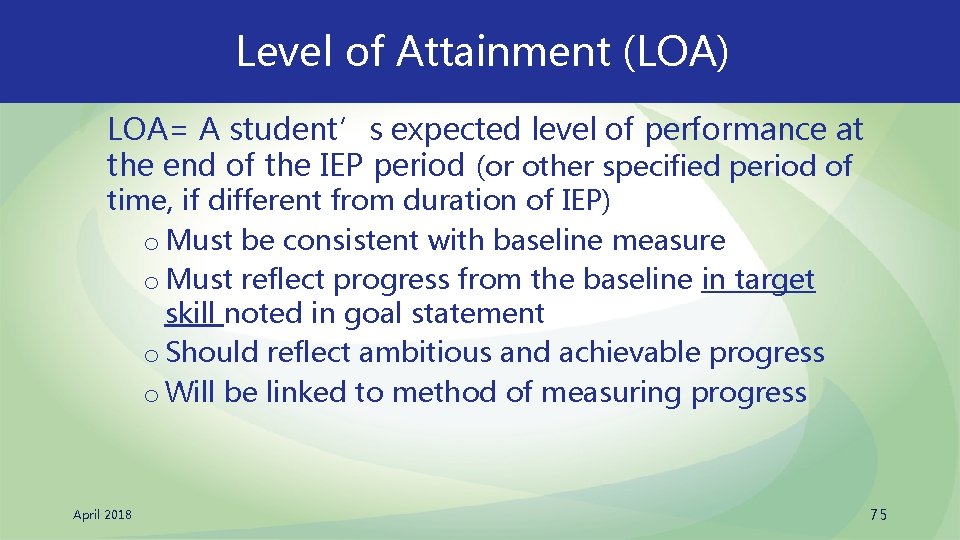
Level of Attainment (LOA) LOA= A student’s expected level of performance at the end of the IEP period (or other specified period of time, if different from duration of IEP) o Must be consistent with baseline measure o Must reflect progress from the baseline in target skill noted in goal statement o Should reflect ambitious and achievable progress o Will be linked to method of measuring progress April 2018 75
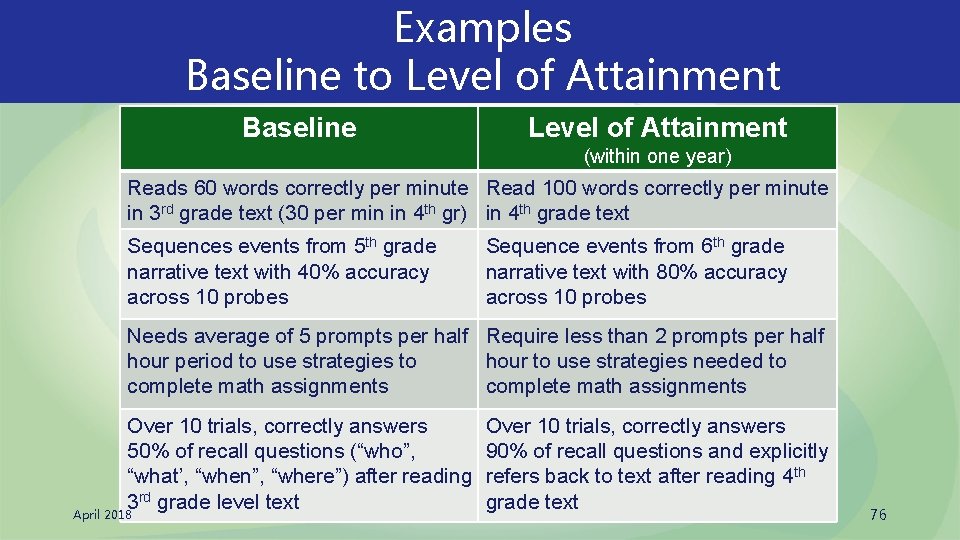
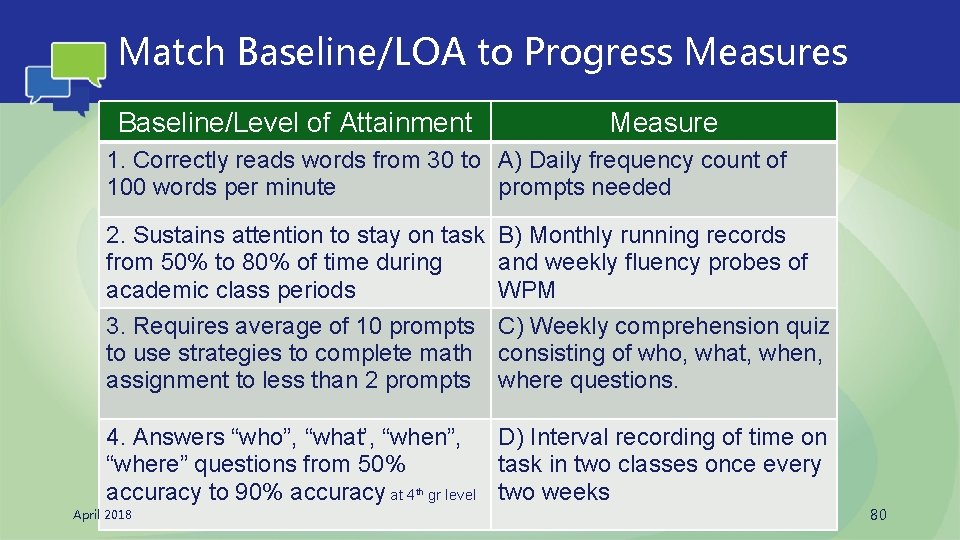
Examples Baseline to Level of Attainment Baseline Level of Attainment (within one year) Reads 60 words correctly per minute Read 100 words correctly per minute in 3 rd grade text (30 per min in 4 th gr) in 4 th grade text Sequences events from 5 th grade narrative text with 40% accuracy across 10 probes Sequence events from 6 th grade narrative text with 80% accuracy across 10 probes Needs average of 5 prompts per half Require less than 2 prompts per half hour period to use strategies to hour to use strategies needed to complete math assignments Over 10 trials, correctly answers 50% of recall questions (“who”, “what’, “when”, “where”) after reading 3 rd grade level text April 2018 Over 10 trials, correctly answers 90% of recall questions and explicitly refers back to text after reading 4 th grade text 76
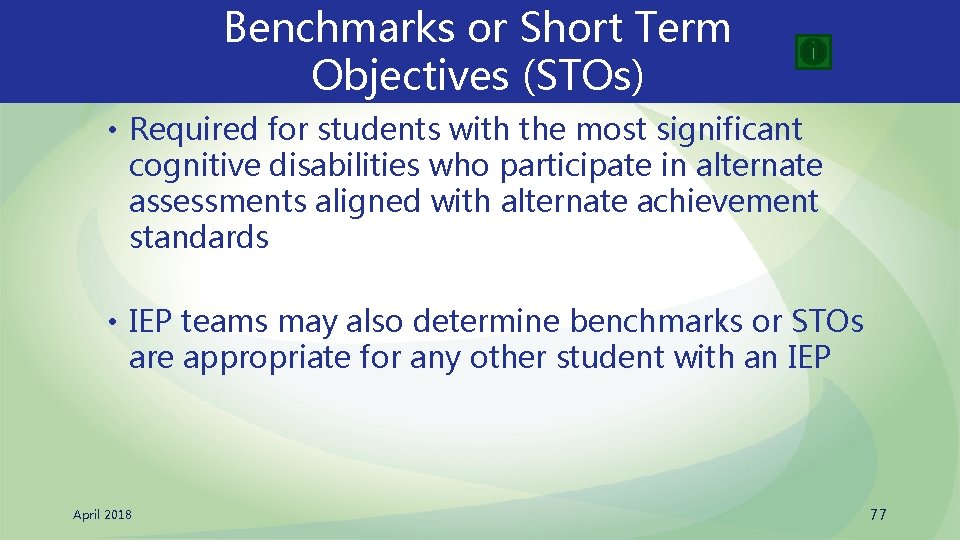
Benchmarks or Short Term Objectives (STOs) • Required for students with the most significant cognitive disabilities who participate in alternate assessments aligned with alternate achievement standards • IEP teams may also determine benchmarks or STOs are appropriate for any other student with an IEP April 2018 77
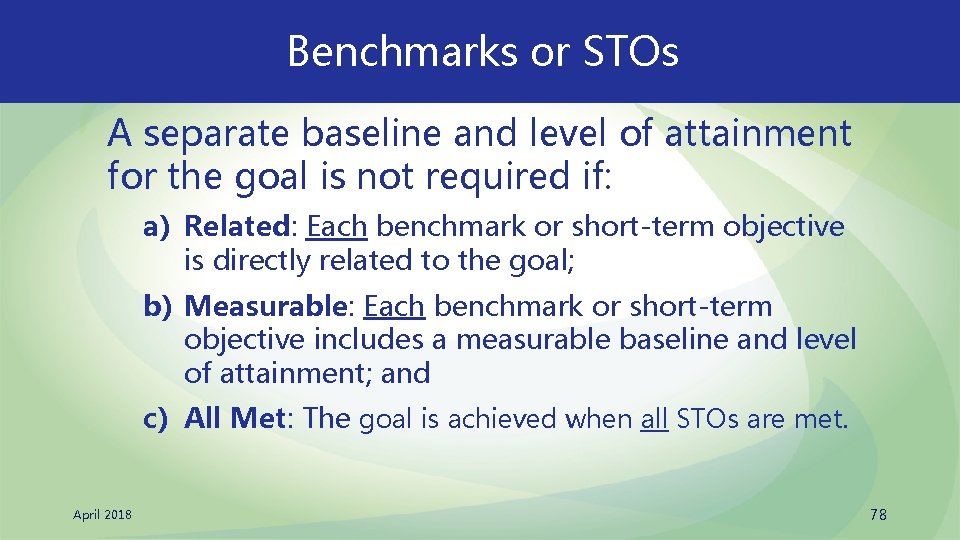
Benchmarks or STOs A separate baseline and level of attainment for the goal is not required if: a) Related: Each benchmark or short-term objective is directly related to the goal; b) Measurable: Each benchmark or short-term objective includes a measurable baseline and level of attainment; and c) All Met: The goal is achieved when all STOs are met. April 2018 78
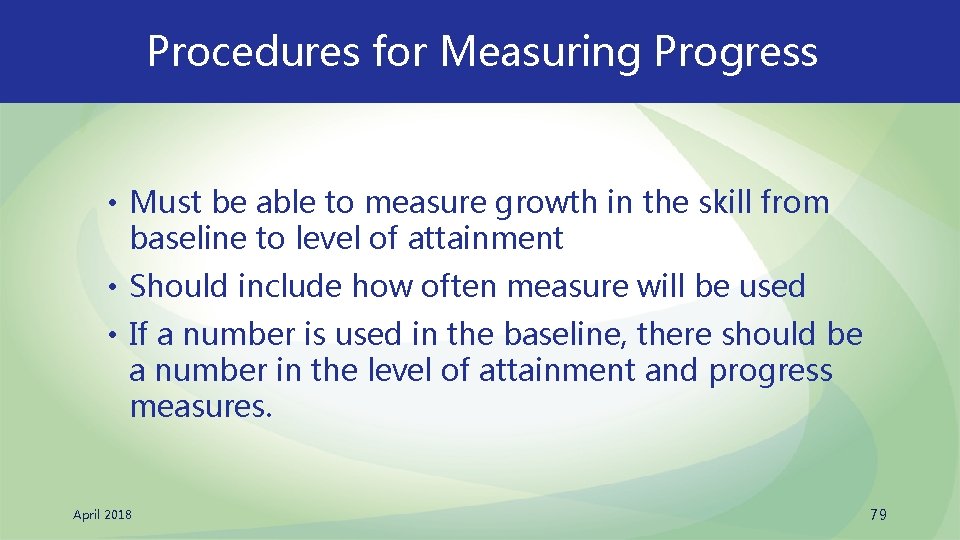
Procedures for Measuring Progress • Must be able to measure growth in the skill from baseline to level of attainment • Should include how often measure will be used • If a number is used in the baseline, there should be a number in the level of attainment and progress measures. April 2018 79
Match Baseline/LOA to Progress Measures Baseline/Level of Attainment Measure 1. Correctly reads words from 30 to A) Daily frequency count of 100 words per minute prompts needed 2. Sustains attention to stay on task B) Monthly running records from 50% to 80% of time during and weekly fluency probes of academic class periods WPM 3. Requires average of 10 prompts C) Weekly comprehension quiz to use strategies to complete math consisting of who, what, when, assignment to less than 2 prompts where questions. 4. Answers “who”, “what’, “when”, D) Interval recording of time on “where” questions from 50% task in two classes once every accuracy to 90% accuracy at 4 th gr level two weeks April 2018 80
Other Reminders • Progress towards goals must be periodically reported to parents • IEP goals must be reviewed and revised, as appropriate, on an annual basis o This is covered more thoroughly in Step 5. • A disability-related need affecting reading must be addressed by a minimum of one goal o Indicate on the IEP Linking Form which disabilityrelated need is being addressed. April 2018 81
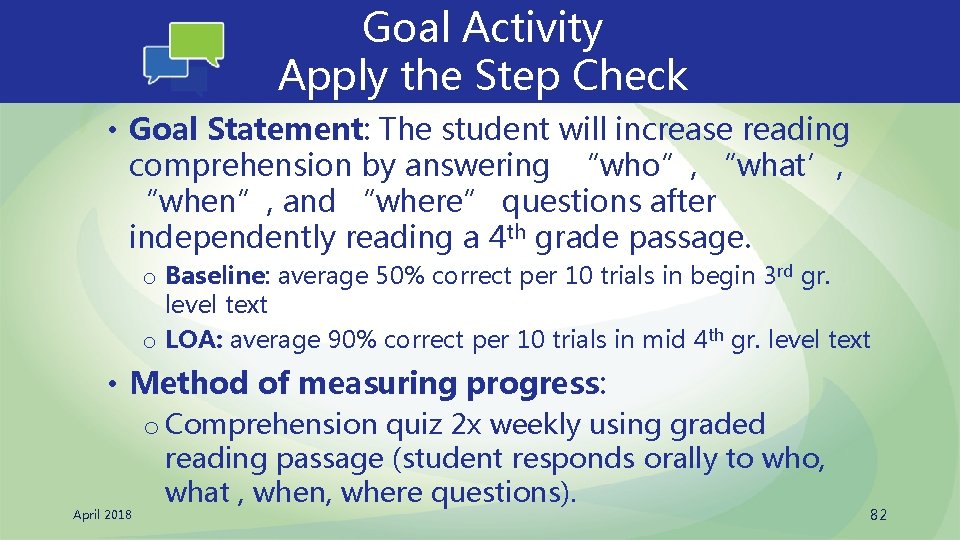
Goal Activity Apply the Step Check • Goal Statement: The student will increase reading comprehension by answering “who”, “what’, “when”, and “where” questions after independently reading a 4 th grade passage. o Baseline: average 50% correct per 10 trials in begin 3 rd gr. level text o LOA: average 90% correct per 10 trials in mid 4 th gr. level text • Method of measuring progress: April 2018 o Comprehension quiz 2 x weekly using graded reading passage (student responds orally to who, what , when, where questions). 82
ü Step 3 Check Also refer to IEP Goal Self-Check ü Does each goal address at least one skill or behavior associated with one or more disability-related need(s)? ü Are goals ambitious and achievable? • Designed to close gaps? • Did team review progress before revising/developing a new goal? ü Are goals (and benchmarks or STOs) measurable? • Is there a baseline and a level of attainment for each? ü Will methods of measuring progress allow for comparison of baseline and level of attainment? ü Are goal statements understandable to all? üIf need not addressed by a goal, has team discussed why 83 April 2018
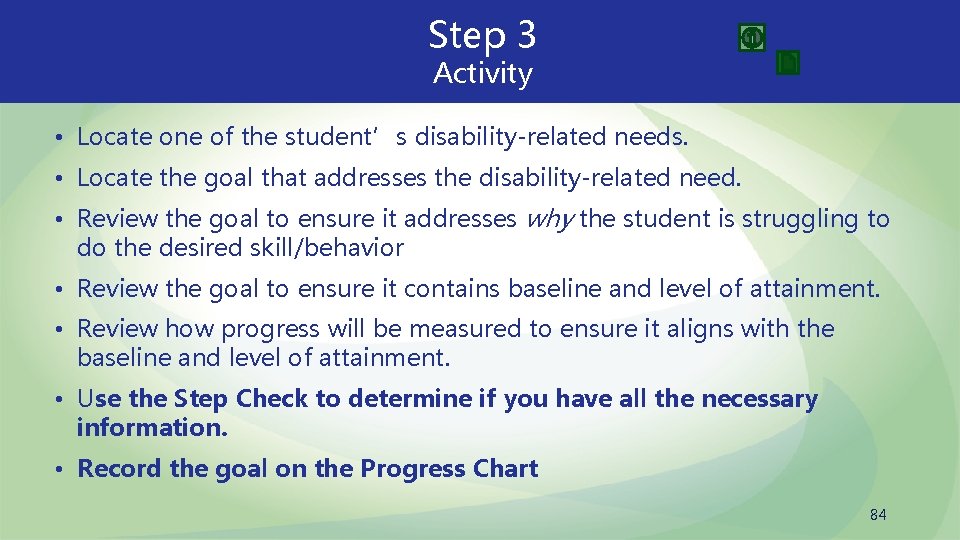
Step 3 Activity • Locate one of the student’s disability-related needs. • Locate the goal that addresses the disability-related need. • Review the goal to ensure it addresses why the student is struggling to do the desired skill/behavior • Review the goal to ensure it contains baseline and level of attainment. • Review how progress will be measured to ensure it aligns with the baseline and level of attainment. • Use the Step Check to determine if you have all the necessary information. • Record the goal on the Progress Chart 84
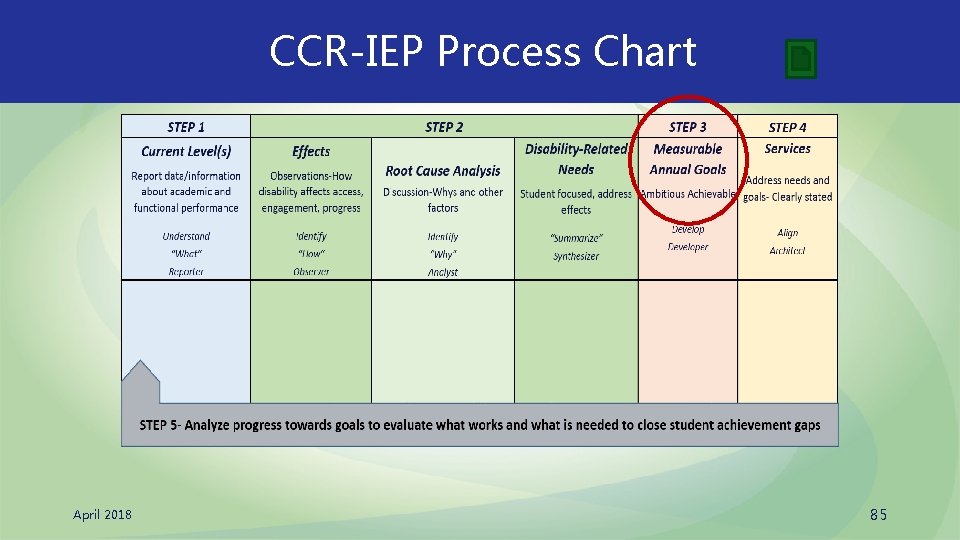
CCR-IEP Process Chart April 2018 85
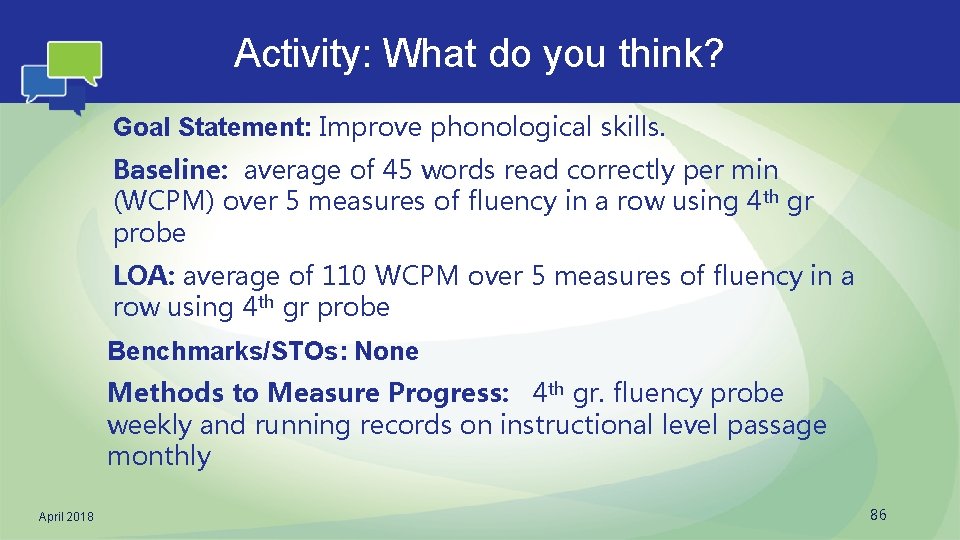
Activity: What do you think? Goal Statement: Improve phonological skills. Baseline: average of 45 words read correctly per min (WCPM) over 5 measures of fluency in a row using 4 th gr probe LOA: average of 110 WCPM over 5 measures of fluency in a row using 4 th gr probe Benchmarks/STOs: None Methods to Measure Progress: 4 th gr. fluency probe weekly and running records on instructional level passage monthly April 2018 86
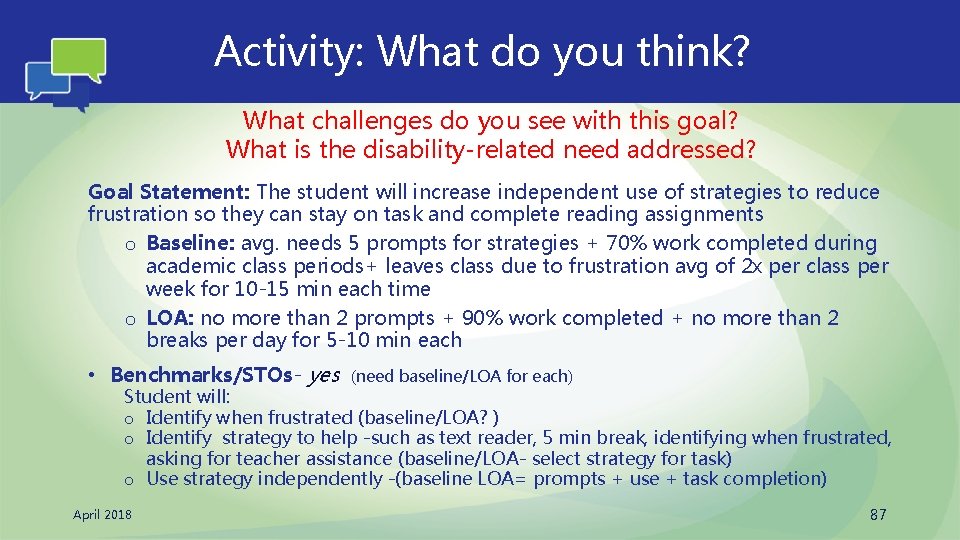
Activity: What do you think? What challenges do you see with this goal? What is the disability-related need addressed? Goal Statement: The student will increase independent use of strategies to reduce frustration so they can stay on task and complete reading assignments o Baseline: avg. needs 5 prompts for strategies + 70% work completed during academic class periods+ leaves class due to frustration avg of 2 x per class per week for 10 -15 min each time o LOA: no more than 2 prompts + 90% work completed + no more than 2 breaks per day for 5 -10 min each • Benchmarks/STOs- yes (need baseline/LOA for each) Student will: o Identify when frustrated (baseline/LOA? ) o Identify strategy to help -such as text reader, 5 min break, identifying when frustrated, asking for teacher assistance (baseline/LOA- select strategy for task) o Use strategy independently -(baseline LOA= prompts + use + task completion) April 2018 87
CCR-IEP 5 Step Process Understand Achievement Analyze Progress Identify Effects of Disability (and disability related needs) Align Services April 2018 Develop Goals 88
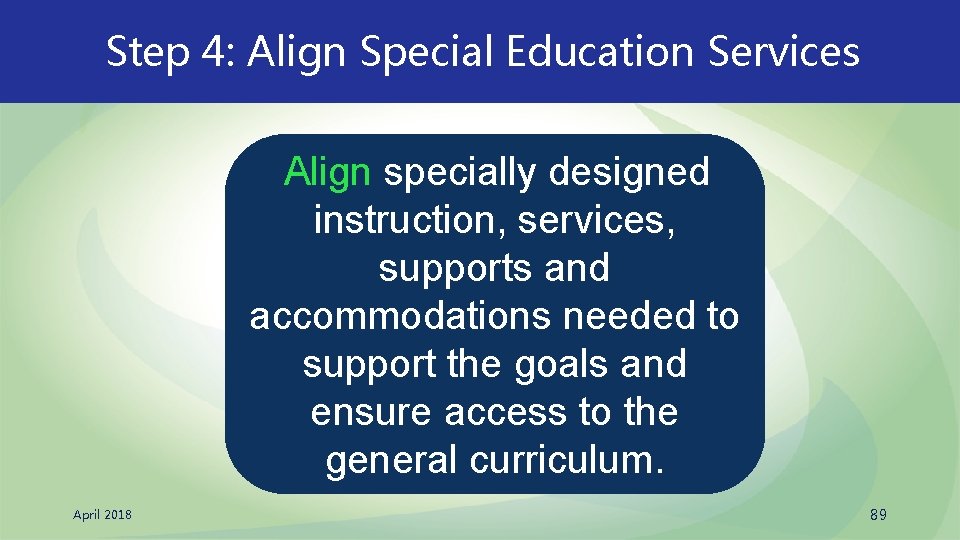
Step 4: Align Special Education Services Align specially designed instruction, services, supports and accommodations needed to support the goals and ensure access to the general curriculum. April 2018 89
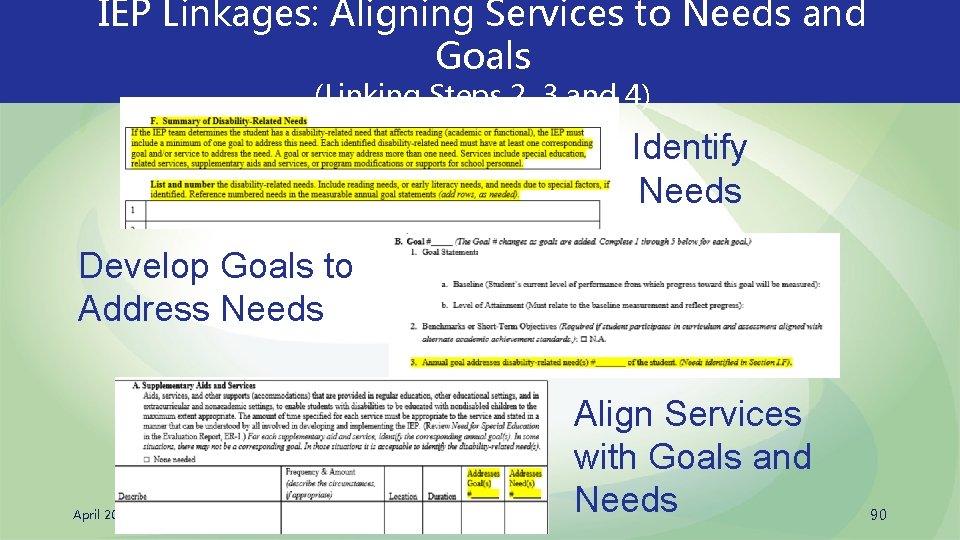
IEP Linkages: Aligning Services to Needs and Goals (Linking Steps 2, 3 and 4) Identify Needs Develop Goals to Address Needs April 2018 Align Services with Goals and Needs 90
Step 4 Key Ideas Understanding the purpose of IEP services and why each service is needed to improve access, engagement and/or progress is central to linking services to IEP goals and disability-related needs April 2018 91
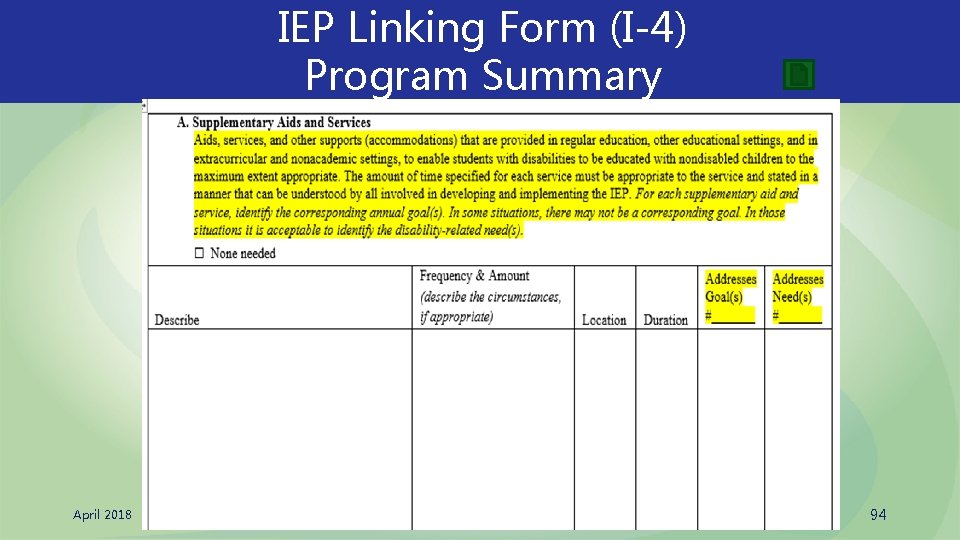
Step 4 Key Ideas Services are aligned to address disability-related needs and support goal attainment o Enable the student to make sufficient progress towards the goals o Reduce barriers and support access, engagement, and progress in early childhood/ grade level standards-based curriculum and instruction, other activities, and environments o All disability-related needs must be addressed by services April 2018 92
Step 4 Key Ideas • Services may include: o supplementary aids and services, o specially designed instruction, o related services, and o program modifications & supports for personnel • Specially designed instruction must be included in every IEP • If a disability-related need affects reading, there must be at least one goal and service to support that need April 2018 93
IEP Linking Form (I-4) Program Summary April 2018 94
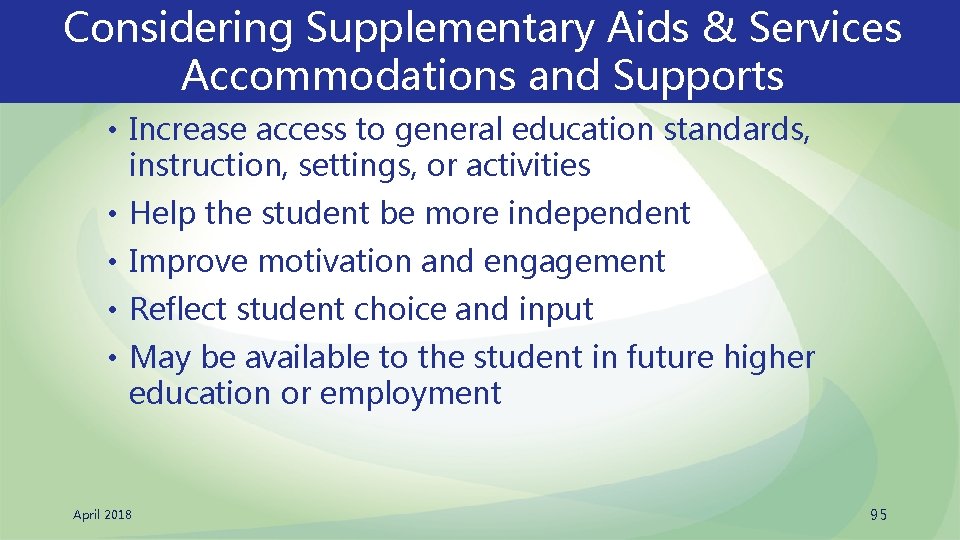
Considering Supplementary Aids & Services Accommodations and Supports • Increase access to general education standards, instruction, settings, or activities • Help the student be more independent • Improve motivation and engagement • Reflect student choice and input • May be available to the student in future higher education or employment April 2018 95
National Instructional Materials Accessibility Standard (NIMAS) • Students who are blind or visually impaired or have other print disabilities, must timely receive accessible materials in the appropriate format • NIMAS establishes criteria for standardization of accessible electronic text files for eligible students o Materials sent to access center (NIMAC) by LEA request via Wisconsin Accessible Materials Portal (WAMP) • During Step 4, the IEP team considers if student requires instructional materials in a specialized format to address disability related needs April 2018 96
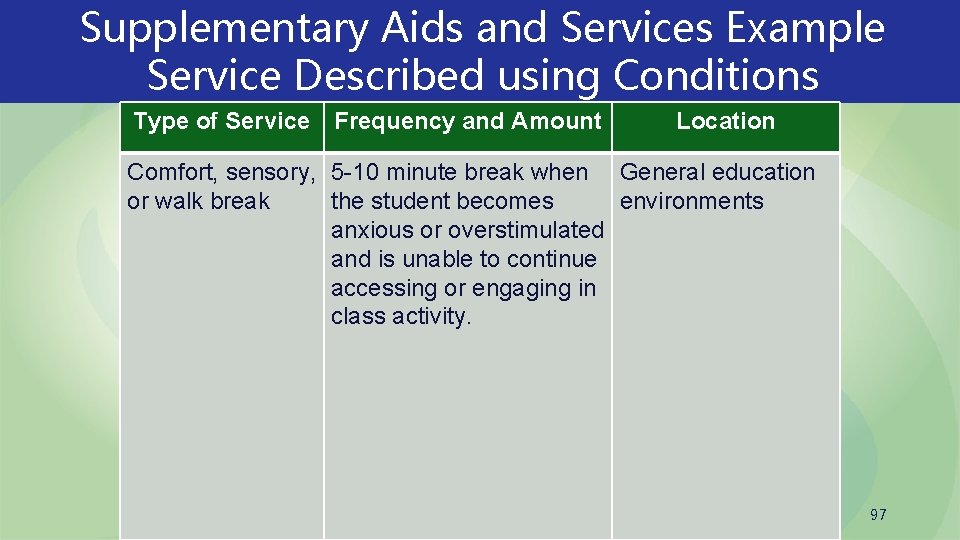
Supplementary Aids and Services Example Service Described using Conditions Type of Service Frequency and Amount Location Comfort, sensory, 5 -10 minute break when General education or walk break the student becomes environments anxious or overstimulated and is unable to continue accessing or engaging in class activity. 97
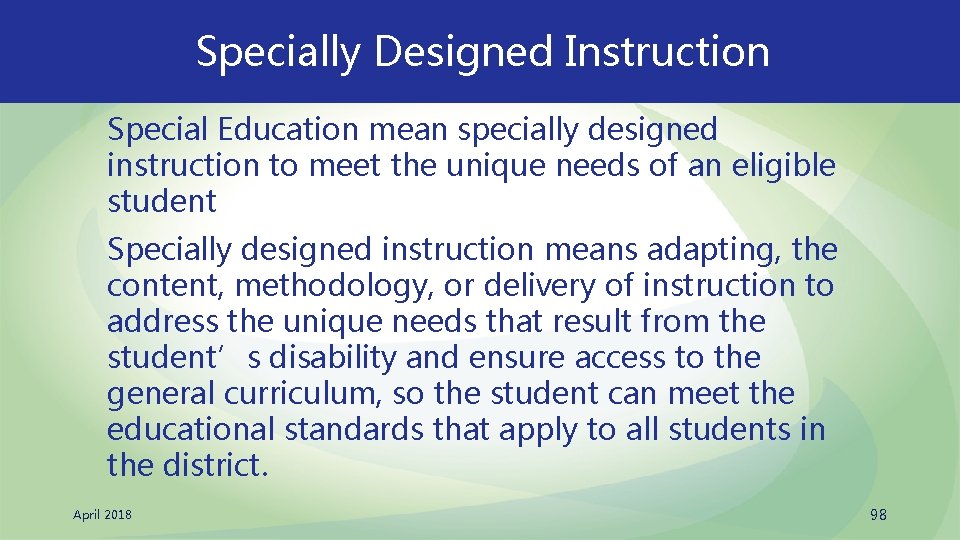
Specially Designed Instruction Special Education mean specially designed instruction to meet the unique needs of an eligible student Specially designed instruction means adapting, the content, methodology, or delivery of instruction to address the unique needs that result from the student’s disability and ensure access to the general curriculum, so the student can meet the educational standards that apply to all students in the district. April 2018 98
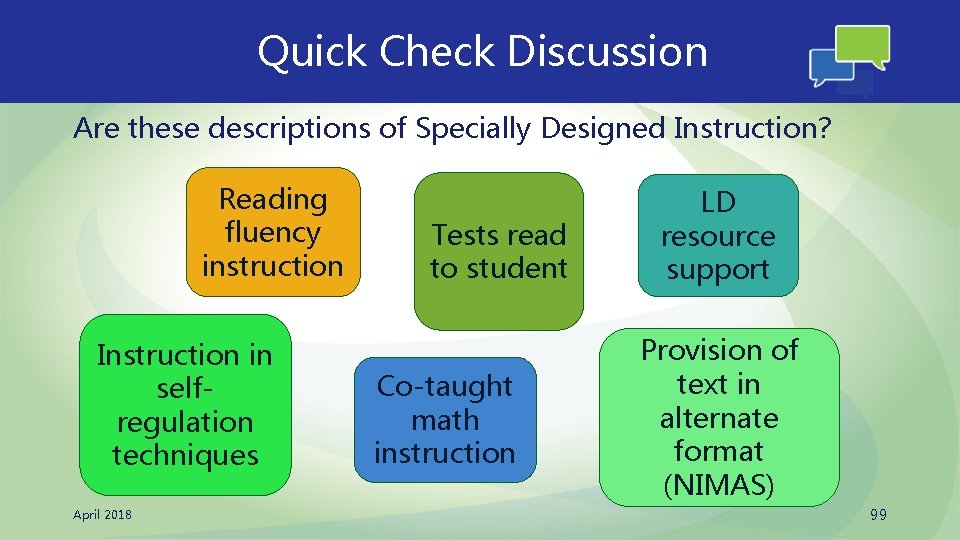
Quick Check Discussion Are these descriptions of Specially Designed Instruction? Reading fluency instruction Instruction in selfregulation techniques April 2018 Tests read to student Co-taught math instruction LD resource support Provision of text in alternate format (NIMAS) 99
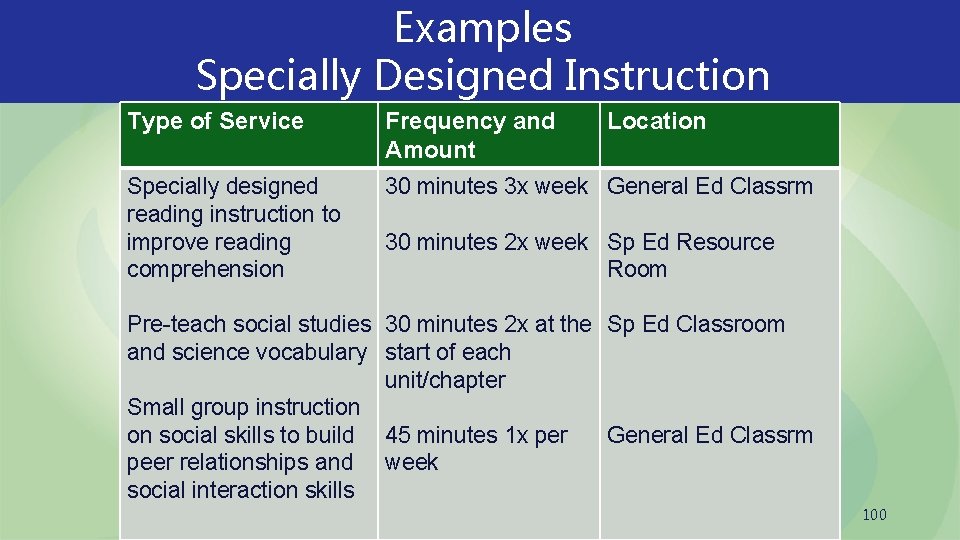
Examples Specially Designed Instruction Type of Service Frequency and Amount Location Specially designed reading instruction to improve reading comprehension 30 minutes 3 x week General Ed Classrm 30 minutes 2 x week Sp Ed Resource Room Pre-teach social studies 30 minutes 2 x at the Sp Ed Classroom and science vocabulary start of each unit/chapter Small group instruction on social skills to build 45 minutes 1 x per General Ed Classrm peer relationships and week social interaction skills 100
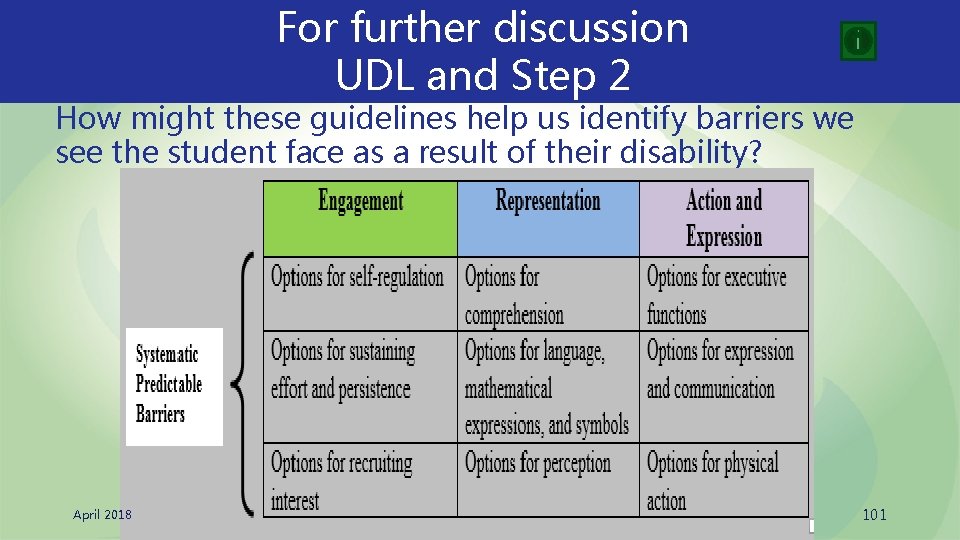
For further discussion UDL and Step 2 How might these guidelines help us identify barriers we see the student face as a result of their disability? April 2018 101
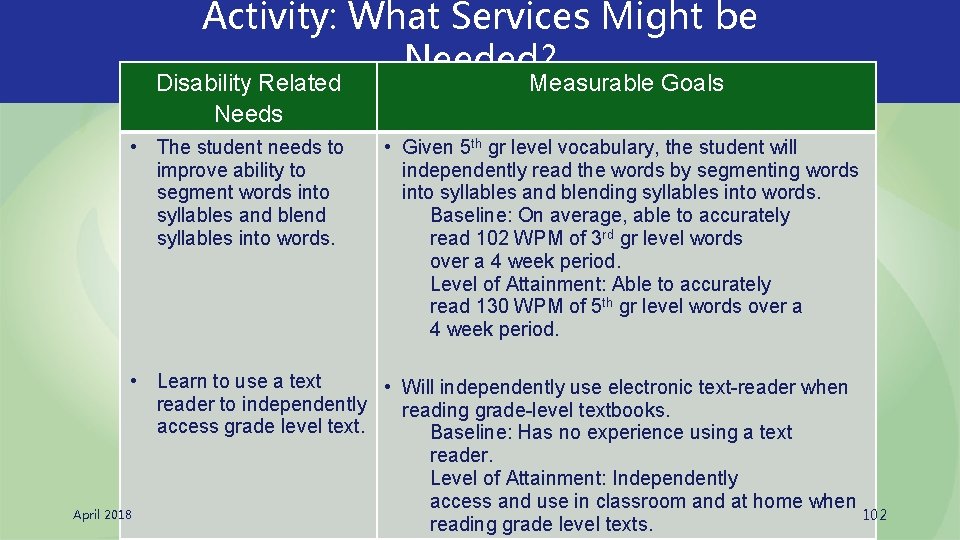
Activity: What Services Might be Needed? Disability Related Needs • The student needs to improve ability to segment words into syllables and blend syllables into words. Measurable Goals • Given 5 th gr level vocabulary, the student will independently read the words by segmenting words into syllables and blending syllables into words. Baseline: On average, able to accurately read 102 WPM of 3 rd gr level words over a 4 week period. Level of Attainment: Able to accurately read 130 WPM of 5 th gr level words over a 4 week period. • Learn to use a text • Will independently use electronic text-reader when reader to independently reading grade-level textbooks. access grade level text. Baseline: Has no experience using a text reader. Level of Attainment: Independently access and use in classroom and at home when April 2018 102 reading grade level texts.
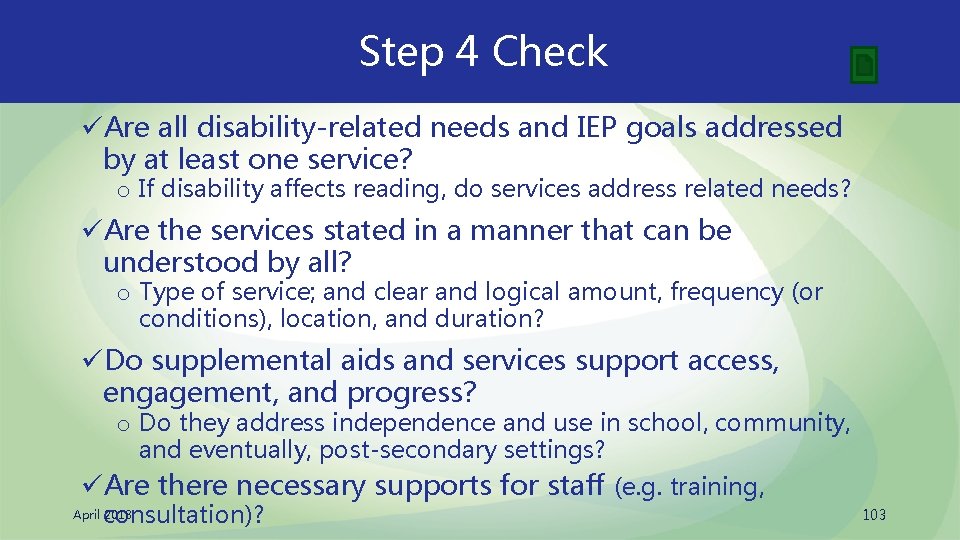
Step 4 Check üAre all disability-related needs and IEP goals addressed by at least one service? o If disability affects reading, do services address related needs? üAre the services stated in a manner that can be understood by all? o Type of service; and clear and logical amount, frequency (or conditions), location, and duration? üDo supplemental aids and services support access, engagement, and progress? o Do they address independence and use in school, community, and eventually, post-secondary settings? üAre there necessary supports for staff (e. g. training, consultation)? April 2018 103
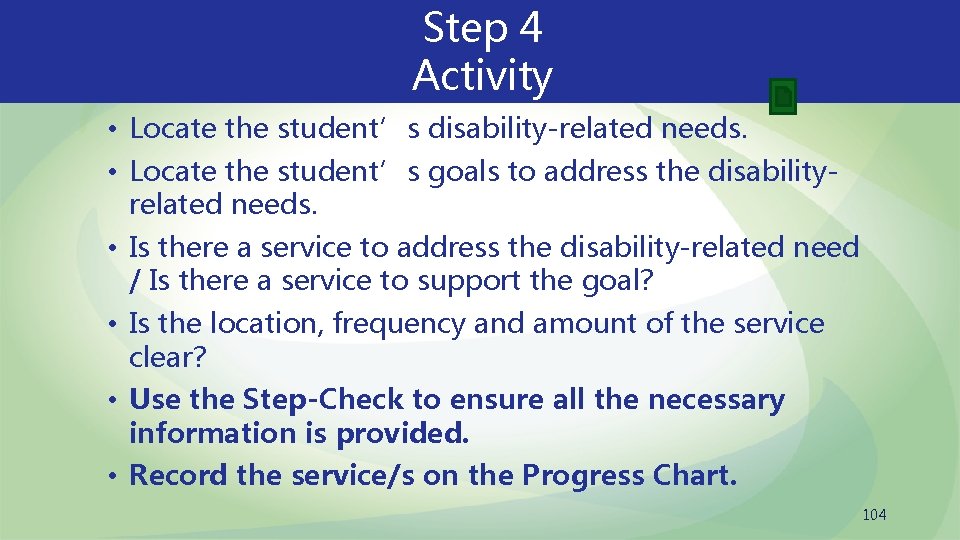
Step 4 Activity • Locate the student’s disability-related needs. • Locate the student’s goals to address the disabilityrelated needs. • Is there a service to address the disability-related need / Is there a service to support the goal? • Is the location, frequency and amount of the service clear? • Use the Step-Check to ensure all the necessary information is provided. • Record the service/s on the Progress Chart. 104
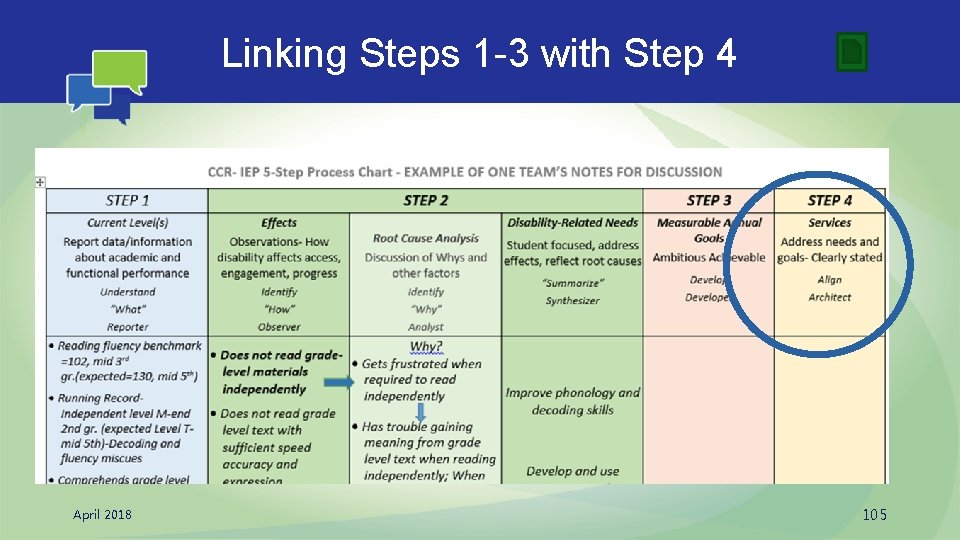
Linking Steps 1 -3 with Step 4 April 2018 105
For Discussion • What do you see as the most challenging aspects of this step? • What questions might you ask to help prompt IEP team participants to address the key ideas of this step during an IEP team meeting? April 2018 106
College and Career Ready IEP Five Step Process Understand Achievement Analyze Progress Identify Effects of Disability (and disability related needs) Align Services April 2018 Develop Goals 107
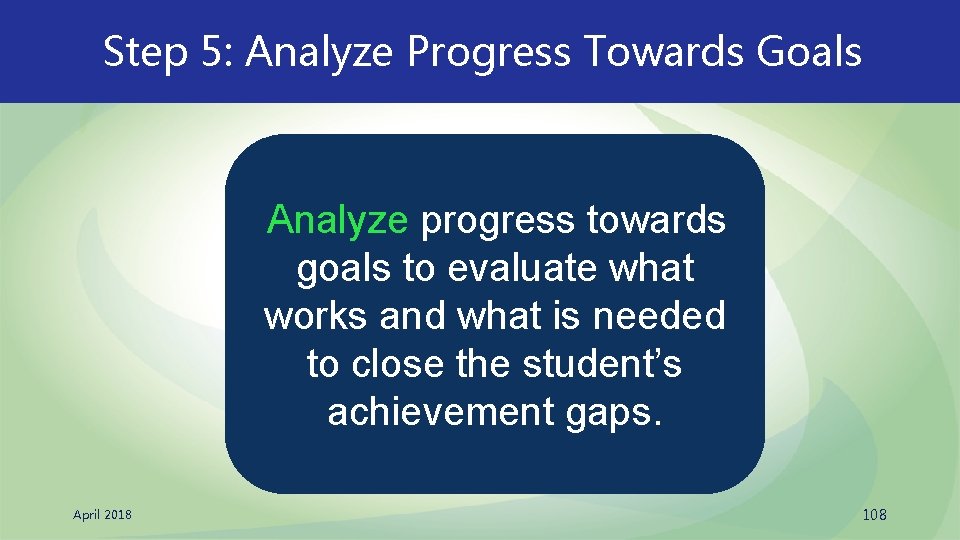
Step 5: Analyze Progress Towards Goals Analyze progress towards goals to evaluate what works and what is needed to close the student’s achievement gaps. April 2018 108
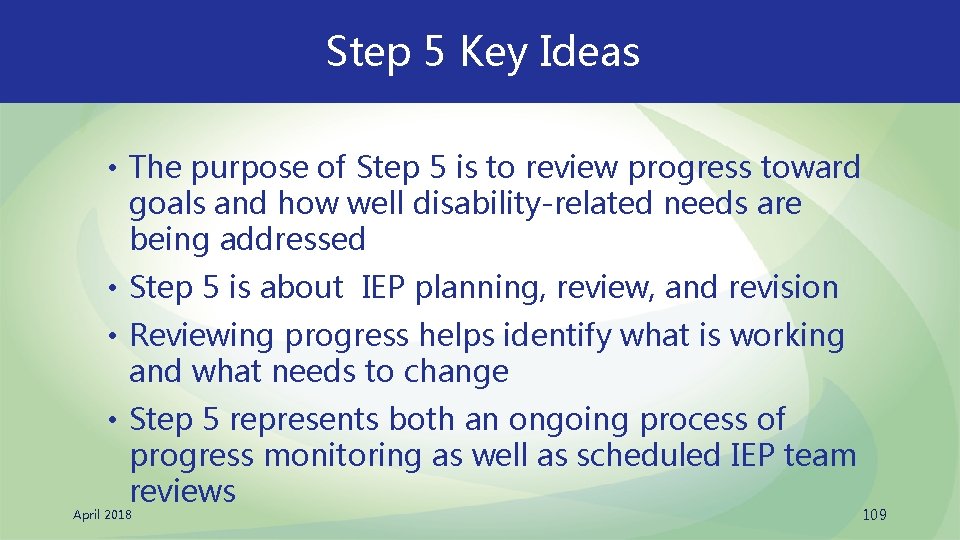
Step 5 Key Ideas • The purpose of Step 5 is to review progress toward goals and how well disability-related needs are being addressed • Step 5 is about IEP planning, review, and revision • Reviewing progress helps identify what is working and what needs to change • Step 5 represents both an ongoing process of progress monitoring as well as scheduled IEP team reviews April 2018 109
Step 5 Key Ideas • The IEP team analyzes the student’s progress towards the IEP goals to inform future IEP development • The IEP must be reviewed periodically, but at least annually o The IEP must state when IEP progress will be reported to parents (e. g. , quarterly, concurrent with general education report cards, etc. ) April 2018 110
Step 5 Key Ideas When a student is not making sufficient progress towards achieving IEP goals and closing achievement gaps, the CCR IEP Five. Step Process provides a good framework for reviewing and revising the IEP April 2018 111
Step 5 Check Your System • Are there set procedures and schedules for reviewing IEP goals? • Are there procedures for ensuring IEPs are implemented with fidelity? • Do all educators have access to data needed to review IEPs? • Are instructional resources available to match student needs with effective interventions? • Do educators need additional training or support to implement IEP services ? • Do educators need additional training or support to April 2018 112
Step 5 Check üIs progress data aligned with baseline and level of attainment for each goal? üAre interim progress reports on each goal included in review? üWas the IEP reviewed annually? üIs data/information from multiple sources included (teachers, student and parents)? üIs student making sufficient progress? Is there data to support? üIf student is not making sufficient progress, has IEP been April 2018 113 revised to address lack of progress?
Step 5 Activity • Review the I-6 (Interim Review) • Is the student making sufficient progress? • What data supports this conclusion? • If not, how is lack of progress being addressed? • Review the I-5 (Annual Review) • Were goals reviewed prior to developing new IEP? • What data supports this conclusion? • If goals weren’t met, how was IEP revised? 114
For Discussion Step 5 • What do you see as the most challenging aspects of this step? • How might you prepare to review progress during an IEP team meeting? April 2018 115
For Further Practice Chart and Discuss Linkages using an existing IEP • Review “At A Glance” documents for Steps 1 -4 • Pick one disability-related need • Look at the services statement(s) identified to address the need and, as appropriate, corresponding goal(s) (refer to numbered need/goal) • Is there a clear and logical link between the disabilityrelated need, corresponding goal(s), and service(s)? o Are goals and services explicitly developed to address a root cause rather than symptom(s)? • Try to trace the process backwards by seeing if you can write the corresponding information from Steps 4, 3, 2, and 1 on a blank 5 Step Process Chart April 2018 116
Resources
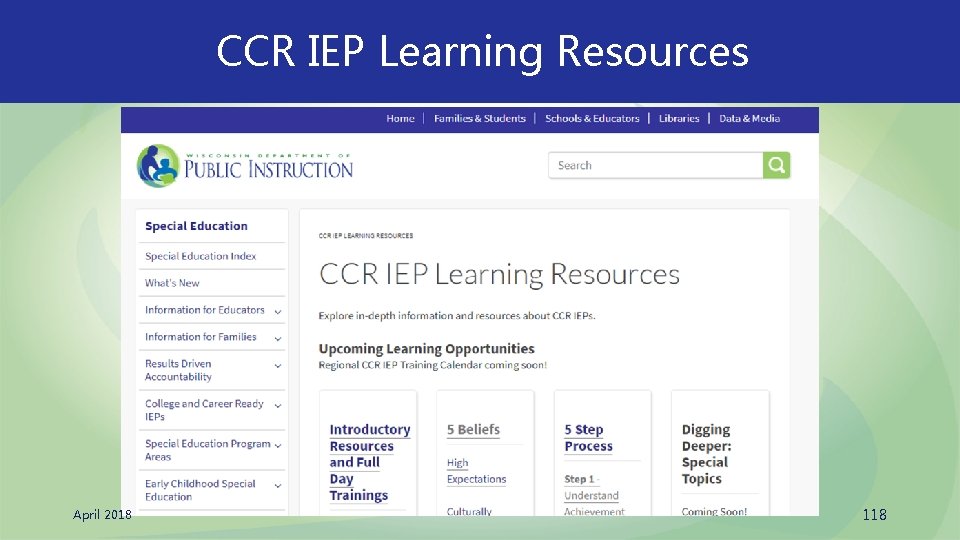
CCR IEP Learning Resources April 2018 118
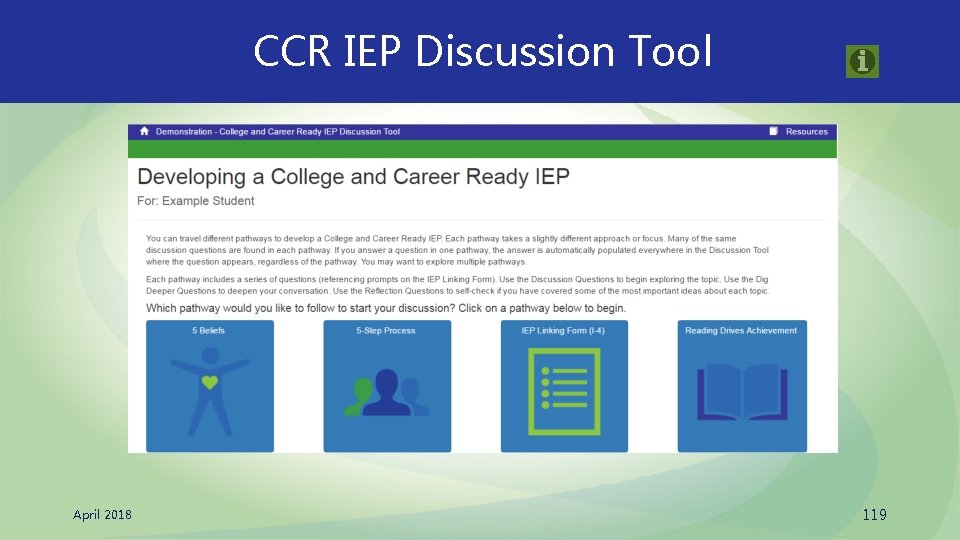
CCR IEP Discussion Tool April 2018 119
CCR IEP Video April 2018 120
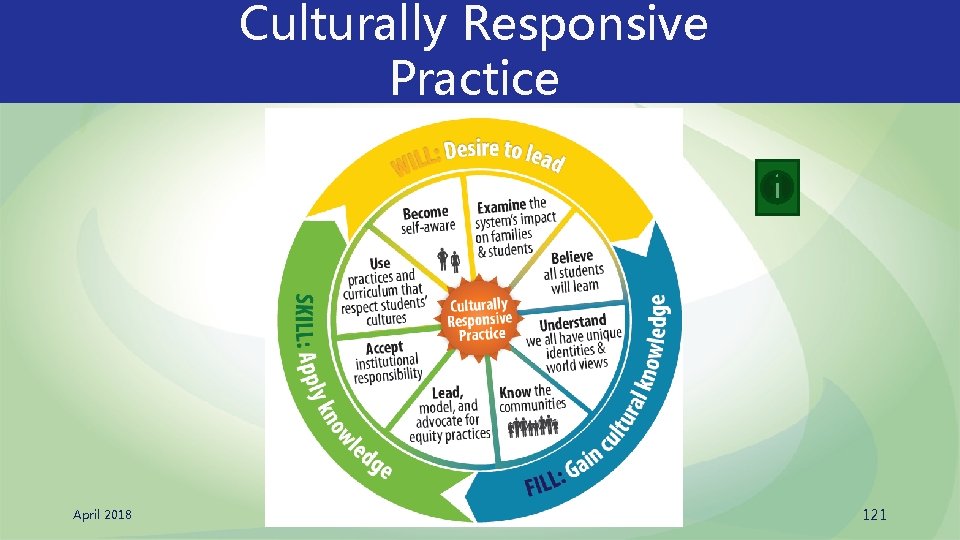
Culturally Responsive Practice April 2018 121
Family and Community Engagement in Promoting Excellence For All Wisconsin State Parent Educator Initiative (WSPEI) http: //wspei. org/ WSPEI CCR-IEP Family Engagement Resources http: //www. livebinders. com/play? id=2191 148 Report of the State Superintendent’s Parent Advisory Council dpi. wi. gov/pacreport April 2018 122
Collective Responsibility Co-Teaching https: //youtu. be/Xurgvdq 3 J 8 s April 2018 123
Sample IEP Forms and PCSA Resource Links • DPI Special Education Forms Page (includes copies of all sample forms, history of changes to forms, and additional guidance) • Guide to Special Education Forms • Sample IEP Forms Frequently Asked Questions (FAQ) • Information about Procedural Compliance Self. Assessment (RDA-PCSA) April 2018 124