
StandardsBased IEPs Module 1 IEP Overview A Plan
Standards-Based IEPs Module 1: IEP Overview – A Plan for Guiding Instruction and Service Provision
Product vs. Process �Product: § An individualized plan reasonably calculated to result in educational benefit (FAPE) �Process: § Planning to determine what is needed for student to benefit from education
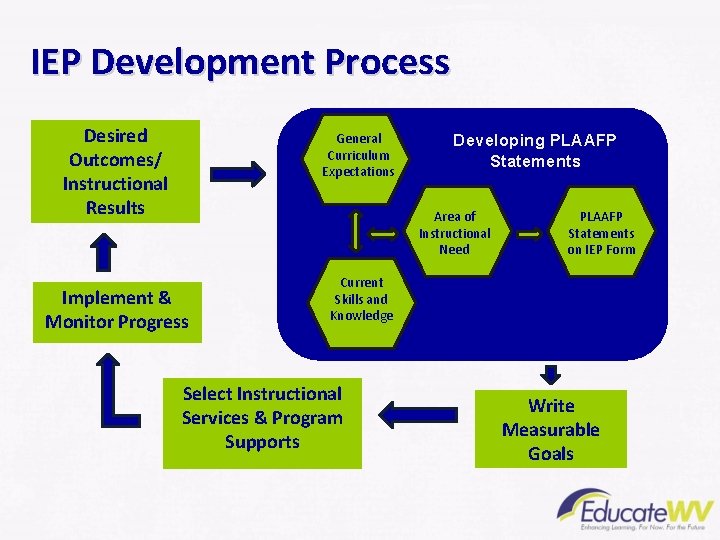
IEP Development Process Desired Outcomes/ Instructional Results General Curriculum Expectations Developing PLAAFP Statements Area of Instructional Need Implement & Monitor Progress PLAAFP Statements on IEP Form Current Skills and Knowledge Select Instructional Services & Program Supports Write Measurable Goals
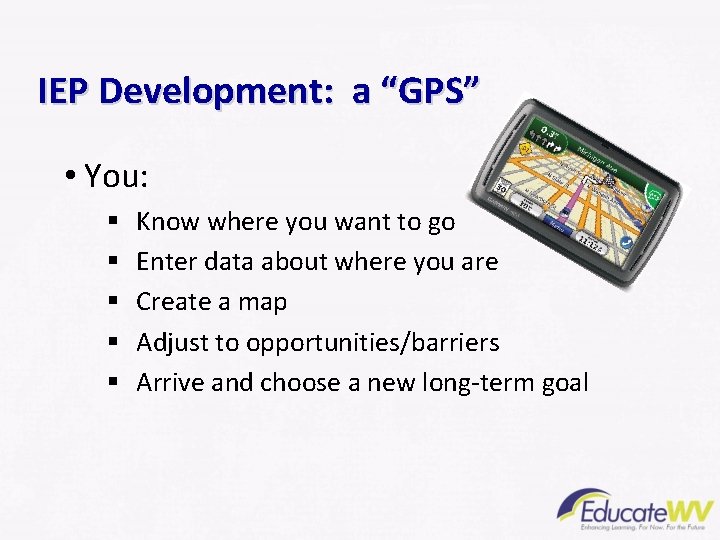
IEP Development: a “GPS” • You: § § § Know where you want to go Enter data about where you are Create a map Adjust to opportunities/barriers Arrive and choose a new long-term goal
Planning: Two Critical Components § Knowing where you want to go § Using data as the basis
Assumptions • Good IEPs are: § Reasonably calculated to result in educational benefit § Connected to state standards as a fundamental component to educational benefit
Assumptions • Good IEPs are: § Dependent upon knowledge of curriculum/effective practice § Not an isolated event § Consistent with regulation/best practice
The “I” in IEP • Requires: § Consideration of individualized data/needs § Different goals for different students based on needs
Activity 1. 1 Reflect & Note: • Why: § Are standards important? § Should we consider them? § Standards-Based IEPs?
Elementary and Secondary Education Act (ESEA) �Added accountability by requiring: § Demonstrated progress on state standards § Assessment on grade-level standards § Students with disabilities as a reported subgroup
Individuals with Disabilities Education Act (IDEA) “…meet the child's needs. . . to enable the child to be involved in and make progress in the general education curriculum. . . ” 34 CFR 300. 320(a)(2)(i)(A)
ESEA/IDEA Intersect • Successful educational outcomes for all students • Statewide Assessment Accountability for all students • Consequences for not assessing all students • Access to the general curriculum is essential to closing the achievement gap and reaching Annual Measurable Objectives (AMO)
Ultimately… “ It means that all our kids, even the ones our system calls ‘hard to teach’ can learn. ” Rod Paige, former Secretary of Education “Ready means ‘never’ if we continuously focus on the lowest-level skills. ” -Maggie Mc. Laughlin, Autumn 2009
Activity 1. 2 In Your Own Words… Finish this sentence: Standards-Based IEPs are important because…
Accessing the General Education Curriculum • What is meant by the general education curriculum? § The full range of courses, activities, lessons, and materials routinely used by the general population • What is meant by access? § Participation in the knowledge and skills that make up the general education curriculum
Access to the General Education Curriculum for Students with Disabilities ACCESS is not: • Students with disabilities sitting in the general education classroom completing work that is unrelated to the grade-level standards. • Students with disabilities sitting in the general education classroom exposed to content that is out of their reach.
Access to the General Education Curriculum for Students with Disabilities • It is essential to determine how students with disabilities will participate in the content of the general education curriculum. • The student’s strengths provide the best information to determine how the student can access the knowledge and skills of the general education curriculum.
Standards Drive Curriculum • Provide instructional accountability • Drive general education content instruction • Support instruction in the least restrictive environment • Define the expectations of all students with or without disabilities • Create a structure for linking the IEP to the general curriculum
Why Connect IEPs to Standards? • High stakes accountability, performance goals and indicators • IDEA – access to the general curriculum • Essential for closing the achievement gap • Promotes a single system of education – inclusion and a common language • Encourages greater consistency across schools and districts • It’s best for kids – assumes more, not less
Activity 1. 3 Think and Discuss • How are you using the standards in your school to shape your curriculum and instruction? • How are you using the standards to develop IEP goals?
Connecting IEPs to Standards… • Does not mean – § Writing goals that restate the standards § Using the academic standards alone to determine goals § Assuming that every student will work only on grade-level content
Connecting IEPs to Standards… • Does mean – § Referring to standards to determine expectations at grade level § Using the standards as a guide to determine what is important for the student to learn or be able to do § Conducting an analysis to determine gap between grade expectations and current skills/knowledge
What is a Standards-Based IEP? • A process and a document (product) that is framed by the state standards to ensure instructional accountability for each student with an exceptionality. • A plan that contains goals individually designed to facilitate the student’s achievement of gradelevel state standards. • The cornerstone of access to the general education curriculum for students with exceptionalities. 23
General Steps: 1. Consider the grade-level content standards § Examine benchmarks § Discuss expected knowledge and skills § Consider prerequisite knowledge and skills 2. Examine student data to determine where student is in relation to grade-level standards § Compare expectations with student’s current instructional level § Gap Analysis
Standards-Based IEPs: Review and Wrap-up § Content is determined through planning process § Development is like using a GPS
Standards-Based IEPs: Review & Wrap -up • Depend on good data from multiple sources • Start with discussion about the desired outcome • Include vision with parent and student as a source of data • Determine instructional need(s) by a gap analysis • Include data from comprehensive evaluation as one source of data
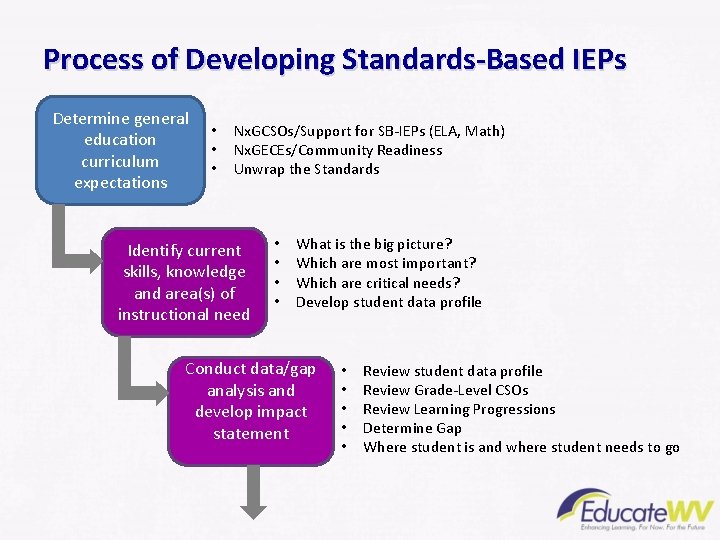
Process of Developing Standards-Based IEPs Determine general education curriculum expectations • • • Nx. GCSOs/Support for SB-IEPs (ELA, Math) Nx. GECEs/Community Readiness Unwrap the Standards Identify current skills, knowledge and area(s) of instructional need • • What is the big picture? Which are most important? Which are critical needs? Develop student data profile Conduct data/gap analysis and develop impact statement • • • Review student data profile Review Grade-Level CSOs Review Learning Progressions Determine Gap Where student is and where student needs to go
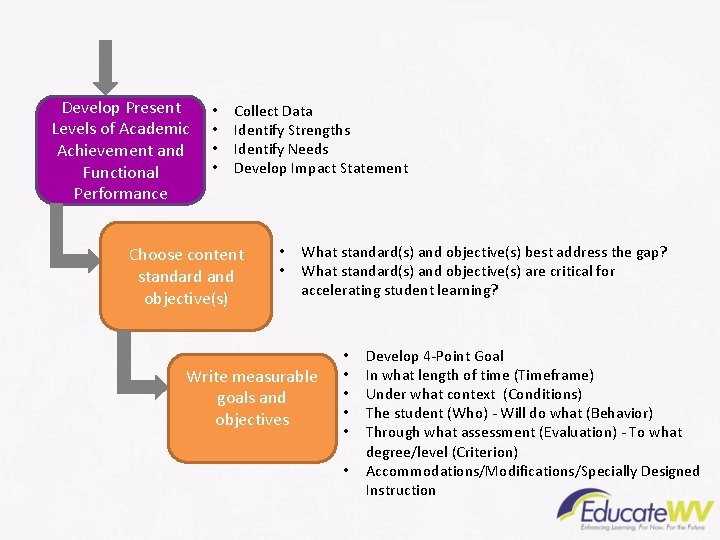
Develop Present Levels of Academic Achievement and Functional Performance • • Collect Data Identify Strengths Identify Needs Develop Impact Statement Choose content standard and objective(s) • • What standard(s) and objective(s) best address the gap? What standard(s) and objective(s) are critical for accelerating student learning? • Write measurable • goals and • • objectives • • Develop 4 -Point Goal In what length of time (Timeframe) Under what context (Conditions) The student (Who) - Will do what (Behavior) Through what assessment (Evaluation) - To what degree/level (Criterion) Accommodations/Modifications/Specially Designed Instruction

High achievement always takes place in the framework of high expectation.
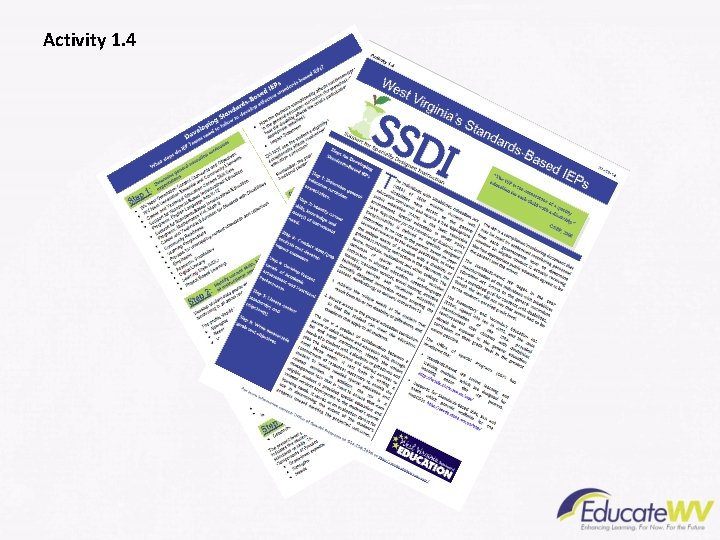
Activity 1. 4
Which Came First? Standard Present Levels of Academic Achievement and Functional Performance
- Slides: 31