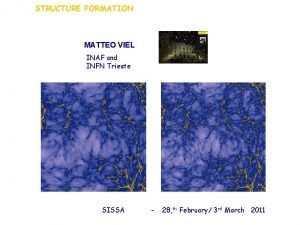
STRUCTURE FORMATION MATTEO VIEL INAF and INFN Trieste






- Slides: 53
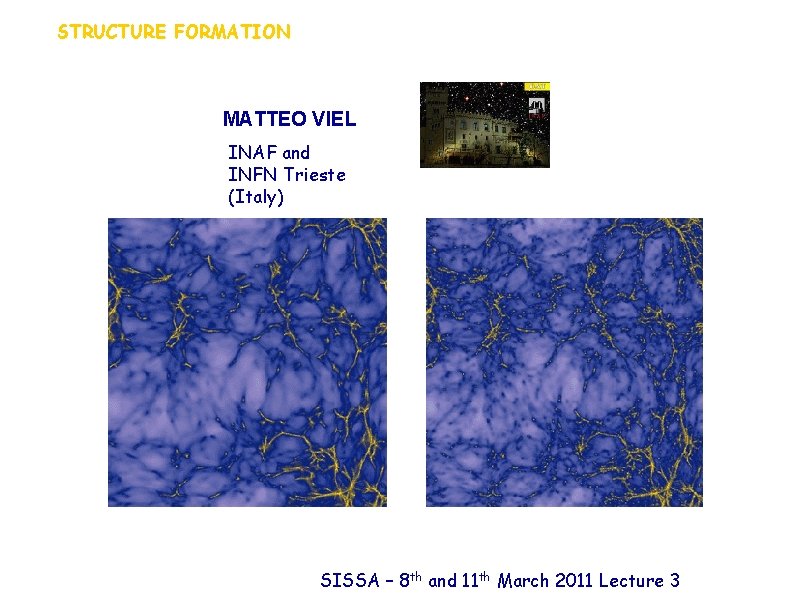
STRUCTURE FORMATION MATTEO VIEL INAF and INFN Trieste (Italy) SISSA – 8 th and 11 th March 2011 Lecture 3
OUTLINE: LECTURES 1. Structure formation: tools and the high redshift universe 2. The dark ages and the universe at 21 cm 3. IGM cosmology at z=2 -6 4. IGM astrophysics at z=2 -6 5. Low redshift: gas and galaxies 6. Cosmological probes LCDM scenario
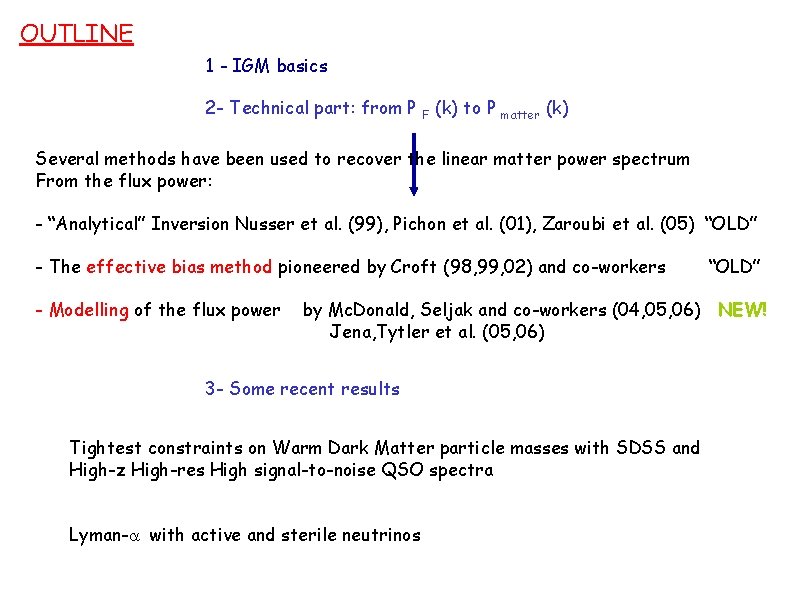
OUTLINE 1 - IGM basics 2 - Technical part: from P F (k) to P matter (k) Several methods have been used to recover the linear matter power spectrum From the flux power: - “Analytical” Inversion Nusser et al. (99), Pichon et al. (01), Zaroubi et al. (05) “OLD” - The effective bias method pioneered by Croft (98, 99, 02) and co-workers - Modelling of the flux power “OLD” by Mc. Donald, Seljak and co-workers (04, 05, 06) NEW! Jena, Tytler et al. (05, 06) 3 - Some recent results Tightest constraints on Warm Dark Matter particle masses with SDSS and High-z High-res High signal-to-noise QSO spectra Lyman-a with active and sterile neutrinos
BASICS IGM: baryonic (gaseous) matter (not in collapsed objects) that lies between galaxies
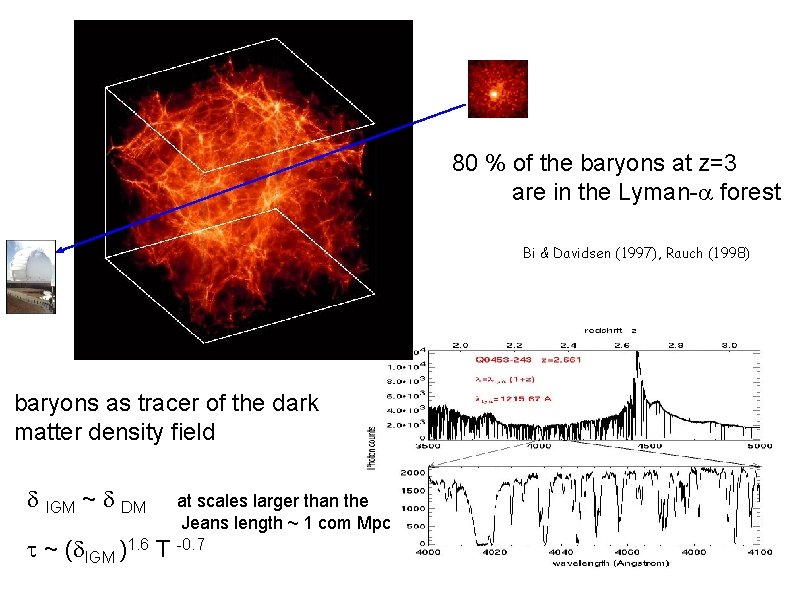
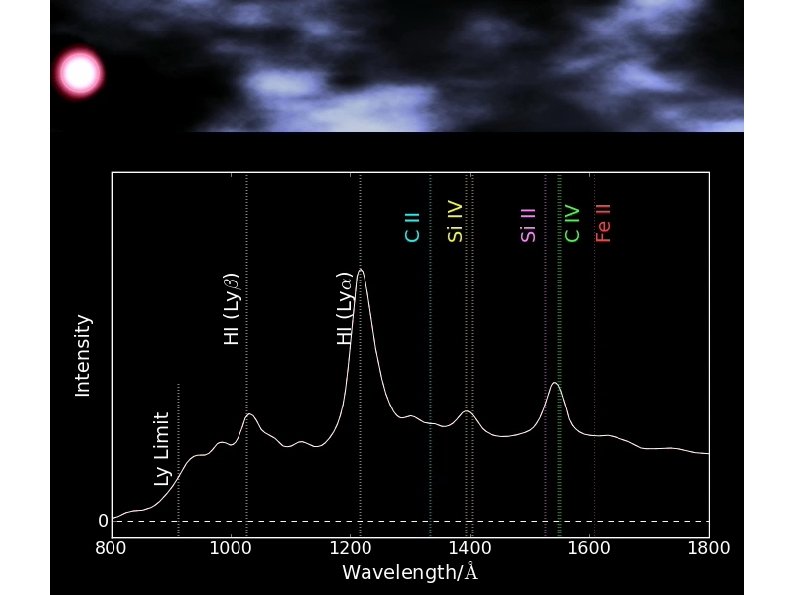
80 % of the baryons at z=3 are in the Lyman-a forest Bi & Davidsen (1997), Rauch (1998) baryons as tracer of the dark matter density field d IGM ~ d DM at scales larger than the Jeans length ~ 1 com Mpc t ~ (d. IGM )1. 6 T -0. 7
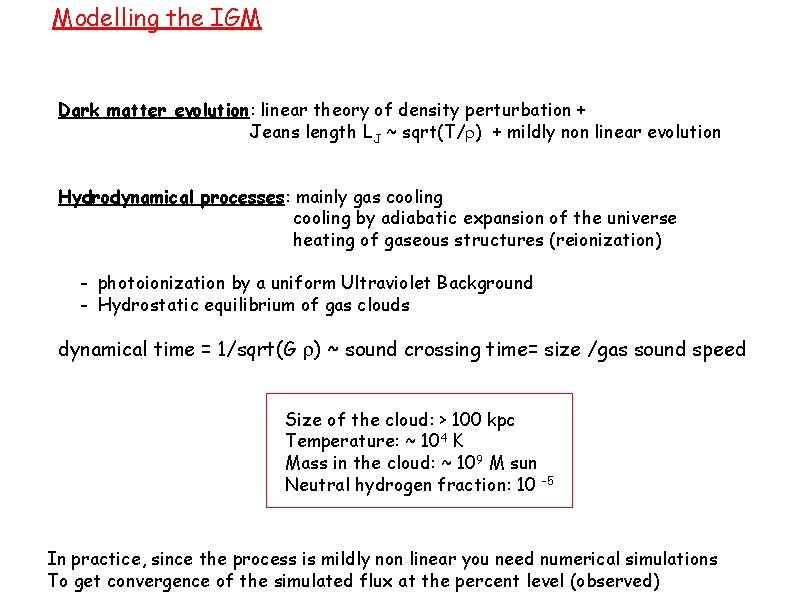
Modelling the IGM Dark matter evolution: linear theory of density perturbation + Jeans length LJ ~ sqrt(T/r) + mildly non linear evolution Hydrodynamical processes: mainly gas cooling by adiabatic expansion of the universe heating of gaseous structures (reionization) - photoionization by a uniform Ultraviolet Background - Hydrostatic equilibrium of gas clouds dynamical time = 1/sqrt(G r) ~ sound crossing time= size /gas sound speed Size of the cloud: > 100 kpc Temperature: ~ 104 K Mass in the cloud: ~ 109 M sun Neutral hydrogen fraction: 10 -5 In practice, since the process is mildly non linear you need numerical simulations To get convergence of the simulated flux at the percent level (observed)
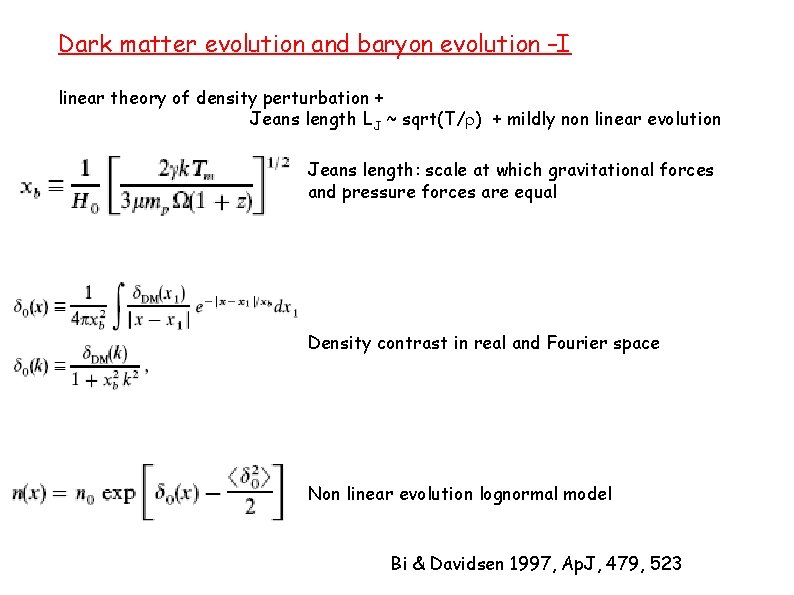
Dark matter evolution and baryon evolution –I linear theory of density perturbation + Jeans length LJ ~ sqrt(T/r) + mildly non linear evolution Jeans length: scale at which gravitational forces and pressure forces are equal Density contrast in real and Fourier space Non linear evolution lognormal model Bi & Davidsen 1997, Ap. J, 479, 523
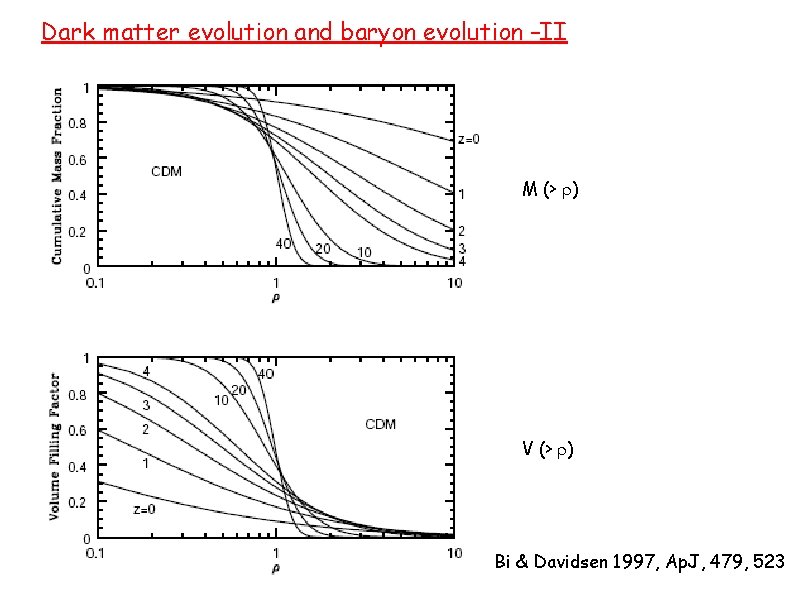
Dark matter evolution and baryon evolution –II M (> r) V (> r) Bi & Davidsen 1997, Ap. J, 479, 523
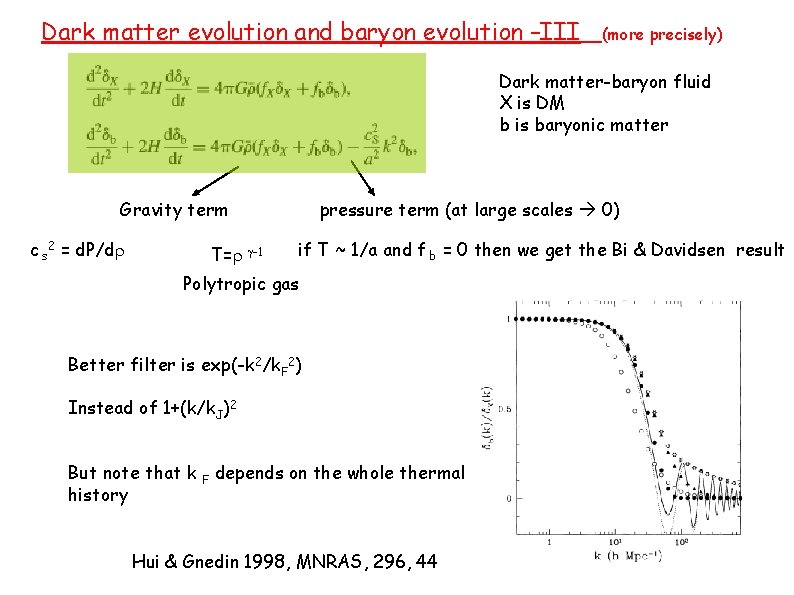
Dark matter evolution and baryon evolution –III (more precisely) Dark matter-baryon fluid X is DM b is baryonic matter Gravity term c s 2 = d. P/dr T=r g-1 pressure term (at large scales 0) if T ~ 1/a and f b = 0 then we get the Bi & Davidsen result Polytropic gas Better filter is exp(-k 2/k. F 2) Instead of 1+(k/k. J)2 But note that k history F depends on the whole thermal Hui & Gnedin 1998, MNRAS, 296, 44
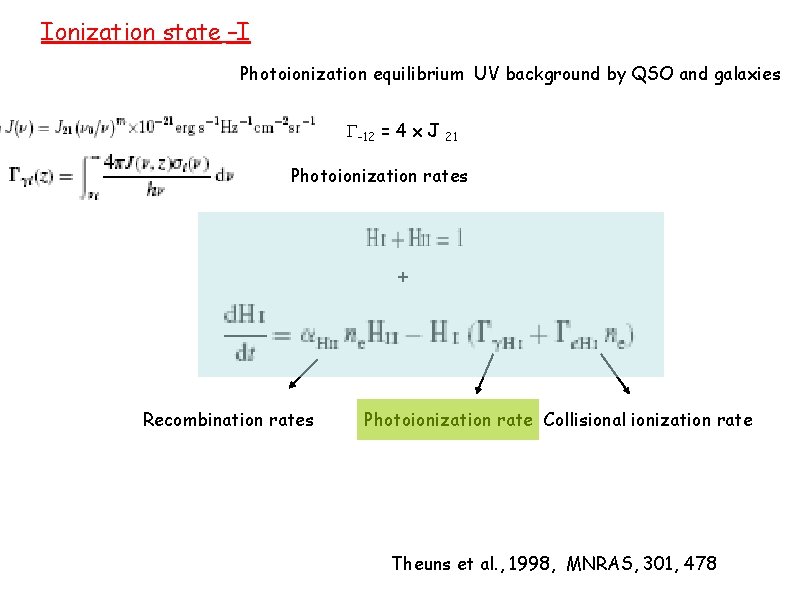
Ionization state –I Photoionization equilibrium UV background by QSO and galaxies G-12 = 4 x J 21 Photoionization rates + Recombination rates Photoionization rate Collisional ionization rate Theuns et al. , 1998, MNRAS, 301, 478
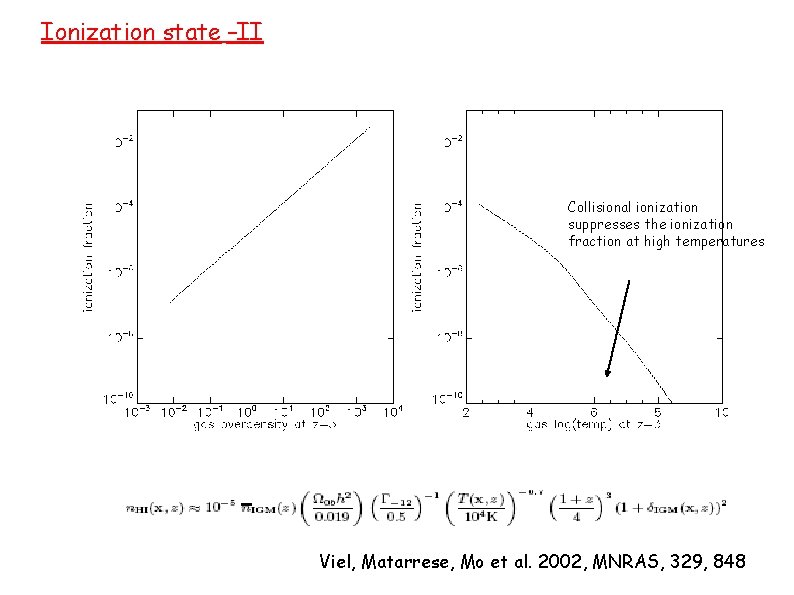
Ionization state –II Collisional ionization suppresses the ionization fraction at high temperatures Viel, Matarrese, Mo et al. 2002, MNRAS, 329, 848
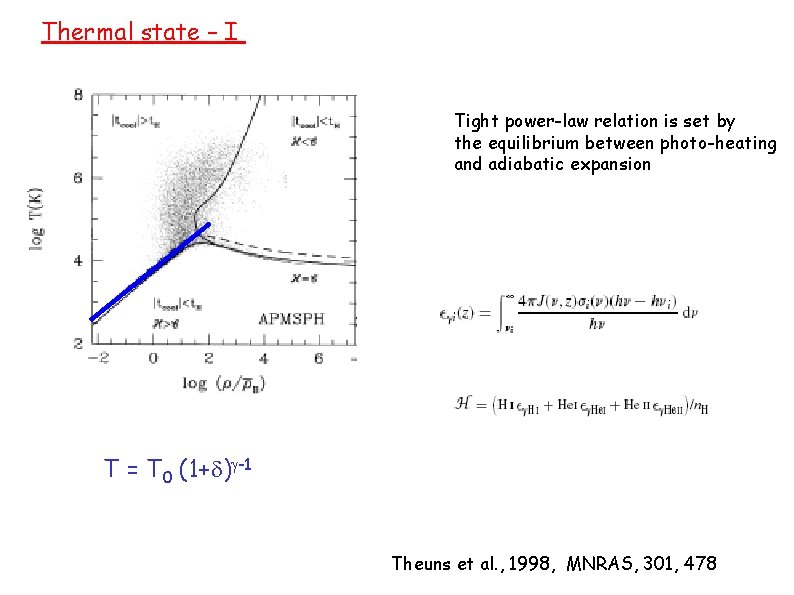
Thermal state – I Tight power-law relation is set by the equilibrium between photo-heating and adiabatic expansion T = T 0 (1+d)g-1 Theuns et al. , 1998, MNRAS, 301, 478
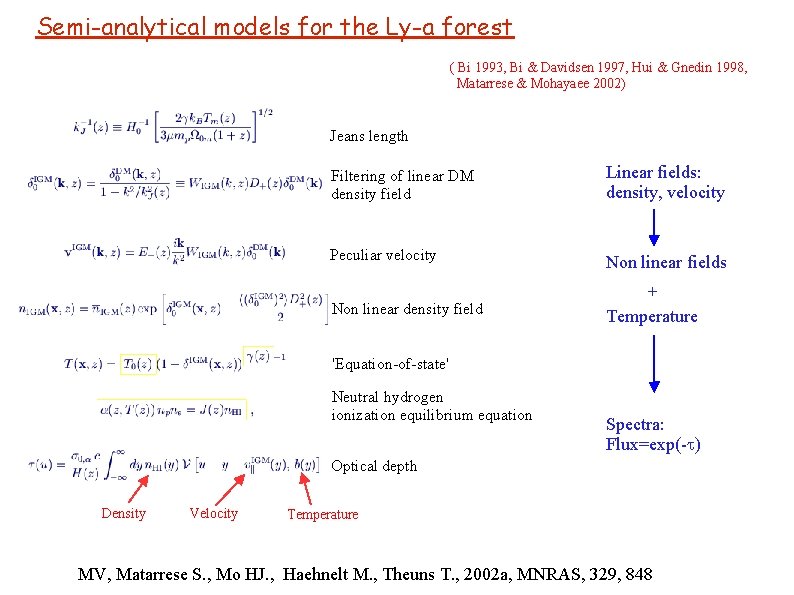
Semi-analytical models for the Ly-a forest ( Bi 1993, Bi & Davidsen 1997, Hui & Gnedin 1998, Matarrese & Mohayaee 2002) Jeans length Filtering of linear DM density field Linear fields: density, velocity Peculiar velocity Non linear fields Non linear density field + Temperature 'Equation-of-state' Neutral hydrogen ionization equilibrium equation Spectra: Flux=exp(-t) Optical depth Density Velocity Temperature MV, Matarrese S. , Mo HJ. , Haehnelt M. , Theuns T. , 2002 a, MNRAS, 329, 848
END OF IGM BASICS More in Meiksin review 2007 ar. Xiv: 0711. 3358
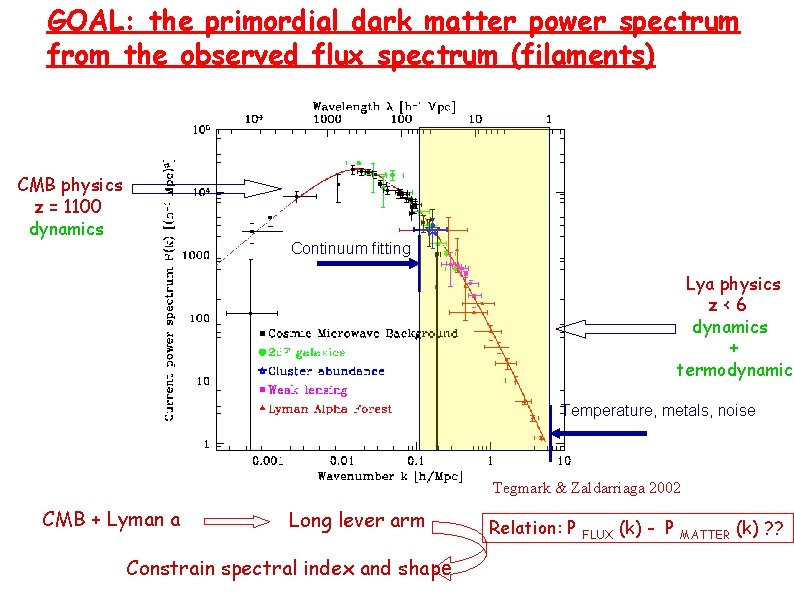
GOAL: the primordial dark matter power spectrum from the observed flux spectrum (filaments) CMB physics z = 1100 dynamics Continuum fitting Lya physics z<6 dynamics + termodynamics Temperature, metals, noise Tegmark & Zaldarriaga 2002 CMB + Lyman a Long lever arm Constrain spectral index and shape Relation: P FLUX (k) - P MATTER (k) ? ?
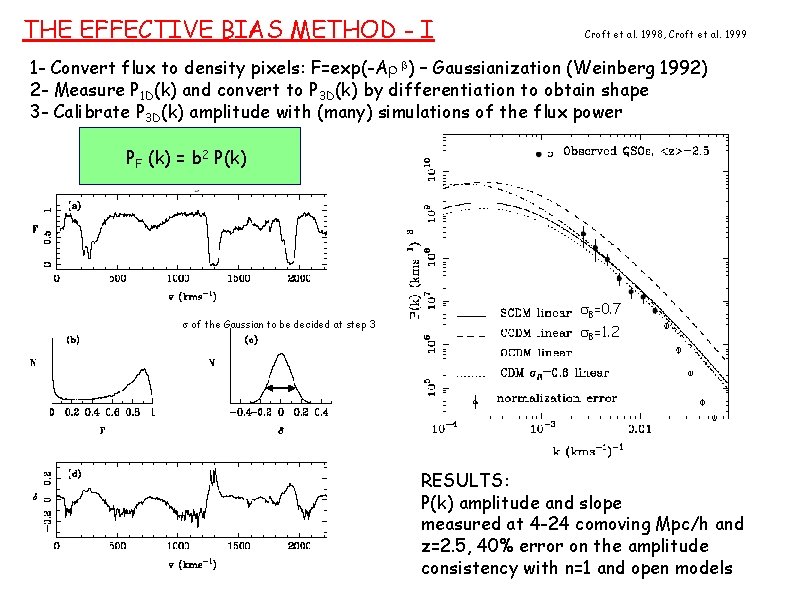
THE EFFECTIVE BIAS METHOD - I Croft et al. 1998, Croft et al. 1999 1 - Convert flux to density pixels: F=exp(-Ar b) – Gaussianization (Weinberg 1992) 2 - Measure P 1 D(k) and convert to P 3 D(k) by differentiation to obtain shape 3 - Calibrate P 3 D(k) amplitude with (many) simulations of the flux power PF (k) = b 2 P(k) s of the Gaussian to be decided at step 3 s 8=0. 7 s 8=1. 2 RESULTS: P(k) amplitude and slope measured at 4 -24 comoving Mpc/h and z=2. 5, 40% error on the amplitude consistency with n=1 and open models
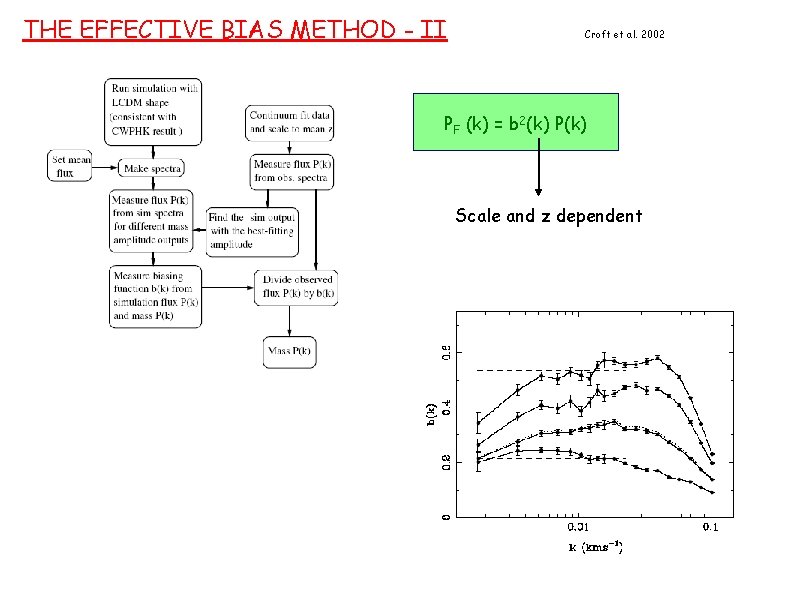
THE EFFECTIVE BIAS METHOD - II Croft et al. 2002 PF (k) = b 2(k) P(k) Scale and z dependent
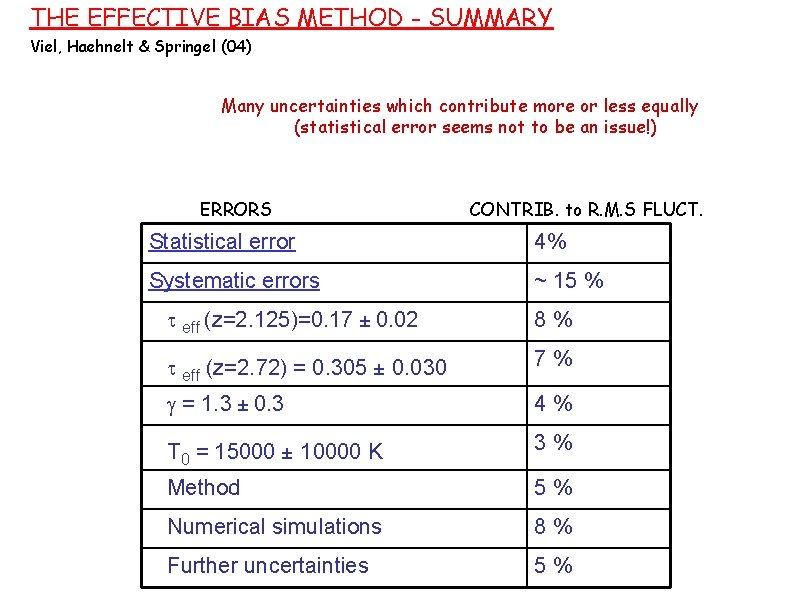
THE EFFECTIVE BIAS METHOD - SUMMARY Viel, Haehnelt & Springel (04) Many uncertainties which contribute more or less equally (statistical error seems not to be an issue!) ERRORS CONTRIB. to R. M. S FLUCT. Statistical error 4% Systematic errors ~ 15 % t eff (z=2. 125)=0. 17 ± 0. 02 8% t eff (z=2. 72) = 0. 305 ± 0. 030 7% g = 1. 3 ± 0. 3 4% T 0 = 15000 ± 10000 K 3% Method 5% Numerical simulations 8% Further uncertainties 5%
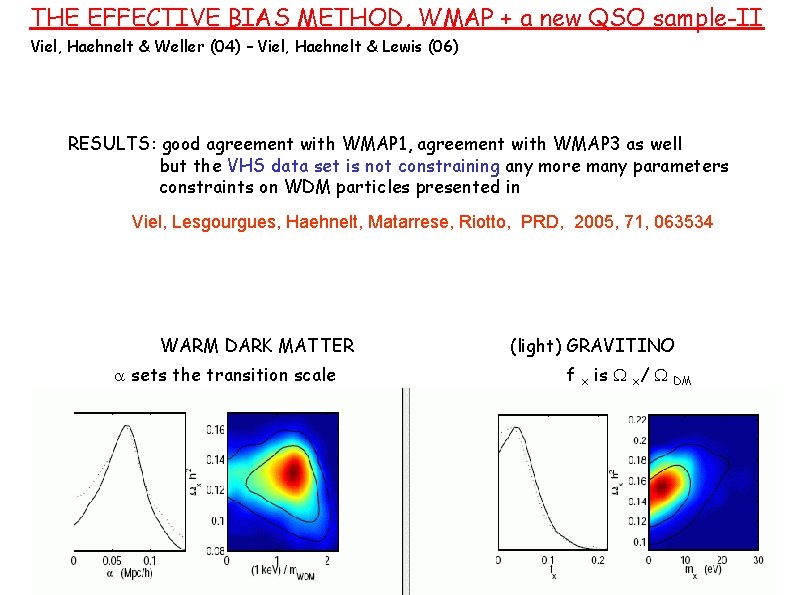
THE EFFECTIVE BIAS METHOD, WMAP + a new QSO sample-II Viel, Haehnelt & Weller (04) – Viel, Haehnelt & Lewis (06) RESULTS: good agreement with WMAP 1, agreement with WMAP 3 as well but the VHS data set is not constraining any more many parameters constraints on WDM particles presented in Viel, Lesgourgues, Haehnelt, Matarrese, Riotto, PRD, 2005, 71, 063534 WARM DARK MATTER a sets the transition scale (light) GRAVITINO f x is W x/ W DM
FORWARD MODELLING OF THE FLUX POWER
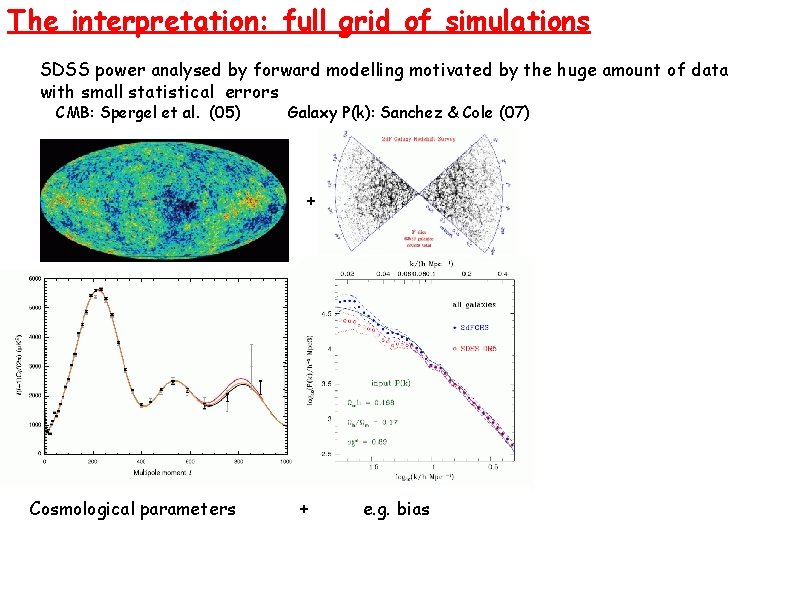
The interpretation: full grid of simulations SDSS power analysed by forward modelling motivated by the huge amount of data with small statistical errors CMB: Spergel et al. (05) Galaxy P(k): Sanchez & Cole (07) + Flux Power: Mc. Donald (05) + 132 data points Cosmological parameters + e. g. bias + Parameters describing IGM physics
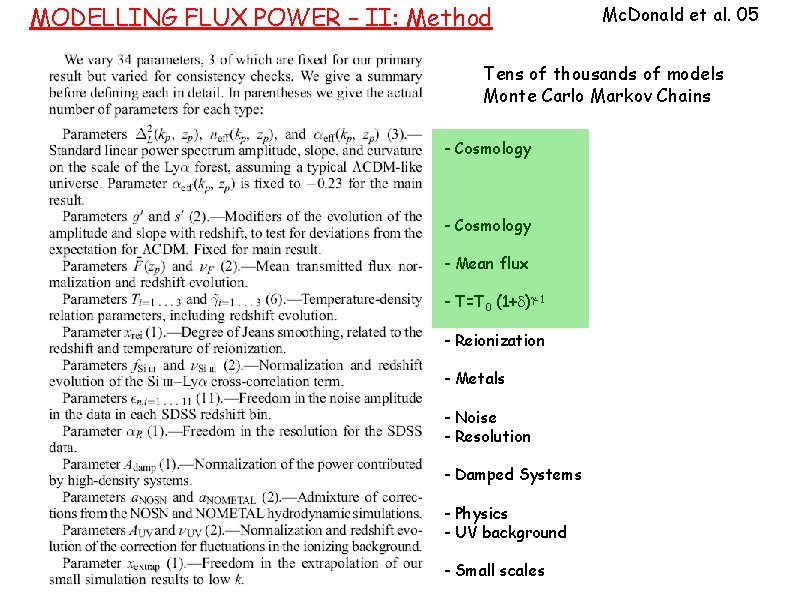
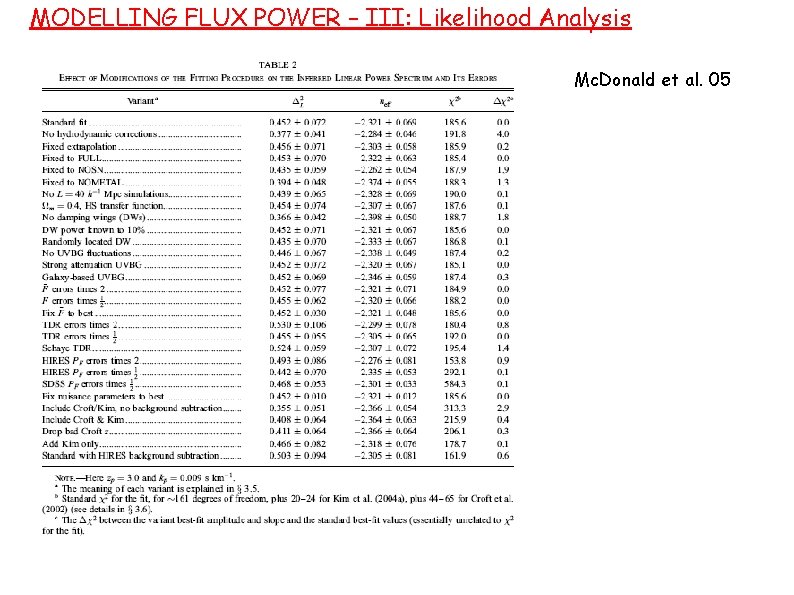
MODELLING FLUX POWER – II: Method Mc. Donald et al. 05 Tens of thousands of models Monte Carlo Markov Chains - Cosmology - Mean flux - T=T 0 (1+d)g-1 - Reionization - Metals - Noise - Resolution - Damped Systems - Physics - UV background - Small scales
MODELLING FLUX POWER – III: Likelihood Analysis Mc. Donald et al. 05
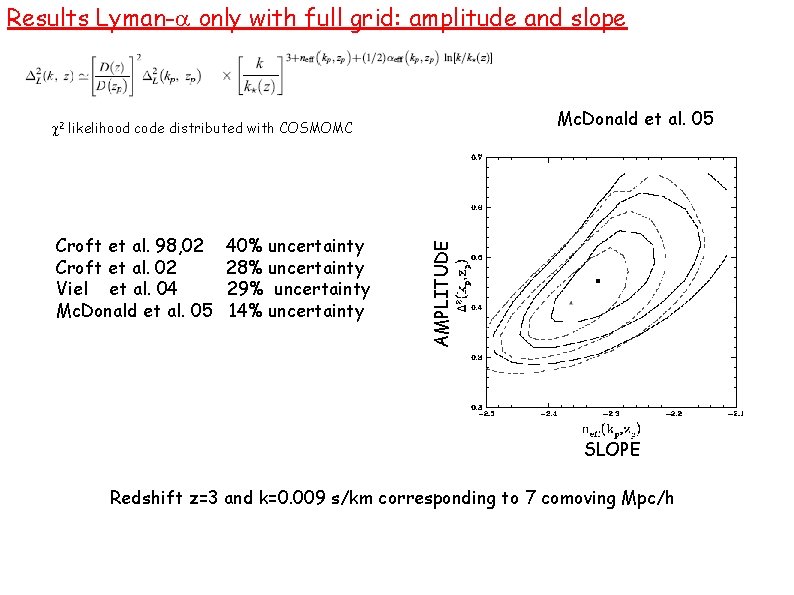
Results Lyman-a only with full grid: amplitude and slope Mc. Donald et al. 05 Croft et al. 98, 02 Croft et al. 02 Viel et al. 04 Mc. Donald et al. 05 40% uncertainty 28% uncertainty 29% uncertainty 14% uncertainty AMPLITUDE c 2 likelihood code distributed with COSMOMC SLOPE Redshift z=3 and k=0. 009 s/km corresponding to 7 comoving Mpc/h
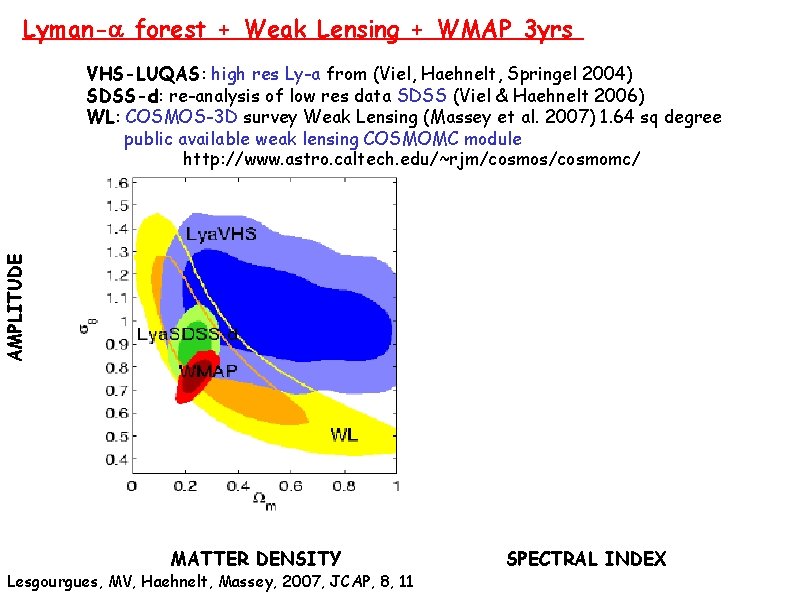
Lyman-a forest + Weak Lensing + WMAP 3 yrs AMPLITUDE VHS-LUQAS: high res Ly-a from (Viel, Haehnelt, Springel 2004) SDSS-d: re-analysis of low res data SDSS (Viel & Haehnelt 2006) WL: COSMOS-3 D survey Weak Lensing (Massey et al. 2007) 1. 64 sq degree public available weak lensing COSMOMC module http: //www. astro. caltech. edu/~rjm/cosmos/cosmomc/ VHS+WMAP 1 MATTER DENSITY Lesgourgues, MV, Haehnelt, Massey, 2007, JCAP, 8, 11 SPECTRAL INDEX
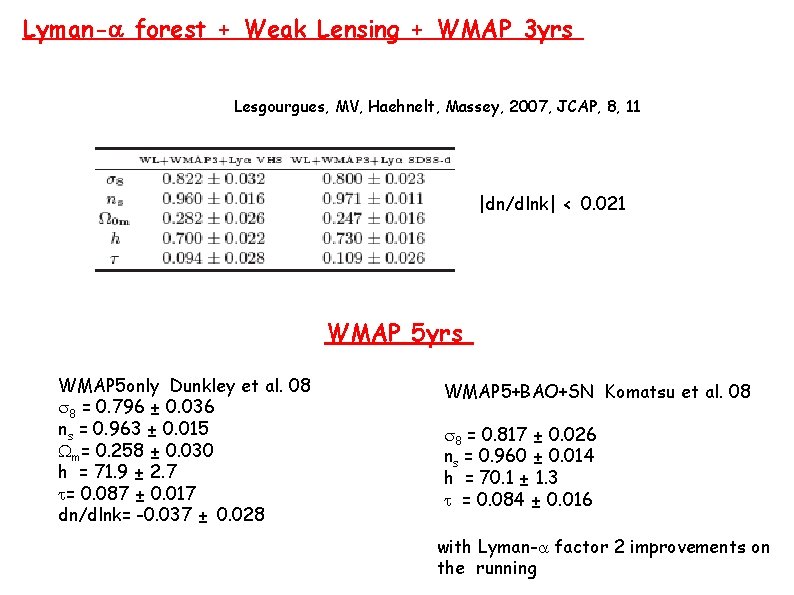
Lyman-a forest + Weak Lensing + WMAP 3 yrs Lesgourgues, MV, Haehnelt, Massey, 2007, JCAP, 8, 11 |dn/dlnk| < 0. 021 WMAP 5 yrs WMAP 5 only Dunkley et al. 08 s 8 = 0. 796 ± 0. 036 ns = 0. 963 ± 0. 015 Wm= 0. 258 ± 0. 030 h = 71. 9 ± 2. 7 t= 0. 087 ± 0. 017 dn/dlnk= -0. 037 ± 0. 028 WMAP 5+BAO+SN Komatsu et al. 08 s 8 = 0. 817 ± 0. 026 ns = 0. 960 ± 0. 014 h = 70. 1 ± 1. 3 t = 0. 084 ± 0. 016 with Lyman-a factor 2 improvements on the running
FORWARD MODELLING OF THE FLUX POWER: A DIFFERENT APPROACH
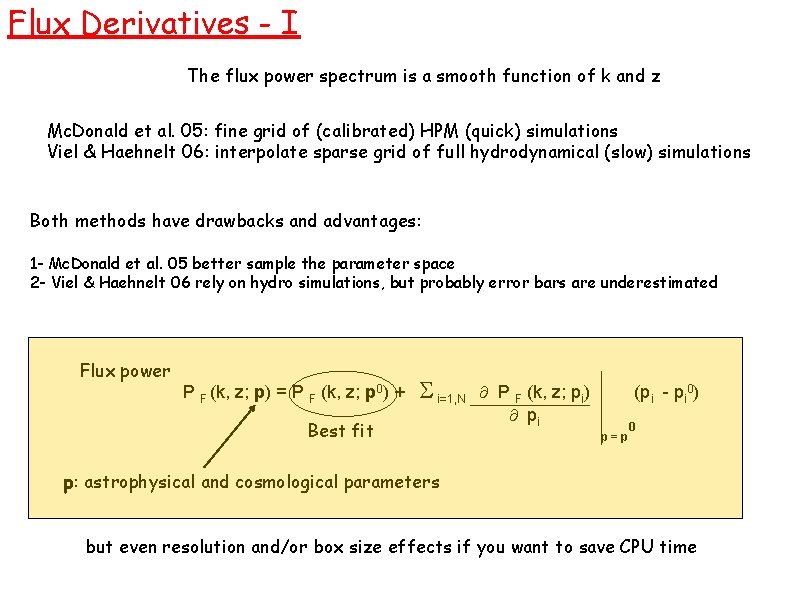
Flux Derivatives - I The flux power spectrum is a smooth function of k and z Mc. Donald et al. 05: fine grid of (calibrated) HPM (quick) simulations Viel & Haehnelt 06: interpolate sparse grid of full hydrodynamical (slow) simulations Both methods have drawbacks and advantages: 1 - Mc. Donald et al. 05 better sample the parameter space 2 - Viel & Haehnelt 06 rely on hydro simulations, but probably error bars are underestimated Flux power P F (k, z; p) = P F (k, z; p 0) + S i=1, N Best fit P F (k, z; pi) pi (pi - pi 0) 0 p=p p: astrophysical and cosmological parameters but even resolution and/or box size effects if you want to save CPU time
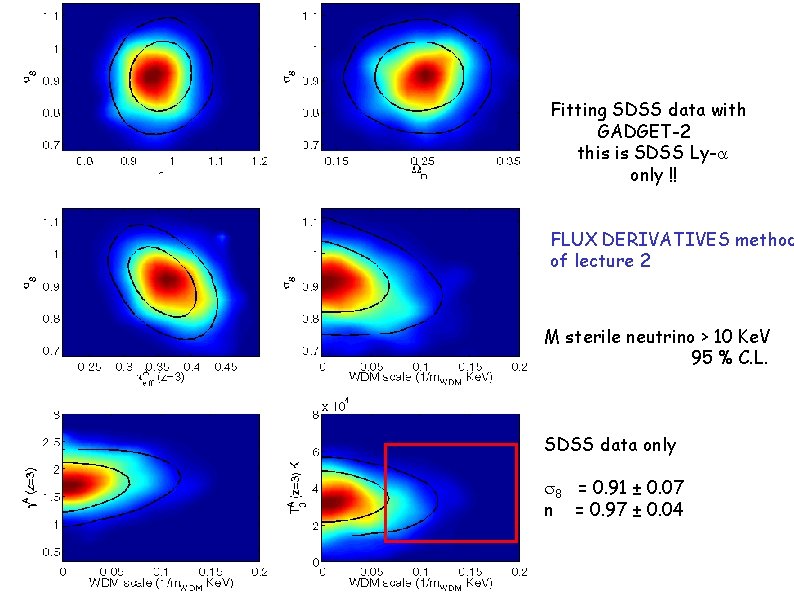
Fitting SDSS data with GADGET-2 this is SDSS Ly-a only !! FLUX DERIVATIVES method of lecture 2 M sterile neutrino > 10 Ke. V 95 % C. L. SDSS data only s 8 = 0. 91 ± 0. 07 n = 0. 97 ± 0. 04
SOME RECENT RESULTS
RESULTS WARM DARK MATTER Or if you prefer. . How cold is cold dark matter?
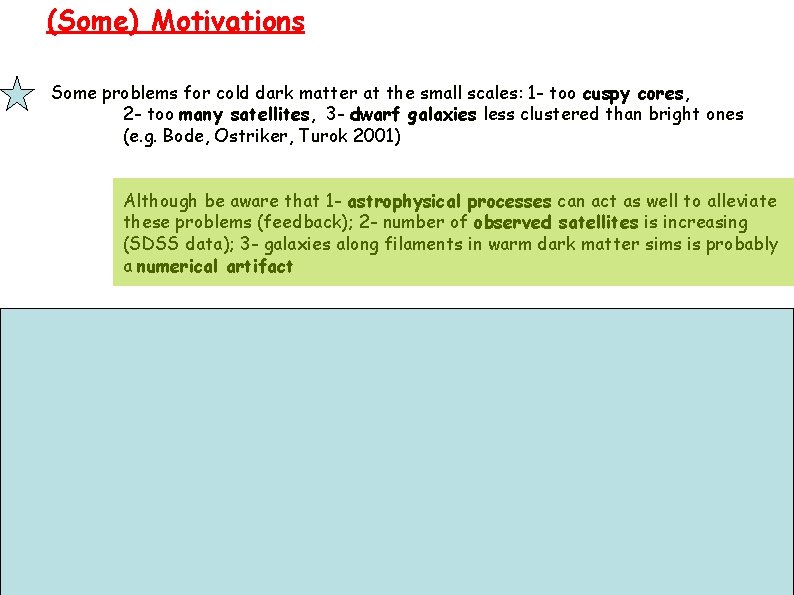
(Some) Motivations Some problems for cold dark matter at the small scales: 1 - too cuspy cores, 2 - too many satellites, 3 - dwarf galaxies less clustered than bright ones (e. g. Bode, Ostriker, Turok 2001) Although be aware that 1 - astrophysical processes can act as well to alleviate these problems (feedback); 2 - number of observed satellites is increasing (SDSS data); 3 - galaxies along filaments in warm dark matter sims is probably a numerical artifact Minimal extension of the Standard Model for particle physics that accommodates neutrino oscillations naturally Hints of a sterile sector: LSND experiment prefers a sterile neutrino m n < 1 e. V but Lyman-a data m n < 0. 26 e. V and best fit N eff (active) = 5. 3 The LSND result has just been rejected by Mini. Boone Although be aware that LSND results are controversial and that Lyman-a data that wish to probe the sube. V limits are prone to systematic effects
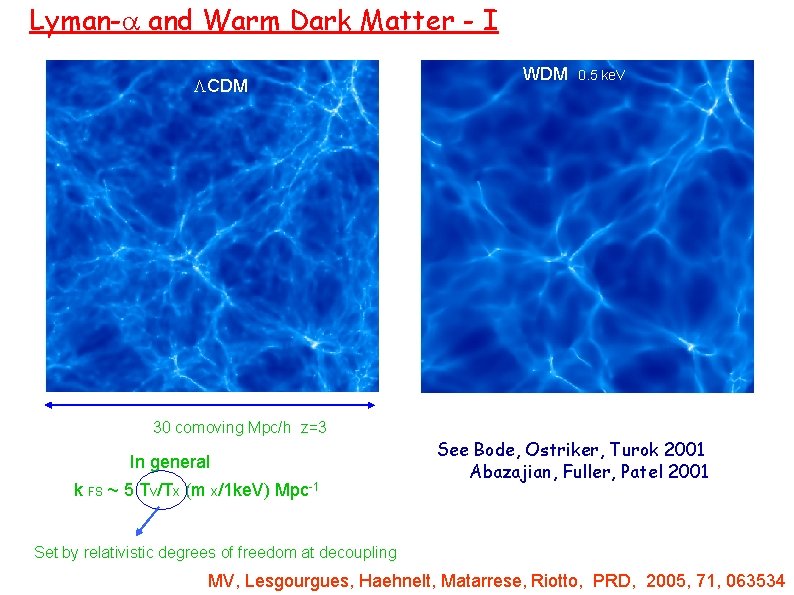
Lyman-a and Warm Dark Matter - I LCDM 30 comoving Mpc/h z=3 In general k FS ~ 5 Tv/Tx (m x/1 ke. V) Mpc-1 WDM 0. 5 ke. V See Bode, Ostriker, Turok 2001 Abazajian, Fuller, Patel 2001 Set by relativistic degrees of freedom at decoupling MV, Lesgourgues, Haehnelt, Matarrese, Riotto, PRD, 2005, 71, 063534
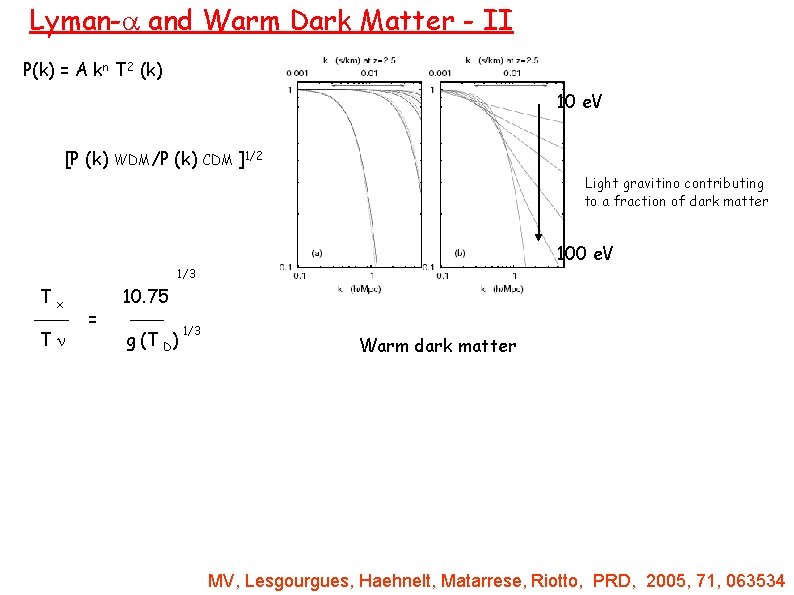
Lyman-a and Warm Dark Matter - II P(k) = A kn T 2 (k) [P (k) WDM/P LCDM (k) 10 e. V CDM ]1/2 Light gravitino contributing to a fraction of dark matter 100 e. V 1/3 Tx Tn = 10. 75 g (T D) 1/3 Warm dark matter MV, Lesgourgues, Haehnelt, Matarrese, Riotto, PRD, 2005, 71, 063534
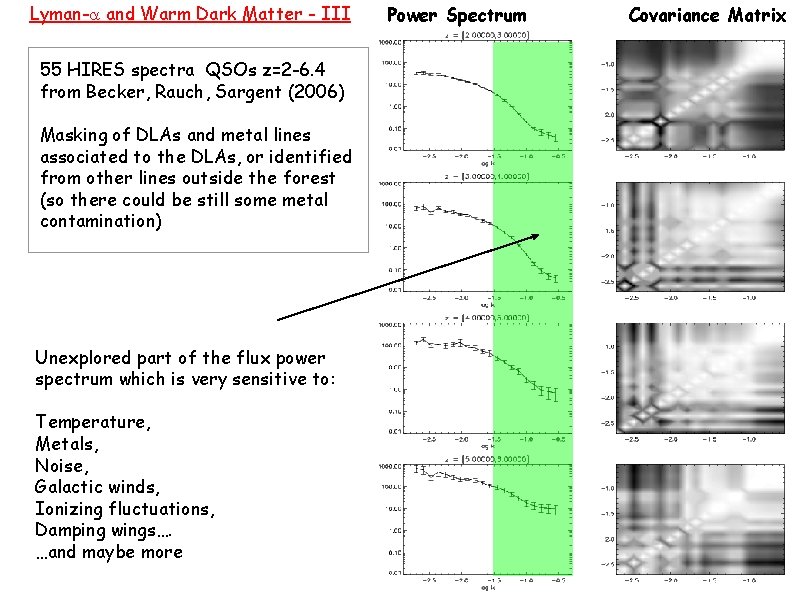
Lyman-a and Warm Dark Matter - III 55 HIRES spectra QSOs z=2 -6. 4 from Becker, Rauch, Sargent (2006) Masking of DLAs and metal lines associated to the DLAs, or identified from other lines outside the forest (so there could be still some metal contamination) Unexplored part of the flux power spectrum which is very sensitive to: Temperature, Metals, Noise, Galactic winds, Ionizing fluctuations, Damping wings…. …and maybe more Power Spectrum Covariance Matrix
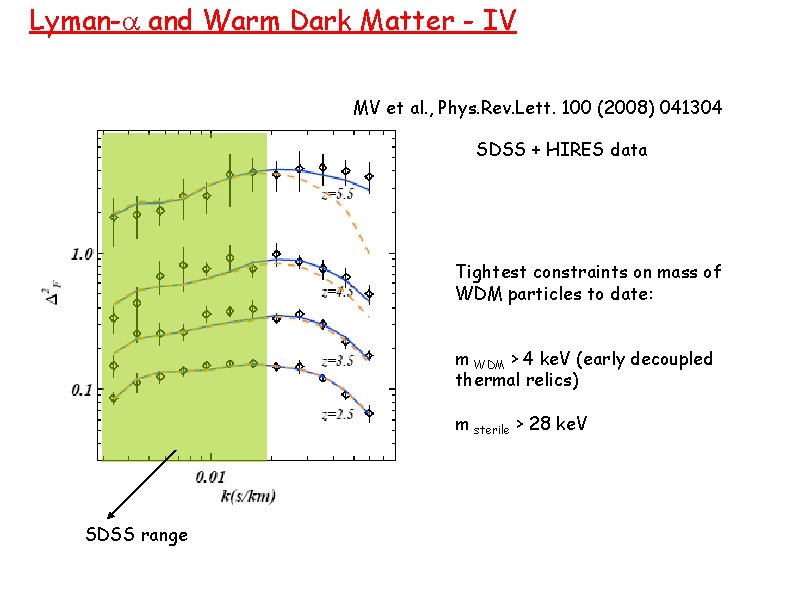
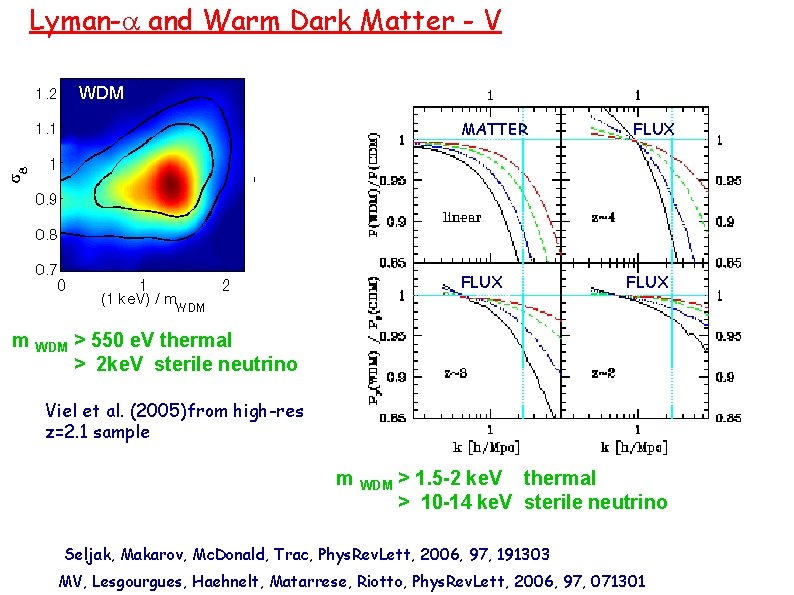
Lyman-a and Warm Dark Matter - IV MV et al. , Phys. Rev. Lett. 100 (2008) 041304 SDSS + HIRES data Tightest constraints on mass of WDM particles to date: m WDM > 4 ke. V (early decoupled thermal relics) m sterile > 28 ke. V SDSS range
Lyman-a and Warm Dark Matter - V WDM LCWDM (gravitinos) MATTER FLUX neutrinos FLUX m WDM > 550 e. V thermal > 2 ke. V sterile neutrino Viel et al. (2005)from high-res z=2. 1 sample m WDM > 1. 5 -2 ke. V thermal > 10 -14 ke. V sterile neutrino Seljak, Makarov, Mc. Donald, Trac, Phys. Rev. Lett, 2006, 97, 191303 MV, Lesgourgues, Haehnelt, Matarrese, Riotto, Phys. Rev. Lett, 2006, 97, 071301
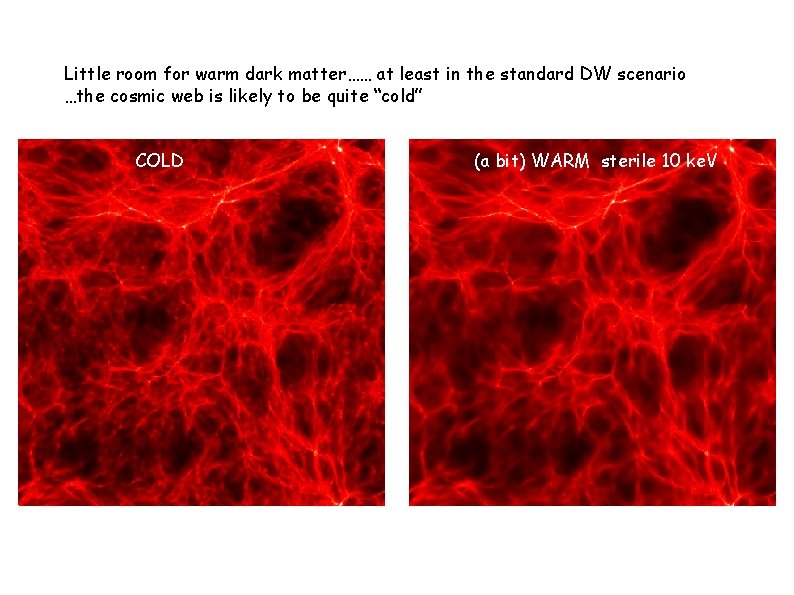
Little room for warm dark matter…… at least in the standard DW scenario …the cosmic web is likely to be quite “cold” COLD (a bit) WARM sterile 10 ke. V
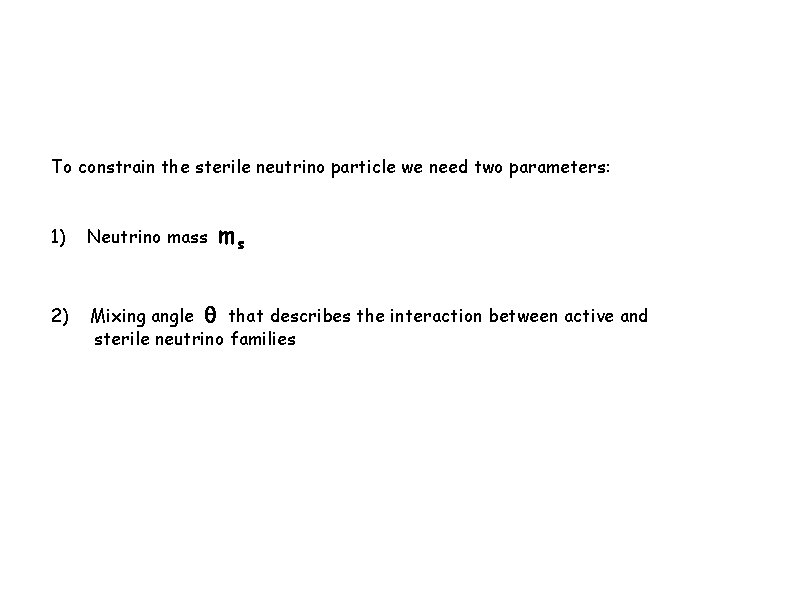
To constrain the sterile neutrino particle we need two parameters: ms 1) Neutrino mass 2) Mixing angle q that describes the interaction between active and sterile neutrino families
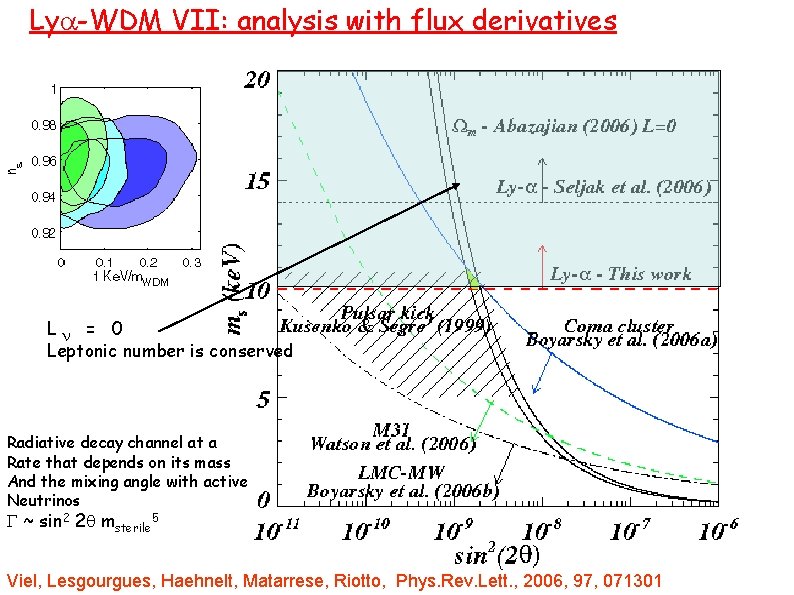
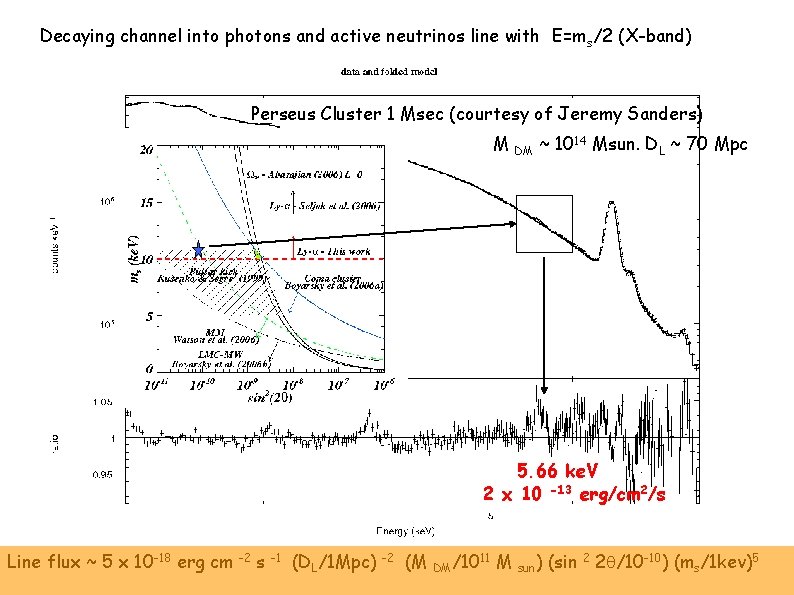
Lya-WDM VII: analysis with flux derivatives z < 4. 2 z < 3. 8 Ln = 0 Leptonic number is conserved Radiative decay channel at a Rate that depends on its mass And the mixing angle with active Neutrinos G ~ sin 2 2 q msterile 5 Viel, Lesgourgues, Haehnelt, Matarrese, Riotto, Phys. Rev. Lett. , 2006, 97, 071301
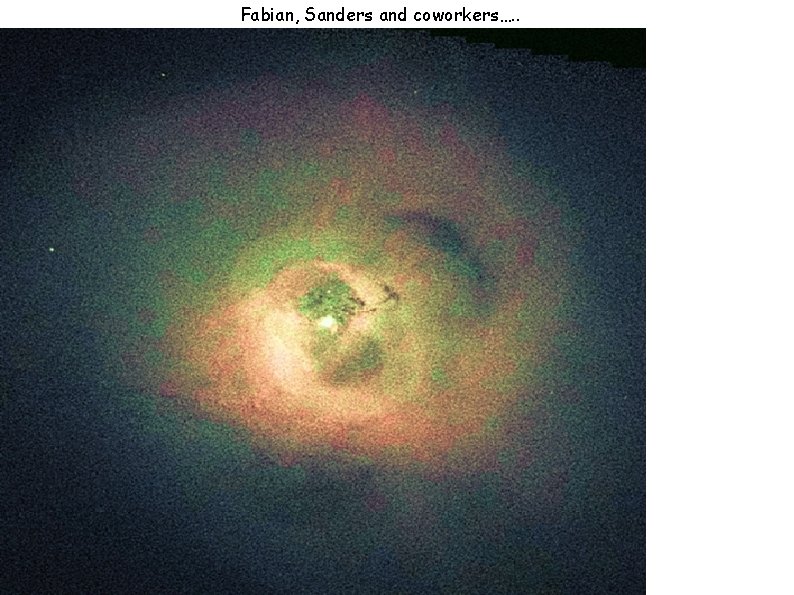
Fabian, Sanders and coworkers…. .
Decaying channel into photons and active neutrinos line with E=m s/2 (X-band) Perseus Cluster 1 Msec (courtesy of Jeremy Sanders) M DM ~ 1014 Msun. DL ~ 70 Mpc 5. 66 ke. V 2 x 10 -13 erg/cm 2/s Line flux ~ 5 x 10 -18 erg cm -2 s -1 (DL/1 Mpc) -2 (M DM/10 11 M sun) (sin 2 2 q/10 -10) (ms/1 kev)5
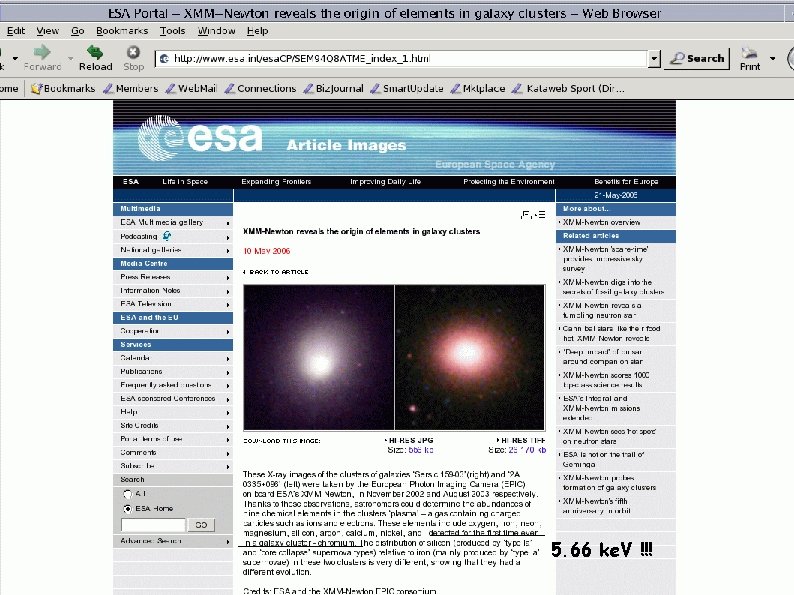
5. 66 ke. V !!!
DE line = v virial E /c ~ 50 e. V for a galaxy cluster 5 e. V for a galaxy for E=5 ke. V Note that the EDGE Low Energy Telescope will be at < 3(1. 6) ke. V with a resolution of 1 e. V So if the sterile neutrino is more massive than 10 ke. V it might not be seen by EDGE DE Xraybackground ~E SENSITIVITY of DETECTION ~ 1/ √(D E), √(A eff), √ FOV, Note that both clusters and dwarf galaxies are about 1 deg 2 in the sky having a larger field of view will not improve things dramatically See Boyarsky, den Herder, Neronov, Ruchayskiy, 2006, astro-ph/0612219
RESULTS NEUTRINOS
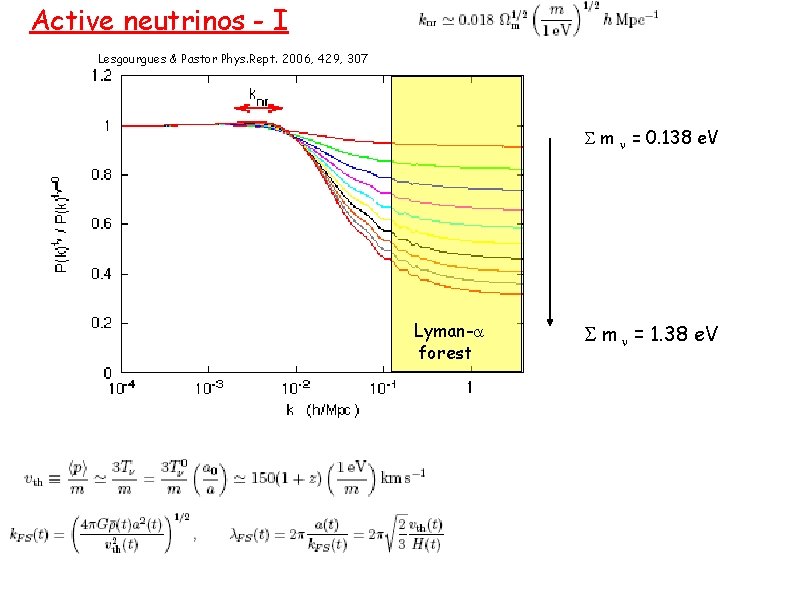
Active neutrinos - I Lesgourgues & Pastor Phys. Rept. 2006, 429, 307 S m n = 0. 138 e. V Lyman-a forest S m n = 1. 38 e. V
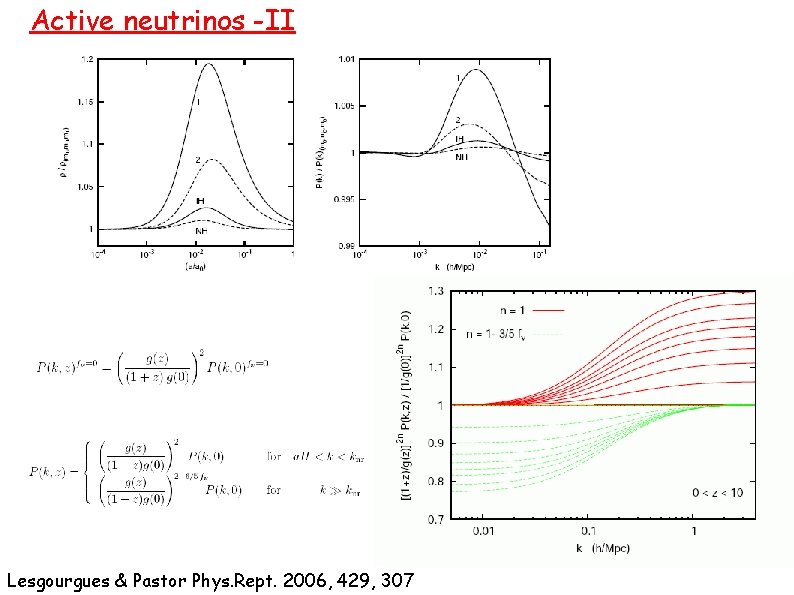
Active neutrinos -II Lesgourgues & Pastor Phys. Rept. 2006, 429, 307
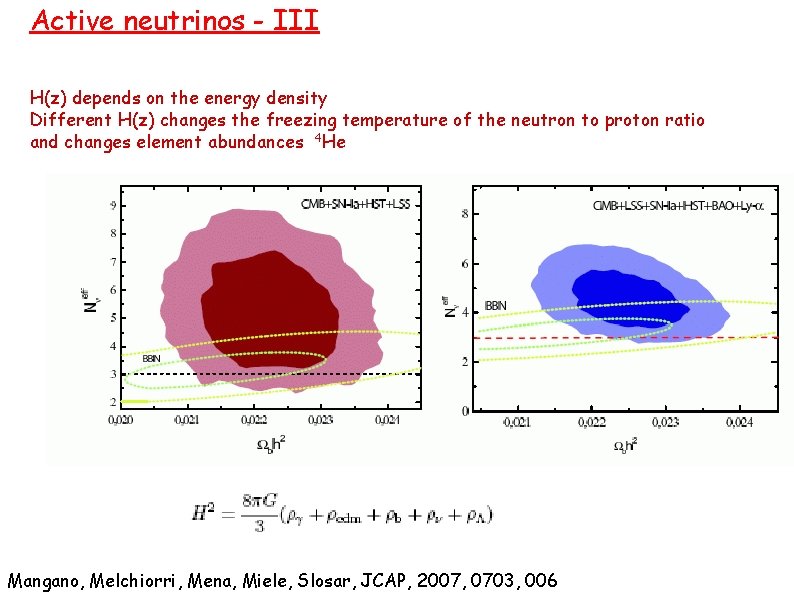
Active neutrinos - III H(z) depends on the energy density Different H(z) changes the freezing temperature of the neutron to proton ratio and changes element abundances 4 He Mangano, Melchiorri, Mena, Miele, Slosar, JCAP, 2007, 0703, 006
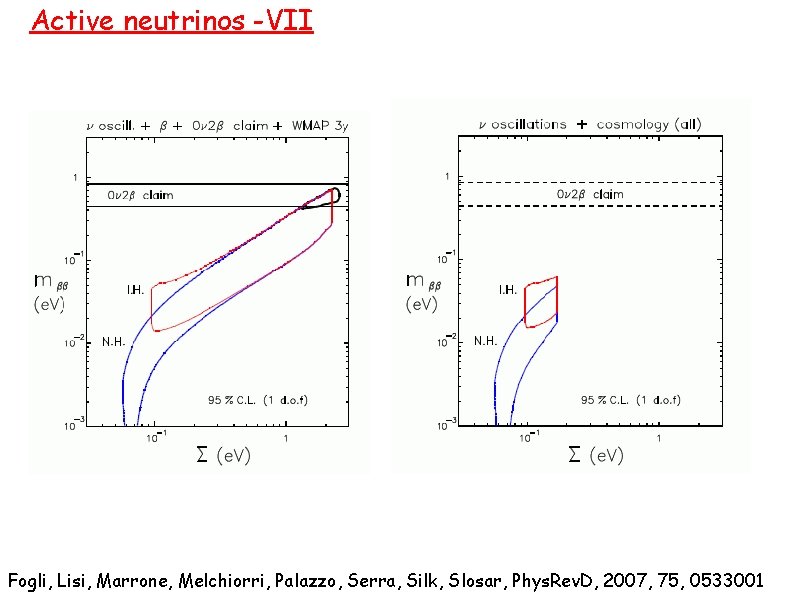
Active neutrinos -VII Fogli, Lisi, Marrone, Melchiorri, Palazzo, Serra, Silk, Slosar, Phys. Rev. D, 2007, 75, 0533001
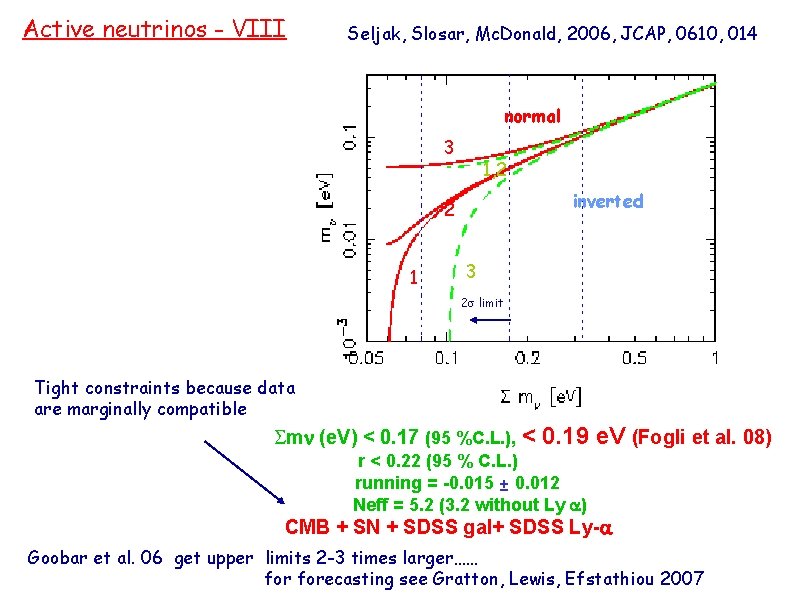
Active neutrinos - VIII Seljak, Slosar, Mc. Donald, 2006, JCAP, 0610, 014 normal 3 1, 2 inverted 2 1 3 2 s limit Tight constraints because data are marginally compatible Smn (e. V) < 0. 17 (95 %C. L. ), < 0. 19 e. V (Fogli et al. 08) r < 0. 22 (95 % C. L. ) running = -0. 015 ± 0. 012 Neff = 5. 2 (3. 2 without Ly a) CMB + SN + SDSS gal+ SDSS Ly-a Goobar et al. 06 get upper limits 2 -3 times larger…… forecasting see Gratton, Lewis, Efstathiou 2007
SUMMARY
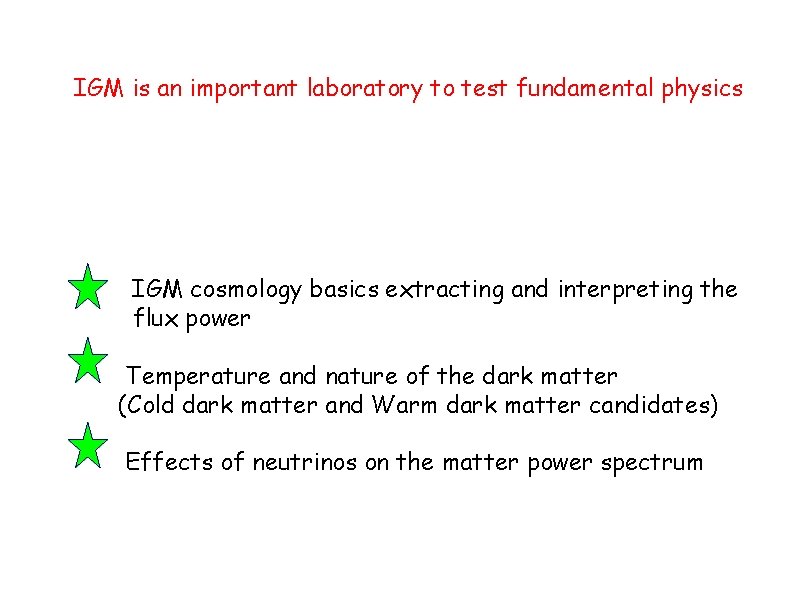
IGM is an important laboratory to test fundamental physics IGM cosmology basics extracting and interpreting the flux power Temperature and nature of the dark matter (Cold dark matter and Warm dark matter candidates) Effects of neutrinos on the matter power spectrum