
Detector Geometry Working Group Summary Matteo Rama Achille
- Slides: 30
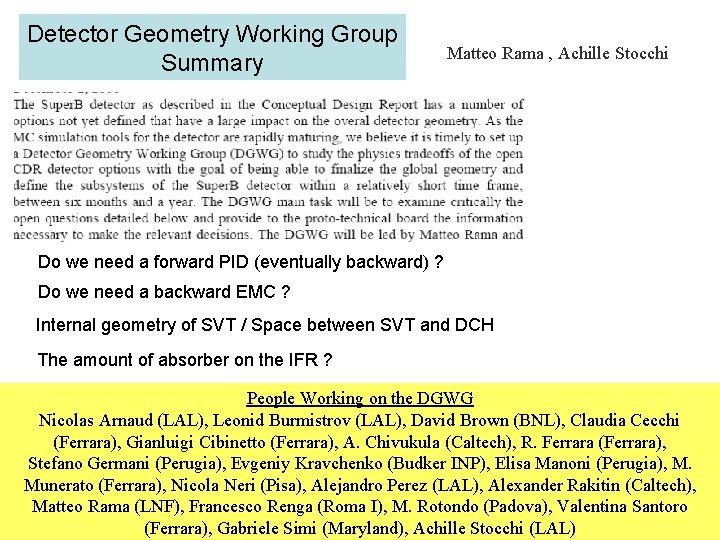
Detector Geometry Working Group Summary Matteo Rama , Achille Stocchi Do we need a forward PID (eventually backward) ? Do we need a backward EMC ? Internal geometry of SVT / Space between SVT and DCH The amount of absorber on the IFR ? People Working on the DGWG Nicolas Arnaud (LAL), Leonid Burmistrov (LAL), David Brown (BNL), Claudia Cecchi (Ferrara), Gianluigi Cibinetto (Ferrara), A. Chivukula (Caltech), R. Ferrara (Ferrara), Stefano Germani (Perugia), Evgeniy Kravchenko (Budker INP), Elisa Manoni (Perugia), M. Munerato (Ferrara), Nicola Neri (Pisa), Alejandro Perez (LAL), Alexander Rakitin (Caltech), Matteo Rama (LNF), Francesco Renga (Roma I), M. Rotondo (Padova), Valentina Santoro (Ferrara), Gabriele Simi (Maryland), Achille Stocchi (LAL)
Some results already obtained
Different configurations can be now used (available in Fast. Sim) Super. B++
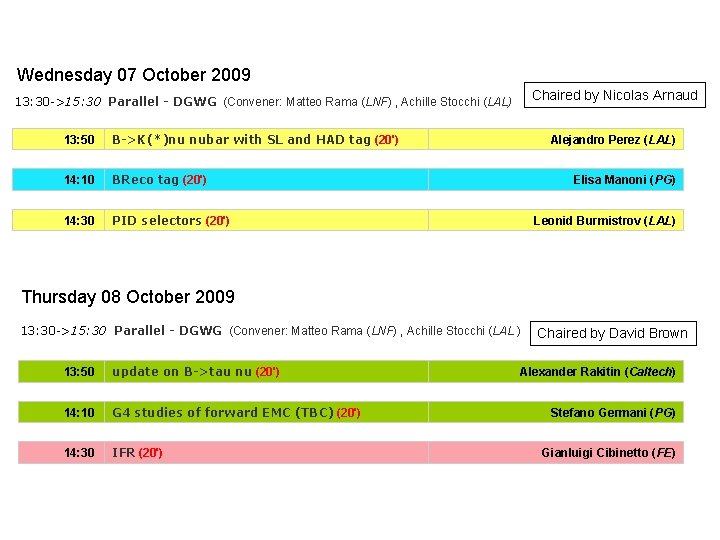
Wednesday 07 October 2009 Chaired by Nicolas Arnaud 13: 30 ->15: 30 Parallel - DGWG (Convener: Matteo Rama (LNF) , Achille Stocchi (LAL) 13: 50 B->K(*)nu nubar with SL and HAD tag (20') 14: 10 BReco tag (20') 14: 30 PID selectors (20') Alejandro Perez (LAL) Elisa Manoni (PG) Leonid Burmistrov (LAL) Thursday 08 October 2009 13: 30 ->15: 30 Parallel - DGWG (Convener: Matteo Rama (LNF) , Achille Stocchi (LAL ) 13: 50 update on B->tau nu (20') 14: 10 G 4 studies of forward EMC (TBC) (20') 14: 30 IFR (20') Chaired by David Brown Alexander Rakitin (Caltech) Stefano Germani (PG) Gianluigi Cibinetto (FE)
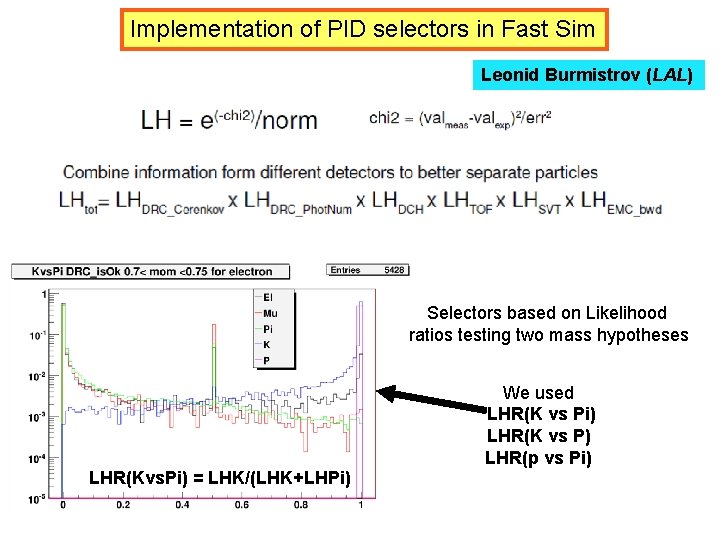
Implementation of PID selectors in Fast Sim Leonid Burmistrov (LAL) Selectors based on Likelihood ratios testing two mass hypotheses We used LHR(K vs Pi) LHR(K vs P) LHR(p vs Pi) LHR(Kvs. Pi) = LHK/(LHK+LHPi)
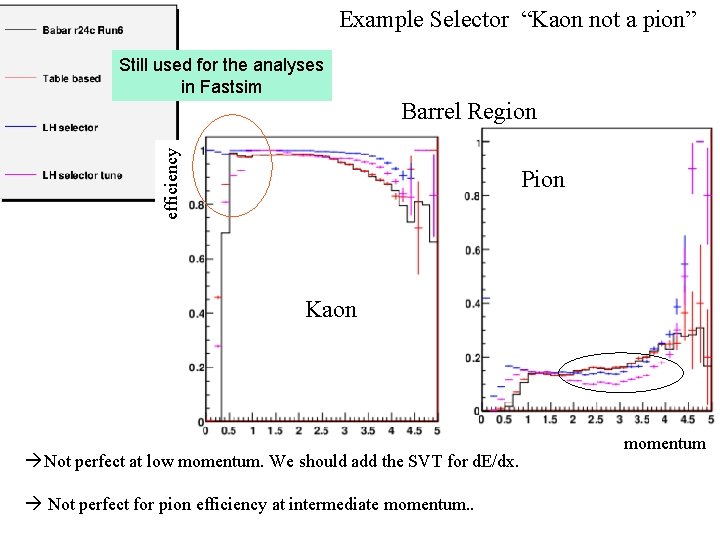
Example Selector “Kaon not a pion” Still used for the analyses in Fastsim efficiency Barrel Region Pion Kaon Not perfect at low momentum. We should add the SVT for d. E/dx. Not perfect for pion efficiency at intermediate momentum. . momentum
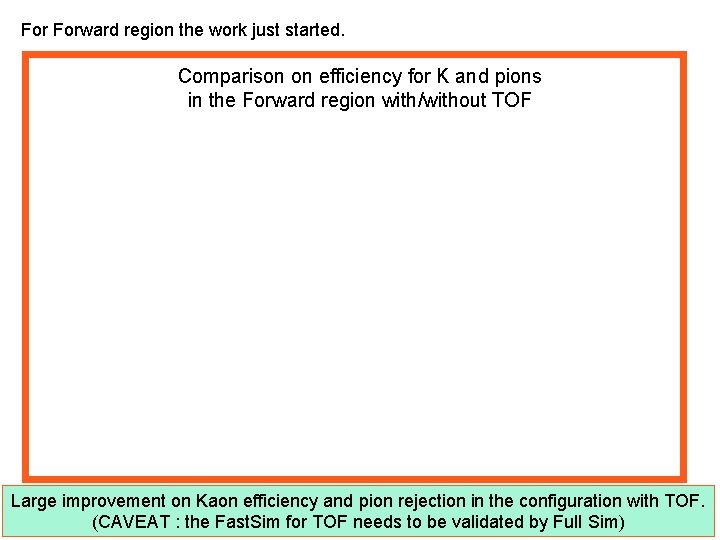
For Forward region the work just started. Comparison on efficiency for K and pions in the Forward region with/without TOF Large improvement on Kaon efficiency and pion rejection in the configuration with TOF. (CAVEAT : the Fast. Sim for TOF needs to be validated by Full Sim)
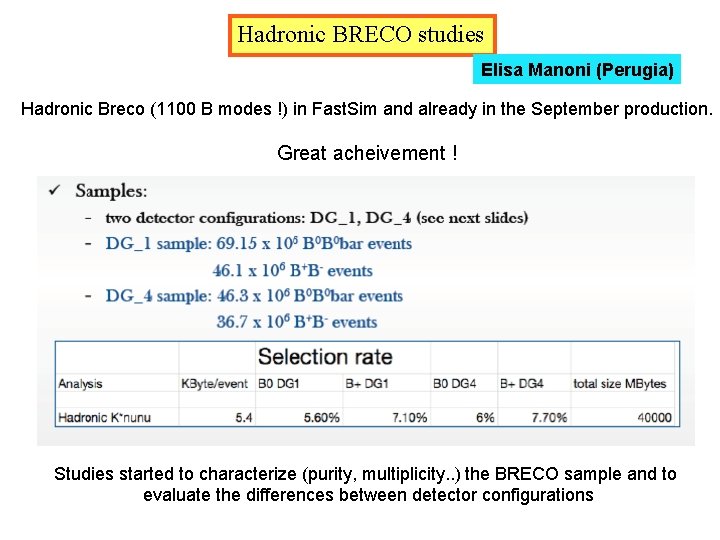
Hadronic BRECO studies Elisa Manoni (Perugia) Hadronic Breco (1100 B modes !) in Fast. Sim and already in the September production. Great acheivement ! Studies started to characterize (purity, multiplicity. . ) the BRECO sample and to evaluate the differences between detector configurations
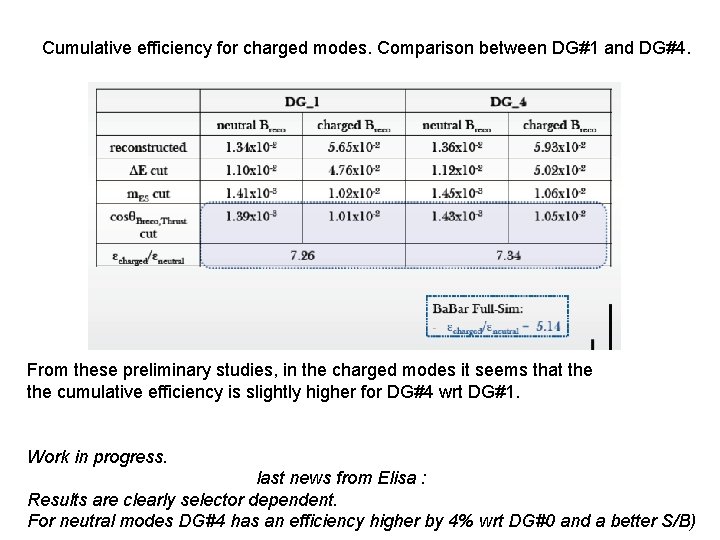
Cumulative efficiency for charged modes. Comparison between DG#1 and DG#4. From these preliminary studies, in the charged modes it seems that the cumulative efficiency is slightly higher for DG#4 wrt DG#1. Work in progress. last news from Elisa : Results are clearly selector dependent. For neutral modes DG#4 has an efficiency higher by 4% wrt DG#0 and a better S/B)
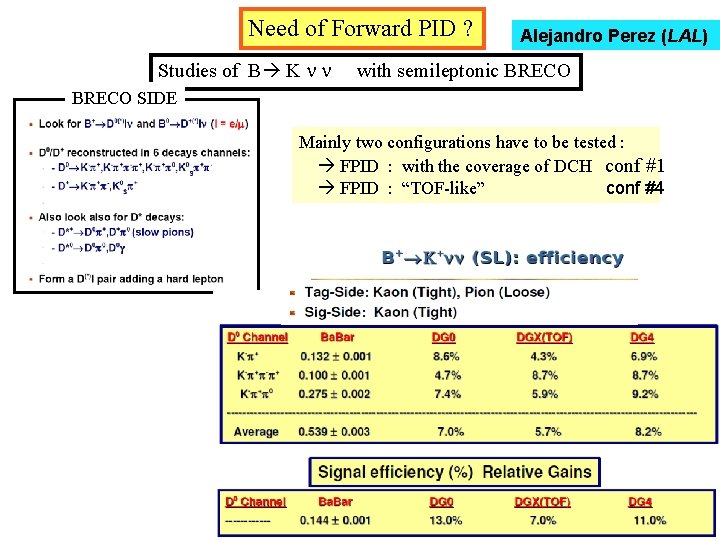
Need of Forward PID ? Alejandro Perez (LAL) Studies of B K n n with semileptonic BRECO SIDE Mainly two configurations have to be tested : FPID : with the coverage of DCH conf #1 FPID : “TOF-like” conf #4
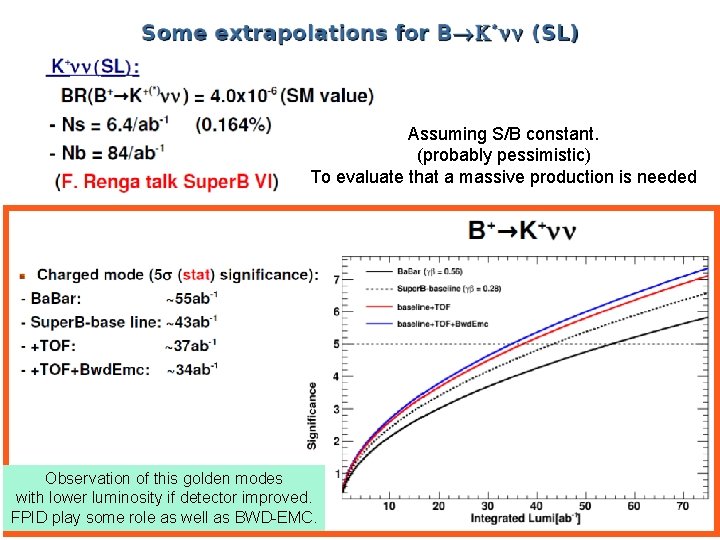
Assuming S/B constant. (probably pessimistic) To evaluate that a massive production is needed Observation of this golden modes with lower luminosity if detector improved. FPID play some role as well as BWD-EMC.
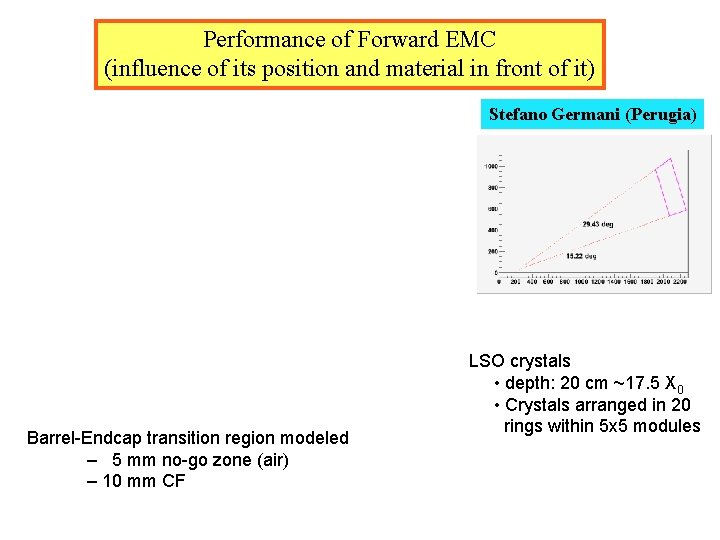
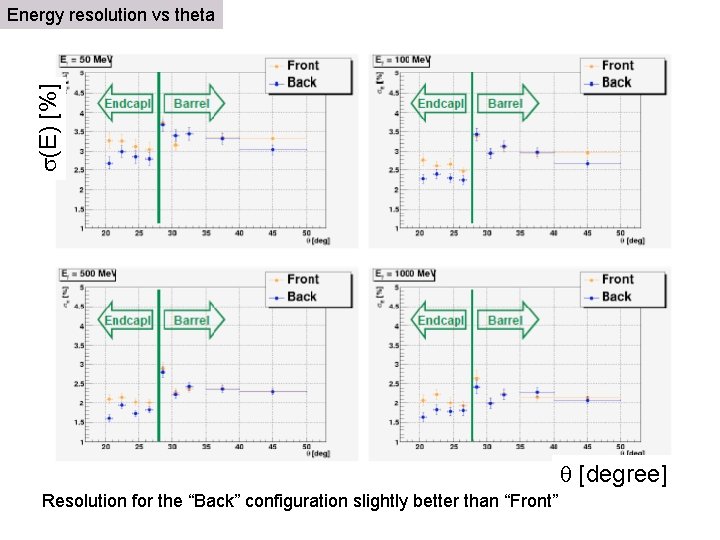
Performance of Forward EMC (influence of its position and material in front of it) Stefano Germani (Perugia) Barrel-Endcap transition region modeled – 5 mm no-go zone (air) – 10 mm CF LSO crystals • depth: 20 cm ~17. 5 X 0 • Crystals arranged in 20 rings within 5 x 5 modules
s(E) [%] Energy resolution vs theta q [degree] Resolution for the “Back” configuration slightly better than “Front”
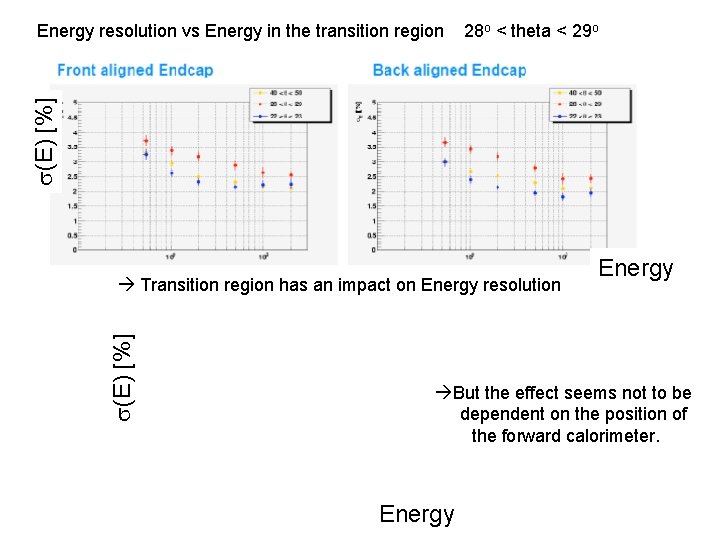
s(E) [%] Energy resolution vs Energy in the transition region 28 o < theta < 29 o s(E) [%] Transition region has an impact on Energy resolution Energy But the effect seems not to be dependent on the position of the forward calorimeter. Energy
s(E) [%] Forward PID material effect q [degree] The PID material in front of the calorimeter seems to have a non negligible effect on the energy resolution (to be kept <0. 3 X 0 ? ). More detailed analysis needed to quantify the max amount of “acceptable” X 0
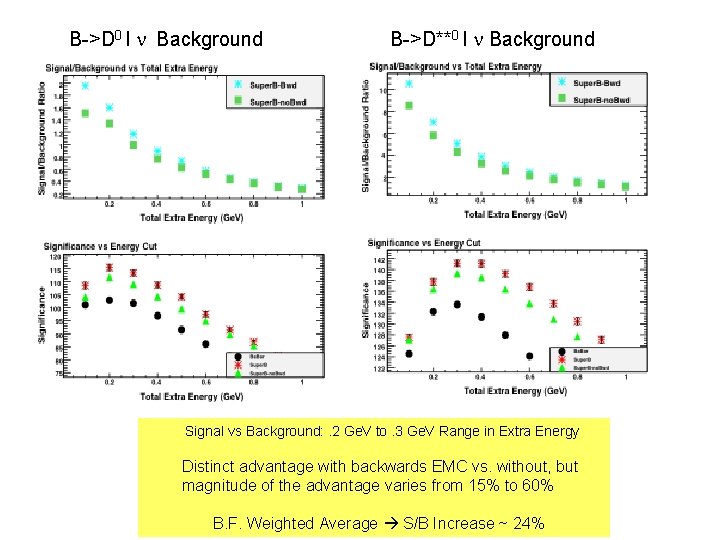
Performance of Backward EMC 1. Alexander Rakitin (Cal. Tech) Using B t n with hadronic BRECO analysis B+ D 0 p , D 0 K+ p- (simplest hadronic tag for the moment) St ud ied ! Many possible background :
B->D 0 l n Background B->D**0 l n Background Signal vs Background: . 2 Ge. V to. 3 Ge. V Range in Extra Energy Distinct advantage with backwards EMC vs. without, but magnitude of the advantage varies from 15% to 60% B. F. Weighted Average S/B Increase ~ 24%
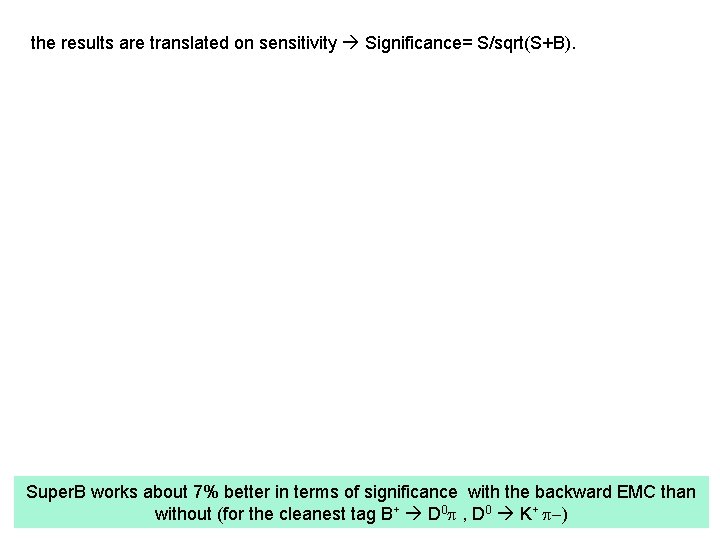
the results are translated on sensitivity Significance= S/sqrt(S+B). Super. B works about 7% better in terms of significance with the backward EMC than without (for the cleanest tag B+ D 0 p , D 0 K+ p-)
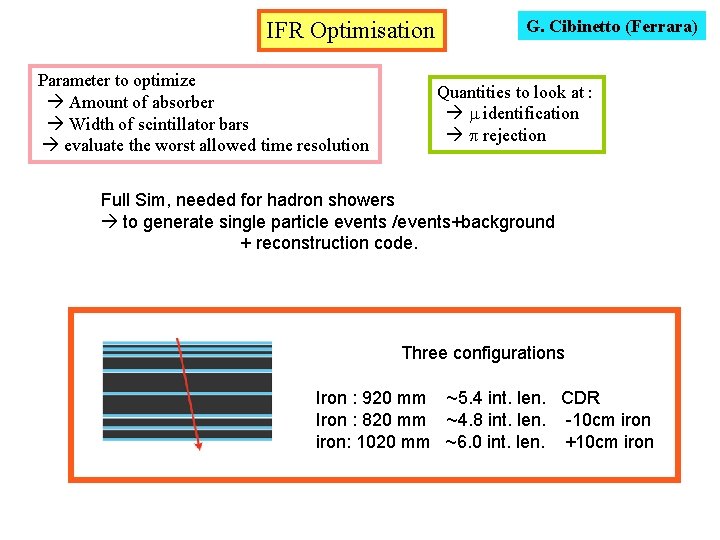
IFR Optimisation Parameter to optimize Amount of absorber Width of scintillator bars evaluate the worst allowed time resolution G. Cibinetto (Ferrara) Quantities to look at : m identification p rejection Full Sim, needed for hadron showers to generate single particle events /events+background + reconstruction code. Three configurations Iron : 920 mm ~5. 4 int. len. CDR Iron : 820 mm ~4. 8 int. len. -10 cm iron: 1020 mm ~6. 0 int. len. +10 cm iron
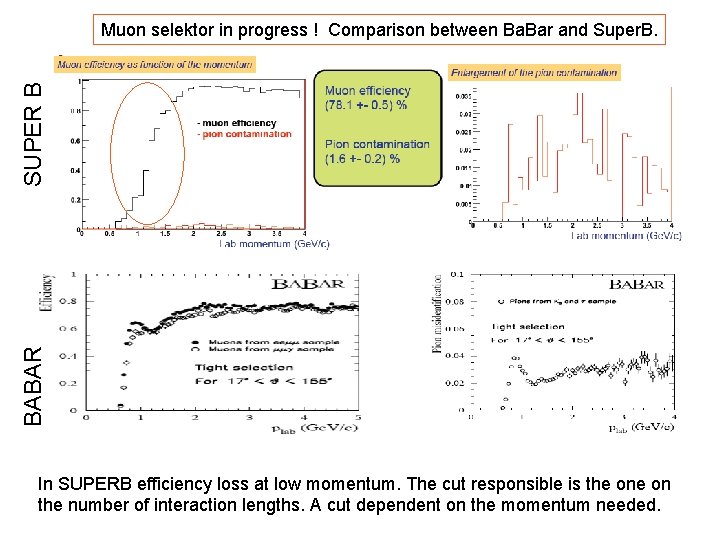
BABAR SUPER B Muon selektor in progress ! Comparison between Ba. Bar and Super. B. In SUPERB efficiency loss at low momentum. The cut responsible is the on the number of interaction lengths. A cut dependent on the momentum needed.
Muons selector for different detector configurations Preliminary conclusions. Probably don’t need to add iron to the CDR layout reuse of Ba. Bar iron is fine Other studies : change the position of the active layers leaving the total amount of iron unaffected. Ex : move layer 4 closer to layer 3 (CDR config. ) has no effect.
Importance of the noise. With an occupancy of ~>5% muons start to look like pions. A better track finder could help in reducing the impact of the noise on the reduction of the efficiency
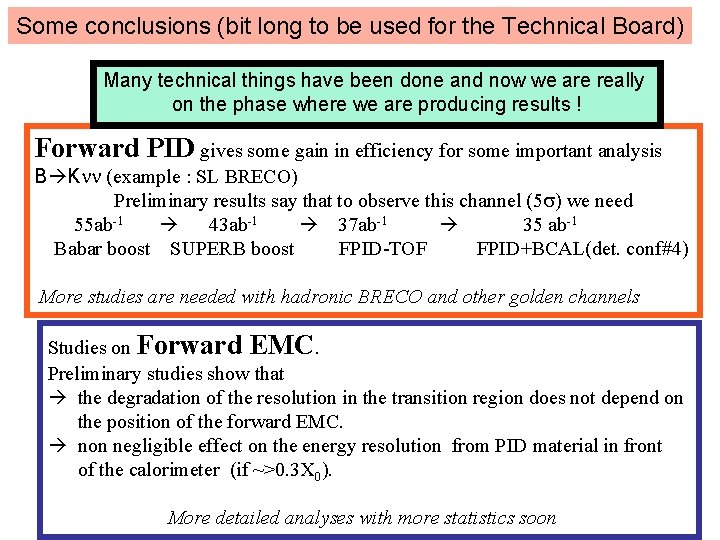
Some conclusions (bit long to be used for the Technical Board) Many technical things have been done and now we are really on the phase where we are producing results ! Forward PID gives some gain in efficiency for some important analysis B Knn (example : SL BRECO) Preliminary results say that to observe this channel (5 s) we need 55 ab-1 43 ab-1 37 ab-1 35 ab-1 Babar boost SUPERB boost FPID-TOF FPID+BCAL(det. conf#4) More studies are needed with hadronic BRECO and other golden channels Studies on Forward EMC. Preliminary studies show that the degradation of the resolution in the transition region does not depend on the position of the forward EMC. non negligible effect on the energy resolution from PID material in front of the calorimeter (if ~>0. 3 X 0). More detailed analyses with more statistics soon
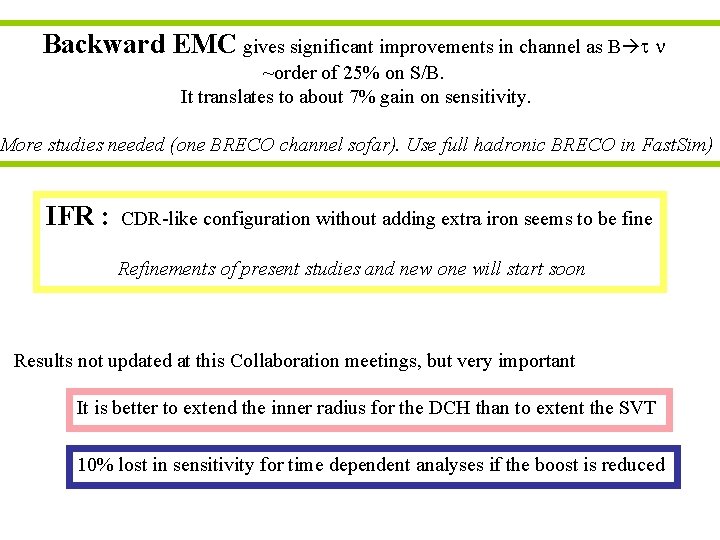
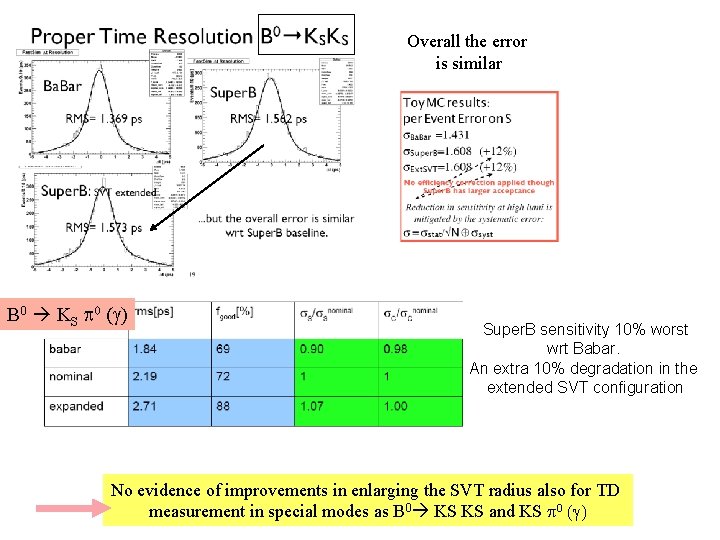
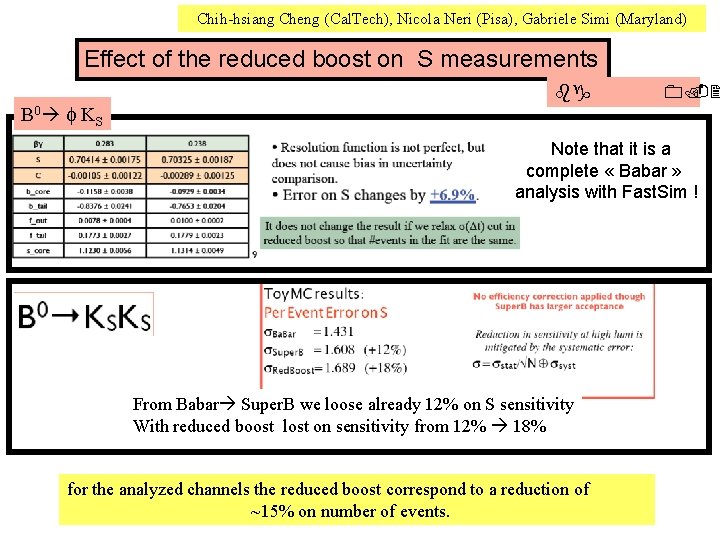
Backward EMC gives significant improvements in channel as B t n ~order of 25% on S/B. It translates to about 7% gain on sensitivity. More studies needed (one BRECO channel sofar). Use full hadronic BRECO in Fast. Sim) IFR : CDR-like configuration without adding extra iron seems to be fine Refinements of present studies and new one will start soon Results not updated at this Collaboration meetings, but very important It is better to extend the inner radius for the DCH than to extent the SVT 10% lost in sensitivity for time dependent analyses if the boost is reduced
BACKUP MATERIAL (some presented in the Introductory talk)
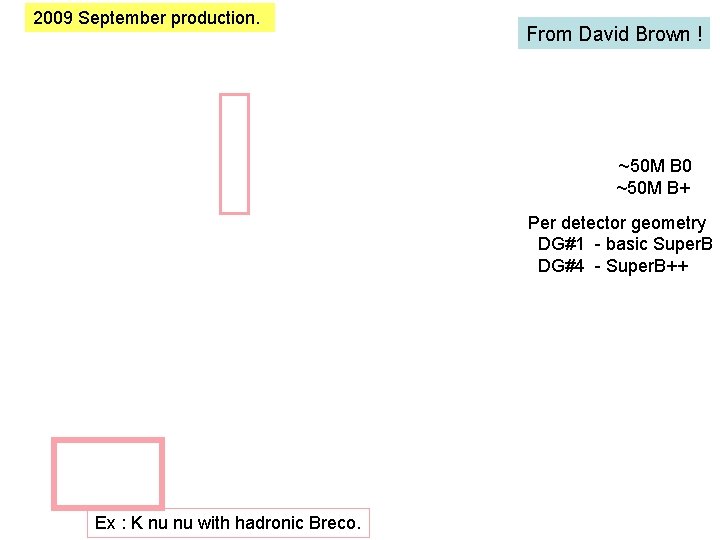
2009 September production. From David Brown ! ~50 M B 0 ~50 M B+ Per detector geometry DG#1 - basic Super. B DG#4 - Super. B++ Ex : K nu nu with hadronic Breco.
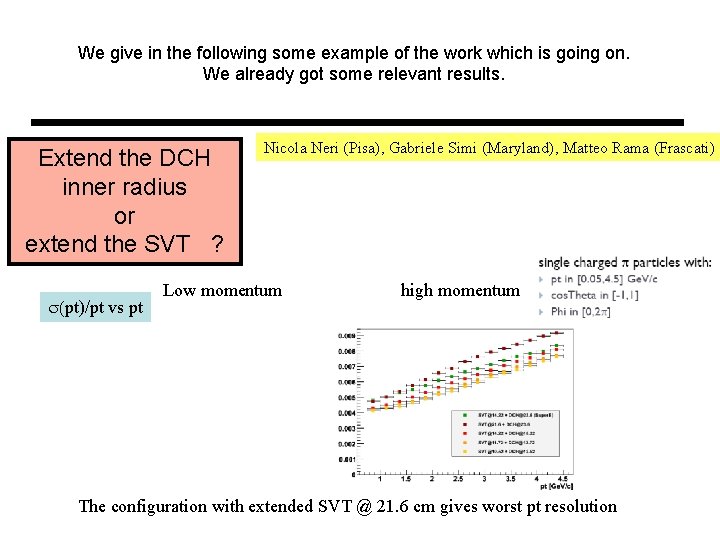
We give in the following some example of the work which is going on. We already got some relevant results. Extend the DCH inner radius or extend the SVT ? s(pt)/pt vs pt Nicola Neri (Pisa), Gabriele Simi (Maryland), Matteo Rama (Frascati) Low momentum high momentum The configuration with extended SVT @ 21. 6 cm gives worst pt resolution
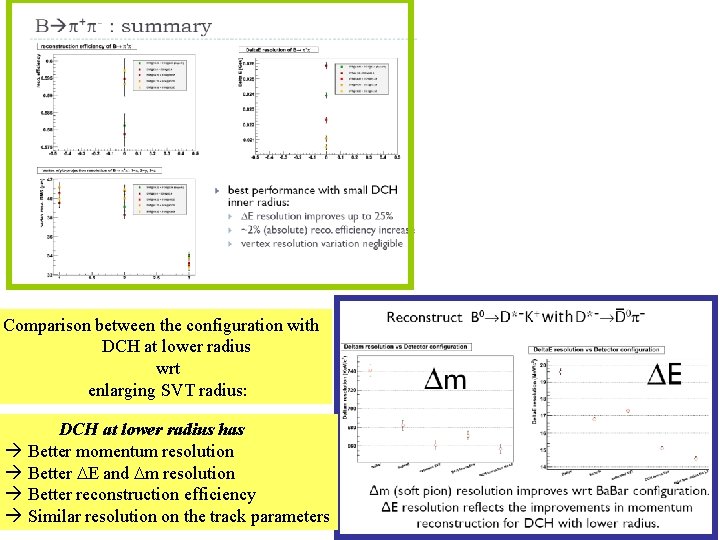
Comparison between the configuration with DCH at lower radius wrt enlarging SVT radius: DCH at lower radius has Better momentum resolution Better DE and Dm resolution Better reconstruction efficiency Similar resolution on the track parameters
Overall the error is similar B 0 KS p 0 (g) Super. B sensitivity 10% worst wrt Babar. An extra 10% degradation in the extended SVT configuration No evidence of improvements in enlarging the SVT radius also for TD measurement in special modes as B 0 KS KS and KS p 0 (g)
Chih-hsiang Cheng (Cal. Tech), Nicola Neri (Pisa), Gabriele Simi (Maryland) Effect of the reduced boost on S measurements bg 0. 2 B 0 f KS Note that it is a complete « Babar » analysis with Fast. Sim ! From Babar Super. B we loose already 12% on S sensitivity With reduced boost lost on sensitivity from 12% 18% for the analyzed channels the reduced boost correspond to a reduction of ~15% on number of events.