Straight and Level The Flight Training Manual Section

- Slides: 24
Straight and Level The Flight Training Manual - Section 6
Objectives • To establish and maintain straight and level flight at: a constant airspeed; constant altitude; in a constant direction; and, in balance. • To regain straight and level flight; and, • To maintain straight and level flight at selected airspeeds or power settings.
Principles of Flight • • • Straight and Level - Definition Flying Attitude The Four Forces Lift Performance
Straight and Level - Definition For Straight and Level Flight, the aircraft is travelling: in a Constant Direction (straight), at a Constant Altitude (level) and at a Constant Speed i. e. not climbing or descending, and not accelerating. The aircraft is in a state of Equilibrium. Therefore the opposing forces acting on the aircraft must be equal to, and opposite to each other.
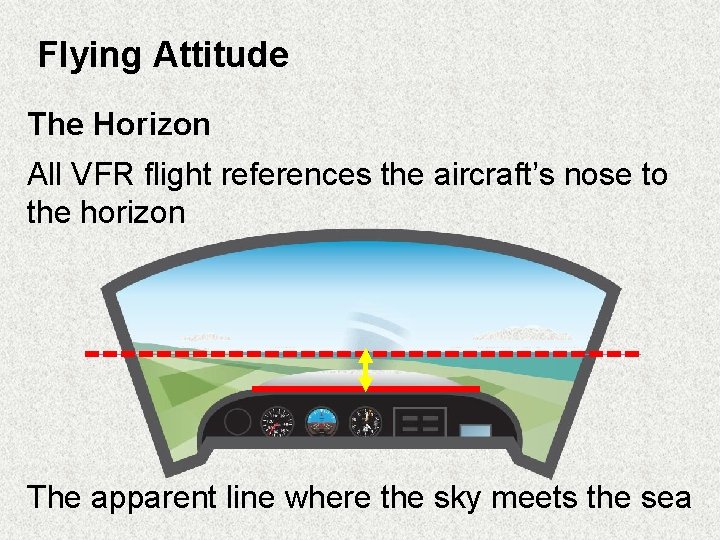
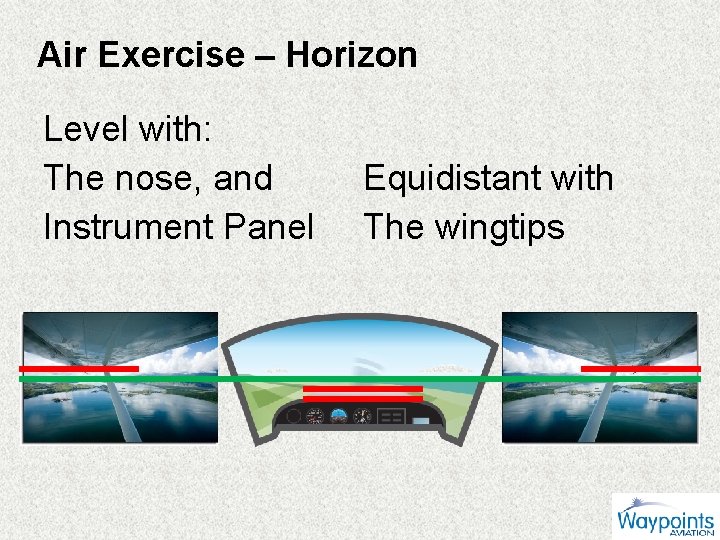
Flying Attitude The Horizon All VFR flight references the aircraft’s nose to the horizon The apparent line where the sky meets the sea
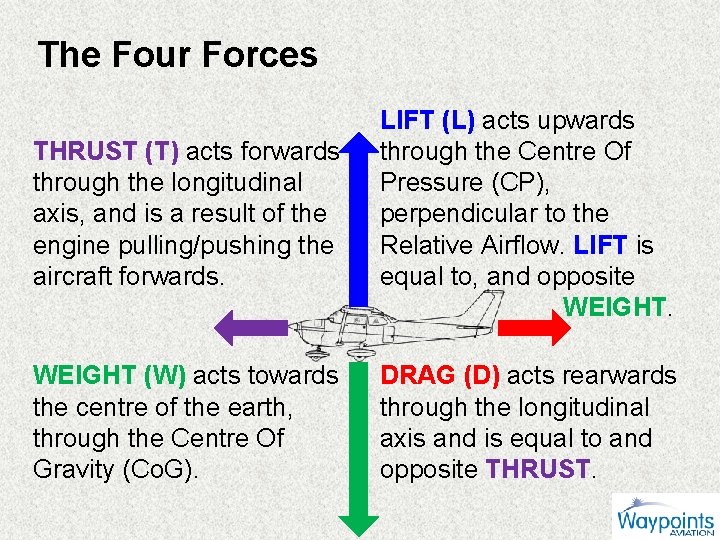
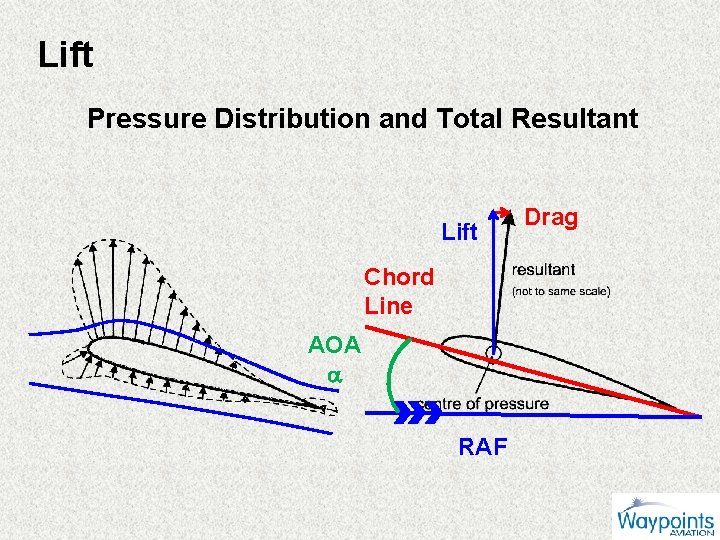
The Four Forces THRUST (T) acts forwards through the longitudinal axis, and is a result of the engine pulling/pushing the aircraft forwards. LIFT (L) acts upwards through the Centre Of Pressure (CP), perpendicular to the Relative Airflow. LIFT is equal to, and opposite WEIGHT (W) acts towards the centre of the earth, through the Centre Of Gravity (Co. G). DRAG (D) acts rearwards through the longitudinal axis and is equal to and opposite THRUST.
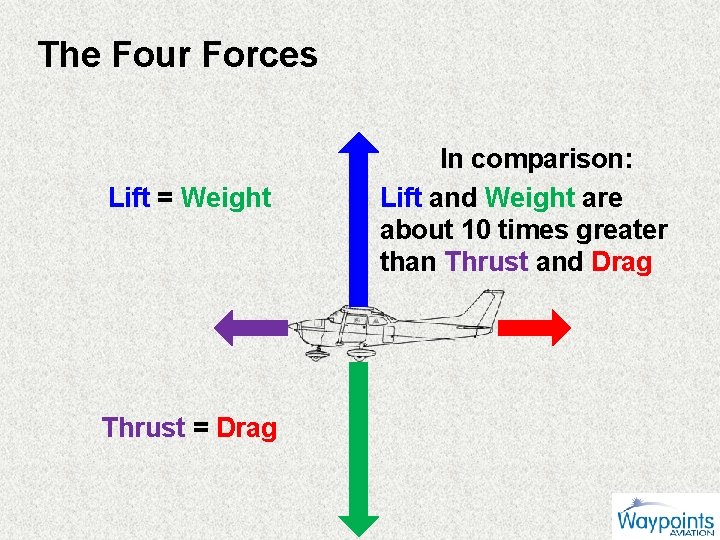
The Four Forces Lift = Weight Thrust = Drag In comparison: Lift and Weight are about 10 times greater than Thrust and Drag
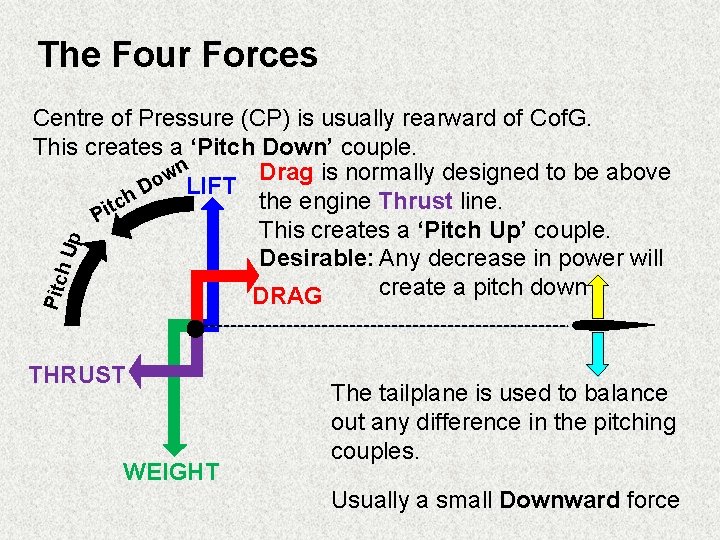
The Four Forces Pitc h. U p Centre of Pressure (CP) is usually rearward of Cof. G. This creates a ‘Pitch Down’ couple. n w o LIFT Drag is normally designed to be above D the engine Thrust line. ch t i P This creates a ‘Pitch Up’ couple. Desirable: Any decrease in power will create a pitch down DRAG THRUST WEIGHT The tailplane is used to balance out any difference in the pitching couples. Usually a small Downward force
Lift Pressure Distribution and Total Resultant Lift Chord Line AOA RAF Drag
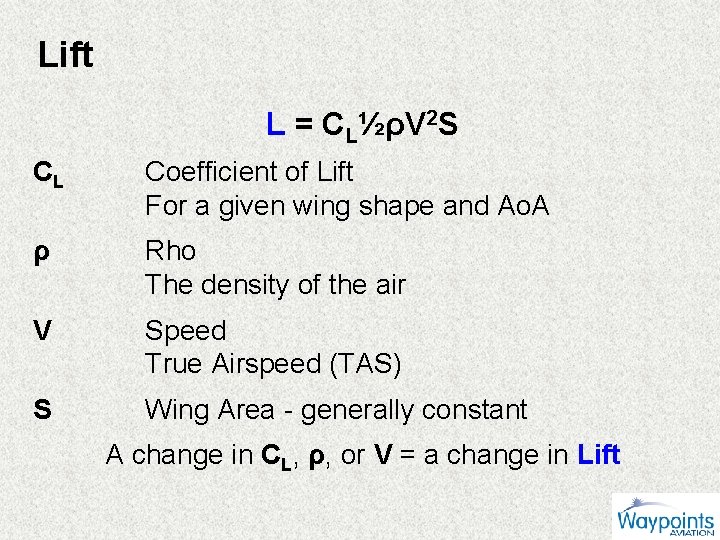
Lift L = CL½ρV 2 S CL Coefficient of Lift For a given wing shape and Ao. A ρ Rho The density of the air V Speed True Airspeed (TAS) S Wing Area - generally constant A change in CL, ρ, or V = a change in Lift
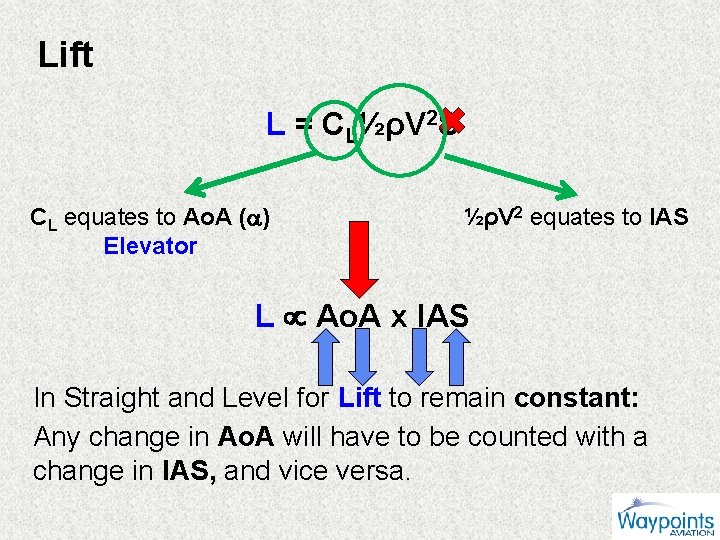
Lift L = CL½ρV 2 S CL equates to Ao. A ( ) Elevator ½ρV 2 equates to IAS L Ao. A x IAS In Straight and Level for Lift to remain constant: Any change in Ao. A will have to be counted with a change in IAS, and vice versa.
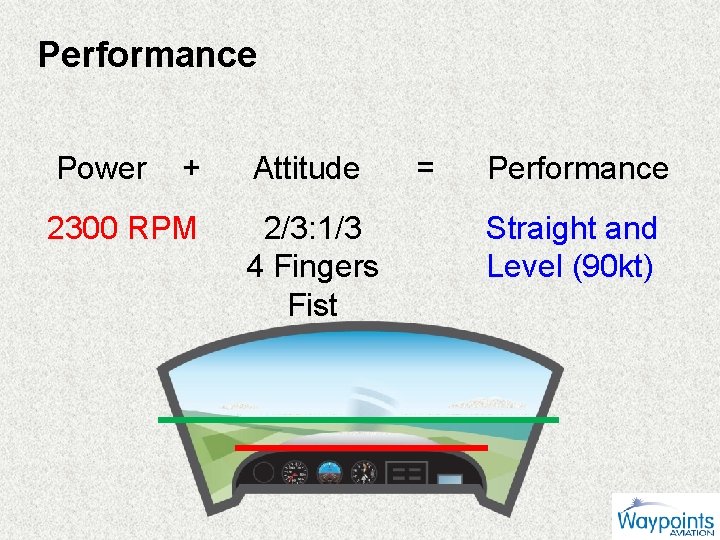
Performance Power + 2300 RPM Attitude 2/3: 1/3 4 Fingers Fist = Performance Straight and Level (90 kt)
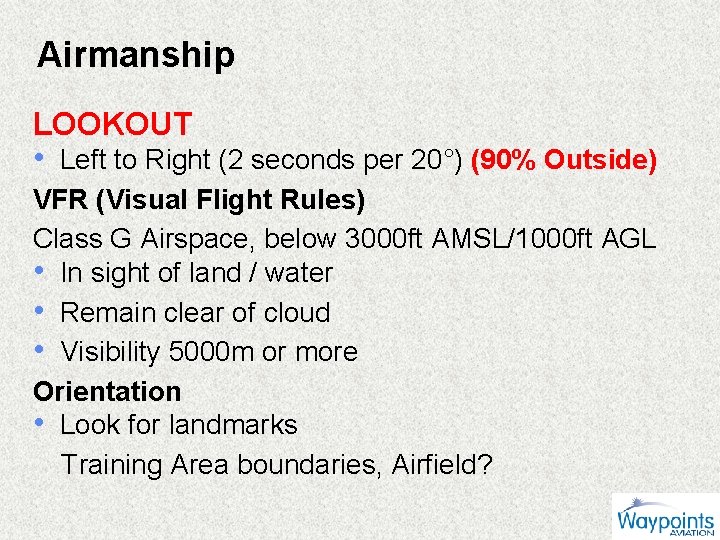
Airmanship LOOKOUT • Left to Right (2 seconds per 20°) (90% Outside) VFR (Visual Flight Rules) Class G Airspace, below 3000 ft AMSL/1000 ft AGL • In sight of land / water • Remain clear of cloud • Visibility 5000 m or more Orientation • Look for landmarks Training Area boundaries, Airfield?
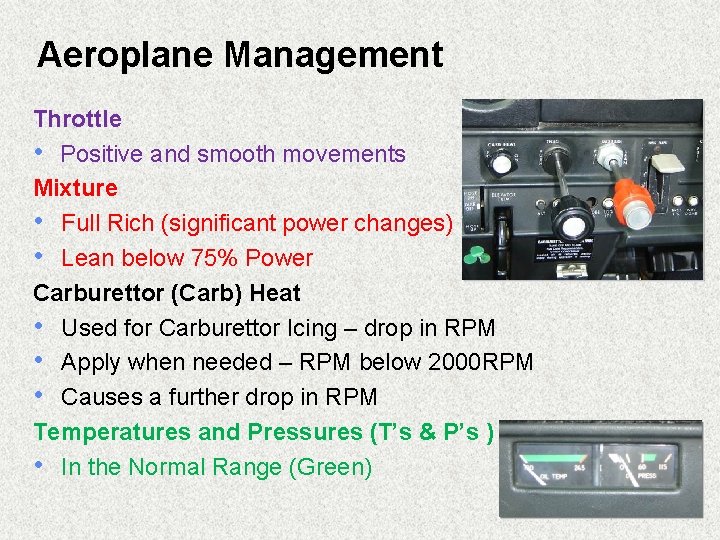
Aeroplane Management Throttle • Positive and smooth movements Mixture • Full Rich (significant power changes) • Lean below 75% Power Carburettor (Carb) Heat • Used for Carburettor Icing – drop in RPM • Apply when needed – RPM below 2000 RPM • Causes a further drop in RPM Temperatures and Pressures (T’s & P’s ) • In the Normal Range (Green)
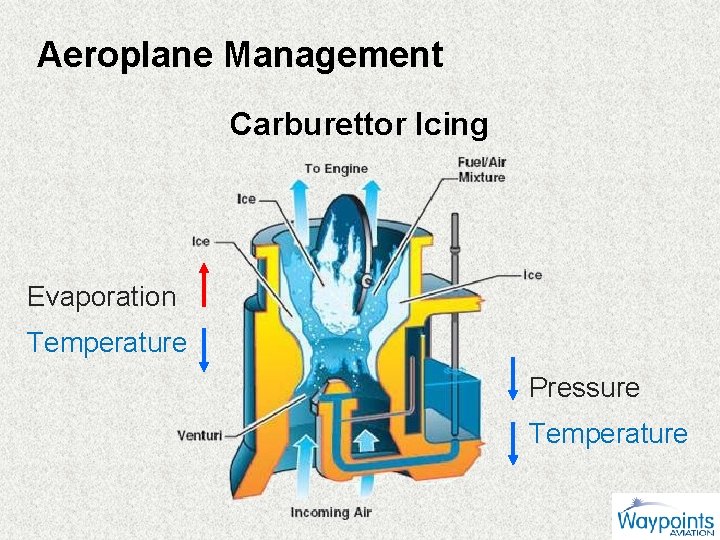
Aeroplane Management Carburettor Icing Evaporation Temperature Pressure Temperature
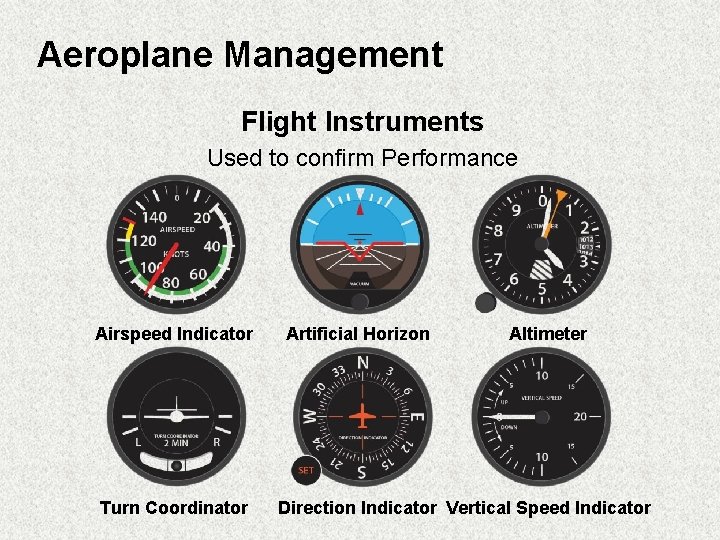
Aeroplane Management Flight Instruments Used to confirm Performance Airspeed Indicator Turn Coordinator Artificial Horizon Altimeter Direction Indicator Vertical Speed Indicator
Human Factors Lookout: Blind spots • Pillars, • Door frames, • Instructor, etc. Lesson Structure: • A lot of information • Mastery of skills with time and practice
Air Exercise – Horizon Level with: The nose, and Instrument Panel Equidistant with The wingtips
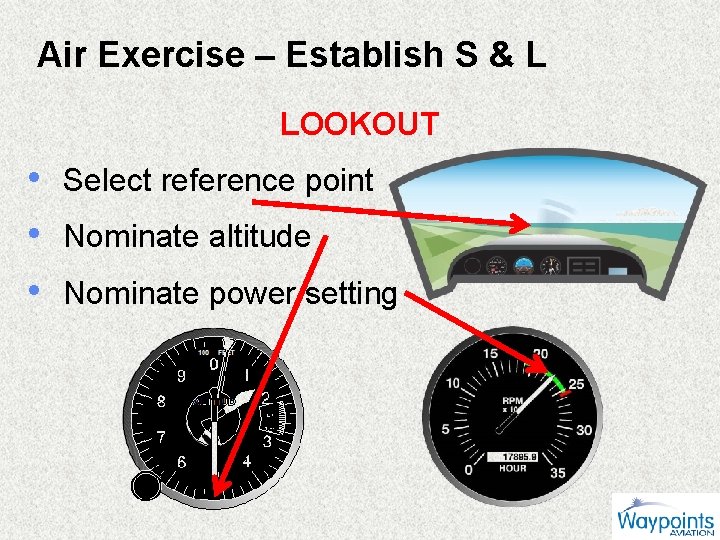
Air Exercise – Establish S & L LOOKOUT • Select reference point • Nominate altitude • Nominate power setting
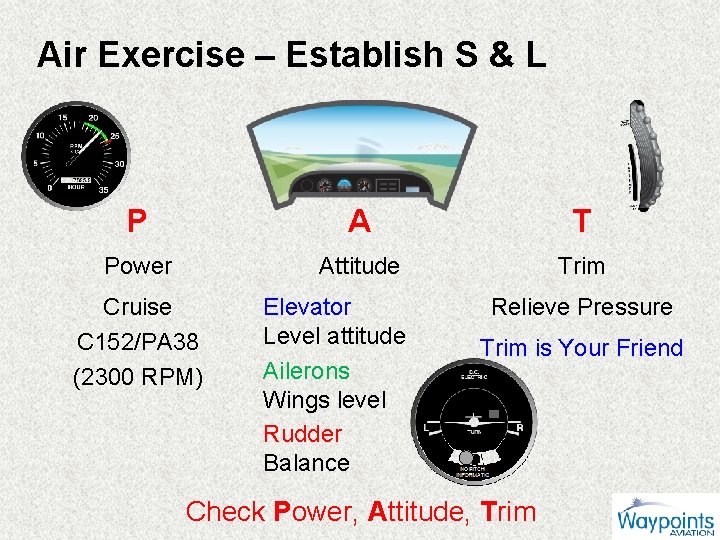
Air Exercise – Establish S & L P A T Power Attitude Trim Cruise C 152/PA 38 (2300 RPM) Elevator Level attitude Ailerons Wings level Rudder Balance Relieve Pressure Trim is Your Friend Check Power, Attitude, Trim
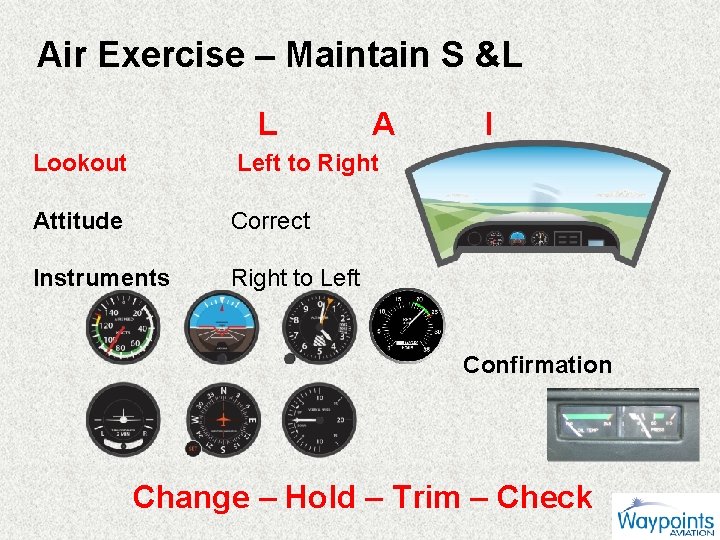
Air Exercise – Maintain S &L L A Lookout Left to Right Attitude Correct Instruments Right to Left I Confirmation Change – Hold – Trim – Check
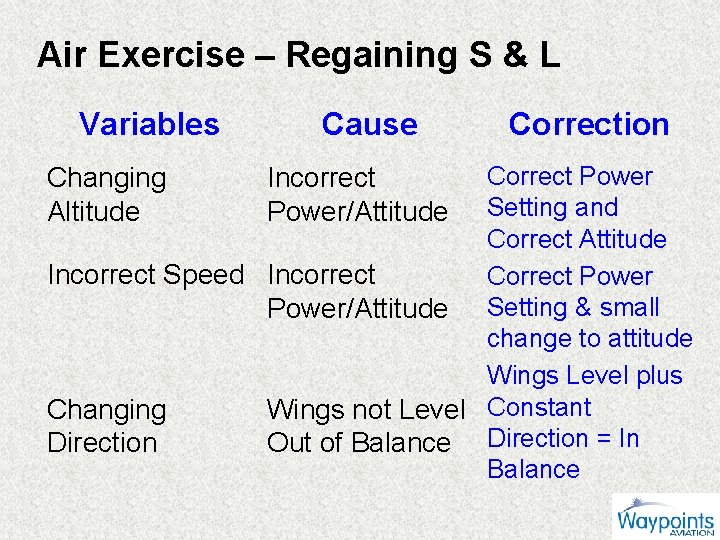
Air Exercise – Regaining S & L Variables Cause Correction Correct Power Setting and Correct Attitude Incorrect Speed Incorrect Correct Power/Attitude Setting & small change to attitude Wings Level plus Wings not Level Constant Changing Out of Balance Direction = In Direction Balance Changing Altitude Incorrect Power/Attitude
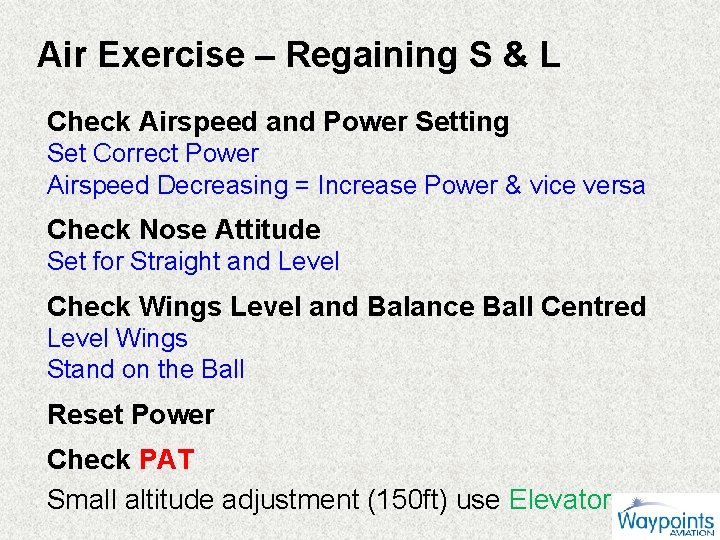
Air Exercise – Regaining S & L Check Airspeed and Power Setting Set Correct Power Airspeed Decreasing = Increase Power & vice versa Check Nose Attitude Set for Straight and Level Check Wings Level and Balance Ball Centred Level Wings Stand on the Ball Reset Power Check PAT Small altitude adjustment (150 ft) use Elevator
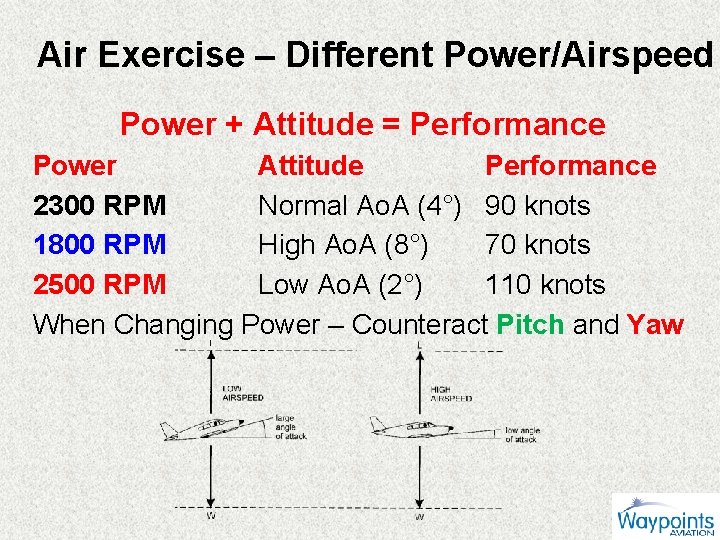
Air Exercise – Different Power/Airspeed Power + Attitude = Performance Power Attitude Performance 2300 RPM Normal Ao. A (4°) 90 knots 1800 RPM High Ao. A (8°) 70 knots 2500 RPM Low Ao. A (2°) 110 knots When Changing Power – Counteract Pitch and Yaw