
Courtesy of Shan Lan Cindy Barnhart and JohnPaul
Courtesy of Shan Lan, Cindy Barnhart and John-Paul Clarke. Used with permission New Approaches to Add Robustness into Airline Schedules Shan Lan, Cindy Barnhart and John-Paul Clarke Center for Transportation and Logistics Massachusetts Institute of Technology May 5 , 2002
Outline o Background, Motivation and Our Contributions o Overview of Robust Airline Schedule Planning o Robust Aircraft Maintenance Routing – reduce delay propagation o Flight Schedule Retiming – reduce passenger missed connections o Summary and Future Research Directions 2
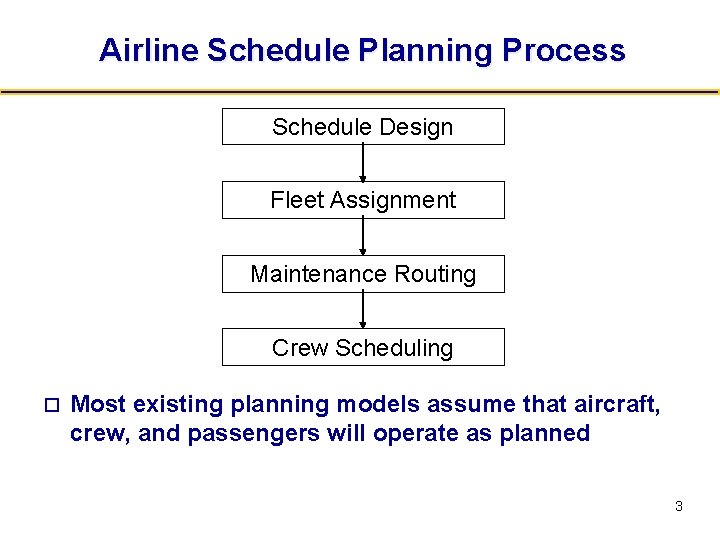
Airline Schedule Planning Process Schedule Design Fleet Assignment Maintenance Routing Crew Scheduling o Most existing planning models assume that aircraft, crew, and passengers will operate as planned 3
Airline Operations o Many reasons can cause delays Ø Severe weather conditions, unexpected aircraft and personnel failures, congested traffic, etc. o Delays may propagate through the network o Long delays and cancellations cause schedule disruptions o Airlines must reschedule aircraft/crew and reaccommodate passengers o Huge revenue loss: Ø Delays cost consumers and airlines about $6. 5 billion in 2000 (Air Transport Association) 4
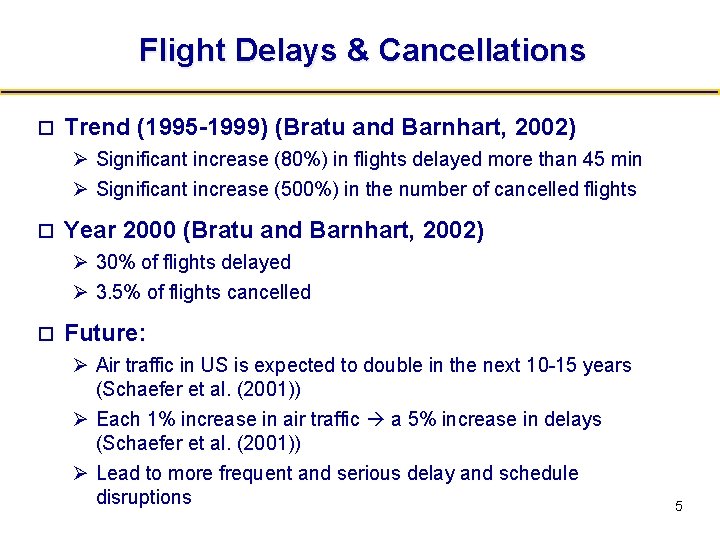
Flight Delays & Cancellations o Trend (1995 -1999) (Bratu and Barnhart, 2002) Ø Significant increase (80%) in flights delayed more than 45 min Ø Significant increase (500%) in the number of cancelled flights o Year 2000 (Bratu and Barnhart, 2002) Ø 30% of flights delayed Ø 3. 5% of flights cancelled o Future: Ø Air traffic in US is expected to double in the next 10 -15 years (Schaefer et al. (2001)) Ø Each 1% increase in air traffic a 5% increase in delays (Schaefer et al. (2001)) Ø Lead to more frequent and serious delay and schedule disruptions 5
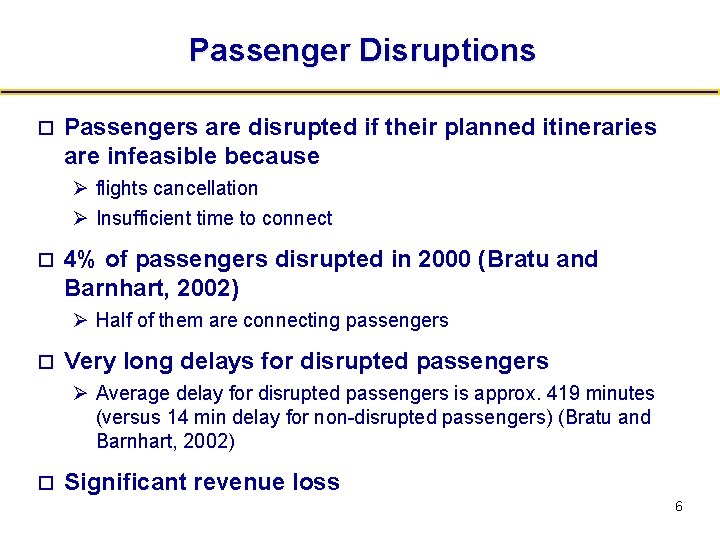
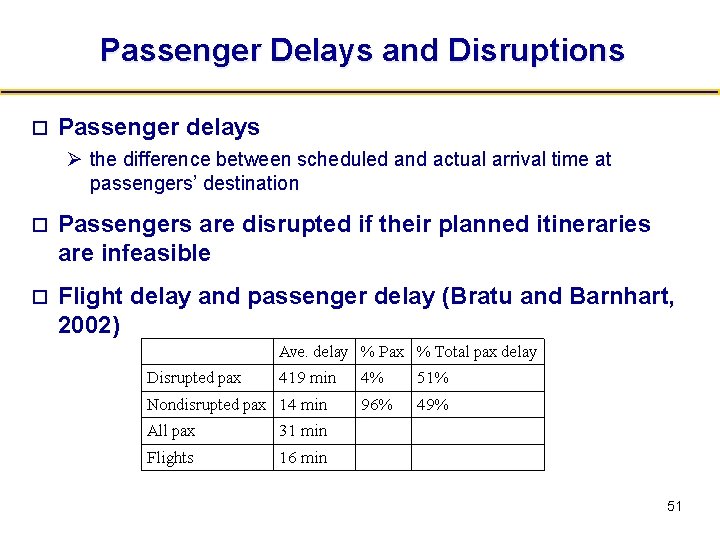
Passenger Disruptions o Passengers are disrupted if their planned itineraries are infeasible because Ø flights cancellation Ø Insufficient time to connect o 4% of passengers disrupted in 2000 (Bratu and Barnhart, 2002) Ø Half of them are connecting passengers o Very long delays for disrupted passengers Ø Average delay for disrupted passengers is approx. 419 minutes (versus 14 min delay for non-disrupted passengers) (Bratu and Barnhart, 2002) o Significant revenue loss 6
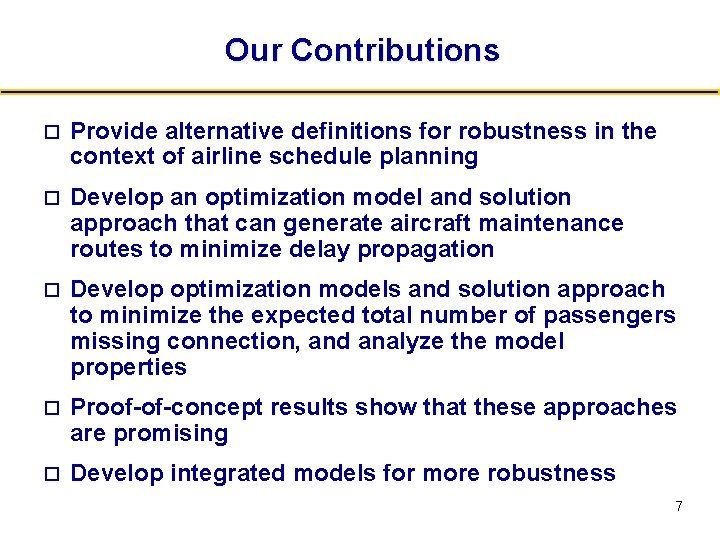
Our Contributions o Provide alternative definitions for robustness in the context of airline schedule planning o Develop an optimization model and solution approach that can generate aircraft maintenance routes to minimize delay propagation o Develop optimization models and solution approach to minimize the expected total number of passengers missing connection, and analyze the model properties o Proof-of-concept results show that these approaches are promising o Develop integrated models for more robustness 7
Outline o Background, Motivation and Our Contributions o Overview of Robust Airline Schedule Planning Ø Ø How to deal with schedule disruptions Challenges of building robust airline schedules Definitions of robustness Robust airline schedule planning approaches o Robust Aircraft Maintenance Routing -- reduce delay propagation o Flight Schedule Retiming – reduce passenger missed connections o Summary and Future Research Directions 8
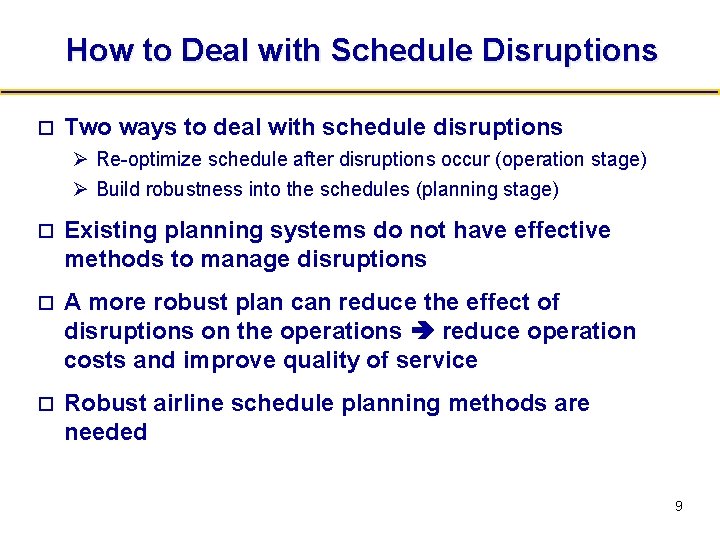
How to Deal with Schedule Disruptions o Two ways to deal with schedule disruptions Ø Re-optimize schedule after disruptions occur (operation stage) Ø Build robustness into the schedules (planning stage) o Existing planning systems do not have effective methods to manage disruptions o A more robust plan can reduce the effect of disruptions on the operations reduce operation costs and improve quality of service o Robust airline schedule planning methods are needed 9
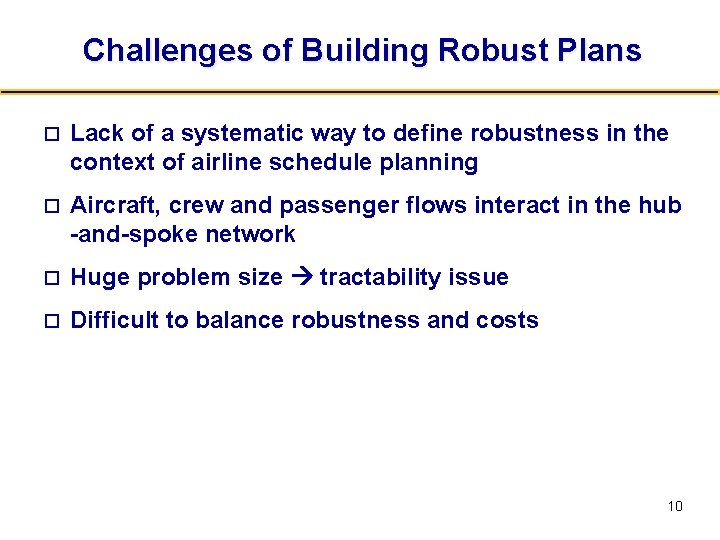
Challenges of Building Robust Plans o Lack of a systematic way to define robustness in the context of airline schedule planning o Aircraft, crew and passenger flows interact in the hub -and-spoke network o Huge problem size tractability issue o Difficult to balance robustness and costs 10
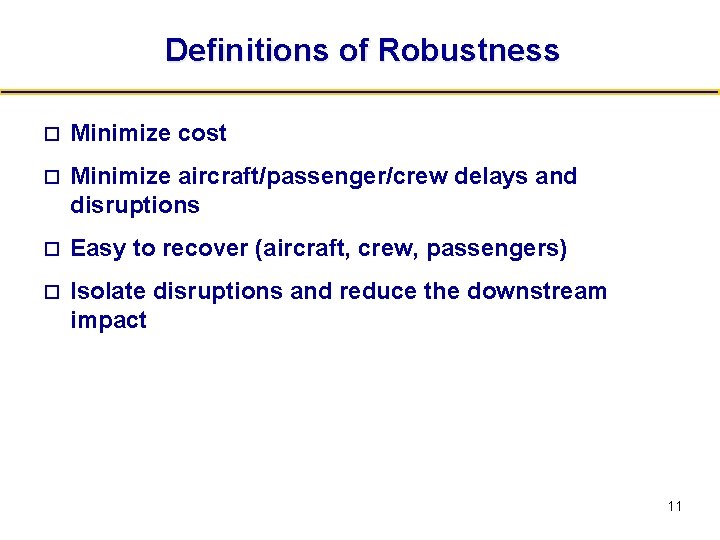
Definitions of Robustness o Minimize cost o Minimize aircraft/passenger/crew delays and disruptions o Easy to recover (aircraft, crew, passengers) o Isolate disruptions and reduce the downstream impact 11
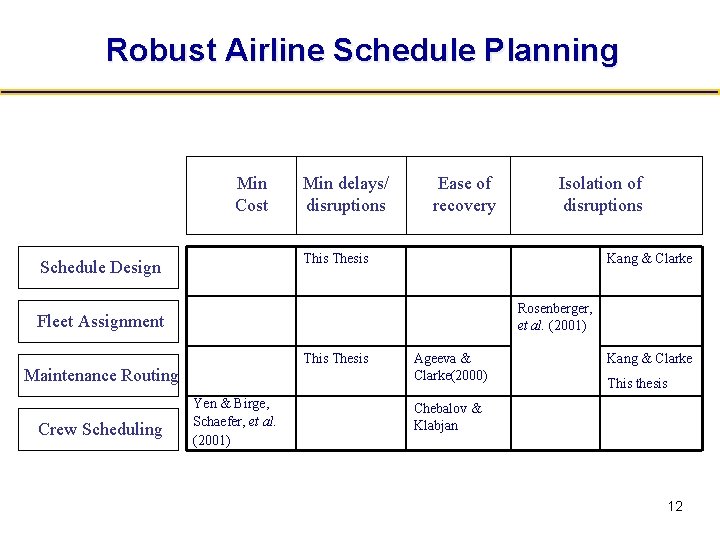
Robust Airline Schedule Planning Min Cost Min delays/ disruptions Ease of recovery This Thesis Schedule Design Kang & Clarke Rosenberger, et al. (2001) Fleet Assignment This Thesis Maintenance Routing Crew Scheduling Isolation of disruptions Yen & Birge, Schaefer, et al. (2001) Ageeva & Clarke(2000) Kang & Clarke This thesis Chebalov & Klabjan 12
Where Should We Start? o Difficult to balance cost that airlines are willing to pay for robustness versus cost of operation o Looking for robust solution without significant added costs Ø Aircraft maintenance routing problem: The financial impact is relatively small It is more a feasibility problem Ø How to route aircraft has impacts on flight delays and cancellations, passengers, crews Ø Question: § What robustness can be achieved for the maintenance routing problem? 13
Outline o Background, Motivation and Our Contributions o Overview of Robust Airline Schedule Planning o Robust Aircraft Maintenance Routing – reduce delay propagation Ø Ø Ø Delay Propagation Modeling Idea String based formulation Solution approach Proof-of-concept results o Flight Schedule Retiming – reduce passenger missed connections o Summary and Future Research Directions 14
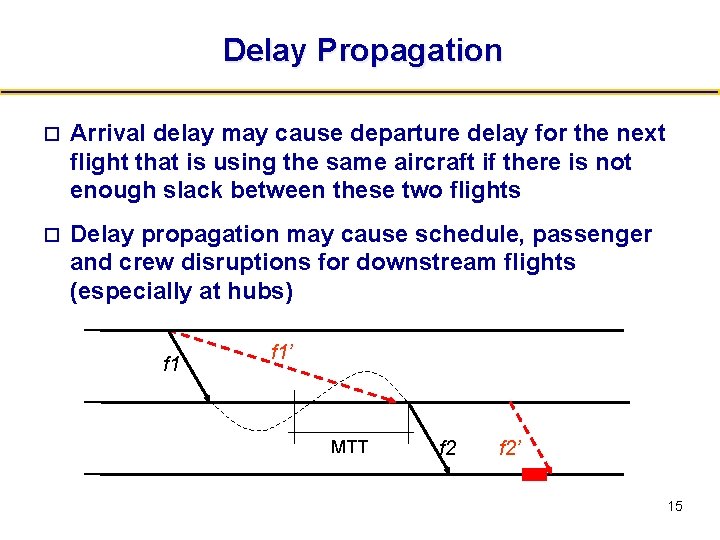
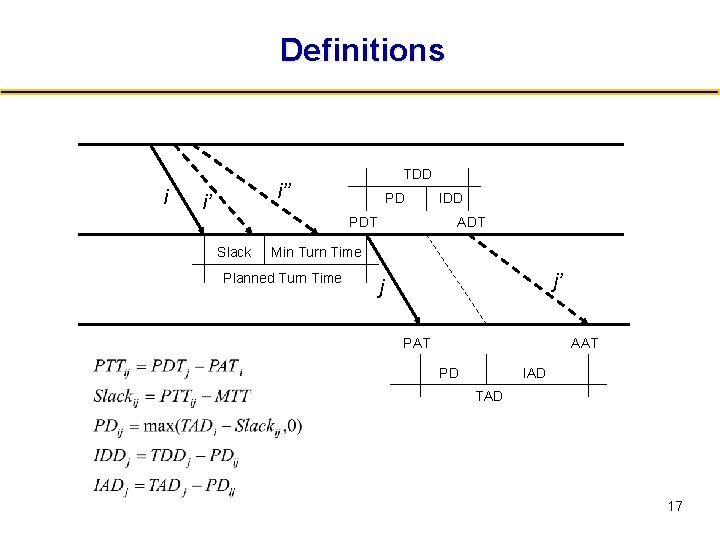
Delay Propagation o Arrival delay may cause departure delay for the next flight that is using the same aircraft if there is not enough slack between these two flights o Delay propagation may cause schedule, passenger and crew disruptions for downstream flights (especially at hubs) f 1’ MTT f 2’ 15
Propagated Delay vs. Independent Delay o Flight delay may be divided into two categories: Ø Propagated delay § Caused by inbound aircraft delay – function of routing § 20 -30% of total delay (Continental Airlines) Ø Independent delay § Caused by other factors – not a function of routing 16
Definitions i TDD i’’ i’ PD PDT Slack IDD ADT Min Turn Time Planned Turn Time j’ j PAT AAT PD IAD TAD 17
Modeling Idea o Delays propagate along aircraft routes o Only limited slack can be added o Appropriately located slack can prevent delay propagation o Routing aircraft intelligently better allocated slack o Essentially add slack where advantageous, reducing slack where less needed 18
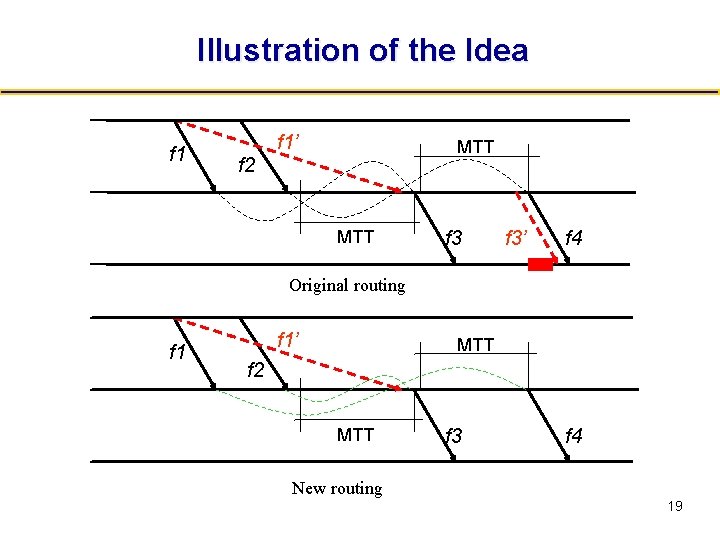
Illustration of the Idea f 1’ MTT f 2 MTT f 3’ f 4 Original routing f 1’ MTT f 2 MTT New routing f 3 f 4 19
Modeling Issues o Difficult to use leg-based models to track the delay propagation o One variable (string) for each aircraft route between two maintenances (Barnhart, et al. 1998) Ø A string: a sequence of connected flights that begins and ends at maintenance stations Ø Delay propagation for each route can be determined o Need to determine delays for each feasible route Ø Most of the feasible routes haven’t been realized yet § PD and TAD are a function of routing § PD and TAD for these routes can’t be found in the historical data Ø IAD is not a function of routing and can be calculated by tracking the route of each individual aircraft in the historical data 20
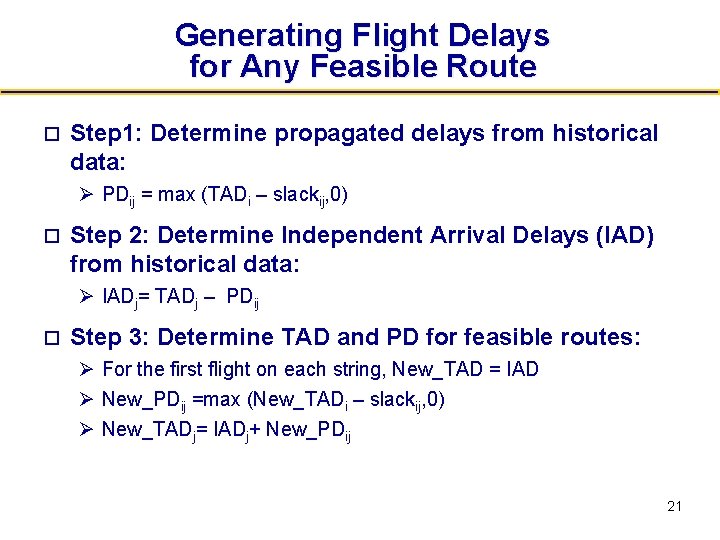
Generating Flight Delays for Any Feasible Route o Step 1: Determine propagated delays from historical data: Ø PDij = max (TADi – slackij, 0) o Step 2: Determine Independent Arrival Delays (IAD) from historical data: Ø IADj= TADj – PDij o Step 3: Determine TAD and PD for feasible routes: Ø For the first flight on each string, New_TAD = IAD Ø New_PDij =max (New_TADi – slackij, 0) Ø New_TADj= IADj+ New_PDij 21
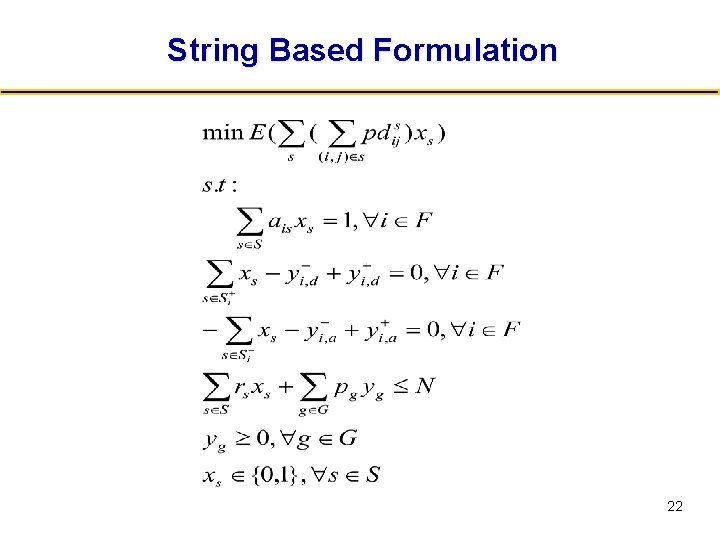
String Based Formulation 22
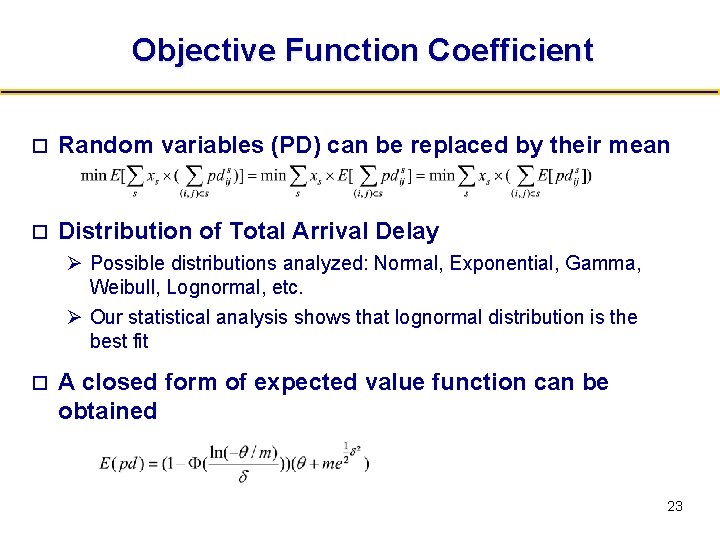
Objective Function Coefficient o Random variables (PD) can be replaced by their mean o Distribution of Total Arrival Delay Ø Possible distributions analyzed: Normal, Exponential, Gamma, Weibull, Lognormal, etc. Ø Our statistical analysis shows that lognormal distribution is the best fit o A closed form of expected value function can be obtained 23
Solution Approach o This formulation is a deterministic mixed-integer program with a huge number of 0 -1 variables o Branch-and-price Ø Branch-and-Bound with a linear programming relaxation solved at each node of the branch-and-bound tree using column generation o IP solution Ø A special branching strategy: branching on follow-ons (Ryan and Foster 1981, Barnhart et al. 1998) 24
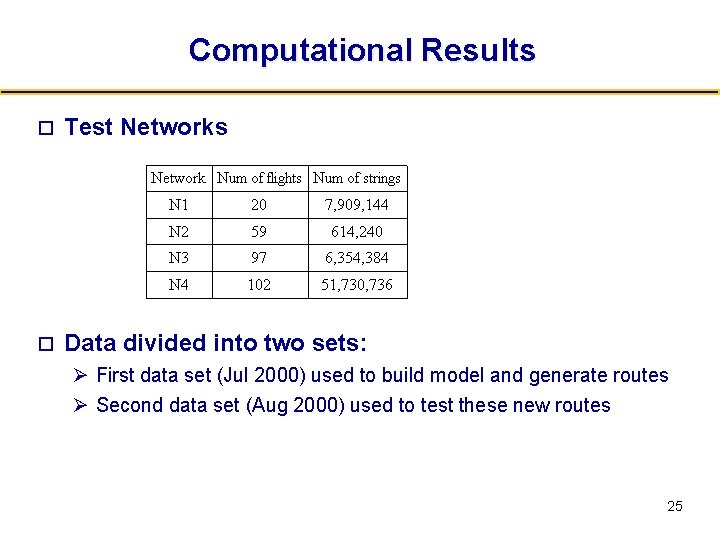
Computational Results o Test Networks o Data divided into two sets: Ø First data set (Jul 2000) used to build model and generate routes Ø Second data set (Aug 2000) used to test these new routes 25
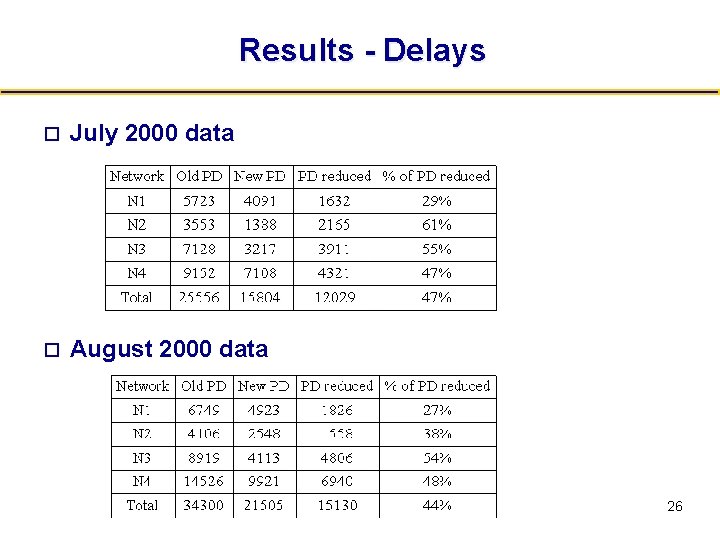
Results - Delays o July 2000 data o August 2000 data 26
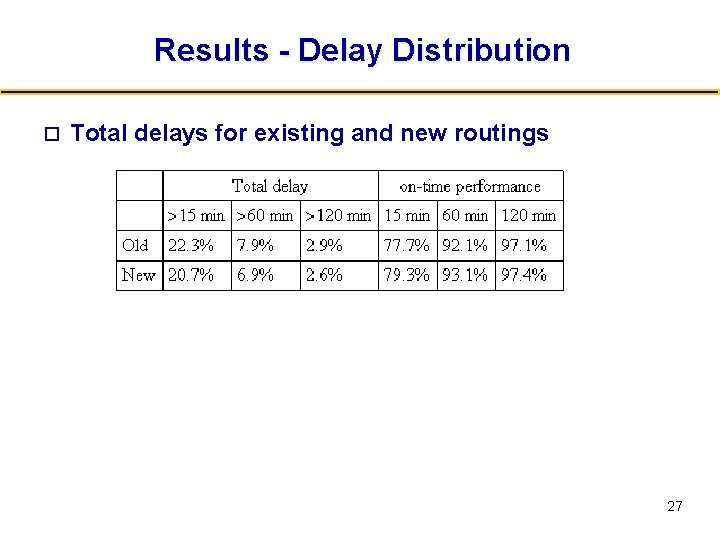
Results - Delay Distribution o Total delays for existing and new routings 27
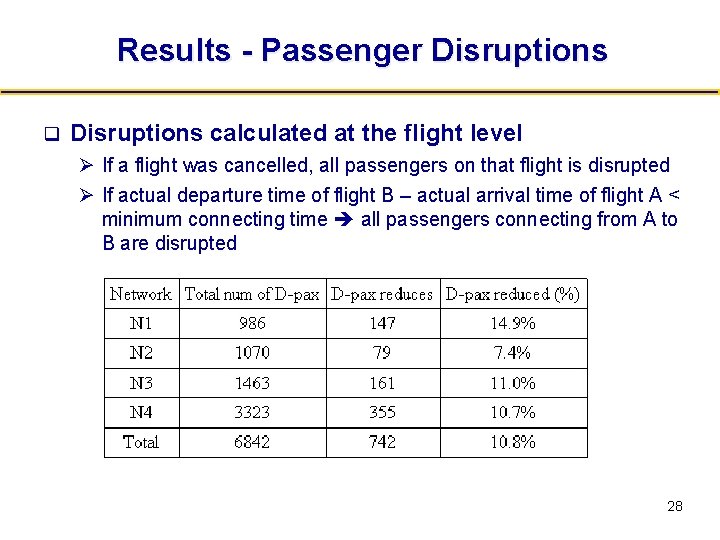
Results - Passenger Disruptions q Disruptions calculated at the flight level Ø If a flight was cancelled, all passengers on that flight is disrupted Ø If actual departure time of flight B – actual arrival time of flight A < minimum connecting time all passengers connecting from A to B are disrupted 28
Outline o Background, Motivation and Our Contributions o Overview of Robust Airline Schedule Planning o Robust Aircraft Maintenance Routing o Flight Schedule Retiming – reduce passenger missed connections Ø Ø Ø o Passenger delays and disruptions Modeling Idea Formulations and their properties Solution approach Proof-of-concept results Summary and Future Research Directions 29
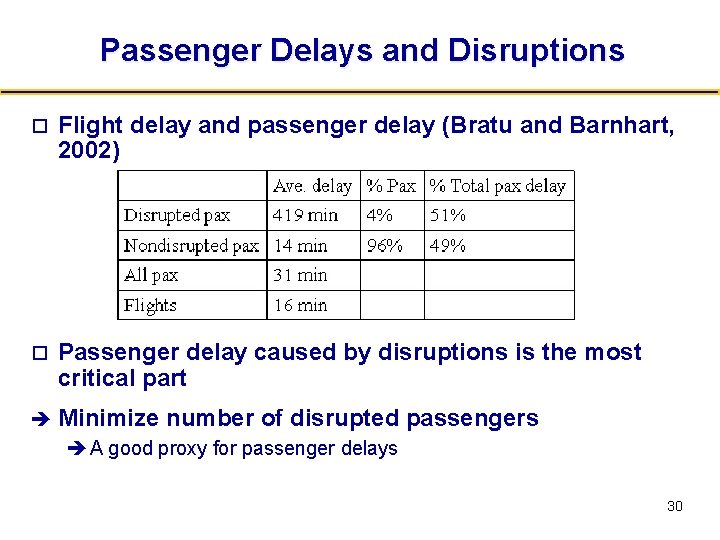
Passenger Delays and Disruptions o Flight delay and passenger delay (Bratu and Barnhart, 2002) o Passenger delay caused by disruptions is the most critical part Minimize number of disrupted passengers A good proxy for passenger delays 30
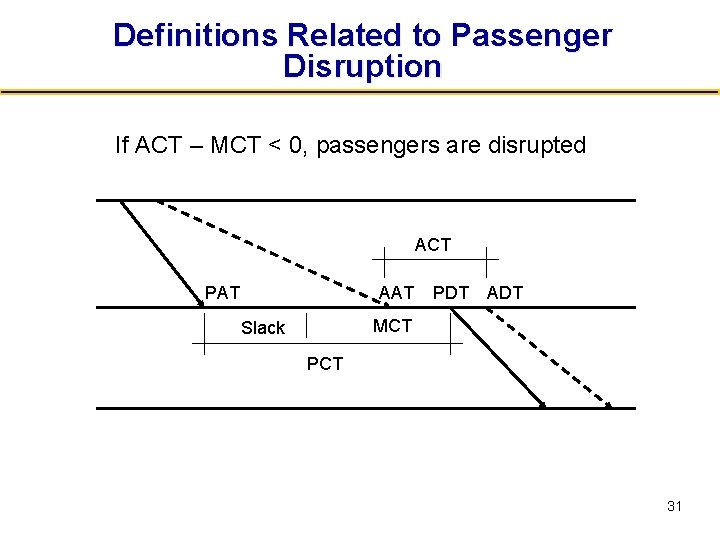
Definitions Related to Passenger Disruption If ACT – MCT < 0, passengers are disrupted ACT PAT AAT PDT ADT MCT Slack PCT 31
Minimize Passenger Missed Connections o If the slack is “eaten” by flight delay, passengers are disrupted o Adding more slack can be good for connecting passengers, but can result in reduced productivity o Appropriately located slack can prevent passenger disruptions o Moving flight departure times in a small time window can lead to better allocated slack 32
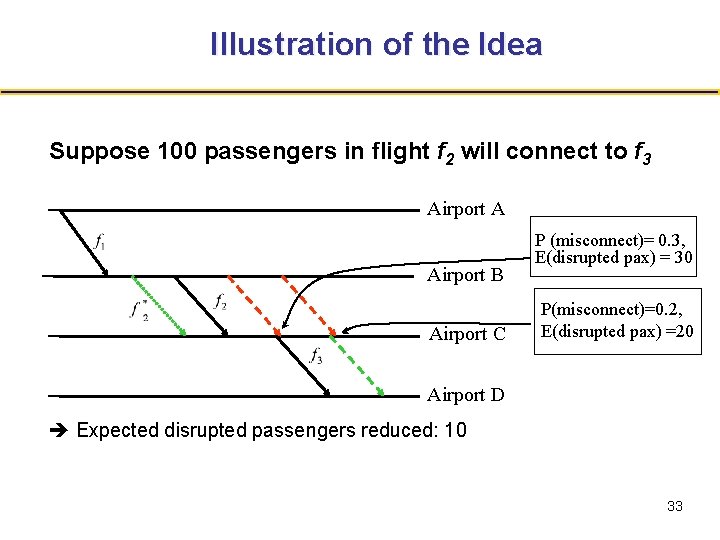
Illustration of the Idea Suppose 100 passengers in flight f 2 will connect to f 3 Airport A Airport B Airport C P (misconnect)= 0. 3, E(disrupted pax) = 30 P(misconnect)=0. 2, E(disrupted pax) =20 Airport D Expected disrupted passengers reduced: 10 33
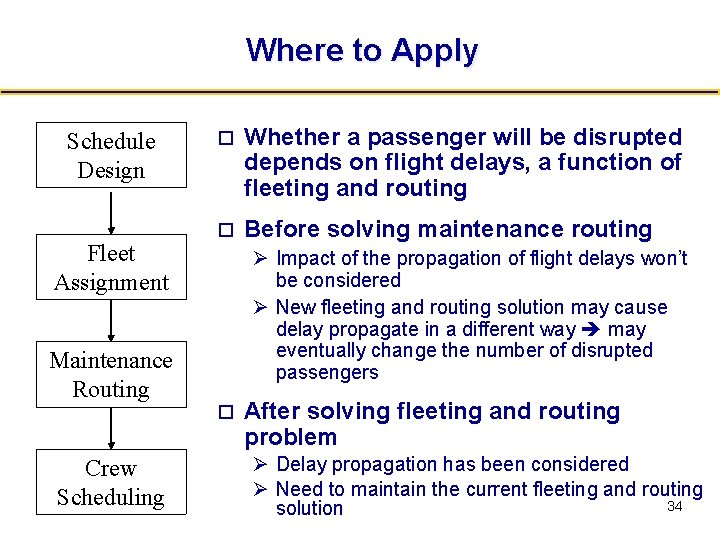
Where to Apply Schedule Design Fleet Assignment Maintenance Routing Crew Scheduling o Whether a passenger will be disrupted depends on flight delays, a function of fleeting and routing o Before solving maintenance routing Ø Impact of the propagation of flight delays won’t be considered Ø New fleeting and routing solution may cause delay propagate in a different way may eventually change the number of disrupted passengers o After solving fleeting and routing problem Ø Delay propagation has been considered Ø Need to maintain the current fleeting and routing 34 solution
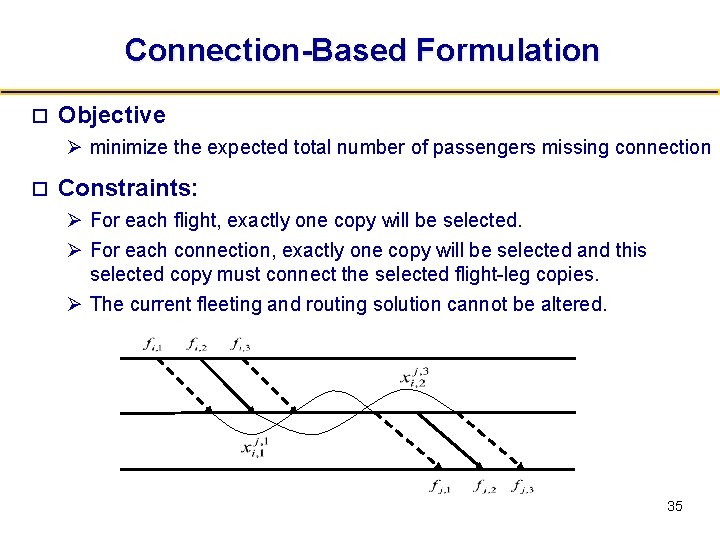
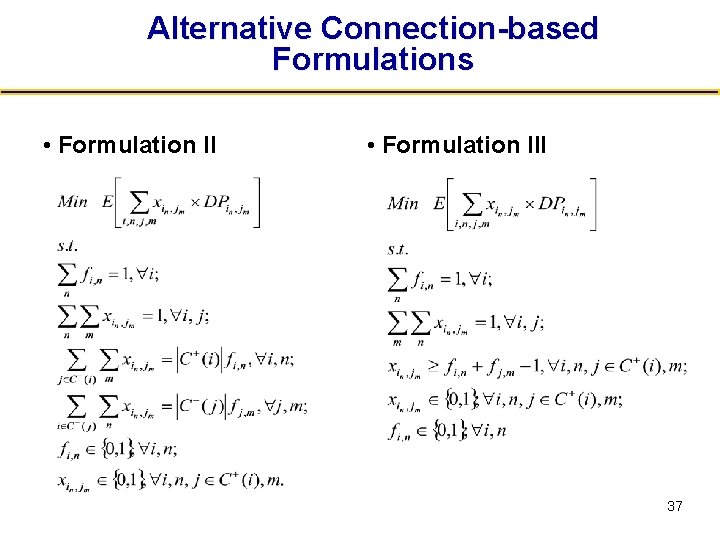
Connection-Based Formulation o Objective Ø minimize the expected total number of passengers missing connection o Constraints: Ø For each flight, exactly one copy will be selected. Ø For each connection, exactly one copy will be selected and this selected copy must connect the selected flight-leg copies. Ø The current fleeting and routing solution cannot be altered. 35
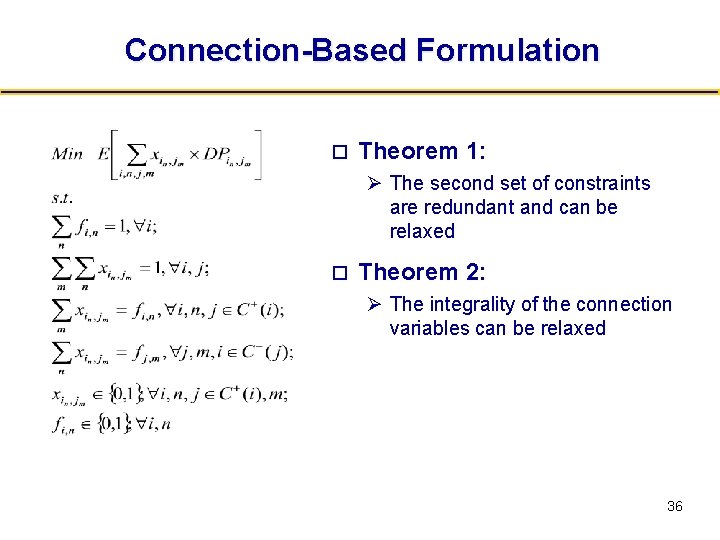
Connection-Based Formulation o Theorem 1: Ø The second set of constraints are redundant and can be relaxed o Theorem 2: Ø The integrality of the connection variables can be relaxed 36
Alternative Connection-based Formulations • Formulation III 37
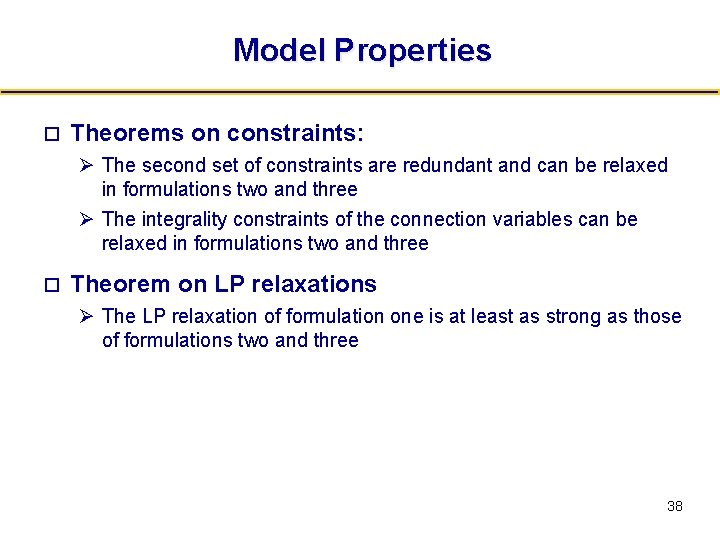
Model Properties o Theorems on constraints: Ø The second set of constraints are redundant and can be relaxed in formulations two and three Ø The integrality constraints of the connection variables can be relaxed in formulations two and three o Theorem on LP relaxations Ø The LP relaxation of formulation one is at least as strong as those of formulations two and three 38
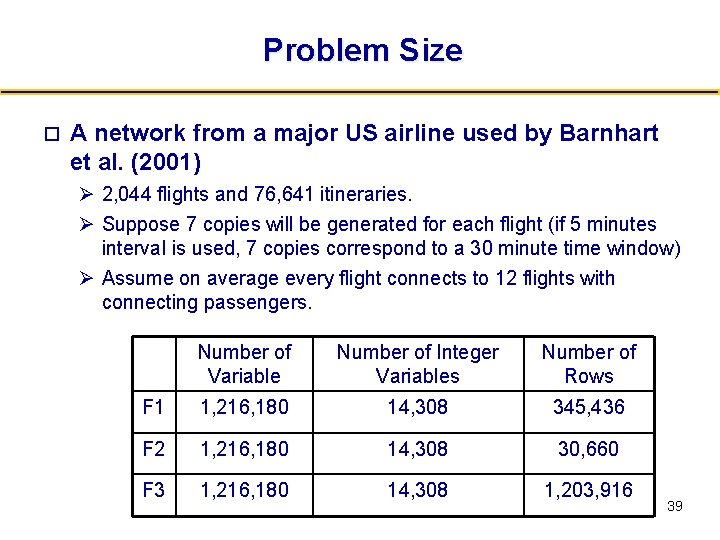
Problem Size o A network from a major US airline used by Barnhart et al. (2001) Ø 2, 044 flights and 76, 641 itineraries. Ø Suppose 7 copies will be generated for each flight (if 5 minutes interval is used, 7 copies correspond to a 30 minute time window) Ø Assume on average every flight connects to 12 flights with connecting passengers. Number of Variable Number of Integer Variables Number of Rows F 1 1, 216, 180 14, 308 345, 436 F 2 1, 216, 180 14, 308 30, 660 F 3 1, 216, 180 14, 308 1, 203, 916 39
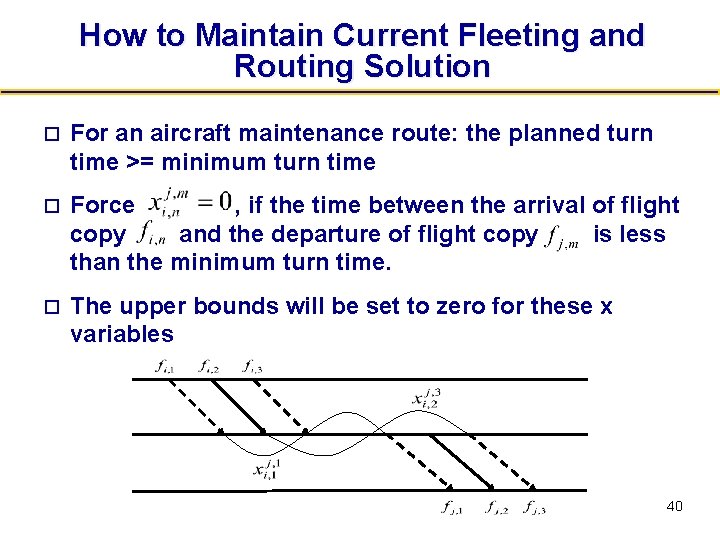
How to Maintain Current Fleeting and Routing Solution o For an aircraft maintenance route: the planned turn time >= minimum turn time o Force , if the time between the arrival of flight copy and the departure of flight copy is less than the minimum turn time. o The upper bounds will be set to zero for these x variables 40
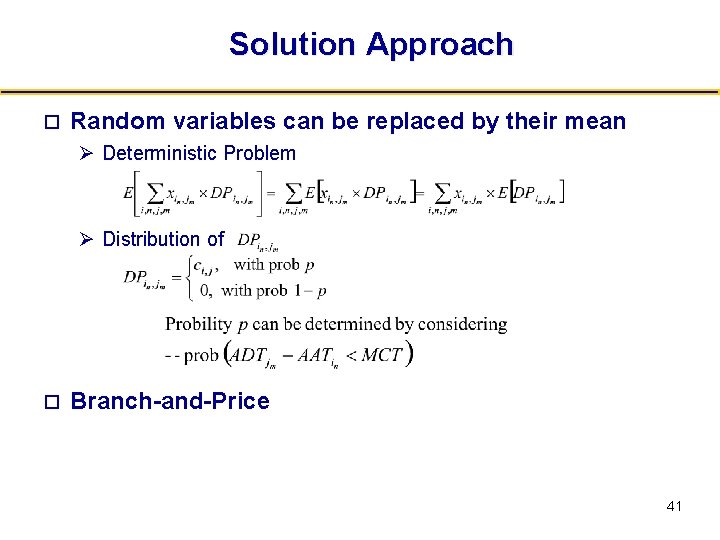
Solution Approach o Random variables can be replaced by their mean Ø Deterministic Problem Ø Distribution of o Branch-and-Price 41
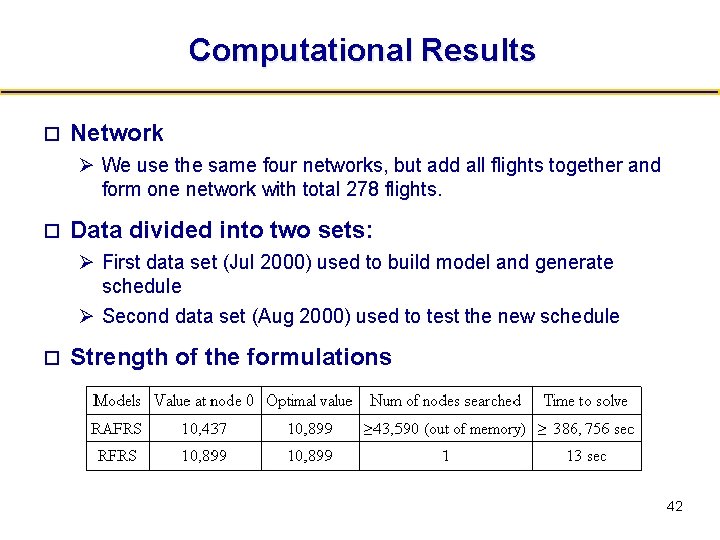
Computational Results o Network Ø We use the same four networks, but add all flights together and form one network with total 278 flights. o Data divided into two sets: Ø First data set (Jul 2000) used to build model and generate schedule Ø Second data set (Aug 2000) used to test the new schedule o Strength of the formulations 42
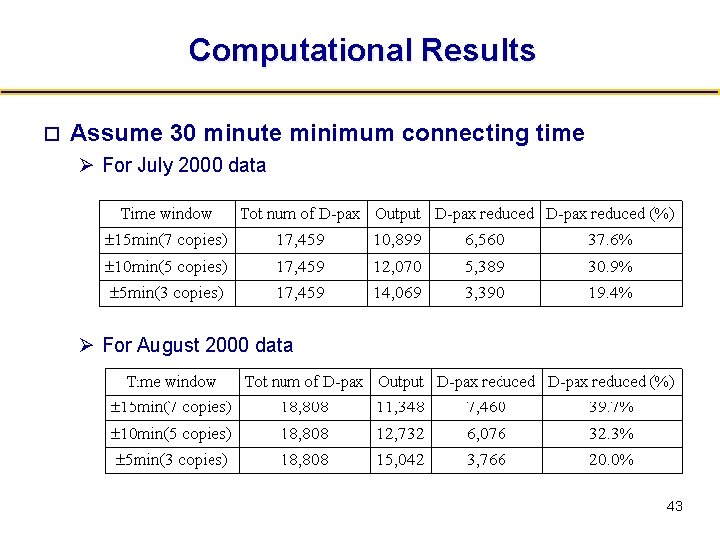
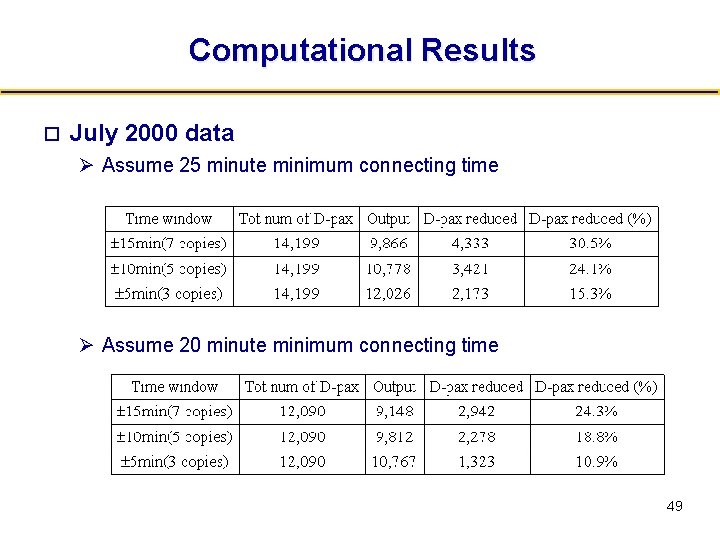
Computational Results o Assume 30 minute minimum connecting time Ø For July 2000 data Ø For August 2000 data 43
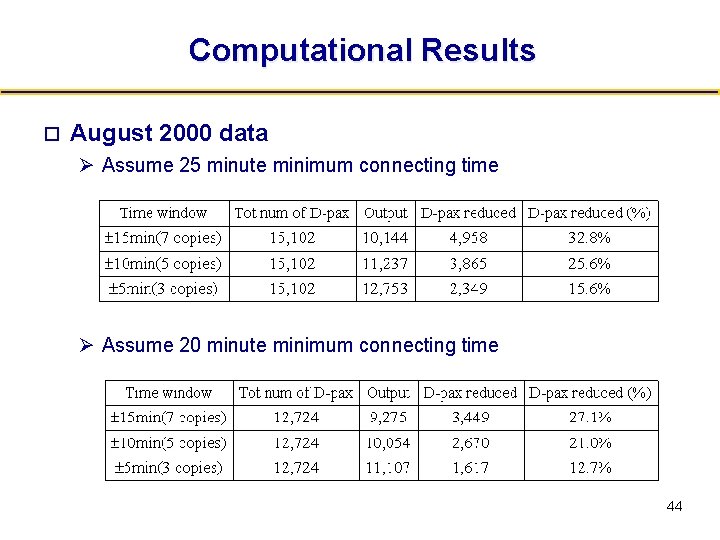
Computational Results o August 2000 data Ø Assume 25 minute minimum connecting time Ø Assume 20 minute minimum connecting time 44
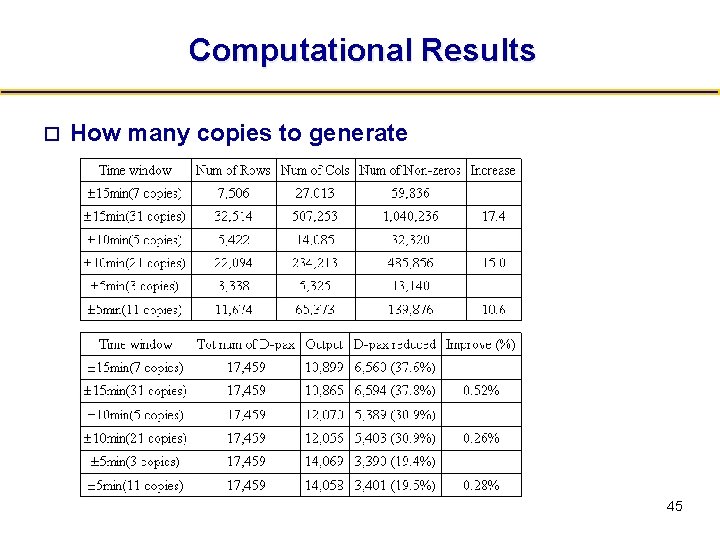
Computational Results o How many copies to generate 45
Outline o Background, Motivation and Our Contributions o Overview of Robust Airline Schedule Planning o Robust Maintenance Routing o Flight Schedule Retiming o Summary and Future Research Directions Ø Summary of Contributions Ø Future Research Directions 46
Summary of Contributions o Provide alternative definitions for robustness in the context of airline schedule planning o Develop an optimization model and solution approach that can generate aircraft maintenance routes to minimize delay propagation o Develop optimization models and solution approach to minimize the expected total number of passengers missing connections, and analyze the model properties o Proof-of-concept results show that these approaches are promising o Develop integrated models for more robustness 47
Future Research Directions o Integrated Models Ø Integrated robust aircraft maintenance routing with fleet assignment Ø Robust aircraft maintenance routing with time window Ø Integrated flight schedule re-timing with FAMTW o Other approaches Ø Ø Fleet assignment with minimal expected cost Fleet assignment under demand uncertainty Aircraft routes with swap opportunities Aircraft routes with short cycles 48
Computational Results o July 2000 data Ø Assume 25 minute minimum connecting time Ø Assume 20 minute minimum connecting time 49
Impact on Passengers q Disruptions calculated at the flight level Ø If a flight was cancelled, all passengers on that flight is disrupted Ø If actual departure time of flight B – actual arrival time of flight A < minimum connecting time all passengers connecting from A to B are disrupted q Number of disrupted passengers only calculated for connections between flights that both have ASQP records Ø ASQP has records only for domestic flights flown by jet airplanes and major airlines Ø Actual departure and arrival times for flights without ASQP records are unknown Assume no disruptions for these flights q Passengers only counted as disrupted once Ø If passenger is disrupted on any flight leg of itinerary, passenger not counted as disrupted on the following flight legs 50
Passenger Delays and Disruptions o Passenger delays Ø the difference between scheduled and actual arrival time at passengers’ destination o Passengers are disrupted if their planned itineraries are infeasible o Flight delay and passenger delay (Bratu and Barnhart, 2002) 51
Passenger Disruption o Disrupted passengers Ø Ø Ø o Significant numbers: 4% 20 -30 million in U. S. Experience very long delay Contribute to more than half of the total passenger delay Cause huge revenue loss Destroy airlines’ image Reduce disrupted passengers Ø Passenger delay caused by disruption is the most critical part Ø Hard to determine the delays for each disrupted passengers Minimize number of disrupted passengers 52
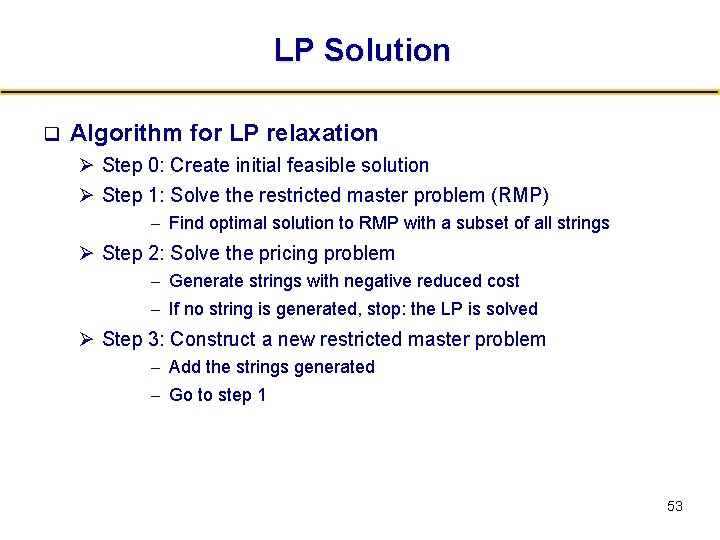
LP Solution q Algorithm for LP relaxation Ø Step 0: Create initial feasible solution Ø Step 1: Solve the restricted master problem (RMP) – Find optimal solution to RMP with a subset of all strings Ø Step 2: Solve the pricing problem – Generate strings with negative reduced cost – If no string is generated, stop: the LP is solved Ø Step 3: Construct a new restricted master problem – Add the strings generated – Go to step 1 53
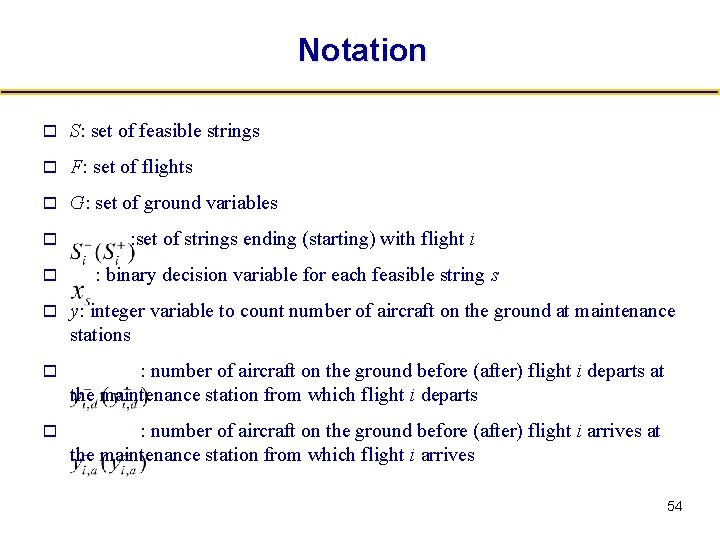
Notation o S: set of feasible strings o F: set of flights o G: set of ground variables o o : set of strings ending (starting) with flight i : binary decision variable for each feasible string s o y: integer variable to count number of aircraft on the ground at maintenance stations o : number of aircraft on the ground before (after) flight i departs at the maintenance station from which flight i departs o : number of aircraft on the ground before (after) flight i arrives at the maintenance station from which flight i arrives 54
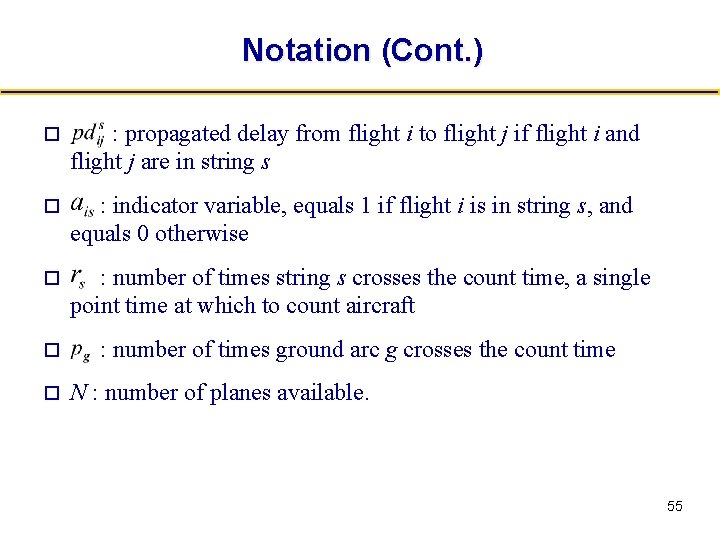
Notation (Cont. ) o : propagated delay from flight i to flight j if flight i and flight j are in string s o : indicator variable, equals 1 if flight i is in string s, and equals 0 otherwise o : number of times string s crosses the count time, a single point time at which to count aircraft o : number of times ground arc g crosses the count time o N : number of planes available. 55
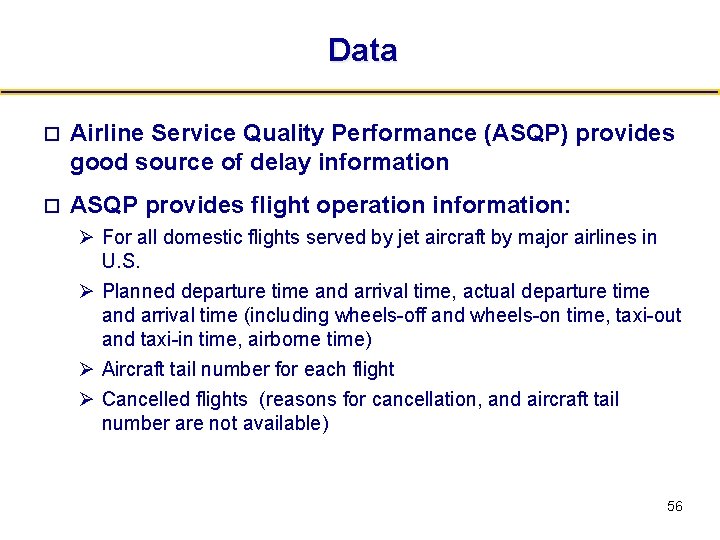
Data o Airline Service Quality Performance (ASQP) provides good source of delay information o ASQP provides flight operation information: Ø For all domestic flights served by jet aircraft by major airlines in U. S. Ø Planned departure time and arrival time, actual departure time and arrival time (including wheels-off and wheels-on time, taxi-out and taxi-in time, airborne time) Ø Aircraft tail number for each flight Ø Cancelled flights (reasons for cancellation, and aircraft tail number are not available) 56
Effect of Cancellations o For cancelled flights in the historical data Ø we don’t know which aircraft supposed to fly them Ø We don’t have the delay information Ø We assume the propagated delays for these flights are zero o Lower cancellation rates Ø Less passengers disrupted because of cancellation Ø More passengers disrupted because of flight delays o 7 days in Aug 2000 with very few cancellations (cancellation rate = 0. 19%) Ø For Aug 2000, 65% of disrupted passengers are disrupted because of flight delays Ø For 7 selected days in Aug 2000, 92% of disrupted passengers are disrupted because of flight delays 57
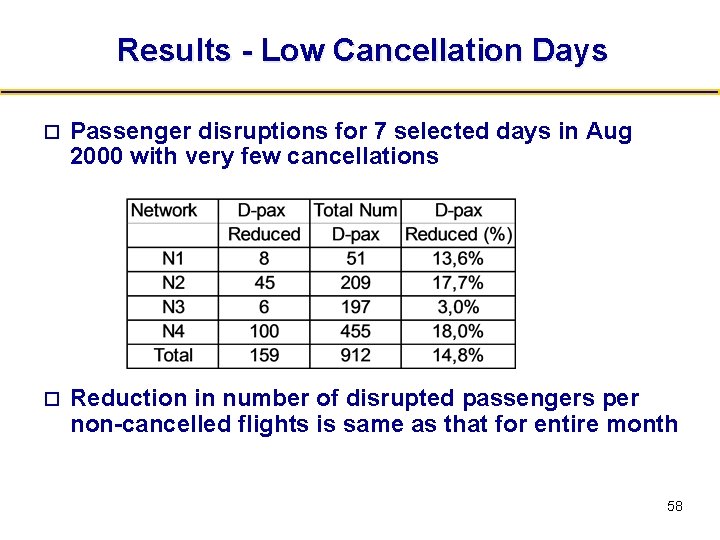
Results - Low Cancellation Days o Passenger disruptions for 7 selected days in Aug 2000 with very few cancellations o Reduction in number of disrupted passengers per non-cancelled flights is same as that for entire month 58
Extensions o Combine with scheduling Ø More slacks may be added further reduce delay propagation o Combine with fleet assignment Ø Need to determine cost for propagated delay Ø More feasible strings better solution Ø Minimum turn time is a function of fleet type o Integrate with fleet assignment and schedule generation 59
- Slides: 59