
The Bar keeping Vocation Becoming a Bartender The

The Bar keeping Vocation: Becoming a Bartender
The bartender is a person who mixes and serves drinks to the customer at the bar and fills the drink orders to the server.
The bartender is a skilled tradesman who has to have thorough knowledge of bar management if he/she is to be efficient.
This person provides good spirit with a ready smile, a friendly word, a sympathetic ear and a shoulder to cry upon.
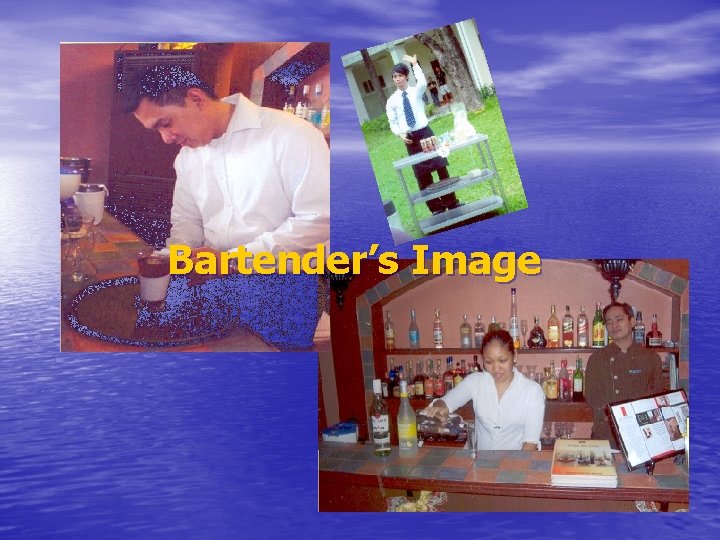
Bartender’s Image
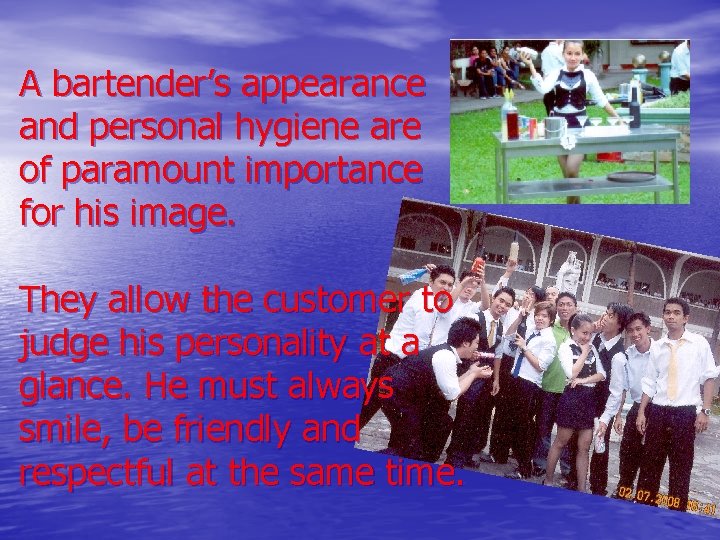
A bartender’s appearance and personal hygiene are of paramount importance for his image. They allow the customer to judge his personality at a glance. He must always smile, be friendly and respectful at the same time.
*Posture – habitually upright but easy. *Hair – close, cut, clean, well-brushed, women should have their hair tied neatly. *Perfume – not permissible while on duty. *Manner – alert, cheerful, ready to smile, well poised. *Face – clean-shaven for men neat make-up for women. *Habits – no drinking, eating, or smoking while on duty.
*Neck tie – neat and properly tied. *Jewelry – preferably not worn while on duty. *Hands – kept dry and clean, nails closely trimmed. *Uniform – free from stains, spot, perspiration and well pressed. *Hose/stocking – free from holes and tears. *Shoe - neat, well shinned and comfortable for standing long hours at a time.
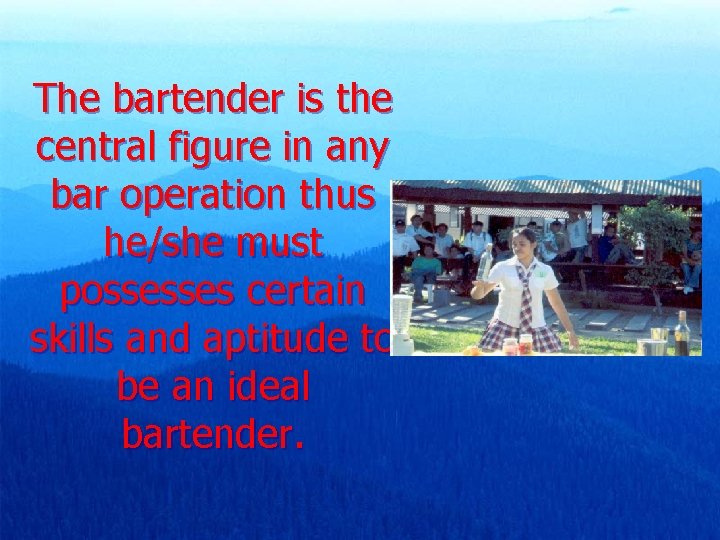
The bartender is the central figure in any bar operation thus he/she must possesses certain skills and aptitude to be an ideal bartender.
• Must be dexterous and have good short-term memory. • Must have the ability to work with great speed under pressure. • Must have a pleasing appearance and personality. • Must be dedicated to his work and industrious. • Must have excellent talent in public relations. Is a typical host and promoter that can build goodwill and good business.
• Must be resourceful, creative and innovative. • Must be good merchandiser. • Must have store knowledge of information. • Must be knowledgeable in basics accounting (especially cost control). • Must be courteous at all times. • Most important quality of all is honest
Grooming and Hygiene: • Personal Appearance: – One should wear proper uniform – Takes a bath everyday – Apply deodorant – Maintains properly combed hair – Wears appropriate shoes (black) – Brushed teeth regularly (after each meal) – Never wears the same underwear/ socks in 2 days
• Personal Appearance: – Possesses a handkerchief – Keeps nails short and clean – Hair is trimmed as often as necessary – Avoids wearing jewelry while on duty – Avoids drinking behind the bar
This is not the only demand that will be placed on your people skills. What are you serving? A substance that affects inhibition. Usually, a bar is a happy and sociable place. But there will come times when you’ll have to deal with drunks – some swaggering, some stubborn; others defiant, macho, obnoxious, pathetic, or downright scary.
• Sanitation: – Never smokes behind the bar, it’s unsightly – Never chews gum in public – Never picks eye, ears, and/or nose in public – Never comb your hair in front of guests – Never cough or sneeze in front of guests – Wash hands with soap and water after using the toilette – Be sure hands are clean and dry before mixing drinks – Avoid using dripping hands (wet) when mixing drinks
Bartending is a lot less about pouring and shaking than its about people. If you don’t have people skills, get them. And if you can’t get them, don’t even think about tending bar for a living.

The well-worn cliché about the bartender being the poor-man’s psychiatrist is well worn for a reason: it’s true. You’ll listen to hours of problems, both petty and profound. With some people you’ll sympathize. You’ll probably take a liking to many customers. But you can also count on running across a sizable number of jerks. To them you must also give attention and never let on what you may really feel.
This is not the only demand that will be placed on your people skills. What are you serving? A substance that affects inhibition. Usually, a bar is a happy and sociable place. But there will come times when you’ll have to deal with drunks – some swaggering, some stubborn; others defiant, macho, obnoxious, pathetic, or downright scary.
It is your responsibility to keep an eye on your customers, to recognize when someone has had enough or more than enough, and it is your responsibility to refuse to give them more. If serving customers is demanding, not serving them can be even more challenging.

Acting the Part
The successful bartender continuously broadcasts three messages: 1. I am friendly and courteous and want to serve you. 2. I am confident and efficient and will serve you well. 3. I am supremely confident and will serve you with authority.
The last item is perhaps the most important. Act vague, confused, or tentative and customers will question the quality of the drinks you mix (even if nothing is wrong with them).
Project confidence in the way you move. Keep your bar well arranged, so that you can grab the right bottle in a single motion, quickly and firmly by the neck. Pour without hesitation, speak clearly, and always express yourself positively.
None of this means that you have to be infallible. Obviously, the more you know about missing drinks, the better, and you should certainly know the most frequently requested drinks by heart.
But if you’re stumped, boldly ask the customer. “You’ve got me there. What goes into a Sazerac? ” Never reply that you don’t know how to make such-and-such. Instead, ask the customer. If the customer doesn’t know either, ask, “Well, do you mind if I look this one up? ”

Customer Service
Adopt a the-customer-is-alwaysright attitude, even if the customer is wrong. If a patron insists that you make a drink a certain way – even if it’s the wrong way – don’t argue. Just do it.
If you are sure that the result will be absolutely awful, reply this way: “That’s interesting. I’ve never made one that way. Have you tried it with…? ” This will give the customer a chance to save face if he realizes he is wrong. If the customer still wants it his way, give it to him his way without another word.
If you are asked to recommend a drink or a brand of liquor, do so, but never suggest to a customer that he or she has made a bad choice.
And accept that smoking and drinking go together. Never comment on smoking, pro or con. If a customer goes for a cigarette, light it, if you can.
Keep the ashtrays clean, changing them by putting the clean ashtray over the dirty one lifting both from the bar, putting the dirty one down behind the bar, and putting the clean one in its place. This is called capping the ashtray; it keeps ashes from fluttering out of the dirty one as you move it.
Bartender Required Qualities:
The first requirement for bartenders, as for everyone else working in the hospitality industry, is the right attitude, the determination to make sure that your customers are not made to feel welcome and that when they leave they will want to return. Not everyone can make a good bartender s the job demands an impressive range of characteristics.
• You need to be personable, considerate and patient and to • • have a sense of humor. You need to be courteous and good mannered, tactful and a good listener. You must be neat and clean and take pride in your appearance. You must be reliable, punctual, responsible and cooperative. You must be positive and energetic, able to take the initiative and to cope with stress. You must have common sense. You must be accurate and able to handle money. You must be able to organize yourself and be efficient. You must be honest. You must be able to work in a team, helping your workmates and the manager, who is of course, part of the team. And you must know your job.
Position: Beverage Manager Reports to: Operations Manager • Responsibilities include: – Hiring and firing of personnel – Training, scheduling and supervision of beverages related personnel – Forecasting and budgeting
• Responsibilities include: – Purchasing beverages and equipment or requisitioning them from central storage – Carrying out control systems – Maintaining records – Maintaining quality of service and operational procedures – Promoting the enterprise and merchandise – Setting standards and making policy on matters relating to beverage operation
Position: Bartender Reports to: Beverage Manager • Duties and responsibilities: – Prepare and or mixes alcoholic and nonalcoholic drinks according to prescribed standards. – Set-up the bar, equipping it with beverage stock, tools, and necessary equipments and supplies. – Prepares bar garnishes and ice supply.
• Duties and Responsibilities: – Maintain cleanliness and orderliness inside the bar area and stock room. – Checks and maintain stock levels of bar supplies, makes requisitions when necessary, obtains requisition supplies. – Takes charge of storage and refrigeration of beverages including wines. – Washes and dries dirty glasses, as well as other bar tools and equipment. – Takes order from and serve drinks to guests in the bar counter, presents bills/receipts, accepts payments and gives them to the cashier.
• Duties and Responsibilities: – Makes report on beverage consumption, as well as reports on losses and breakages of equipments; submits reports to the supervisor/ manager. – Participates in inventories of the bar stocks and equipments done by the cost control/ accounting. – Takes charge in closing the bar after operating hours. – Perform such other duties related to bar service as may be assigned.
The Rewards and Risks of Bartending
According to Les Krantz’s jobs Rated Almanac (third edition, 1995), the average bartender works just under a 40 -hour week. However, bartending is one of those jobs that usually can be worked part time or overtime.
While you’ll probably never get rich as a full-time bartender – unless you use the job as a stepping stone to a management or ownership position – bartending can be an excellent part-time profession.
Hours are often flexible, as are opportunities for mobility: few populated places on the globe are very distant from a bar. Nor are you restricted to working in a single type of environment. A bar may be set in the corner tavern; the local disco; the hottest, hardestto-get-into nightclub; a motel; a hotel; a fine restaurant; an airport - you name it. You don’t even have to work in a bar. Catering services set up bars in people’s homes, in auditoriums and convention halls, at outdoor events, and so on.
Bartending’s biggest challenge – dealing with a lot of people on an intimate level – is also, for most professionals, its greatest attraction. You’ll meet a cross section of humanity. You’ll make friends. You’ll make contacts you would not make into in any other profession. You’ll have the opportunity to watch people interact and be – people.
In most bars, bartending is not a particularly hazardous job. While it is true that the potential exists for unpleasant or even violent events, larger bars employ some form of security personnel: a bouncer. In many popular and thickly populated clubs, off-duty police officers serve as the security staff.

Despite the presence of professional security personnel, bartender can be at some personal risk. Women bartenders especially find themselves fending off unwanted advances from customers. Such attention is often fairly benign, if annoying, but it can become intimidating and even threatening.
There also dangers associated with any late night job, as you travel to and from work or even walk from the bar to your car at two in the morning (or even later in some locales). Bartending can be hazardous to your health in other ways.
Possible assaults on your constitutions include sleep deprivation, prolonged exposure to second-hand cigarette smoke, and hearing loss as a result of sustained bombardment by multi decibel music.
There is also a downside to being around so much liquor. A bartender who samples the wares rarely lasts long as a bartender. Not only are you drinking up profits, you simply cannot do your job well if you’re chronically buzzed.
Manual dexterity deteriorates, and short-term memory takes a vacation. But let’s say you somehow get away with it. A bartender who drinks night after night is headed for all the ills alcohol can bring. Bartending is not a profession for people with addiction-prone personalities.

- The End -
- Slides: 51