
Comprehensive training to support the national TBHIV Information
Comprehensive training to support the national TB/HIV Information System (THIS) integration initiative Change management processes to implement integrated TB and HIV data management in facilities, using TIER. Net
TIER. Net implementation TIER overview and implementation phases 2
Background In 2011 South Africa adopted the 3 Tiered ART M&E Strategy, consisting of: q 1 st tier paper ART register, or q 2 nd tier TIER. Net, a non networked electronic monitoring system, which digitizes HIV patients at facility level, or q 3 rd tier – sm. ARTer, networked Electronic Medical Record. In 2015 it was selected to expand capture for TB patients, based on independent system review. TIER is entrenched nationally: 3, 600 facilities (94% of ART sites) are digitising ART data in TIER. Net at facility level. 3
Phases of implementation for ART Phase 0: Preparation (buy in meeting with facility managers, filing, orientation, and process flow). Phase 1: Installation and training. Phase 2: Back capturing. Phase 3: Back capturing with live capturing. Phase 4: Live capturing (back capturing complete) and data cleaning in progress. Phase 5: Data signoff by DIT/PIT after completion of data clean up and baseline audit done. Phase 6: Completion. 4
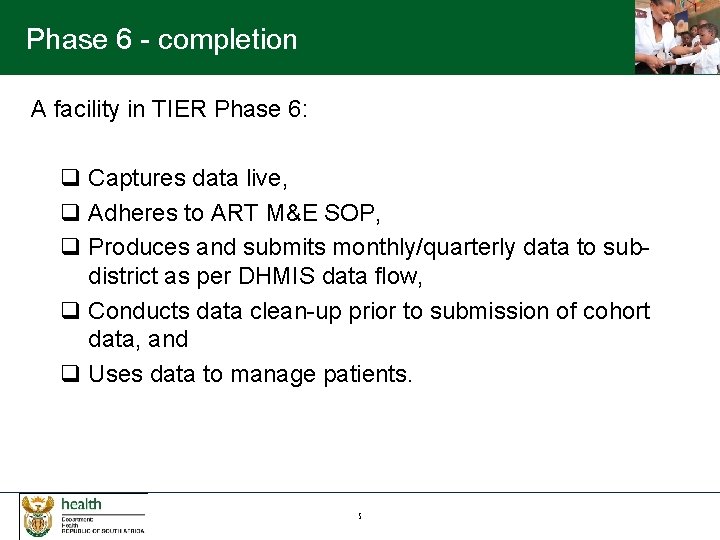
Phase 6 completion A facility in TIER Phase 6: q Captures data live, q Adheres to ART M&E SOP, q Produces and submits monthly/quarterly data to sub district as per DHMIS data flow, q Conducts data clean up prior to submission of cohort data, and q Uses data to manage patients. 5
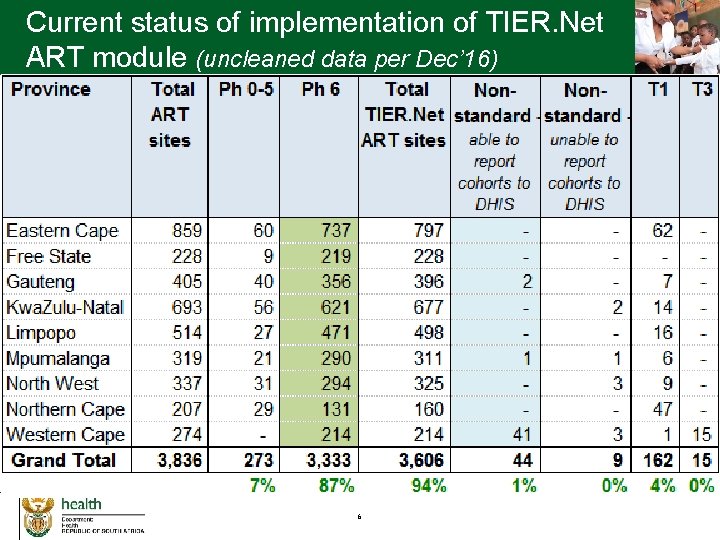
Current status of implementation of TIER. Net ART module (uncleaned data per Dec’ 16) 6
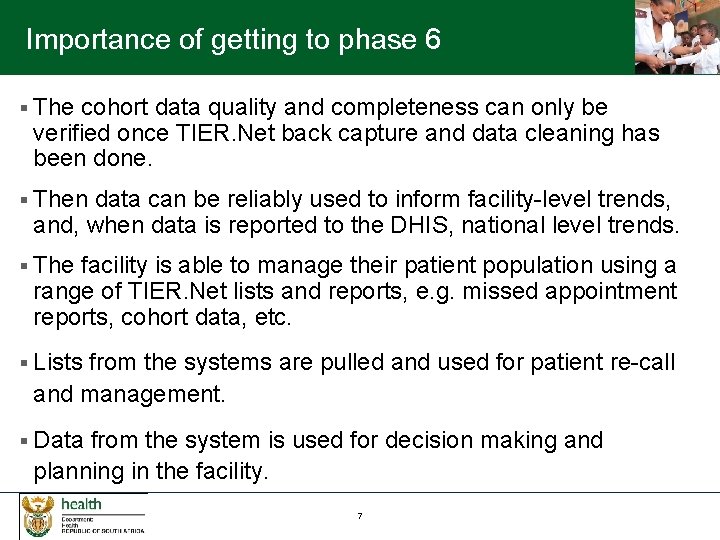
Importance of getting to phase 6 § The cohort data quality and completeness can only be verified once TIER. Net back capture and data cleaning has been done. § Then data can be reliably used to inform facility level trends, and, when data is reported to the DHIS, national level trends. § The facility is able to manage their patient population using a range of TIER. Net lists and reports, e. g. missed appointment reports, cohort data, etc. § Lists from the systems are pulled and used for patient re call and management. § Data from the system is used for decision making and planning in the facility. 7
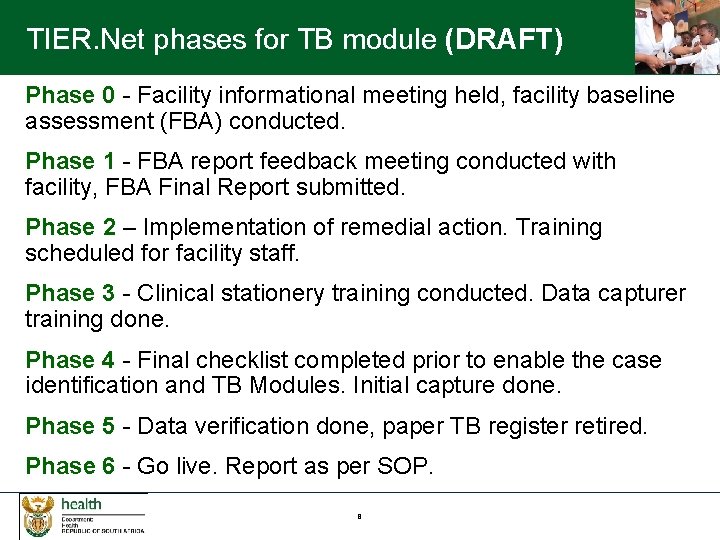
TIER. Net phases for TB module (DRAFT) Phase 0 Facility informational meeting held, facility baseline assessment (FBA) conducted. Phase 1 FBA report feedback meeting conducted with facility, FBA Final Report submitted. Phase 2 – Implementation of remedial action. Training scheduled for facility staff. Phase 3 Clinical stationery training conducted. Data capturer training done. Phase 4 Final checklist completed prior to enable the case identification and TB Modules. Initial capture done. Phase 5 Data verification done, paper TB register retired. Phase 6 Go live. Report as per SOP. 8
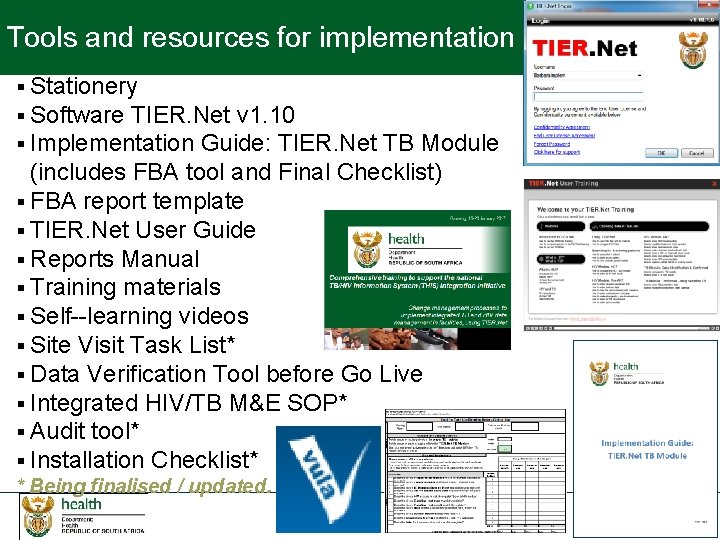
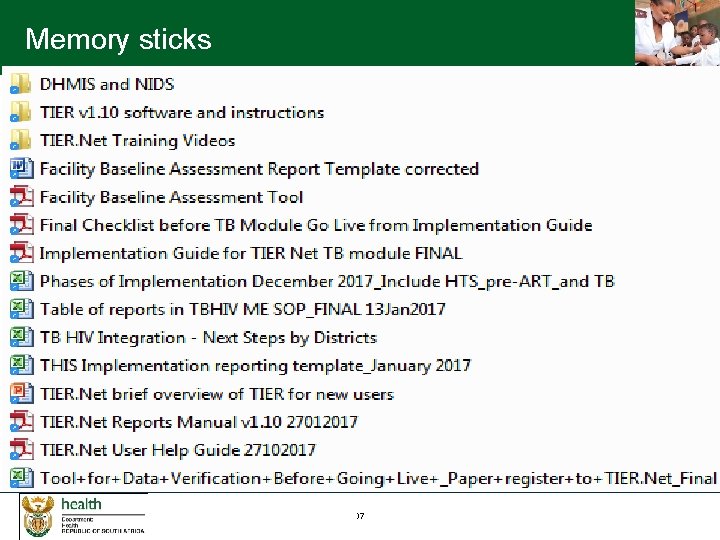
Tools and resources for implementation § Stationery § Software TIER. Net v 1. 10 § Implementation Guide: TIER. Net TB Module (includes FBA tool and Final Checklist) § FBA report template § TIER. Net User Guide § Reports Manual § Training materials § Self learning videos § Site Visit Task List* § Data Verification Tool before Go Live § Integrated HIV/TB M&E SOP* § Audit tool* § Installation Checklist* * Being finalised / updated. 9

Questions? 10
TIER governance / implementation structures TKIs, DITs, PITs 11
Selection of TIER Key Implementers (TKIs) § Each district must have at least 1 TKI, identified by DIT. § In densely populated / heavily burdened districts, each sub district should have at least 1 TKI. § TKIs should primarily be drawn from TB or HAST cadres, and/or from M&E / Information Management. § TKIs should primarily be government officials. TKIs are also chosen for their go-getter approach, their work ethic, their tenacity, their problem-solving skills, their pro-activeness, their dependability. That is you! § District Manager formally signs off TKI appointment letters. 12
TKI responsibilities TKIs are responsible for driving the THIS integration rollout. This includes ensuring that each of the steps outlined in the: o Implementation Guide, o TB / HIV M&E SOP, and o Training materials are carried out smoothly and according to protocol at each facility. Note: difference in scope between TKIs at Provincial / District / Sub District level. 13
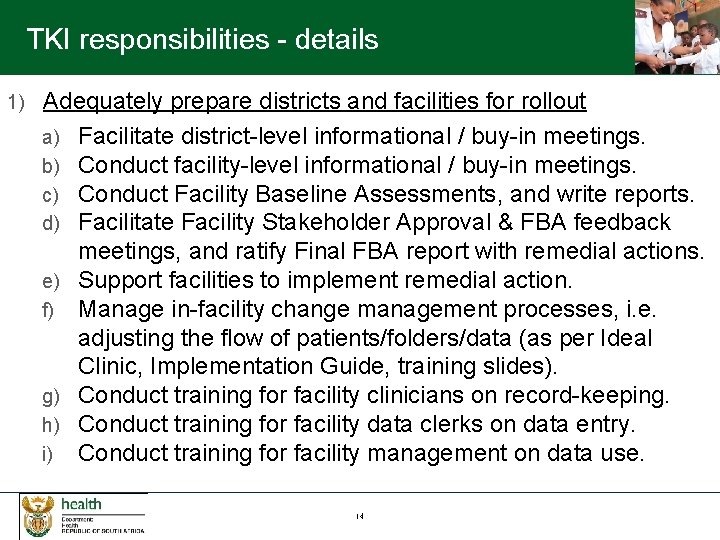
TKI responsibilities details 1) Adequately prepare districts and facilities for rollout a) Facilitate district level informational / buy in meetings. b) Conduct facility level informational / buy in meetings. c) Conduct Facility Baseline Assessments, and write reports. d) Facilitate Facility Stakeholder Approval & FBA feedback meetings, and ratify Final FBA report with remedial actions. e) Support facilities to implement remedial action. f) Manage in facility change management processes, i. e. adjusting the flow of patients/folders/data (as per Ideal Clinic, Implementation Guide, training slides). g) Conduct training for facility clinicians on record keeping. h) Conduct training for facility data clerks on data entry. i) Conduct training for facility management on data use. 14
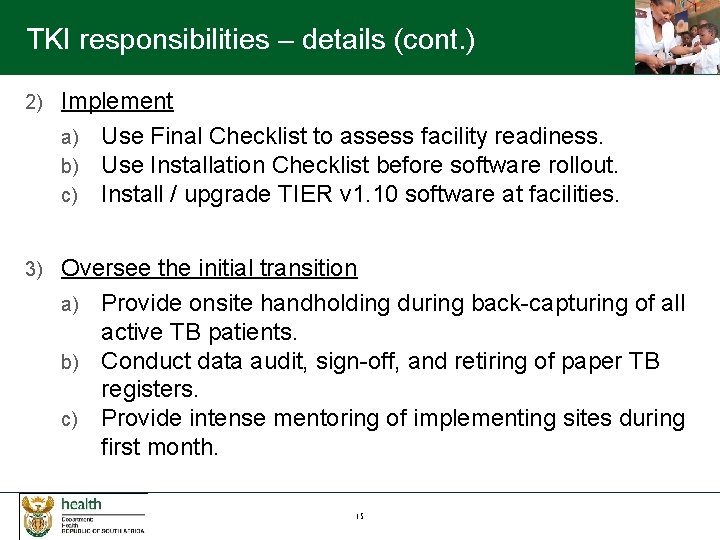
TKI responsibilities – details (cont. ) 2) Implement a) Use Final Checklist to assess facility readiness. b) Use Installation Checklist before software rollout. c) Install / upgrade TIER v 1. 10 software at facilities. 3) Oversee the initial transition a) Provide onsite handholding during back capturing of all active TB patients. b) Conduct data audit, sign off, and retiring of paper TB registers. c) Provide intense mentoring of implementing sites during first month. 15
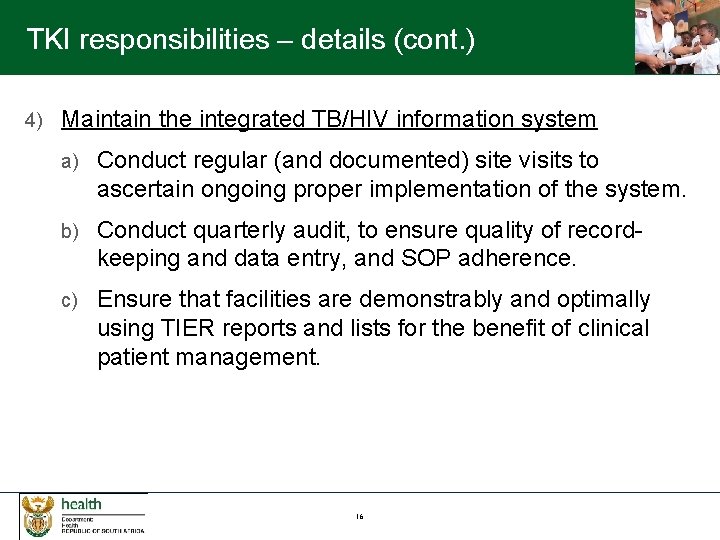
TKI responsibilities – details (cont. ) 4) Maintain the integrated TB/HIV information system a) Conduct regular (and documented) site visits to ascertain ongoing proper implementation of the system. b) Conduct quarterly audit, to ensure quality of record keeping and data entry, and SOP adherence. c) Ensure that facilities are demonstrably and optimally using TIER reports and lists for the benefit of clinical patient management. 16
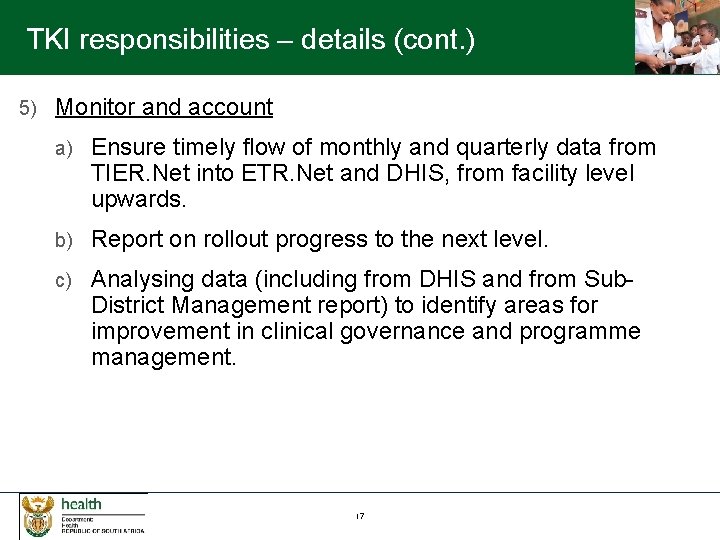
TKI responsibilities – details (cont. ) 5) Monitor and account a) Ensure timely flow of monthly and quarterly data from TIER. Net into ETR. Net and DHIS, from facility level upwards. b) Report on rollout progress to the next level. c) Analysing data (including from DHIS and from Sub District Management report) to identify areas for improvement in clinical governance and programme management. 17
TKI responsibilities – needs time and support All this needs protected time, and needs support from next level. What, how, who, when…? 18
TIER TB module implementation steps Summary / refresher on Implementation Guide and provincial road shows 25
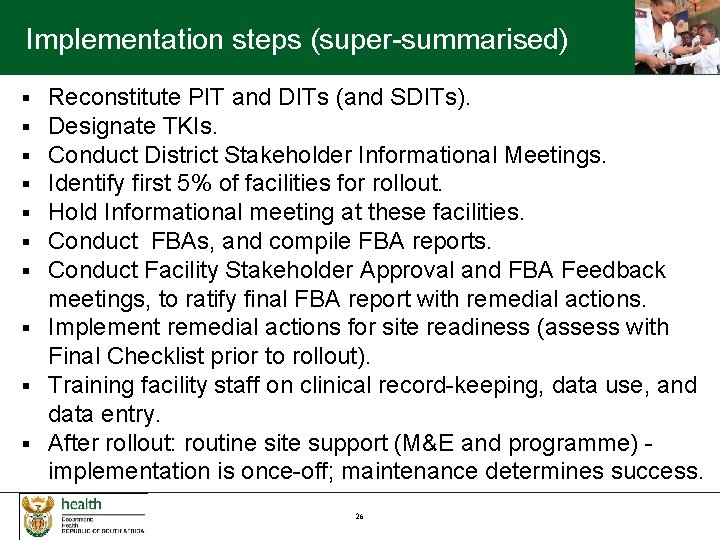
Implementation steps (super summarised) Reconstitute PIT and DITs (and SDITs). Designate TKIs. Conduct District Stakeholder Informational Meetings. Identify first 5% of facilities for rollout. Hold Informational meeting at these facilities. Conduct FBAs, and compile FBA reports. Conduct Facility Stakeholder Approval and FBA Feedback meetings, to ratify final FBA report with remedial actions. § Implement remedial actions for site readiness (assess with Final Checklist prior to rollout). § Training facility staff on clinical record keeping, data use, and data entry. § After rollout: routine site support (M&E and programme) implementation is once off; maintenance determines success. § § § § 26
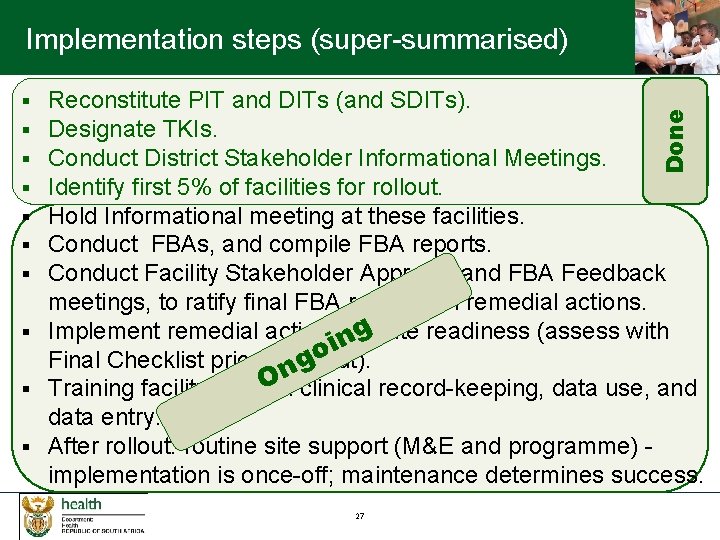
Implementation steps (super summarised) Reconstitute PIT and DITs (and SDITs). Designate TKIs. Conduct District Stakeholder Informational Meetings. Identify first 5% of facilities for rollout. Hold Informational meeting at these facilities. Conduct FBAs, and compile FBA reports. Conduct Facility Stakeholder Approval and FBA Feedback meetings, to ratify final FBA report with remedial actions. § Implement remedial actionsnfor site readiness (assess with g i o Final Checklist prior tonrollout). g § Training facility staff O on clinical record keeping, data use, and data entry. § After rollout: routine site support (M&E and programme) implementation is once off; maintenance determines success. Done § § § § 27
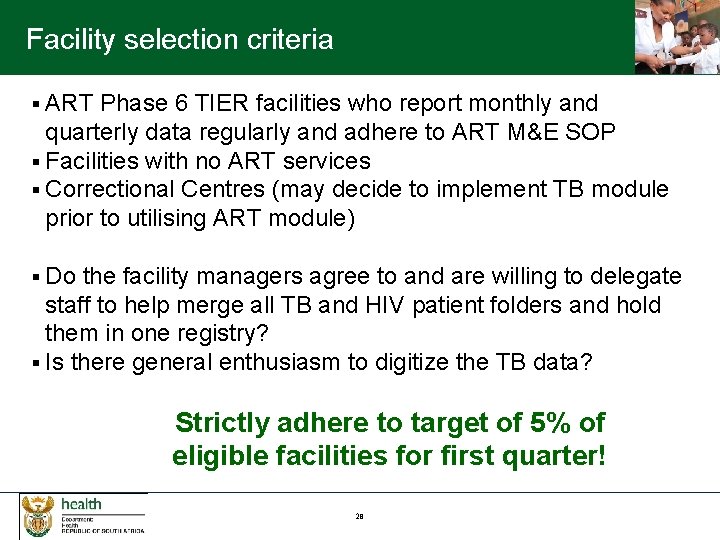
Facility selection criteria § ART Phase 6 TIER facilities who report monthly and quarterly data regularly and adhere to ART M&E SOP § Facilities with no ART services § Correctional Centres (may decide to implement TB module prior to utilising ART module) § Do the facility managers agree to and are willing to delegate staff to help merge all TB and HIV patient folders and hold them in one registry? § Is there general enthusiasm to digitize the TB data? Strictly adhere to target of 5% of eligible facilities for first quarter! 28
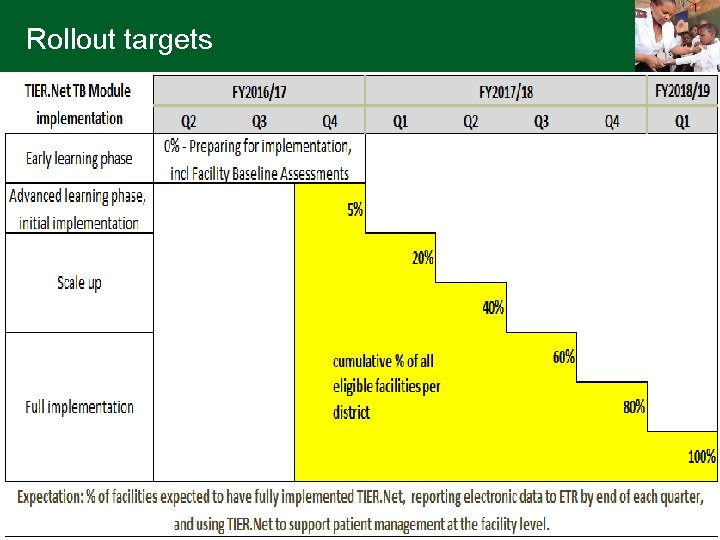
Rollout targets 29
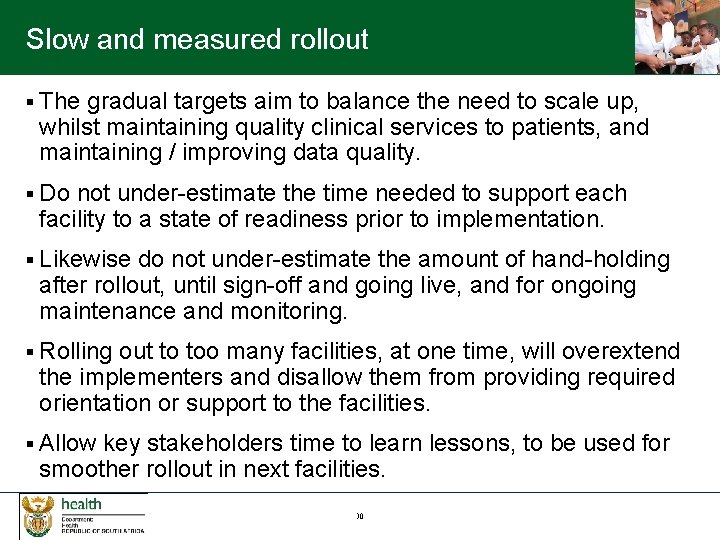
Slow and measured rollout § The gradual targets aim to balance the need to scale up, whilst maintaining quality clinical services to patients, and maintaining / improving data quality. § Do not under estimate the time needed to support each facility to a state of readiness prior to implementation. § Likewise do not under estimate the amount of hand holding after rollout, until sign off and going live, and for ongoing maintenance and monitoring. § Rolling out to too many facilities, at one time, will overextend the implementers and disallow them from providing required orientation or support to the facilities. § Allow key stakeholders time to learn lessons, to be used for smoother rollout in next facilities. 30
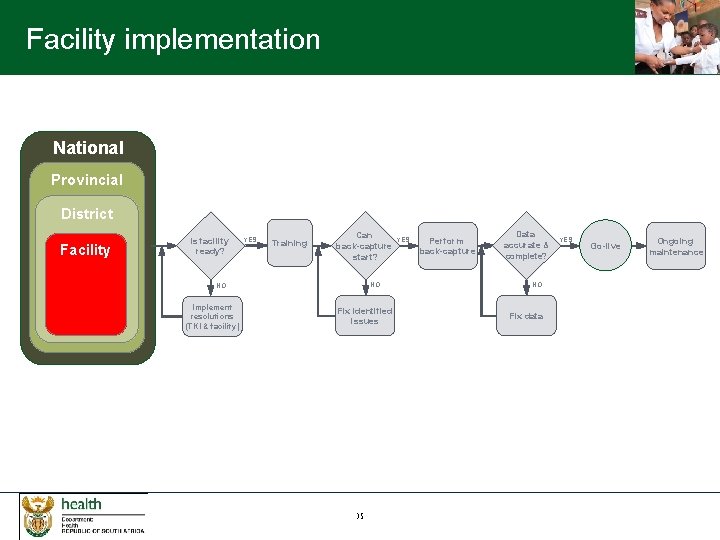
Facility implementation National Provincial District Facility Is facility ready? YES Training Can back-capture start? NO NO Implement resolutions (TKI & facility) Fix identified issues 35 YES Perform back-capture Data accurate & complete? NO Fix data YES Go-live Ongoing maintenance
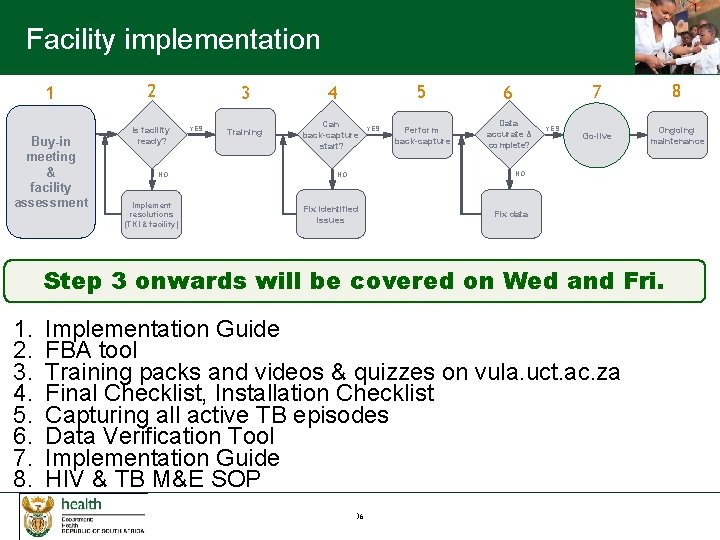
Facility implementation 1 Buy-in meeting & facility assessment 2 Is facility ready? NO Implement resolutions (TKI & facility) YES 3 4 Training Can back-capture start? YES 5 6 Perform back-capture Data accurate & complete? YES 7 8 Go-live Ongoing maintenance NO NO Fix identified issues Fix data Implementation Guidewill & other tools for on all steps in process: Step 3 onwards be covered Wed and Fri. 1. 2. 3. 4. 5. 6. 7. 8. Implementation Guide FBA tool Training packs and videos & quizzes on vula. uct. ac. za Final Checklist, Installation Checklist Capturing all active TB episodes Data Verification Tool Implementation Guide HIV & TB M&E SOP 36
Memory sticks 37
Questions? 38
Contact details of NIT members Nevilla Somnath – National TB Programme – RIMES – Nevilla. Somnath@health. gov. za Riona Govender – NDo. H M&E – Riona. Govender@health. gov. za Catherine White – M&E Technical Support to NDo. H cwhite@clintonhealthaccess. org Barbara Franken – Project Manager for THIS integration bfranken@clintonhealthaccess. org Ipeleng Mojaki – TIER Implementation Associate imojaki@clintonhealthaccess. org Moeketsi Finger – TIER Implementation Associate mfinger@clintonhealthaccess. org 39
- Slides: 29