Soil Acidity and p H Causes remediation and

- Slides: 35
Soil Acidity and p. H Causes, remediation, and implications
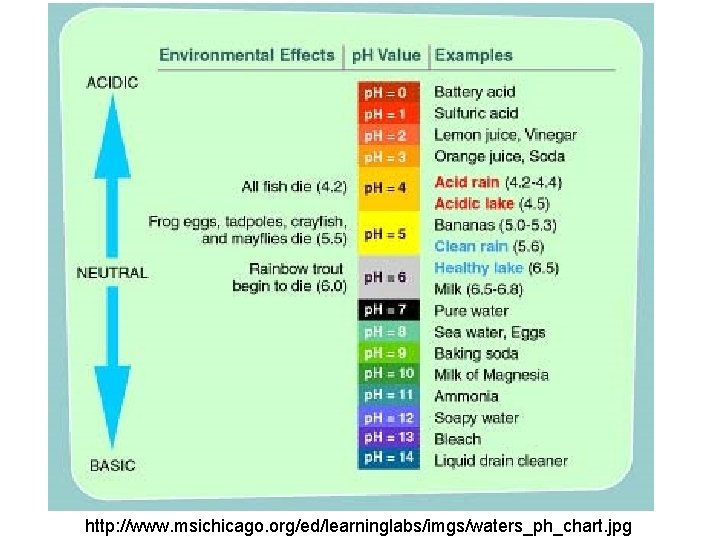
http: //www. msichicago. org/ed/learninglabs/imgs/waters_ph_chart. jpg
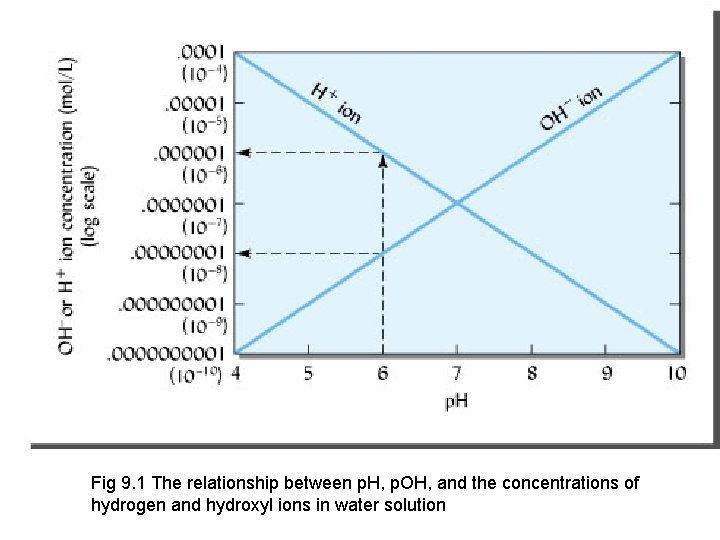
Fig 9. 1 The relationship between p. H, p. OH, and the concentrations of hydrogen and hydroxyl ions in water solution
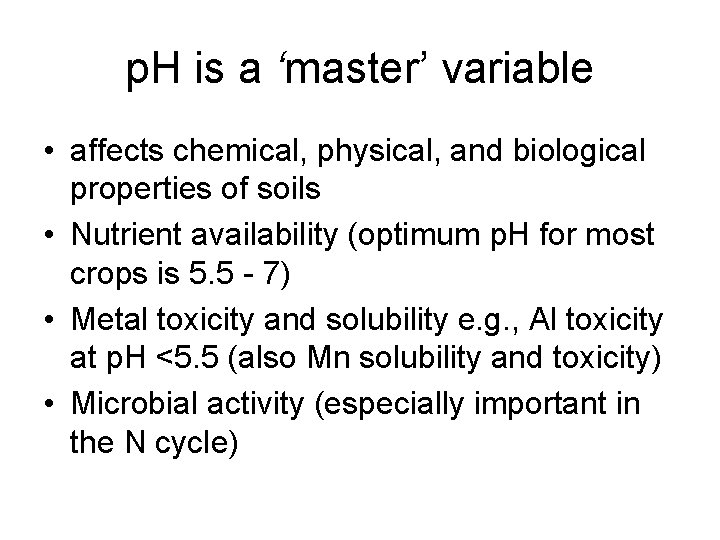
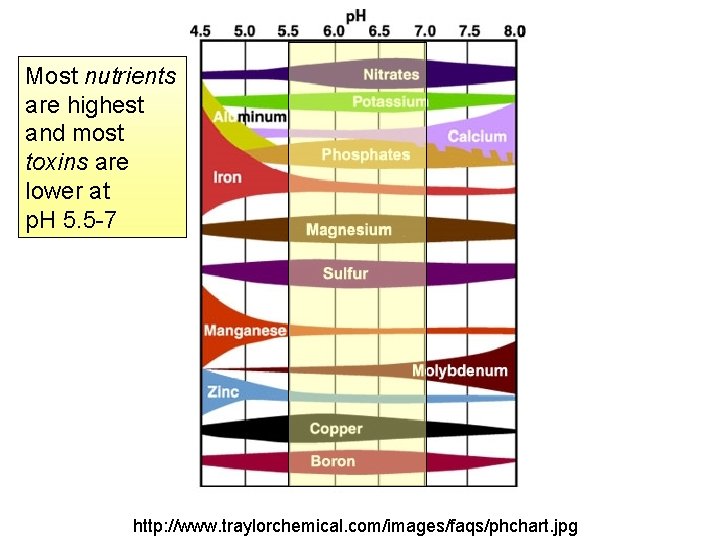
p. H is a ‘master’ variable • affects chemical, physical, and biological properties of soils • Nutrient availability (optimum p. H for most crops is 5. 5 - 7) • Metal toxicity and solubility e. g. , Al toxicity at p. H <5. 5 (also Mn solubility and toxicity) • Microbial activity (especially important in the N cycle)
Most nutrients are highest and most toxins are lower at p. H 5. 5 -7 http: //www. traylorchemical. com/images/faqs/phchart. jpg
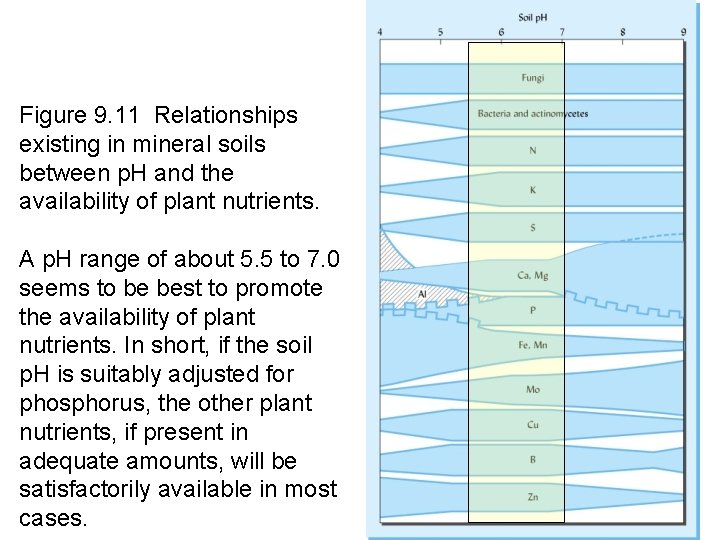
Figure 9. 11 Relationships existing in mineral soils between p. H and the availability of plant nutrients. A p. H range of about 5. 5 to 7. 0 seems to be best to promote the availability of plant nutrients. In short, if the soil p. H is suitably adjusted for phosphorus, the other plant nutrients, if present in adequate amounts, will be satisfactorily available in most cases.
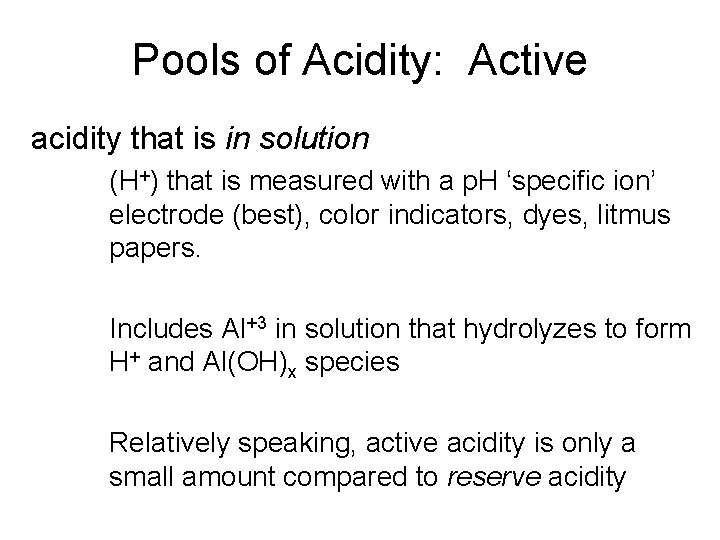
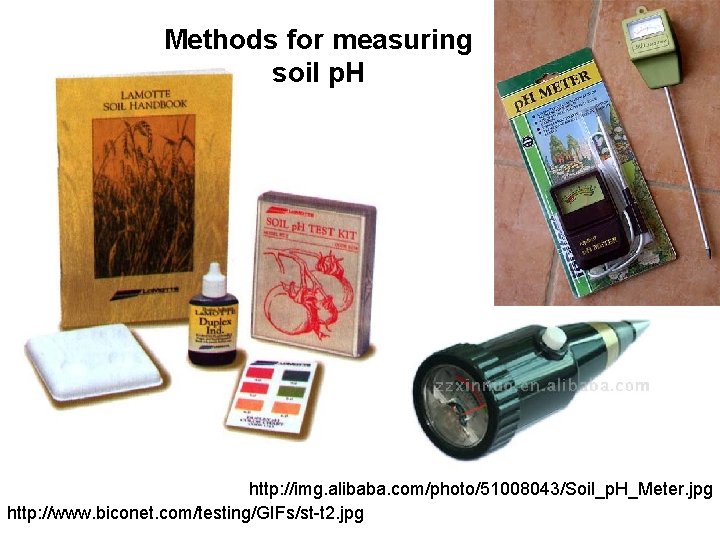
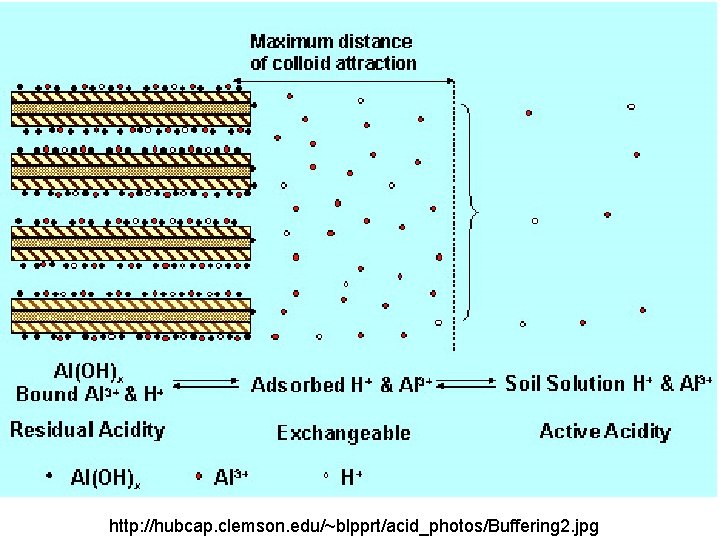
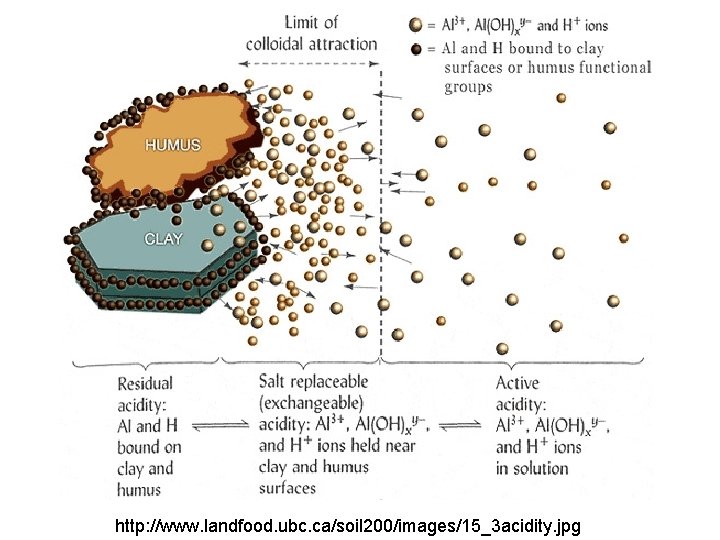
Pools of Acidity: Active acidity that is in solution (H+) that is measured with a p. H ‘specific ion’ electrode (best), color indicators, dyes, litmus papers. Includes Al+3 in solution that hydrolyzes to form H+ and Al(OH)x species Relatively speaking, active acidity is only a small amount compared to reserve acidity
Methods for measuring soil p. H http: //img. alibaba. com/photo/51008043/Soil_p. H_Meter. jpg http: //www. biconet. com/testing/GIFs/st-t 2. jpg
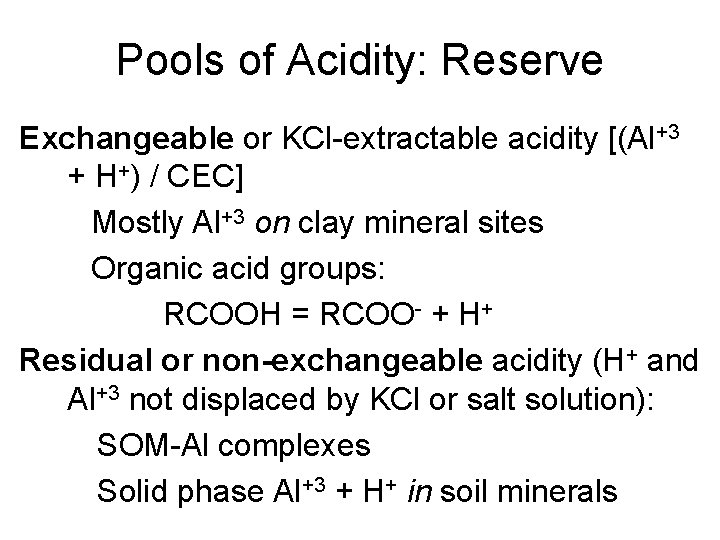
Pools of Acidity: Reserve Exchangeable or KCl-extractable acidity [(Al+3 + H+) / CEC] Mostly Al+3 on clay mineral sites Organic acid groups: RCOOH = RCOO- + H+ Residual or non-exchangeable acidity (H+ and Al+3 not displaced by KCl or salt solution): SOM-Al complexes Solid phase Al+3 + H+ in soil minerals
http: //hubcap. clemson. edu/~blpprt/acid_photos/Buffering 2. jpg
http: //www. landfood. ubc. ca/soil 200/images/15_3 acidity. jpg
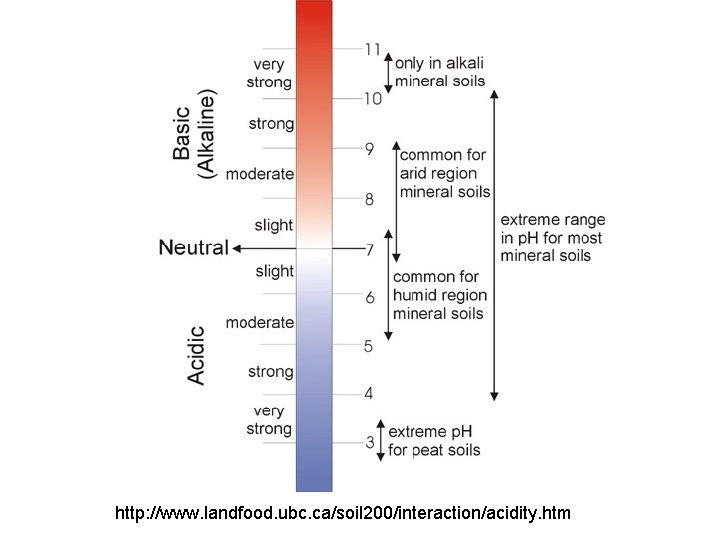
http: //www. landfood. ubc. ca/soil 200/interaction/acidity. htm
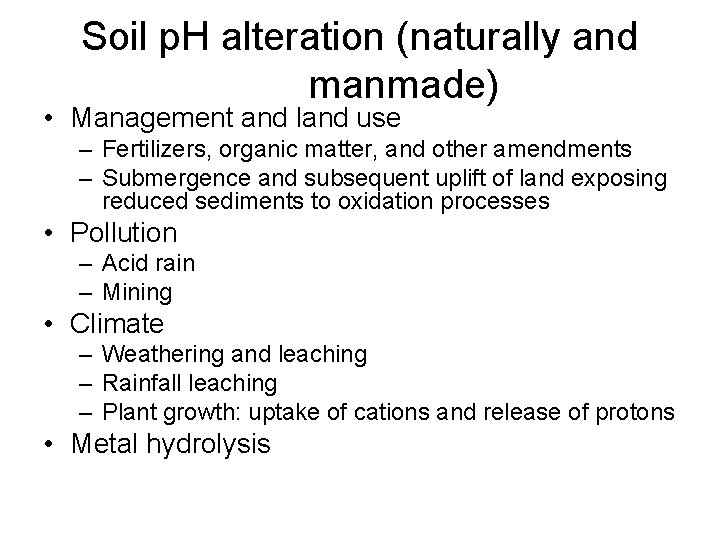
Soil p. H alteration (naturally and manmade) • Management and land use – Fertilizers, organic matter, and other amendments – Submergence and subsequent uplift of land exposing reduced sediments to oxidation processes • Pollution – Acid rain – Mining • Climate – Weathering and leaching – Rainfall leaching – Plant growth: uptake of cations and release of protons • Metal hydrolysis
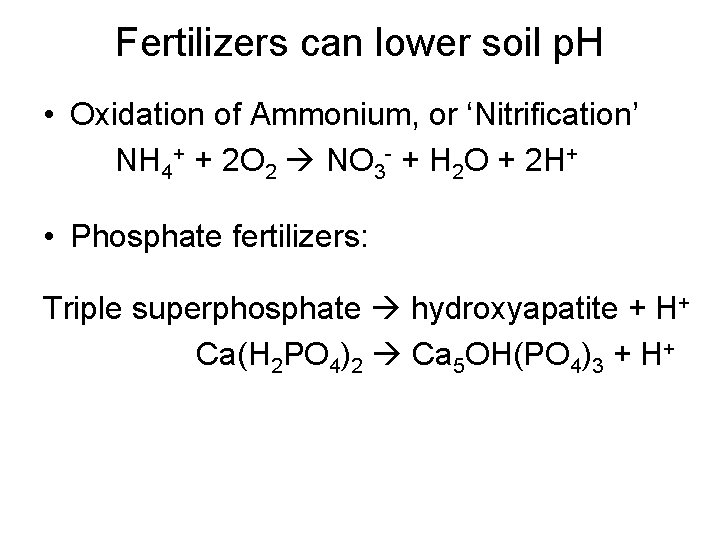
Fertilizers can lower soil p. H • Oxidation of Ammonium, or ‘Nitrification’ NH 4+ + 2 O 2 NO 3 - + H 2 O + 2 H+ • Phosphate fertilizers: Triple superphosphate hydroxyapatite + H+ Ca(H 2 PO 4)2 Ca 5 OH(PO 4)3 + H+
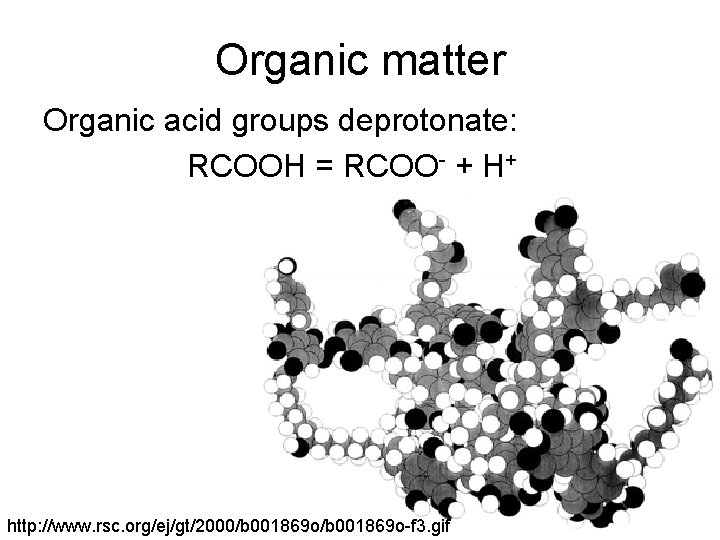
Organic matter Organic acid groups deprotonate: RCOOH = RCOO- + H+ http: //www. rsc. org/ej/gt/2000/b 001869 o-f 3. gif
Amendments that lower soil p. H Oxidation of elemental sulfur produces sulfuric acid which dissociates easily S 0 + 3/2 O 2 + H 2 O H 2 SO 4 Some growers even use sulfuric acid – but it is very dangerous, expensive, and doesn’t last long in arid zone soils Alum, KAl(SO 4)2 is a commercial product for lowering p. H
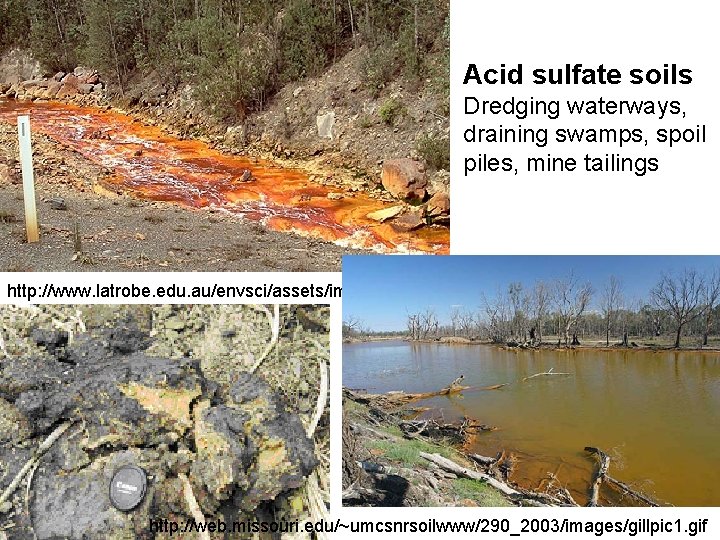
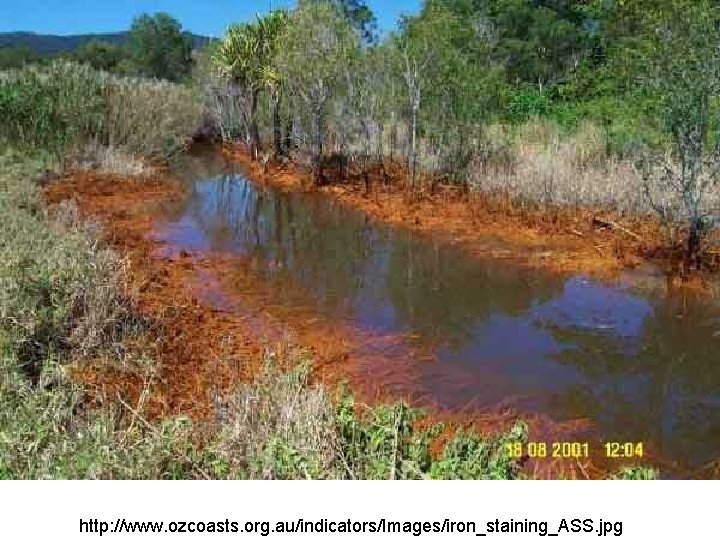
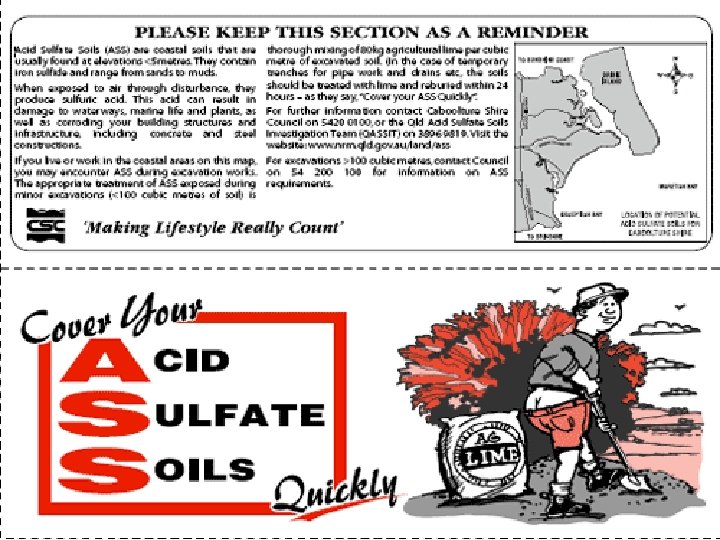
Acid sulfate soils Dredging waterways, draining swamps, spoil piles, mine tailings http: //www. latrobe. edu. au/envsci/assets/images/publicity/amd 2 -edit. jpg http: //web. missouri. edu/~umcsnrsoilwww/290_2003/images/gillpic 1. gif
http: //www. ozcoasts. org. au/indicators/Images/iron_staining_ASS. jpg
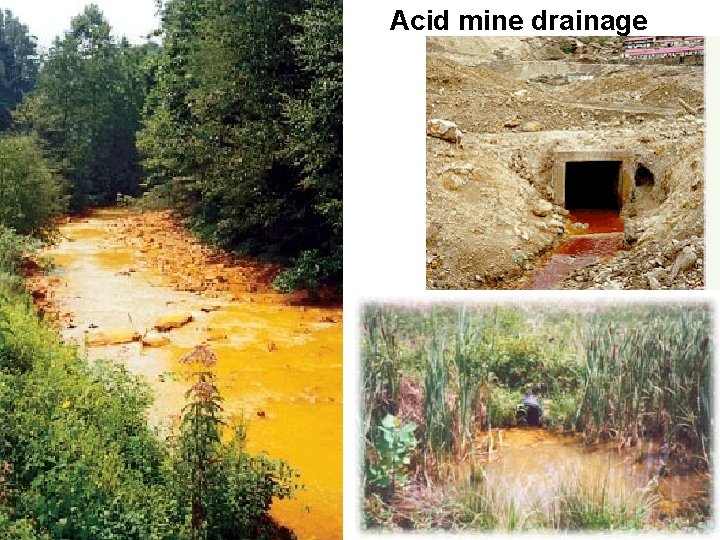
Iron staining is often a good indicator of disturbed acid sulfate soils. When acid sulfate soils are disturbed and undergo oxidization, the sulfuric acid produced mobilizes iron, aluminum and heavy metals present in the soil. Toxic amounts of dissolved iron can then be washed into waterways. This iron can precipitate when in contact with less acid water, such as rainwater or seawater. This results in a rust-colored iron oxide scum or ‘floc' which can smother vegetation and stain concrete and soil. ('QASSIT, Qld Department of Natural Resources and Mines').
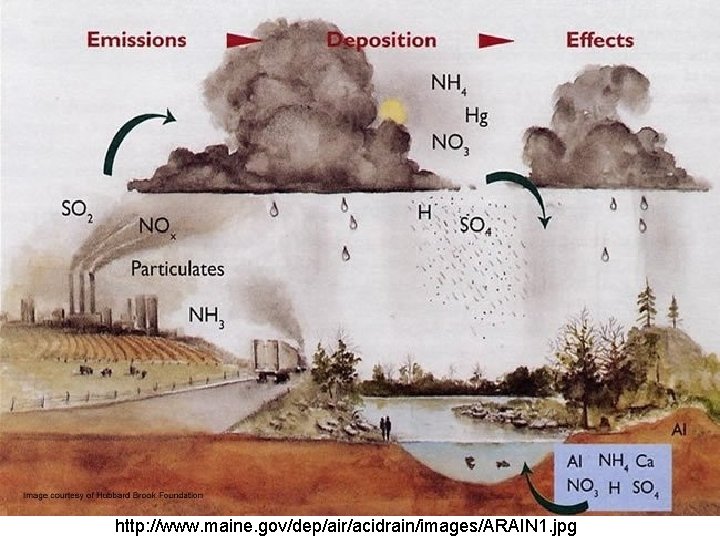
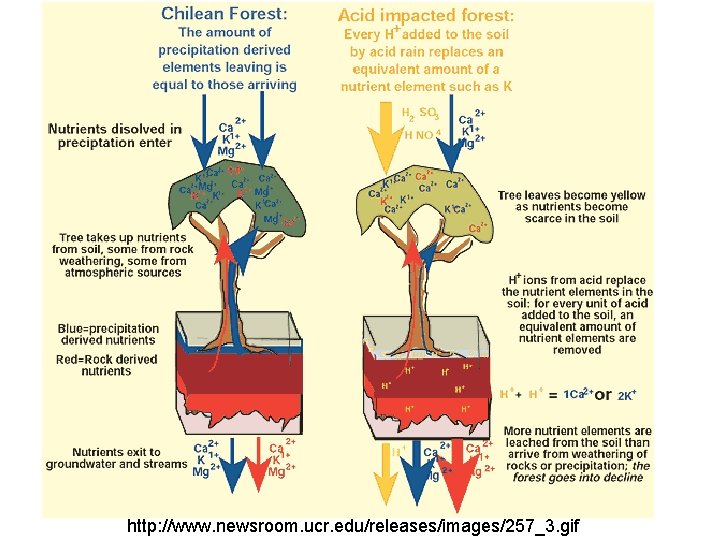
Acid rain • Oxidation of sulfur (SO 2) in coal (power plants) and NOx (car exhaust) to sulfuric and nitric acid • p. H 4 -5 (pure rainfall = p. H 5. 6) • Extensive in heavily populated areas with heavy rainfall (soils already slightly acid) • Recent regulations have improved some conditions. • Lakes and forests impacted, low buffering capacity
http: //www. maine. gov/dep/air/acidrain/images/ARAIN 1. jpg
http: //www. newsroom. ucr. edu/releases/images/257_3. gif
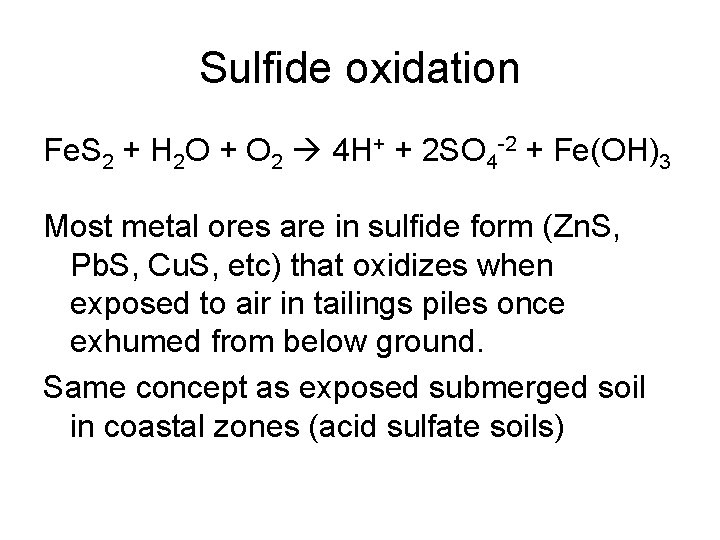
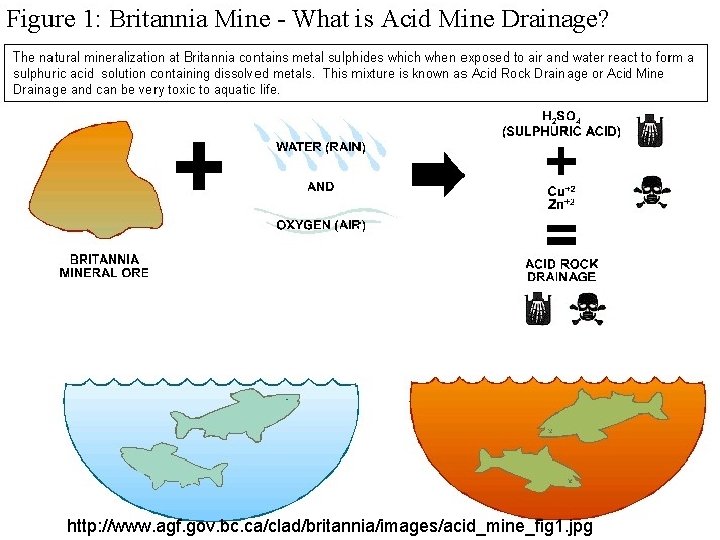
Sulfide oxidation Fe. S 2 + H 2 O + O 2 4 H+ + 2 SO 4 -2 + Fe(OH)3 Most metal ores are in sulfide form (Zn. S, Pb. S, Cu. S, etc) that oxidizes when exposed to air in tailings piles once exhumed from below ground. Same concept as exposed submerged soil in coastal zones (acid sulfate soils)
http: //www. agf. gov. bc. ca/clad/britannia/images/acid_mine_fig 1. jpg
Acid mine drainage
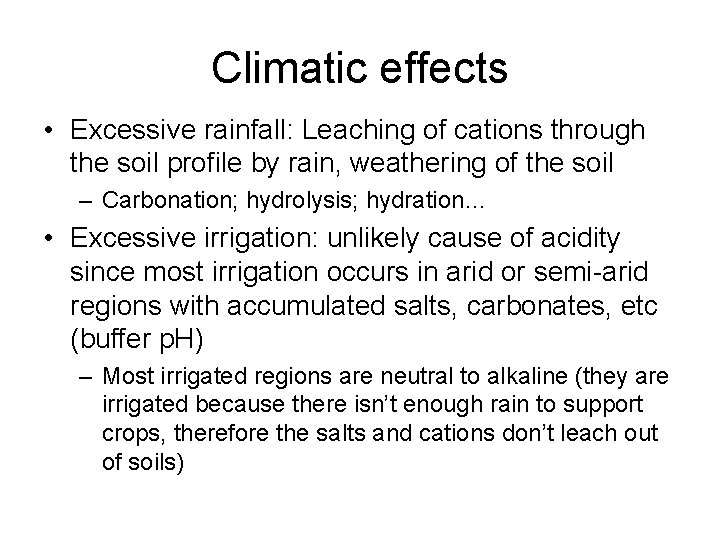
Climatic effects • Excessive rainfall: Leaching of cations through the soil profile by rain, weathering of the soil – Carbonation; hydrolysis; hydration… • Excessive irrigation: unlikely cause of acidity since most irrigation occurs in arid or semi-arid regions with accumulated salts, carbonates, etc (buffer p. H) – Most irrigated regions are neutral to alkaline (they are irrigated because there isn’t enough rain to support crops, therefore the salts and cations don’t leach out of soils)
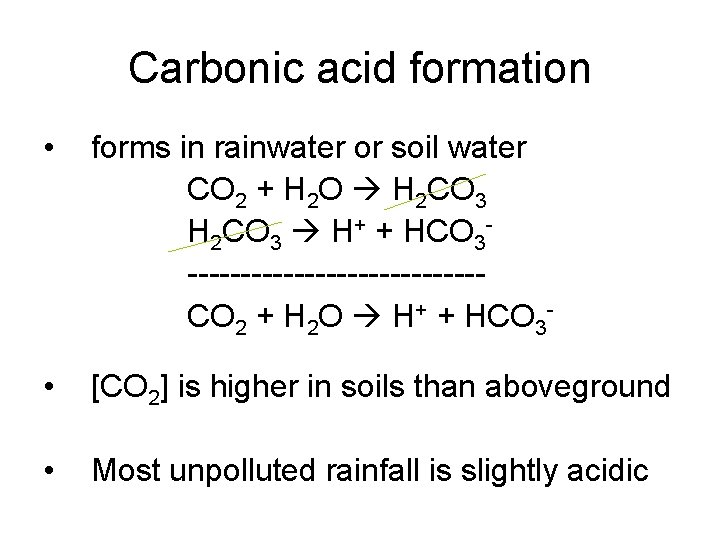
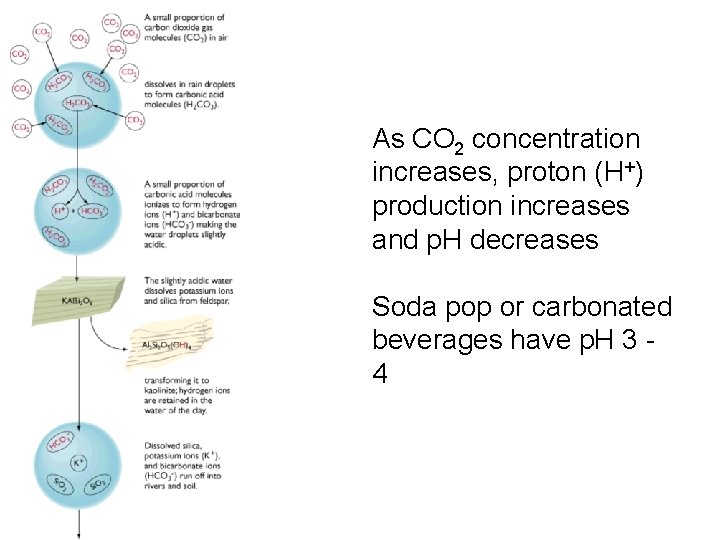
Carbonic acid formation • forms in rainwater or soil water CO 2 + H 2 O H 2 CO 3 H+ + HCO 3 --------------CO 2 + H 2 O H+ + HCO 3 - • [CO 2] is higher in soils than aboveground • Most unpolluted rainfall is slightly acidic
As CO 2 concentration increases, proton (H+) production increases and p. H decreases Soda pop or carbonated beverages have p. H 3 - 4
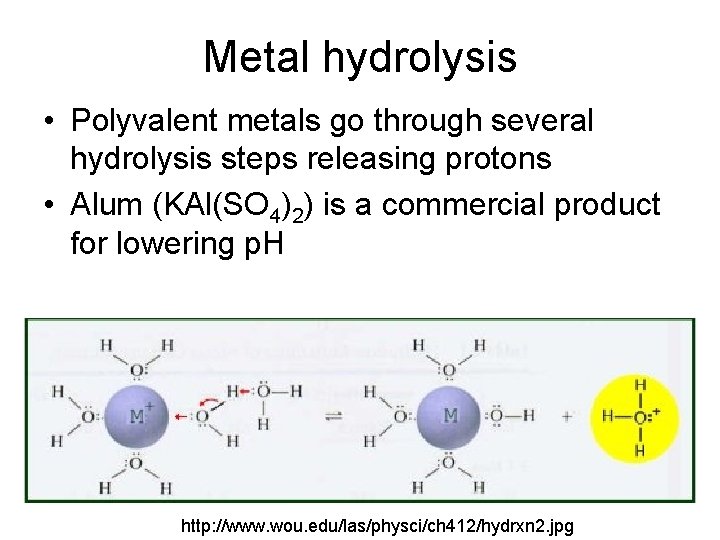
Metal hydrolysis • Polyvalent metals go through several hydrolysis steps releasing protons • Alum (KAl(SO 4)2) is a commercial product for lowering p. H http: //www. wou. edu/las/physci/ch 412/hydrxn 2. jpg
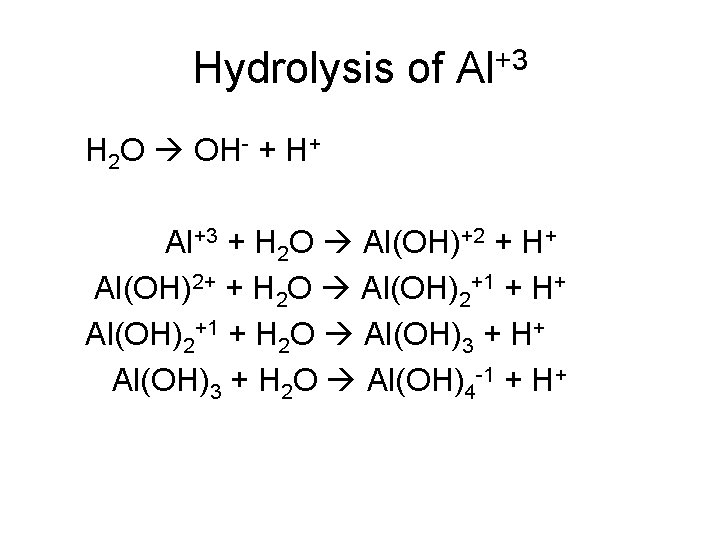
Hydrolysis of Al+3 H 2 O OH- + H+ Al+3 + H 2 O Al(OH)+2 + H+ Al(OH)2+ + H 2 O Al(OH)2+1 + H+ Al(OH)2+1 + H 2 O Al(OH)3 + H+ Al(OH)3 + H 2 O Al(OH)4 -1 + H+
Increasing soil p. H • Burning plant residues or adding ashes – Wood ashes are a source of K, Ca, Mg CO 3’s • Liming materials (pure calcium carbonate or dolomitic lime) will increase soil p. H. – Lime is a certified organic product – Slow-release product. Do not add every year. – 15 -25 lbs lime per 1000 sq ft is recommended • Gypsum is calcium sulfate. – It is not a substitute for lime, and has very little effect on soil p. H. Gypsum only improves structure in soils that have extremely high sodium contents
Lime material • • • Ca. CO 3 calcic limestone Ca. Mg(CO 3)2 Dolomite Ca. O: Quick lime Byproducts: ground shells, cement factory Gypsum is NOT a liming material, as it has very slight effect on p. H, but can provide Ca as a nutrient or exchange with Na
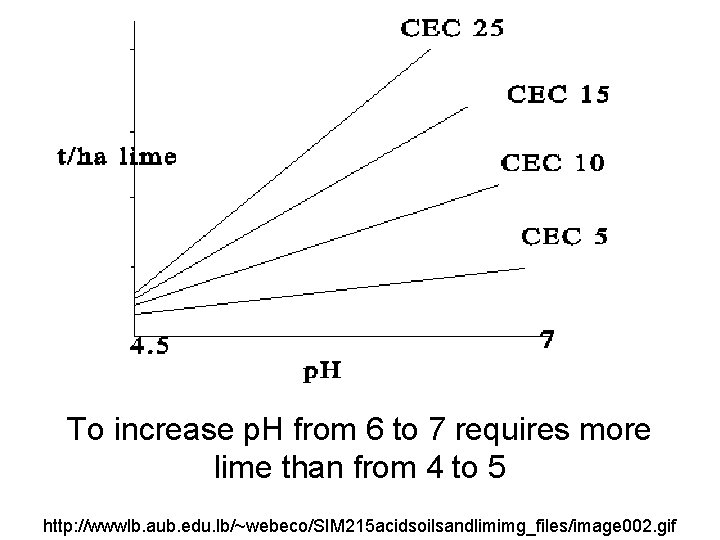
Liming to increase soil p. H • Lime characteristics – cost – purity – speed of effect (fine ground vs coarse) – ease of handling • Lime requirement – depends on p. H, CEC and buffer capacity of the soil • Lime Application: small amounts split and incorporated into the soil
To increase p. H from 6 to 7 requires more lime than from 4 to 5 http: //wwwlb. aub. edu. lb/~webeco/SIM 215 acidsoilsandlimimg_files/image 002. gif