SOFTWARE FOR VERIFICATION OF HOMOGENEITY RESULTS FROM AUTOMATED


- Slides: 30
SOFTWARE FOR VERIFICATION OF HOMOGENEITY RESULTS FROM AUTOMATED URINE ANALYZERS IN REAL TIME Waldemar Volanski Ademir Luiz do Prado Geraldo Picheth et al.
AGENDA 1. INTRODUCTION 2. OBJECTIVE 3. MATERIAL AND METHOD 4. RESULTS 5. CONCLUSION
INTRODUCTION Urinalysis is one of most traditional tests in clinical laboratories 1. Automated urine analyzer machines have become popular, with laboratories often having two or more of these instruments 2. In these cases, one of the challenges of the laboratory is to guarantee that results are consistent homogeneous among across the different machines equipment 3.
INTRODUCTION Commercially available calibrations systems and controls used in quality control programs usually cannot detect variation in the results dispersion between equipment machines during routine analysis 4.
INTRODUCTION: DELTA CHECK The Delta Check is a procedure designed to verify the consistency of results. In this process, a biological sample from a patient (usually blood or serum) is divided into two identical fractions, which are analyzed for the same analyte separately in an automated system 5.
OBJECTIVE 1. INTRODUCTION 2. OBJECTIVE 3. MATERIAL AND METHOD 4. RESULTS 5. CONCLUSION
OBJECTIVE • The employed the concept of Delta Check methodology to compare the performance of two automated urine analysis machines. • Analysis of analyte bacteria in the comparison between the two devices UF 100. 7
MATERIAL AND METHOD 1. INTRODUCTION 2. OBJECTIVE 3. MATERIAL AND METHOD 4. RESULTS 5. CONCLUSION
ETHICS COMMITTEE • The work was approved by the Ethics in Human Research of the Federal University of Parana (CAE: 0106. 0. 0. 091. 000 -09).
FIELD OF STUDY Partial Urine Test. Elements in the urine (erythrocytes, leukocytes, epithelial cells and bacteria) were used for this 9. Each machine was calibrated and controlled (two levels) with the reagents recommended by the manufacturer 10. For this study, the bacterial count was the parameter analyzed 11 10
FLOW CYTOMETRY Is a technique for counting , examining , and sorting microscopic particles suspended in a liquid medium flow using hydrodynamic focusing. Allows analysis of multiple parameters simultaneously. An optical - electronic detection device analyzes are possible physical or chemical characteristics of a cell. 11
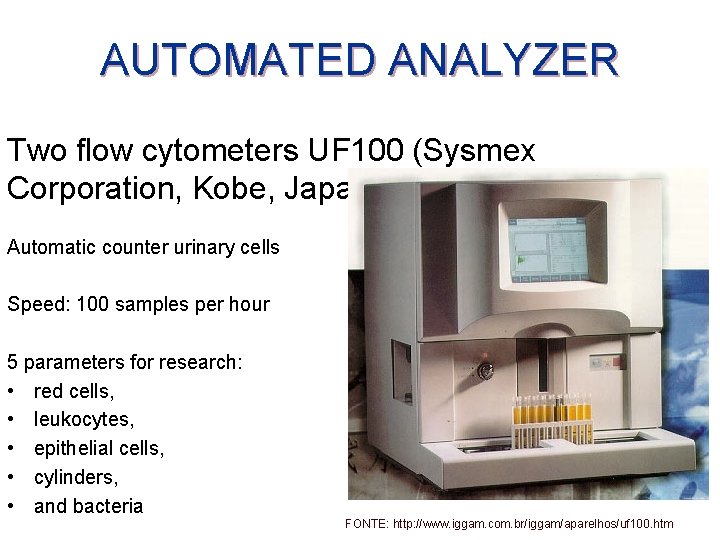
AUTOMATED ANALYZER Two flow cytometers UF 100 (Sysmex Corporation, Kobe, Japan) Automatic counter urinary cells Speed: 100 samples per hour 5 parameters for research: • red cells, • leukocytes, • epithelial cells, • cylinders, • and bacteria FONTE: http: //www. iggam. com. br/iggam/aparelhos/uf 100. htm 12
SOFTWARES Technologies for Application Development (Middleware): • HTML XML CSS AJAX • ASP © • Web Server IIS © • Microsoft Access © Export results of tests in the Curitiba Municipal Laboratory : • DBMS CACHÉ ©
METHODOLOGY • This database was developed with the goal of storing capture and store all information concerning the samples analyzed by flow cytometry. Database records of clinical laboratory results for automated urinalysis (n = 50, 000) were obtained for two automated machines equipment from this database it was possible to obtain the cutoff values for the development of this study 8.
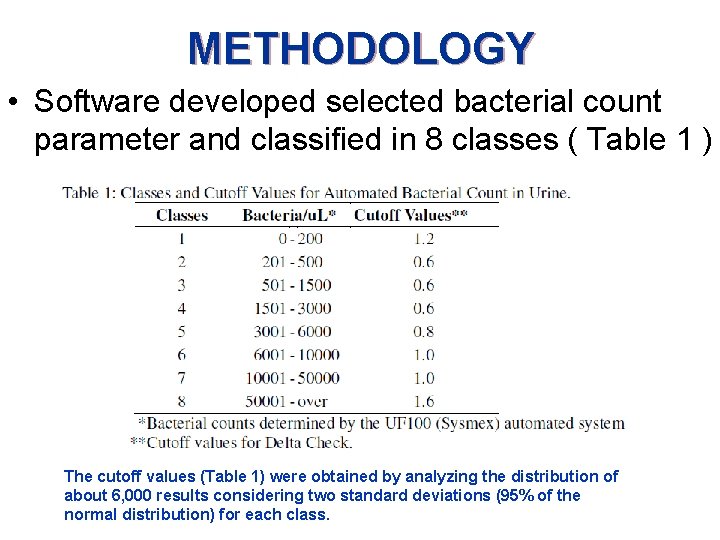
METHODOLOGY • Software developed selected bacterial count parameter and classified in 8 classes ( Table 1 ) The cutoff values (Table 1) were obtained by analyzing the distribution of about 6, 000 results considering two standard deviations (95% of the normal distribution) for each class.
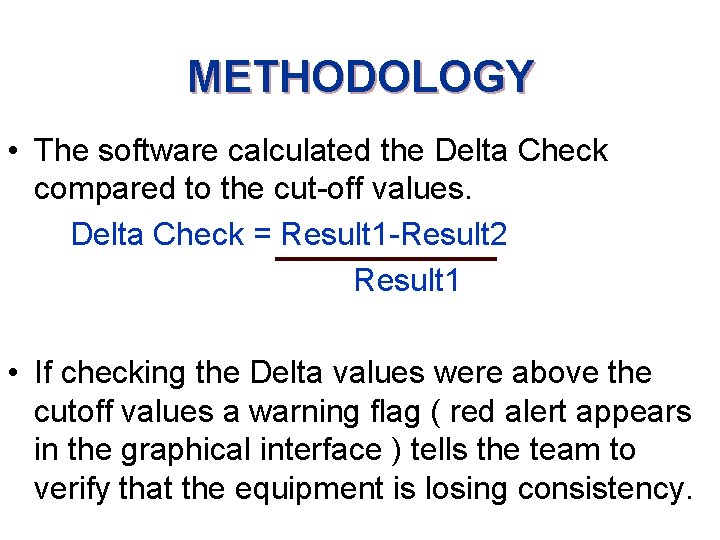
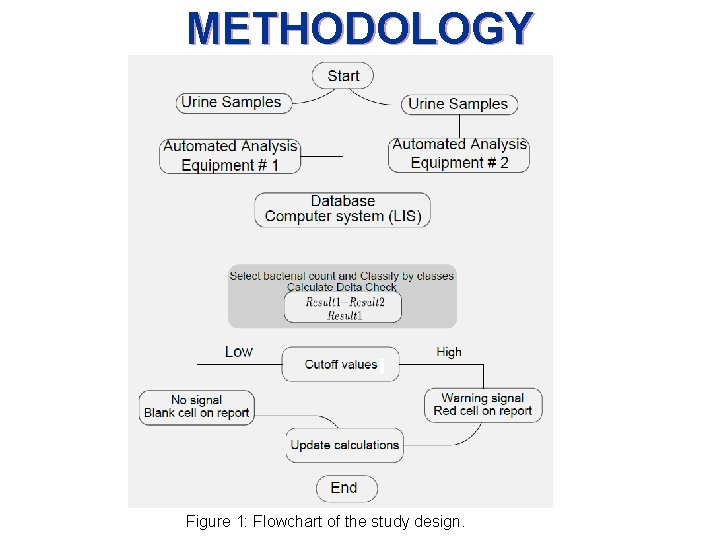
METHODOLOGY • The software calculated the Delta Check compared to the cut-off values. Delta Check = Result 1 -Result 2 Result 1 • If checking the Delta values were above the cutoff values a warning flag ( red alert appears in the graphical interface ) tells the team to verify that the equipment is losing consistency.
METHODOLOGY Figure 1: Flowchart of the study design.
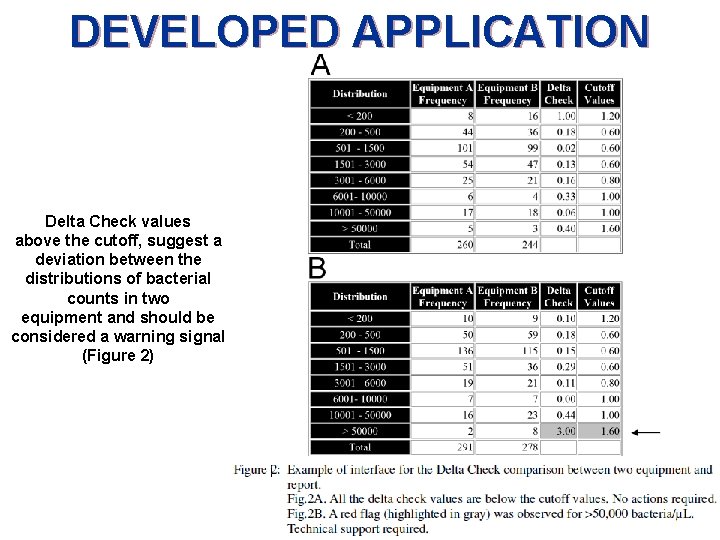
DEVELOPED APPLICATION Delta Check values above the cutoff, suggest a deviation between the distributions of bacterial counts in two equipment and should be considered a warning signal (Figure 2)
DEVELOPED APPLICATION
DEVELOPED APPLICATION
RESULTS 1. INTRODUCTION 2. OBJECTIVE 3. MATERIAL AND METHOD 4. RESULTS 5. CONCLUSION
RESULTS • A preliminary study showed that the bacterial count was the parameter of the automated urinalysis most susceptible to variation between two devices machines. This feature makes the bacterial count a sensitive indicator to detect differences in the performances of two similar equipment. http: //www. openepi. com
RESULTS The equipment A and B (Figure 2) do not differ on bacterial count report. The major causes of a warning on the Delta Check bacterial count were: • The equipment may be obstructed due to some sample; • Presence of particulate material in the sample; • Deviation of equipment; • Calibration and laser problems (misalignment or fatigue). http: //www. openepi. com
CONCLUSION 1. INTRODUCTION 2. OBJECTIVE 3. MATERIAL AND METHOD 4. RESULTS 5. CONCLUSION
CONCLUSION • The computerized system presented is able to evaluate the consistency of results between two similar equipment for automated urinalysis.
CONCLUSION • The software proved to be effective, sensitive, low cost and able of early identification of deviations of consistency between two equipment in real time.
FUTURE WORKS This project will extend to study the application of this software for: • New tecnology in flow cytometers UF 1000 (Sysmex Corporation, Kobe, Japan); • Hematology determination; • Clinical chemistry and immunochemistry tests.
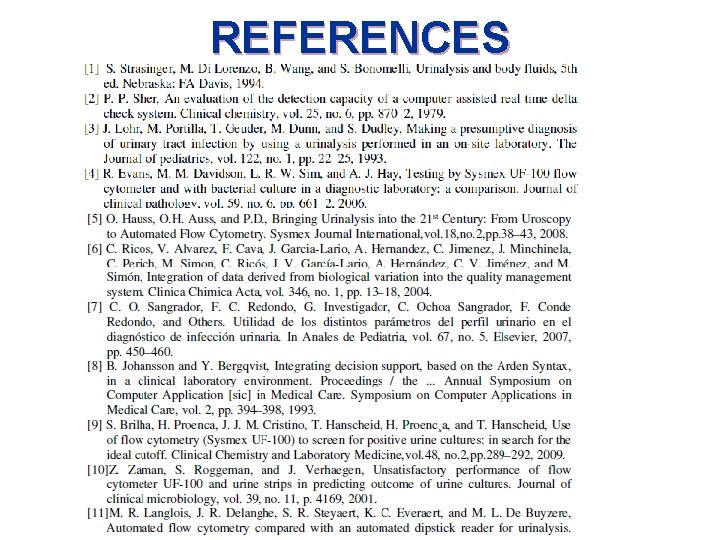
REFERENCES
TANKS
SOFTWARE FOR VERIFICATION OF HOMOGENEITY RESULTS FROM AUTOMATED URINE ANALYZERS IN REAL TIME Waldemar Volanski – volanski@ufpr. br Ademir Luiz do Prado Geraldo Picheth et al.