SHINE Program Certification Training Welcome n SHINE Serving






- Slides: 76
SHINE Program Certification Training
Welcome! n SHINE = Serving the Health Insurance Needs of Everyone…. . on Medicare n Started in Massachusetts 1985 n Partially federally funded since 1992 n Part of national SHIP= State Health Insurance Assistance Programs 2
State Organization n Executive Office of Elder Affairs • State SHINE Director: Cindy Phillips • Assistant State Director: Barbara Deveau • State Field Operations Manager/Training Coordinator: Annie Toth • State Program Coordinator: Sandra Bowden 3
Regional Organization n Regional SHINE Office: n Regional SHINE Director: n SHINE Program Assistant: 4
Overall Goal n To ensure that Medicare beneficiaries have access to accurate, unbiased information regarding health insurance and health care options n To help people help themselves 5
Examples Of What We Do n Assist people in understanding their Medicare and Mass. Health rights and benefits n Educate people about all of their health insurance options n Screen for public benefits (State and Federal) n Assist with applications n Resolve problems with insurances; Medicare, Mass. Health 6
Training n Certification training n Mentoring n Monthly training meetings n October: Review and training for Medicare’s annual Open Enrollment n Recertification review every spring 7
We’re Here To Support You n Regional Office Staff • Director: • Assistant Director: n SHINE Counselor Website • shinecounselor. 800 ageinfo. com ØCommon Resources ØSHINE newsletter: The Beacon 8
Medicare Part A & Part B
Medicare n Federal health insurance program for: • Individuals age 65 and over • Individuals under age 65 with a disability Enacted into law 1965, Title XVIII of the Social Security Act; Effective July 1 st , 1966 • Entitlement program Never intended to cover 100% of healthcare costs • NOT a comprehensive health insurance program 10
Medicare n Medicare only pays for services which are reasonable and medically necessary for the treatment and diagnosis of an accident or illness n Even when “medically necessary”, there are gaps in Medicare coverage and the beneficiary must pay a portion of the medical expenses n In most situations, Medicare won’t pay for health care or supplies outside the U. S. 11
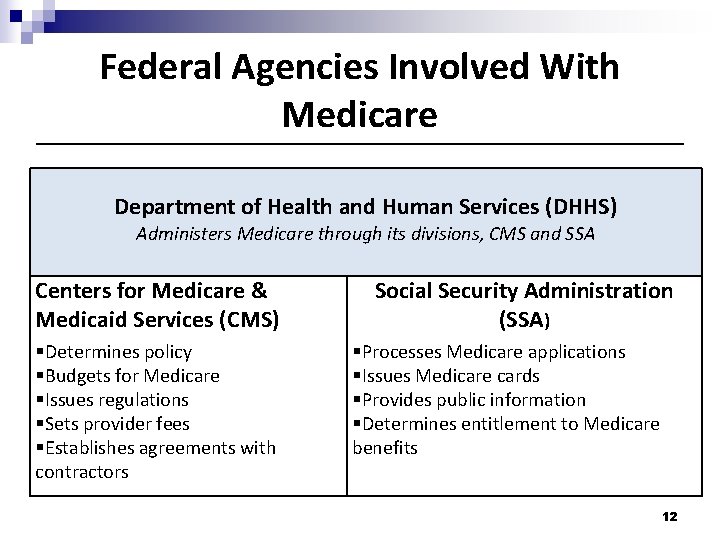
Federal Agencies Involved With Medicare Department of Health and Human Services (DHHS) Administers Medicare through its divisions, CMS and SSA Centers for Medicare & Medicaid Services (CMS) Determines policy Budgets for Medicare Issues regulations Sets provider fees Establishes agreements with contractors Social Security Administration (SSA) Processes Medicare applications Issues Medicare cards Provides public information Determines entitlement to Medicare benefits 12
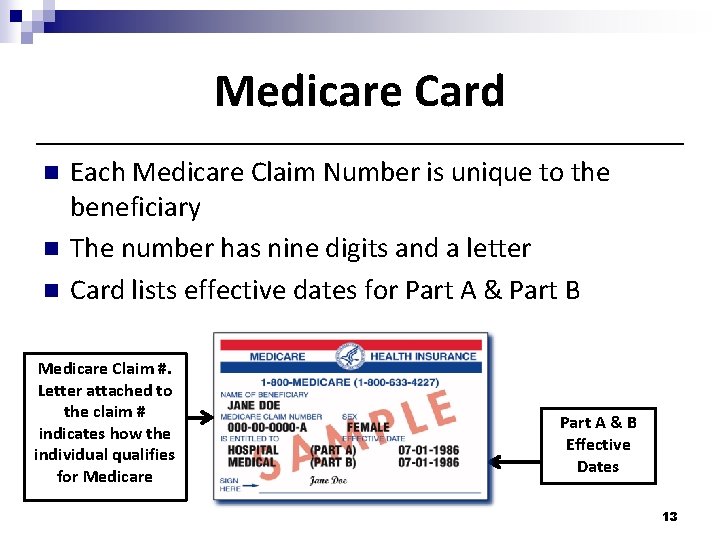
Medicare Card n n n Each Medicare Claim Number is unique to the beneficiary The number has nine digits and a letter Card lists effective dates for Part A & Part B Medicare Claim #. Letter attached to the claim # indicates how the individual qualifies for Medicare Part A & B Effective Dates 13
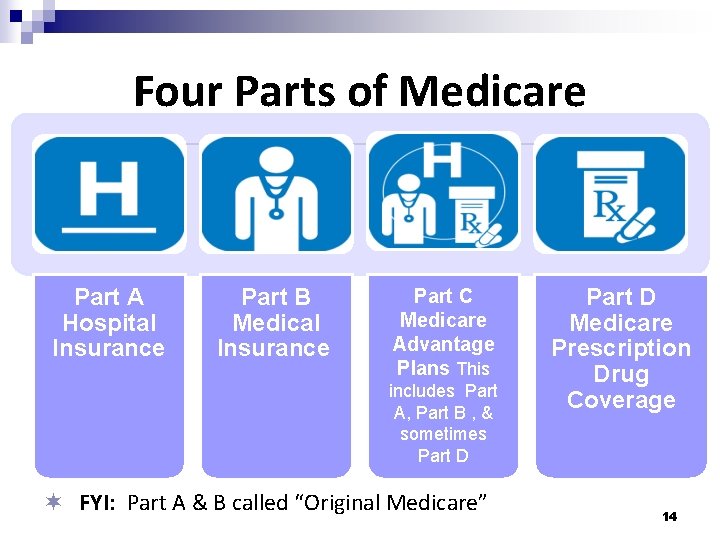
Four Parts of Medicare Part A Hospital Insurance Part B Medical Insurance Part C Medicare Advantage Plans This includes Part A, Part B , & sometimes Part D ¬ FYI: Part A & B called “Original Medicare” Part D Medicare Prescription Drug Coverage 14
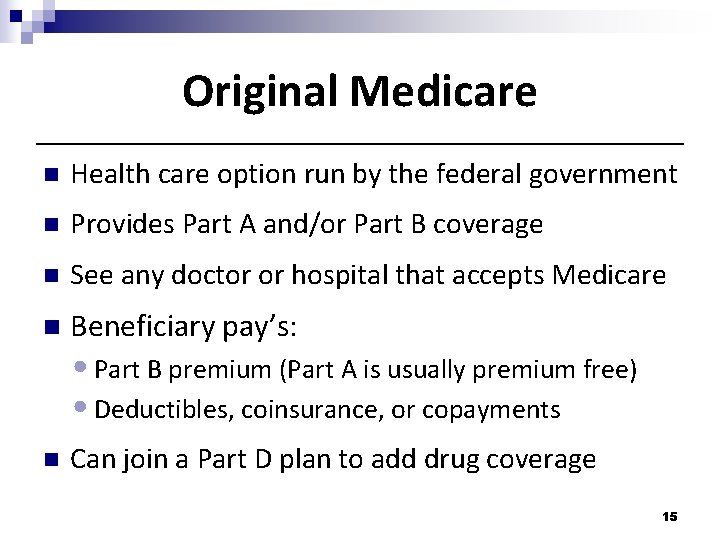
Original Medicare n Health care option run by the federal government n Provides Part A and/or Part B coverage n See any doctor or hospital that accepts Medicare n Beneficiary pay’s: • Part B premium (Part A is usually premium free) • Deductibles, coinsurance, or copayments n Can join a Part D plan to add drug coverage 15
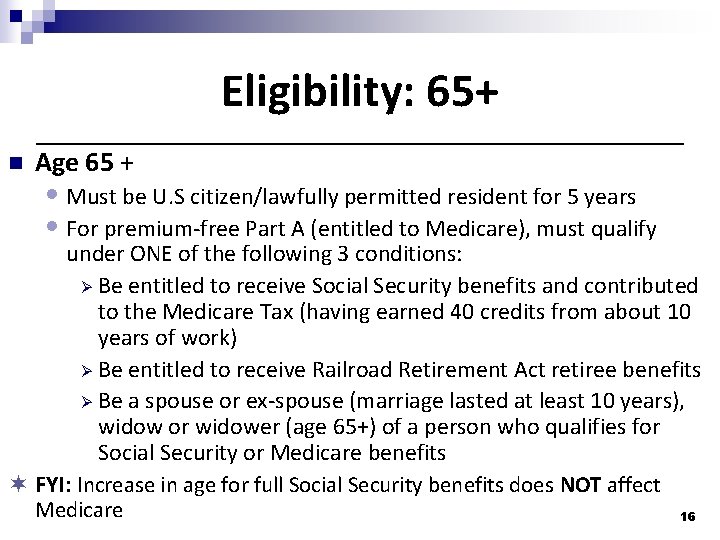
Eligibility: 65+ n Age 65 + • Must be U. S citizen/lawfully permitted resident for 5 years • For premium-free Part A (entitled to Medicare), must qualify under ONE of the following 3 conditions: Ø Be entitled to receive Social Security benefits and contributed to the Medicare Tax (having earned 40 credits from about 10 years of work) Ø Be entitled to receive Railroad Retirement Act retiree benefits Ø Be a spouse or ex-spouse (marriage lasted at least 10 years), widow or widower (age 65+) of a person who qualifies for Social Security or Medicare benefits ¬ FYI: Increase in age for full Social Security benefits does NOT affect Medicare 16
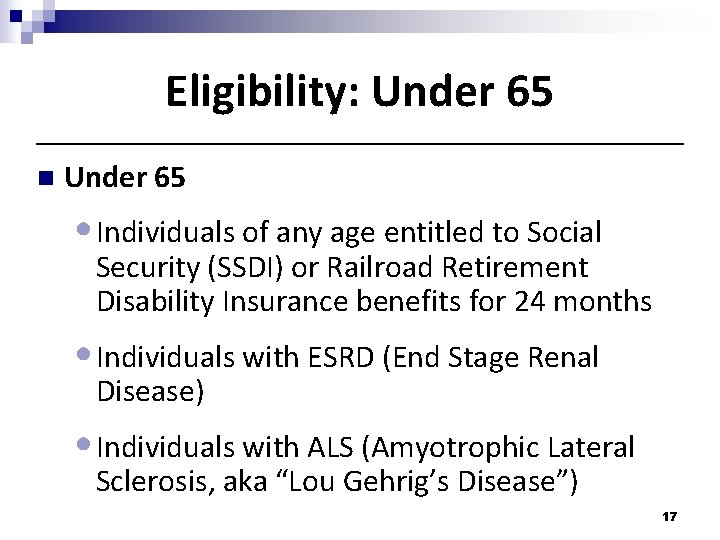
Eligibility: Under 65 n Under 65 • Individuals of any age entitled to Social Security (SSDI) or Railroad Retirement Disability Insurance benefits for 24 months • Individuals with ESRD (End Stage Renal Disease) • Individuals with ALS (Amyotrophic Lateral Sclerosis, aka “Lou Gehrig’s Disease”) 17
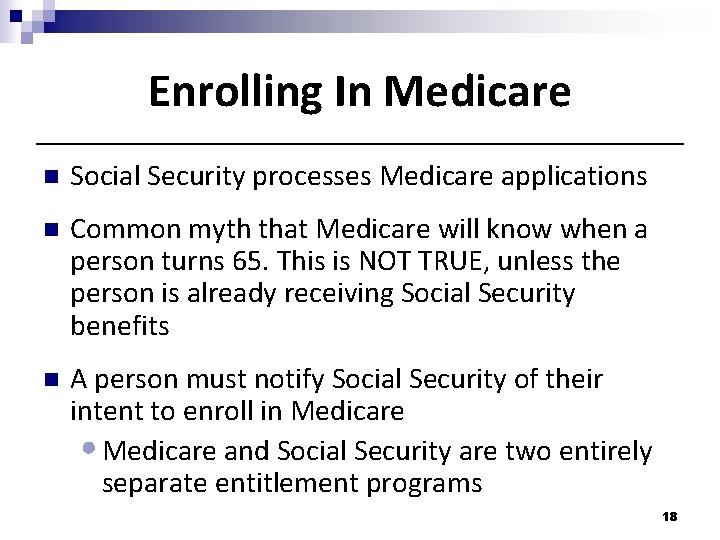
Enrolling In Medicare n Social Security processes Medicare applications n Common myth that Medicare will know when a person turns 65. This is NOT TRUE, unless the person is already receiving Social Security benefits n A person must notify Social Security of their intent to enroll in Medicare • Medicare and Social Security are two entirely separate entitlement programs 18
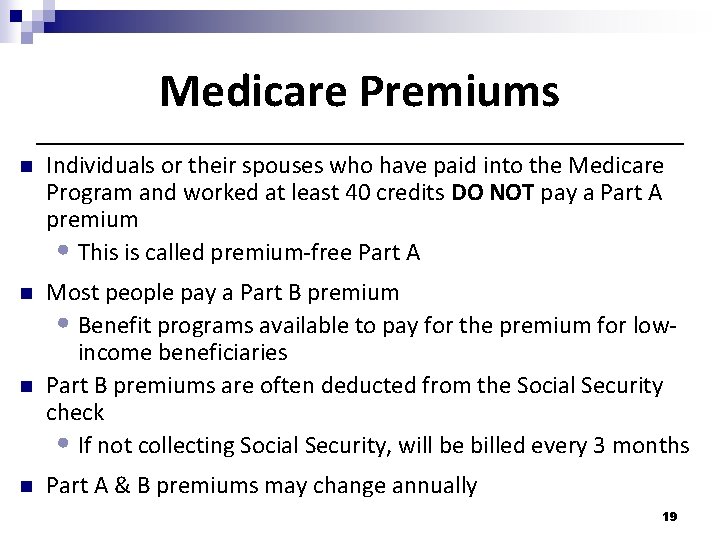
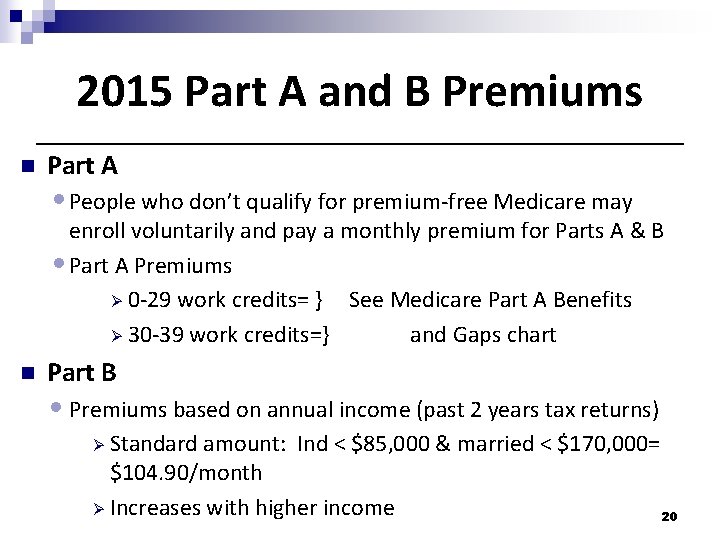
Medicare Premiums n Individuals or their spouses who have paid into the Medicare Program and worked at least 40 credits DO NOT pay a Part A premium • This is called premium-free Part A n Most people pay a Part B premium • Benefit programs available to pay for the premium for lowincome beneficiaries Part B premiums are often deducted from the Social Security check • If not collecting Social Security, will be billed every 3 months n n Part A & B premiums may change annually 19
2015 Part A and B Premiums n Part A • People who don’t qualify for premium-free Medicare may enroll voluntarily and pay a monthly premium for Parts A & B • Part A Premiums Ø 0 -29 work credits= } See Medicare Part A Benefits Ø 30 -39 work credits=} and Gaps chart n Part B • Premiums based on annual income (past 2 years tax returns) Standard amount: Ind < $85, 000 & married < $170, 000= $104. 90/month Ø Increases with higher income 20 Ø
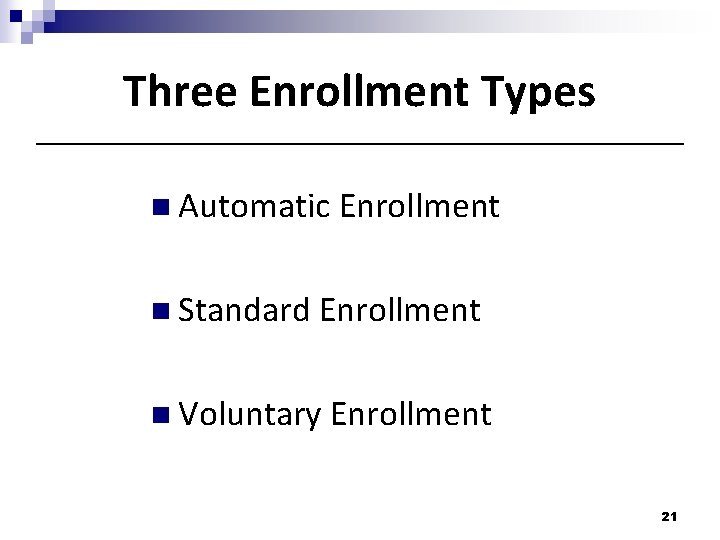
Three Enrollment Types n Automatic Enrollment n Standard Enrollment n Voluntary Enrollment 21
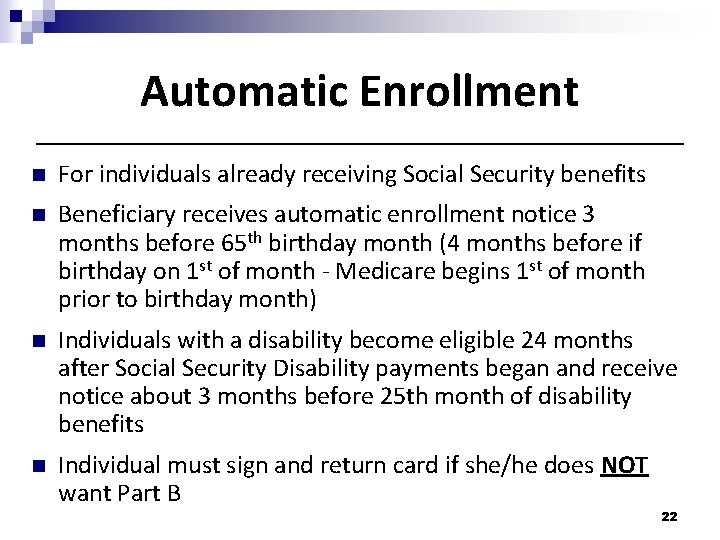
Automatic Enrollment n For individuals already receiving Social Security benefits n Beneficiary receives automatic enrollment notice 3 months before 65 th birthday month (4 months before if birthday on 1 st of month - Medicare begins 1 st of month prior to birthday month) n Individuals with a disability become eligible 24 months after Social Security Disability payments began and receive notice about 3 months before 25 th month of disability benefits n Individual must sign and return card if she/he does NOT want Part B 22
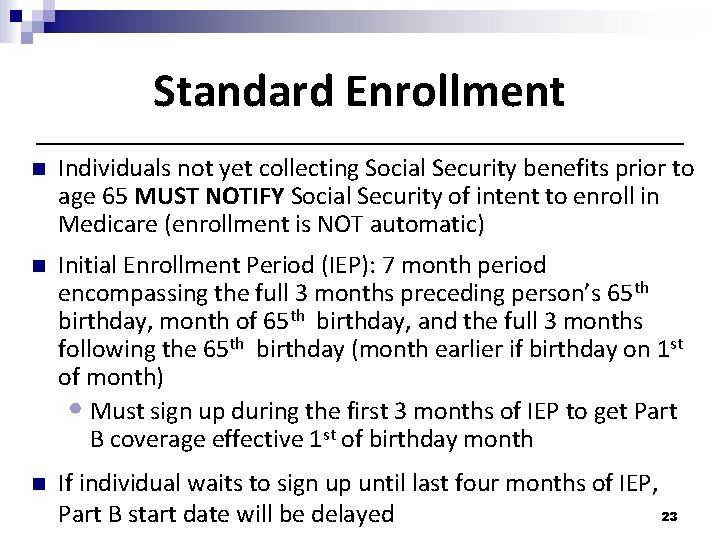
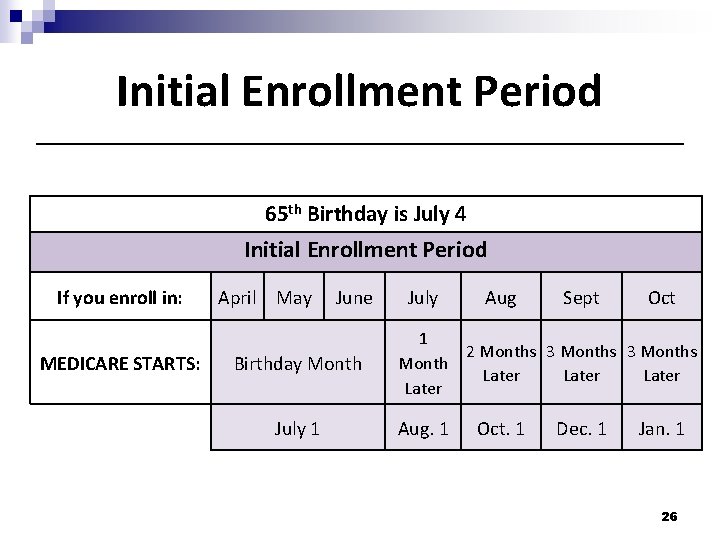
Standard Enrollment n Individuals not yet collecting Social Security benefits prior to age 65 MUST NOTIFY Social Security of intent to enroll in Medicare (enrollment is NOT automatic) n Initial Enrollment Period (IEP): 7 month period encompassing the full 3 months preceding person’s 65 th birthday, month of 65 th birthday, and the full 3 months following the 65 th birthday (month earlier if birthday on 1 st of month) • Must sign up during the first 3 months of IEP to get Part B coverage effective 1 st of birthday month n If individual waits to sign up until last four months of IEP, 23 Part B start date will be delayed
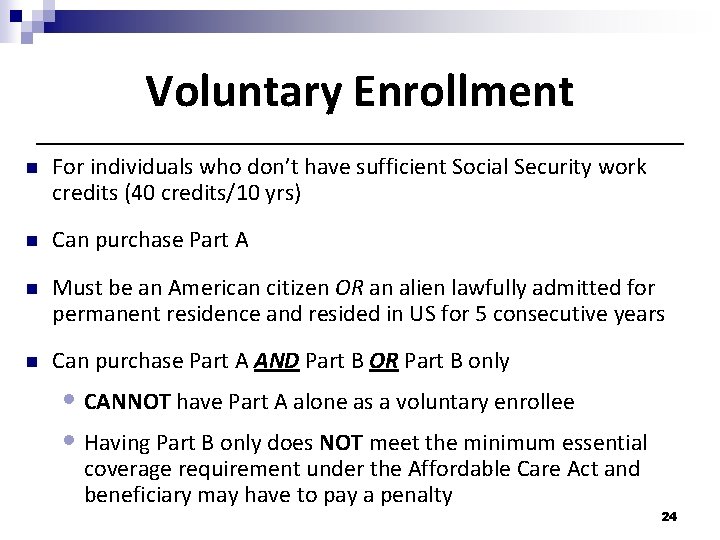
Voluntary Enrollment n For individuals who don’t have sufficient Social Security work credits (40 credits/10 yrs) n Can purchase Part A n Must be an American citizen OR an alien lawfully admitted for permanent residence and resided in US for 5 consecutive years n Can purchase Part A AND Part B OR Part B only • CANNOT have Part A alone as a voluntary enrollee • Having Part B only does NOT meet the minimum essential coverage requirement under the Affordable Care Act and beneficiary may have to pay a penalty 24
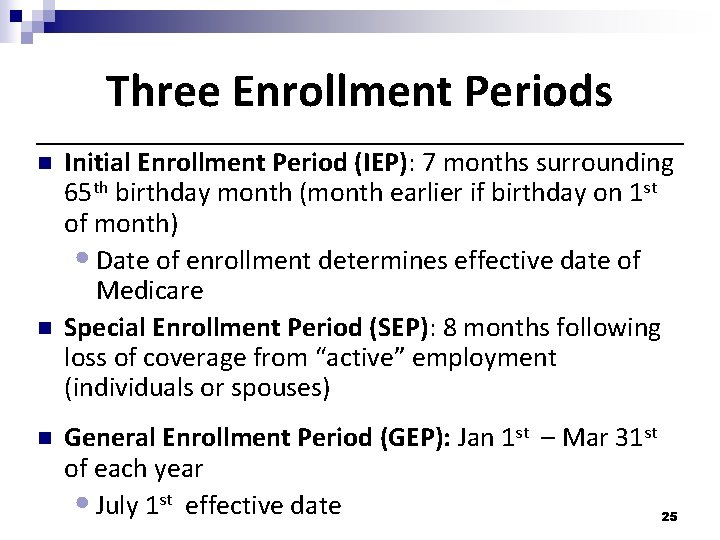
Three Enrollment Periods n n n Initial Enrollment Period (IEP): 7 months surrounding 65 th birthday month (month earlier if birthday on 1 st of month) • Date of enrollment determines effective date of Medicare Special Enrollment Period (SEP): 8 months following loss of coverage from “active” employment (individuals or spouses) General Enrollment Period (GEP): Jan 1 st – Mar 31 st of each year • July 1 st effective date 25
Initial Enrollment Period 65 th Birthday is July 4 Initial Enrollment Period If you enroll in: MEDICARE STARTS: April May June July Birthday Month 1 Month Later July 1 Aug Sept Oct 2 Months 3 Months Later Oct. 1 Dec. 1 Jan. 1 26
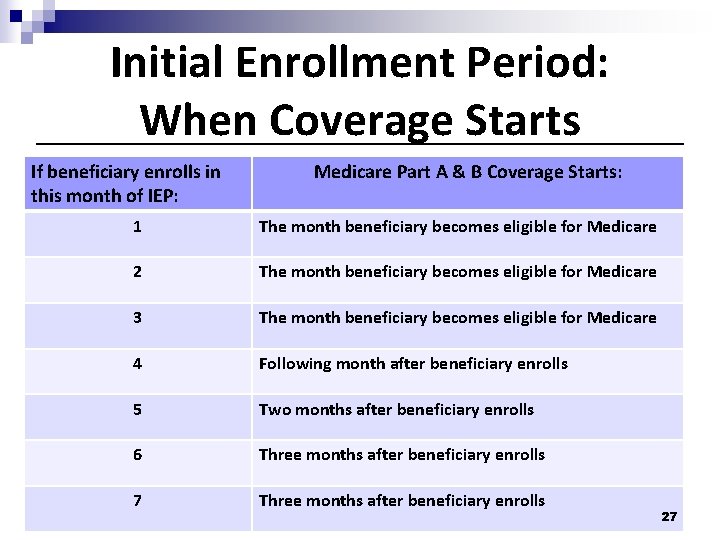
Initial Enrollment Period: When Coverage Starts If beneficiary enrolls in this month of IEP: Medicare Part A & B Coverage Starts: 1 The month beneficiary becomes eligible for Medicare 2 The month beneficiary becomes eligible for Medicare 3 The month beneficiary becomes eligible for Medicare 4 Following month after beneficiary enrolls 5 Two months after beneficiary enrolls 6 Three months after beneficiary enrolls 7 Three months after beneficiary enrolls 27
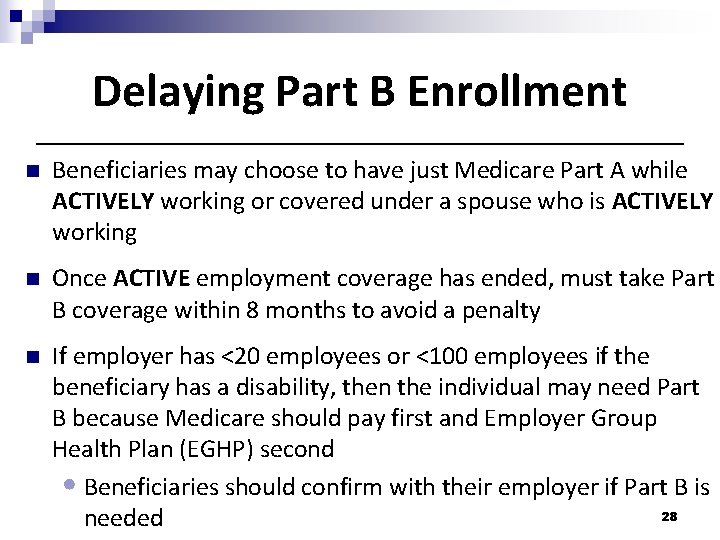
Delaying Part B Enrollment n Beneficiaries may choose to have just Medicare Part A while ACTIVELY working or covered under a spouse who is ACTIVELY working n Once ACTIVE employment coverage has ended, must take Part B coverage within 8 months to avoid a penalty n If employer has <20 employees or <100 employees if the beneficiary has a disability, then the individual may need Part B because Medicare should pay first and Employer Group Health Plan (EGHP) second • Beneficiaries should confirm with their employer if Part B is 28 needed
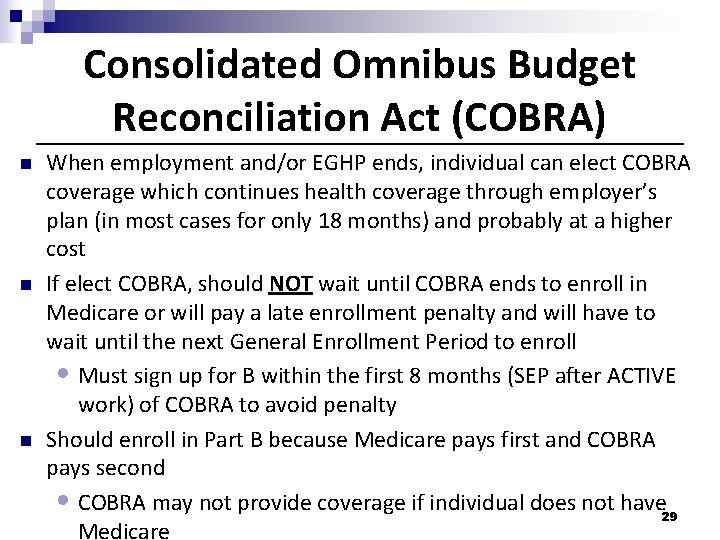
Consolidated Omnibus Budget Reconciliation Act (COBRA) n n n When employment and/or EGHP ends, individual can elect COBRA coverage which continues health coverage through employer’s plan (in most cases for only 18 months) and probably at a higher cost If elect COBRA, should NOT wait until COBRA ends to enroll in Medicare or will pay a late enrollment penalty and will have to wait until the next General Enrollment Period to enroll • Must sign up for B within the first 8 months (SEP after ACTIVE work) of COBRA to avoid penalty Should enroll in Part B because Medicare pays first and COBRA pays second • COBRA may not provide coverage if individual does not have 29 Medicare
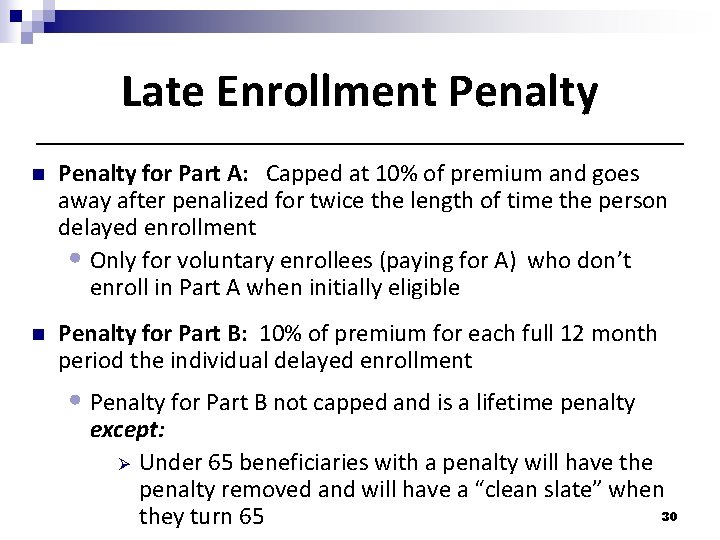
Late Enrollment Penalty n Penalty for Part A: Capped at 10% of premium and goes away after penalized for twice the length of time the person delayed enrollment • Only for voluntary enrollees (paying for A) who don’t enroll in Part A when initially eligible n Penalty for Part B: 10% of premium for each full 12 month period the individual delayed enrollment • Penalty for Part B not capped and is a lifetime penalty except: Ø Under 65 beneficiaries with a penalty will have the penalty removed and will have a “clean slate” when 30 they turn 65
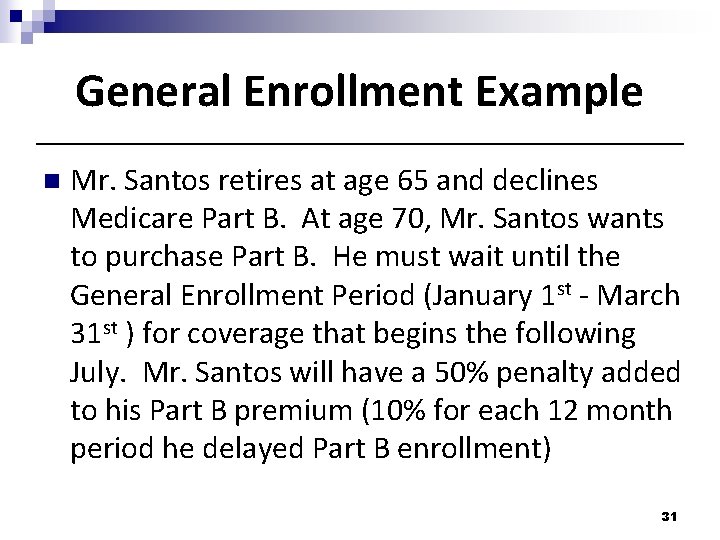
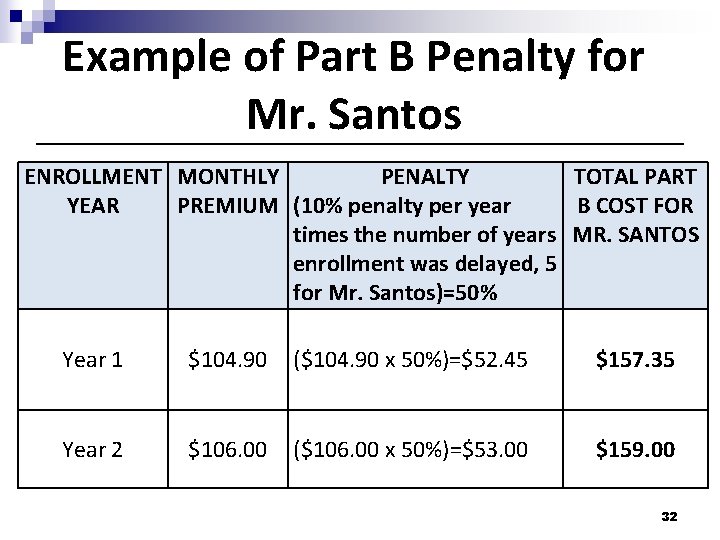
General Enrollment Example n Mr. Santos retires at age 65 and declines Medicare Part B. At age 70, Mr. Santos wants to purchase Part B. He must wait until the General Enrollment Period (January 1 st - March 31 st ) for coverage that begins the following July. Mr. Santos will have a 50% penalty added to his Part B premium (10% for each 12 month period he delayed Part B enrollment) 31
Example of Part B Penalty for Mr. Santos ENROLLMENT MONTHLY PENALTY TOTAL PART YEAR PREMIUM (10% penalty per year B COST FOR times the number of years MR. SANTOS enrollment was delayed, 5 for Mr. Santos)=50% Year 1 $104. 90 ($104. 90 x 50%)=$52. 45 $157. 35 Year 2 $106. 00 ($106. 00 x 50%)=$53. 00 $159. 00 32
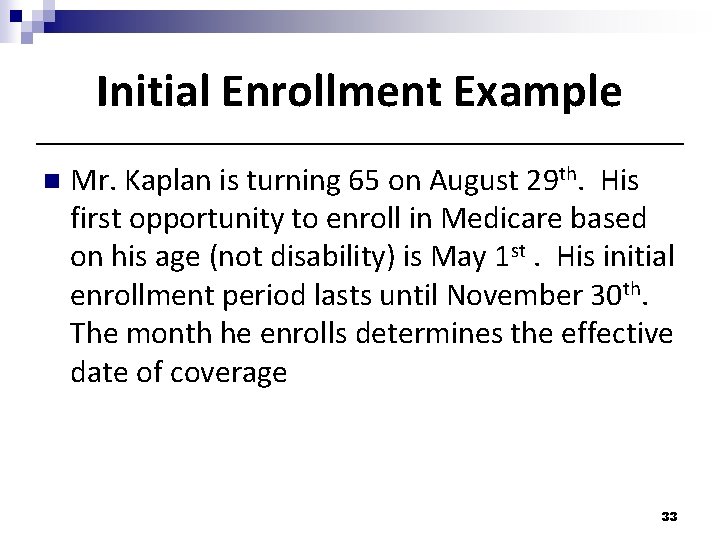
Initial Enrollment Example n Mr. Kaplan is turning 65 on August 29 th. His first opportunity to enroll in Medicare based on his age (not disability) is May 1 st. His initial enrollment period lasts until November 30 th. The month he enrolls determines the effective date of coverage 33
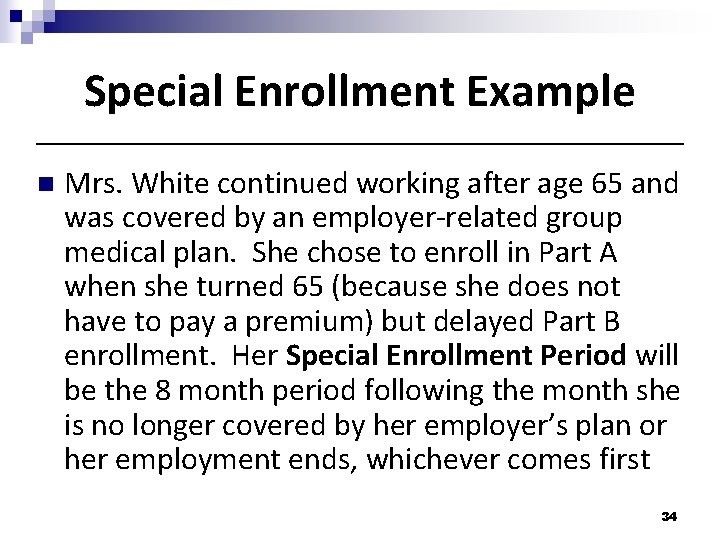
Special Enrollment Example n Mrs. White continued working after age 65 and was covered by an employer-related group medical plan. She chose to enroll in Part A when she turned 65 (because she does not have to pay a premium) but delayed Part B enrollment. Her Special Enrollment Period will be the 8 month period following the month she is no longer covered by her employer’s plan or her employment ends, whichever comes first 34
Medicare Part A (Hospital Insurance)
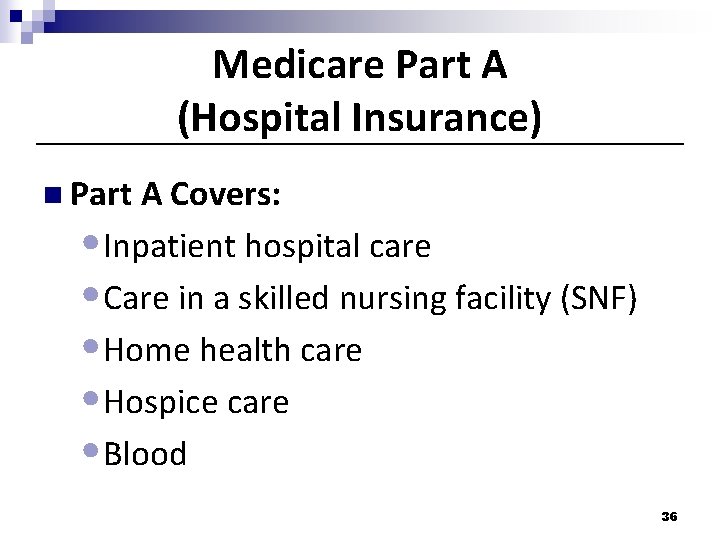
Medicare Part A (Hospital Insurance) n Part A Covers: • Inpatient hospital care • Care in a skilled nursing facility (SNF) • Home health care • Hospice care • Blood 36
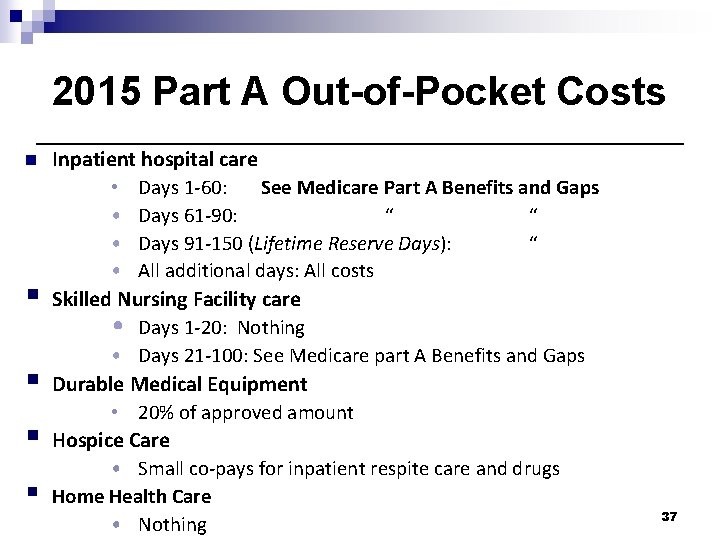
2015 Part A Out-of-Pocket Costs n Inpatient hospital care • Days 1 -60: See Medicare Part A Benefits and Gaps • Days 61 -90: “ “ • Days 91 -150 (Lifetime Reserve Days): “ • All additional days: All costs Skilled Nursing Facility care • Days 1 -20: Nothing • Days 21 -100: See Medicare part A Benefits and Gaps Durable Medical Equipment • 20% of approved amount Hospice Care • Small co-pays for inpatient respite care and drugs Home Health Care • Nothing 37
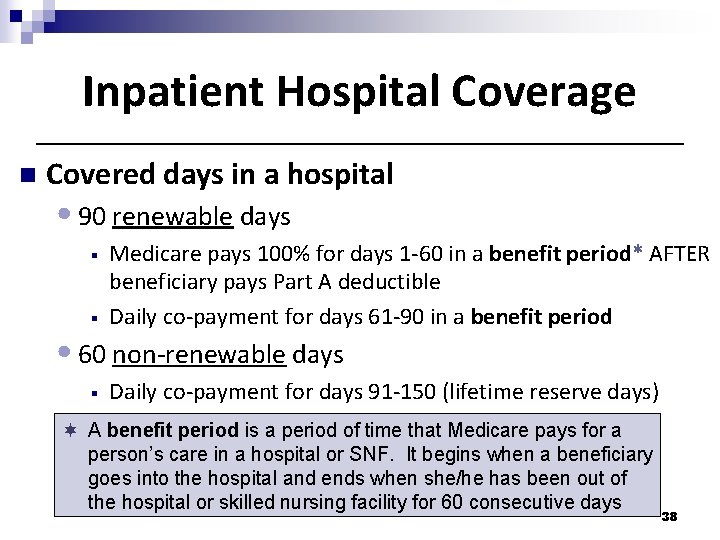
Inpatient Hospital Coverage n Covered days in a hospital • 90 renewable days Medicare pays 100% for days 1 -60 in a benefit period* AFTER beneficiary pays Part A deductible Daily co-payment for days 61 -90 in a benefit period • 60 non-renewable days Daily co-payment for days 91 -150 (lifetime reserve days) ¬ A benefit period is a period of time that Medicare pays for a person’s care in a hospital or SNF. It begins when a beneficiary goes into the hospital and ends when she/he has been out of the hospital or skilled nursing facility for 60 consecutive days 38
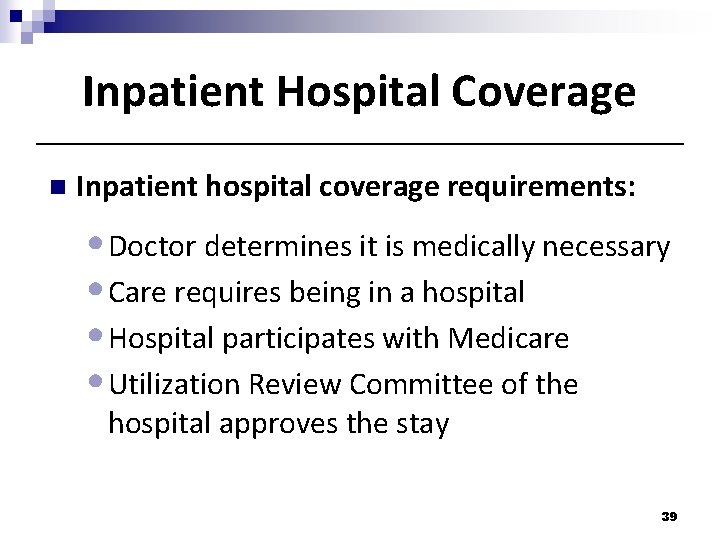
Inpatient Hospital Coverage n Inpatient hospital coverage requirements: • Doctor determines it is medically necessary • Care requires being in a hospital • Hospital participates with Medicare • Utilization Review Committee of the hospital approves the stay 39
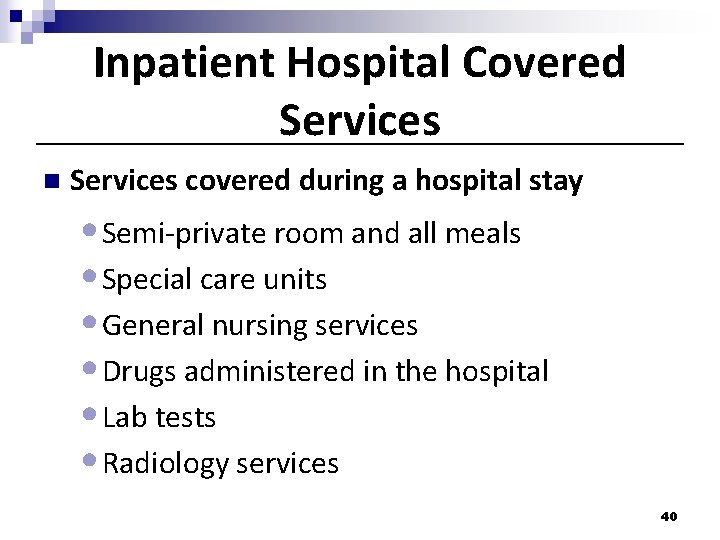
Inpatient Hospital Covered Services n Services covered during a hospital stay • Semi-private room and all meals • Special care units • General nursing services • Drugs administered in the hospital • Lab tests • Radiology services 40
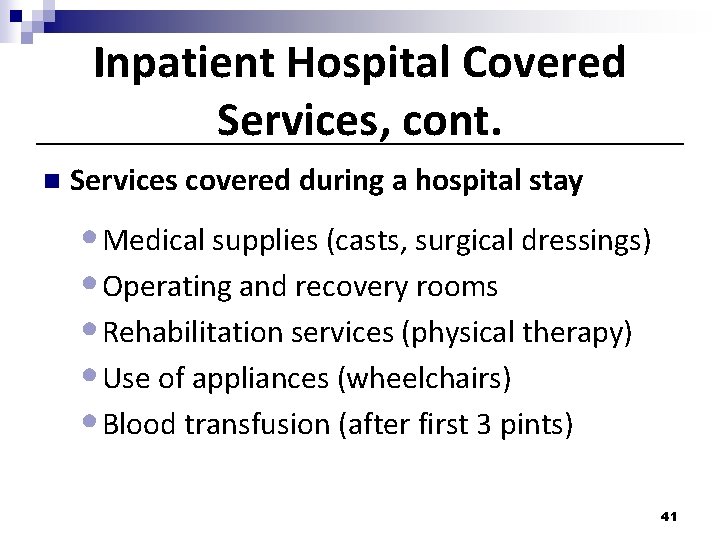
Inpatient Hospital Covered Services, cont. n Services covered during a hospital stay • Medical supplies (casts, surgical dressings) • Operating and recovery rooms • Rehabilitation services (physical therapy) • Use of appliances (wheelchairs) • Blood transfusion (after first 3 pints) 41
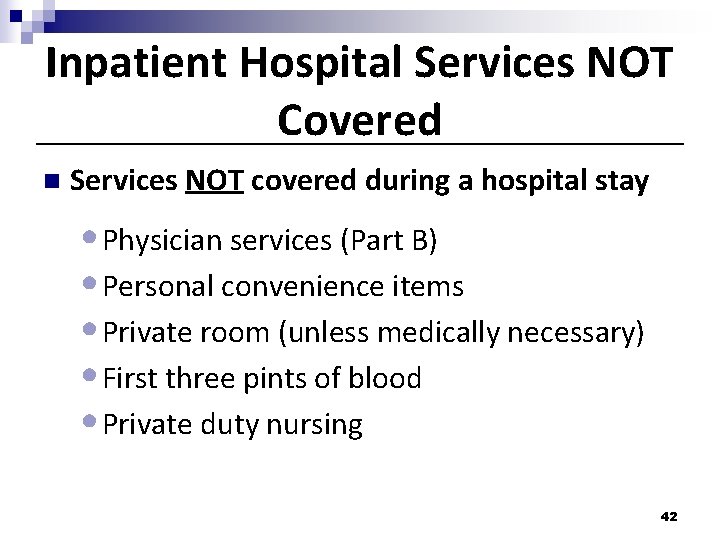
Inpatient Hospital Services NOT Covered n Services NOT covered during a hospital stay • Physician services (Part B) • Personal convenience items • Private room (unless medically necessary) • First three pints of blood • Private duty nursing 42
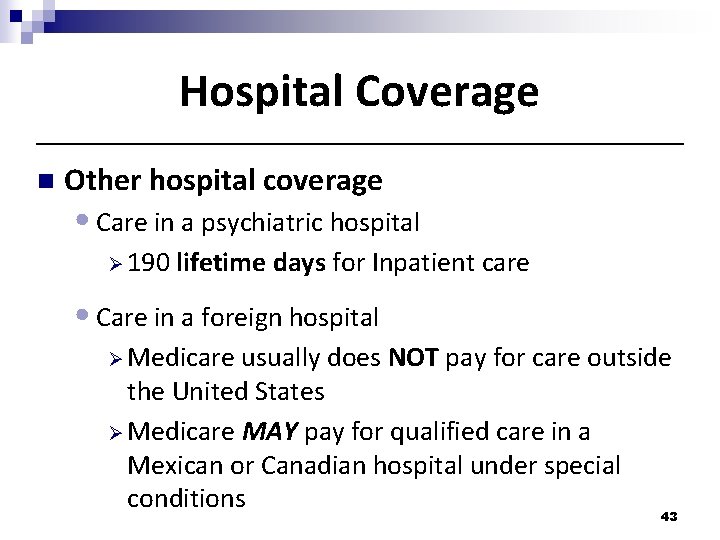
Hospital Coverage n Other hospital coverage • Care in a psychiatric hospital Ø 190 lifetime days for Inpatient care • Care in a foreign hospital Ø Medicare usually does NOT pay for care outside the United States Ø Medicare MAY pay for qualified care in a Mexican or Canadian hospital under special conditions 43
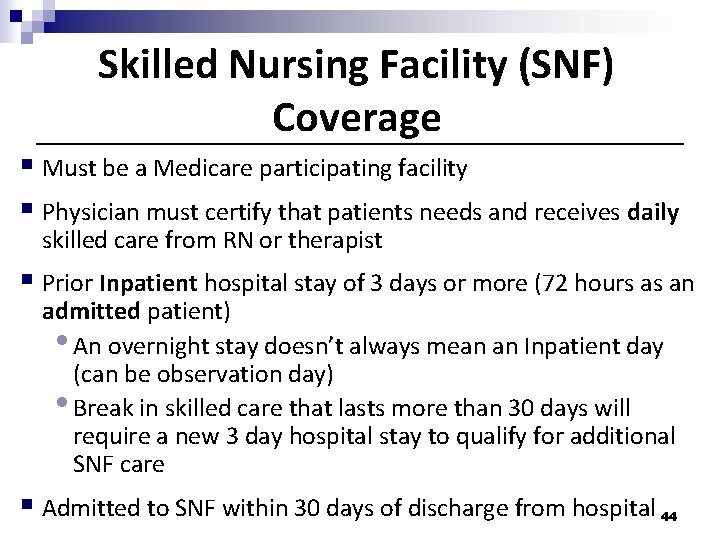
Skilled Nursing Facility (SNF) Coverage Must be a Medicare participating facility Physician must certify that patients needs and receives daily skilled care from RN or therapist Prior Inpatient hospital stay of 3 days or more (72 hours as an admitted patient) • An overnight stay doesn’t always mean an Inpatient day (can be observation day) • Break in skilled care that lasts more than 30 days will require a new 3 day hospital stay to qualify for additional SNF care Admitted to SNF within 30 days of discharge from hospital 44
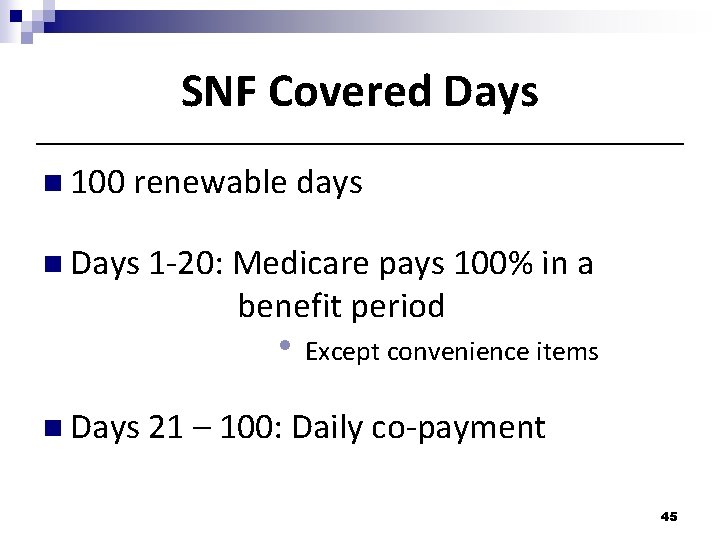
SNF Covered Days n 100 renewable days n Days 1 -20: Medicare pays 100% in a benefit period • Except convenience items n Days 21 – 100: Daily co-payment 45
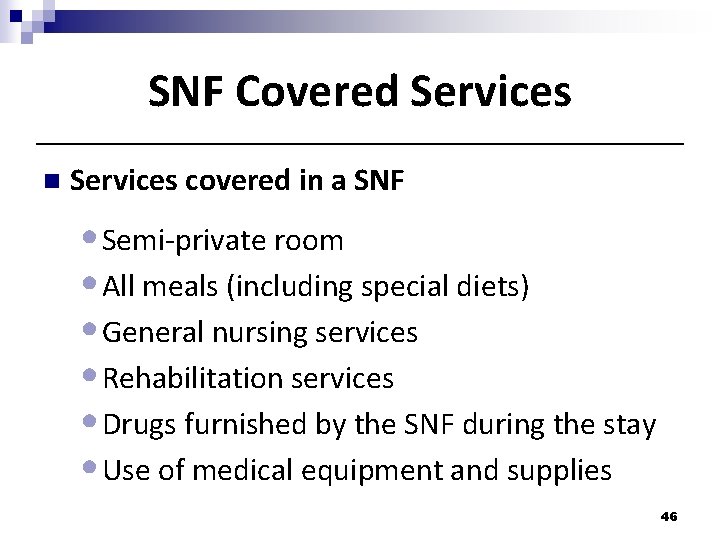
SNF Covered Services n Services covered in a SNF • Semi-private room • All meals (including special diets) • General nursing services • Rehabilitation services • Drugs furnished by the SNF during the stay • Use of medical equipment and supplies 46
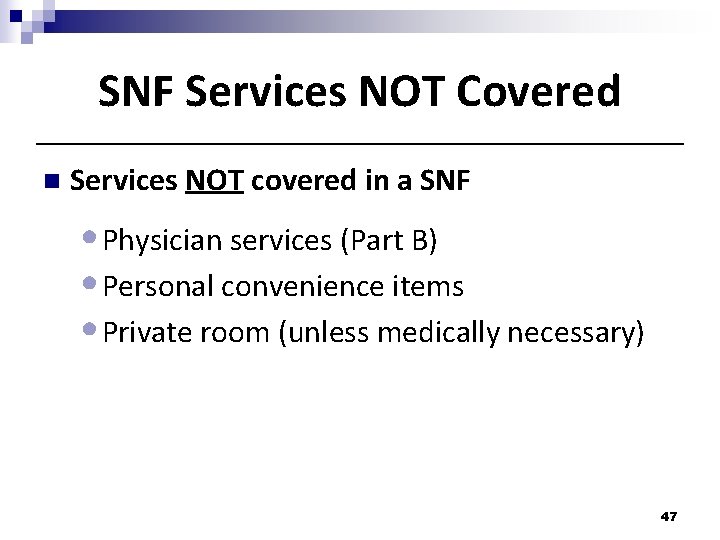
SNF Services NOT Covered n Services NOT covered in a SNF • Physician services (Part B) • Personal convenience items • Private room (unless medically necessary) 47
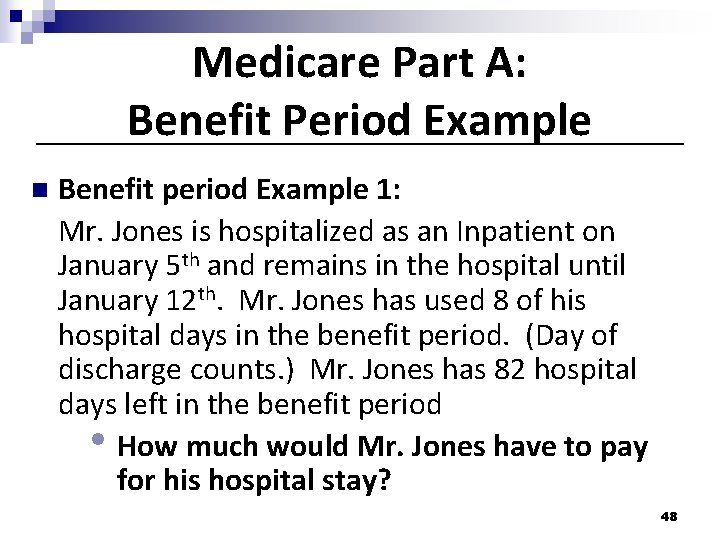
Medicare Part A: Benefit Period Example n Benefit period Example 1: Mr. Jones is hospitalized as an Inpatient on January 5 th and remains in the hospital until January 12 th. Mr. Jones has used 8 of his hospital days in the benefit period. (Day of discharge counts. ) Mr. Jones has 82 hospital days left in the benefit period • How much would Mr. Jones have to pay for his hospital stay? 48
Medicare Part A: Benefit Period Example n Benefit period Example 2: Mr. Jones is discharged from the hospital on January 12 th and transferred to a SNF where he remains until February 9 th. Mr. Jones used 29 days of his SNF benefit. He has 71 days left • How much would Mr. Jones have to pay for his Skilled Nursing Facility care? 49
Home Health Benefit n Home health benefit coverage requirements: • Must need skilled care on intermittent basis • Home health agency must be Medicare-approved • Physician must authorize treatment and have face-toface meeting with beneficiary prior to start • Beneficiary must be “homebound” (see next slide) • Medicare pays 100% for all covered and medically necessary home health services Ø EXCEPTION: Medicare pays 80% of durable equipment 50
Homebound n Homebound means normally unable to leave home or that leaving home is a major effort and must: • Require a supportive device, or • Use of special transportation, or • Require the assistance of another person Can leave home, but it must be infrequent and for a short time. • Examples: Leave to get medical care (may include adult day care), attend a religious service, get a haircut 51
Home Health Benefit: Covered Services n Services covered by home health benefit • Skilled nursing care • Physical, occupational, or speech therapy • Medical social services (dietary counseling) • Care by home health aide (bathing, changing dressing) • Medical supplies • Equipment (20% co-insurance) 52
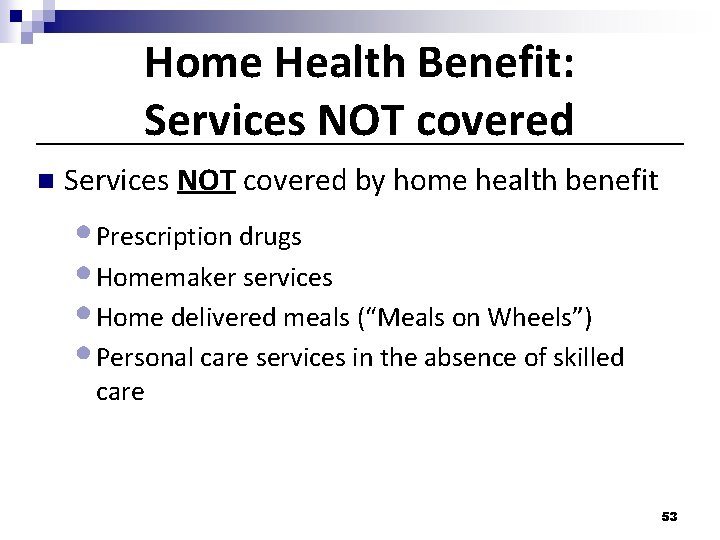
Home Health Benefit: Services NOT covered n Services NOT covered by home health benefit • Prescription drugs • Homemaker services • Home delivered meals (“Meals on Wheels”) • Personal care services in the absence of skilled care 53
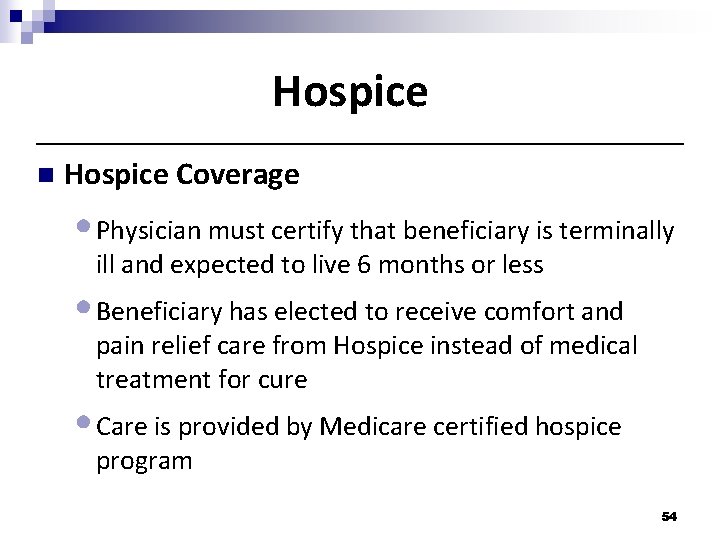
Hospice n Hospice Coverage • Physician must certify that beneficiary is terminally ill and expected to live 6 months or less • Beneficiary has elected to receive comfort and pain relief care from Hospice instead of medical treatment for cure • Care is provided by Medicare certified hospice program 54
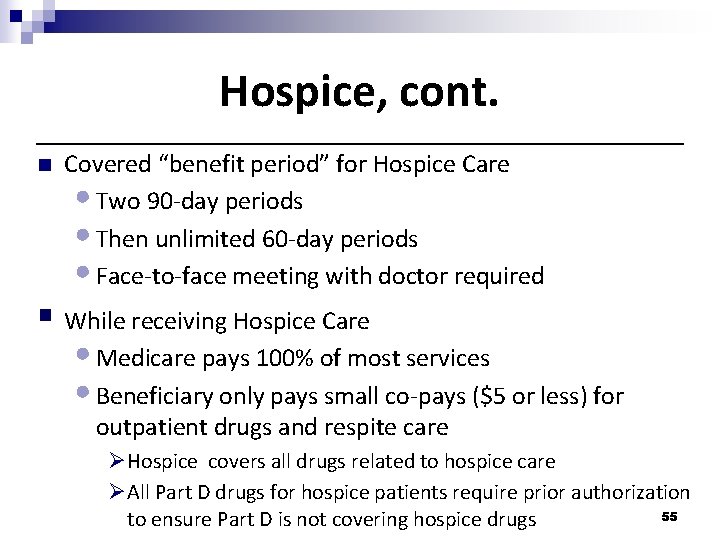
Hospice, cont. n Covered “benefit period” for Hospice Care • Two 90 -day periods • Then unlimited 60 -day periods • Face-to-face meeting with doctor required While receiving Hospice Care • Medicare pays 100% of most services • Beneficiary only pays small co-pays ($5 or less) for outpatient drugs and respite care ØHospice covers all drugs related to hospice care ØAll Part D drugs for hospice patients require prior authorization 55 to ensure Part D is not covering hospice drugs
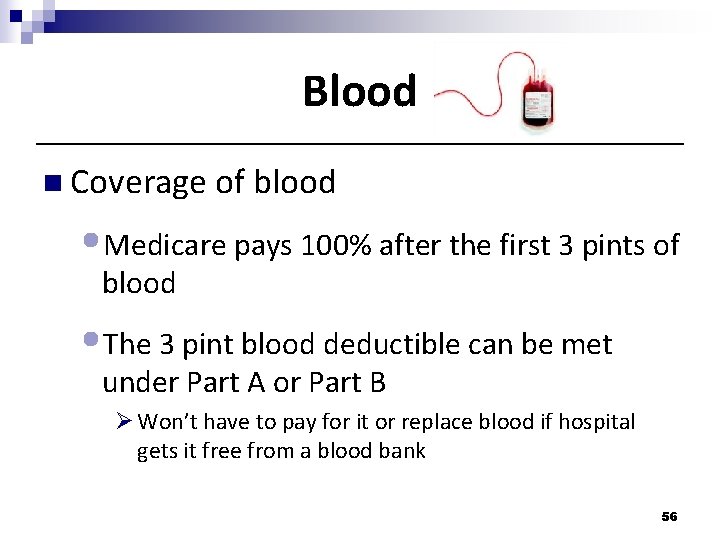
Blood n Coverage of blood • Medicare pays 100% after the first 3 pints of blood • The 3 pint blood deductible can be met under Part A or Part B Ø Won’t have to pay for it or replace blood if hospital gets it free from a blood bank 56
Utilization Review Committee n Reviews patient stays in hospitals and SNF’s to determine if patient meets Medicare standard for needing care in hospital setting • Each patient’s doctor must satisfy the Utilization Review Committee (URC) that patient meets admission criteria and continues to need acute hospital level of care n Has authority to terminate Medicare’s obligation to pay for medical services in hospital or SNF n Determines patient time of discharge 57
Hospital Discharge n Discharge Plan • Beneficiaries should be an active part of their discharge plan • Beneficiary should be given written discharge plan at least 24 hours prior to discharge • Beneficiary signs plan to acknowledge receipt (Signature does not mean beneficiary agrees the plan is appropriate) • If unsatisfied with plan, the beneficiary can appeal ØBeneficiary should ask for written “Notice of Non. Coverage” and appeal if appropriate to Dept. of Public Health 58
Medicare Part A Review n Review 1. What are the two major federal agencies involved with the Medicare Program and what is each of their roles? 2. Who can enroll in Medicare? 3. When can someone enroll in Medicare? 4. Does someone have to enroll in both parts of Medicare (A & B)? 5. What is a benefit period? 59
Medicare Part B (Medical Insurance)
Medicare Part B (Medical Insurance) n Physicians’ Services n Outpatient hospital services n Durable medical equipment n Prosthetics, orthotics, and supplies n Ambulance n Home health care (if not Part A) n Blood (if not Part A) 61
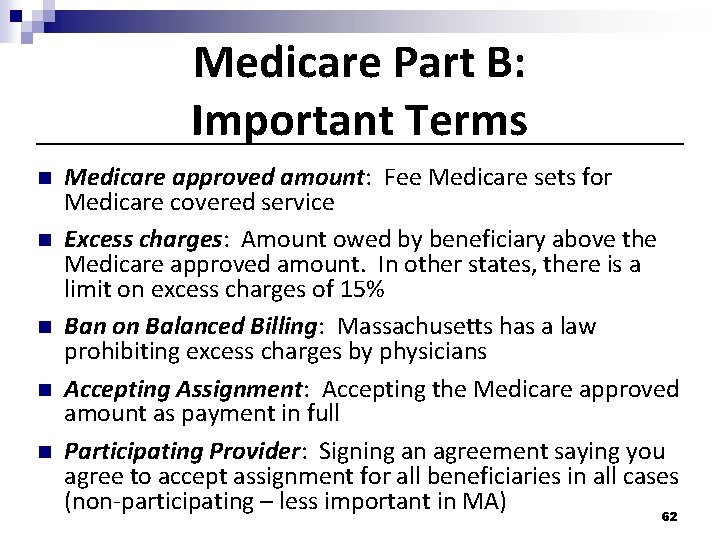
Medicare Part B: Important Terms n n n Medicare approved amount: Fee Medicare sets for Medicare covered service Excess charges: Amount owed by beneficiary above the Medicare approved amount. In other states, there is a limit on excess charges of 15% Ban on Balanced Billing: Massachusetts has a law prohibiting excess charges by physicians Accepting Assignment: Accepting the Medicare approved amount as payment in full Participating Provider: Signing an agreement saying you agree to accept assignment for all beneficiaries in all cases (non-participating – less important in MA) 62
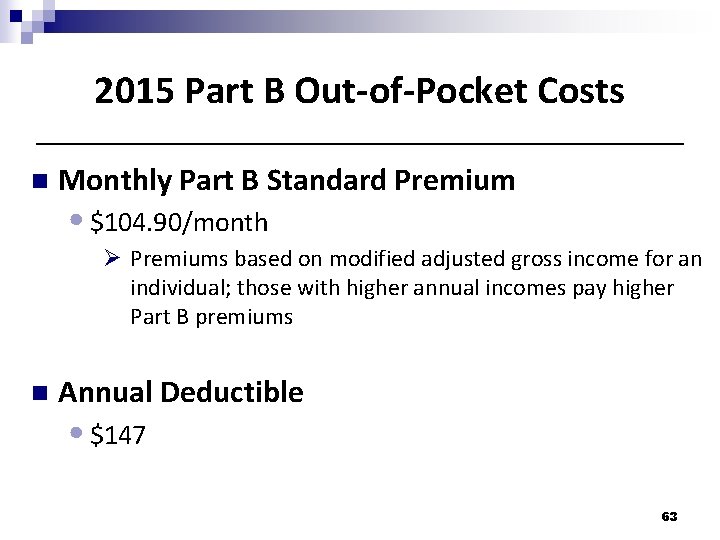
2015 Part B Out-of-Pocket Costs n Monthly Part B Standard Premium • $104. 90/month Ø Premiums based on modified adjusted gross income for an individual; those with higher annual incomes pay higher Part B premiums n Annual Deductible • $147 63
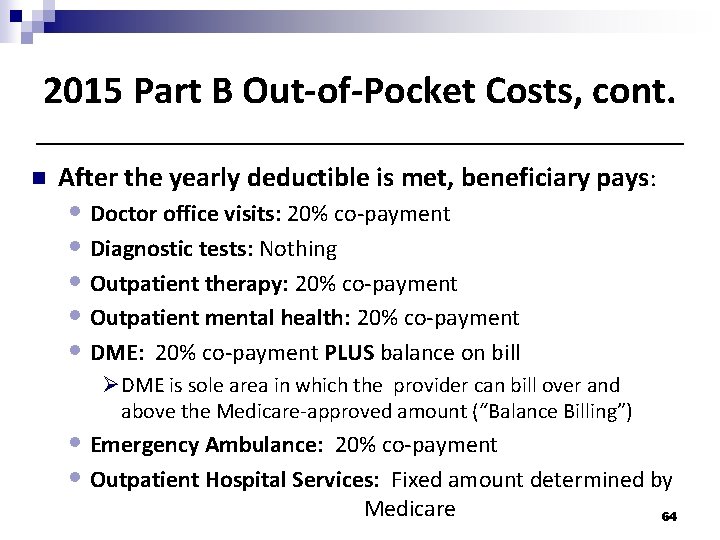
2015 Part B Out-of-Pocket Costs, cont. n After the yearly deductible is met, beneficiary pays: • Doctor office visits: 20% co-payment • Diagnostic tests: Nothing • Outpatient therapy: 20% co-payment • Outpatient mental health: 20% co-payment • DME: 20% co-payment PLUS balance on bill ØDME is sole area in which the provider can bill over and above the Medicare-approved amount (“Balance Billing”) • Emergency Ambulance: 20% co-payment • Outpatient Hospital Services: Fixed amount determined by Medicare 64
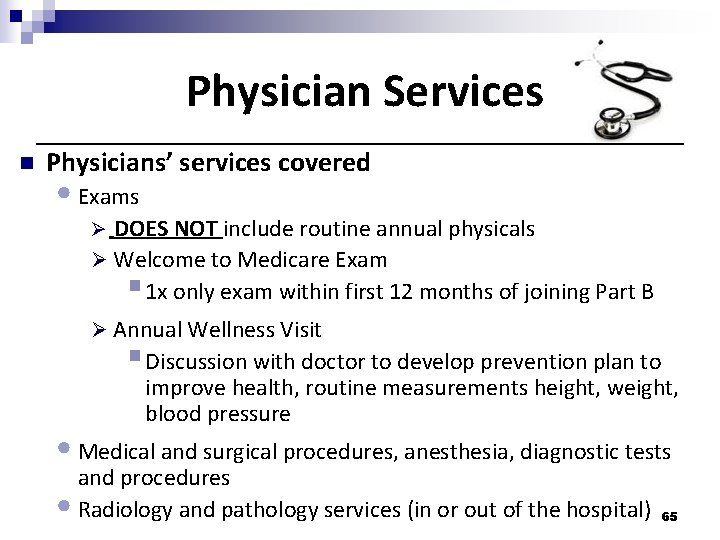
Physician Services n Physicians’ services covered • Exams Ø DOES NOT include routine annual physicals Ø Welcome to Medicare Exam 1 x only exam within first 12 months of joining Part B Ø Annual Wellness Visit Discussion with doctor to develop prevention plan to improve health, routine measurements height, weight, blood pressure • Medical and surgical procedures, anesthesia, diagnostic tests and procedures • Radiology and pathology services (in or out of the hospital) 65
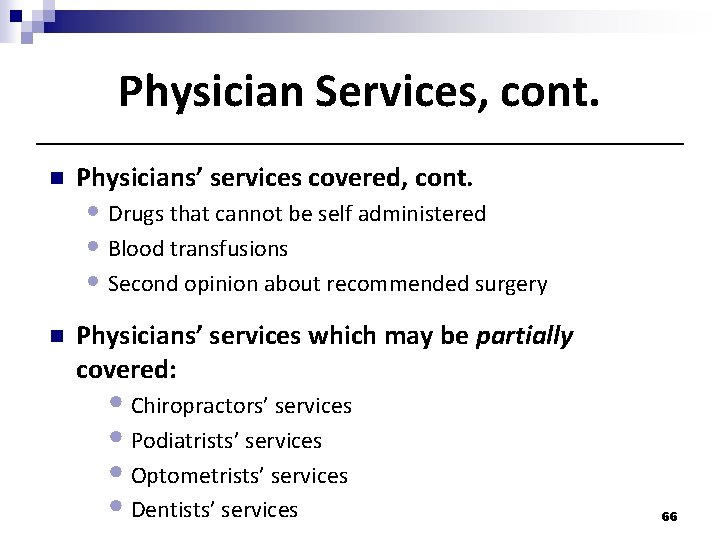
Physician Services, cont. n Physicians’ services covered, cont. • Drugs that cannot be self administered • Blood transfusions • Second opinion about recommended surgery n Physicians’ services which may be partially covered: • Chiropractors’ services • Podiatrists’ services • Optometrists’ services • Dentists’ services 66
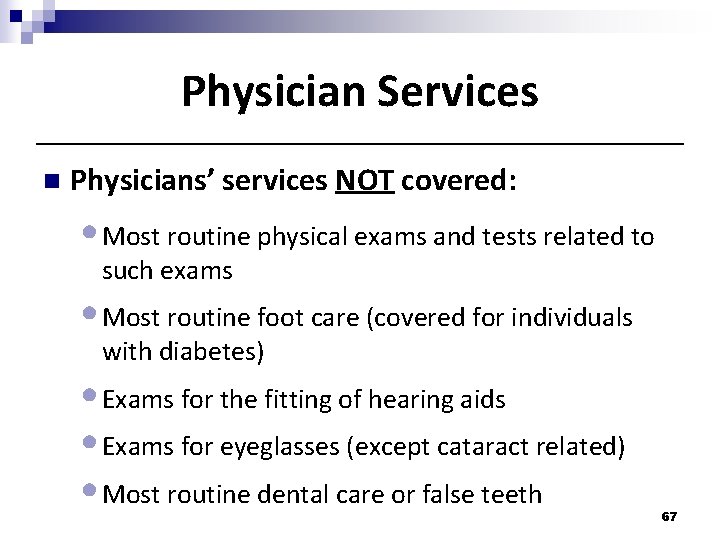
Physician Services n Physicians’ services NOT covered: • Most routine physical exams and tests related to such exams • Most routine foot care (covered for individuals with diabetes) • Exams for the fitting of hearing aids • Exams for eyeglasses (except cataract related) • Most routine dental care or false teeth 67
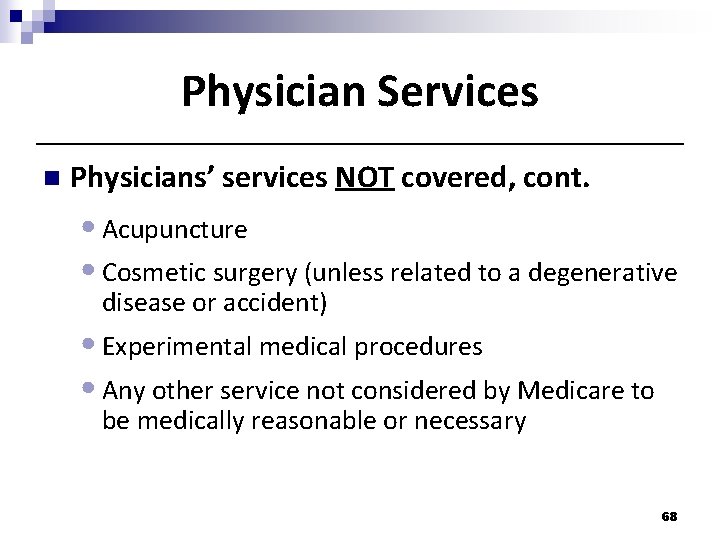
Physician Services n Physicians’ services NOT covered, cont. • Acupuncture • Cosmetic surgery (unless related to a degenerative disease or accident) • Experimental medical procedures • Any other service not considered by Medicare to be medically reasonable or necessary 68
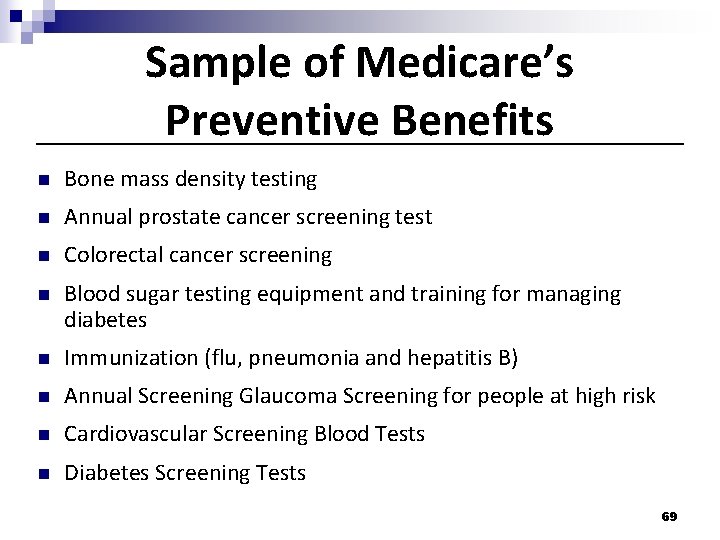
Sample of Medicare’s Preventive Benefits n Bone mass density testing n Annual prostate cancer screening test n Colorectal cancer screening n Blood sugar testing equipment and training for managing diabetes n Immunization (flu, pneumonia and hepatitis B) n Annual Screening Glaucoma Screening for people at high risk n Cardiovascular Screening Blood Tests n Diabetes Screening Tests 69
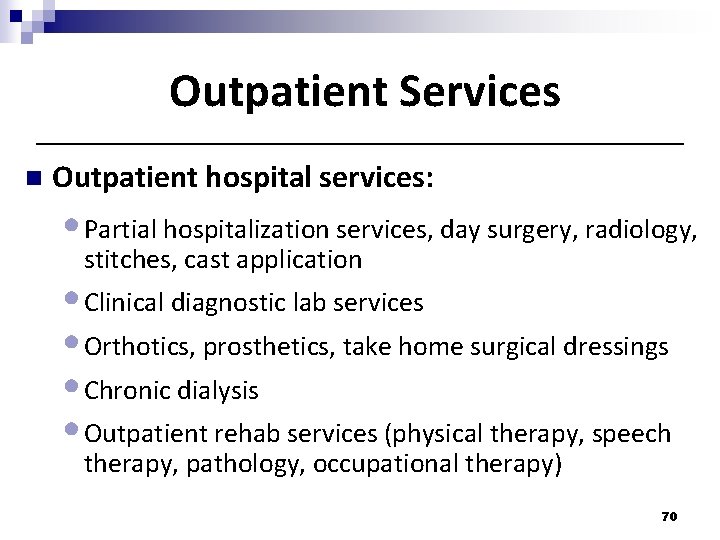
Outpatient Services n Outpatient hospital services: • Partial hospitalization services, day surgery, radiology, stitches, cast application • Clinical diagnostic lab services • Orthotics, prosthetics, take home surgical dressings • Chronic dialysis • Outpatient rehab services (physical therapy, speech therapy, pathology, occupational therapy) 70
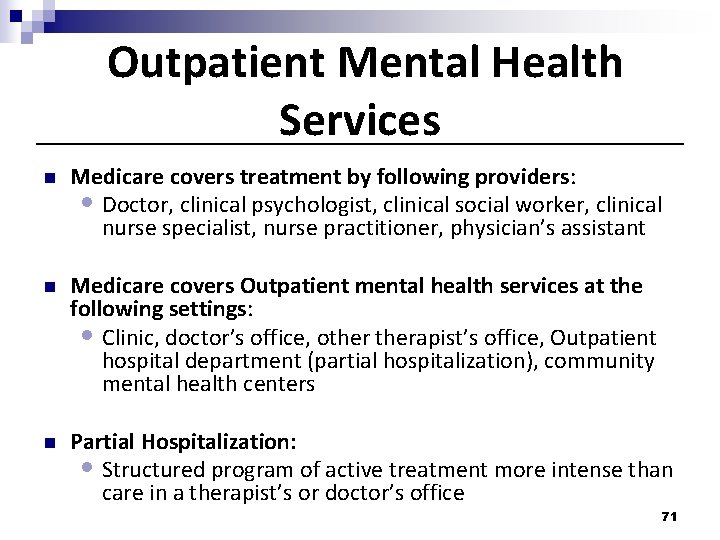
Outpatient Mental Health Services n Medicare covers treatment by following providers: • Doctor, clinical psychologist, clinical social worker, clinical nurse specialist, nurse practitioner, physician’s assistant n Medicare covers Outpatient mental health services at the following settings: • Clinic, doctor’s office, otherapist’s office, Outpatient hospital department (partial hospitalization), community mental health centers n Partial Hospitalization: • Structured program of active treatment more intense than care in a therapist’s or doctor’s office 71
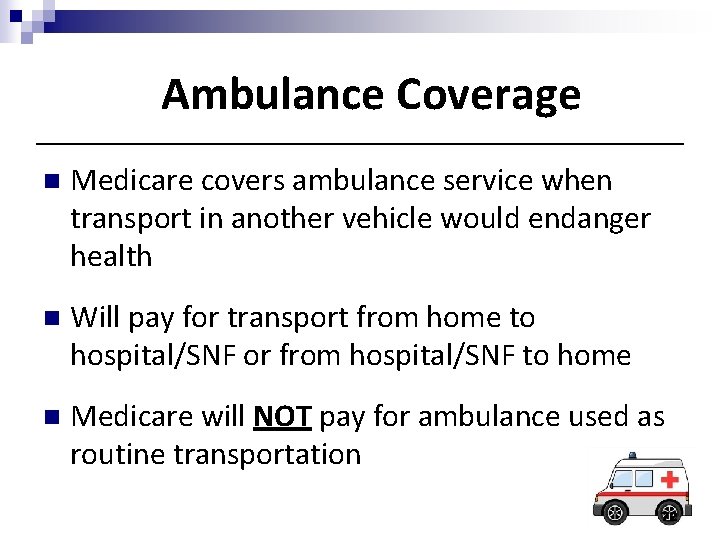
Ambulance Coverage n Medicare covers ambulance service when transport in another vehicle would endanger health n Will pay for transport from home to hospital/SNF or from hospital/SNF to home n Medicare will NOT pay for ambulance used as routine transportation 72
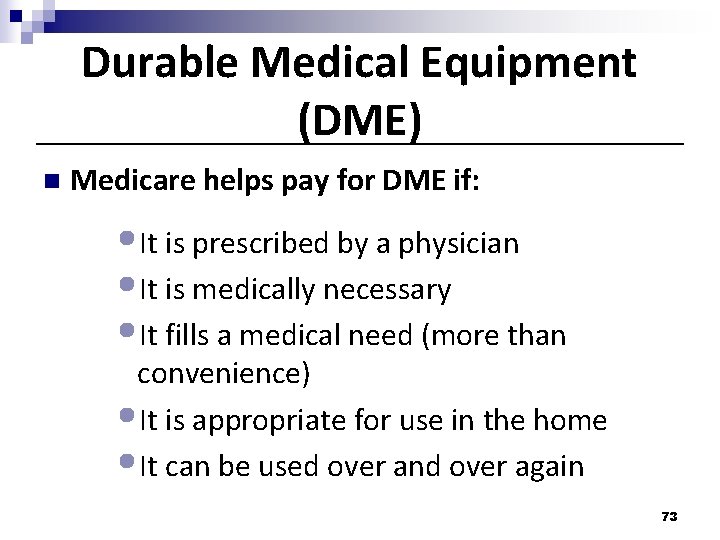
Durable Medical Equipment (DME) n Medicare helps pay for DME if: • It is prescribed by a physician • It is medically necessary • It fills a medical need (more than convenience) • It is appropriate for use in the home • It can be used over and over again 73
Durable Medical Equipment What Medicare pays for DME: • Medicare pays 80% of Medicare approved amount • If the supplier accepts assignment, beneficiary pays 20% • If supplier does NOT accept assignment, beneficiary pays 20% PLUS difference between what Medicare approves and supplier charges • Supplier is required to bill Medicare • Beneficiary can buy or rent DME 74
DME Counseling Tips n Encourage clients to: • Make sure the physician fills out a Certificate of Medical Necessity • Ask the supplier if they accept Medicare assignment • If the item is on the DMEPOS list, make sure it is ordered from a DMEPOS supplier • Use Medicare. gov to find a DMEPOS-CBP supplier 75
Medicare Part B Review 1. What kinds of services does Part B cover? 2. What out of pocket expenses does a beneficiary have for Part B services? 3. What does accepting assignment mean? 4. What is a participating provider? 5. What are excess charges? 6. What is the Ban on Balanced Billing? 76