
MANAGE RESPONSIBLE SERVICE OF ALCOHOL D 1 HBS
MANAGE RESPONSIBLE SERVICE OF ALCOHOL D 1. HBS. CL 5. 03 Slide 1
Manage responsible service of alcohol This Unit comprises three Elements: 1. Maintain a responsible drinking environment within a licensed environment 2. Dispense alcoholic beverages 3. Ensure customers drink within appropriate limits Slide 2
Assessment for this Unit may include: � Oral questions � Written questions � Work projects � Workplace observation of practical skills � Practical exercises � Formal report from employer or supervisor Slide 3
Maintain a responsible drinking environment Performance Criteria for this Element are: � 1. 1 Identify customers who should be refused service � 1. 2 Apply enterprise & licensing authority eligibility standards &/or requirements to be served alcohol � 1. 3 Explain restrictions for service courteously & diplomatically � 1. 4 Where appropriate, request proof of age prior to service Slide 4
Identify customers who should be refused service Basic requirements: � All premises serving alcohol must be licensed � Licensed venues must comply with legal obligations � Additional requirements for individual premises may be imposed by the terms and conditions of individual licences Slide 5
Identify customers who should be refused service ‘Terms & conditions’ of a liquor licence can address: � Trading days & hours � Types of liquor which can be sold � Licensed areas � Identification of classes of people to whom liquor can be sold or supplied � On-premises and or off-premises authority Slide 6
Identify customers who should be refused service Licensed premises may include: � Hotels � Restaurants � Bars � Night clubs � Gaming venues � Bottle shops Slide 7
Identify customers who should be refused service Refusal of service is an important aspect of RSA & may relate to: � Refusal of service of alcohol � Refusal of all service – but allowed to remain on the premises � Refusal of all service – and asked to leave Slide 8
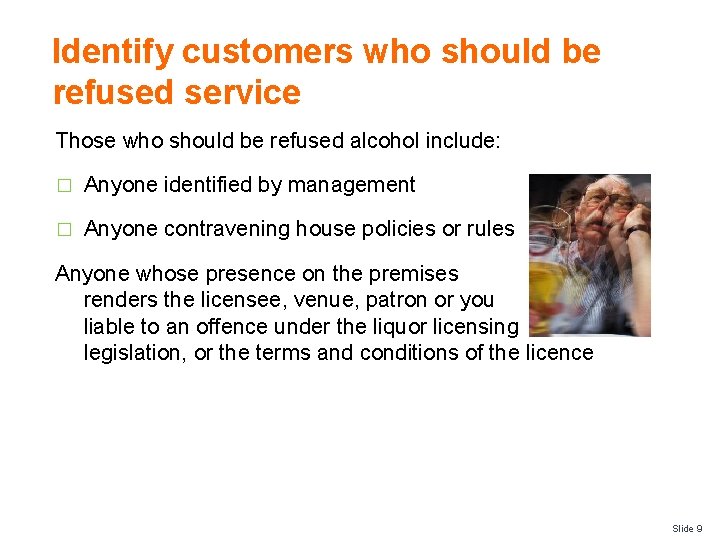
Identify customers who should be refused service Those who should be refused alcohol include: � Anyone identified by management � Anyone contravening house policies or rules Anyone whose presence on the premises renders the licensee, venue, patron or you liable to an offence under the liquor licensing legislation, or the terms and conditions of the licence Slide 9
Identify customers who should be refused service Ways to identify who should be refused service: � Check people on entry � Watch patrons � Listen to customers � Monitor alcohol consumption – by type and quantity over time Slide 10
Apply relevant standards and requirements to the service of alcohol All liquor service must occur within legal and ‘house’ standards and requirements in order to deliver practical RSA. This is essential to : � Demonstrate the responsible attitude of the venue � Prevent you being charged by the Authorities � Protect the venue against legal action (Continued) Slide 11
Apply relevant standards and requirements to the service of alcohol � Reduce the incidence of drunk patrons starting fights � Reduce the level of Police attendance at the venue � Help protect patrons from drink-related injury or accident � Reduce alcohol-related violence and health issues � Provide a better working environment for staff Slide 12
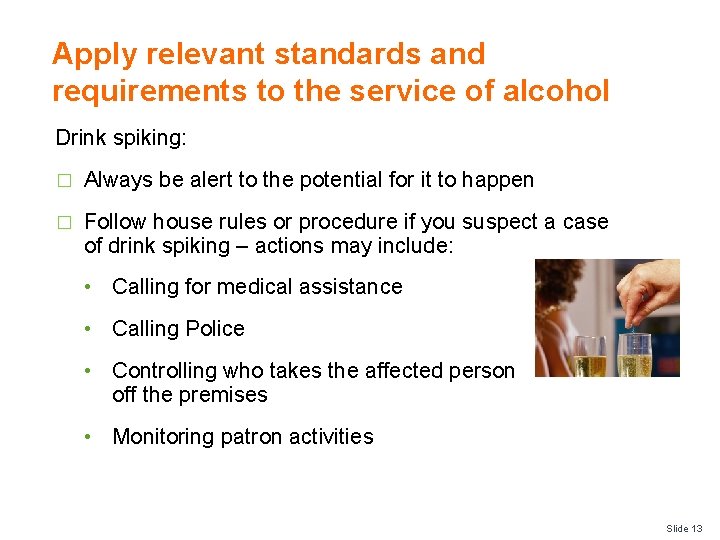
Apply relevant standards and requirements to the service of alcohol Drink spiking: � Always be alert to the potential for it to happen � Follow house rules or procedure if you suspect a case of drink spiking – actions may include: • Calling for medical assistance • Calling Police • Controlling who takes the affected person off the premises • Monitoring patron activities Slide 13
Apply relevant standards & requirements to the service of alcohol You can learn legal liquor licensing requirements by: � Reading workplace liquor licences � Visiting local liquor licensing website � Requesting licensing information from Authorities � Contacting licensing officer or Inspector � Reading relevant legislation � Attending in-house training Slide 14
Apply relevant standards and requirements to the service of alcohol You can learn house rules or policies on liquor service by : � Reading internal rules, policies, SOPs � Participating in in-house RSA training � Talking to experienced liquor service staff � Talking to management � Watching and listening to what happens in the workplace Slide 15
Apply relevant standards and requirements to the service of alcohol Practices to ensure legal and responsible service of liquor include: � Asking for, checking on ID of those who look under-age � Only relying on approved documents as acceptable evidence of age � Checking people at the door as they enter the venue � Refusing entry to those who are banned (Continued) Slide 16
Apply relevant standards and requirements to the service of alcohol � Monitoring patron intake of alcohol � Ensure those who are refused service are not provided with liquor by other people � Ensure those who have been asked to leave do not return � Notify other staff of those who have been refused service � Monitoring patron behaviour � Being alert to potential for third party sales � Adhering to internal liquor serving protocols designed to deliver RSA Slide 17
Explain restrictions for service You may need to explain legal and in-house restrictions to patrons if they do not know or understand what the requirements or limitations are. This must be done in a customer-focussed manner featuring: � Courtesy � Diplomacy Slide 18
Explain restrictions for service Being courteous at this stage means: � Apologising for the need to explain things � Using customer’s name � Using polite and respectful language � Being assertive Slide 19
Explain restrictions for service Being ‘diplomatic’ involves: � Using a suitable tone and volume � Trying to talk to them on their own � Advising patron many others make the same mistake � Thanking them for their time and understanding � Offering another (non-alcoholic) product (where appropriate and legal) so they can remain on the premises � Give the customer ‘options’, not ‘ultimatums’ Slide 20
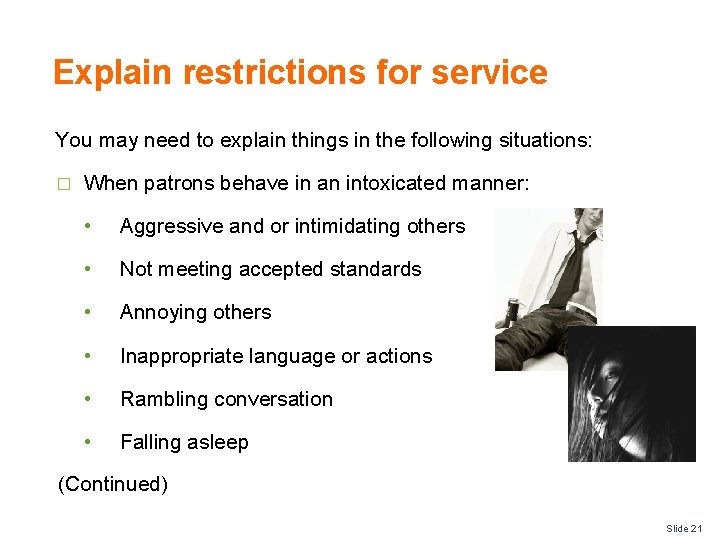
Explain restrictions for service You may need to explain things in the following situations: � When patrons behave in an intoxicated manner: • Aggressive and or intimidating others • Not meeting accepted standards • Annoying others • Inappropriate language or actions • Rambling conversation • Falling asleep (Continued) Slide 21
Explain restrictions for service � When patrons behave in a: • Violent manner – even when not drunk • Disorderly manner – even when not drunk � Where under-age persons are identified on the premises (Continued) Slide 22
Explain restrictions for service � When a person seeks entry or service and they have been excluded or banned � When patrons seek to be served outside licensing hours: • ‘Grace period’ allows patrons to finish the drinks they have but not to be served or supplied with more drinks • Some accommodation venues can serve ‘guests’ 24 hours-a-day in their rooms (Continued) Slide 23
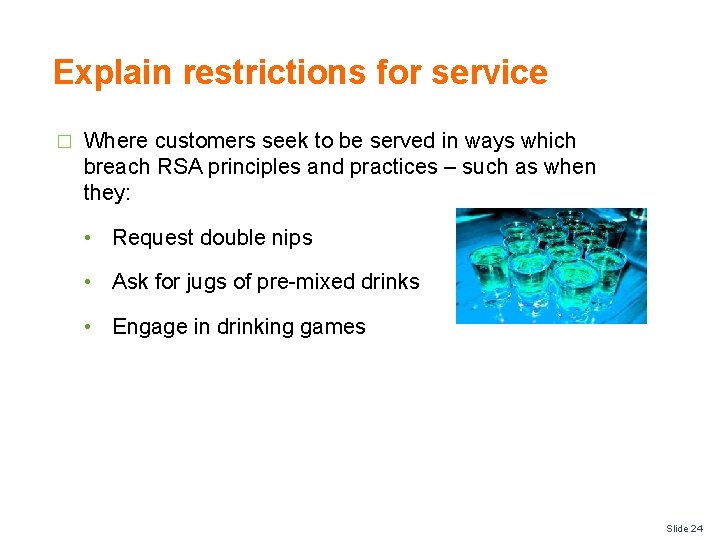
Explain restrictions for service � Where customers seek to be served in ways which breach RSA principles and practices – such as when they: • Request double nips • Ask for jugs of pre-mixed drinks • Engage in drinking games Slide 24
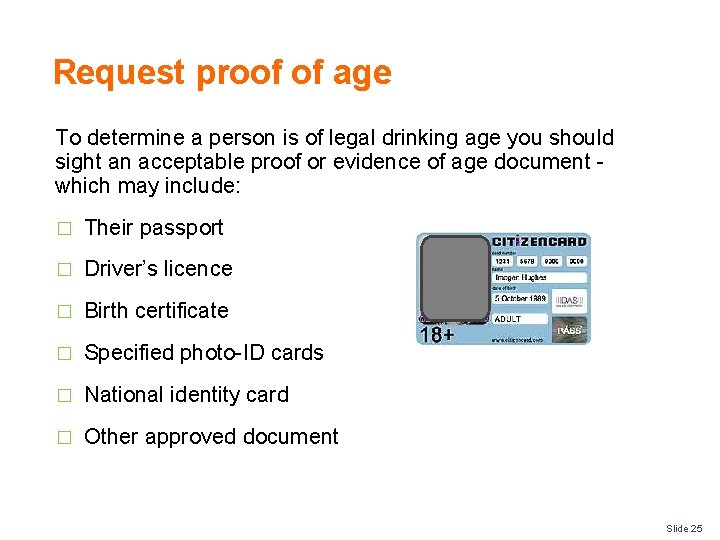
Request proof of age To determine a person is of legal drinking age you should sight an acceptable proof or evidence of age document which may include: � Their passport � Driver’s licence � Birth certificate � Specified photo-ID cards � National identity card � Other approved document Slide 25
Request proof of age You must: � Ask everyone for evidence of age if you do not already know them and their age and you believe they may be under age � Do this every time you have a suspicion of under age � Check on anyone you do not know who appears ‘just a bit older’ than the legal minimum age Slide 26
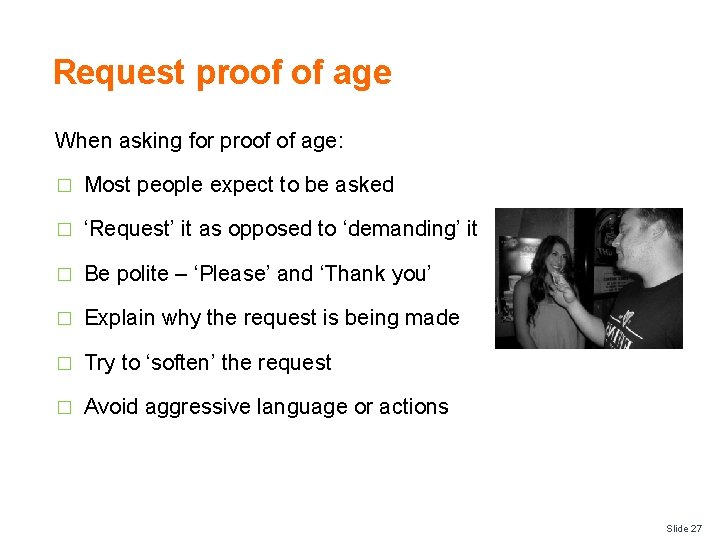
Request proof of age When asking for proof of age: � Most people expect to be asked � ‘Request’ it as opposed to ‘demanding’ it � Be polite – ‘Please’ and ‘Thank you’ � Explain why the request is being made � Try to ‘soften’ the request � Avoid aggressive language or actions Slide 27
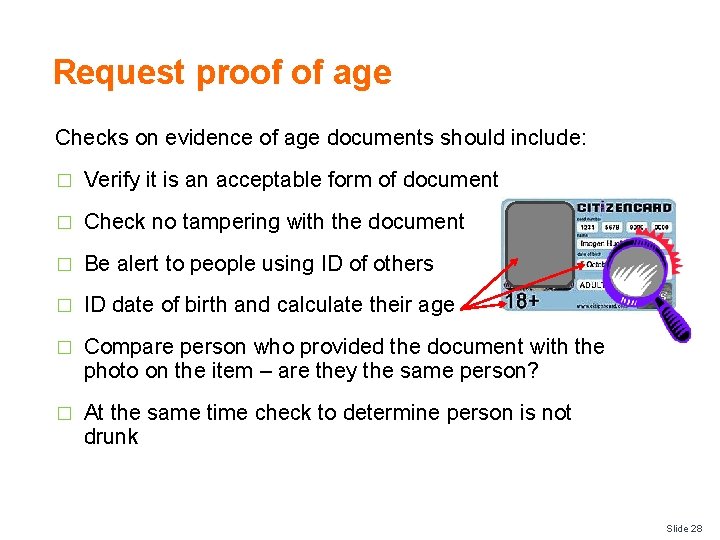
Request proof of age Checks on evidence of age documents should include: � Verify it is an acceptable form of document � Check no tampering with the document � Be alert to people using ID of others � ID date of birth and calculate their age � Compare person who provided the document with the photo on the item – are they the same person? � At the same time check to determine person is not drunk Slide 28
Request proof of age If you find someone has provided you with a false evidence of age document: � Follow legal obligations – if they exist � Adhere to house policy: • Seize the document • Notify Authorities � There may be a legal ban on seizing suspected or actual false driving licences Slide 29
Summary – Element 1 When maintaining a responsible drinking environment within a licensed environment: � Understand all relevant liquor licensing legislation � Know terms and conditions of your liquor licence � Know who should be refused service of liquor and circumstances under which this refusal applies � Monitor behaviour and drinking of patrons on an ongoing basis (Continued) Slide 30
Summary – Element 1 � Give people warnings so they have an opportunity to modify their alcohol intake or behaviour or language � Ensure all legal liquor service obligations and house policies are complied with when serving alcohol � Apply standard RSA principles and practices in terms of liquor service � Explain legal requirements and house policies to patrons in a courteous and professional manner � Request proof of age from anyone you suspect may be under the legal drinking age Slide 31
Prepare and serve standard drinks Performance Criteria for this Element are: � 2. 1 Prepare and serve standard drinks � 2. 2 Decline request for drinks that exceed standard limits politely and advise reasons for refusal � 2. 3 Provide accurate advice to customers on alcoholic beverages if required � 2. 4 Refuse service to intoxicated customers in a suitable and consistent manner Slide 32
Prepare and serve standard drinks A ‘standard drink’: � Contains a standard amount of alcohol measured in ‘grams of pure alcohol’ � Standard drinks range from 7 - 14 grams of pure alcohol per drink � Our definition = an alcoholic drink containing 10 grams of pure alcohol per drink Slide 33
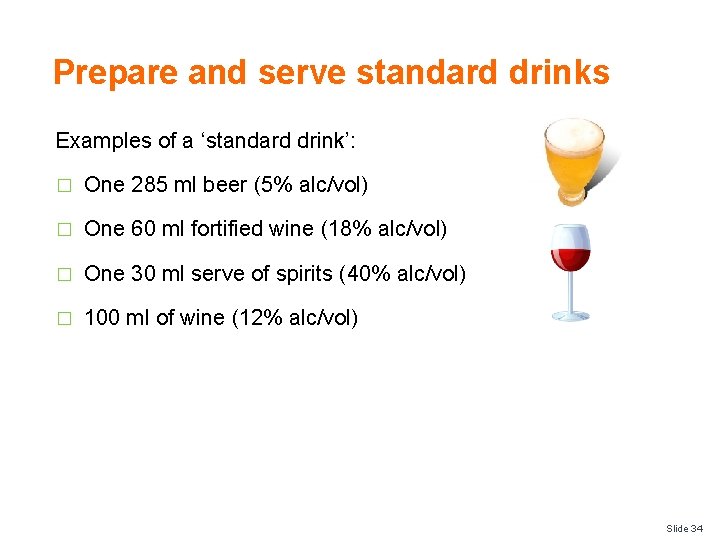
Prepare and serve standard drinks Examples of a ‘standard drink’: � One 285 ml beer (5% alc/vol) � One 60 ml fortified wine (18% alc/vol) � One 30 ml serve of spirits (40% alc/vol) � 100 ml of wine (12% alc/vol) Slide 34
Prepare and serve standard drinks Points to note about alcohol consumption and processing: � There is a relationship between time taken to consume alcohol and its effect on the body � The body processes alcohol (generally) at the rate of 1 standard drink per hour – which varies depending on: • Gender • Size • Health • Age (Continued) Slide 35
Prepare and serve standard drinks � Alcohol enters bloodstream quicker if there is no food in the stomach � Medications can interact with and increase the effect of alcohol � Alcohol can stay in people’s system for hours � Alcohol is processed by the body at the (approximate) rate of 1 standard drink per hour (Continued) Slide 36
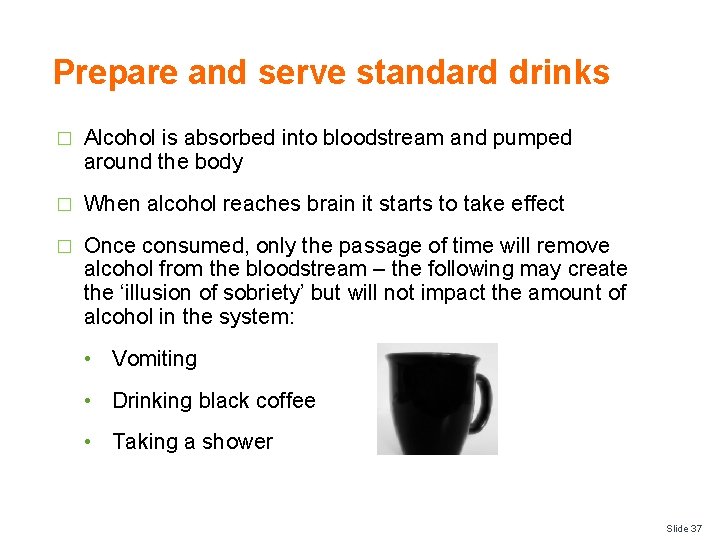
Prepare and serve standard drinks � Alcohol is absorbed into bloodstream and pumped around the body � When alcohol reaches brain it starts to take effect � Once consumed, only the passage of time will remove alcohol from the bloodstream – the following may create the ‘illusion of sobriety’ but will not impact the amount of alcohol in the system: • Vomiting • Drinking black coffee • Taking a shower Slide 37
Prepare and serve standard drinks Responsible drinking of alcohol guidelines: � Males: 4 standard drinks per day � Females: 2 standard drinks per day � Zero alcohol for pregnant women � No ‘stockpiling’ of drinks � Two alcohol-free days per week Slide 38
Prepare and serve standard drinks To ensure only standard drinks are prepared and served: � Develop and adhere to House Recipes � Refuse orders for non-standard drinks � Use signs to notify public of House Policy � Do not have ‘double measures’ behind the bar (Continued) Slide 39
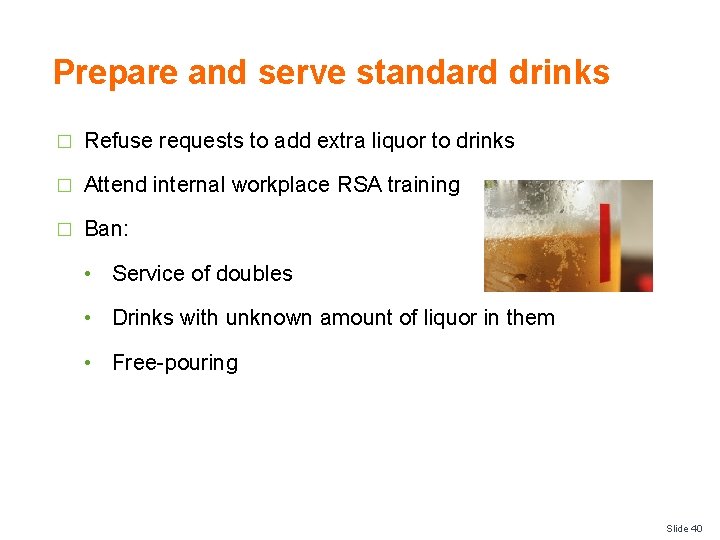
Prepare and serve standard drinks � Refuse requests to add extra liquor to drinks � Attend internal workplace RSA training � Ban: • Service of doubles • Drinks with unknown amount of liquor in them • Free-pouring Slide 40
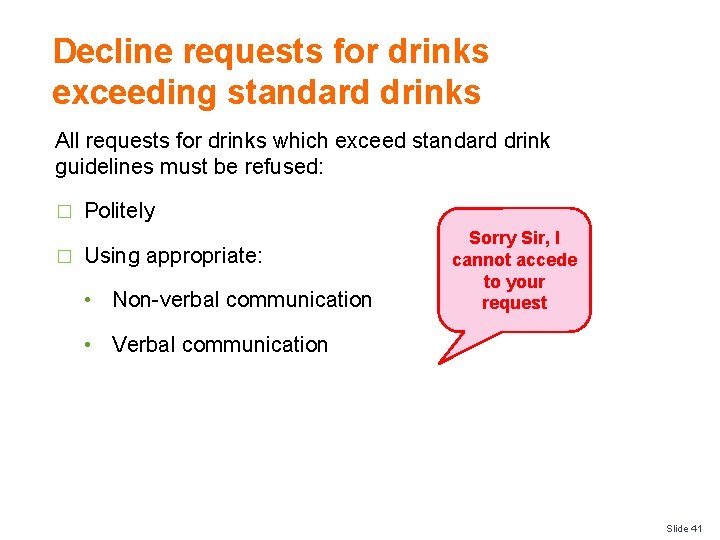
Decline requests for drinks exceeding standard drinks All requests for drinks which exceed standard drink guidelines must be refused: � � Politely Using appropriate: • Non-verbal communication Sorry Sir, I cannot accede to your request • Verbal communication Slide 41
Decline requests for drinks exceeding standard drinks When refusing non-standard drinks, non-verbal language refers to: � How you say what you say � Tone of voice � Eye contact � How you stand Slide 42
Decline requests for drinks exceeding standard drinks Verbal language points to note when explaining refusal of non-standard drinks: � Body language and verbal language must match � Apologise � Use “Please” and “Thank you” (Continued) Slide 43
Decline requests for drinks exceeding standard drinks � Be respectful � Explain reasons � Apologise again � Offer a suitable alternative � Thank patron if they order something � Respond appropriately if customer is upset or angry Slide 44
Decline requests for drinks exceeding standard drinks Possible reasons a venue may refuse to serve nonstandard drinks: � Venue supports local agreement � Venue wants to prevent patrons becoming drunk � Venue wants to protect itself � Venue wants to protect patrons against danger • Accident and injury • Legal problems � Venue wants to be a responsible corporate citizen Slide 45
Provide accurate advice to customers on alcoholic beverages It is important to be able to provide information to customers about alcoholic drinks : � Ensure all advice is accurate � Never guess at an answer if you do not know the answer � Follow standard industry practices if you do not know the answer Slide 46
Provide accurate advice to customers on alcoholic beverages High levels of product knowledge are necessary to: � Demonstrate professionalism � Optimise sales � Increases patron enjoyment � Recommend appropriate drinks � Support responsible consumption Slide 47
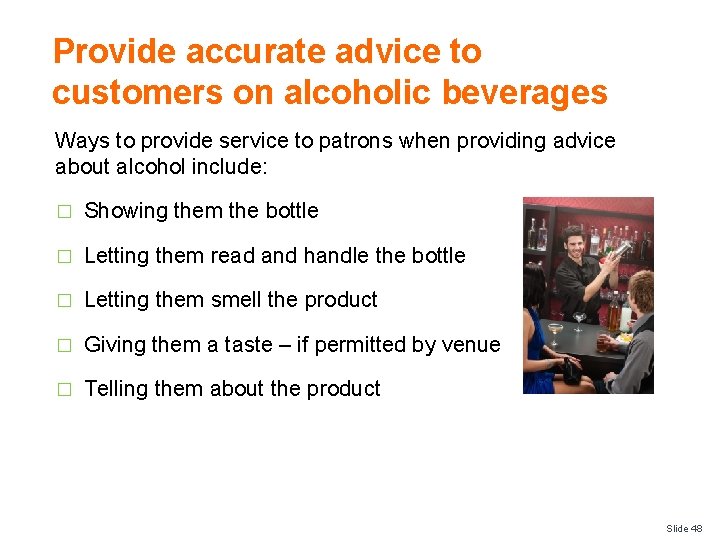
Provide accurate advice to customers on alcoholic beverages Ways to provide service to patrons when providing advice about alcohol include: � Showing them the bottle � Letting them read and handle the bottle � Letting them smell the product � Giving them a taste – if permitted by venue � Telling them about the product Slide 48
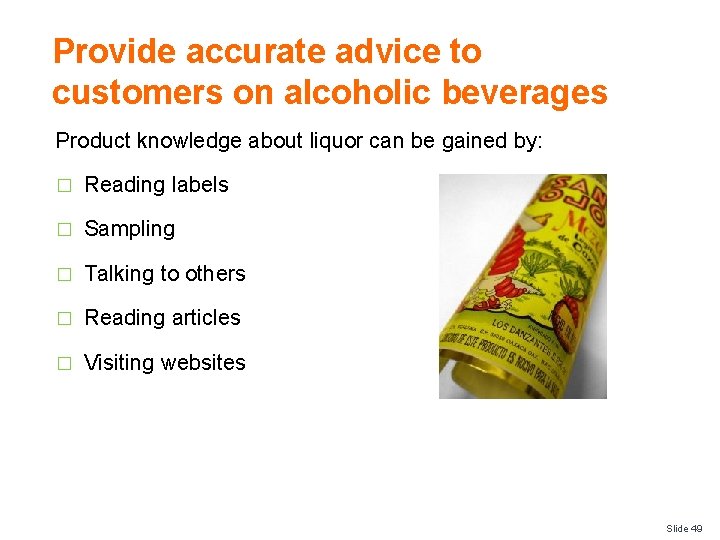
Provide accurate advice to customers on alcoholic beverages Product knowledge about liquor can be gained by: � Reading labels � Sampling � Talking to others � Reading articles � Visiting websites Slide 49
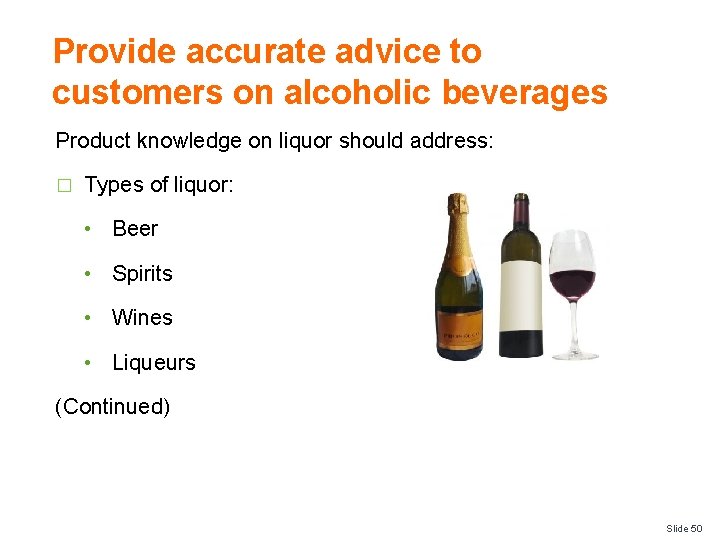
Provide accurate advice to customers on alcoholic beverages Product knowledge on liquor should address: � Types of liquor: • Beer • Spirits • Wines • Liqueurs (Continued) Slide 50
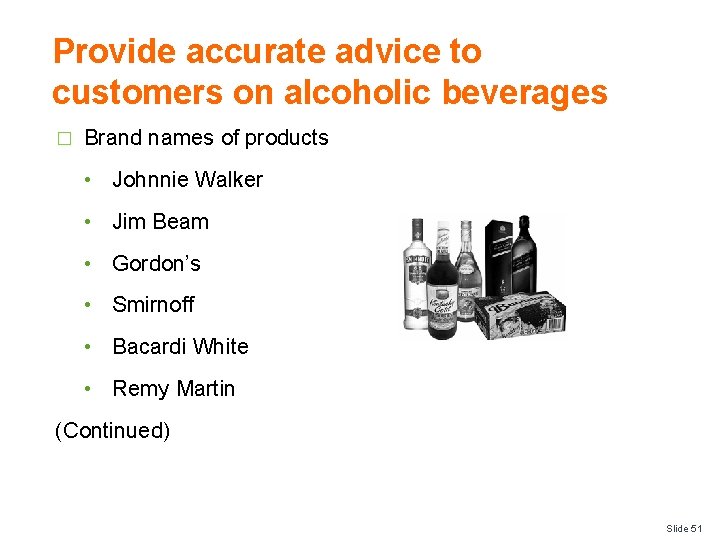
Provide accurate advice to customers on alcoholic beverages � Brand names of products • Johnnie Walker • Jim Beam • Gordon’s • Smirnoff • Bacardi White • Remy Martin (Continued) Slide 51
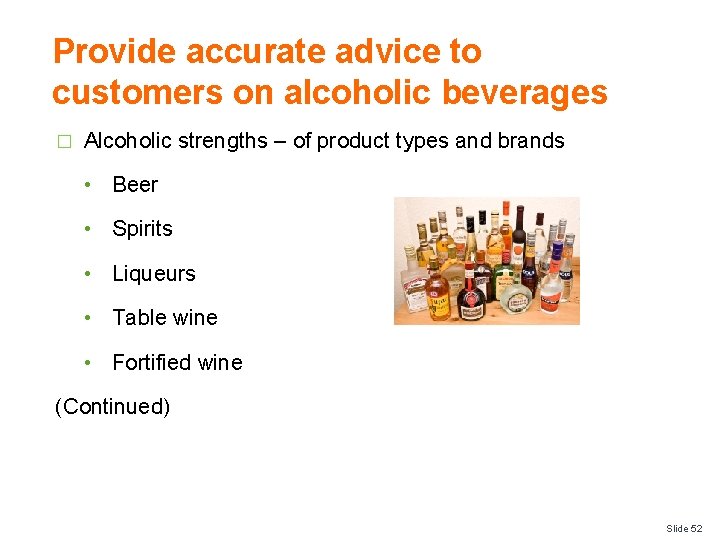
Provide accurate advice to customers on alcoholic beverages � Alcoholic strengths – of product types and brands • Beer • Spirits • Liqueurs • Table wine • Fortified wine (Continued) Slide 52
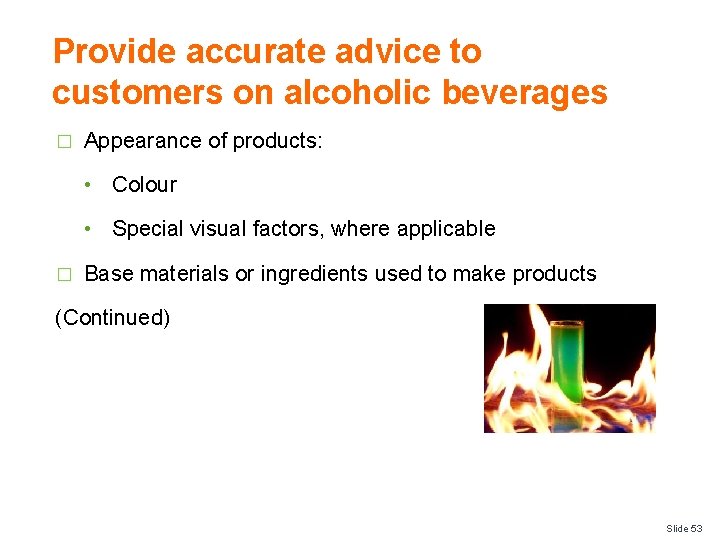
Provide accurate advice to customers on alcoholic beverages � Appearance of products: • Colour • Special visual factors, where applicable � Base materials or ingredients used to make products (Continued) Slide 53
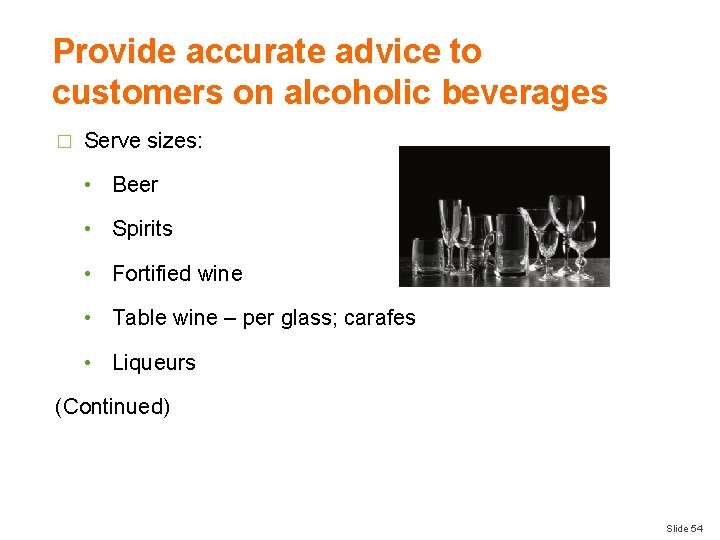
Provide accurate advice to customers on alcoholic beverages � Serve sizes: • Beer • Spirits • Fortified wine • Table wine – per glass; carafes • Liqueurs (Continued) Slide 54
Provide accurate advice to customers on alcoholic beverages � Price � Product uses � Awards won � Popularity Slide 55
Refuse service to intoxicated customers Service needs to be refused to those who are: � Drunk � Disorderly � Showing signs of excess alcohol consumption � Behaving in an acceptable manner � Banned � Under-age Slide 56
Refuse service to intoxicated customers When refusing service: � Watch and listen to an experienced person refuse service before you attempt to do so – learn from what they say and do � Practice or rehearse what you will say and do before you actually refuse service to a patron � Get other staff to monitor your first few ‘refusals of service’ (Continued) Slide 57
Refuse service to intoxicated customers � Realise every refusal of service situation is unique � Understand some customers will feel they have to object to being refused service � Never change your mind once the decision to refuse service has been made (Continued) Slide 58
Refuse service to intoxicated customers � Realise all your actions in relation to refusing service are on public show to all other patrons – you send a message to all customers when you: • Refuse service or speak to a patron • Allow a customer to do or say (‘get away with’) something � Be respectful and polite � Consider giving patrons warnings – before refusing them service Slide 59
Summary – Element 2 When dispensing alcoholic drinks: � Know the definition of a standard drink � Only prepare drinks which meet standard drink, or house recipe, requirements � Refuse service of drinks exceeding standard drink � Explain reasons venue will only serve standard drinks � Learn about all the alcoholic products you offer for sale � Offer accurate advice to customers Slide 60
Summary – Element 2 � Refuse service courteously to those who are not entitled to be served with liquor � Explain reasons for refusal of service � Try to give people options as opposed to ultimatums � Be firm, fair and consistent when refusing service � Follow House Statements and or practices for refusing service (where they exist) Slide 61
Ensure customers drink within appropriate limits Performance Criteria for this Element are : � Assess intoxication levels of customers � Offer assistance to intoxicated customers politely � Refer difficult situations to an appropriate person within the establishment � Seek assistance from appropriate people for situations which pose a threat to safety or security of colleagues, customers or property Slide 62
Assess intoxication level of customers You must monitor patron intoxications levels so you can: � Issue warnings � Refuse service to those who are significantly affected by alcohol but who are not ‘drunk’ � Determine who has to be asked to leave the premises Slide 63
Assess intoxication level of customers Signs of intoxication: � Noticeable change in behaviour � Intimidating manner � Unacceptable standards of behaviour � Annoying others (Continued) Slide 64
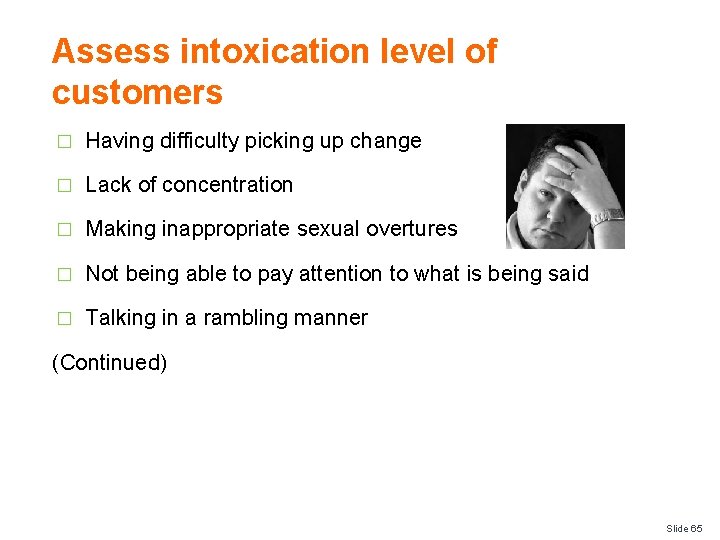
Assess intoxication level of customers � Having difficulty picking up change � Lack of concentration � Making inappropriate sexual overtures � Not being able to pay attention to what is being said � Talking in a rambling manner (Continued) Slide 65
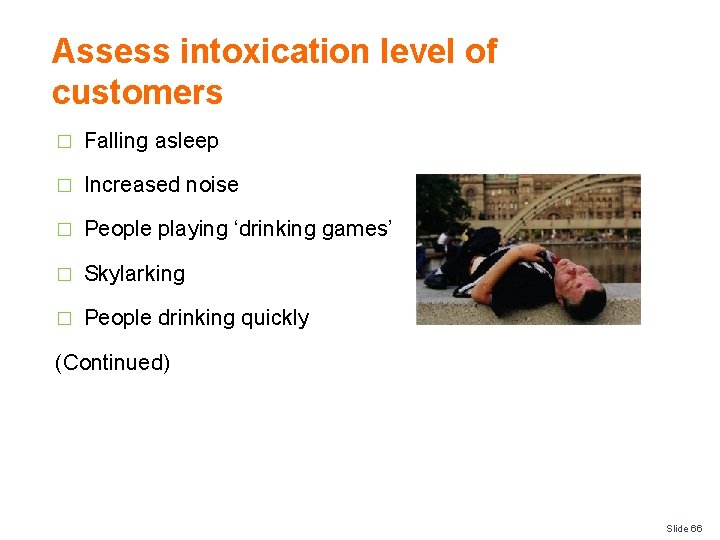
Assess intoxication level of customers � Falling asleep � Increased noise � People playing ‘drinking games’ � Skylarking � People drinking quickly (Continued) Slide 66
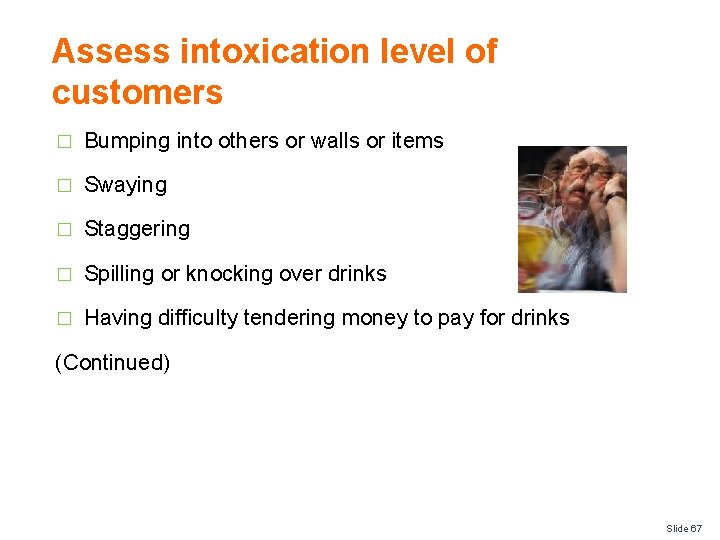
Assess intoxication level of customers � Bumping into others or walls or items � Swaying � Staggering � Spilling or knocking over drinks � Having difficulty tendering money to pay for drinks (Continued) Slide 67
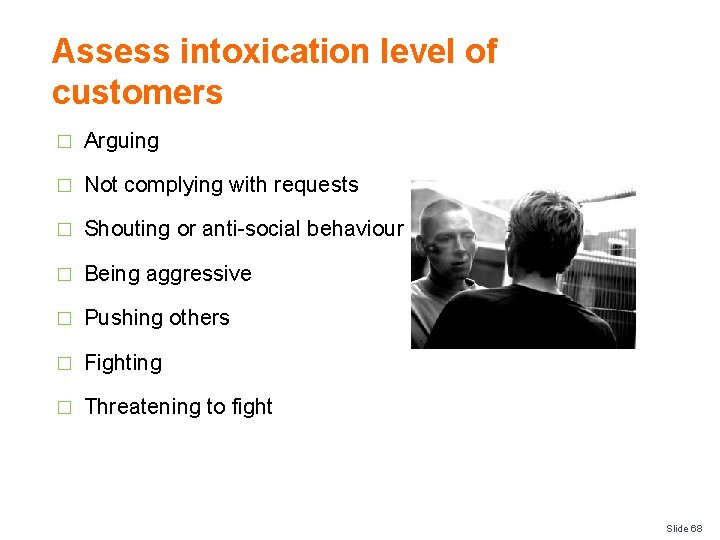
Assess intoxication level of customers � Arguing � Not complying with requests � Shouting or anti-social behaviour � Being aggressive � Pushing others � Fighting � Threatening to fight Slide 68
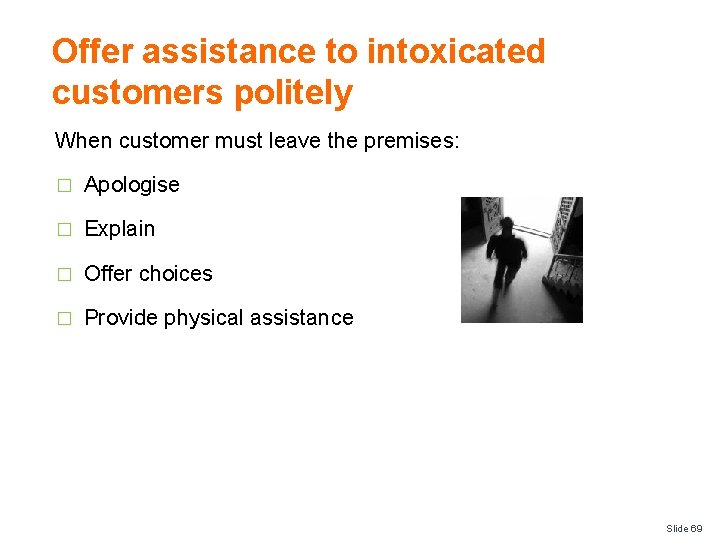
Offer assistance to intoxicated customers politely When customer must leave the premises: � Apologise � Explain � Offer choices � Provide physical assistance Slide 69
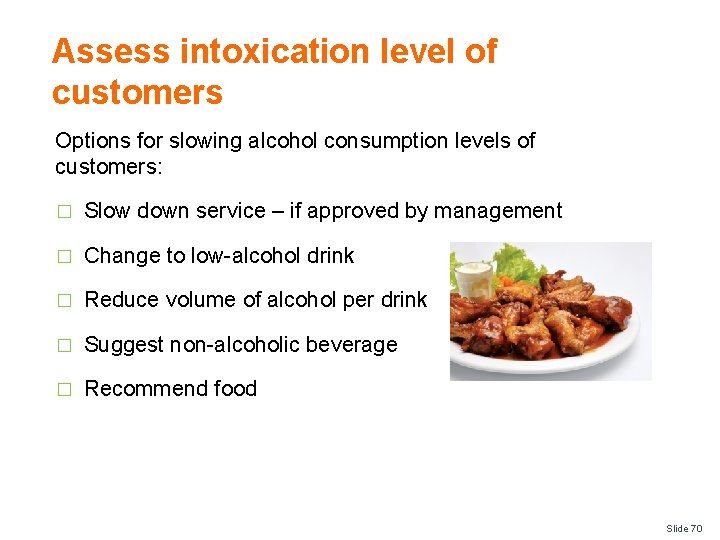
Assess intoxication level of customers Options for slowing alcohol consumption levels of customers: � Slow down service – if approved by management � Change to low-alcohol drink � Reduce volume of alcohol per drink � Suggest non-alcoholic beverage � Recommend food Slide 70
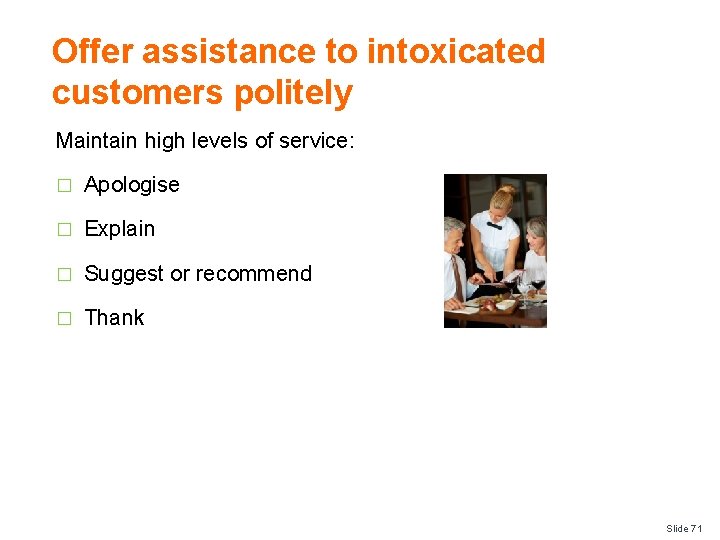
Offer assistance to intoxicated customers politely Maintain high levels of service: � Apologise � Explain � Suggest or recommend � Thank Slide 71
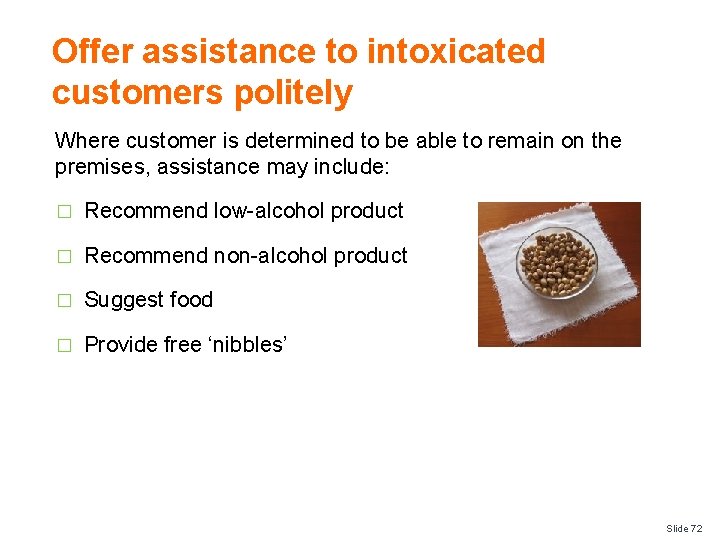
Offer assistance to intoxicated customers politely Where customer is determined to be able to remain on the premises, assistance may include: � Recommend low-alcohol product � Recommend non-alcohol product � Suggest food � Provide free ‘nibbles’ Slide 72
Refer difficult situations within the establishment Customers may become hard to deal with in difficult situations such as: � Demanding to ‘see the Manager’ � Refusing to comply with requests � Being abusive – verbally or physically � Where others are involved in the situation Slide 73
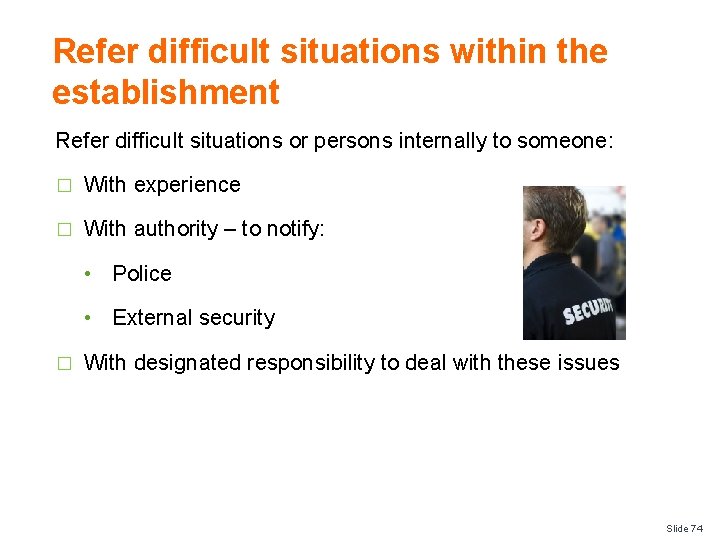
Refer difficult situations within the establishment Refer difficult situations or persons internally to someone: � With experience � With authority – to notify: • Police • External security � With designated responsibility to deal with these issues Slide 74
Refer difficult situations within the establishment It is not your job to: � Physically throw people out of the venue � Get involved in fights � Put yourself in harm’s way Slide 75
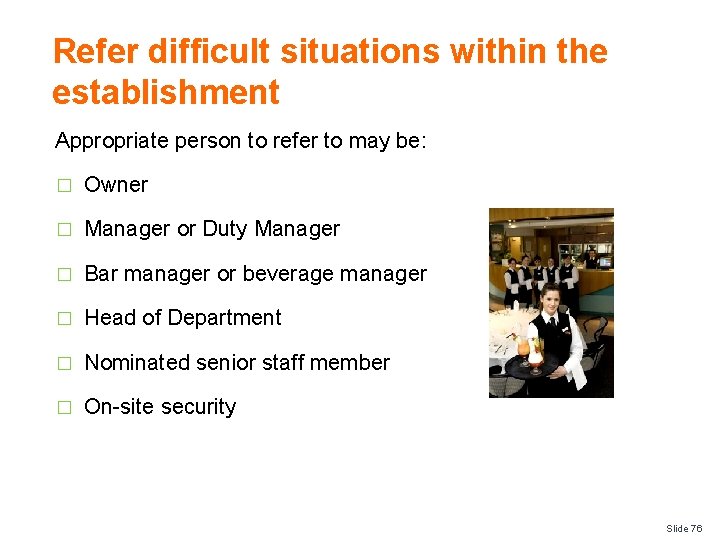
Refer difficult situations within the establishment Appropriate person to refer to may be: � Owner � Manager or Duty Manager � Bar manager or beverage manager � Head of Department � Nominated senior staff member � On-site security Slide 76
Refer difficult situations within the establishment When referring difficult situations: � Make the decision to refer as soon as possible � Advise of exact location � Provide as much detail as possible about the situation � Try not to let the customer know you are referring the situation Slide 77
Seek assistance where there is threat to safety or security If danger or threat arises, always respond according to house protocols: � Safety of people MUST ALWAYS take priority over property, equipment or cash � Choose protecting people above protecting assets � Pick the greatest good for the greatest number Slide 78
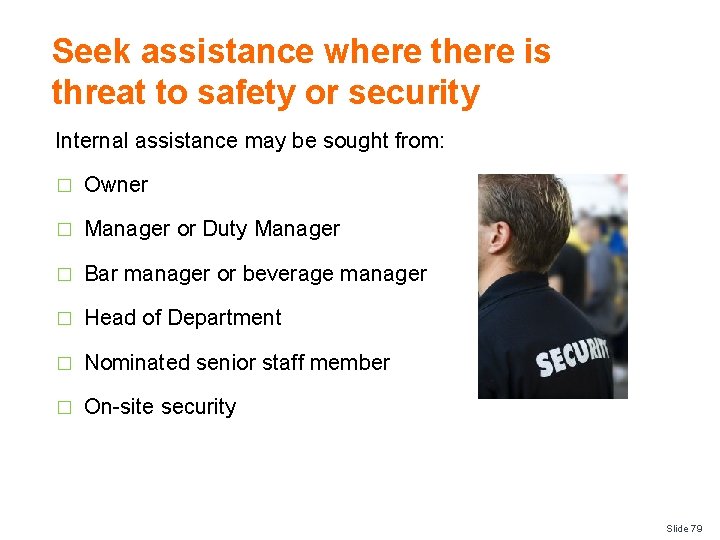
Seek assistance where there is threat to safety or security Internal assistance may be sought from: � Owner � Manager or Duty Manager � Bar manager or beverage manager � Head of Department � Nominated senior staff member � On-site security Slide 79
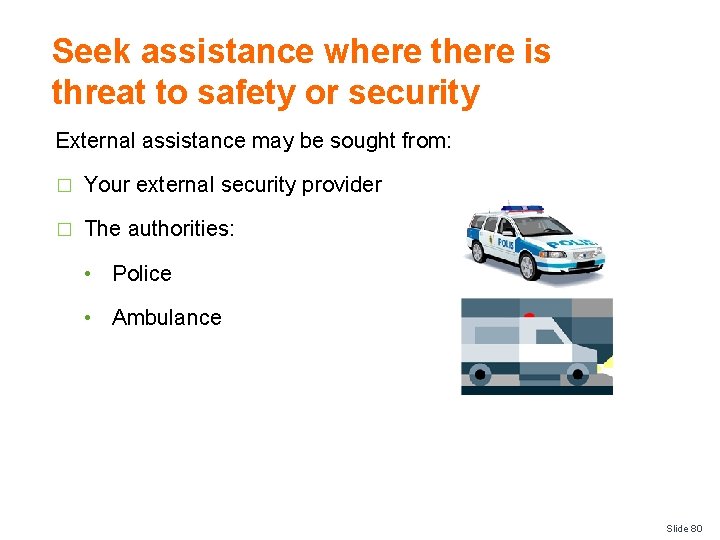
Seek assistance where there is threat to safety or security External assistance may be sought from: � Your external security provider � The authorities: • Police • Ambulance Slide 80
Seek assistance where there is threat to safety or security When summoning internal assistance: � Identify self � Advise location of incident � Advise type of situation � Identify numbers and demeanor � Explain action taken so far Slide 81
Seek assistance where there is threat to safety or security Emergency Services will need certain details before they can respond: � Be guided by them – answer their questions: let them lead the exchange � Speak clearly and calmly � Do not hang up until told to do so Slide 82
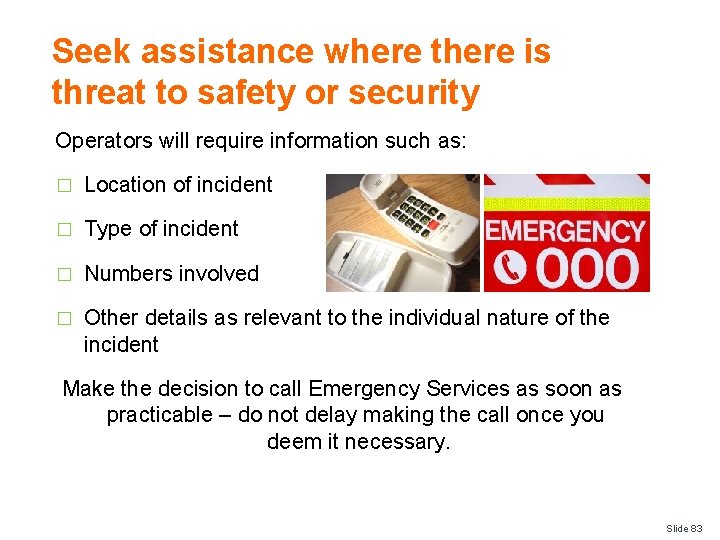
Seek assistance where there is threat to safety or security Operators will require information such as: � Location of incident � Type of incident � Numbers involved � Other details as relevant to the individual nature of the incident Make the decision to call Emergency Services as soon as practicable – do not delay making the call once you deem it necessary. Slide 83
Summary – Element 3 When ensuring customers drink within appropriate limits: � Ensure you can identify the signs of intoxication � Assess the signs of intoxication in customers � Apply approved techniques to slow the consumption of alcohol by patrons, where appropriate � Maintain high levels of customer service (Continued) Slide 84
Summary – Element 3 � Provide suitable assistance, alternatives and advice to patrons who must be refused alcohol but can remain on the premises � Offer appropriate assistance and alternatives to customers who must be asked to leave the premises � Refer difficult situations and customers to designated personnel within the venue (Continued) Slide 85
Summary – Element 3 � Provide advice and information about any person or situation which is referred � Determine if you have the authority to summon external assistance (police or ambulance) if necessary � Follow house protocols in every instance in regard to calling for assistance Slide 86
- Slides: 86