Section 1 4 Continuity and OneSided Limits Example

- Slides: 23
Section 1. 4: Continuity and One-Sided Limits
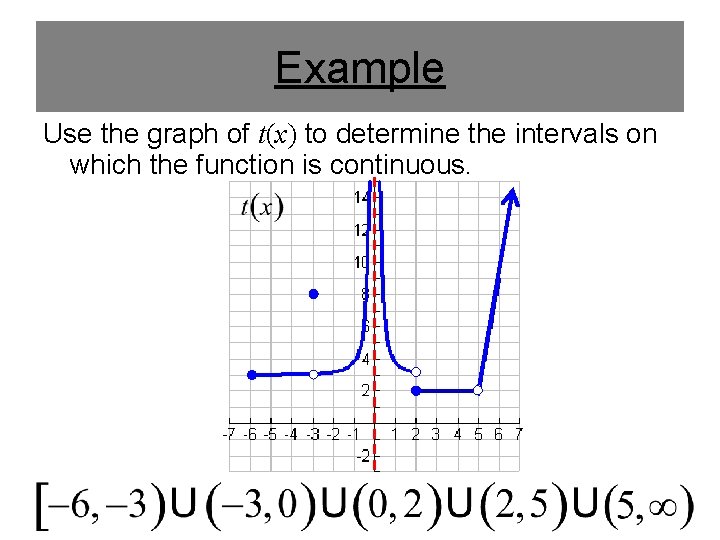
Example Use the graph of t(x) to determine the intervals on which the function is continuous.
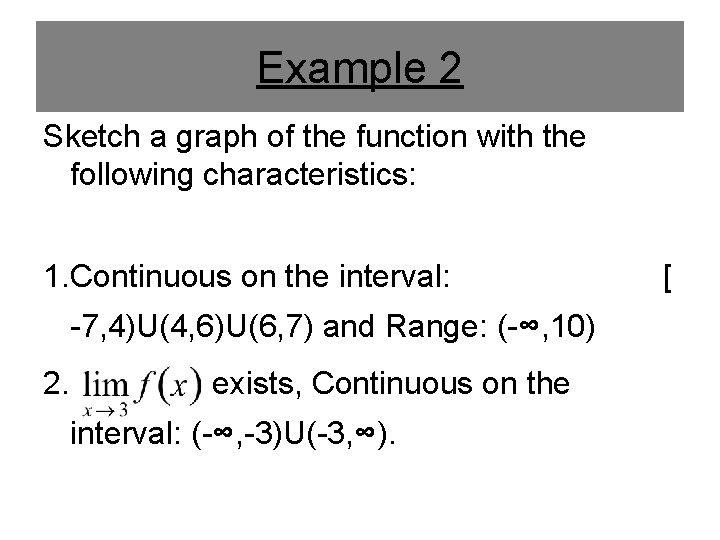
Example 2 Sketch a graph of the function with the following characteristics: 1. Continuous on the interval: -7, 4)U(4, 6)U(6, 7) and Range: (-∞, 10) 2. exists, Continuous on the interval: (-∞, -3)U(-3, ∞). [
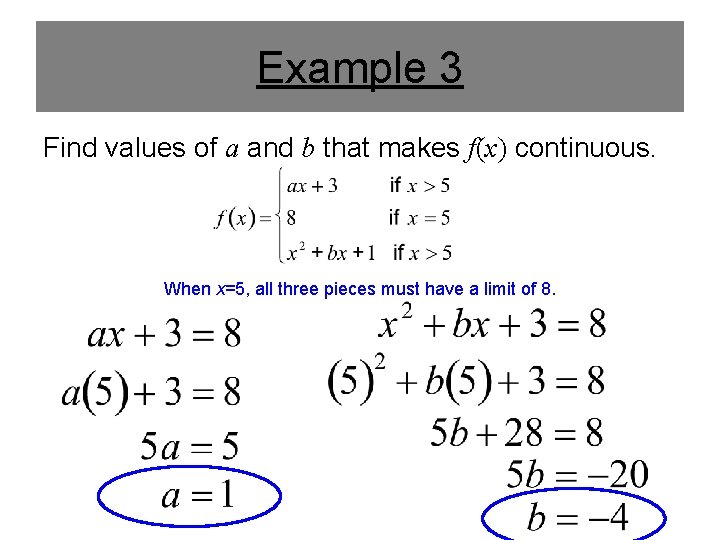
Example 3 Find values of a and b that makes f(x) continuous. When x=5, all three pieces must have a limit of 8.
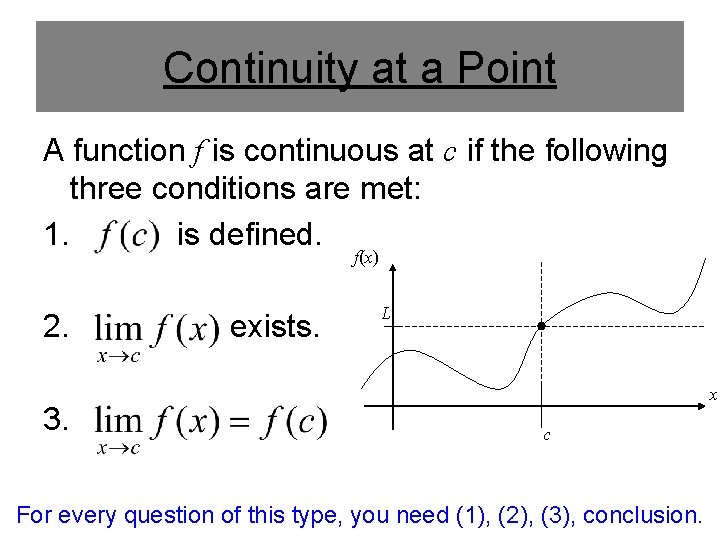
Continuity at a Point A function f is continuous at c if the following three conditions are met: 1. is defined. f(x) 2. 3. exists. L x c For every question of this type, you need (1), (2), (3), conclusion.
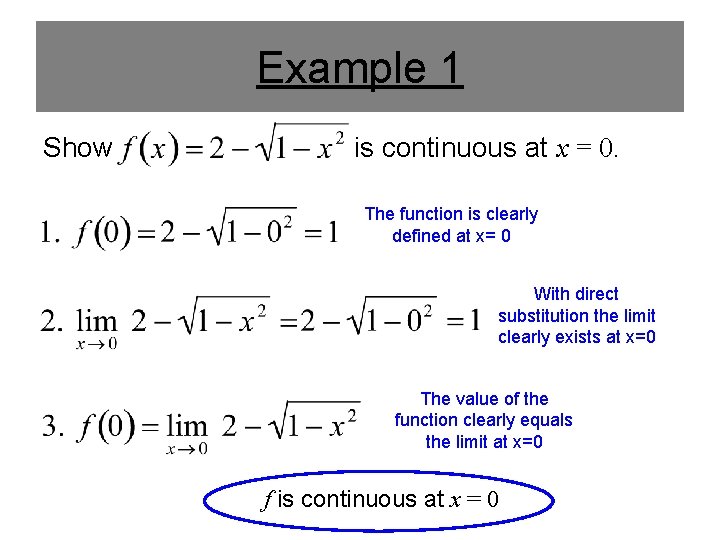
Example 1 Show is continuous at x = 0. The function is clearly defined at x= 0 With direct substitution the limit clearly exists at x=0 The value of the function clearly equals the limit at x=0 f is continuous at x = 0
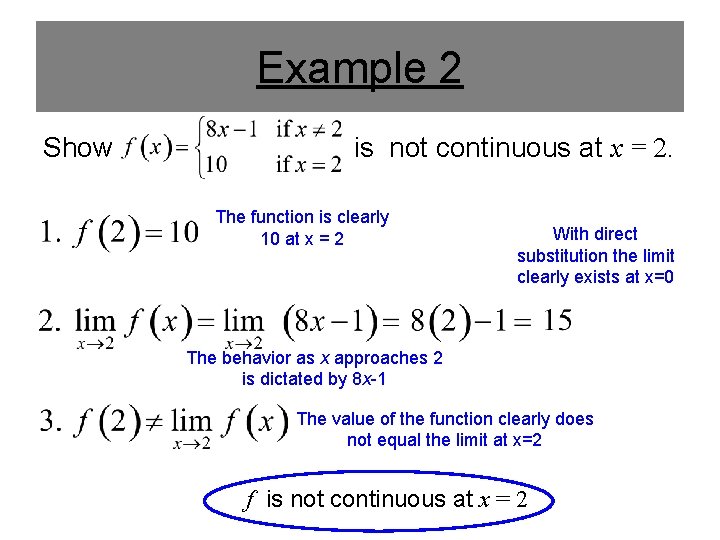
Example 2 Show is not continuous at x = 2. The function is clearly 10 at x = 2 With direct substitution the limit clearly exists at x=0 The behavior as x approaches 2 is dictated by 8 x-1 The value of the function clearly does not equal the limit at x=2 f is not continuous at x = 2
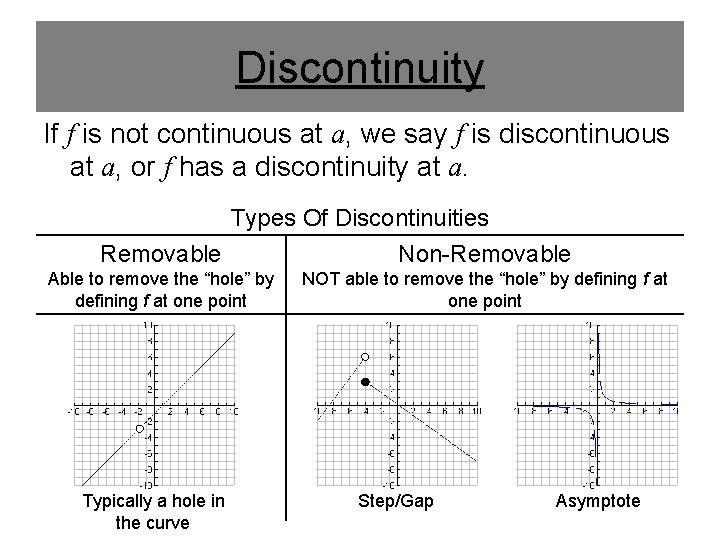
Discontinuity If f is not continuous at a, we say f is discontinuous at a, or f has a discontinuity at a. Types Of Discontinuities Removable Non-Removable Able to remove the “hole” by defining f at one point Typically a hole in the curve NOT able to remove the “hole” by defining f at one point Step/Gap Asymptote
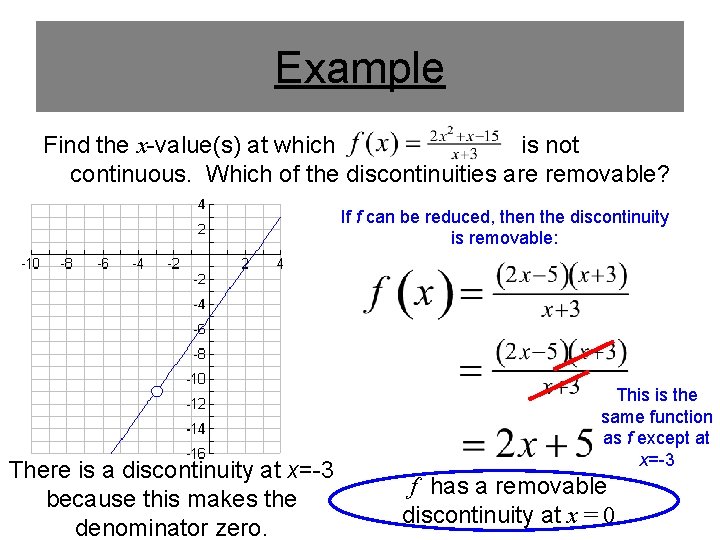
Example Find the x-value(s) at which is not continuous. Which of the discontinuities are removable? If f can be reduced, then the discontinuity is removable: There is a discontinuity at x=-3 because this makes the denominator zero. This is the same function as f except at x=-3 f has a removable discontinuity at x = 0
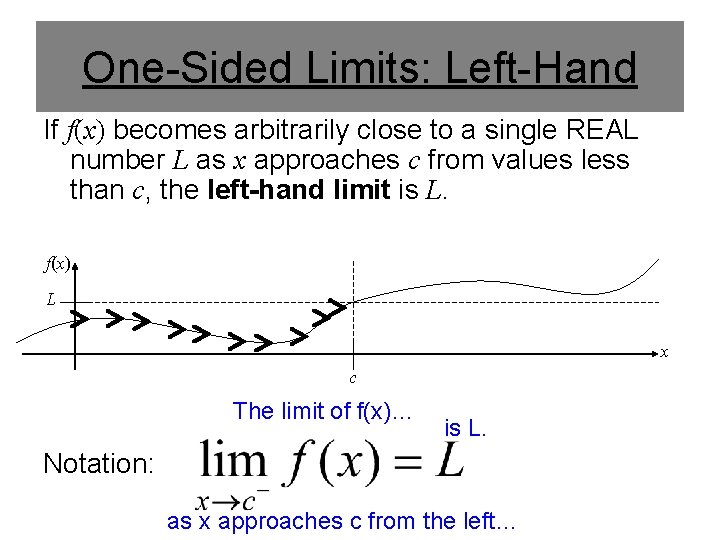
One-Sided Limits: Left-Hand If f(x) becomes arbitrarily close to a single REAL number L as x approaches c from values less than c, the left-hand limit is L. f(x) L x c The limit of f(x)… is L. Notation: as x approaches c from the left…
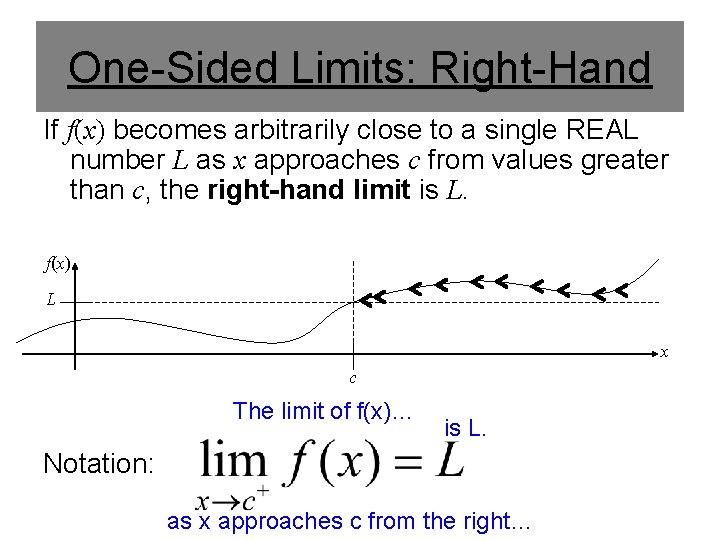
One-Sided Limits: Right-Hand If f(x) becomes arbitrarily close to a single REAL number L as x approaches c from values greater than c, the right-hand limit is L. f(x) L x c The limit of f(x)… is L. Notation: as x approaches c from the right…
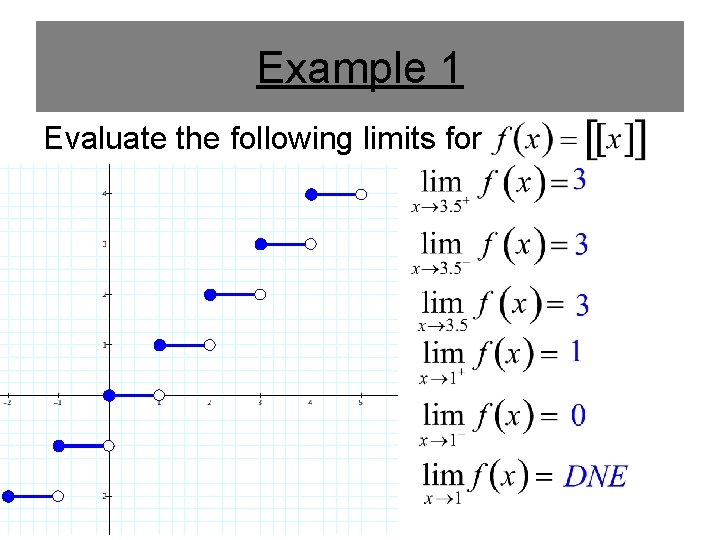
Example 1 Evaluate the following limits for
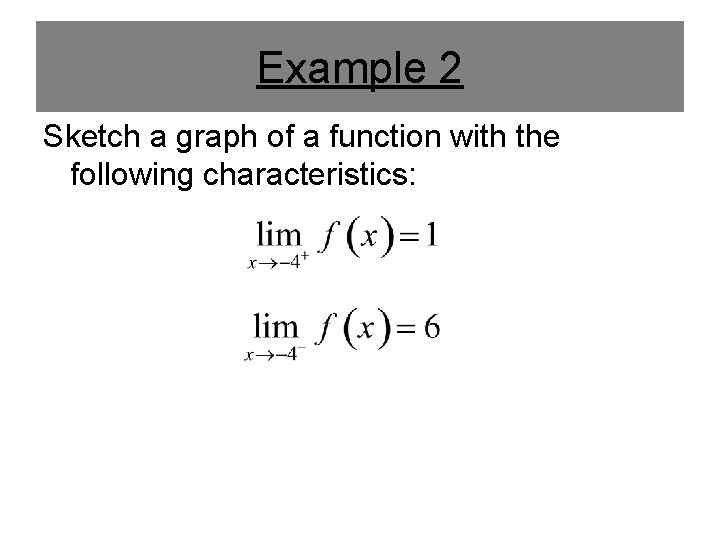
Example 2 Sketch a graph of a function with the following characteristics:
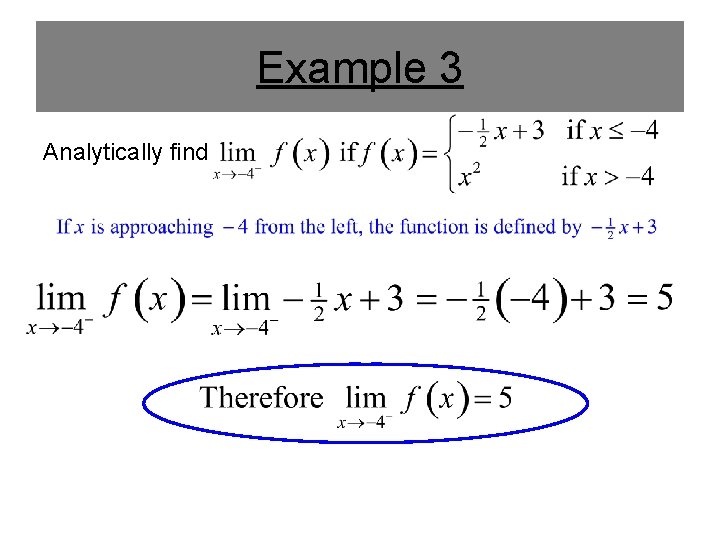
Example 3 Analytically find .
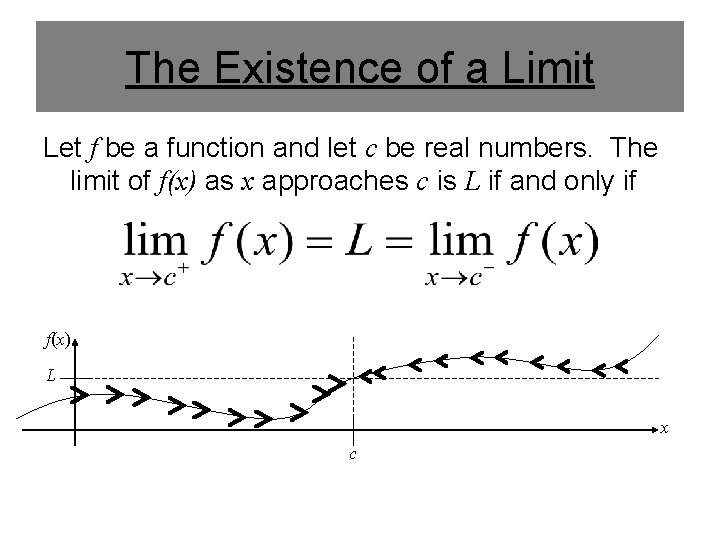
The Existence of a Limit Let f be a function and let c be real numbers. The limit of f(x) as x approaches c is L if and only if f(x) L x c
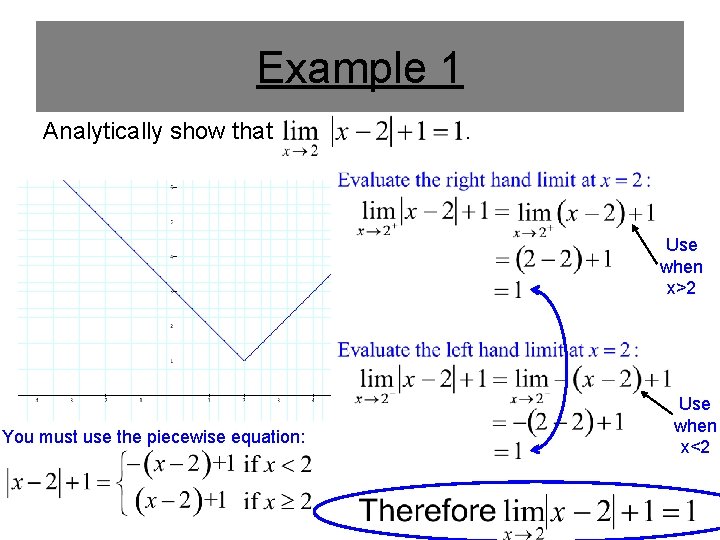
Example 1 Analytically show that . Use when x>2 You must use the piecewise equation: Use when x<2
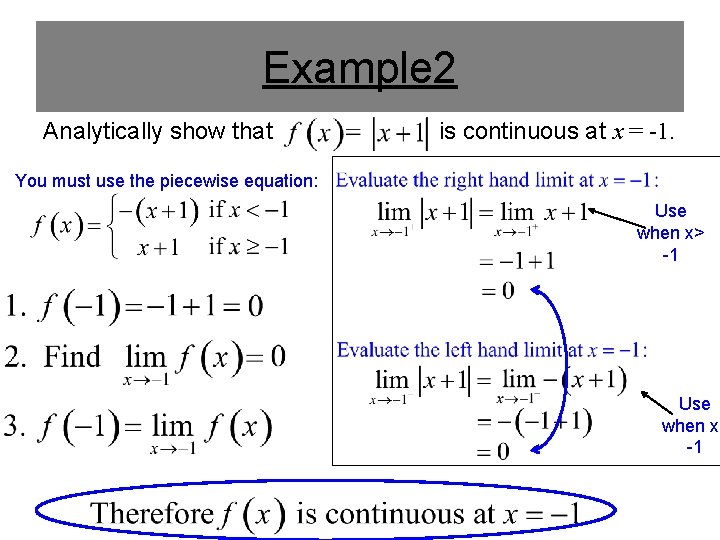
Example 2 Analytically show that is continuous at x = -1. You must use the piecewise equation: Use when x> -1 Use when x< -1
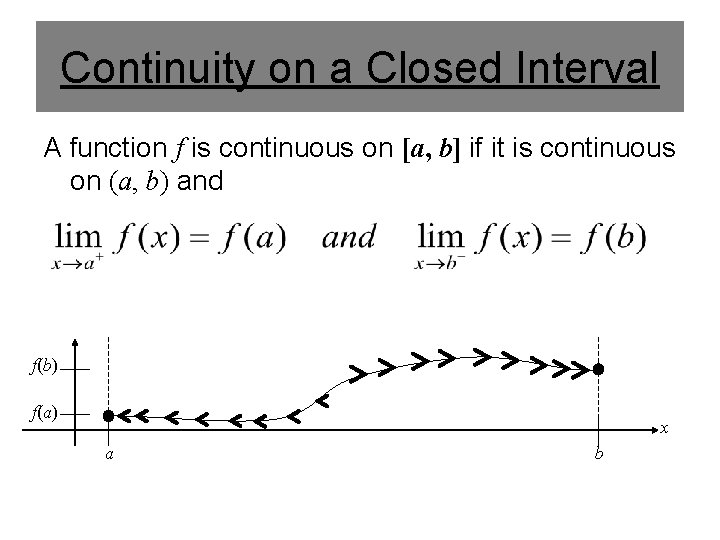
Continuity on a Closed Interval A function f is continuous on [a, b] if it is continuous on (a, b) and f(b) f(a) x a b
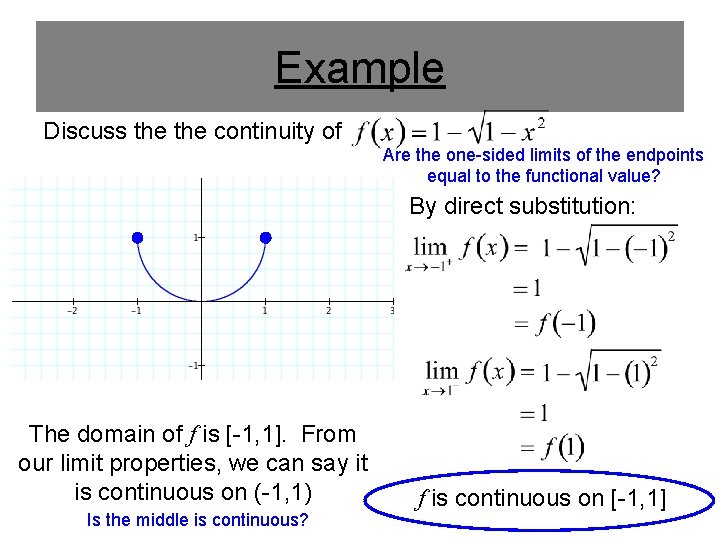
Example Discuss the continuity of Are the one-sided limits of the endpoints equal to the functional value? By direct substitution: The domain of f is [-1, 1]. From our limit properties, we can say it is continuous on (-1, 1) Is the middle is continuous? f is continuous on [-1, 1]
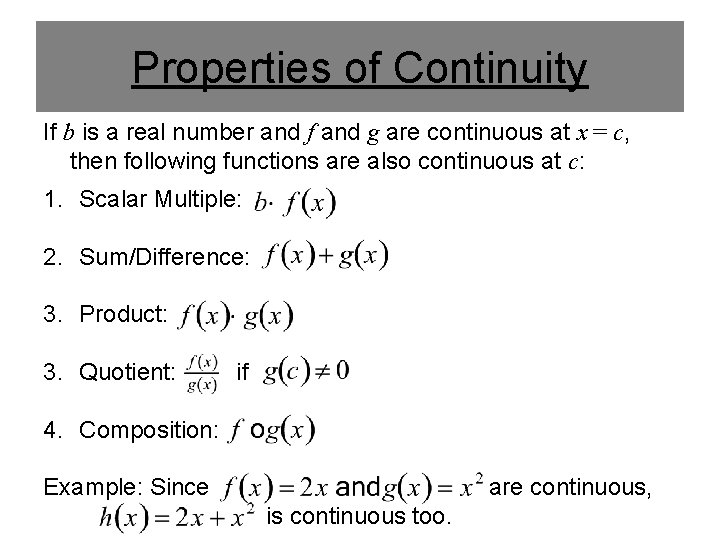
Properties of Continuity If b is a real number and f and g are continuous at x = c, then following functions are also continuous at c: 1. Scalar Multiple: 2. Sum/Difference: 3. Product: 3. Quotient: if 4. Composition: Example: Since are continuous, is continuous too.
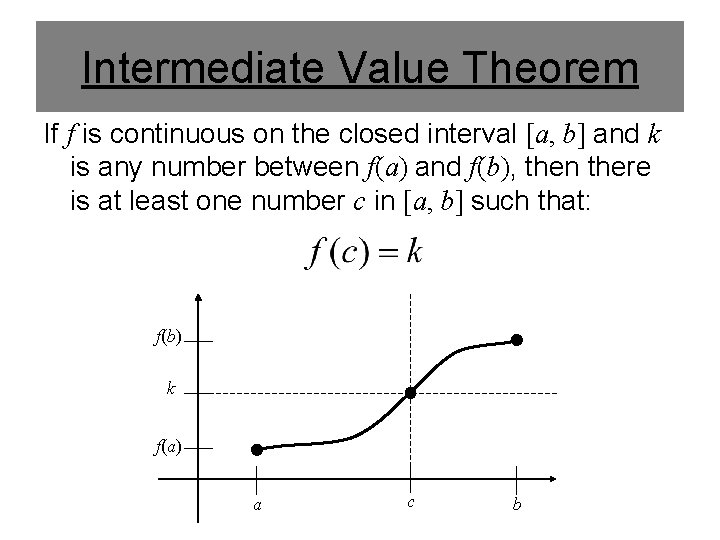
Intermediate Value Theorem If f is continuous on the closed interval [a, b] and k is any number between f(a) and f(b), then there is at least one number c in [a, b] such that: f(b) k f(a) a c b
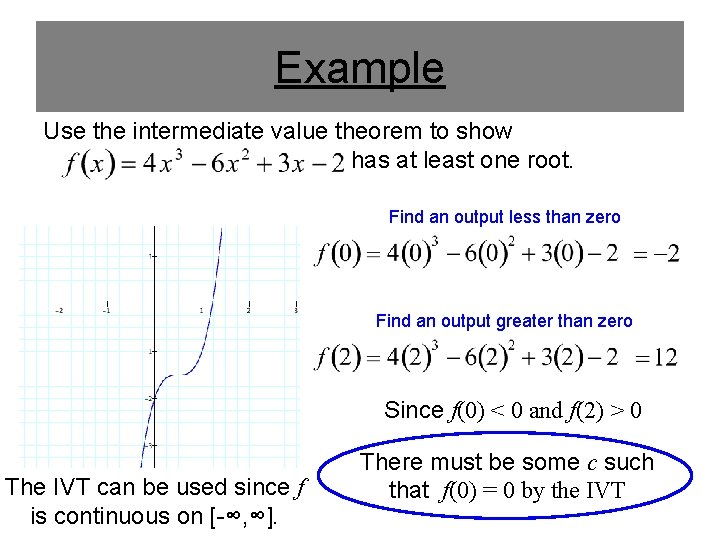
Example Use the intermediate value theorem to show has at least one root. Find an output less than zero Find an output greater than zero Since f(0) < 0 and f(2) > 0 The IVT can be used since f is continuous on [-∞, ∞]. There must be some c such that f(0) = 0 by the IVT
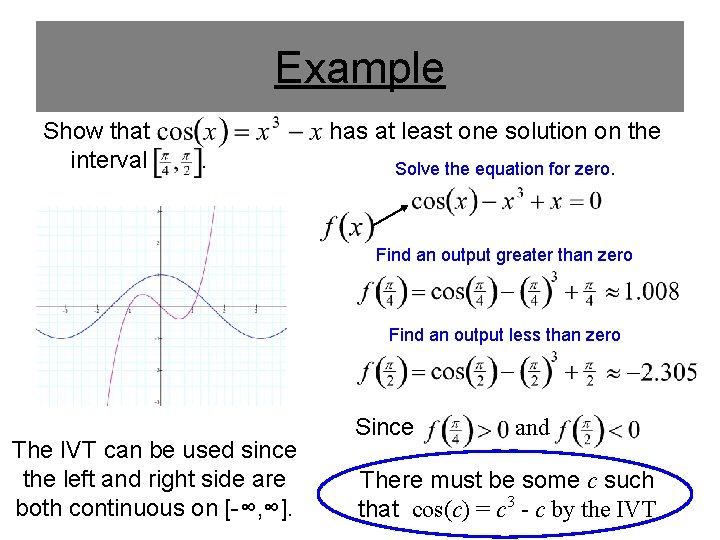
Example Show that interval has at least one solution on the. Solve the equation for zero. Find an output greater than zero Find an output less than zero The IVT can be used since the left and right side are both continuous on [-∞, ∞]. Since and There must be some c such that cos(c) = c 3 - c by the IVT