Parliament Limits the English Monarchy Chapter 5 Section
- Slides: 16
Parliament Limits the English Monarchy Chapter 5 Section 5
§ How did the people (especially in France) view a government under an absolute ruler?
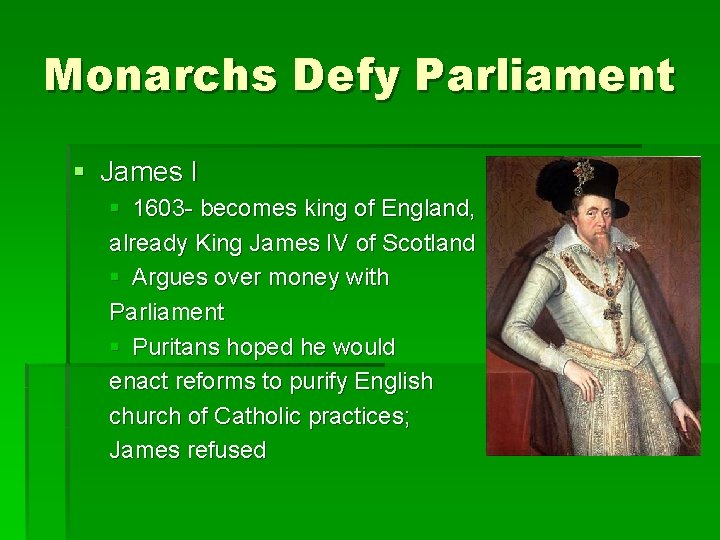
Monarchs Defy Parliament § James I § 1603 - becomes king of England, already King James IV of Scotland § Argues over money with Parliament § Puritans hoped he would enact reforms to purify English church of Catholic practices; James refused
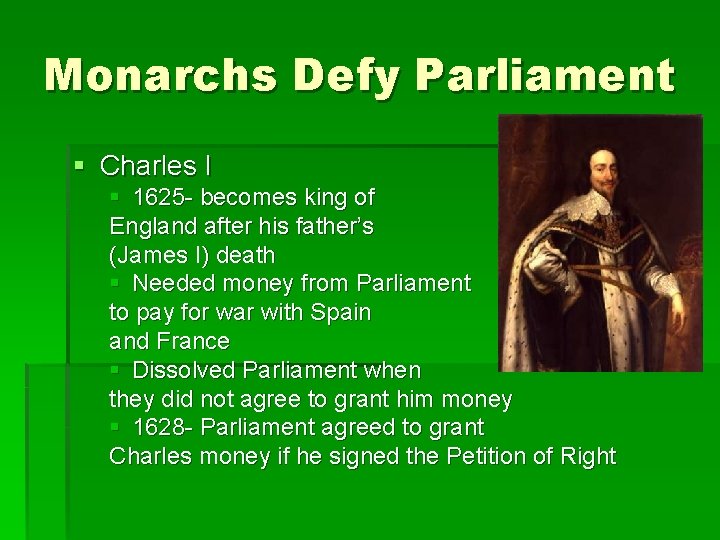
Monarchs Defy Parliament § Charles I § 1625 - becomes king of England after his father’s (James I) death § Needed money from Parliament to pay for war with Spain and France § Dissolved Parliament when they did not agree to grant him money § 1628 - Parliament agreed to grant Charles money if he signed the Petition of Right
1628 -Petition of Right § 1. Charles I would not imprison subjects without due cause. § 2. He would not levy taxes without Parliament’s consent. § 3. He would not house soldiers in private homes. § 4. He would not impose martial law in peacetime. § Charles refused to follow the petition and dissolved Parliament in 1629.
§ Why was the Petition of Right important even though King Charles I ignored it?
English Civil War § 1641 - Parliament passed laws to limit royal power; Charles arrested leaders in 1642 § 1642 -1649 - English Civil War § Royalists (Cavaliers)- remained loyal to the king § Puritan supporters of Parliament (Roundheads)- opposed the king
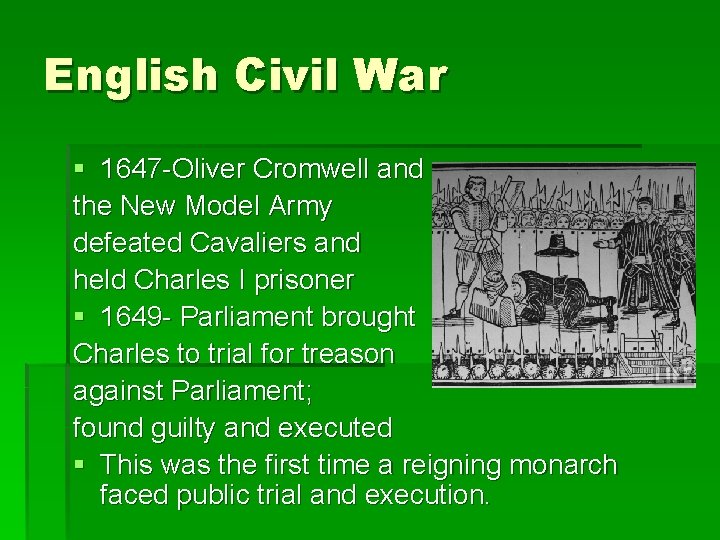
English Civil War § 1647 -Oliver Cromwell and the New Model Army defeated Cavaliers and held Charles I prisoner § 1649 - Parliament brought Charles to trial for treason against Parliament; found guilty and executed § This was the first time a reigning monarch faced public trial and execution.
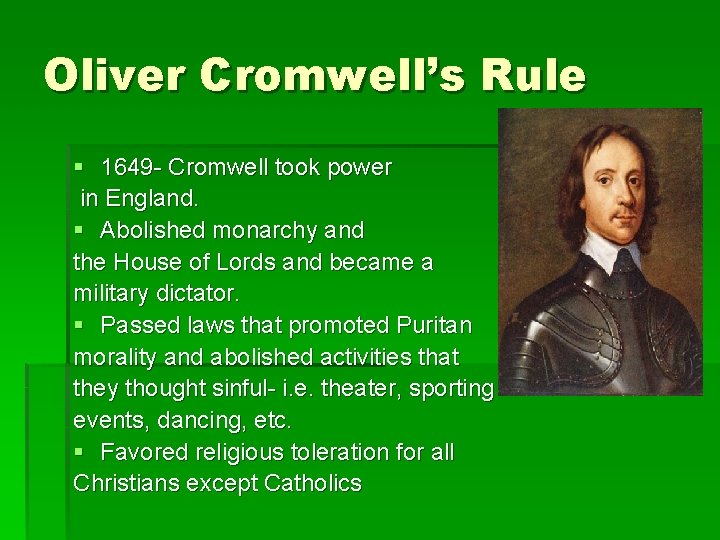
Oliver Cromwell’s Rule § 1649 - Cromwell took power in England. § Abolished monarchy and the House of Lords and became a military dictator. § Passed laws that promoted Puritan morality and abolished activities that they thought sinful- i. e. theater, sporting events, dancing, etc. § Favored religious toleration for all Christians except Catholics
§ How was Cromwell’s rule similar to an absolute monarchy?
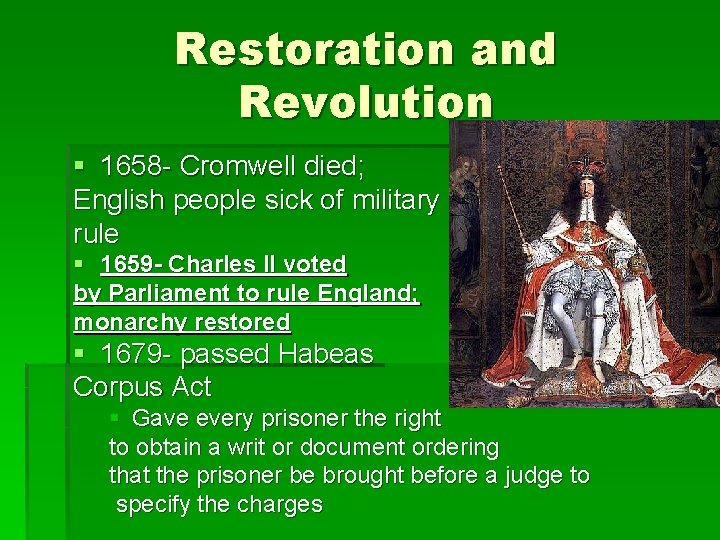
Restoration and Revolution § 1658 - Cromwell died; English people sick of military rule § 1659 - Charles II voted by Parliament to rule England; monarchy restored § 1679 - passed Habeas Corpus Act § Gave every prisoner the right to obtain a writ or document ordering that the prisoner be brought before a judge to specify the charges
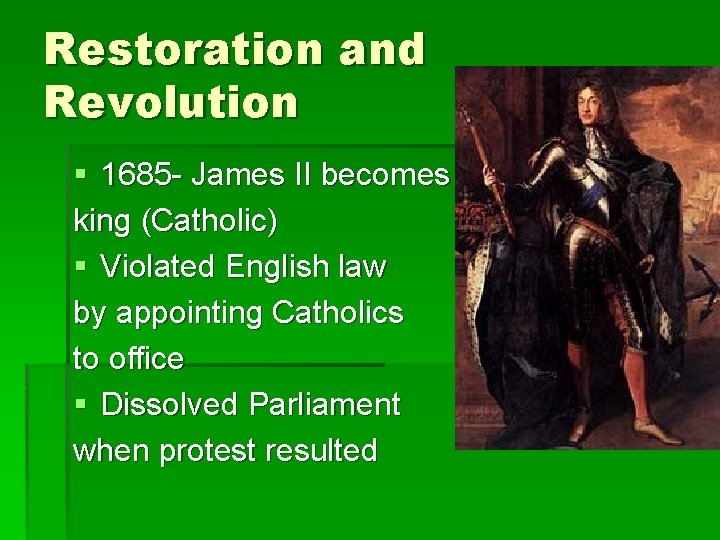
Restoration and Revolution § 1685 - James II becomes king (Catholic) § Violated English law by appointing Catholics to office § Dissolved Parliament when protest resulted
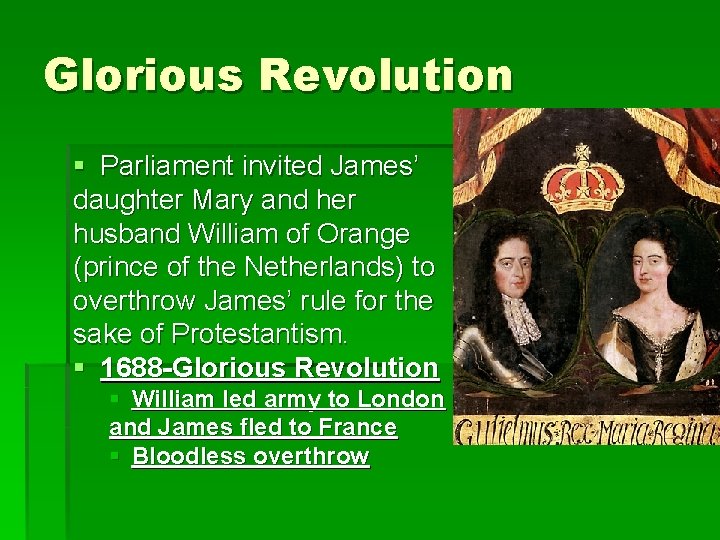
Glorious Revolution § Parliament invited James’ daughter Mary and her husband William of Orange (prince of the Netherlands) to overthrow James’ rule for the sake of Protestantism. § 1688 -Glorious Revolution § William led army to London and James fled to France § Bloodless overthrow
Limits on Monarch’s Power § William and Mary vowed to recognize Parliament as their partner in governing. § England was now a constitutional monarchy (laws limited the ruler’s power).
Limits on Monarch’s Power § English Bill of Rights- lists what a ruler could not do § § No suspending of Parliament’s laws No levying of taxes without a specific grant from Parliament No interfering with freedom of speech in Parliament No penalty for a citizen who petitions the king about grievances § Cabinet System § Acted in the ruler’s name but represented the majority party of Parliament § Prime minister- leader of the majority party in Parliamentsame system used today
§ In what ways were the English Bill of Rights similar to the United States’ Bill of Rights?