SCIENTIFIC METHODS Logical ord erly sequen ce of




- Slides: 37
SCIENTIFIC METHODS Logical, ord erly sequen ce of metho ds used to solve a prob lem
SCIENTIFIC VIDE 0 0 https: //www. youtube. com/watch? feature=player_det ailpage&v=wlb 7 t. LJy 5 AI
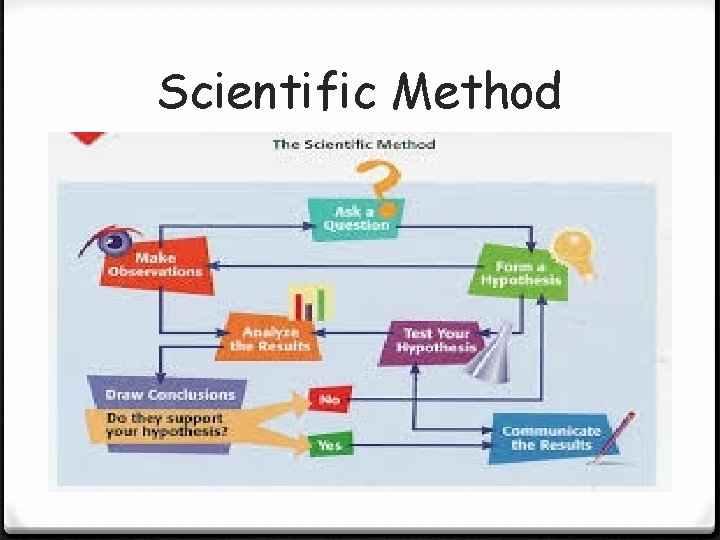
Scientific Method
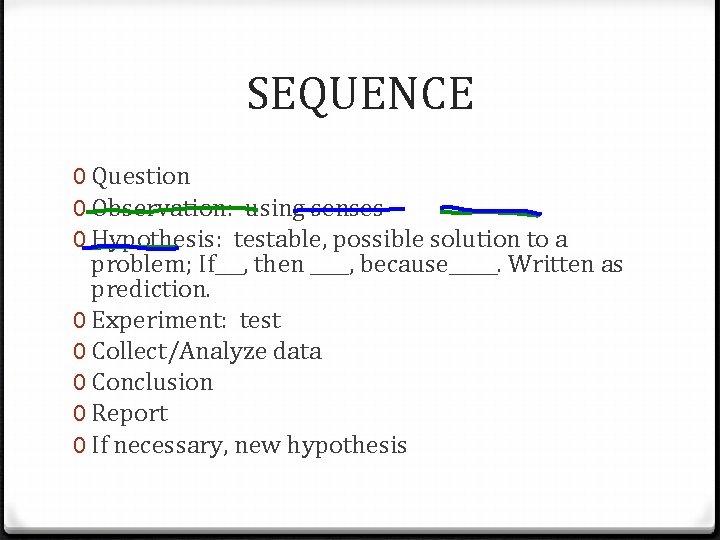
SEQUENCE 0 Question 0 Observation: using senses 0 Hypothesis: testable, possible solution to a problem; If___, then ____, because_____. Written as prediction. 0 Experiment: test 0 Collect/Analyze data 0 Conclusion 0 Report 0 If necessary, new hypothesis
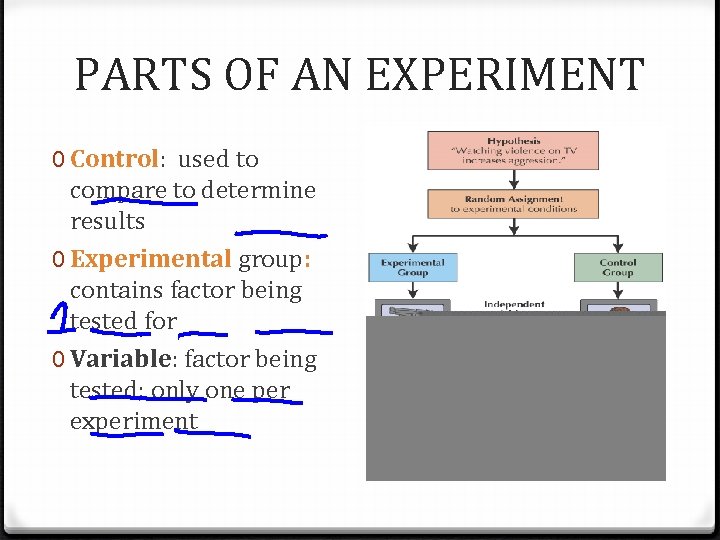
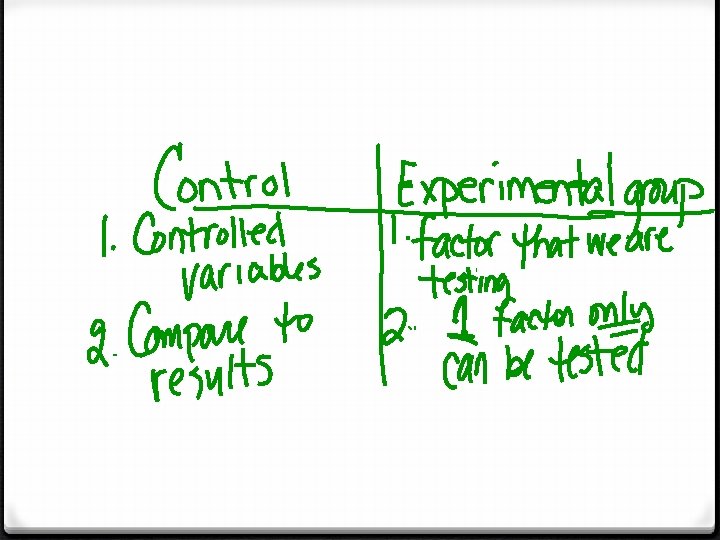
PARTS OF AN EXPERIMENT 0 Control: used to compare to determine results 0 Experimental group: contains factor being tested for 0 Variable: factor being tested; only one per experiment
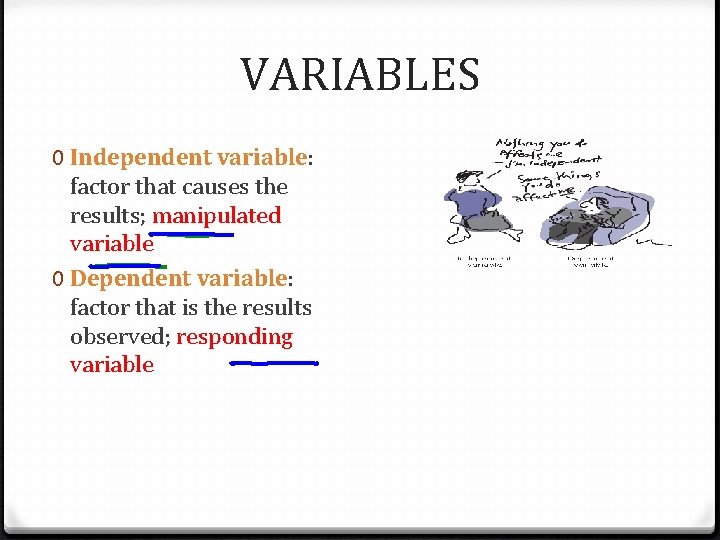
VARIABLES 0 Independent variable: factor that causes the results; manipulated variable 0 Dependent variable: factor that is the results observed; responding variable
DATA 0 Quantitative: statistics; numerical data 0 Qualitative: narrative; written 0 In quantitative, units of measurements must always be used.
SCIENTIFIC METHOD EXAMPLE 0 If fertilizer is used on azaleas, then the azaleas with the smallest amount used will show the largest increase in height because large amounts of fertilizer will be toxic to the plants. 0 Set up 4 containers with an azalea bush: one without fertilizer and 3 with varying amounts of fertilizer. Maintain the same amount of light and water. Light and water are the constants, conditions that will not change in the experiment. 0 Measure height of plants weekly. 0 After 3 months, analyze data to determine results by organizing in graphs, tables, or charts.
MV and RV 0 http: //www. youtube. com/watch? v=a. Lesk 8 fuj. H 8&fea ture=player_detailpage
REDI’S EXPERIMENT 0 Controlled variables 0 Independent variable 0 Dependent variable
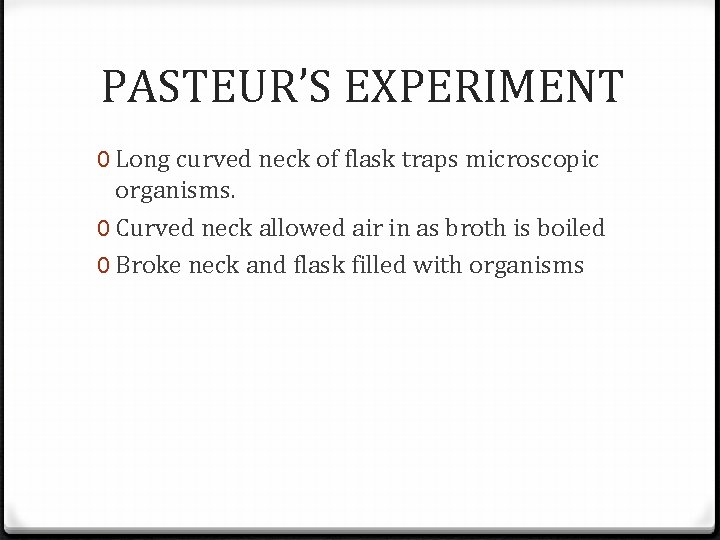
PASTEUR’S EXPERIMENT 0 Long curved neck of flask traps microscopic organisms. 0 Curved neck allowed air in as broth is boiled 0 Broke neck and flask filled with organisms
VARIABLES 0 http: //www. youtube. com/watch? v=Hxbz 656 Euyw&f eature=player_detailpage
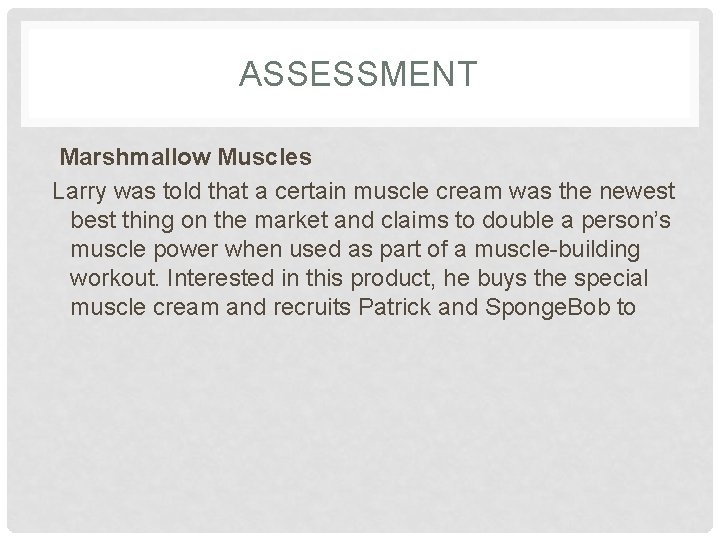
ASSESSMENT Marshmallow Muscles Larry was told that a certain muscle cream was the newest best thing on the market and claims to double a person’s muscle power when used as part of a muscle-building workout. Interested in this product, he buys the special muscle cream and recruits Patrick and Sponge. Bob to
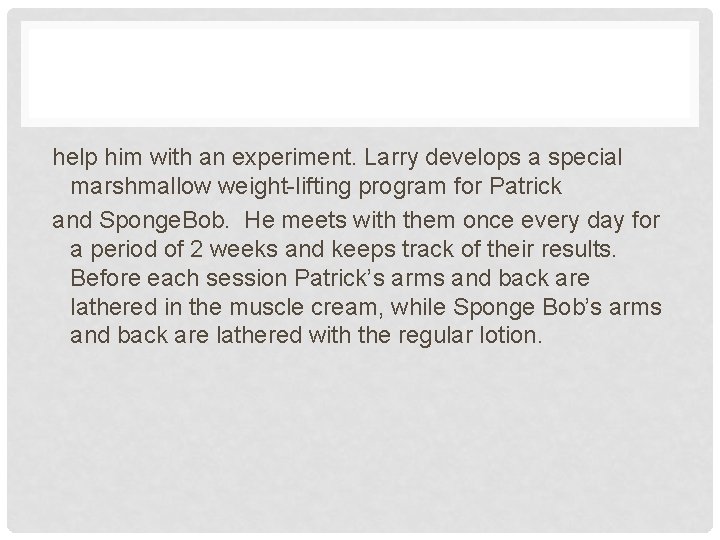
help him with an experiment. Larry develops a special marshmallow weight-lifting program for Patrick and Sponge. Bob. He meets with them once every day for a period of 2 weeks and keeps track of their results. Before each session Patrick’s arms and back are lathered in the muscle cream, while Sponge Bob’s arms and back are lathered with the regular lotion.
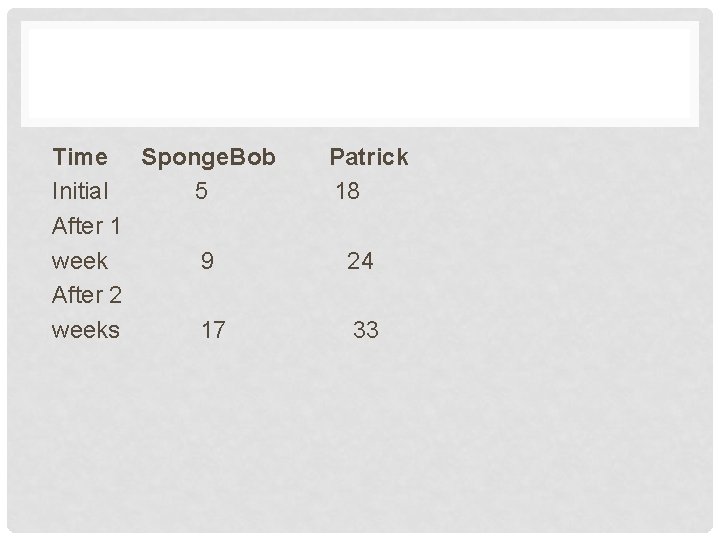
Time Sponge. Bob Initial 5 After 1 week 9 After 2 weeks 17 Patrick 18 24 33
QUESTIONS • • Which person is in the control group? What is the independent variable? What is the dependent variable? What should Larry’s conclusion be?
ANSWERS Marshmallow Muscles (ANSWERS) Which person is in the control group? Sponge. Bob What is the independent variable? Muscle cream What is the dependent variable? Amount of marshmallows lifted (strength)
What should Larry’s conclusion be? Since both Patrick and Sponge. Bob improved their results by the end of two weeks, it does not appear that the claims for the special muscle cream are true. If the claims were correct, we should have seen Patrick’s amount double, but not Sponge. Bob’s amount.
ANSWERS The improvements were likely a result of Larry’s special workout. REINFORCEMENT http: //sciencespot. net/Media/scimethodwkst. pdf
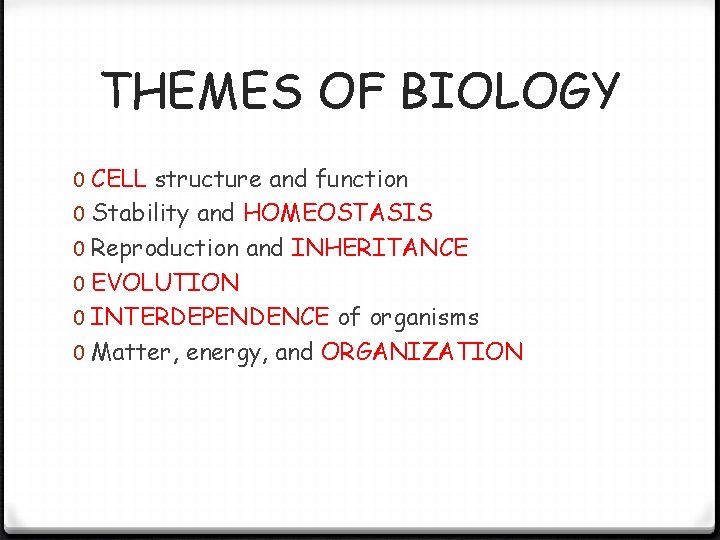
THEMES OF BIOLOGY 0 CELL structure and function 0 Stability and HOMEOSTASIS 0 Reproduction and INHERITANCE 0 EVOLUTION 0 INTERDEPENDENCE of organisms 0 Matter, energy, and ORGANIZATION
CHARACTERISTICS OF LIFE
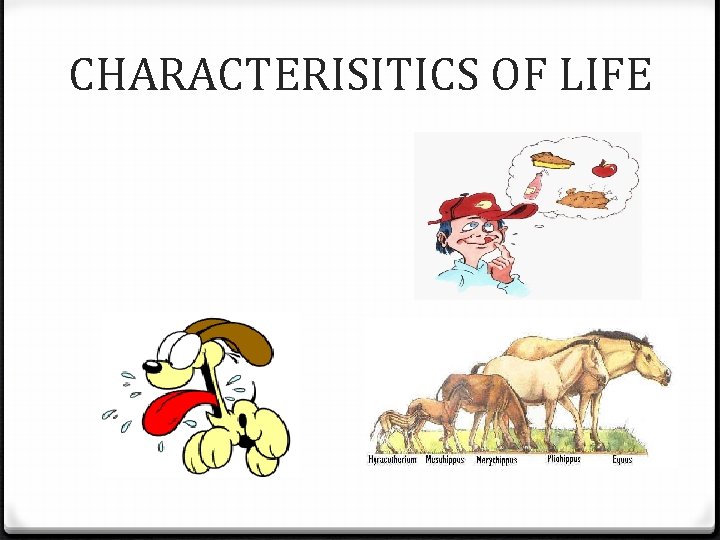
CHARACTERISITICS OF LIFE
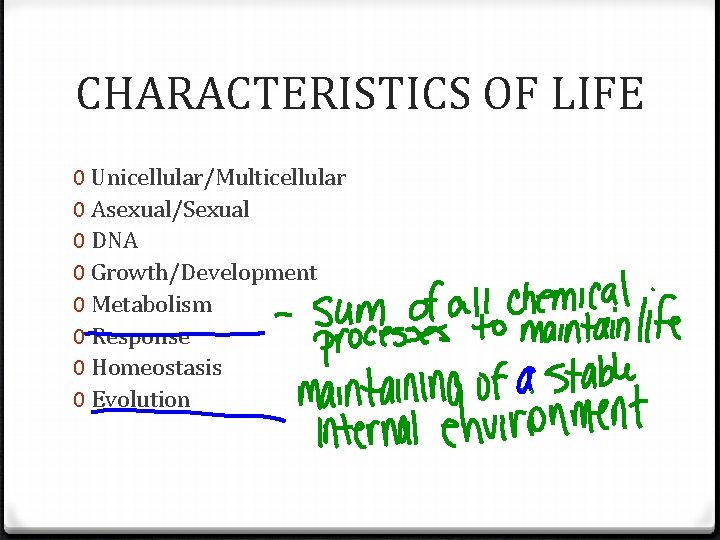
CHARACTERISTICS OF LIFE 0 Unicellular/Multicellular 0 Asexual/Sexual 0 DNA 0 Growth/Development 0 Metabolism 0 Response 0 Homeostasis 0 Evolution
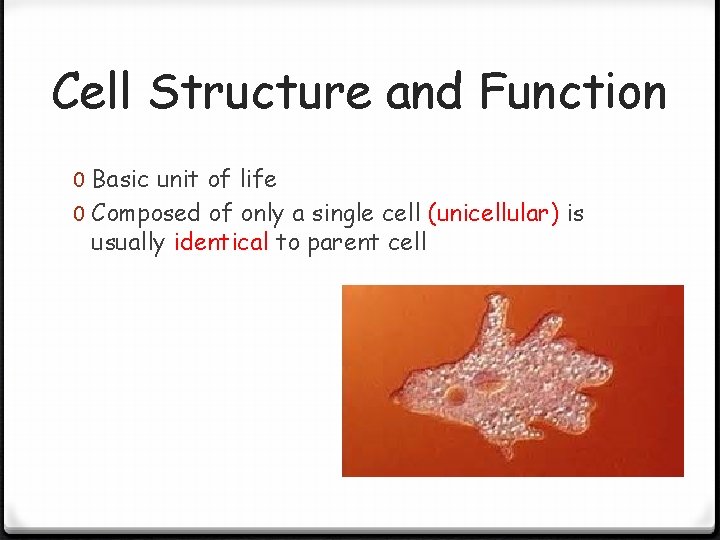
Cell Structure and Function 0 Basic unit of life 0 Composed of only a single cell (unicellular) is usually identical to parent cell
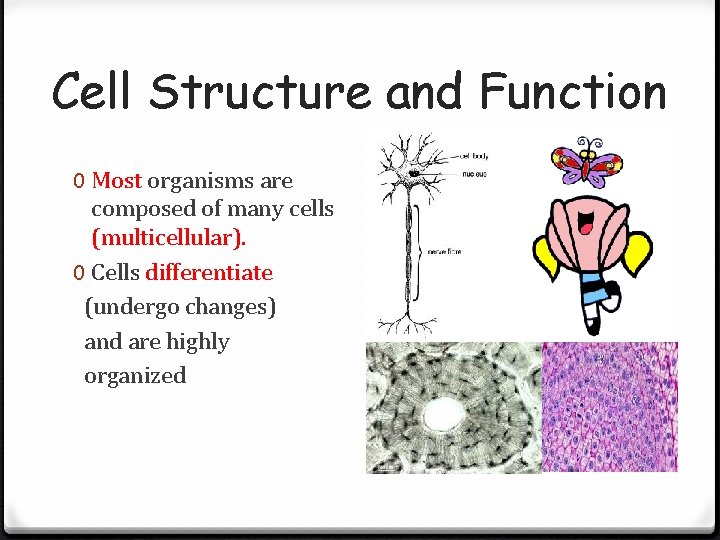
Cell Structure and Function 0 Most organisms are composed of many cells (multicellular). 0 Cells differentiate (undergo changes) and are highly organized
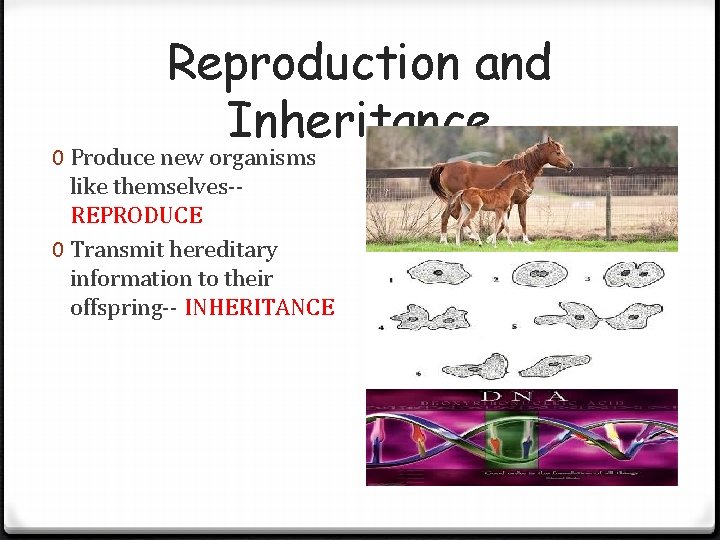
Reproduction and Inheritance 0 Produce new organisms like themselves-REPRODUCE 0 Transmit hereditary information to their offspring-- INHERITANCE
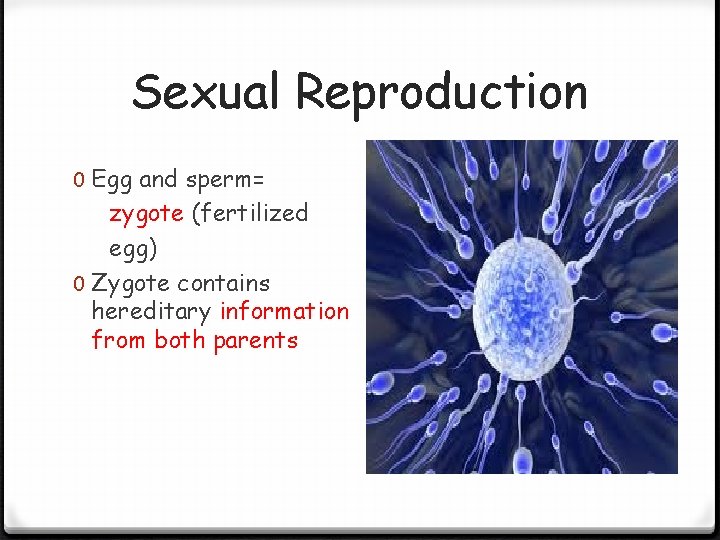
Sexual Reproduction 0 Egg and sperm= zygote (fertilized egg) 0 Zygote contains hereditary information from both parents
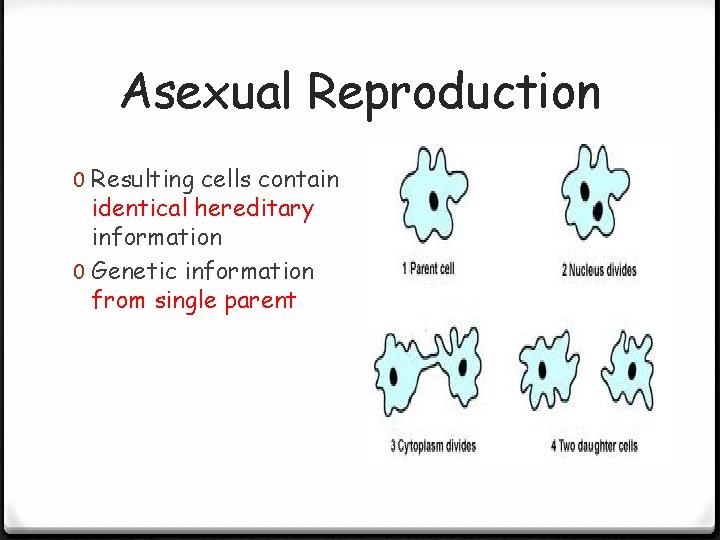
Asexual Reproduction 0 Resulting cells contain identical hereditary information 0 Genetic information from single parent
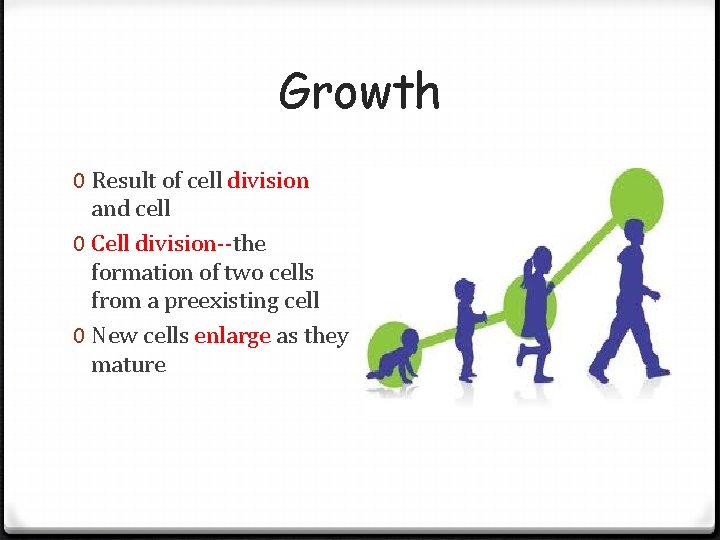
Growth 0 Result of cell division and cell 0 Cell division--the formation of two cells from a preexisting cell 0 New cells enlarge as they mature
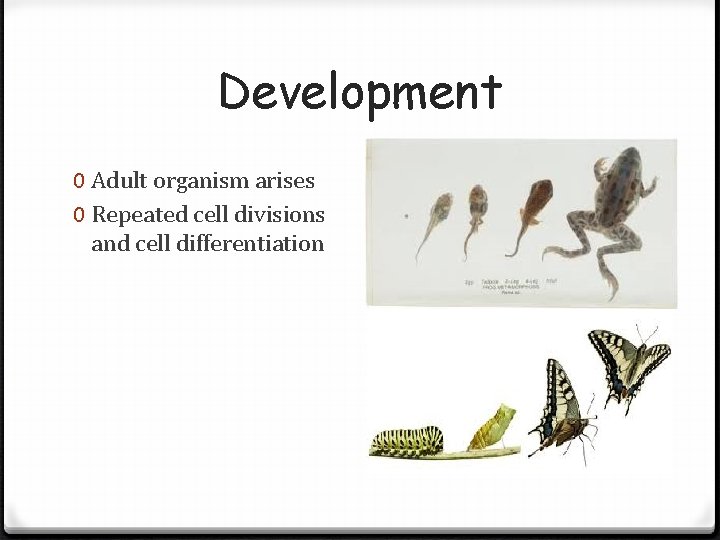
Development 0 Adult organism arises 0 Repeated cell divisions and cell differentiation
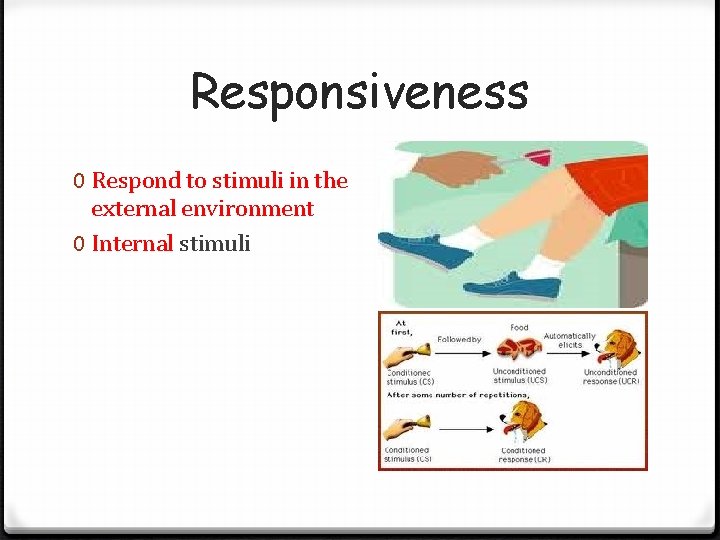
Responsiveness 0 Respond to stimuli in the external environment 0 Internal stimuli
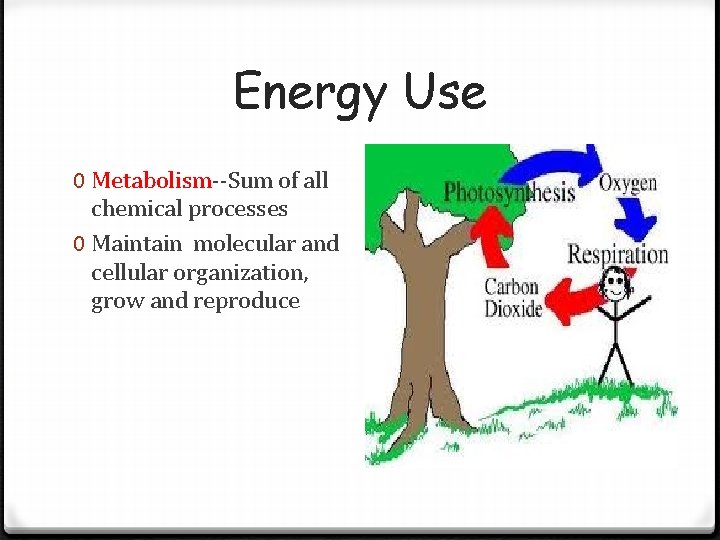
Energy Use 0 Metabolism--Sum of all chemical processes 0 Maintain molecular and cellular organization, grow and reproduce
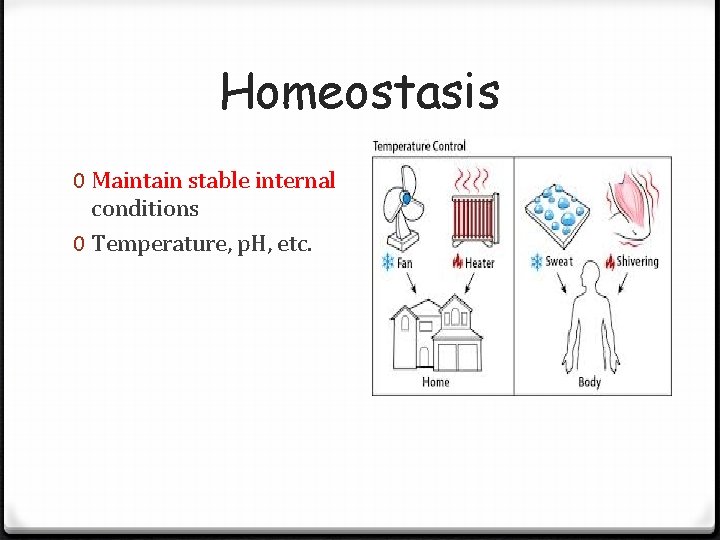
Homeostasis 0 Maintain stable internal conditions 0 Temperature, p. H, etc.
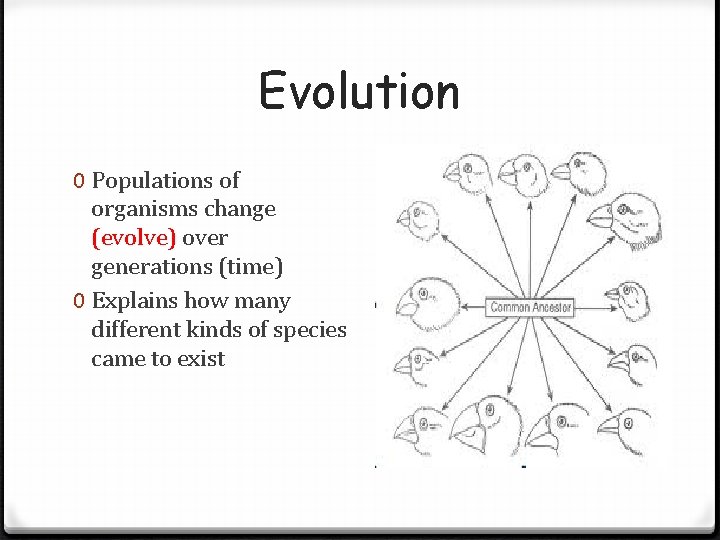
Evolution 0 Populations of organisms change (evolve) over generations (time) 0 Explains how many different kinds of species came to exist
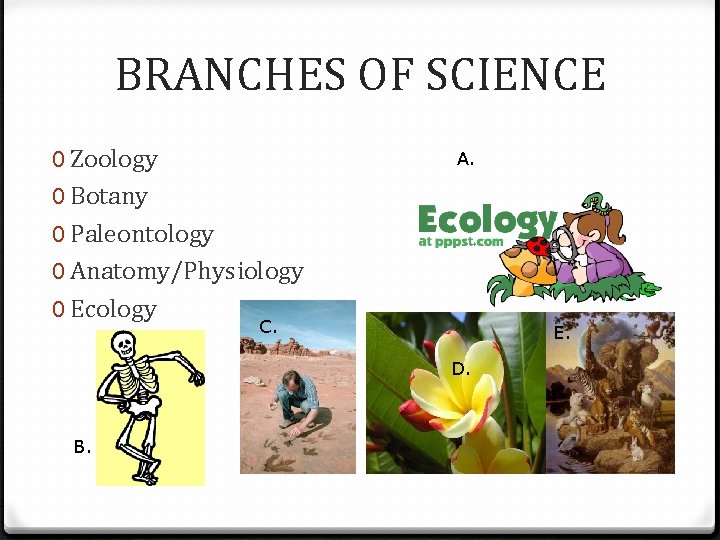
BRANCHES OF SCIENCE 0 Zoology 0 Botany 0 Paleontology 0 Anatomy/Physiology 0 Ecology A. C. E. D. B.