
Biconnectivity SEA PVD ORD SNA 362021 Biconnectivity FCO
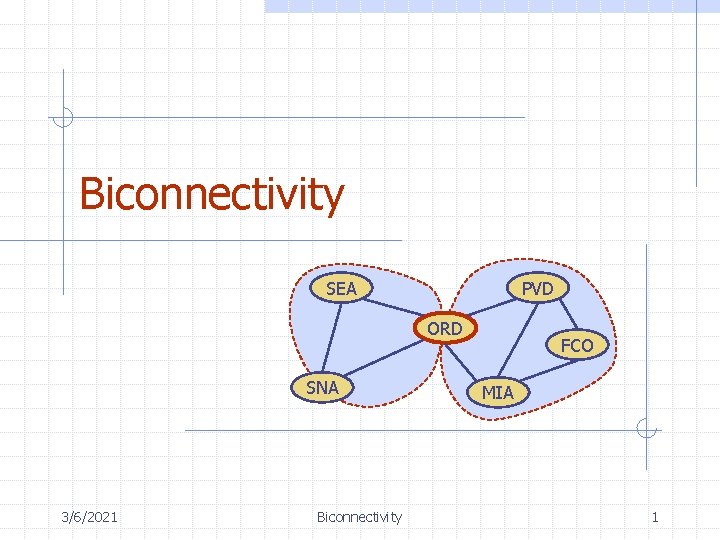
Biconnectivity SEA PVD ORD SNA 3/6/2021 Biconnectivity FCO MIA 1
Outline and Reading Definitions (§ 6. 3. 2) n n n Separation vertices and edges Biconnected graph Biconnected components Equivalence classes Linked edges and link components Algorithms (§ 6. 3. 2) n n 3/6/2021 Auxiliary graph Proxy graph Biconnectivity 2
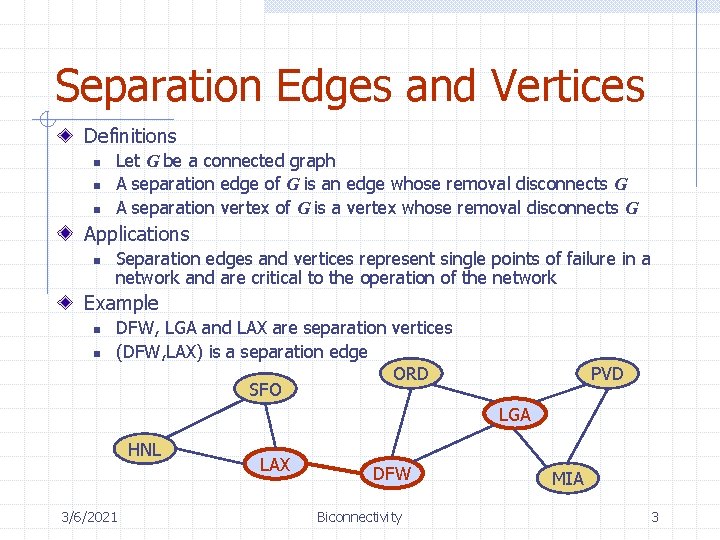
Separation Edges and Vertices Definitions n n n Let G be a connected graph A separation edge of G is an edge whose removal disconnects G A separation vertex of G is a vertex whose removal disconnects G Applications n Separation edges and vertices represent single points of failure in a network and are critical to the operation of the network Example n n DFW, LGA and LAX are separation vertices (DFW, LAX) is a separation edge ORD SFO PVD LGA HNL 3/6/2021 LAX DFW Biconnectivity MIA 3

Biconnected Graph Equivalent definitions of a biconnected graph G n n n Graph G has no separation edges and no separation vertices For any two vertices u and v of G, there are two disjoint simple paths between u and v (i. e. , two simple paths between u and v that share no other vertices or edges) For any two vertices u and v of G, there is a simple cycle containing u and v Example SFO PVD ORD LGA HNL LAX 3/6/2021 DFW Biconnectivity MIA 4

Biconnected Components Biconnected component of a graph G n n A maximal biconnected subgraph of G, or A subgraph consisting of a separation edge of G and its end vertices Interaction of biconnected components n n n An edge belongs to exactly one biconnected component A nonseparation vertex belongs to exactly one biconnected component A separation vertex belongs to two or more biconnected components Example of a graph with four biconnected components SFO ORD PVD LGA HNL 3/6/2021 LAX DFW Biconnectivity RDU MIA 5
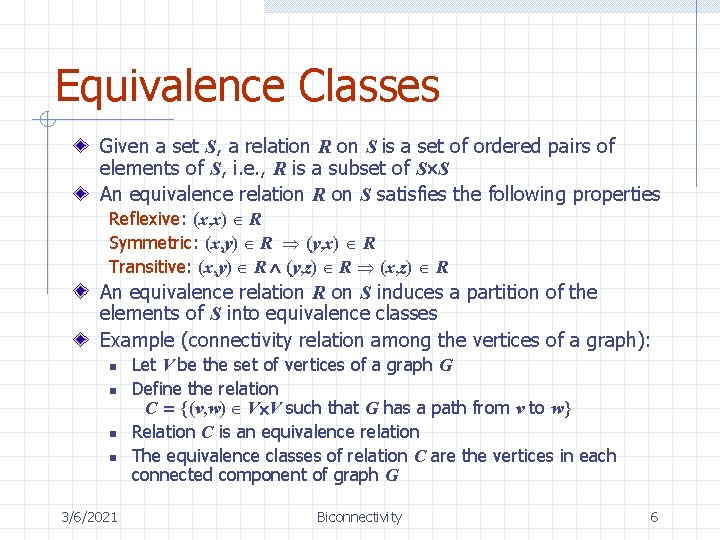
Equivalence Classes Given a set S, a relation R on S is a set of ordered pairs of elements of S, i. e. , R is a subset of S S An equivalence relation R on S satisfies the following properties Reflexive: (x, x) R Symmetric: (x, y) R (y, x) R Transitive: (x, y) R (y, z) R (x, z) R An equivalence relation R on S induces a partition of the elements of S into equivalence classes Example (connectivity relation among the vertices of a graph): n n 3/6/2021 Let V be the set of vertices of a graph G Define the relation C = {(v, w) V V such that G has a path from v to w} Relation C is an equivalence relation The equivalence classes of relation C are the vertices in each connected component of graph G Biconnectivity 6
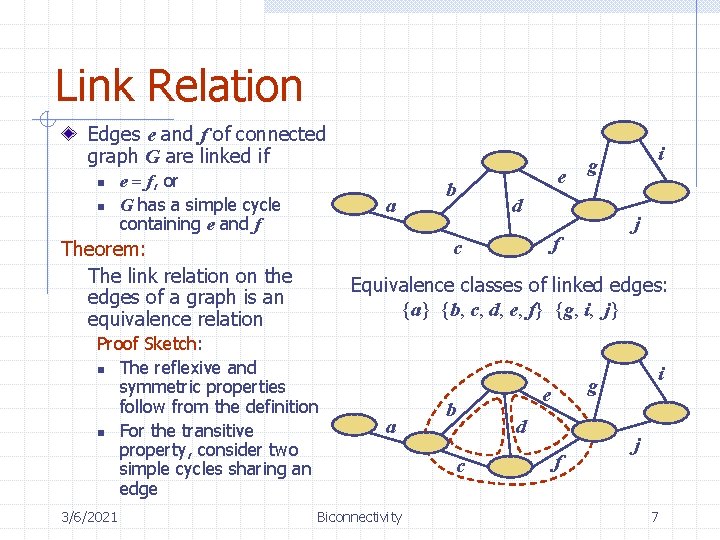
Link Relation Edges e and f of connected graph G are linked if n n e = f, or G has a simple cycle containing e and f a Theorem: The link relation on the edges of a graph is an equivalence relation e d j f c Equivalence classes of linked edges: {a} {b, c, d, e, f} {g, i, j} Proof Sketch: n The reflexive and symmetric properties follow from the definition n For the transitive property, consider two simple cycles sharing an edge 3/6/2021 b i g a Biconnectivity b c i g e d f j 7
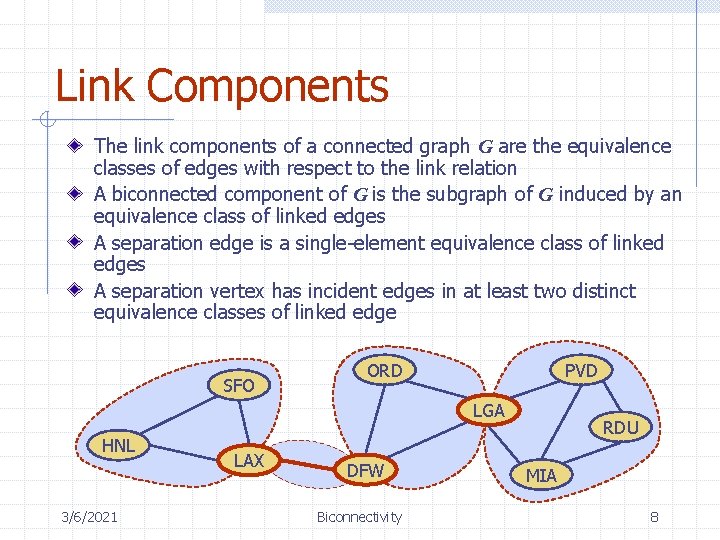
Link Components The link components of a connected graph G are the equivalence classes of edges with respect to the link relation A biconnected component of G is the subgraph of G induced by an equivalence class of linked edges A separation edge is a single-element equivalence class of linked edges A separation vertex has incident edges in at least two distinct equivalence classes of linked edge SFO ORD PVD LGA HNL 3/6/2021 LAX DFW Biconnectivity RDU MIA 8
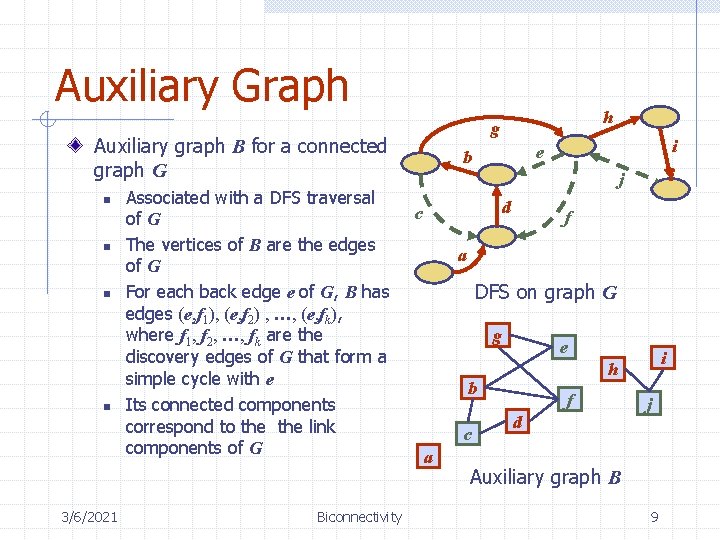
Auxiliary Graph Auxiliary graph B for a connected graph G n n 3/6/2021 Associated with a DFS traversal of G The vertices of B are the edges of G For each back edge e of G, B has edges (e, f 1), (e, f 2) , …, (e, fk), where f 1, f 2, …, fk are the discovery edges of G that form a simple cycle with e Its connected components correspond to the link components of G Biconnectivity h g i e b i j d c f a DFS on graph G g e b c a i h f d j Auxiliary graph B 9
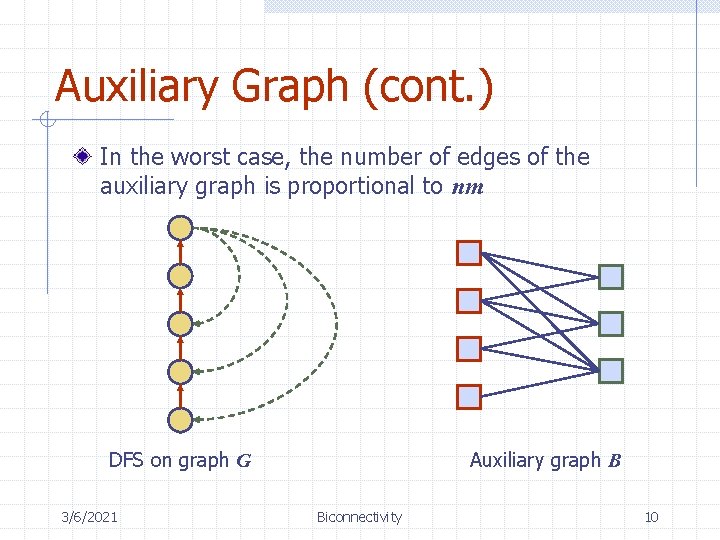
Auxiliary Graph (cont. ) In the worst case, the number of edges of the auxiliary graph is proportional to nm DFS on graph G 3/6/2021 Auxiliary graph B Biconnectivity 10
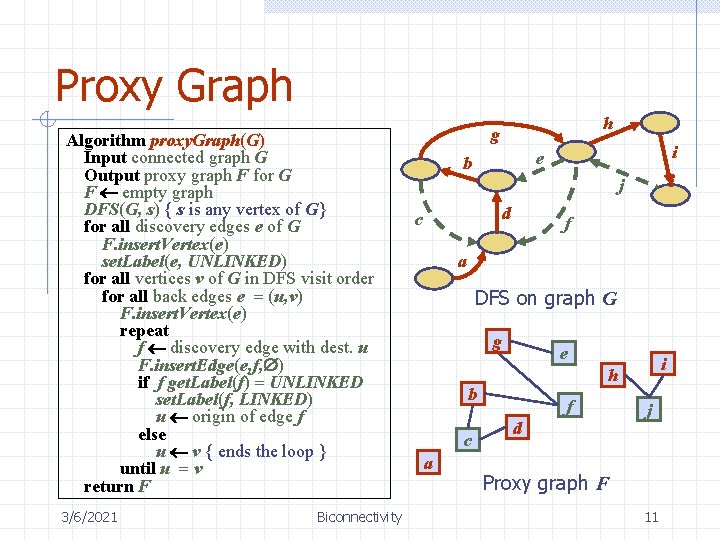
Proxy Graph Algorithm proxy. Graph(G) Input connected graph G Output proxy graph F for G F empty graph DFS(G, s) { s is any vertex of G} for all discovery edges e of G F. insert. Vertex(e) set. Label(e, UNLINKED) for all vertices v of G in DFS visit order for all back edges e = (u, v) F. insert. Vertex(e) repeat f discovery edge with dest. u F. insert. Edge(e, f, ) if f get. Label(f) = UNLINKED set. Label(f, LINKED) u origin of edge f else u v { ends the loop } until u = v return F 3/6/2021 Biconnectivity h g i e b i j d c f a DFS on graph G g e b c a i h f d j Proxy graph F 11
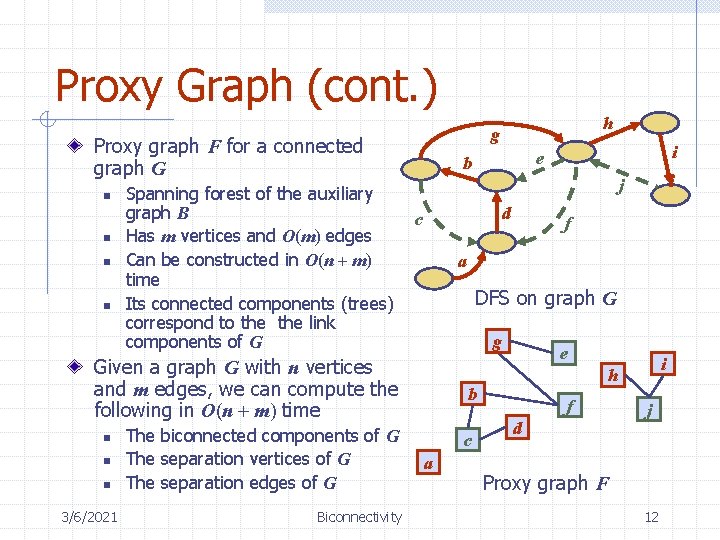
Proxy Graph (cont. ) Proxy graph F for a connected graph G n n Spanning forest of the auxiliary graph B Has m vertices and O(m) edges Can be constructed in O(n + m) time Its connected components (trees) correspond to the link components of G n n 3/6/2021 The biconnected components of G The separation vertices of G The separation edges of G Biconnectivity i e b i j d c f a DFS on graph G g Given a graph G with n vertices and m edges, we can compute the following in O(n + m) time n h g e b c a i h f d j Proxy graph F 12
- Slides: 12