Sakai Overview Charles Severance Chief Architect Sakai Project
- Slides: 36
Sakai Overview Charles Severance Chief Architect, Sakai Project www. sakaiproject. org csev@umich. edu www. dr-chuck. com KYOU / sakai Boundary, Situation
The Sakai Project “The University of Michigan, Indiana University, MIT, Stanford, the u. Portal Consortium, and the Open Knowledge Initiative (OKI) are joining forces to integrate and synchronize their considerable educational software into a preintegrated collection of open source tools. ” Sakai Project receives $2. 4 million grant from Mellon
Sakai Funding • Each of the 4 Core Universities Commits – 5+ developers/architects, etc. under Sakai Board project direction for 2 years – Public commitment to implement Sakai – Open/Open licensing – “Community Source” • So, overall project levels – $4. 4 M in institutional staff (27 FTE) – $2. 4 M Mellon, $300 K Hewlett – Additional investment through partners
What is Sakai? • Sakai is a project - a grant for two years which transitions to a broader community for long term maintenance • Sakai is an extensible software framework provides basic capabilities to support a wide range of tools and services • Sakai is a set of tools - written and supported by various groups • Sakai is a product - a released bundle of the framework and a set of tools which have been tested and released as a unit
The Sakai Product (and Tools)
Placing the Sakai “Product” • Learning Management Systems – Black. Board – Angel – Web. CT • Collaborative Environments – Lotus Notes – Microsoft Share. Point • Collaborative Frameworks – Moodle
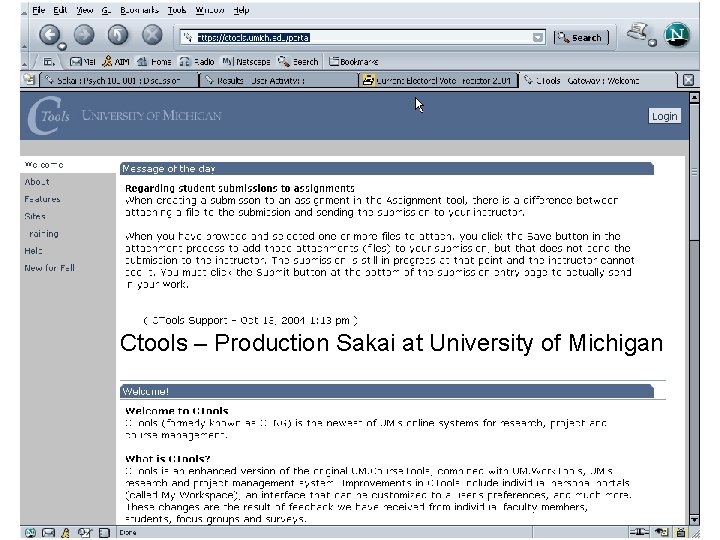
Ctools – Production Sakai at University of Michigan
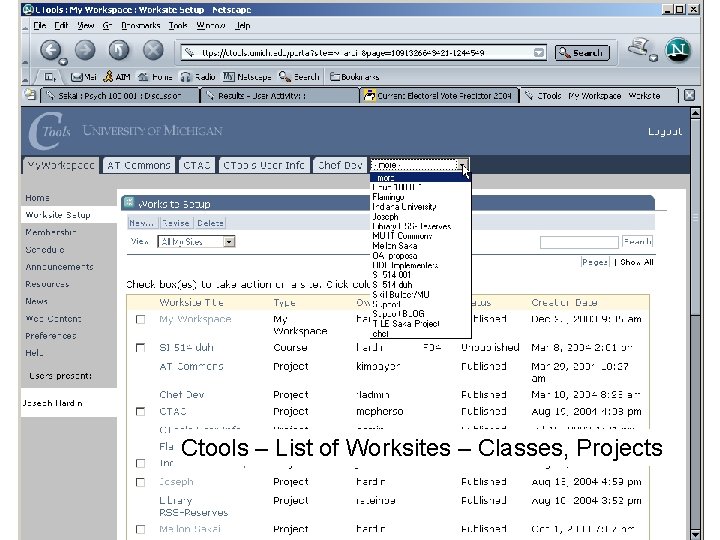
Ctools – List of Worksites – Classes, Projects
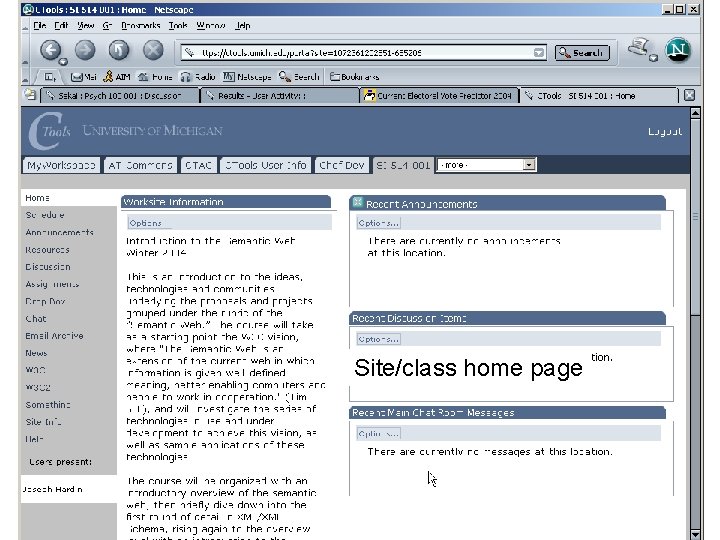
Site/class home page
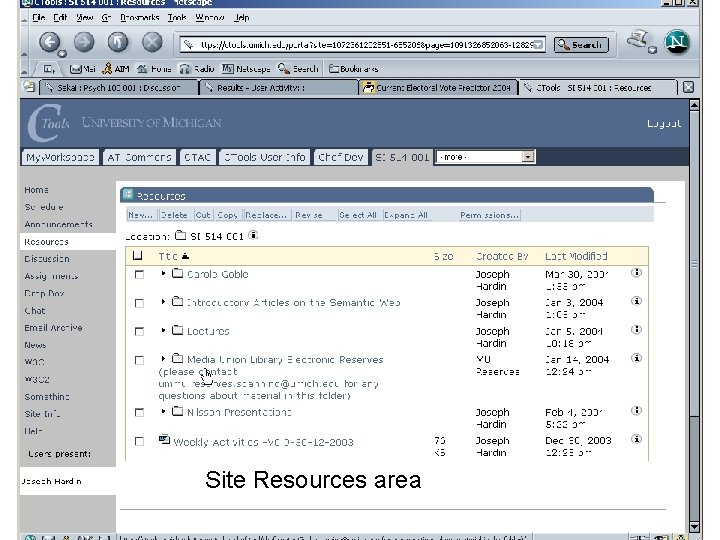
Site Resources area
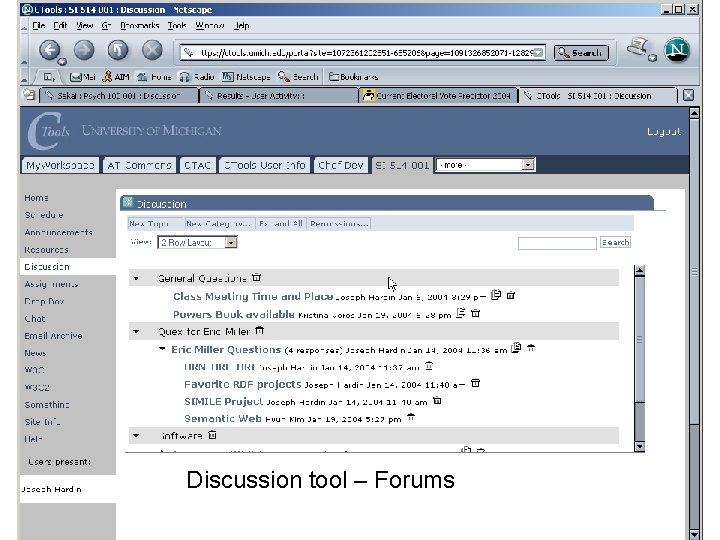
Discussion tool – Forums
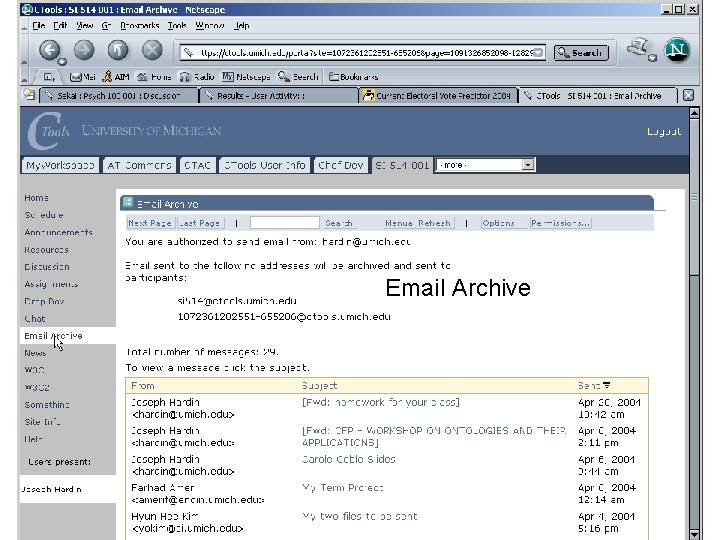
Email Archive
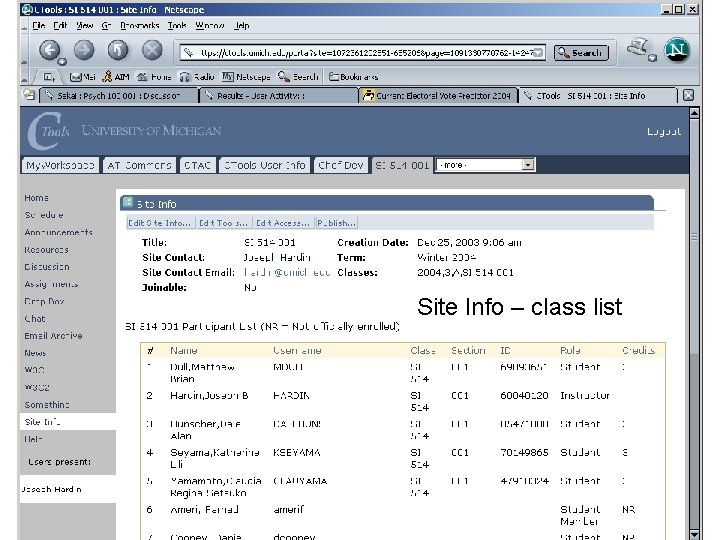
Site Info – class list
Sakai Releases • Sakai 1. 0 - basic collaborative system suitable for small pilots • Sakai 1. 5 - basic collaborative learning system - suitable for significant pilot’s • Sakai 2. 0 - collaborative learning system suitable for significant production deployments • Sakai 3. 0 - hardening, portal integration, preparation for post-project
Sakai 1. 0 Tools Admin: Alias Editor (chef. aliases) Admin: Archive Tool (chef. archive) Admin: Memory / Cache Tool (chef. memory) Admin: On-Line (chef. presence) Admin: Realms Editor (chef. realms) Admin: Sites Editor (chef. sites) Admin: User Editor (chef. users) Announcements (chef. announcements) Assignments (chef. assignment) C. R. U. D. (sakai. crud) Chat Room (chef. chat) Discussion (chef. discussion) Discussion (chef. threadeddiscussion) Dissertation Checklist (chef. dissertation) Dissertation Upload (chef. dissertation. upload) Drop Box (chef. dropbox) Email Archive (chef. mailbox) Help (chef. contact. Support) Membership (chef. membership) Message Of The Day (chef. motd) My Profile Editor (chef. singleuser) News (chef. news) Preferences (chef. noti. prefs) Recent Announcements (chef. synoptic. announcement) Recent Chat Messages (chef. synoptic. chat) Recent Discussion Items (chef. synoptic. discussion) Resources (chef. resources) Sample (sakai. module) Schedule (chef. schedule) Site Browser (chef. sitebrowser) Site Info (chef. siteinfo) Web Content (chef. iframe) Worksite Setup (chef. sitesetup) Web. DAV
Sakai 1. 5 Tools • Samigo - QTI compliant assessment engine (Stanford) • Syllabus Tool (Indiana) • Context Sensitive Help (Indiana) • Presentation Tool (SEPP) • Contributed Tools (not part of bundle) – Blackboard Import (Texas) – Xwiki (Cambridge) • Portfolio Tool - OSPI (R-Smart) (separate release)
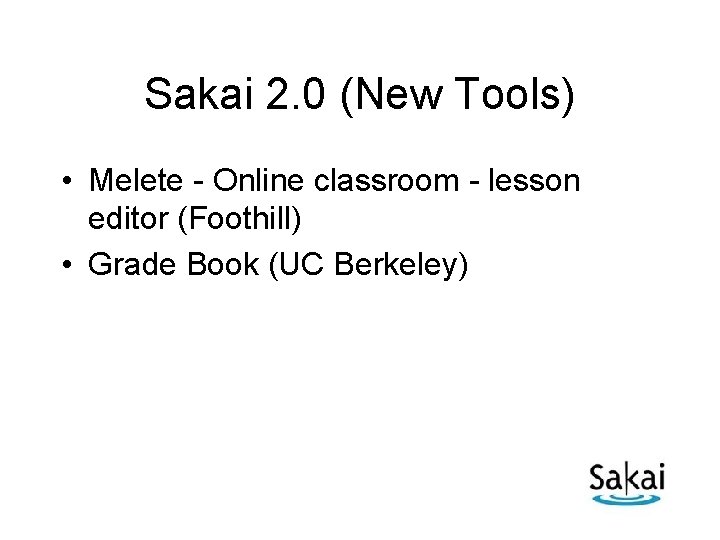
Sakai 2. 0 (New Tools) • Melete - Online classroom - lesson editor (Foothill) • Grade Book (UC Berkeley)
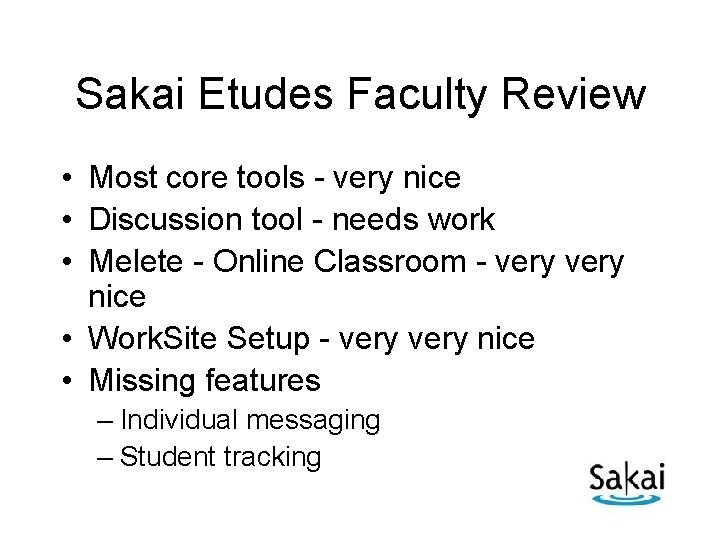
Sakai Etudes Faculty Review • Most core tools - very nice • Discussion tool - needs work • Melete - Online Classroom - very nice • Work. Site Setup - very nice • Missing features – Individual messaging – Student tracking
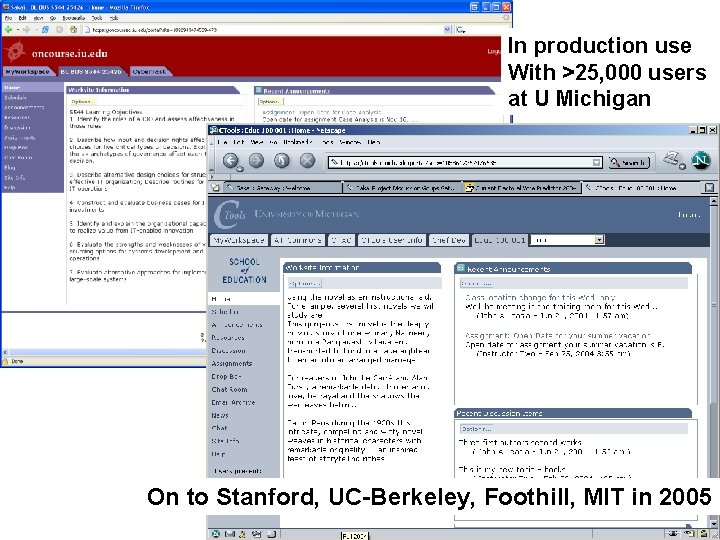
In production use With >25, 000 users at U Michigan On to Stanford, UC-Berkeley, Foothill, MIT in 2005
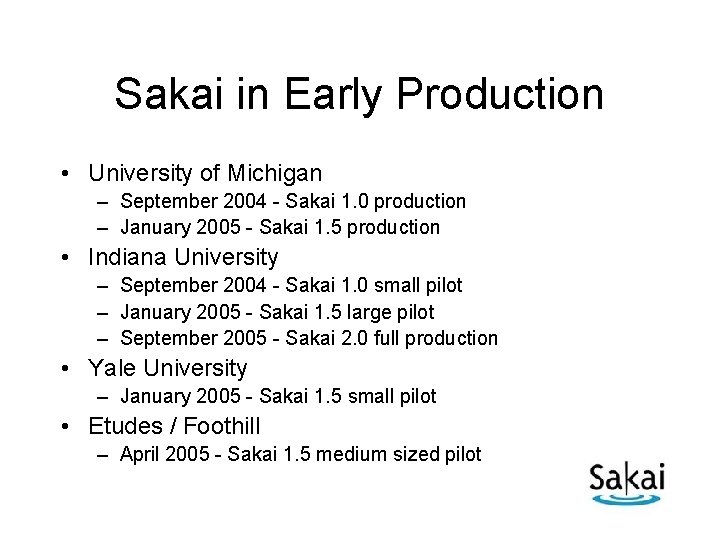
Sakai in Early Production • University of Michigan – September 2004 - Sakai 1. 0 production – January 2005 - Sakai 1. 5 production • Indiana University – September 2004 - Sakai 1. 0 small pilot – January 2005 - Sakai 1. 5 large pilot – September 2005 - Sakai 2. 0 full production • Yale University – January 2005 - Sakai 1. 5 small pilot • Etudes / Foothill – April 2005 - Sakai 1. 5 medium sized pilot
The Sakai Project
Goals of the Sakai Project • Develop an open-source collaborative learning environment – Suitable for use as a learning management system – Suitable for use as a small group collaboration system – Suitable for building research collaboratories – Improve teaching and learning by providing a rich and extensible environment – Bring research and teaching together – Move towards a personal learning and lifelong learning environment
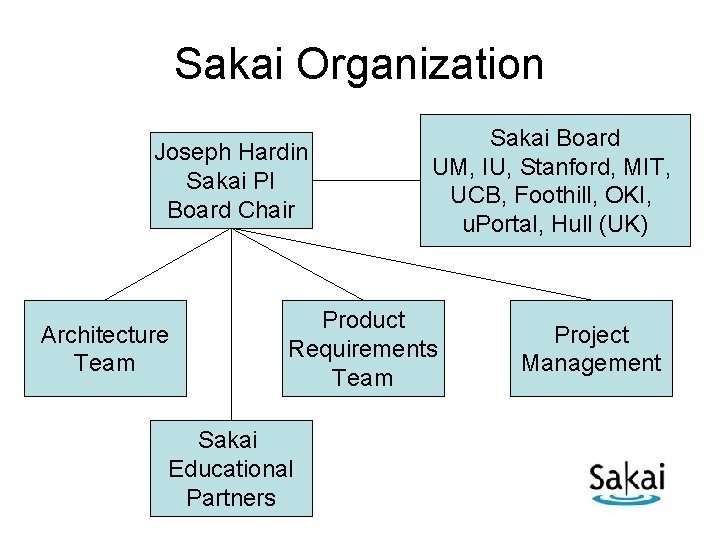
Sakai Organization Joseph Hardin Sakai PI Board Chair Architecture Team Sakai Board UM, IU, Stanford, MIT, UCB, Foothill, OKI, u. Portal, Hull (UK) Product Requirements Team Sakai Educational Partners Project Management
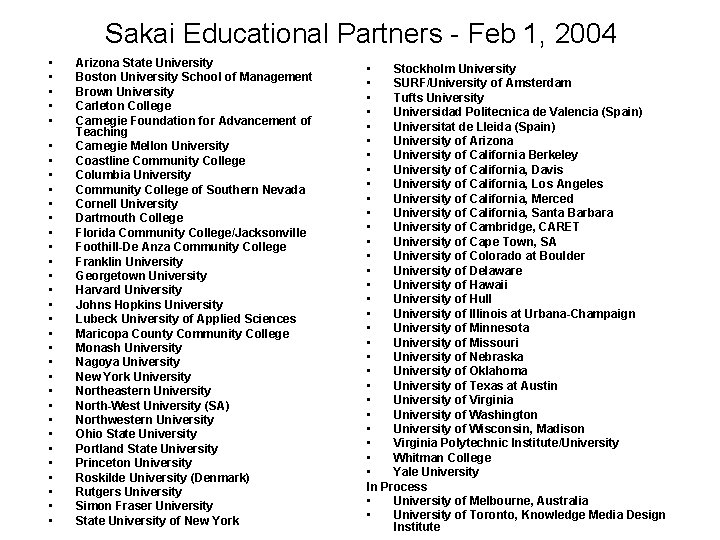
Sakai Educational Partners - Feb 1, 2004 • • • • • • • • Arizona State University Boston University School of Management Brown University Carleton College Carnegie Foundation for Advancement of Teaching Carnegie Mellon University Coastline Community College Columbia University Community College of Southern Nevada Cornell University Dartmouth College Florida Community College/Jacksonville Foothill-De Anza Community College Franklin University Georgetown University Harvard University Johns Hopkins University Lubeck University of Applied Sciences Maricopa County Community College Monash University Nagoya University New York University Northeastern University North-West University (SA) Northwestern University Ohio State University Portland State University Princeton University Roskilde University (Denmark) Rutgers University Simon Fraser University State University of New York • Stockholm University • SURF/University of Amsterdam • Tufts University • Universidad Politecnica de Valencia (Spain) • Universitat de Lleida (Spain) • University of Arizona • University of California Berkeley • University of California, Davis • University of California, Los Angeles • University of California, Merced • University of California, Santa Barbara • University of Cambridge, CARET • University of Cape Town, SA • University of Colorado at Boulder • University of Delaware • University of Hawaii • University of Hull • University of Illinois at Urbana-Champaign • University of Minnesota • University of Missouri • University of Nebraska • University of Oklahoma • University of Texas at Austin • University of Virginia • University of Washington • University of Wisconsin, Madison • Virginia Polytechnic Institute/University • Whitman College • Yale University In Process • University of Melbourne, Australia • University of Toronto, Knowledge Media Design Institute
Sakai SEPP Meetings • Provide a forum for the core and the SEPP to interact and for the SEPP members to interact with one another – June 2004 - Denver Colorado (180) – December 2004 - New Orleans (200+) – June 8 -14 - Baltimore • Community Source Week • u. Portal, Sakai, OSPI – December TBD - Austin, TX
Sakai Commercial Affiliates • Companies who will use/sell/support Sakai – – The r. Smart group Unicon Embanet Sungard SCT • Provides companies access to Sakai core developers and SEPP staff • Access to members-only Sakai meetings (I. e. like the SEPP)
IMS Tool Portability Group • To work on ‘interoperability’ between and among CMS’s/CLE’s • Focus is on making tools portable between systems (Sakai, Web. CT, and Blackboard) • Established to further the discussion with commercial and other CMS/CLE providers • Will use web services and IFRAMES • Will show working demonstration at the July 2005 Alt-I-lab with Samigo in Sakai, Web. CT, and Blackboard
What is “Community Source”?
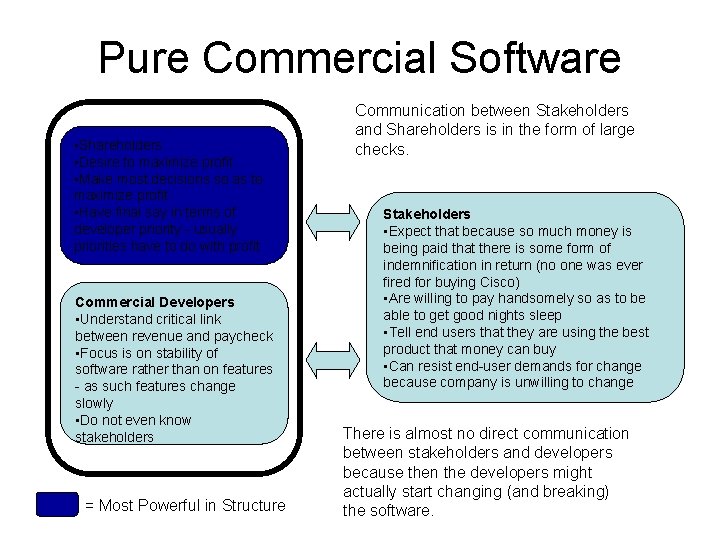
Pure Commercial Software • Shareholders • Desire to maximize profit • Make most decisions so as to maximize profit • Have final say in terms of developer priority - usually priorities have to do with profit Commercial Developers • Understand critical link between revenue and paycheck • Focus is on stability of software rather than on features - as such features change slowly • Do not even know stakeholders = Most Powerful in Structure Communication between Stakeholders and Shareholders is in the form of large checks. Stakeholders • Expect that because so much money is being paid that there is some form of indemnification in return (no one was ever fired for buying Cisco) • Are willing to pay handsomely so as to be able to get good nights sleep • Tell end users that they are using the best product that money can buy • Can resist end-user demands for change because company is unwilling to change There is almost no direct communication between stakeholders and developers because then the developers might actually start changing (and breaking) the software.
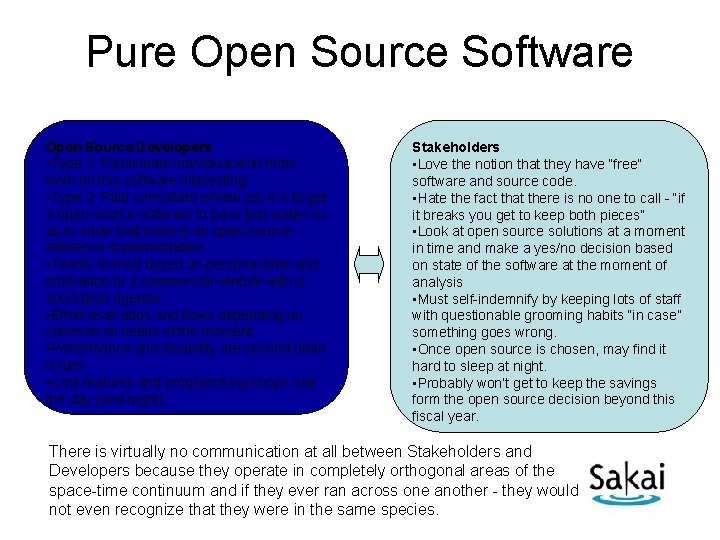
Pure Open Source Software Open Source Developers • Type 1: Passionate individual who finds work on this software interesting • Type 2: Paid consultant whose job it is to get a open-source software to pass test suites so as to show that there is an open-source reference implementation • Teams formed based on personal time and motivation or a commercial venture with a short-term agenda • Effort level ebbs and flows depending on commercial needs of the moment • Performance and reliability are second-order issues • Cool features and programming chops rule the day (and night) Stakeholders • Love the notion that they have “free” software and source code. • Hate the fact that there is no one to call - “if it breaks you get to keep both pieces” • Look at open source solutions at a moment in time and make a yes/no decision based on state of the software at the moment of analysis • Must self-indemnify by keeping lots of staff with questionable grooming habits “in case” something goes wrong. • Once open source is chosen, may find it hard to sleep at night. • Probably won’t get to keep the savings form the open source decision beyond this fiscal year. There is virtually no communication at all between Stakeholders and Developers because they operate in completely orthogonal areas of the space-time continuum and if they ever ran across one another - they would not even recognize that they were in the same species.
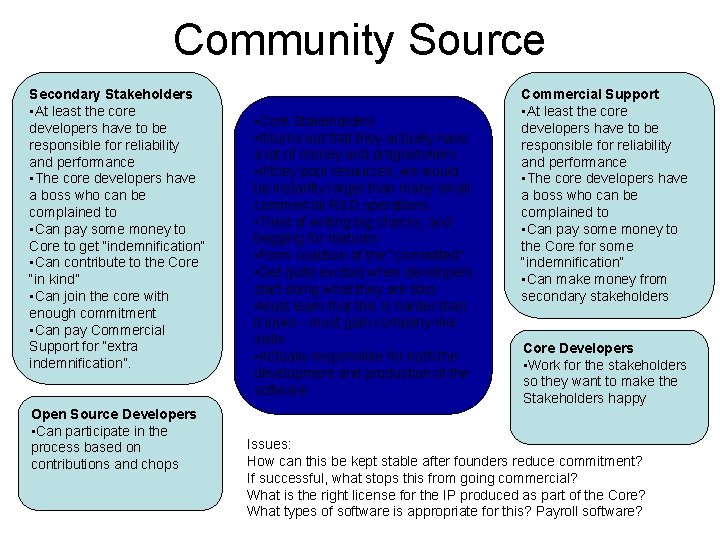
Community Source Secondary Stakeholders • At least the core developers have to be responsible for reliability and performance • The core developers have a boss who can be complained to • Can pay some money to Core to get “indemnification” • Can contribute to the Core “in kind” • Can join the core with enough commitment • Can pay Commercial Support for “extra indemnification”. Open Source Developers • Can participate in the process based on contributions and chops • Core Stakeholders • It turns out that they actually have a lot of money and programmers • If they pool resources, we would be instantly larger than many small commercial R&D operations. • Tired of writing big checks, and begging for features • Form coalition of the “committed” • Get quite excited when developers start doing what they are told. • Must learn that this is harder than it looks - must gain company-like skills. • Actually responsible for both the development and production of the software. Commercial Support • At least the core developers have to be responsible for reliability and performance • The core developers have a boss who can be complained to • Can pay some money to the Core for some “indemnification” • Can make money from secondary stakeholders Core Developers • Work for the stakeholders so they want to make the Stakeholders happy Issues: How can this be kept stable after founders reduce commitment? If successful, what stops this from going commercial? What is the right license for the IP produced as part of the Core? What types of software is appropriate for this? Payroll software?
The Sakai Community • Main site: www. sakaiproject. org • Bugs: bugs. sakaiproject. org • Sakai-wide collaboration area – collab. sakaiproject. org – sakai-dev@sakaiproject. org – sakai-user@sakaiproject. org • Sakai Educational Partners (SEPP) – Separate mailing lists – Dedicated staff – Two meetings per year
Sakai’s Future • Initial grant ends December 2005 • Transition to Community Source – – The SEPP is renamed “Sakai” (800 K/year) Governance is merit-based (like Apache) Core elements of Sakai software pretty stable Small Community funded team (5+) to keep the core maintained and slowly evolving – Significant contributed in-kind resources Michigan, Indiana, Yale, Foothill, Stanford
Summary • Working on Sakai feels like a fast paced commercial startup • We are “owned” by the Universities and Colleges which make up our community • Unlike most grant projects, deadlines, quality, and performance matter - a lot • The two year project has needed close coordination and strong leadership because we have built, rebuilt, defined and redefined on a very tight schedule
Going Forward • By Summer 2005, the core Sakai software will be very solid - the rewrites will be done • Conservative organizations can just adopt and use Sakai or even out-source their Sakai to a commercial vendor • Organizations with money and ideas can begin to innovate rapidly and share their work with many others