
DSL Services Gregory F Wetzel Chief Network Architect

- Slides: 32
DSL Services Gregory F. Wetzel Chief Network Architect February 11, 2004
Agenda • DSL Physical Layers • CPE • ADSL, SDSL, IDSL, T 1 • DSLAM • ATM Switch • DSL Logical Layers • ATM connections • IP • Services Layered on top of DSL • Markets: Consumer, SOHO, Small Business • Subscriber Management • Internet Access • Voice / Video / other? Covad Confidential
DSL Physical Layer
Section Overview • Terminology • Network Elements • CPE • DSLAM • ATM switch • BRAS • ADSL Service Architectures • In a CLEC environment • Wholesale • Retail • Service Matrix Covad Confidential
Terminology • ADSL – Asymmetric DSL • BRAS – Broadband Remote Access Server • CLEC – Competitive Local Exchange Carrier, used in this presentation to generically reference a Local Exchange Carrier other than the Incumbent. For example, Covad, MCI, AT&T, etc. • DSL – Digital Subscriber Line • IDSL – ISDN-based DSL • Line – loop plus ILEC-provided dial tone (think telephone line) Covad Confidential
Terminology • Loop – copper pair connecting end user premise to central office facility • Rate/Reach – DSL analog signals are limited by electrical properties of the loop. Rate/Reach is the tradeoff between getting a certain data rate at a certain distance between the transmitter and receiver. • SDSL – Symmetric DSL (aka, Single Loop DSL) • SMB – Small/Medium size Business • SOHO – Small Office/Home Office Covad Confidential
General DSL Network Architecture Covad Confidential
DSL Technology • Different Markets have Different Requirements • Small-Medium Businesses • Symmetric bandwidth requirements • Vo. DSL • Web hosting or Databases on site • Service Level Agreements • Many PCs • Consumer • Asymmetric bandwidth requirements • One to a few PCs • Price is a decider • Wholesale versus Retail • Managing aggregation by wholesale customer • Many wholesale customers want direct PVC to end user Covad Confidential
DSL Technology • Symmetric DSL (SDSL) • Today SDSL/2 B 1 Q is common, but not standardized • ITU-T G. shdsl soon • Addresses SMB market • ISDN DSL (IDSL) • Used today for customers beyond the reach of other DSL technologies • Distance too great • Behind Digital Loop Carrier • Asymmetric DSL (ADSL) • Standardized • Focused on consumer offerings • T 1 Access to DSLAM • Standarized • Focused on business offerings Covad Confidential
Customer Premises Equipment (CPE) • This equipment comes in a variety of models: • Ethernet Bridge, common for consumer • Ethernet Router, common for SOHO and SMB • Can have a variety of DSL interfaces • ADSL, SDSL, IDSL, T 1 • Different models of CPE support different DSL architectures • Use of PPP over Ethernet or over ATM • Static or Dynamic IP address assignments • Functions • Terminates a copper loop • Terminates the DSL line coding (x. TU-R) • Extracts or Encodes the Layer 2 signal • typically ATM, but can be Ethernet or Frame Relay Covad Confidential
DSL Access Multiplexer • The DSLAM aggregates multiple DSL lines • Functions • Terminates copper loops • Terminates the DSL line coding (x. TU-C) • Provides additional control on DSL signals than the CPE • Extracts or Encodes the Layer 2 signal • typically ATM, but can be Ethernet or Frame Relay • Aggregates Layer 2 input/output from multiple subscribers onto a “backhaul” or “trunk” • Typically ATM PVCs are the element of aggregation Covad Confidential
ATM Switch • Grooms ATM PVCs between • The DSLAM on which the subscriber is attached • The handoff port to • ISP customer or • CLEC’s own IP infrastructure • ATM Switches are arranged in a network • Regional and/or National • ATM connections from a subscriber can be handed off in the same or a different region • Regulatory difference between CLEC and ILEC Covad Confidential
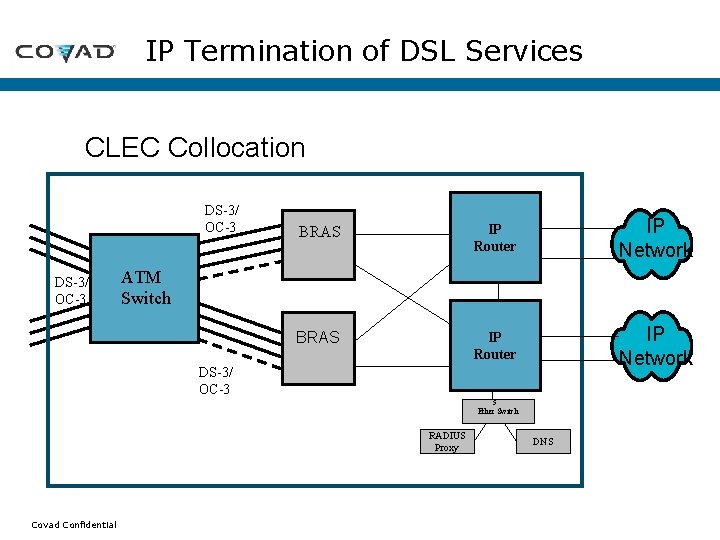
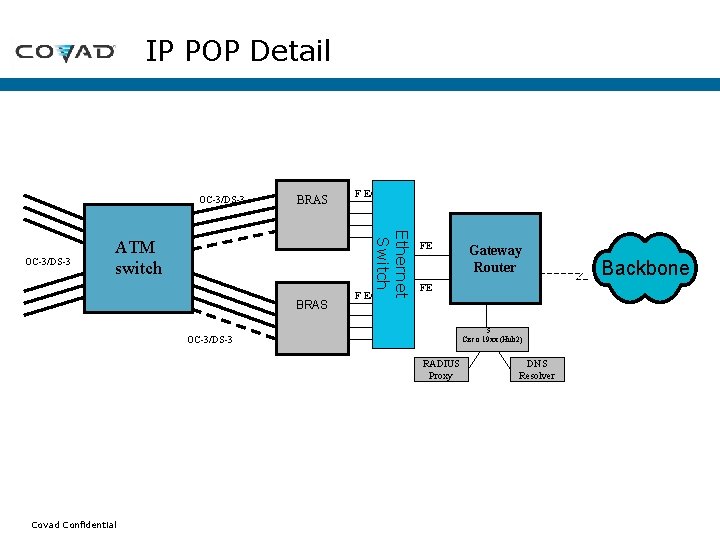
IP Termination of DSL Services CLEC Collocation DS-3/ OC-3 BRAS IP Router IP Network Redback BRAS SMS-1800 IP Router IP Network ATM Switch (#2) DS-3/ OC-3 5 Ether Switch RADIUS Proxy Covad Confidential DNS
Broadband Access Server • The BRAS terminates Layer 2 • Typically ATM PVCs • Also PPP over Ethernet or PPP over ATM • Subscriber Management • Uses RADIUS to • Authenticate userid/password • Configure subscriber parameters • shaping profile • filtering profile (e. g. , restrict email servers or proxy web) • Assigns IP addresses and DNS resolver addresses Covad Confidential
The Flavors of DSL • There are many standard and proprietary versions of Digital Subscriber Line technology • ADSL is the most common and is used mostly with consumers • Asymmetric bandwidth allocation in the up- and downstream directions. More in the down-stream. • Achieved by allocation the spectrum asymmetrically. • Current std has max 6 Mbps down and 768 Kbps up • IDSL is used mainly by CLECs • Regulations do not require ILECs to share Remote Terminals, therefore reach is an issue with CLECs • IDSL bonds an ISDN BRI into a 128 or 144 kbps nonswitched channel Covad Confidential
Flavors of DSL • SDSL or SHDSL is used mainly by SMB • Symmetric service needed by businesses that, e. g. , host web sites • Current SDSL and SHDSL supports up to 2 Mbps • In addition, T 1 s can be attached to DSLAMs, functionally making them a digital access line solution Covad Confidential
CLEC Environment • What do the ILECs sell? • Unbundled Network Element – Loop (UNE-L) • High Frequency Portion of the Loop (HFPL) • Unbundled Network Element – Platform (UNE-P) Covad Confidential
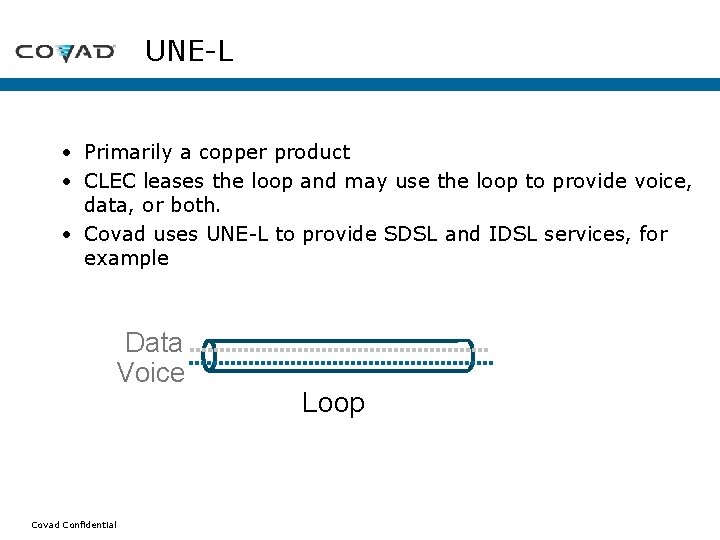
UNE-L • Primarily a copper product • CLEC leases the loop and may use the loop to provide voice, data, or both. • Covad uses UNE-L to provide SDSL and IDSL services, for example Data Voice Covad Confidential Loop
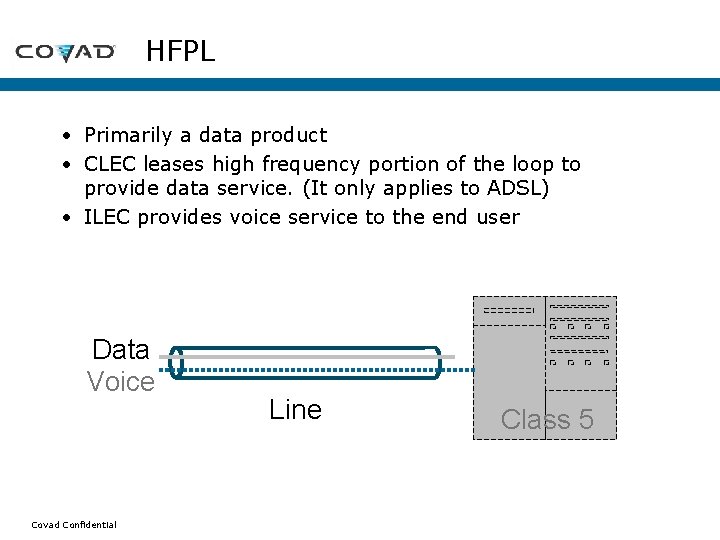
HFPL • Primarily a data product • CLEC leases high frequency portion of the loop to provide data service. (It only applies to ADSL) • ILEC provides voice service to the end user Data Voice Covad Confidential Line Class 5
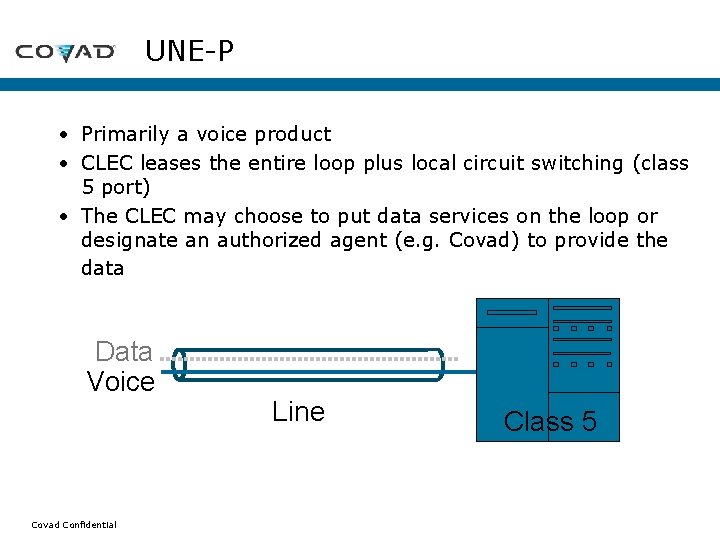
UNE-P • Primarily a voice product • CLEC leases the entire loop plus local circuit switching (class 5 port) • The CLEC may choose to put data services on the loop or designate an authorized agent (e. g. Covad) to provide the data Data Voice Covad Confidential Line Class 5
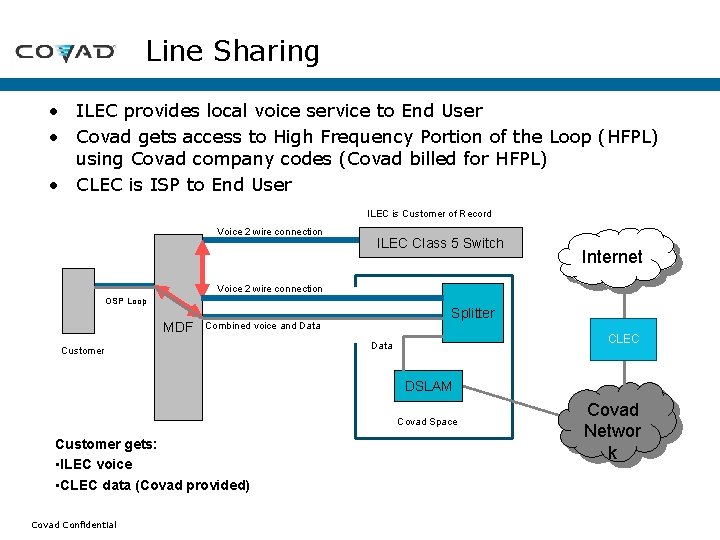
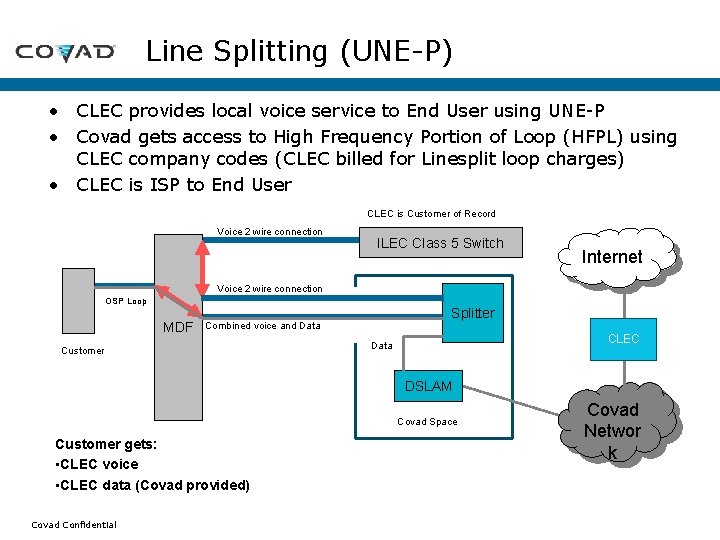
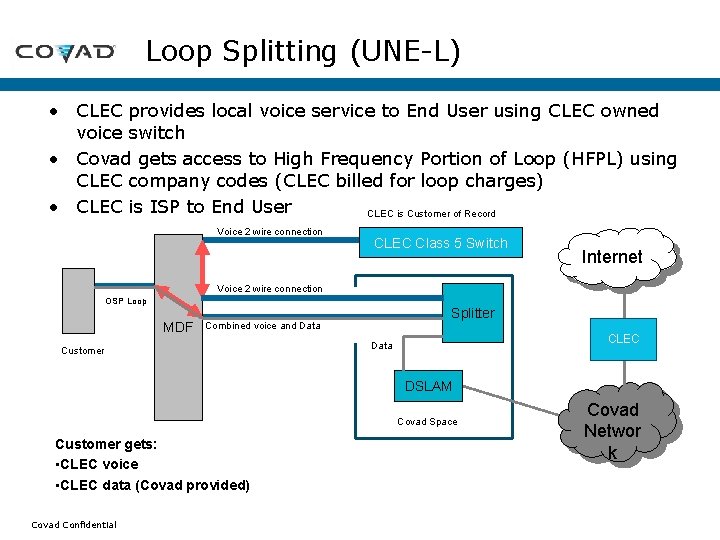
Service Elements • How are the elements used to deliver ADSL services? • Line Sharing (HFPL) • Line Splitting (UNE-P) • Loop Splitting (UNE-L) • Perspective shown in the following slides is primarily wholesale. • Covad is used as the provider name to distinguish access provider from CLEC wholesale customers. Covad Confidential
Line Sharing • ILEC provides local voice service to End User • Covad gets access to High Frequency Portion of the Loop (HFPL) using Covad company codes (Covad billed for HFPL) • CLEC is ISP to End User ILEC is Customer of Record Voice 2 wire connection ILEC Class 5 Switch Internet Voice 2 wire connection OSP Loop MDF Splitter Combined voice and Data Customer CLEC Data DSLAM Covad Space Customer gets: • ILEC voice • CLEC data (Covad provided) Covad Confidential Covad Networ k
Line Splitting (UNE-P) • CLEC provides local voice service to End User using UNE-P • Covad gets access to High Frequency Portion of Loop (HFPL) using CLEC company codes (CLEC billed for Linesplit loop charges) • CLEC is ISP to End User CLEC is Customer of Record Voice 2 wire connection ILEC Class 5 Switch Internet Voice 2 wire connection OSP Loop MDF Splitter Combined voice and Data Customer CLEC Data DSLAM Covad Space Customer gets: • CLEC voice • CLEC data (Covad provided) Covad Confidential Covad Networ k
Loop Splitting (UNE-L) • CLEC provides local voice service to End User using CLEC owned voice switch • Covad gets access to High Frequency Portion of Loop (HFPL) using CLEC company codes (CLEC billed for loop charges) • CLEC is ISP to End User CLEC is Customer of Record Voice 2 wire connection CLEC Class 5 Switch Internet Voice 2 wire connection OSP Loop MDF Splitter Combined voice and Data Customer CLEC Data DSLAM Covad Space Customer gets: • CLEC voice • CLEC data (Covad provided) Covad Confidential Covad Networ k
DSL Logical Layers
What are the Layers? • Layers • DSL physical layer • ATM layer • PPP layer (not always present) • IP layer • ATM Layer rides on DSL Layer and consists of • Typically a single PVC with UBR or VBR-nrt Qo. S using AAL 5 • Possible to have multiple PVCs • Supporting different Qo. S per PVC • Architectures using multiple PVCs become complex due to IP addressing and routing issues • Support ATM OAM flows for troubleshooting Covad Confidential
PPP Layer • PPP over Ethernet for Multi-protocol Encapsulation • Used for consumers • Terminates on PC (or home gateway) • Provides a single login per subscriber PC • CPE can be a bridge (until recently less expensive than a router) • Bridge has very little configuration, good for self-install • PPP over ATM • Used for businesses, terminates on CPE • CPE typically a router • Interworks with RADIUS on the BRAS • Assigns dynamic or “framed-route” IP address/subnet • Pushes DNS resolver addresses Covad Confidential
IP Layer • IP Layer spans from CPE to IP POP • Premises LAN through CPE • CPE encapsulates IP in PPP • CPE encapsulates PPP in AAL 5/ATM • Transmission across ATM network • BRAS undoes ATM and PPP encapsulations • BRAS participates in SP’s IP routed network • In retail or Layer 3 wholesale model BRAS is owned by access provider • In Layer 2 wholesale model BRAS is owned by wholesale customer Covad Confidential
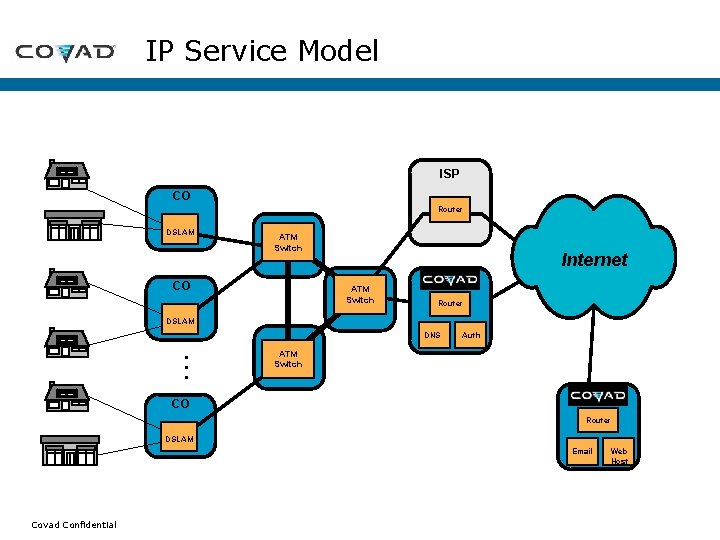
IP Service Model ISP CO Router DSLAM ATM Switch CO Internet ATM Switch ISP Router DSLAM . . . DNS CO Auth ATM Switch ISP Router DSLAM Email Covad Confidential Web Host
IP POP Detail OC-3/DS-3 ATM switch Redback BRAS F E/GE Ethernet Switch OC-3/DS-3 BRAS F E/GE FE FE SMS-1800 (#2) 5 OC-3/DS-3 Cisco 19 xx (Hub 2) RADIUS Proxy Covad Confidential Gateway Router DNS Resolver Backbone
Summary • We’ve discussed overall DSL network architectures • Impacts from market segment • Impacts from government regulations • Technical stacks/layering • DSL • ATM • PPP • IP • Implementation of architecture Covad Confidential
Questions?