RTG Eco Crane InUse Emissions and Fuel Economy
- Slides: 30
RTG Eco. Crane In-Use Emissions and Fuel Economy Test Program at POLA 2013 PEMS Conference and Workshop April 10, 2013 CE-CERT, Riverside, California Energy and Emissions Technology Consulting
Outline • Emisstar Overview • Project • Technology • Test Phases • Test Cycle Development • Instrumentation • Results • Conclusions 2/30
Emisstar LLC • Technology consulting firm • 3 US Offices (NY, TX, CA) • Energy and Emissions Focus – Transportation • Alt Fuels, Vehicle Tech and Clean Energy • Wide Range of Engineering, Verification Support and Testing Services • Founded in 2005 3/30
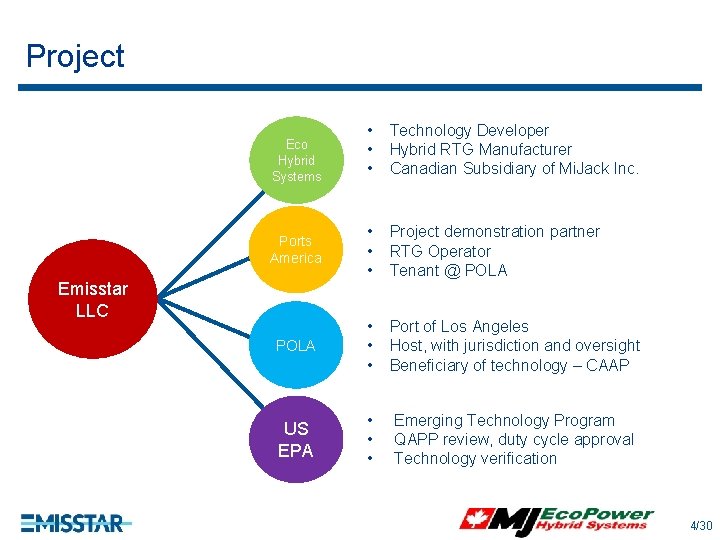
Project • • • Technology Developer Hybrid RTG Manufacturer Canadian Subsidiary of Mi. Jack Inc. Ports America • • • Project demonstration partner RTG Operator Tenant @ POLA • • • Port of Los Angeles Host, with jurisdiction and oversight Beneficiary of technology – CAAP US EPA • • • Emerging Technology Program QAPP review, duty cycle approval Technology verification Eco Hybrid Systems Emisstar LLC 4/30
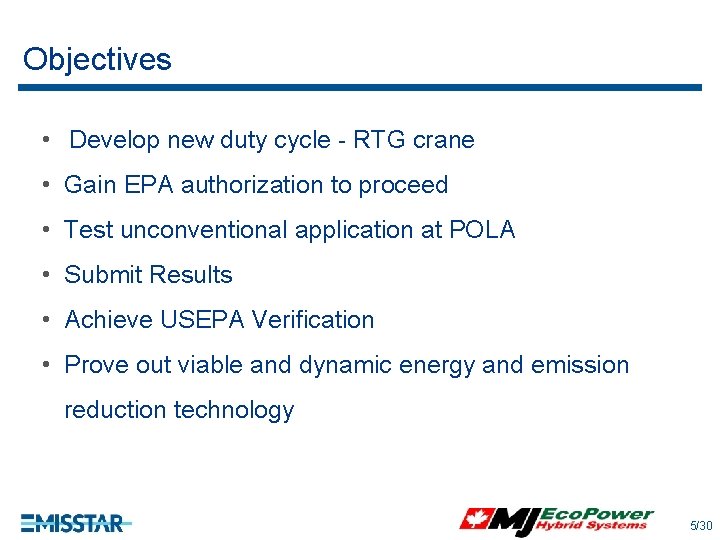
Objectives • Develop new duty cycle - RTG crane • Gain EPA authorization to proceed • Test unconventional application at POLA • Submit Results • Achieve USEPA Verification • Prove out viable and dynamic energy and emission reduction technology 5/30
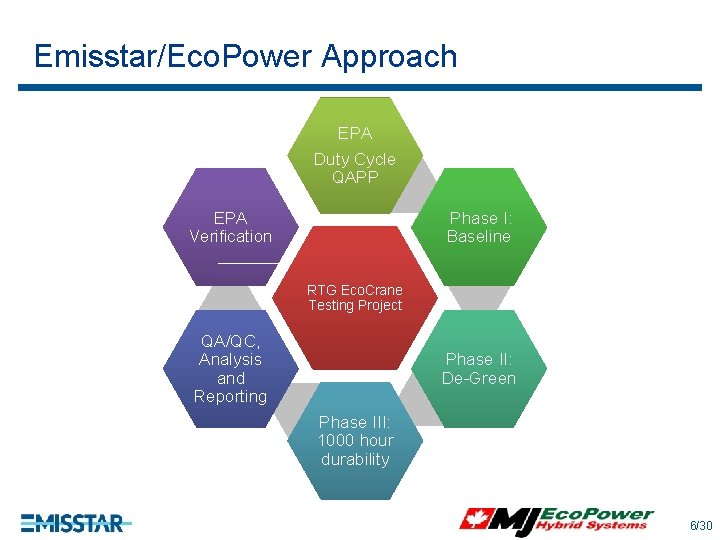
Emisstar/Eco. Power Approach EPA Duty Cycle QAPP EPA Verification Phase I: Baseline RTG Eco. Crane Testing Project QA/QC, Analysis and Reporting Phase II: De-Green Phase III: 1000 hour durability 6/30
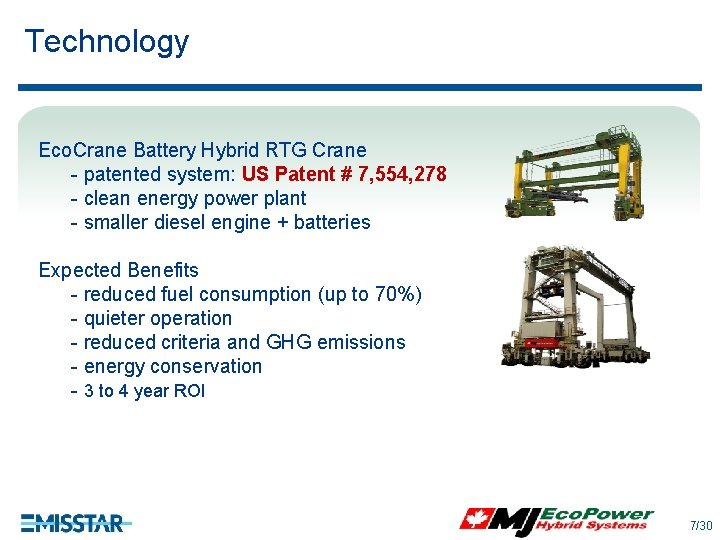
Technology Eco. Crane Battery Hybrid RTG Crane - patented system: US Patent # 7, 554, 278 - clean energy power plant - smaller diesel engine + batteries Expected Benefits - reduced fuel consumption (up to 70%) - quieter operation - reduced criteria and GHG emissions - energy conservation - 3 to 4 year ROI 7/30
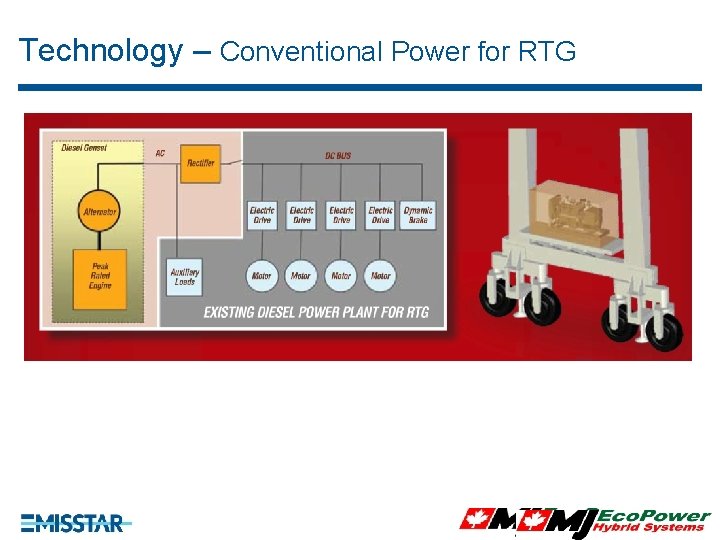
Technology – Conventional Power for RTG 8/30
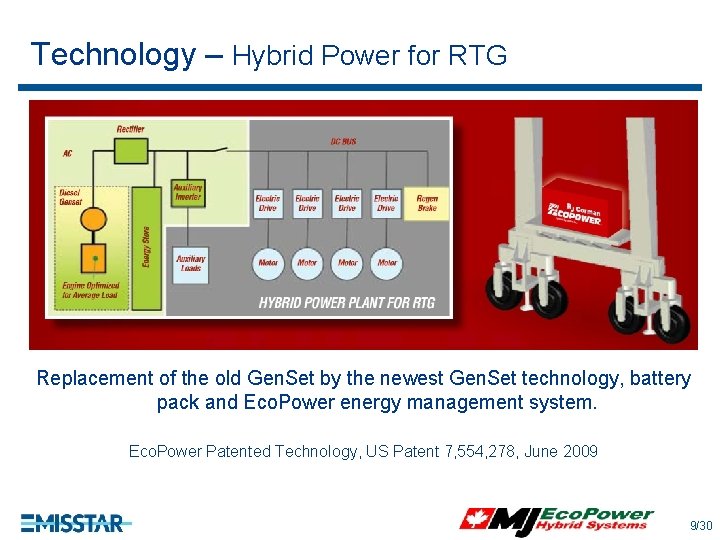
Technology – Hybrid Power for RTG Replacement of the old Gen. Set by the newest Gen. Set technology, battery pack and Eco. Power energy management system. Eco. Power Patented Technology, US Patent 7, 554, 278, June 2009 9/30
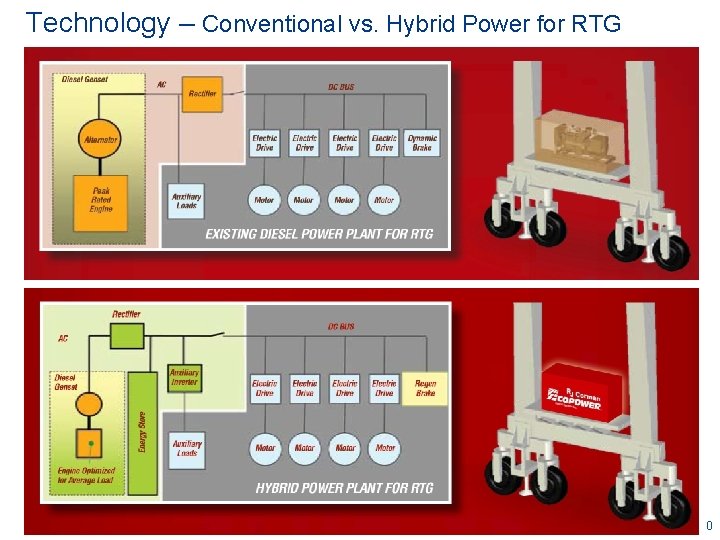
Technology – Conventional vs. Hybrid Power for RTG 10/30
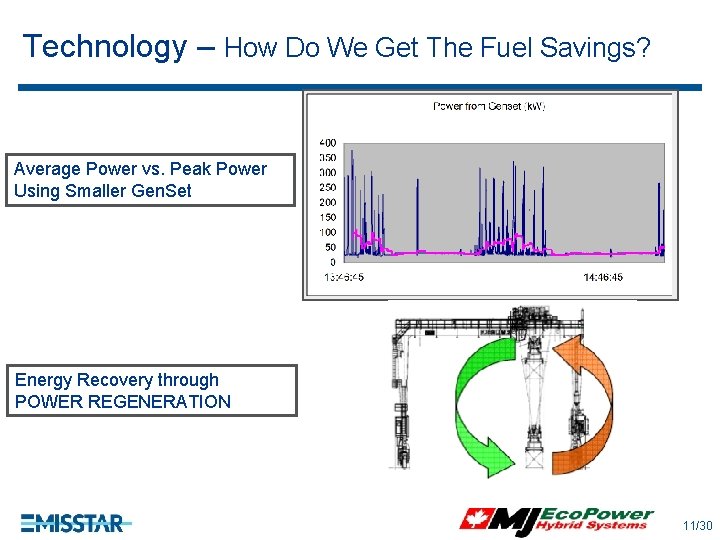
Technology – How Do We Get The Fuel Savings? Average Power vs. Peak Power Using Smaller Gen. Set Energy Recovery through POWER REGENERATION 11/30
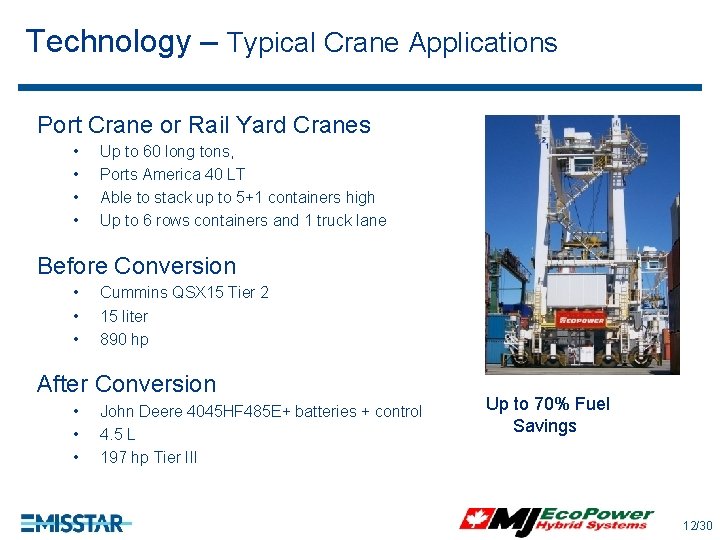
Technology – Typical Crane Applications Port Crane or Rail Yard Cranes • • Up to 60 long tons, Ports America 40 LT Able to stack up to 5+1 containers high Up to 6 rows containers and 1 truck lane Before Conversion • • • Cummins QSX 15 Tier 2 15 liter 890 hp After Conversion • • • John Deere 4045 HF 485 E+ batteries + control 4. 5 L 197 hp Tier III Up to 70% Fuel Savings 12/30
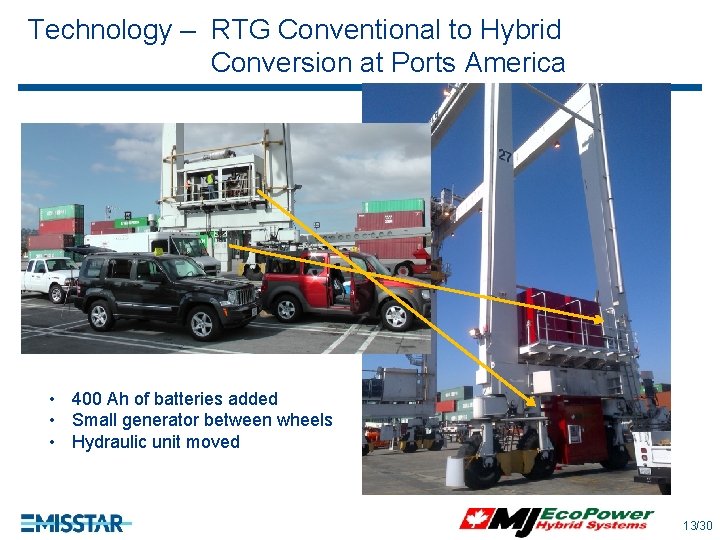
Technology – RTG Conventional to Hybrid Conversion at Ports America • 400 Ah of batteries added • Small generator between wheels • Hydraulic unit moved 13/30
Test Phases • Phase 1: Baseline conventional diesel RTG • Phase 2: “De-Greened” Eco. Crane Hybrid RTG (100 hrs) • Phase 3: “Aged” Eco. Crane Hybrid RTG (1000 hrs) 14/30
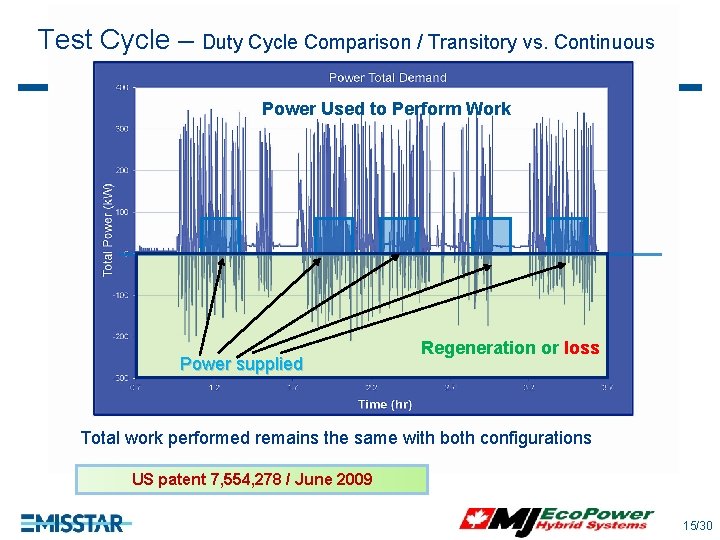
Test Cycle – Duty Cycle Comparison / Transitory vs. Continuous Power Used to Perform Work Power supplied Regeneration or loss Total work performed remains the same with both configurations US patent 7, 554, 278 / June 2009 15/30
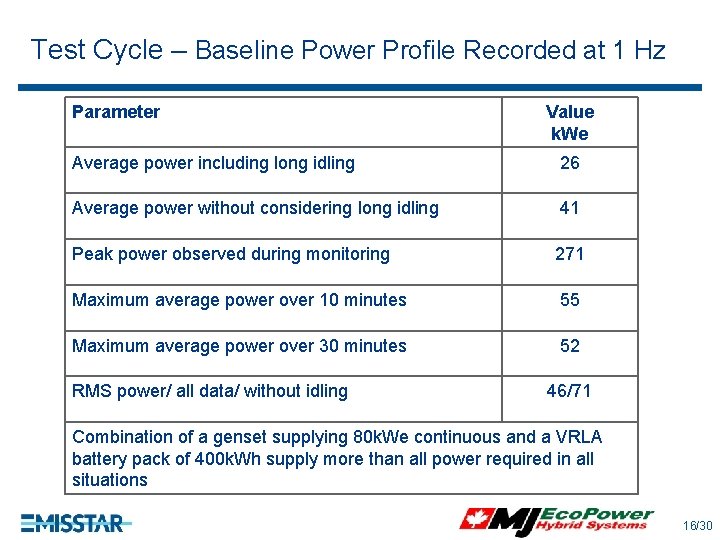
Test Cycle – Baseline Power Profile Recorded at 1 Hz Parameter Value k. We Average power including long idling 26 Average power without considering long idling 41 Peak power observed during monitoring 271 Maximum average power over 10 minutes 55 Maximum average power over 30 minutes 52 RMS power/ all data/ without idling 46/71 Combination of a genset supplying 80 k. We continuous and a VRLA battery pack of 400 k. Wh supply more than all power required in all situations 16/30
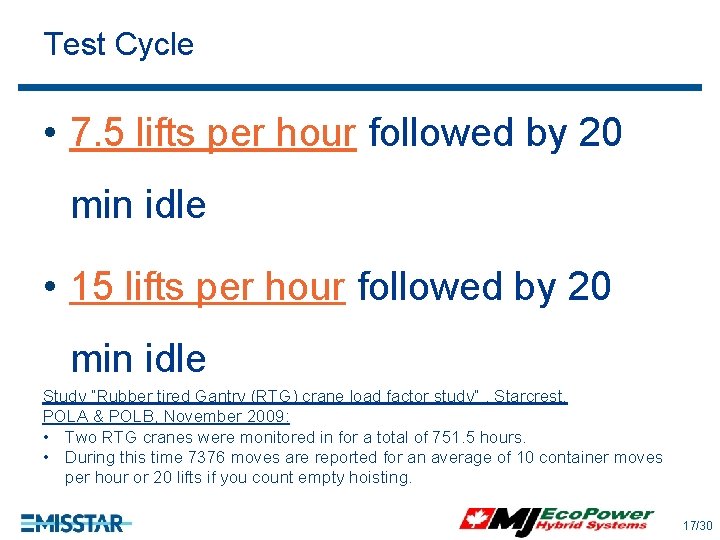
Test Cycle • 7. 5 lifts per hour followed by 20 min idle • 15 lifts per hour followed by 20 min idle Study “Rubber tired Gantry (RTG) crane load factor study” , Starcrest, POLA & POLB, November 2009: • Two RTG cranes were monitored in for a total of 751. 5 hours. • During this time 7376 moves are reported for an average of 10 container moves per hour or 20 lifts if you count empty hoisting. 17/30
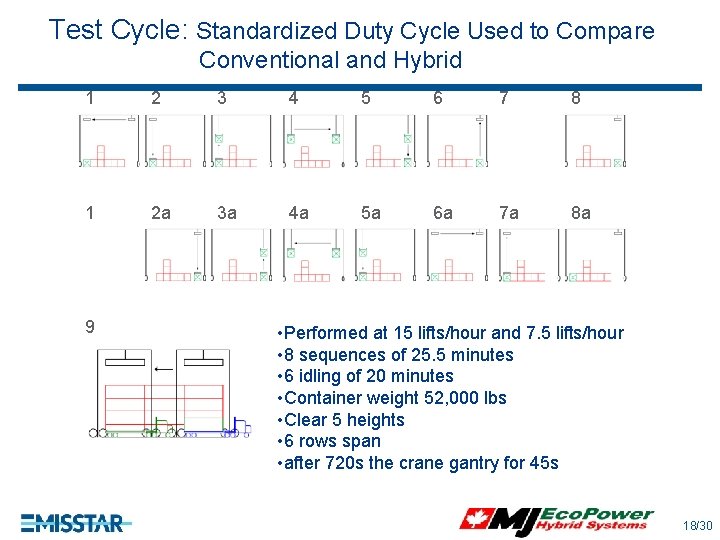
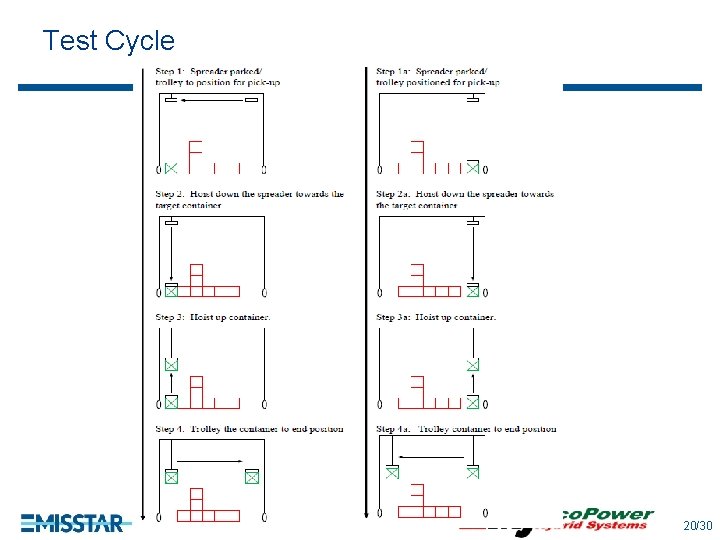
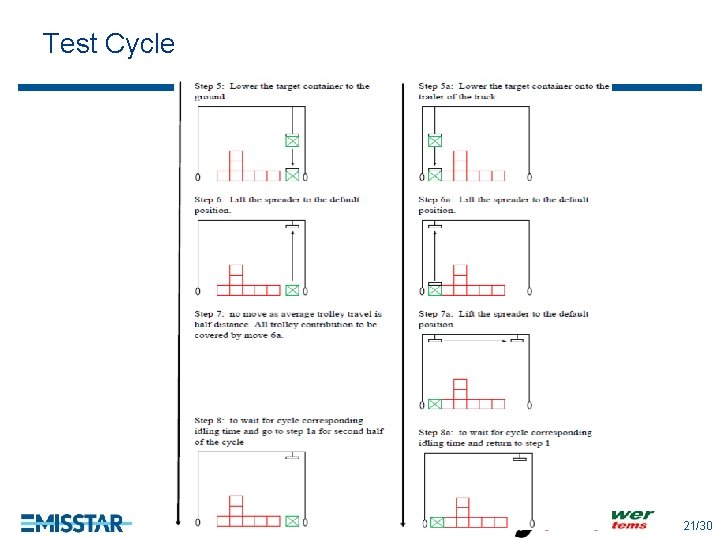
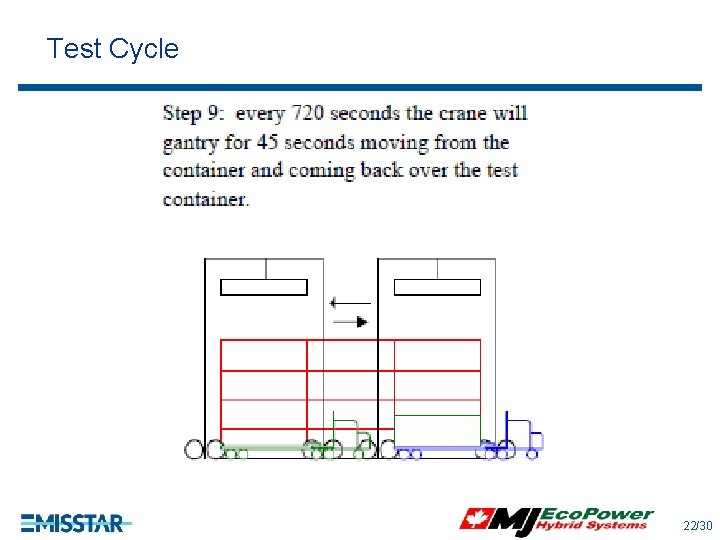
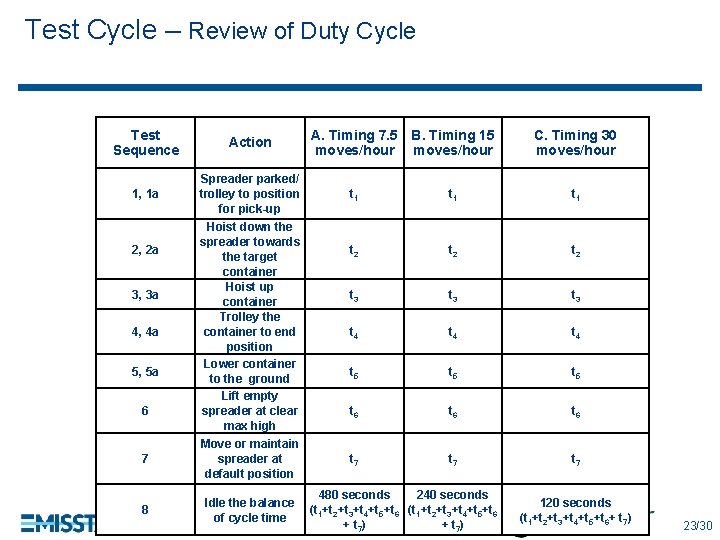
Test Cycle: Standardized Duty Cycle Used to Compare Conventional and Hybrid 1 2 3 4 5 6 7 8 1 2 a 3 a 4 a 5 a 6 a 7 a 8 a 9 • Performed at 15 lifts/hour and 7. 5 lifts/hour • 8 sequences of 25. 5 minutes • 6 idling of 20 minutes • Container weight 52, 000 lbs • Clear 5 heights • 6 rows span • after 720 s the crane gantry for 45 s 18/30
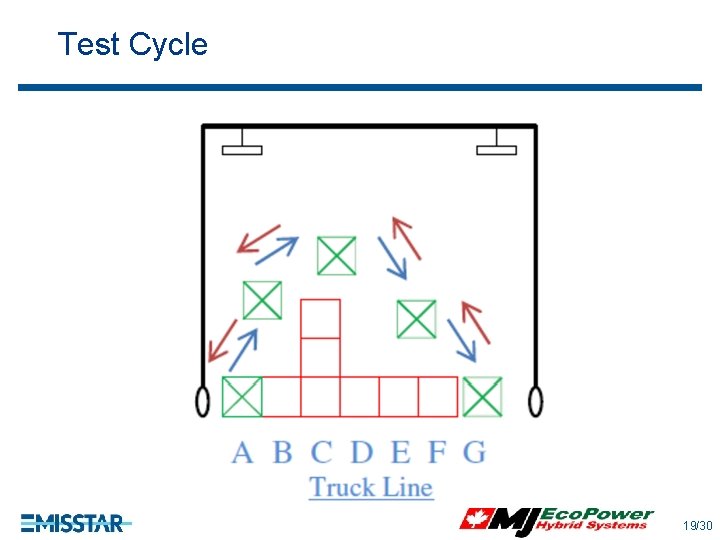
Test Cycle 19/30
Test Cycle 20/30
Test Cycle 21/30
Test Cycle 22/30
Test Cycle – Review of Duty Cycle Test Sequence Action 1, 1 a Spreader parked/ trolley to position for pick-up 2, 2 a 3, 3 a 4, 4 a 5, 5 a 6 Hoist down the spreader towards the target container Hoist up container Trolley the container to end position Lower container to the ground Lift empty spreader at clear max high 7 Move or maintain spreader at default position 8 Idle the balance of cycle time A. Timing 7. 5 B. Timing 15 moves/hour C. Timing 30 moves/hour t 1 t 1 t 2 t 2 t 3 t 3 t 4 t 4 t 5 t 5 t 6 t 6 t 7 t 7 480 seconds 240 seconds (t 1+t 2+t 3+t 4+t 5+t 6 + t 7) 120 seconds (t 1+t 2+t 3+t 4+t 5+t 6+ t 7) 23/30
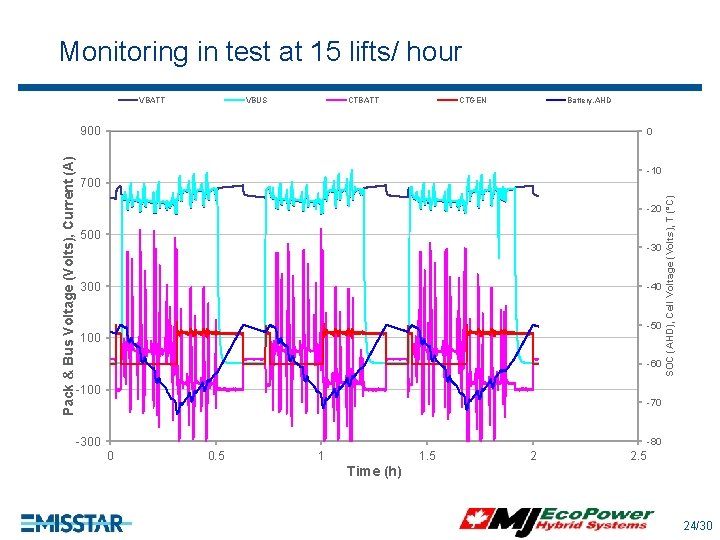
Monitoring in test at 15 lifts/ hour VBATT VBUS CTBATT CTGEN Battery. AHD 0 -10 700 -20 500 -30 300 -40 -50 100 -60 SOC (AHD), Cell Voltage (Volts), T (°C) Pack & Bus Voltage (Volts), Current (A) 900 -100 -70 -300 -80 0 0. 5 1 1. 5 2 2. 5 Time (h) 24/30
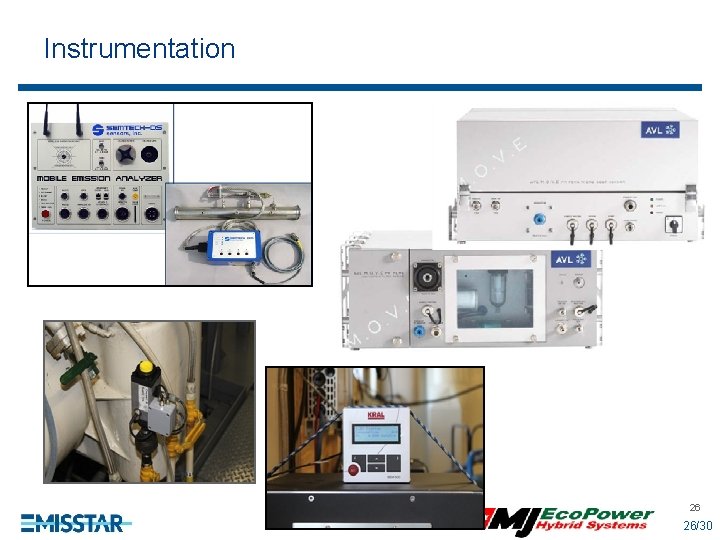
Instrumentation • SEMTECH DS • AVL 494 PM PEMS • Kral fuel flow meter – onboard fuel flow measurement, temperature compensated (*) * 40 CFR § 86. 345 -79 25/30
Instrumentation 26 26/30
Results (Baseline vs. Aged) • Idle Emissions & Fuel Consumption: • 72% reduction in FC • 98% reduction in HC • 90% reduction in NOx • 83% reduction in PM 27/30
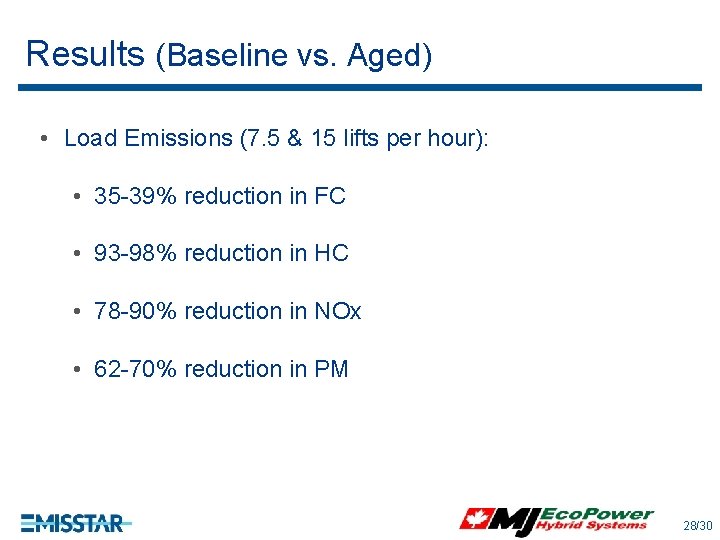
Results (Baseline vs. Aged) • Load Emissions (7. 5 & 15 lifts per hour): • 35 -39% reduction in FC • 93 -98% reduction in HC • 78 -90% reduction in NOx • 62 -70% reduction in PM 28/30
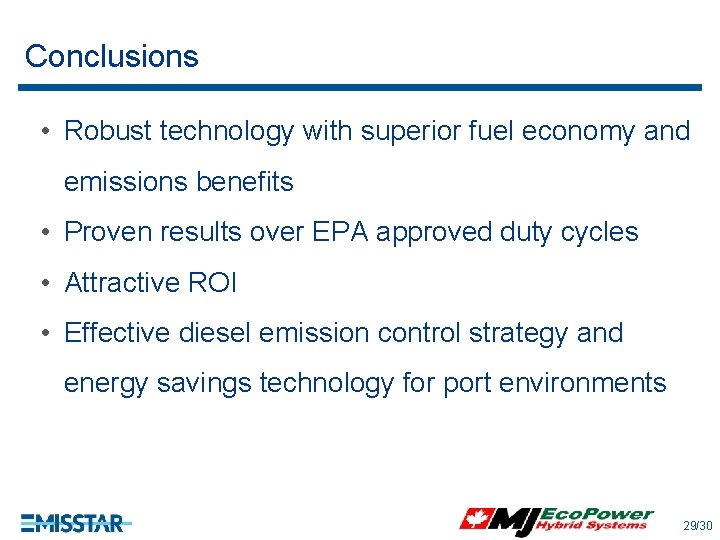
Conclusions • Robust technology with superior fuel economy and emissions benefits • Proven results over EPA approved duty cycles • Attractive ROI • Effective diesel emission control strategy and energy savings technology for port environments 29/30
Contact Information Michael C. Block Emisstar LLC 30982 Ariana Lane Laguna Niguel, CA 92677 michael. block@emisstar. com (949) 218 -8229 30/30