Respiratory Protection l 29 CFR 1910 134 Presented

- Slides: 60
Respiratory Protection l 29 CFR 1910. 134 Presented by: ETTA (919) 807 -2875 This presentation was created by the N. C. Department of Labor for safety and health training.
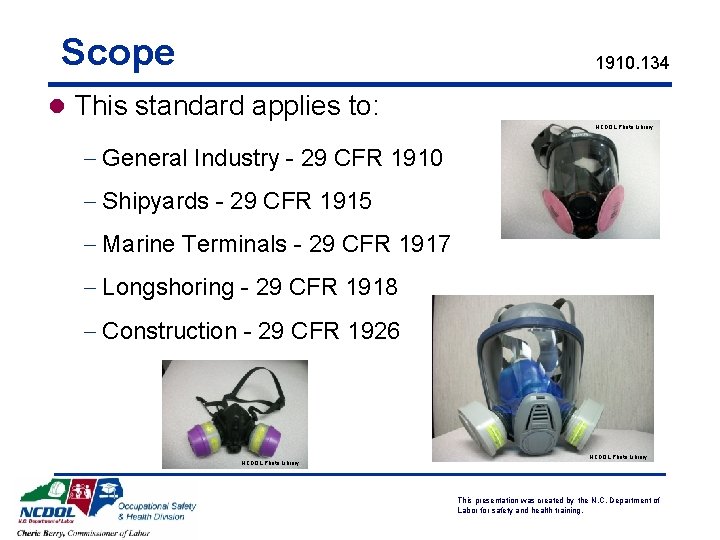
Scope 1910. 134 l This standard applies to: NCDOL Photo Library - General Industry - 29 CFR 1910 - Shipyards - 29 CFR 1915 - Marine Terminals - 29 CFR 1917 - Longshoring - 29 CFR 1918 - Construction - 29 CFR 1926 NCDOL Photo Library This presentation was created by the N. C. Department of Labor for safety and health training.
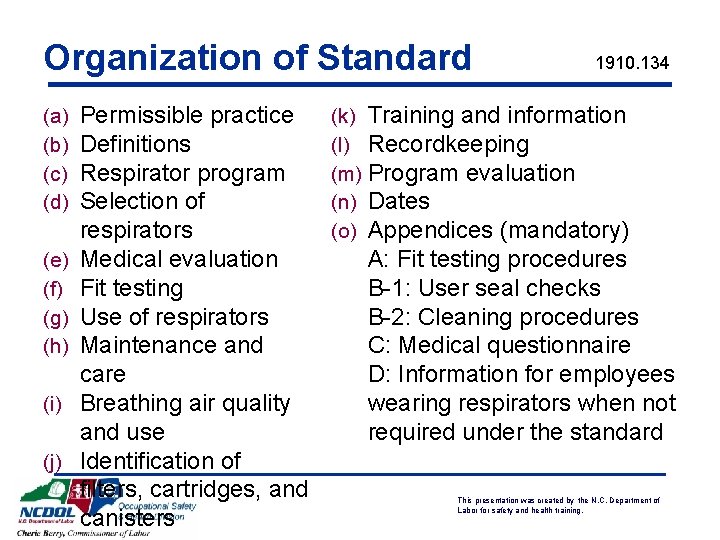
Organization of Standard (a) (b) (c) (d) (e) (f) (g) (h) (i) (j) Permissible practice Definitions Respirator program Selection of respirators Medical evaluation Fit testing Use of respirators Maintenance and care Breathing air quality and use Identification of filters, cartridges, and canisters 1910. 134 (k) Training and information (l) Recordkeeping (m) Program evaluation (n) Dates (o) Appendices (mandatory) A: Fit testing procedures B-1: User seal checks B-2: Cleaning procedures C: Medical questionnaire D: Information for employees wearing respirators when not required under the standard This presentation was created by the N. C. Department of Labor for safety and health training.
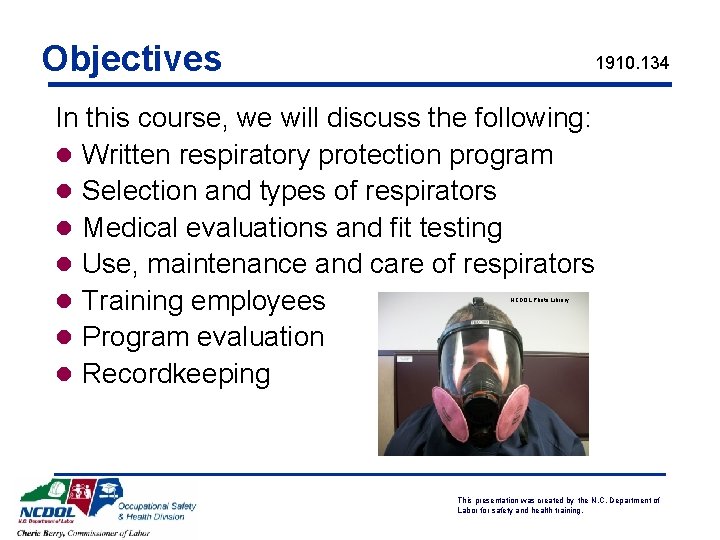
Objectives 1910. 134 In this course, we will discuss the following: l Written respiratory protection program l Selection and types of respirators l Medical evaluations and fit testing l Use, maintenance and care of respirators l Training employees l Program evaluation l Recordkeeping NCDOL Photo Library This presentation was created by the N. C. Department of Labor for safety and health training.
What are the Ten Parts of an Effective Respirator Program? This presentation was created by the N. C. Department of Labor for safety and health training.
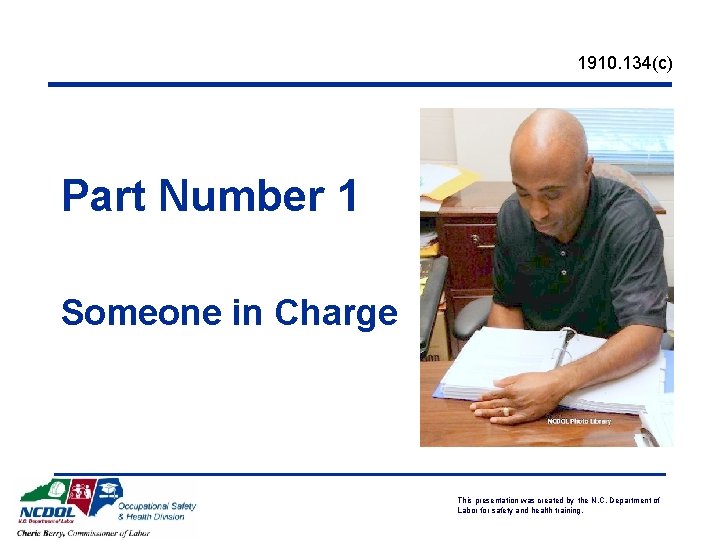
1910. 134(c) Part Number 1 Someone in Charge This presentation was created by the N. C. Department of Labor for safety and health training.
Someone in Charge 1910. 134(c) l Written program must be implemented by a trained program administrator - Must be qualified - Know the hazards in the workplace and if engineering controls can be applied - Identify types of respirators to be used if engineering controls will not work l Update as necessary This presentation was created by the N. C. Department of Labor for safety and health training.
1910. 134(e) Part Number 2 Medical Evaluation This presentation was created by the N. C. Department of Labor for safety and health training.
Why Have Medical Evaluations? 1910. 134(e) l A respirator places a physiological burden on the employee. This burden varies with: - Type of respirator worn - Job and workplace conditions - Medical status of the employee This presentation was created by the N. C. Department of Labor for safety and health training.
Physiological Effects l Pulmonary l Cardiovascular l Body temperature l Senses l Psychological l Irritation and allergy This presentation was created by the N. C. Department of Labor for safety and health training.
Medical Evaluation 1910. 134(e) l Establishes the medical condition of the wearer l Provided before initial respirator use l Prior to fit testing and training l Performed by a physician or other licensed health care professional (PLHCP) - OSHA Respirator Medical Evaluation Questionnaire; Appendix C or - Initial medical examination This presentation was created by the N. C. Department of Labor for safety and health training.
Follow- Up Medical Examinations 1910. 134(e)(3) l Required if: - Positive response to questions 1 - 8 in Section 2, Part A of Appendix C - Initial medical examination indicates need for followup physical l Must include any medical tests, consultations or diagnostic procedures PLHCP deems necessary This presentation was created by the N. C. Department of Labor for safety and health training.
1910. 134(d) Part Number 3 Selection This presentation was created by the N. C. Department of Labor for safety and health training.
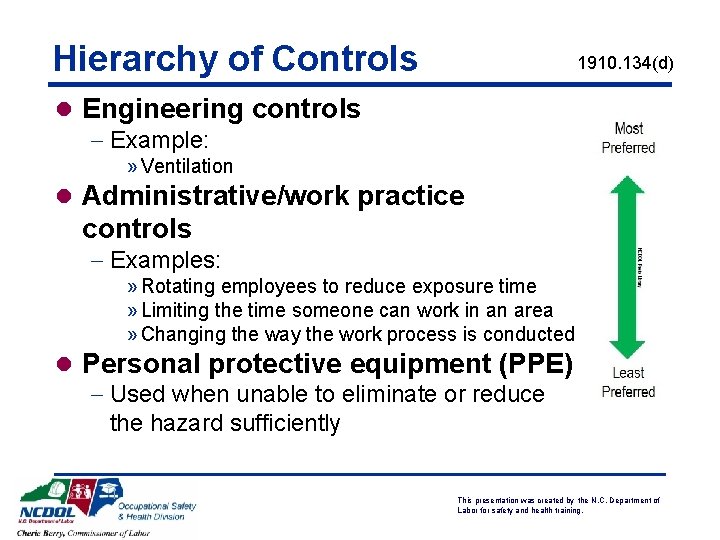
Hierarchy of Controls 1910. 134(d) l Engineering controls - Example: » Ventilation l Administrative/work practice controls - Examples: » Rotating employees to reduce exposure time » Limiting the time someone can work in an area » Changing the way the work process is conducted l Personal protective equipment (PPE) - Used when unable to eliminate or reduce the hazard sufficiently This presentation was created by the N. C. Department of Labor for safety and health training.
Hazards Requiring Respirator Use l Oxygen-deficient atmosphere - Does not contain enough oxygen to sustain breathing. (<19. 5 percent by volume at sea level) » Examples: • Confined spaces • Silos • Boilers • Tanks • Sewers l Immediately dangerous to life or health (IDLH) or unknown atmosphere This presentation was created by the N. C. Department of Labor for safety and health training.
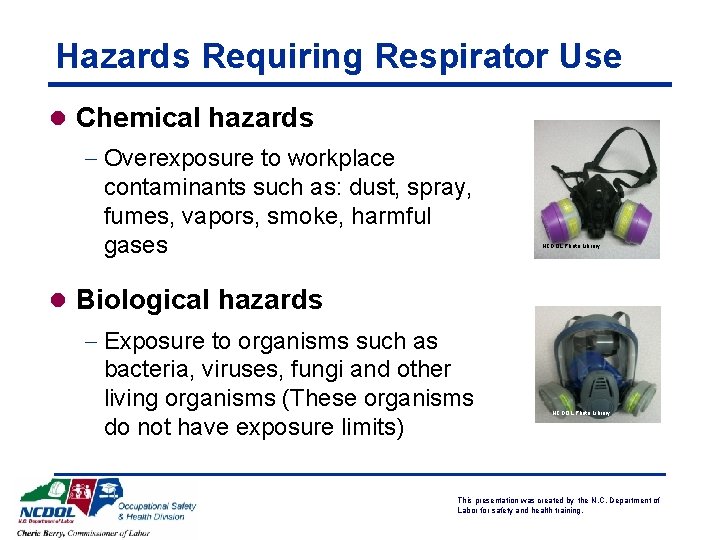
Hazards Requiring Respirator Use l Chemical hazards - Overexposure to workplace contaminants such as: dust, spray, fumes, vapors, smoke, harmful gases NCDOL Photo Library l Biological hazards - Exposure to organisms such as bacteria, viruses, fungi and other living organisms (These organisms do not have exposure limits) NCDOL Photo Library This presentation was created by the N. C. Department of Labor for safety and health training.
Hazard Determination 1910. 134(d) l Identify the contaminants and evaluate the hazards l Determine the physical properties of the contaminants l Identify areas of potential oxygen (O 2) deficiency l Estimate or measure employee’s exposure to the hazards - Assume IDLH, when not known* This presentation was created by the N. C. Department of Labor for safety and health training.
Selection 1910. 134(d)(1) l Select the appropriate respirator based on the hazard, workplace and user factors l Select only NIOSH-certified respirators l Provide sufficient number of respirator models and sizes to correctly fit user This presentation was created by the N. C. Department of Labor for safety and health training.
Breathing Air Use 1910. 134(i) l Compressors - If oil lubricated: » CO alarm, high temperature alarm or both » If only high temperature alarm, must monitor for CO at sufficient intervals - If non-oil lubricated: » Employer shall ensure that the CO level is < 10 ppm - Breathing air couplings must be incompatible with those for non-respirable air or other gas systems This presentation was created by the N. C. Department of Labor for safety and health training.
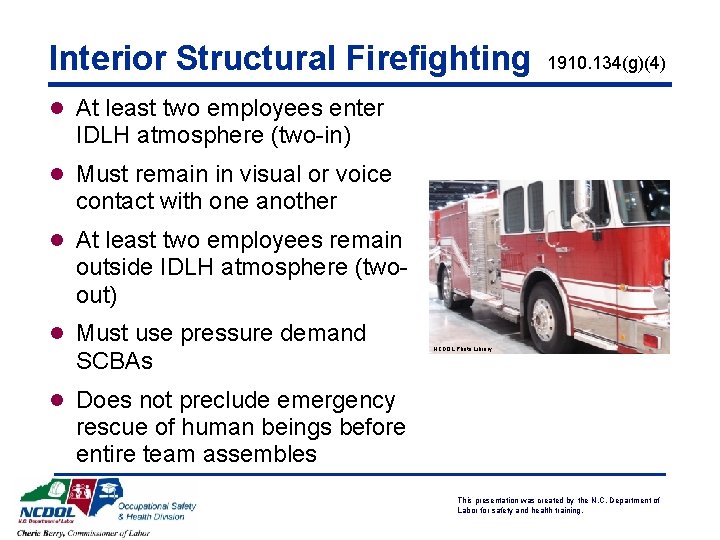
Interior Structural Firefighting 1910. 134(g)(4) l At least two employees enter IDLH atmosphere (two-in) l Must remain in visual or voice contact with one another l At least two employees remain outside IDLH atmosphere (twoout) l Must use pressure demand SCBAs NCDOL Photo Library l Does not preclude emergency rescue of human beings before entire team assembles This presentation was created by the N. C. Department of Labor for safety and health training.
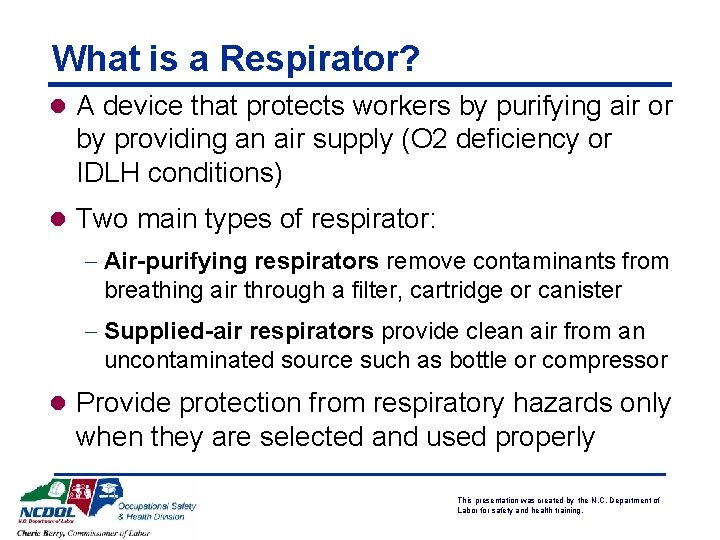
What is a Respirator? l A device that protects workers by purifying air or by providing an air supply (O 2 deficiency or IDLH conditions) l Two main types of respirator: - Air-purifying respirators remove contaminants from breathing air through a filter, cartridge or canister - Supplied-air respirators provide clean air from an uncontaminated source such as bottle or compressor l Provide protection from respiratory hazards only when they are selected and used properly This presentation was created by the N. C. Department of Labor for safety and health training.
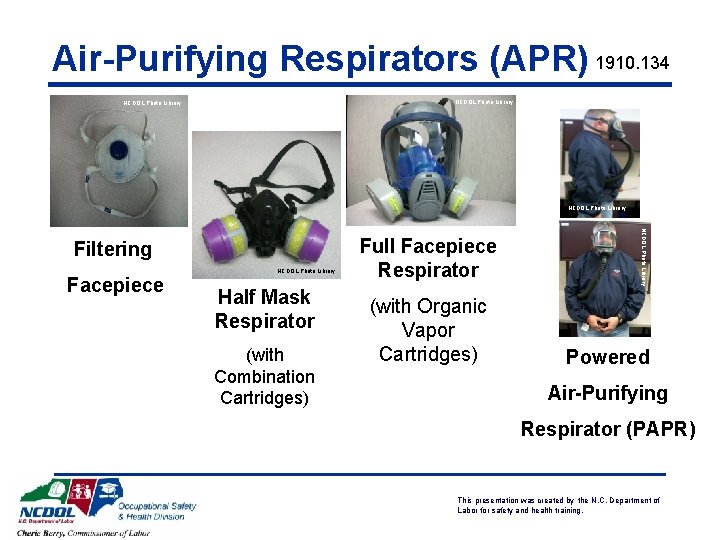
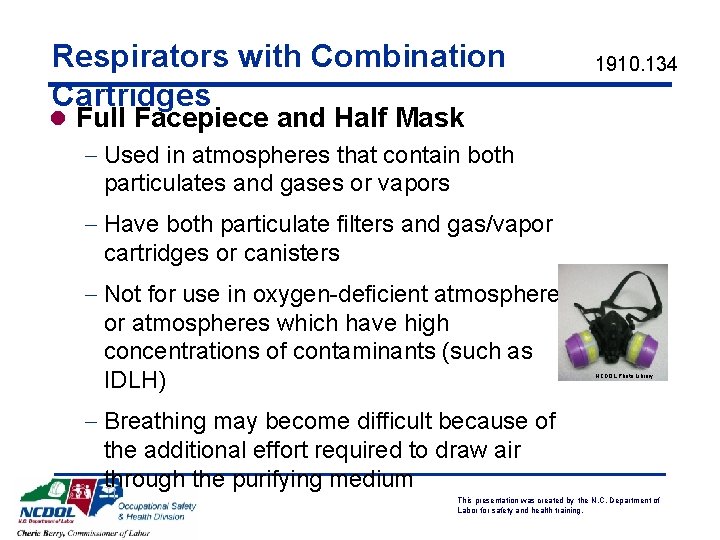
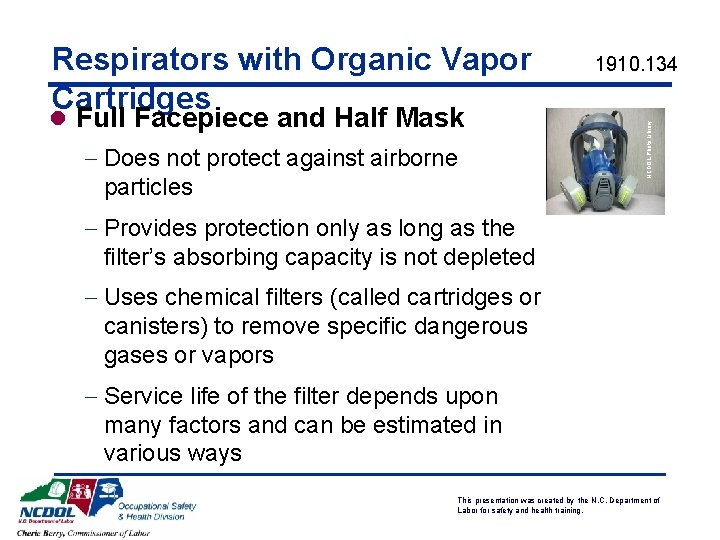
Air-Purifying Respirators (APR) 1910. 134 NCDOL Photo Library Facepiece NCDOL Photo Library Half Mask Respirator (with Combination Cartridges) Full Facepiece Respirator (with Organic Vapor Cartridges) NCDOL Photo Library Filtering Powered Air-Purifying Respirator (PAPR) This presentation was created by the N. C. Department of Labor for safety and health training.
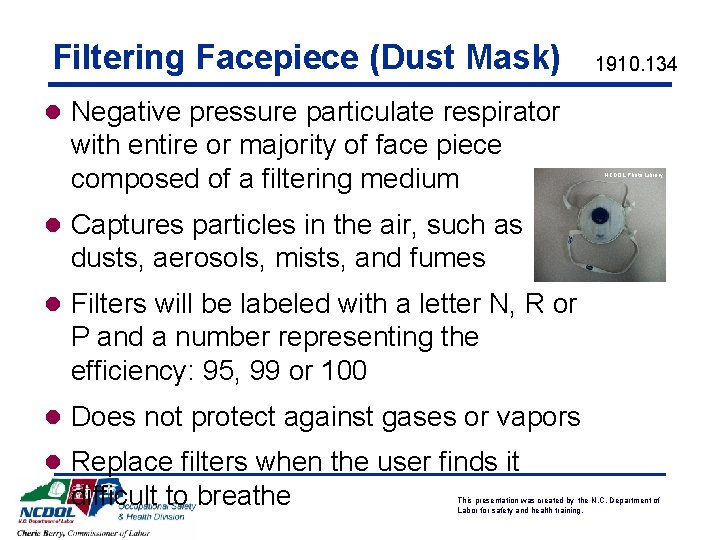
Filtering Facepiece (Dust Mask) 1910. 134 l Negative pressure particulate respirator with entire or majority of face piece composed of a filtering medium NCDOL Photo Library l Captures particles in the air, such as dusts, aerosols, mists, and fumes l Filters will be labeled with a letter N, R or P and a number representing the efficiency: 95, 99 or 100 l Does not protect against gases or vapors l Replace filters when the user finds it difficult to breathe This presentation was created by the N. C. Department of Labor for safety and health training.
Respirators with Combination Cartridges 1910. 134 l Full Facepiece and Half Mask - Used in atmospheres that contain both particulates and gases or vapors - Have both particulate filters and gas/vapor cartridges or canisters - Not for use in oxygen-deficient atmospheres or atmospheres which have high concentrations of contaminants (such as IDLH) NCDOL Photo Library - Breathing may become difficult because of the additional effort required to draw air through the purifying medium This presentation was created by the N. C. Department of Labor for safety and health training.
l Full Facepiece and Half Mask - Does not protect against airborne particles 1910. 134 NCDOL Photo Library Respirators with Organic Vapor Cartridges - Provides protection only as long as the filter’s absorbing capacity is not depleted - Uses chemical filters (called cartridges or canisters) to remove specific dangerous gases or vapors - Service life of the filter depends upon many factors and can be estimated in various ways This presentation was created by the N. C. Department of Labor for safety and health training.
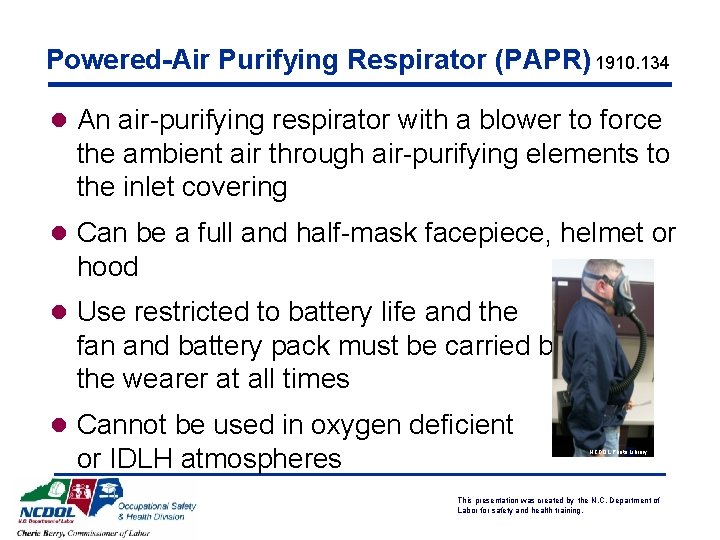
Powered-Air Purifying Respirator (PAPR) 1910. 134 l An air-purifying respirator with a blower to force the ambient air through air-purifying elements to the inlet covering l Can be a full and half-mask facepiece, helmet or hood l Use restricted to battery life and the fan and battery pack must be carried by the wearer at all times l Cannot be used in oxygen deficient or IDLH atmospheres NCDOL Photo Library This presentation was created by the N. C. Department of Labor for safety and health training.
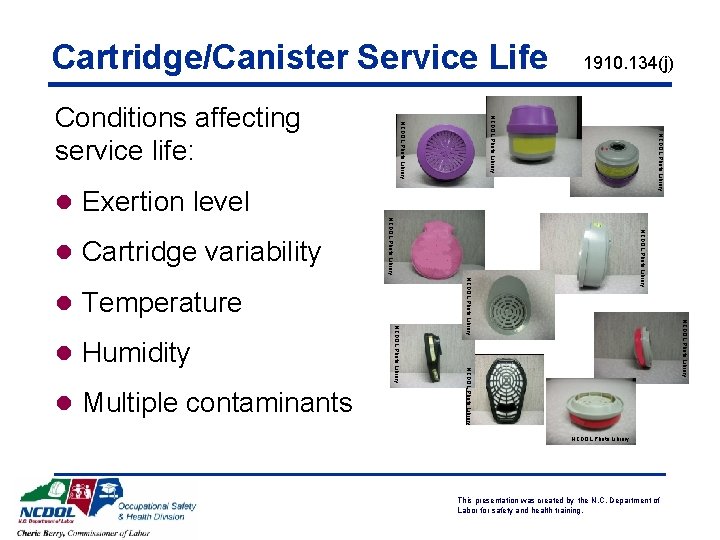
Cartridge/Canister Service Life NCDOL Photo Library Conditions affecting service life: 1910. 134(j) l Exertion level NCDOL Photo Library l Multiple contaminants NCDOL Photo Library l Humidity NCDOL Photo Library l Temperature NCDOL Photo Library l Cartridge variability NCDOL Photo Library This presentation was created by the N. C. Department of Labor for safety and health training.
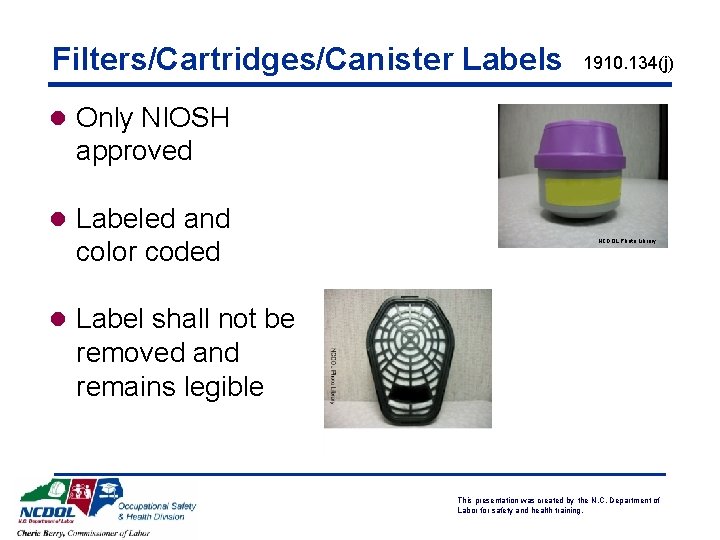
Filters/Cartridges/Canister Labels 1910. 134(j) l Only NIOSH approved l Labeled and color coded NCDOL Photo Library l Label shall not be removed and remains legible This presentation was created by the N. C. Department of Labor for safety and health training.
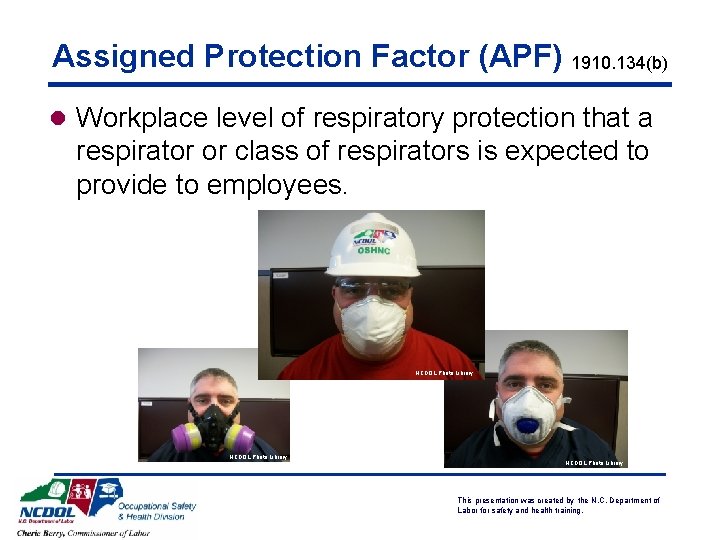
Assigned Protection Factor (APF) 1910. 134(b) l Workplace level of respiratory protection that a respirator or class of respirators is expected to provide to employees. NCDOL Photo Library This presentation was created by the N. C. Department of Labor for safety and health training.
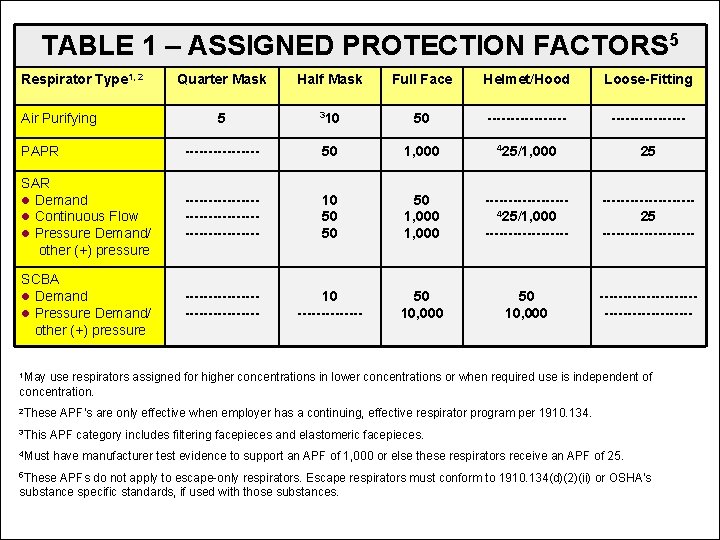
TABLE 1 – ASSIGNED PROTECTION FACTORS 5 Respirator Type 1, 2 Quarter Mask Half Mask Full Face Helmet/Hood Loose-Fitting 5 310 50 --------- PAPR -------- 50 1, 000 425/1, 000 25 SAR l Demand l Continuous Flow l Pressure Demand/ other (+) pressure ----------------------- 10 50 50 50 1, 000 ---------425/1, 000 -------------------25 ---------- SCBA l Demand l Pressure Demand/ other (+) pressure ---------------- 10 ------- 50 10, 000 -------------------- Air Purifying 1 May use respirators assigned for higher concentrations in lower concentrations or when required use is independent of concentration. 2 These 3 This APF’s are only effective when employer has a continuing, effective respirator program per 1910. 134. APF category includes filtering facepieces and elastomeric facepieces. 4 Must have manufacturer test evidence to support an APF of 1, 000 or else these respirators receive an APF of 25. 5 These APFs do not apply to escape-only respirators. Escape respirators must conform to 1910. 134(d)(2)(ii) or OSHA’s substance specific standards, if used with those substances. This presentation was created by the N. C. Department of Labor for safety and health training.
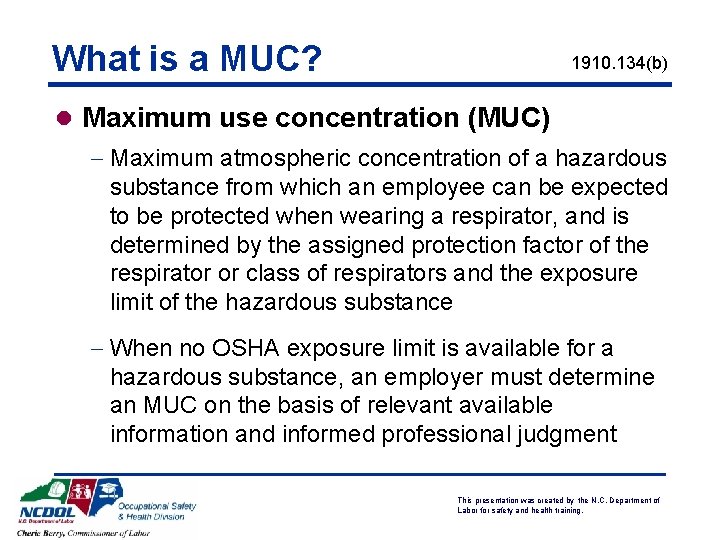
What is a MUC? 1910. 134(b) l Maximum use concentration (MUC) - Maximum atmospheric concentration of a hazardous substance from which an employee can be expected to be protected when wearing a respirator, and is determined by the assigned protection factor of the respirator or class of respirators and the exposure limit of the hazardous substance - When no OSHA exposure limit is available for a hazardous substance, an employer must determine an MUC on the basis of relevant available information and informed professional judgment This presentation was created by the N. C. Department of Labor for safety and health training.
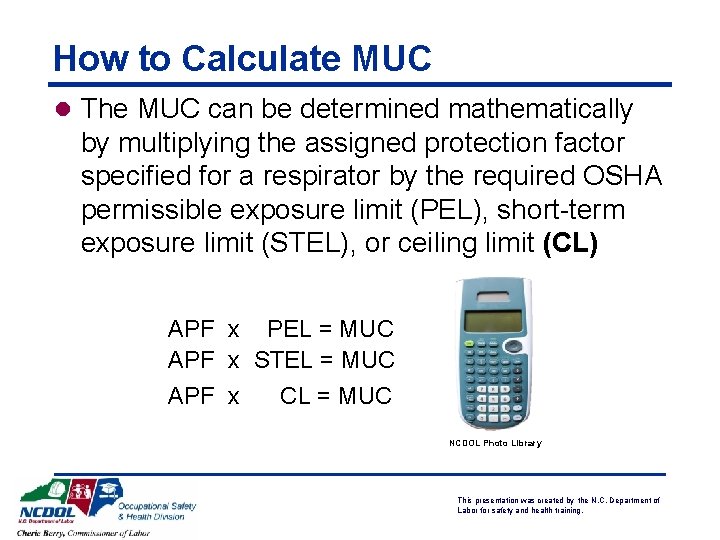
How to Calculate MUC l The MUC can be determined mathematically by multiplying the assigned protection factor specified for a respirator by the required OSHA permissible exposure limit (PEL), short-term exposure limit (STEL), or ceiling limit (CL) ent lopm eve a. D Nov APF x PEL = MUC APF x STEL = MUC APF x CL = MUC NCDOL Photo Library This presentation was created by the N. C. Department of Labor for safety and health training.
Part Number 4 Training and Information This presentation was created by the N. C. Department of Labor for safety and health training.
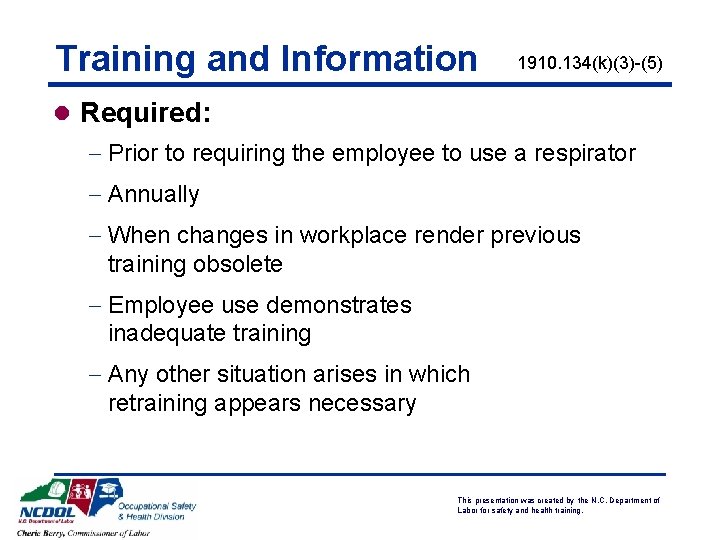
Training and Information 1910. 134(k)(3)-(5) l Required: - Prior to requiring the employee to use a respirator - Annually - When changes in workplace render previous training obsolete - Employee use demonstrates inadequate training - Any other situation arises in which retraining appears necessary This presentation was created by the N. C. Department of Labor for safety and health training.
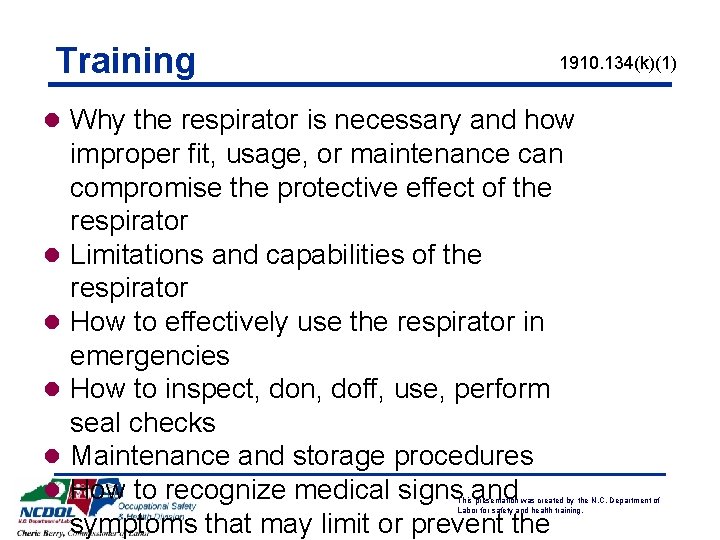
Training 1910. 134(k)(1) l Why the respirator is necessary and how l l l improper fit, usage, or maintenance can compromise the protective effect of the respirator Limitations and capabilities of the respirator How to effectively use the respirator in emergencies How to inspect, don, doff, use, perform seal checks Maintenance and storage procedures How to recognize medical signs and symptoms that may limit or prevent the This presentation was created by the N. C. Department of Labor for safety and health training.
1910. 134(f) Part Number 5 Fit Testing This presentation was created by the N. C. Department of Labor for safety and health training.
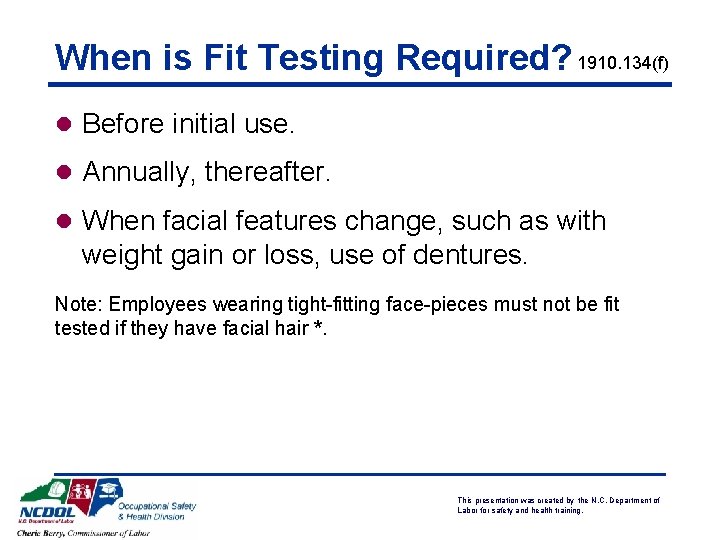
When is Fit Testing Required? 1910. 134(f) l Before initial use. l Annually, thereafter. l When facial features change, such as with weight gain or loss, use of dentures. Note: Employees wearing tight-fitting face-pieces must not be fit tested if they have facial hair *. This presentation was created by the N. C. Department of Labor for safety and health training.
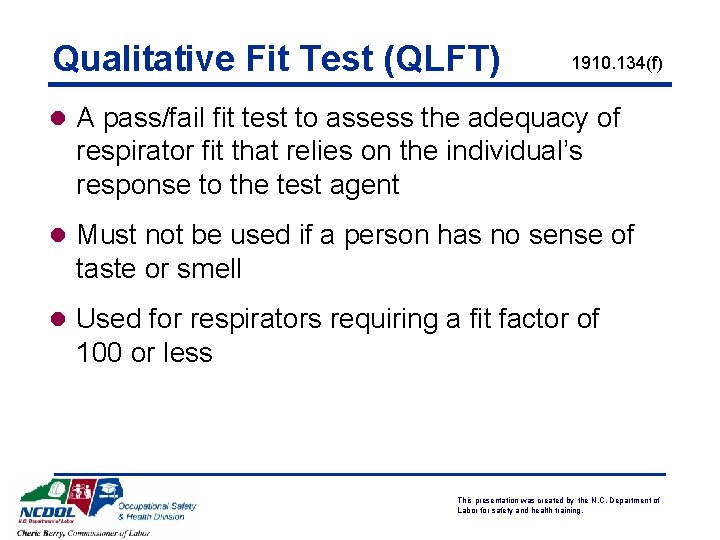
Qualitative Fit Test (QLFT) 1910. 134(f) l A pass/fail fit test to assess the adequacy of respirator fit that relies on the individual’s response to the test agent l Must not be used if a person has no sense of taste or smell l Used for respirators requiring a fit factor of 100 or less This presentation was created by the N. C. Department of Labor for safety and health training.
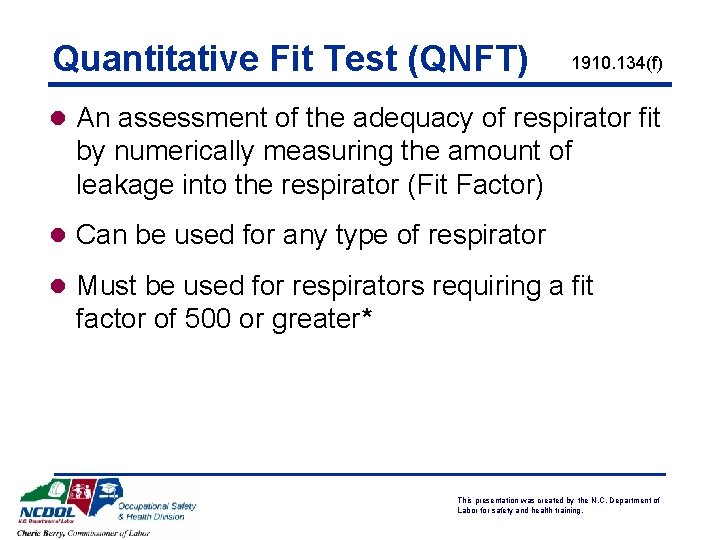
Quantitative Fit Test (QNFT) 1910. 134(f) l An assessment of the adequacy of respirator fit by numerically measuring the amount of leakage into the respirator (Fit Factor) l Can be used for any type of respirator l Must be used for respirators requiring a fit factor of 500 or greater* This presentation was created by the N. C. Department of Labor for safety and health training.
1910. 134(h) Part Number 6 Maintenance and Care This presentation was created by the N. C. Department of Labor for safety and health training.
Cleaning and Disinfecting 1910. 134(h)(1) l Respirators must be clean, sanitary, and in good working order l Respirators must be cleaned and disinfected using the procedures in Appendix B-2 or procedures recommended by the respirator manufacturer This presentation was created by the N. C. Department of Labor for safety and health training.
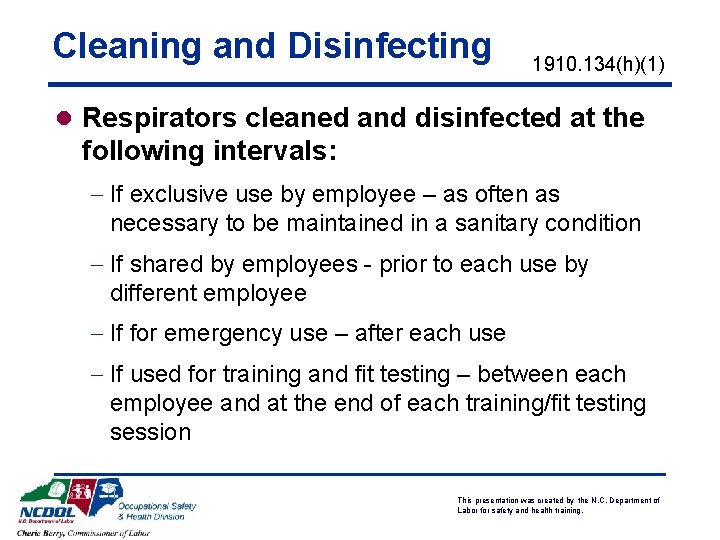
Cleaning and Disinfecting 1910. 134(h)(1) l Respirators cleaned and disinfected at the following intervals: - If exclusive use by employee – as often as necessary to be maintained in a sanitary condition - If shared by employees - prior to each use by different employee - If for emergency use – after each use - If used for training and fit testing – between each employee and at the end of each training/fit testing session This presentation was created by the N. C. Department of Labor for safety and health training.
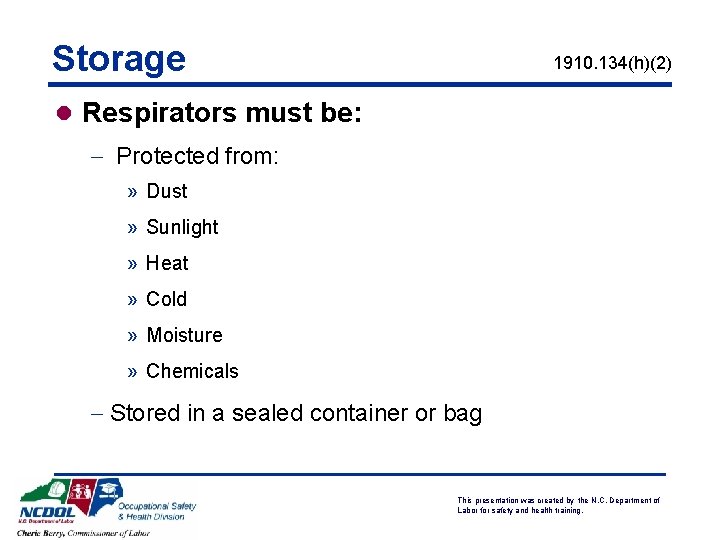
Storage 1910. 134(h)(2) l Respirators must be: - Protected from: » Dust » Sunlight » Heat » Cold » Moisture » Chemicals - Stored in a sealed container or bag This presentation was created by the N. C. Department of Labor for safety and health training.
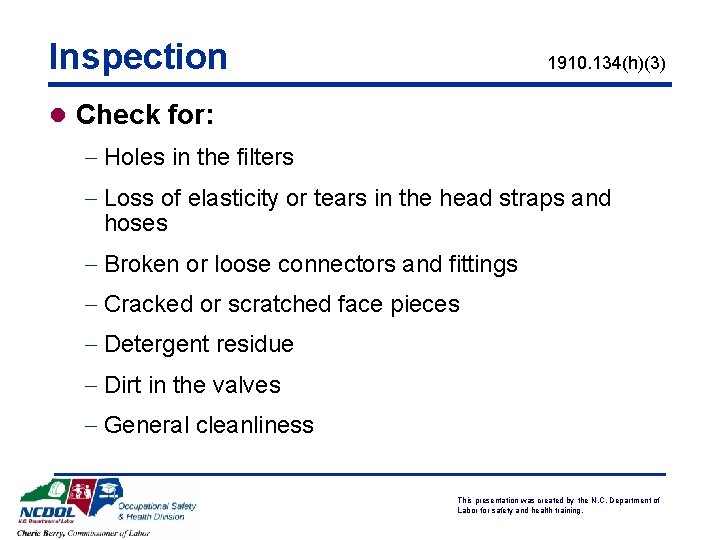
Inspection 1910. 134(h)(3) l Check for: - Holes in the filters - Loss of elasticity or tears in the head straps and hoses - Broken or loose connectors and fittings - Cracked or scratched face pieces - Detergent residue - Dirt in the valves - General cleanliness This presentation was created by the N. C. Department of Labor for safety and health training.
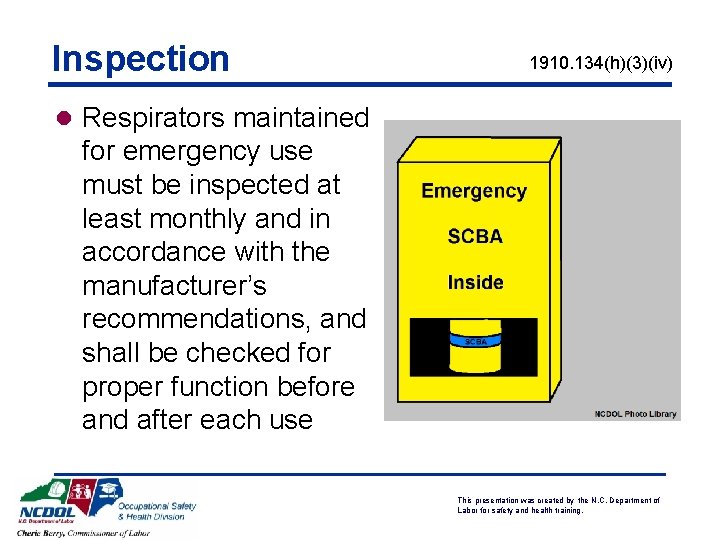
Inspection 1910. 134(h)(3)(iv) l Respirators maintained for emergency use must be inspected at least monthly and in accordance with the manufacturer’s recommendations, and shall be checked for proper function before and after each use This presentation was created by the N. C. Department of Labor for safety and health training.
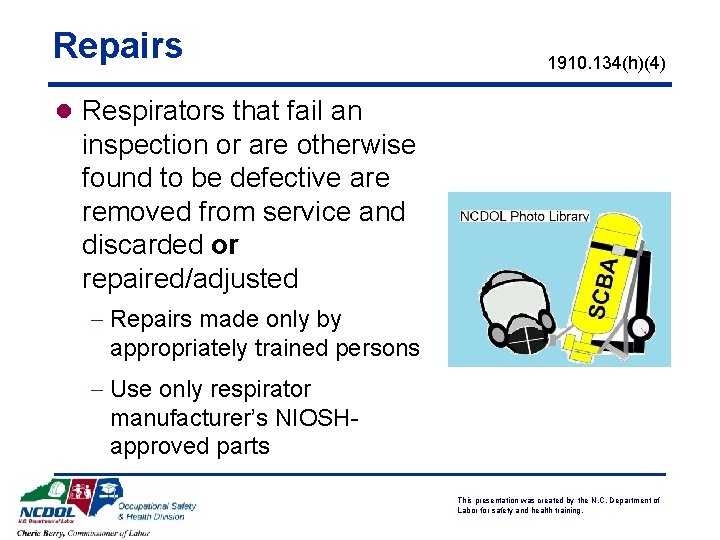
Repairs 1910. 134(h)(4) l Respirators that fail an inspection or are otherwise found to be defective are removed from service and discarded or repaired/adjusted - Repairs made only by appropriately trained persons - Use only respirator manufacturer’s NIOSHapproved parts This presentation was created by the N. C. Department of Labor for safety and health training.
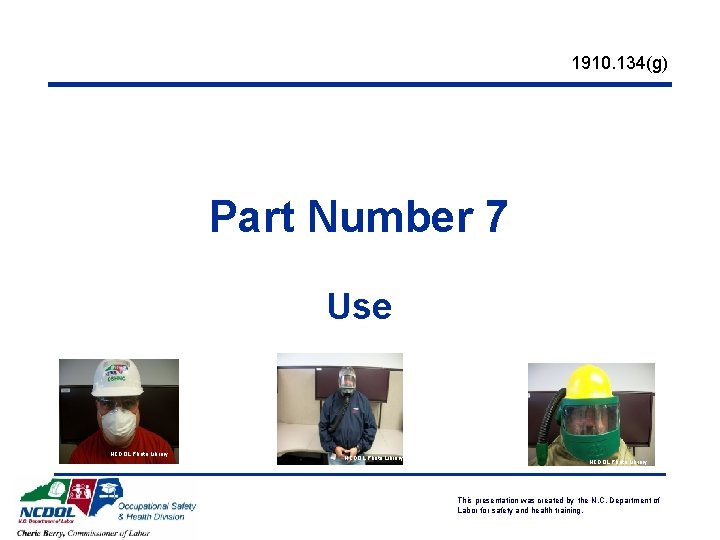
1910. 134(g) Part Number 7 Use NCDOL Photo Library This presentation was created by the N. C. Department of Labor for safety and health training.
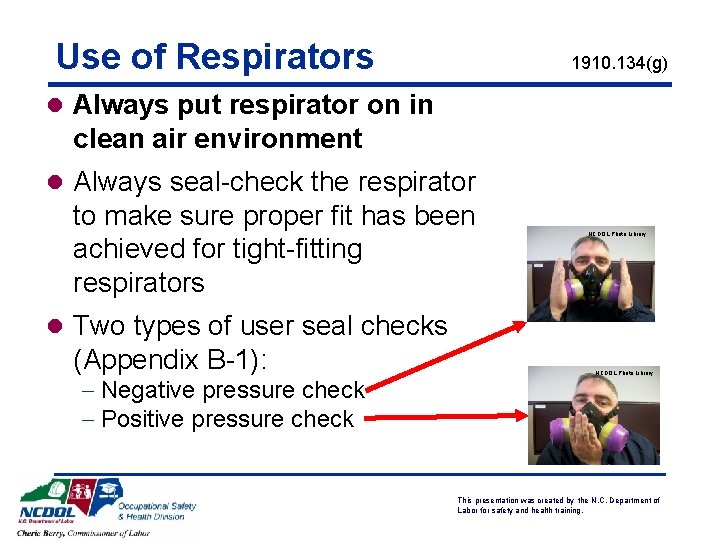
Use of Respirators 1910. 134(g) l Always put respirator on in clean air environment l Always seal-check the respirator to make sure proper fit has been achieved for tight-fitting respirators NCDOL Photo Library l Two types of user seal checks (Appendix B-1): - Negative pressure check - Positive pressure check NCDOL Photo Library This presentation was created by the N. C. Department of Labor for safety and health training.
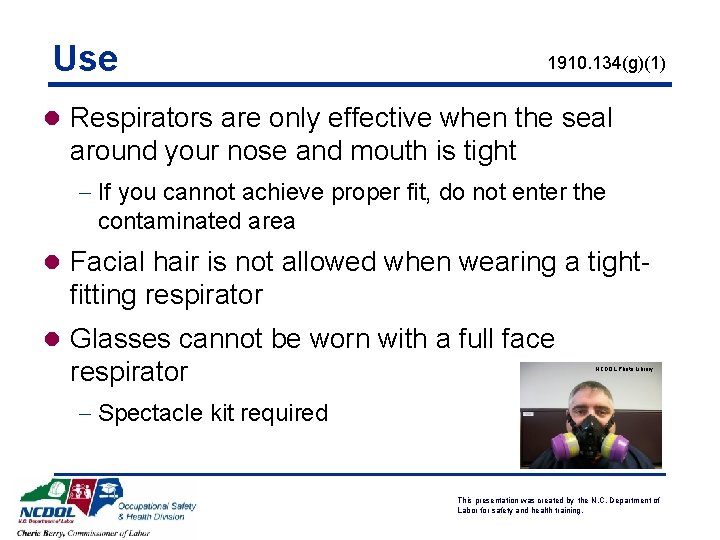
Use 1910. 134(g)(1) l Respirators are only effective when the seal around your nose and mouth is tight - If you cannot achieve proper fit, do not enter the contaminated area l Facial hair is not allowed when wearing a tight- fitting respirator l Glasses cannot be worn with a full face respirator NCDOL Photo Library - Spectacle kit required This presentation was created by the N. C. Department of Labor for safety and health training.
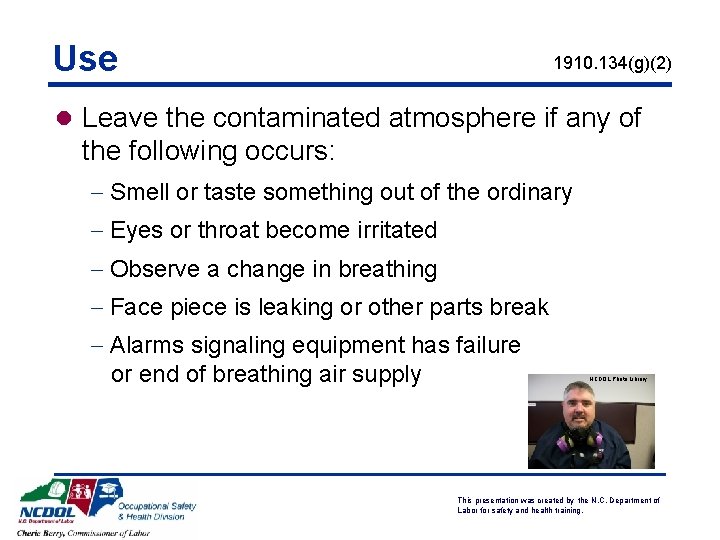
Use 1910. 134(g)(2) l Leave the contaminated atmosphere if any of the following occurs: - Smell or taste something out of the ordinary - Eyes or throat become irritated - Observe a change in breathing - Face piece is leaking or other parts break - Alarms signaling equipment has failure or end of breathing air supply NCDOL Photo Library This presentation was created by the N. C. Department of Labor for safety and health training.
1910. 134(l) Part Number 8 Program Evaluation NCDOL Photo Library This presentation was created by the N. C. Department of Labor for safety and health training.
Program Evaluation 1910. 134(l) l Conduct workplace evaluations l Consult employees concerning: - Respirator fit - Appropriate respirator selection - Proper respirator use - Proper respirator maintenance This presentation was created by the N. C. Department of Labor for safety and health training.
1910. 134(m) Part Number 9 Recordkeeping This presentation was created by the N. C. Department of Labor for safety and health training.
Recordkeeping 1910. 134(m)(1)-(4) l Written program l Medical evaluations l Fit test records NCDOL Photo Library l Emergency use respirator inspection This presentation was created by the N. C. Department of Labor for safety and health training.
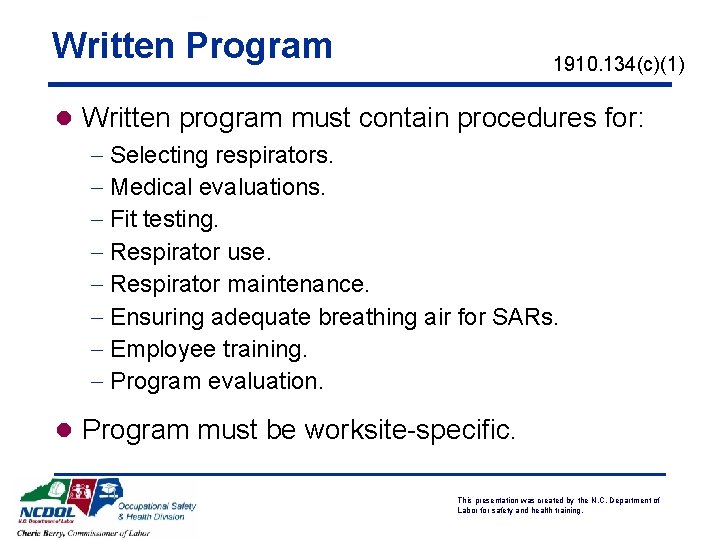
Written Program 1910. 134(c)(1) l Written program must contain procedures for: - Selecting respirators. - Medical evaluations. - Fit testing. - Respirator use. - Respirator maintenance. - Ensuring adequate breathing air for SARs. - Employee training. - Program evaluation. l Program must be worksite-specific. This presentation was created by the N. C. Department of Labor for safety and health training.
1910. 134(c) Part Number 10 Voluntary Use This presentation was created by the N. C. Department of Labor for safety and health training.
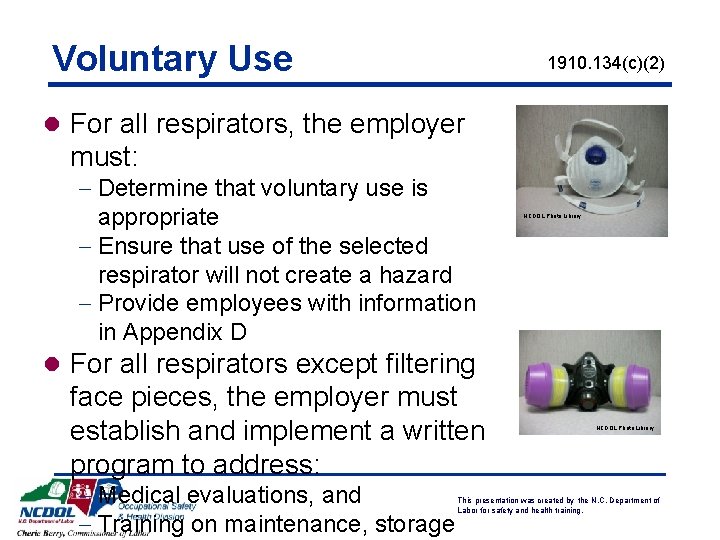
Voluntary Use 1910. 134(c)(2) l For all respirators, the employer must: - Determine that voluntary use is appropriate - Ensure that use of the selected respirator will not create a hazard - Provide employees with information in Appendix D NCDOL Photo Library l For all respirators except filtering face pieces, the employer must establish and implement a written program to address: - Medical evaluations, and - Training on maintenance, storage NCDOL Photo Library This presentation was created by the N. C. Department of Labor for safety and health training.
Appendices 1910. 134 l Appendix A to § 1910. 134: Fit Testing Procedures (Mandatory) l Appendix B-1 to § 1910. 134: User Seal Check Procedures (Mandatory) l Appendix B-2 to § 1910. 134: Respirator Cleaning Procedures (Mandatory) l Appendix C to Sec. 1910. 134: OSHA Respirator Medical Evaluation Questionnaire (Mandatory) Appendix D to Sec. 1910. 134: Information for Employees Using Respirators When Not Required Under the Standard (Mandatory) This presentation was created by the N. C. Department of Labor for safety and health training.
Summary 1910. 134 l Written respiratory protection program l Selection and types of respirators l Medical evaluations and fit testing l Use, maintenance and care of respirators l Training employees l Program evaluation l Recordkeeping This presentation was created by the N. C. Department of Labor for safety and health training.
Thank You For Attending! Final Questions? This presentation was created by the N. C. Department of Labor for safety and health training.