
Introduction to probability Stat 134 FAll 2005 Berkeley
Introduction to probability Stat 134 FAll 2005 Berkeley Lectures prepared by: Elchanan Mossel Yelena Shvets Follows Jim Pitman’s book: Probability Sections 6. 1 -6. 2
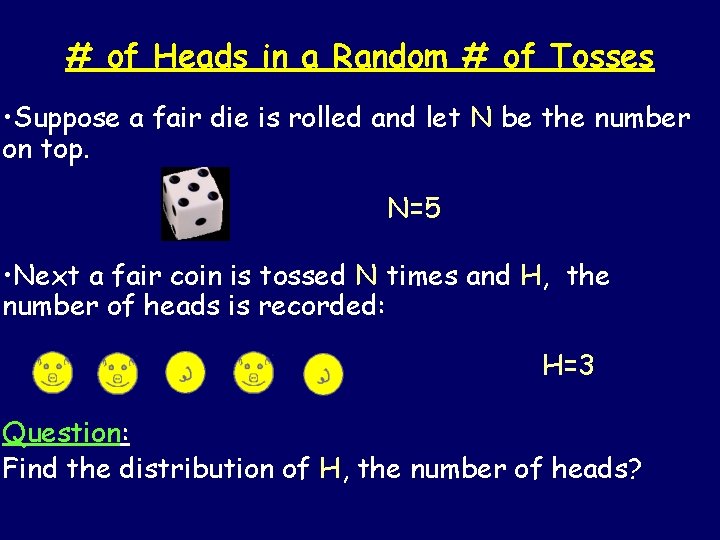
# of Heads in a Random # of Tosses • Suppose a fair die is rolled and let N be the number on top. N=5 • Next a fair coin is tossed N times and H, the number of heads is recorded: H=3 Question: Find the distribution of H, the number of heads?
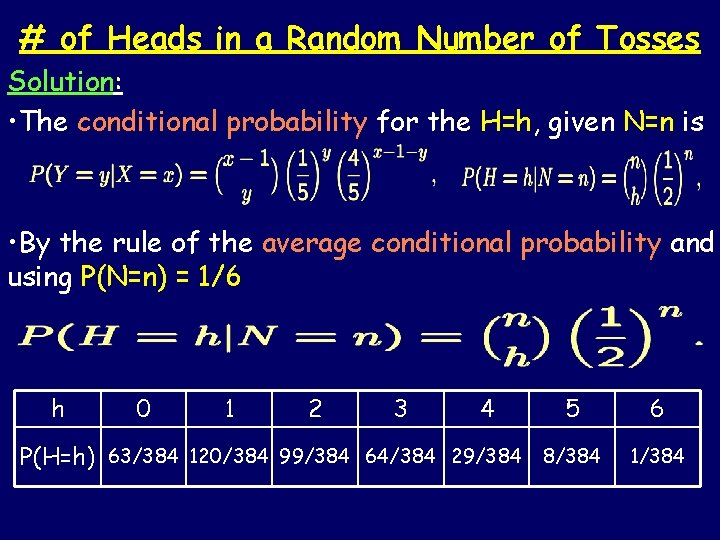
# of Heads in a Random Number of Tosses Solution: • The conditional probability for the H=h, given N=n is • By the rule of the average conditional probability and using P(N=n) = 1/6 h 0 1 2 3 4 5 P(H=h) 63/384 120/384 99/384 64/384 29/384 8/384 6 1/384
Conditional Distribution of Y given X =x Def: For each value x of X, the set of probabilities P(Y=y|X=x) where y varies over all possible values of Y, form a probability distribution, depending on x, called the conditional distribution of Y given X=x. Remarks: • In the example P(H = h | N =n) ~ binomial(n, ½). • The unconditional distribution of Y is the average of the conditional distributions, weighted by P(X=x).
Conditional Distribution of X given Y=y Remark: Once we have the conditional distribution of Y given X=x, using Bayes’ rule we may obtain the conditional distribution of X given Y=y. • Example: We have computed distribution of H given N = n: • Using the product rule we can get the joint distr. of H and N: • Finally:
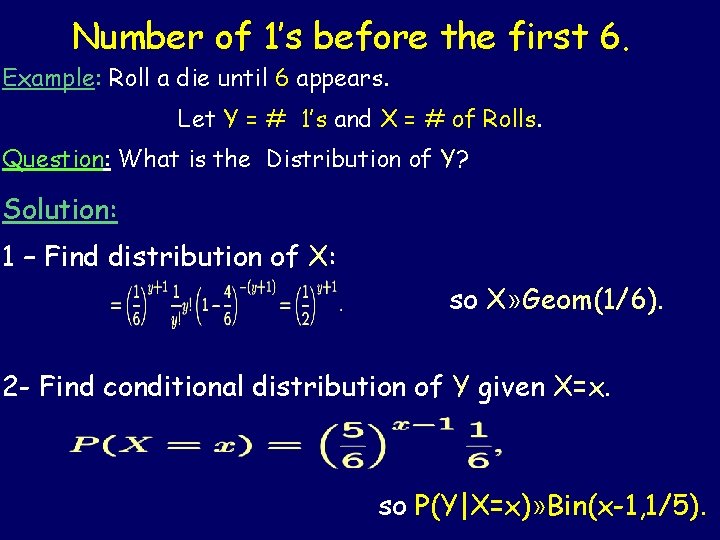
Number of 1’s before the first 6. Example: Roll a die until 6 appears. Let Y = # 1’s and X = # of Rolls. Question: What is the Distribution of Y? Solution: 1 – Find distribution of X: so X» Geom(1/6). 2 - Find conditional distribution of Y given X=x. so P(Y|X=x)» Bin(x-1, 1/5).
Number of 1’s before the first 6. 3 - Use the rule of average conditional probabilities to compute the unconditional distribution of Y. So Y = G-1, where G = Geom(1/2)
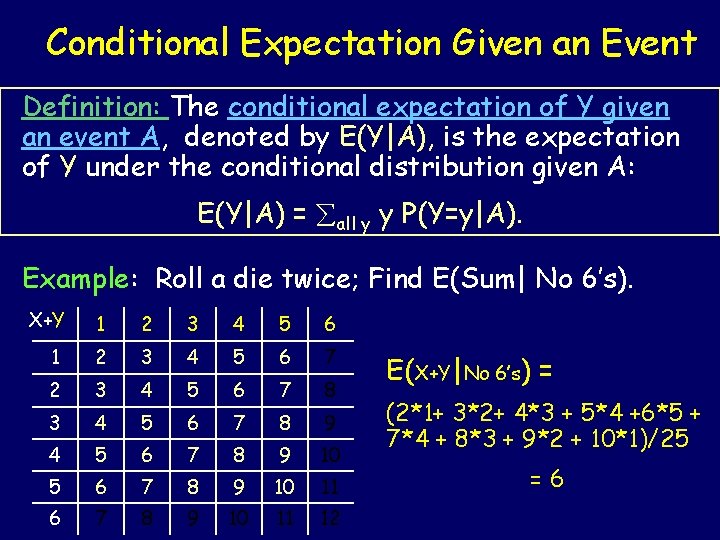
Conditional Expectation Given an Event Definition: The conditional expectation of Y given an event A, denoted by E(Y|A), is the expectation of Y under the conditional distribution given A: E(Y|A) = all y y P(Y=y|A). Example: Roll a die twice; Find E(Sum| No 6’s). X+Y (X, Y) 1 2 3 4 5 6 1 1, 1 2 1, 2 3 1, 3 4 1, 4 5 1, 5 6 1, 6 7 2 2, 1 3 2, 2 4 2, 3 5 2, 4 6 2, 5 7 2, 6 8 3 3, 1 4 3, 2 5 3, 3 6 3, 4 7 3, 5 8 3, 6 9 4 4, 1 5 4, 2 6 4, 3 7 4, 4 8 4, 5 9 4, 6 10 5 5, 1 6 5, 2 7 5, 3 8 5, 4 9 5, 5 10 5, 6 11 6 6, 1 7 6, 2 8 6, 3 9 6, 4 10 6, 5 11 6, 6 12 E(X+Y|No 6’s) = (2*1+ 3*2+ 4*3 + 5*4 +6*5 + 7*4 + 8*3 + 9*2 + 10*1)/25 =6
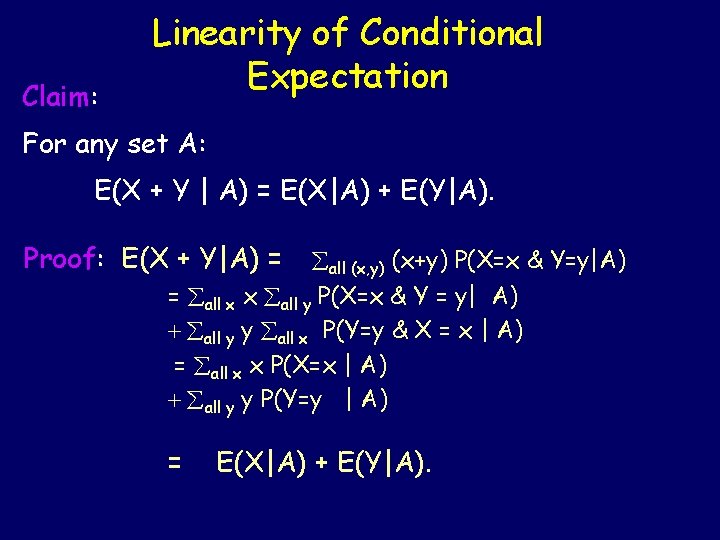
Claim: Linearity of Conditional Expectation For any set A: E(X + Y | A) = E(X|A) + E(Y|A). Proof: E(X + Y|A) = all (x, y) (x+y) P(X=x & Y=y|A) = all x x all y P(X=x & Y = y| A) + all y y all x P(Y=y & X = x | A) = all x x P(X=x | A) + all y y P(Y=y | A) = E(X|A) + E(Y|A).
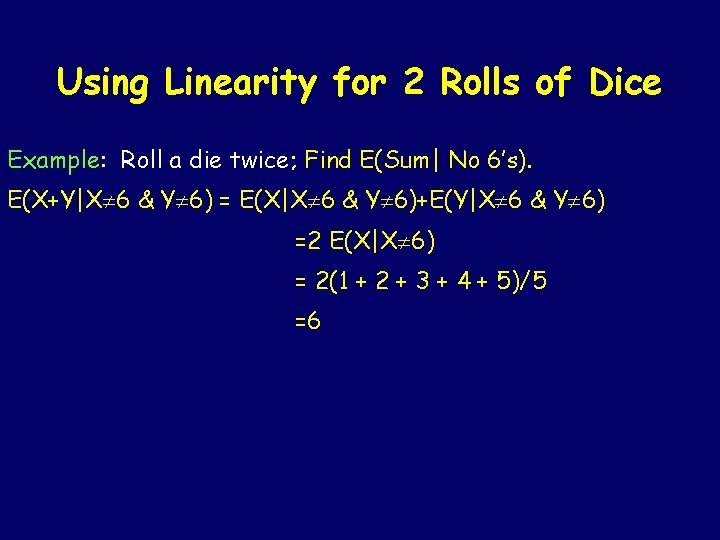
Using Linearity for 2 Rolls of Dice Example: Roll a die twice; Find E(Sum| No 6’s). E(X+Y|X¹ 6 & Y¹ 6) = E(X|X¹ 6 & Y¹ 6)+E(Y|X¹ 6 & Y¹ 6) =2 E(X|X¹ 6) = 2(1 + 2 + 3 + 4 + 5)/5 =6
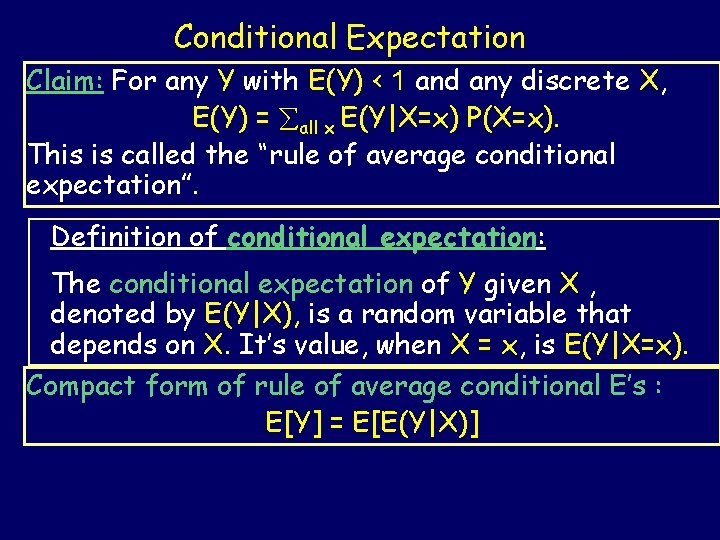
Conditional Expectation Claim: For any Y with E(Y) < 1 and any discrete X, E(Y) = all x E(Y|X=x) P(X=x). This is called the “rule of average conditional expectation”. Definition of conditional expectation: The conditional expectation of Y given X , denoted by E(Y|X), is a random variable that depends on X. It’s value, when X = x, is E(Y|X=x). Compact form of rule of average conditional E’s : E[Y] = E[E(Y|X)]
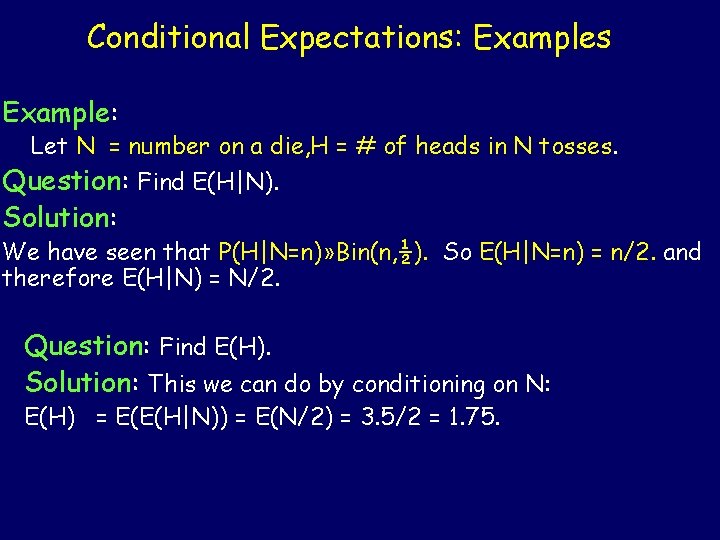
Conditional Expectations: Examples Example: Let N = number on a die, H = # of heads in N tosses. Question: Find E(H|N). Solution: We have seen that P(H|N=n)» Bin(n, ½). So E(H|N=n) = n/2. and therefore E(H|N) = N/2. Question: Find E(H). Solution: This we can do by conditioning on N: E(H) = E(E(H|N)) = E(N/2) = 3. 5/2 = 1. 75.
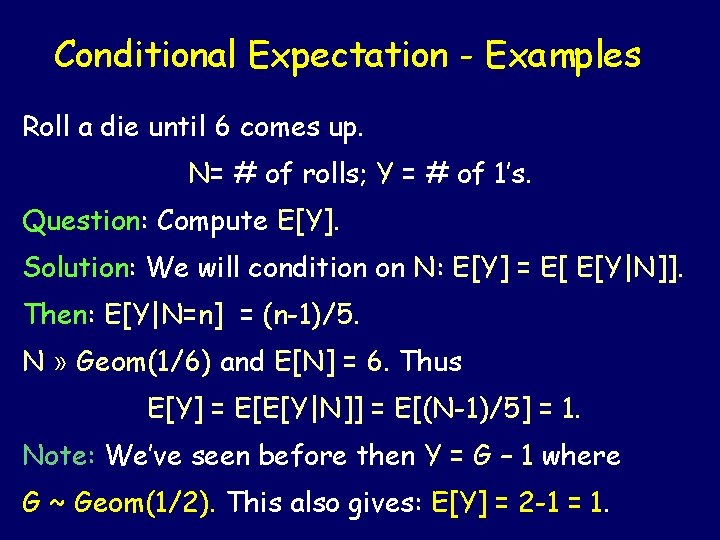
Conditional Expectation - Examples Roll a die until 6 comes up. N= # of rolls; Y = # of 1’s. Question: Compute E[Y]. Solution: We will condition on N: E[Y] = E[ E[Y|N]]. Then: E[Y|N=n] = (n-1)/5. N » Geom(1/6) and E[N] = 6. Thus E[Y] = E[E[Y|N]] = E[(N-1)/5] = 1. Note: We’ve seen before then Y = G – 1 where G ~ Geom(1/2). This also gives: E[Y] = 2 -1 = 1.
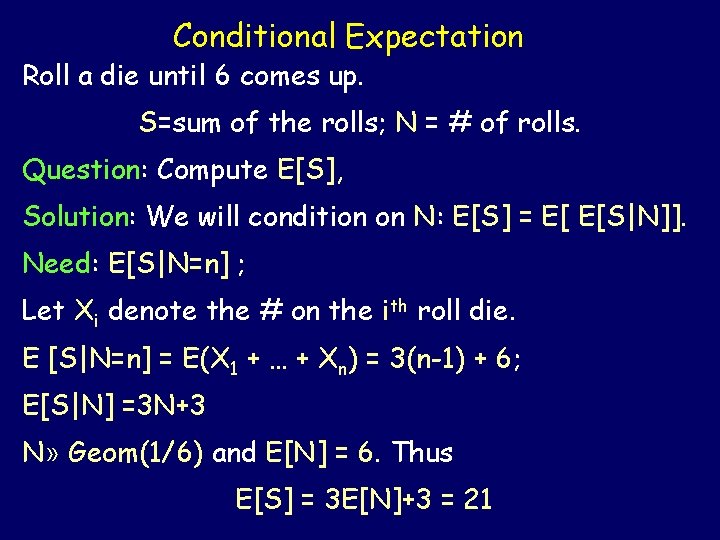
Conditional Expectation Roll a die until 6 comes up. S=sum of the rolls; N = # of rolls. Question: Compute E[S], Solution: We will condition on N: E[S] = E[ E[S|N]]. Need: E[S|N=n] ; Let Xi denote the # on the ith roll die. E [S|N=n] = E(X 1 + … + Xn) = 3(n-1) + 6; E[S|N] =3 N+3 N» Geom(1/6) and E[N] = 6. Thus E[S] = 3 E[N]+3 = 21
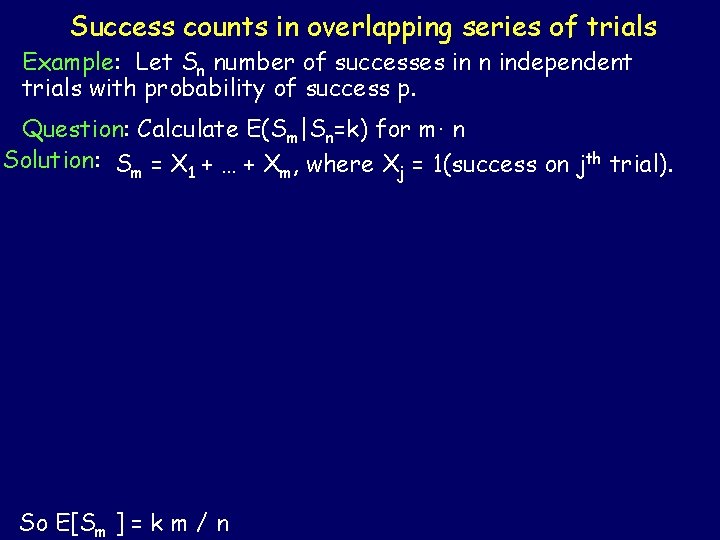
Success counts in overlapping series of trials Example: Let Sn number of successes in n independent trials with probability of success p. Question: Calculate E(Sm|Sn=k) for m· n Solution: Sm = X 1 + … + Xm, where Xj = 1(success on jth trial). So E[Sm ] = k m / n
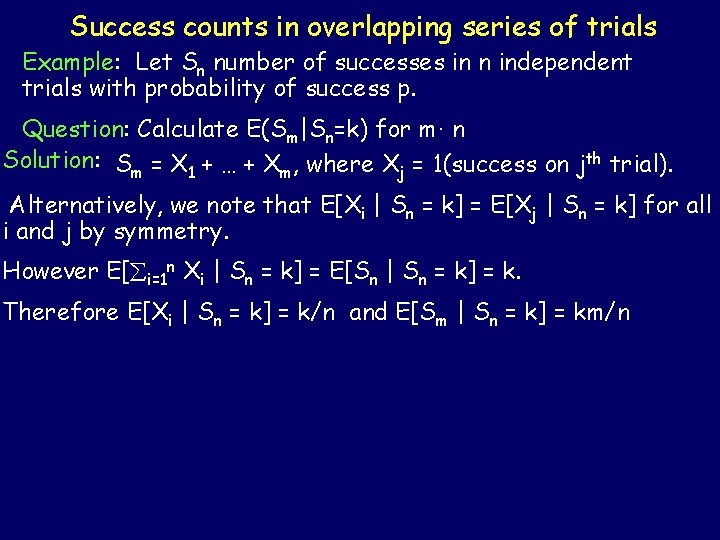
Success counts in overlapping series of trials Example: Let Sn number of successes in n independent trials with probability of success p. Question: Calculate E(Sm|Sn=k) for m· n Solution: Sm = X 1 + … + Xm, where Xj = 1(success on jth trial). Alternatively, we note that E[Xi | Sn = k] = E[Xj | Sn = k] for all i and j by symmetry. However E[ i=1 n Xi | Sn = k] = E[Sn | Sn = k] = k. Therefore E[Xi | Sn = k] = k/n and E[Sm | Sn = k] = km/n
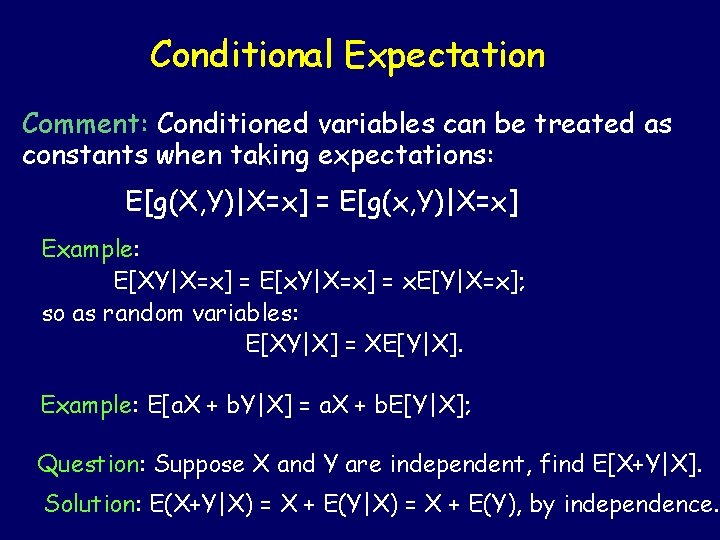
Conditional Expectation Comment: Conditioned variables can be treated as constants when taking expectations: E[g(X, Y)|X=x] = E[g(x, Y)|X=x] Example: E[XY|X=x] = E[x. Y|X=x] = x. E[Y|X=x]; so as random variables: E[XY|X] = XE[Y|X]. Example: E[a. X + b. Y|X] = a. X + b. E[Y|X]; Question: Suppose X and Y are independent, find E[X+Y|X]. Solution: E(X+Y|X) = X + E(Y), by independence.
- Slides: 17