REDD Linking to NDC and SDGs Thaung Naing

- Slides: 31
REDD+ Linking to NDC and SDGs Thaung Naing Oo Ph. D. Director of Forest Research Institute – Forest Department Email: tnoo 71@gmail. com 6 -12 -2019 COP 25, Madrid, Spain
SCOPE OF PRESENTATION § Country Profile § Forest Resources in Myanmar § Policy, Laws, Rules and Regulations of Forestry and Environment Sector § Overview of REDD+ in Myanmar § Key Lessons
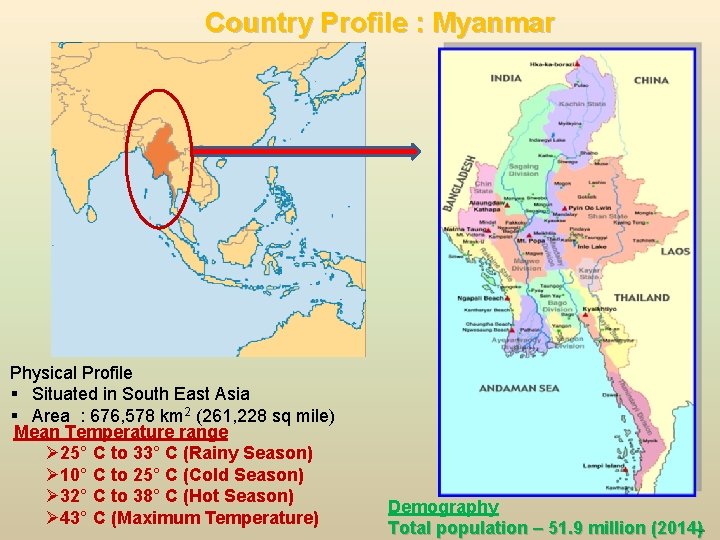
Country Profile : Myanmar Physical Profile § Situated in South East Asia § Area : 676, 578 km 2 (261, 228 sq mile) Mean Temperature range Ø 25° C to 33° C (Rainy Season) Ø 10° C to 25° C (Cold Season) Ø 32° C to 38° C (Hot Season) Ø 43° C (Maximum Temperature) Demography Total population – 51. 9 million (2014)
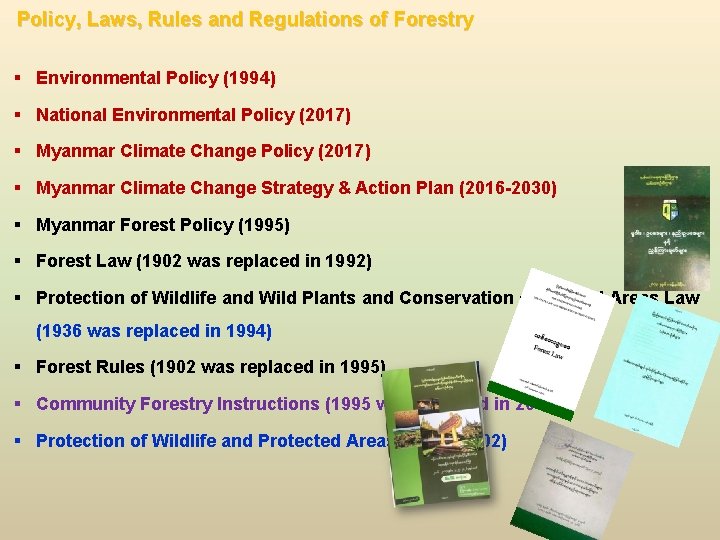
Policy, Laws, Rules and Regulations of Forestry § Environmental Policy (1994) § National Environmental Policy (2017) § Myanmar Climate Change Strategy & Action Plan (2016 -2030) § Myanmar Forest Policy (1995) § Forest Law (1902 was replaced in 1992) § Protection of Wildlife and Wild Plants and Conservation of Natural Areas Law (1936 was replaced in 1994) § Forest Rules (1902 was replaced in 1995) § Community Forestry Instructions (1995 was replaced in 2016) § Protection of Wildlife and Protected Areas Rules (2002)
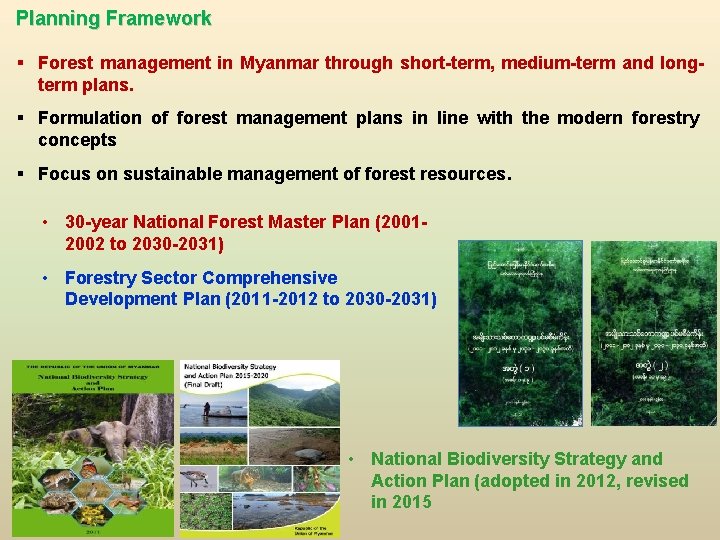
Planning Framework § Forest management in Myanmar through short-term, medium-term and longterm plans. § Formulation of forest management plans in line with the modern forestry concepts § Focus on sustainable management of forest resources. • 30 -year National Forest Master Plan (20012002 to 2030 -2031) • Forestry Sector Comprehensive Development Plan (2011 -2012 to 2030 -2031) • National Biodiversity Strategy and Action Plan (adopted in 2012, revised in 2015
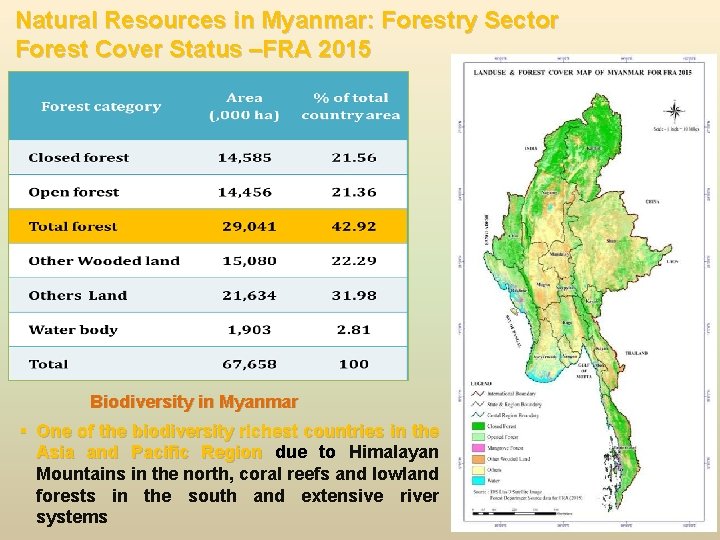
Natural Resources in Myanmar: Forestry Sector Forest Cover Status –FRA 2015 Biodiversity in Myanmar § One of the biodiversity richest countries in the Asia and Pacific Region due to Himalayan Mountains in the north, coral reefs and lowland forests in the south and extensive river systems
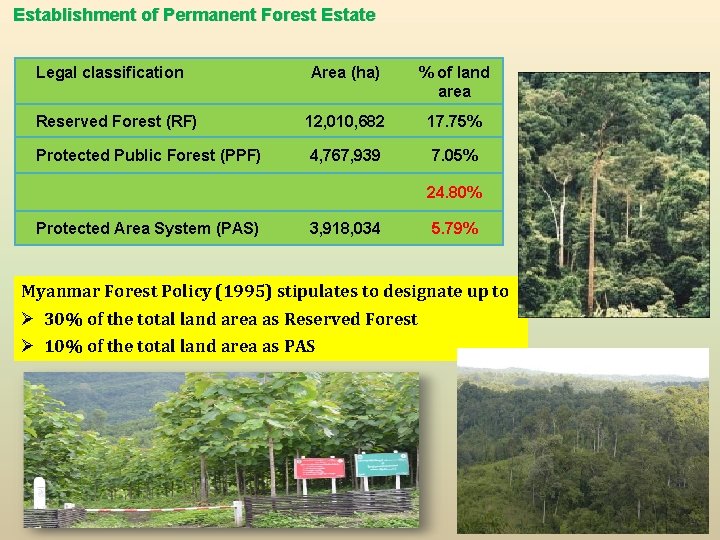
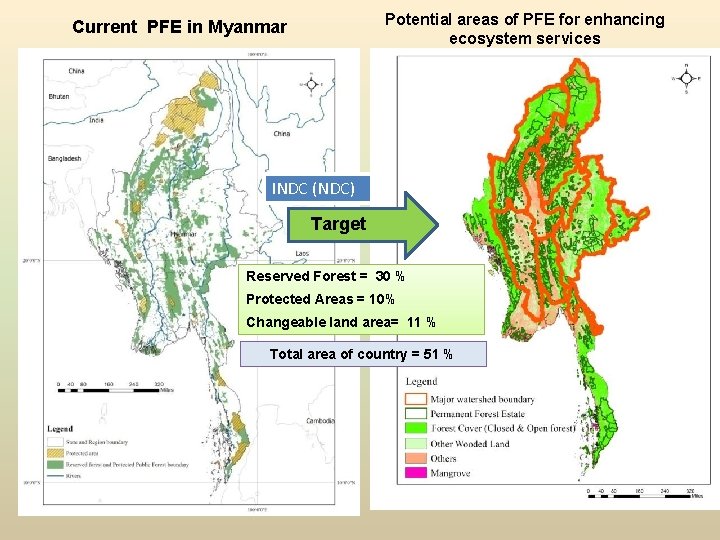
Establishment of Permanent Forest Estate Legal classification Area (ha) % of land area Reserved Forest (RF) 12, 010, 682 17. 75% Protected Public Forest (PPF) 4, 767, 939 7. 05% 24. 80% Protected Area System (PAS) 3, 918, 034 5. 79% Myanmar Forest Policy (1995) stipulates to designate up to Ø 30% of the total land area as Reserved Forest Ø 10% of the total land area as PAS
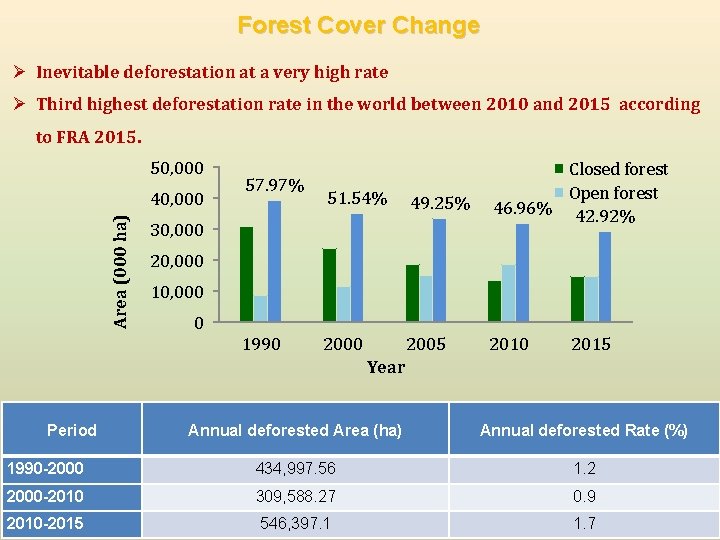
Forest Cover Change Ø Inevitable deforestation at a very high rate Ø Third highest deforestation rate in the world between 2010 and 2015 according to FRA 2015. 50, 000 Area (000 ha) 40, 000 57. 97% 51. 54% 49. 25% 2000 2005 30, 000 Closed forest Open forest 46. 96% 42. 92% 20, 000 10, 000 0 1990 2015 Year Period Annual deforested Area (ha) Annual deforested Rate (%) 1990 -2000 434, 997. 56 1. 2 2000 -2010 309, 588. 27 0. 9 2010 -2015 546, 397. 1 1. 7
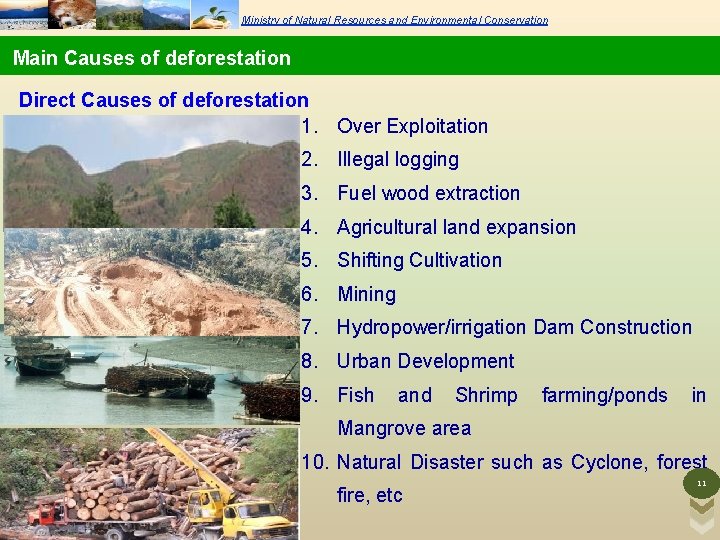
Ministry of Natural Resources and Environmental Conservation Main Causes of deforestation Direct Causes of deforestation 1. Over Exploitation 2. Illegal logging 3. Fuel wood extraction 4. Agricultural land expansion 5. Shifting Cultivation 6. Mining 7. Hydropower/irrigation Dam Construction 8. Urban Development 9. Fish and Shrimp farming/ponds in Mangrove area 10. Natural Disaster such as Cyclone, forest fire, etc 11
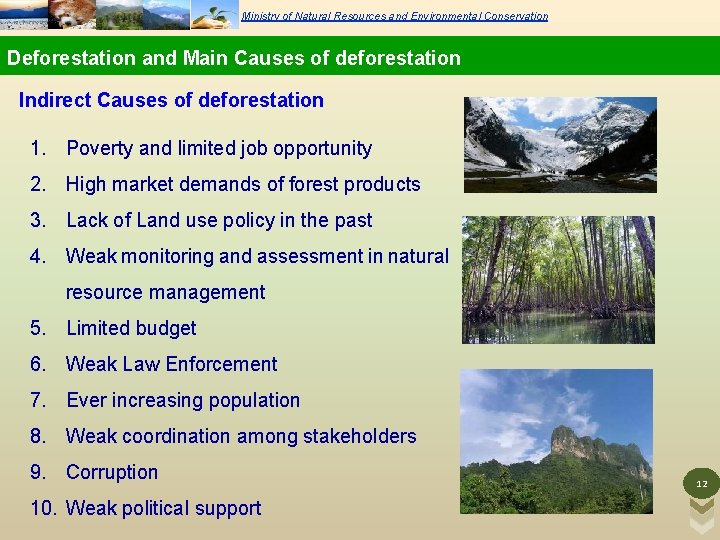
Ministry of Natural Resources and Environmental Conservation Deforestation and Main Causes of deforestation Indirect Causes of deforestation 1. Poverty and limited job opportunity 2. High market demands of forest products 3. Lack of Land use policy in the past 4. Weak monitoring and assessment in natural resource management 5. Limited budget 6. Weak Law Enforcement 7. Ever increasing population 8. Weak coordination among stakeholders 9. Corruption 10. Weak political support 12
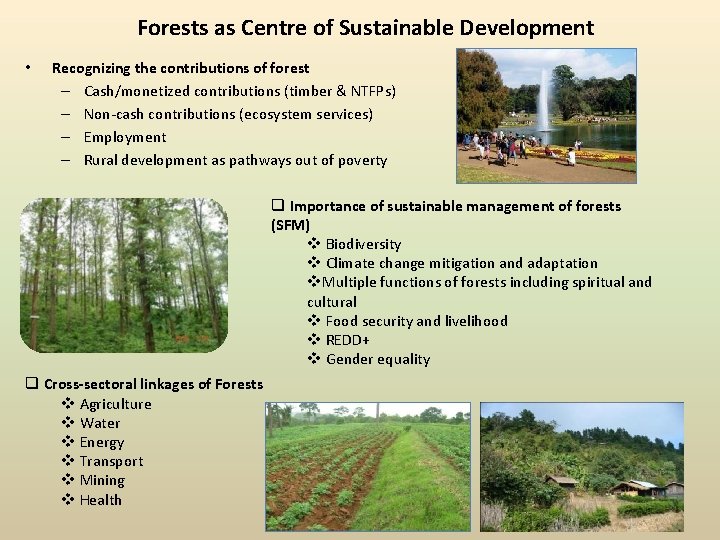
Forests as Centre of Sustainable Development • Recognizing the contributions of forest – Cash/monetized contributions (timber & NTFPs) – Non-cash contributions (ecosystem services) – Employment – Rural development as pathways out of poverty q Importance of sustainable management of forests (SFM) v Biodiversity v Climate change mitigation and adaptation v. Multiple functions of forests including spiritual and cultural v Food security and livelihood v REDD+ v Gender equality q Cross-sectoral linkages of Forests v Agriculture v Water v Energy v Transport v Mining v Health
Overview of REDD+ in Myanmar Mount Khakaborazi in northern Kachin 12
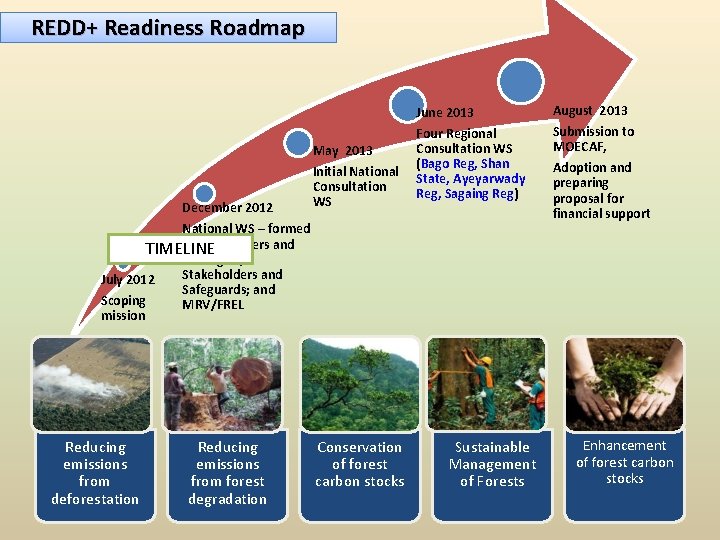
REDD+ Readiness Roadmap May 2013 December 2012 Initial National Consultation WS June 2013 August 2013 Four Regional Consultation WS (Bago Reg, Shan State, Ayeyarwady Reg, Sagaing Reg) Submission to MOECAF, National WS – formed 3 TWG: Drivers and TIMELINE Strategies; Stakeholders and July 2012 Safeguards; and Scoping MRV/FREL mission Reducing emissions from deforestation Reducing emissions from forest degradation Conservation of forest carbon stocks Sustainable Management of Forests Adoption and preparing proposal for financial support Enhancement of forest carbon stocks 13
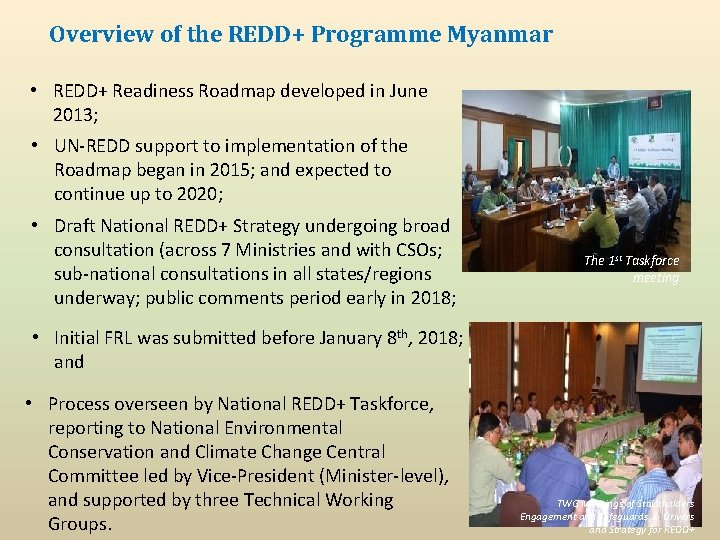
Overview of the REDD+ Programme Myanmar • REDD+ Readiness Roadmap developed in June 2013; • UN-REDD support to implementation of the Roadmap began in 2015; and expected to continue up to 2020; • Draft National REDD+ Strategy undergoing broad consultation (across 7 Ministries and with CSOs; sub-national consultations in all states/regions underway; public comments period early in 2018; The 1 st Taskforce meeting • Initial FRL was submitted before January 8 th, 2018; and • Process overseen by National REDD+ Taskforce, reporting to National Environmental Conservation and Climate Change Central Committee led by Vice-President (Minister-level), and supported by three Technical Working Groups. TWG Meetings of Stakeholders Engagement and Safeguards, & Drivers and Strategy for REDD+
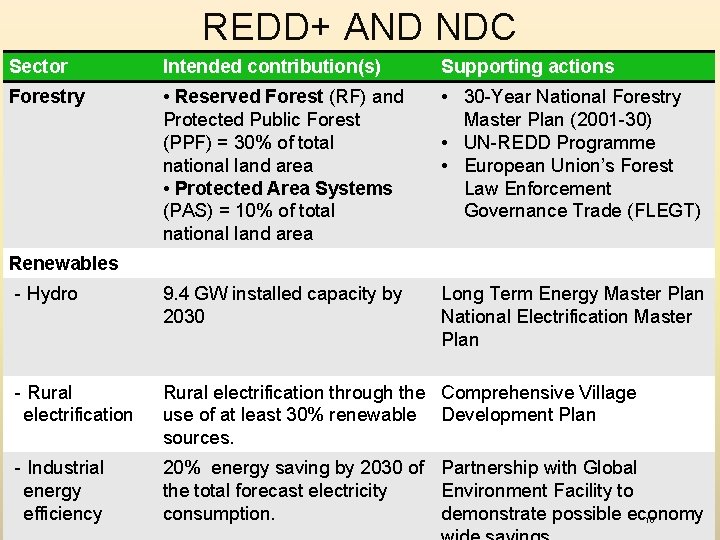
REDD+ AND NDC Sector Intended contribution(s) Supporting actions Forestry • Reserved Forest (RF) and Protected Public Forest (PPF) = 30% of total national land area • Protected Area Systems (PAS) = 10% of total national land area • 30 -Year National Forestry Master Plan (2001 -30) • UN-REDD Programme • European Union’s Forest Law Enforcement Governance Trade (FLEGT) - Hydro 9. 4 GW installed capacity by 2030 Long Term Energy Master Plan National Electrification Master Plan - Rural electrification through the Comprehensive Village use of at least 30% renewable Development Plan sources. - Industrial energy efficiency 20% energy saving by 2030 of Partnership with Global the total forecast electricity Environment Facility to consumption. demonstrate possible economy 15 Renewables
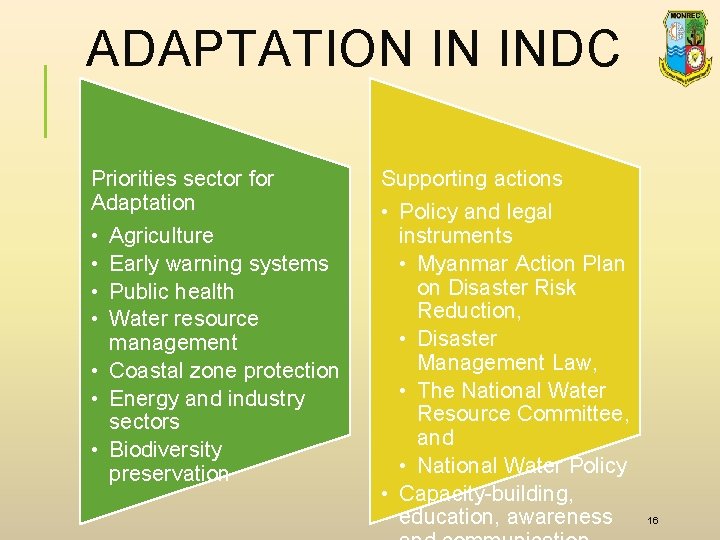
ADAPTATION IN INDC Priorities sector for Adaptation • Agriculture • Early warning systems • Public health • Water resource management • Coastal zone protection • Energy and industry sectors • Biodiversity preservation Supporting actions • Policy and legal instruments • Myanmar Action Plan on Disaster Risk Reduction, • Disaster Management Law, • The National Water Resource Committee, and • National Water Policy • Capacity-building, education, awareness 16
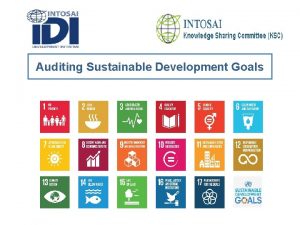
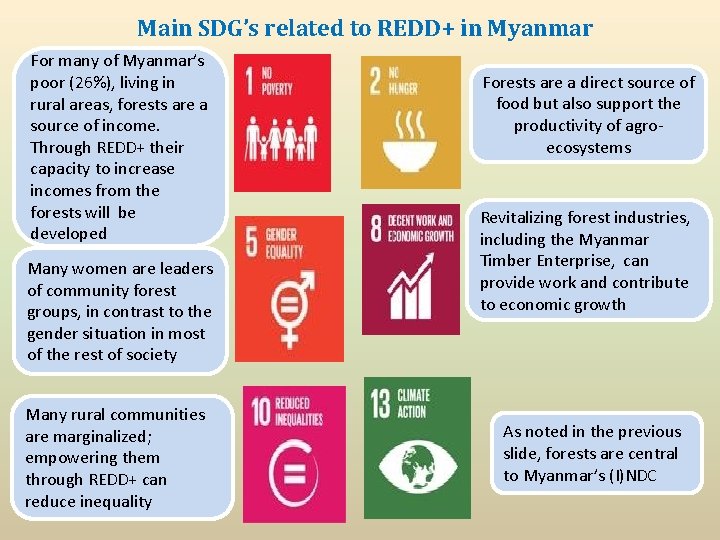
Main SDG’s related to REDD+ in Myanmar For many of Myanmar’s poor (26%), living in rural areas, forests are a source of income. Through REDD+ their capacity to increase incomes from the forests will be developed Many women are leaders of community forest groups, in contrast to the gender situation in most of the rest of society Many rural communities are marginalized; empowering them through REDD+ can reduce inequality Forests are a direct source of food but also support the productivity of agroecosystems Revitalizing forest industries, including the Myanmar Timber Enterprise, can provide work and contribute to economic growth As noted in the previous slide, forests are central to Myanmar’s (I)NDC
Main SDG’s related to REDD+ in Myanmar Protect, restore and sustainable use of terrestrial ecosystems, sustainably managed forests, combat desertification, and halt and reverse land degradation and halt biodiversity loss The underlying causes of threats to forests are often the same as those leading to conflict, including weak institutions. This is central to Myanmar’s efforts to resolve internal conflicts
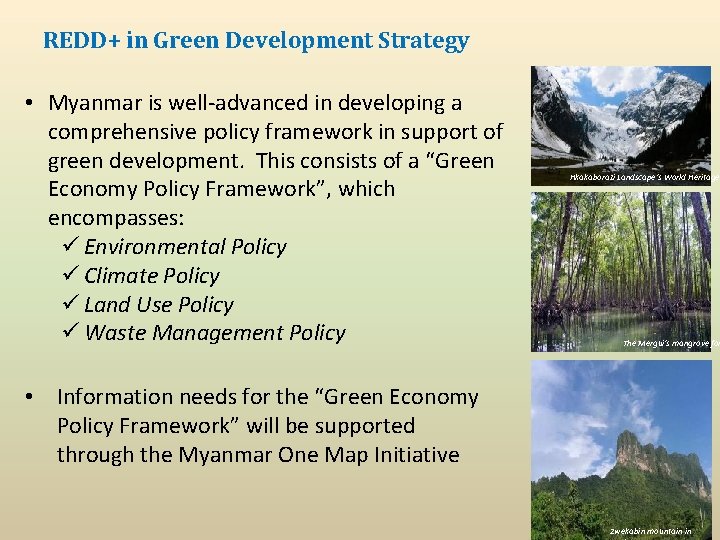
REDD+ in Green Development Strategy • Myanmar is well-advanced in developing a comprehensive policy framework in support of green development. This consists of a “Green Economy Policy Framework”, which encompasses: ü Environmental Policy ü Climate Policy ü Land Use Policy ü Waste Management Policy Hkakaborazi Landscape’s World Heritage The Mergui's mangrove for • Information needs for the “Green Economy Policy Framework” will be supported through the Myanmar One Map Initiative Zwekabin mountain in
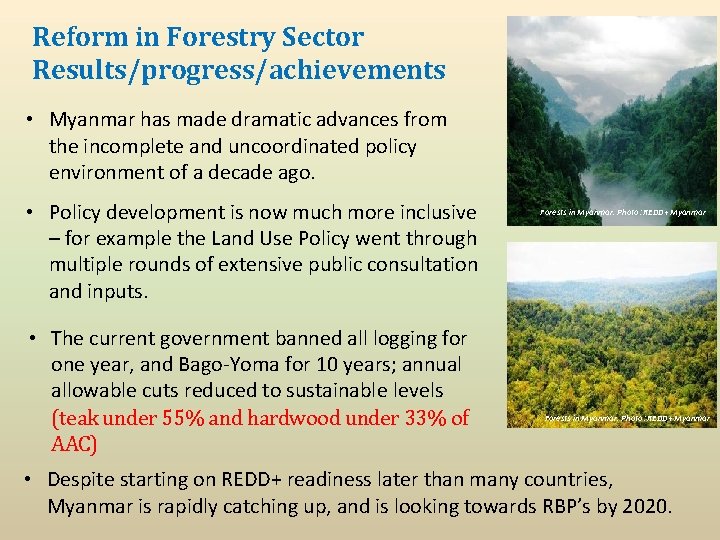
Reform in Forestry Sector Results/progress/achievements • Myanmar has made dramatic advances from the incomplete and uncoordinated policy environment of a decade ago. • Policy development is now much more inclusive – for example the Land Use Policy went through multiple rounds of extensive public consultation and inputs. • The current government banned all logging for one year, and Bago-Yoma for 10 years; annual allowable cuts reduced to sustainable levels (teak under 55% and hardwood under 33% of AAC) Forests in Myanmar. Photo: REDD+ Myanmar • Despite starting on REDD+ readiness later than many countries, Myanmar is rapidly catching up, and is looking towards RBP’s by 2020.
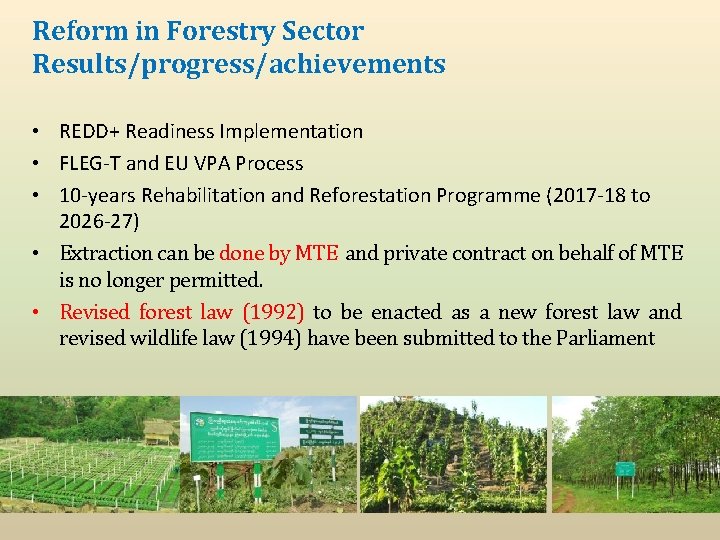
Reform in Forestry Sector Results/progress/achievements • REDD+ Readiness Implementation • FLEG-T and EU VPA Process • 10 -years Rehabilitation and Reforestation Programme (2017 -18 to 2026 -27) • Extraction can be done by MTE and private contract on behalf of MTE is no longer permitted. • Revised forest law (1992) to be enacted as a new forest law and revised wildlife law (1994) have been submitted to the Parliament
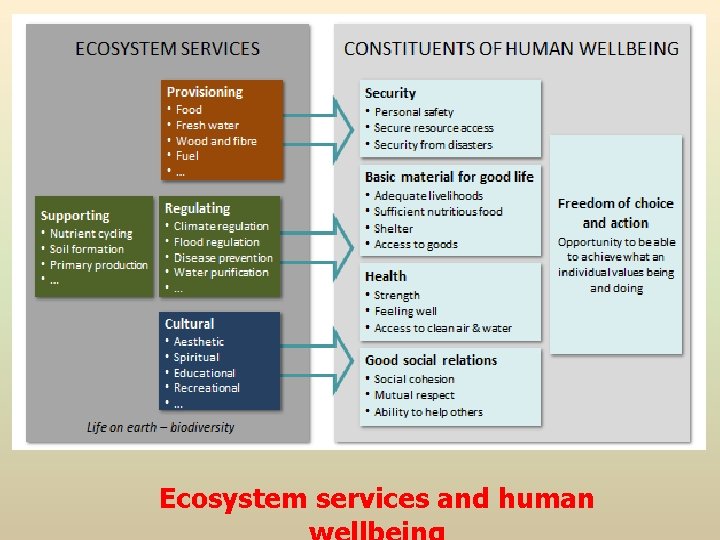
Ecosystem services and human
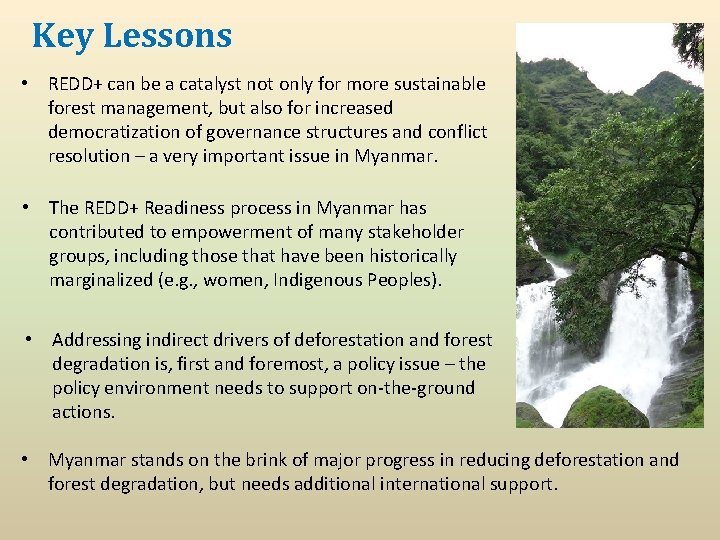
Key Lessons • REDD+ can be a catalyst not only for more sustainable forest management, but also for increased democratization of governance structures and conflict resolution – a very important issue in Myanmar. • The REDD+ Readiness process in Myanmar has contributed to empowerment of many stakeholder groups, including those that have been historically marginalized (e. g. , women, Indigenous Peoples). • Addressing indirect drivers of deforestation and forest degradation is, first and foremost, a policy issue – the policy environment needs to support on-the-ground actions. • Myanmar stands on the brink of major progress in reducing deforestation and forest degradation, but needs additional international support.
THANK YOU FOR YOUR ATTENTION!
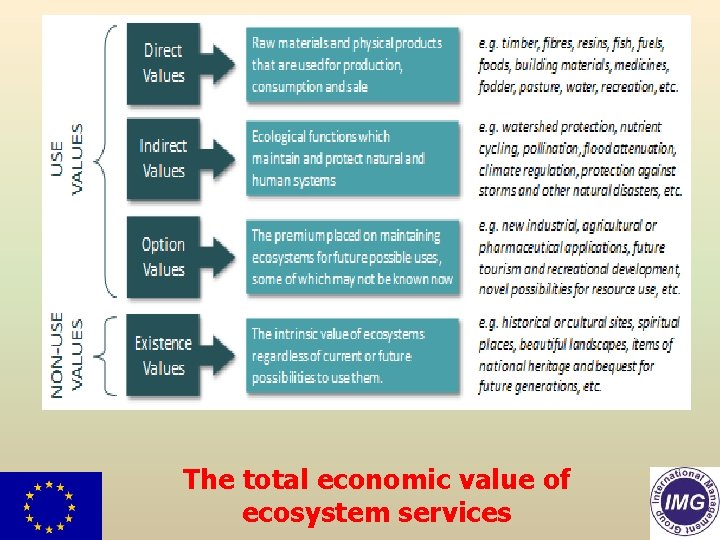
The total economic value of ecosystem services
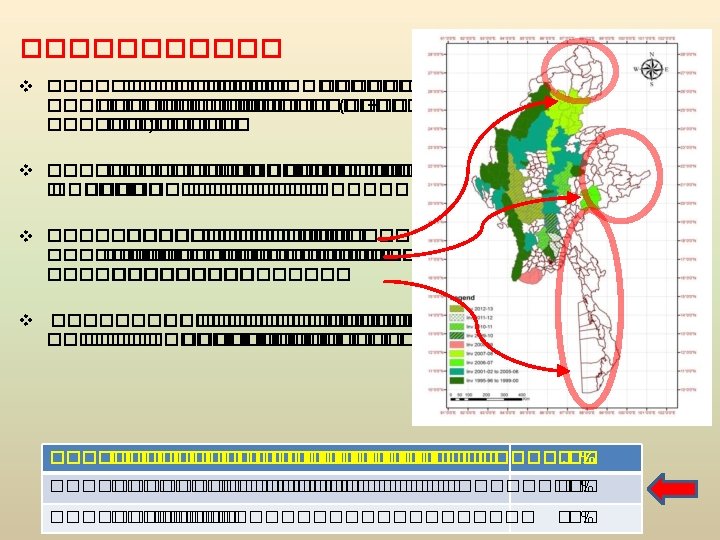
Potential areas of PFE for enhancing ecosystem services Current PFE in Myanmar INDC (NDC) Target Reserved Forest = 30 % Protected Areas = 10% Changeable land area= 11 % Total area of country = 51 %