
INTRODUCTION TO THE REDD CONCEPT STELLA GAMA NATIONAL
- Slides: 23
INTRODUCTION TO THE REDD+ CONCEPT STELLA GAMA NATIONAL REDD+ FOCAL POINT
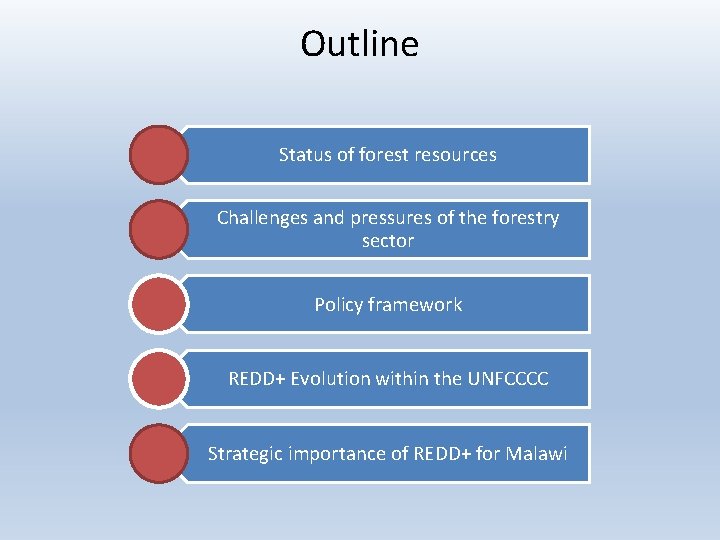
Outline Status of forest resources Challenges and pressures of the forestry sector Policy framework REDD+ Evolution within the UNFCCCC Strategic importance of REDD+ for Malawi
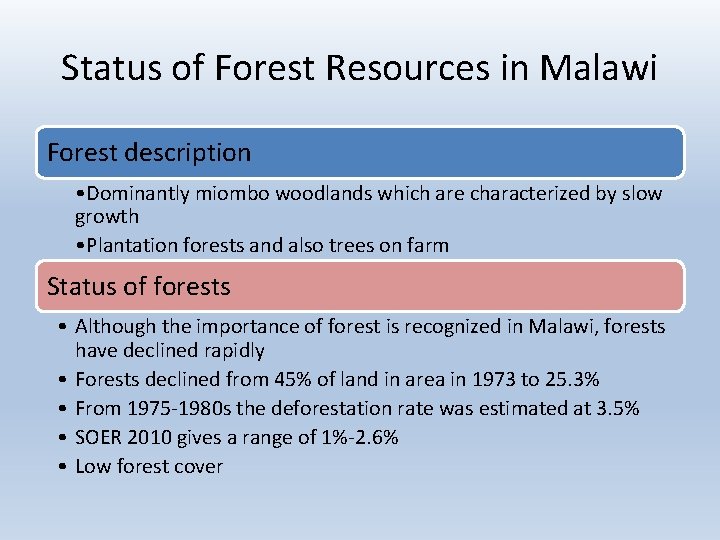
Status of Forest Resources in Malawi Forest description • Dominantly miombo woodlands which are characterized by slow growth • Plantation forests and also trees on farm Status of forests • Although the importance of forest is recognized in Malawi, forests have declined rapidly • Forests declined from 45% of land in area in 1973 to 25. 3% • From 1975 -1980 s the deforestation rate was estimated at 3. 5% • SOER 2010 gives a range of 1%-2. 6% • Low forest cover
Challenges and pressures of the forestry sector Despite their great economic value, forests are the most mismanaged resources • • • Poor forest governance: illegality, enforcement Population pressure: conversion into agric. land Dependence on biomass energy Weak monitoring systems Inadequate resource mobilization Loss of revenues In addition, forest provide global public goods with external benefits
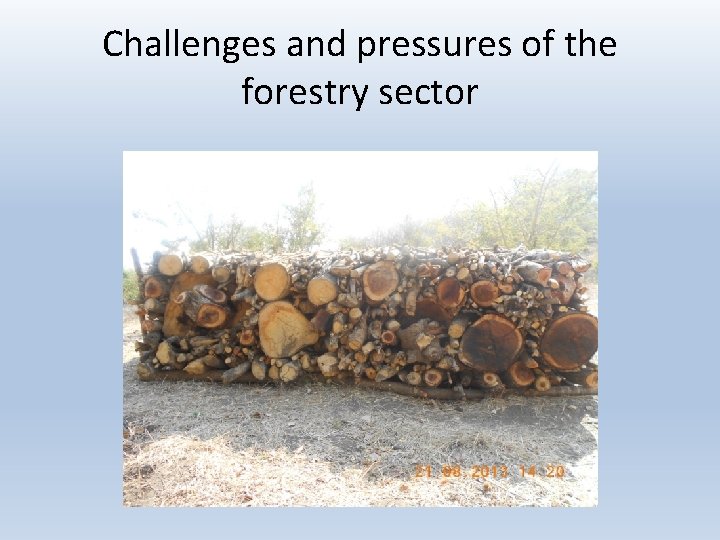
Challenges and pressures of the forestry sector
Policy framework National Level • Forest Policy 1996 • Forest Act 1997 • Emphasize multi-stakeholder participation in forest management and sustainable use of forest resources • Enhancing the role of forests in poverty reduction International • UNFCCC and others CBD. UNCCD. Regional Protocols. • Public goods
The REDD+ Evolution under the UNFCCC • United Nations Framework Convention on Climate Change (UNFCCC) was adopted at the Rio Earth Summit in 1992 and ratified by 194 countries. 1994 entry into force
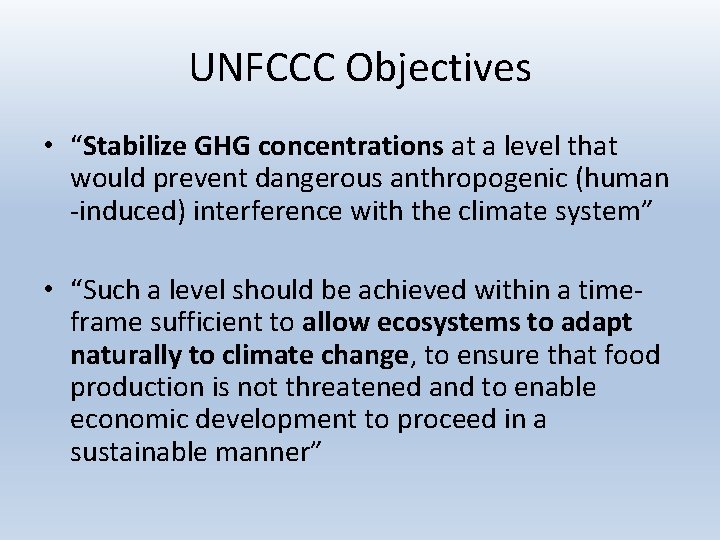
UNFCCC Objectives • “Stabilize GHG concentrations at a level that would prevent dangerous anthropogenic (human -induced) interference with the climate system” • “Such a level should be achieved within a timeframe sufficient to allow ecosystems to adapt naturally to climate change, to ensure that food production is not threatened and to enable economic development to proceed in a sustainable manner”
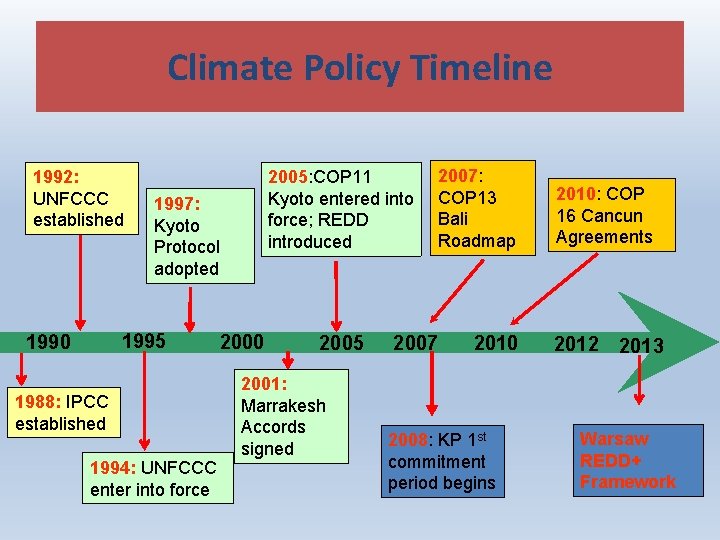
Climate Policy Timeline 1992: UNFCCC established 1997: Kyoto Protocol adopted 1995 1990 2005: COP 11 Kyoto entered into force; REDD introduced 1988: IPCC established 1994: UNFCCC enter into force 2000 2005 2001: Marrakesh Accords signed 2007: COP 13 Bali Roadmap 2010 2008: KP 1 st commitment period begins 2010: COP 16 Cancun Agreements 2012 2013 Warsaw REDD+ Framework
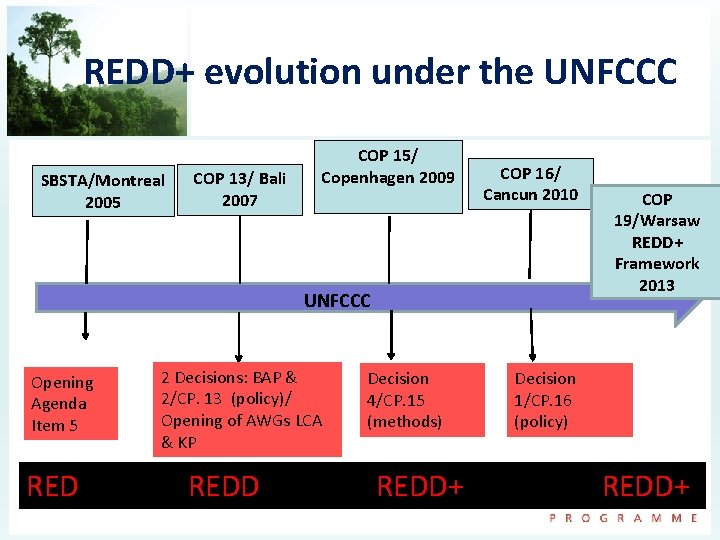
REDD+ evolution under the UNFCCC SBSTA/Montreal 2005 COP 13/ Bali 2007 COP 15/ Copenhagen 2009 COP 16/ Cancun 2010 UNFCCC Opening Agenda Item 5 RED 2 Decisions: BAP & 2/CP. 13 (policy)/ Opening of AWGs LCA & KP REDD Decision 4/CP. 15 (methods) REDD+ COP 19/Warsaw REDD+ Framework 2013 Decision 1/CP. 16 (policy) REDD+
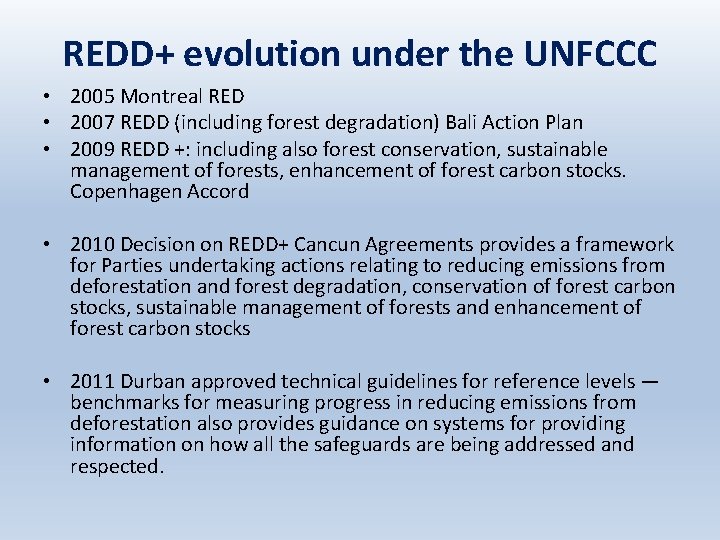
REDD+ evolution under the UNFCCC • 2005 Montreal RED • 2007 REDD (including forest degradation) Bali Action Plan • 2009 REDD +: including also forest conservation, sustainable management of forests, enhancement of forest carbon stocks. Copenhagen Accord • 2010 Decision on REDD+ Cancun Agreements provides a framework for Parties undertaking actions relating to reducing emissions from deforestation and forest degradation, conservation of forest carbon stocks, sustainable management of forests and enhancement of forest carbon stocks • 2011 Durban approved technical guidelines for reference levels — benchmarks for measuring progress in reducing emissions from deforestation also provides guidance on systems for providing information on how all the safeguards are being addressed and respected.
REDD+ evolution under the UNFCCC • 2012 REDD+ finance workshop and a technical paper in preparation for COP 19 Doha • 2013 Warsaw REDD+ Framework: a comprehensive package of seven technical and finance decisions that provide the fundamental architecture for REDD+ to be implemented
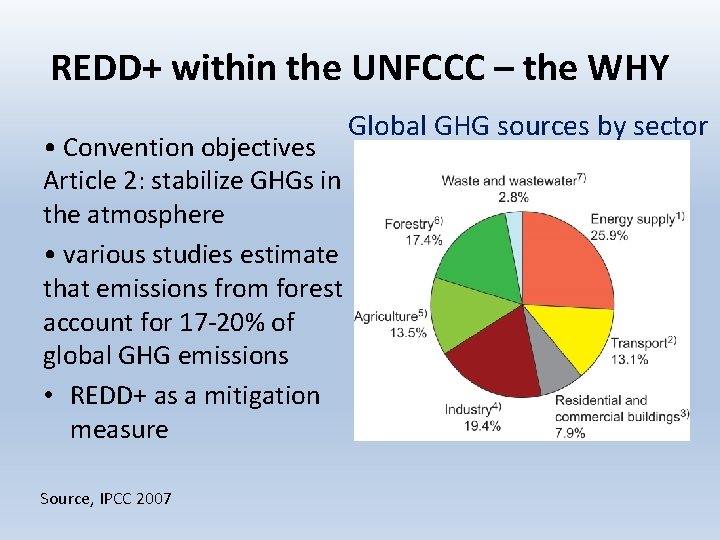
REDD+ within the UNFCCC – the WHY • Convention objectives Article 2: stabilize GHGs in the atmosphere • various studies estimate that emissions from forest account for 17 -20% of global GHG emissions • REDD+ as a mitigation measure Source, IPCC 2007 Global GHG sources by sector
REDD+ within the UNFCCC – the WHY • REDD+ is – an international framework to halt deforestation • A vehicle to financially reward developing countries for SFM • REDD+ Mechanism – to help fight poverty while conserving biodiversity and sustaining vital ecosystem services • Reducing deforestation is the “single largest opportunity for cost-effective and immediate reductions of carbon emissions” (Stern Review)
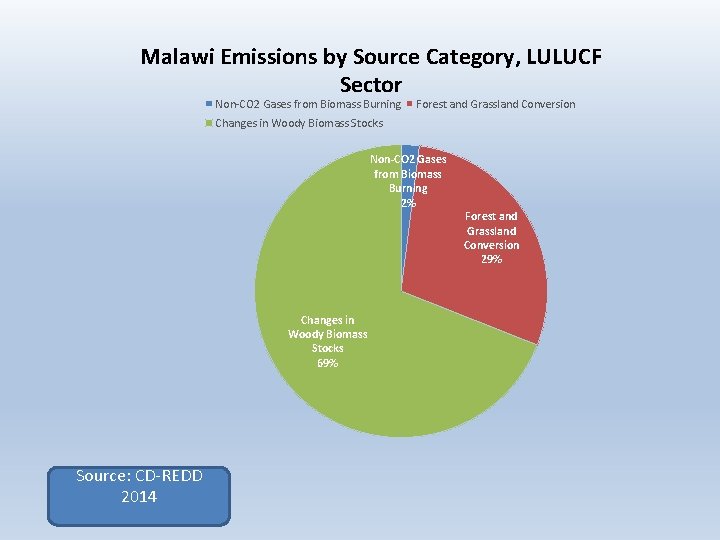
Malawi Emissions by Source Category, LULUCF Sector Non-CO 2 Gases from Biomass Burning Forest and Grassland Conversion Changes in Woody Biomass Stocks Non-CO 2 Gases from Biomass Burning 2% Changes in Woody Biomass Stocks 69% Source: CD-REDD 2014 Forest and Grassland Conversion 29%
Strategic importance for Malawi • Malawi is well into Phase I and going into Phase II of the REDD+ process • The MRP has a solid foundation on which to build a model REDD+ program
Strategic importance for Malawi • Enhance sustainable forest management practices and landscape approach • Improve forest governance • Cross sector coordination: Create inclusive, informed and participatory decision-making • Help leverage other investments and generate new funding for SFM • Promote green growth: low carbon, resource efficient and socially inclusive
Strategic importance for Malawi • Redd+ will deliver Multiple ecosystem services – Low-carbon development and climate change mitigation – Sustaining water-related ecosystem services – Timber and non-timber forest products-renewable • REDD+ will increase resilience of ecosystems to environmental changes • REDD+ has potential to provide monetary benefits (dependent on price of carbon)
Strategic importance for Malawi • Carbon financing not the primary objective • However vital for scientifically sound, rigorous methodologies forest monitoring systems which are consistent, comparable
Conclusion • • • It’s an expedition Lets move forward together Low carbon emission Sustainable and resilient livelihoods Resilient forest landscapes
“A technological society has two choices. First it can wait until catastrophic failures expose systemic deficiencies, distortion and self-deceptions… Secondly, a culture can provide social checks and balances to correct for systemic distortion prior to catastrophic failures. ” - Mahatma Gandhi