
Aung Zaw Naing Lin Ethic Group Hope Support

- Slides: 38
Aung Zaw Naing Lin Ethic Group
Hope Support Care and Concern Red Ribbon mean that I care!!!.
HIV: Human Immunodeficiency Virus It is a retrovirus and destroys the essential conductor of the immune system- -the T 4 cells. AIDS: Acquired Immune Deficiency Syndrome Acquired: The virus is acquired from someone else. Immune: A protection against disease causing microorganisms. Deficiency: A loss of this protection. Syndrome: A group of signs or symptoms that together define AIDS as a human pathology. So. . . AIDS is a deficiency of the human immune system which you get from someone else.
+ It was founded in 1976 in Zaire, Africa. +In 1977, the first reported case of a person ) Dr. Margrethe Rask) to die of complication from the obscure AIDS virus. + AIDS appeared as a clinical entity in 1981. + June 5, 1981 the Center for Disease Control (CDC) made official announcement on this mysterious disease. + In the mean time, researchers were trying to locate “Patient Zero” “(Gaetan Dugas) a French-Canadian airline steward”. + Media pay attention when actor Rock Hudson died with AIDS in 1985.
+ Since HIV/AIDS epidemic began 20 years ago, over 50 million people have been infected with HIV. + Children have lost their parents, Families have lost their property, Communities have lost teachers, health workers; business and government leaders, Famous artists and Athletics, etc. . . + AIDS is already the leading cause of death in adults (defined here as those aged 15 -49).
Impact of HIV and AIDS +Every day, an estimated 15, 000 people become infected with (HIV). +Adults and Children become infected as end of 1999 Total : 34. 3 million +Estimated death of (adult&child) from the beginning of the epidemic to end 1999. Total : 18. 8 million. +Over 90% of (HIV+)people do not have access/can’t afford the various therapies.
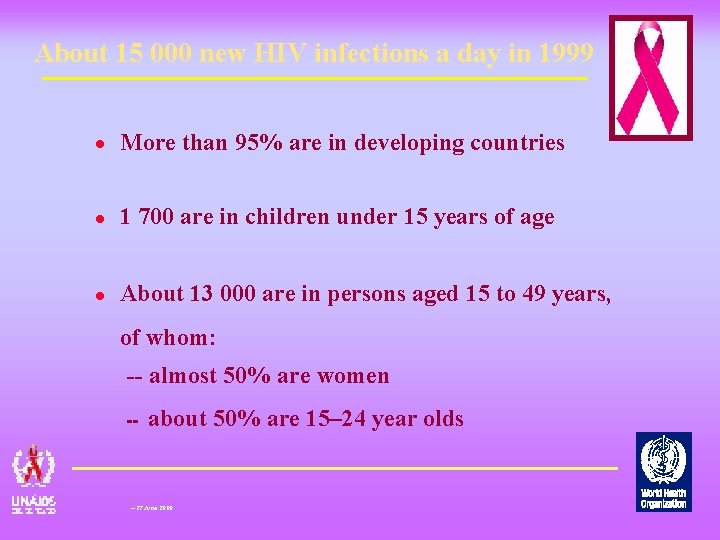
About 15 000 new HIV infections a day in 1999 l More than 95% are in developing countries l 1 700 are in children under 15 years of age l About 13 000 are in persons aged 15 to 49 years, of whom: -- almost 50% are women -- about 50% are 15– 24 year olds – 27 June 2000
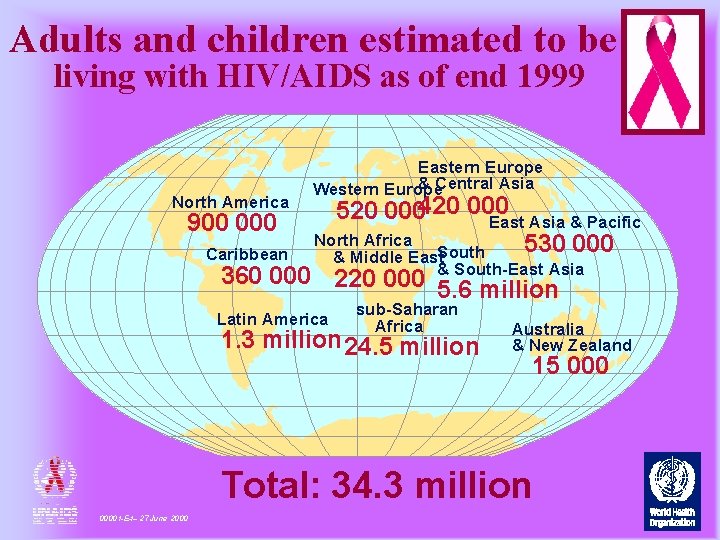
Adults and children estimated to be living with HIV/AIDS as of end 1999 Eastern Europe & Central Asia Western Europe 420 000 520 000 East Asia & Pacific 900 000 North Africa 530 000 Caribbean & Middle East. South 360 000 220 000 & South-East Asia 5. 6 million North America Latin America sub-Saharan Africa 1. 3 million 24. 5 million Australia & New Zealand 15 000 Total: 34. 3 million 00001 -E-1– 27 June 2000
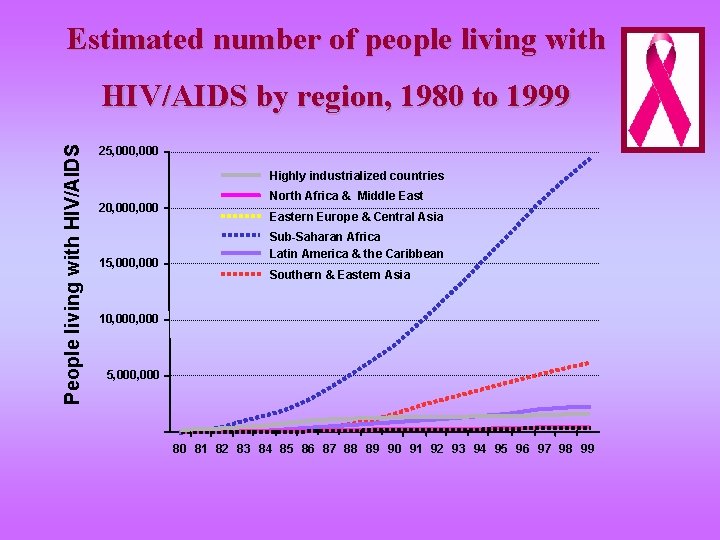
Estimated number of people living with People living with HIV/AIDS by region, 1980 to 1999 25, 000 Highly industrialized countries 20, 000 15, 000 North Africa & Middle Eastern Europe & Central Asia Sub-Saharan Africa Latin America & the Caribbean Southern & Eastern Asia 10, 000 5, 000 80 81 82 83 84 85 86 87 88 89 90 91 92 93 94 95 96 97 98 99
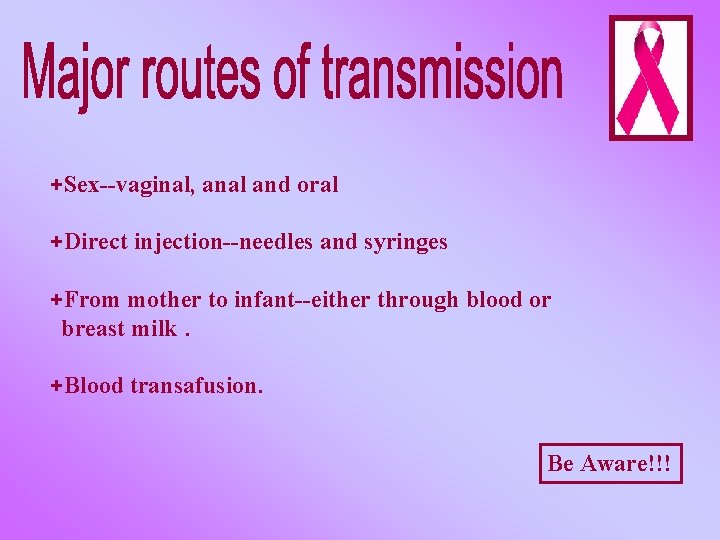
+Sex--vaginal, anal and oral +Direct injection--needles and syringes +From mother to infant--either through blood or breast milk. +Blood transafusion. Be Aware!!!
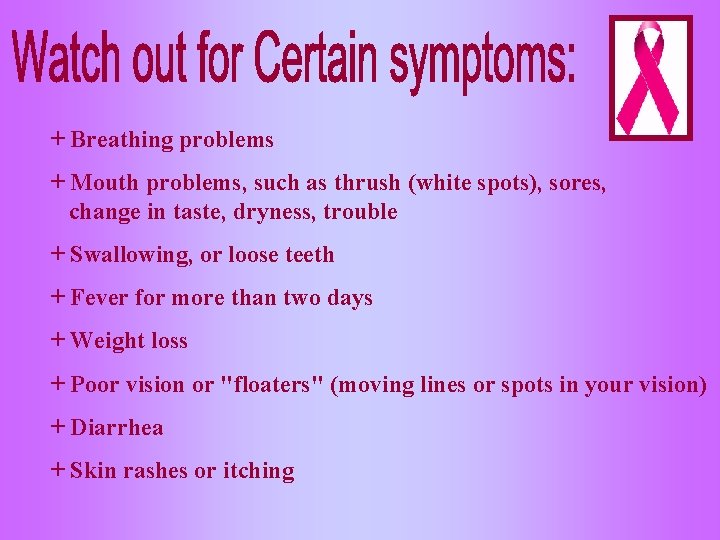
+ Breathing problems + Mouth problems, such as thrush (white spots), sores, change in taste, dryness, trouble + Swallowing, or loose teeth + Fever for more than two days + Weight loss + Poor vision or "floaters" (moving lines or spots in your vision) + Diarrhea + Skin rashes or itching
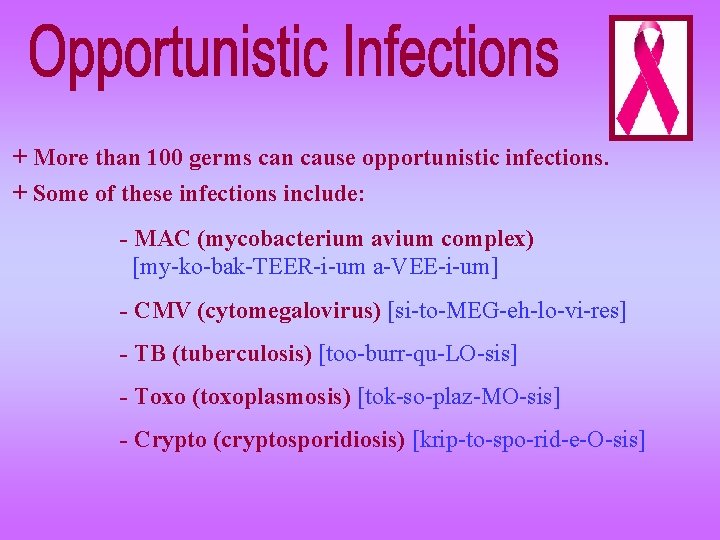
+ More than 100 germs can cause opportunistic infections. + Some of these infections include: - MAC (mycobacterium avium complex) [my-ko-bak-TEER-i-um a-VEE-i-um] - CMV (cytomegalovirus) [si-to-MEG-eh-lo-vi-res] - TB (tuberculosis) [too-burr-qu-LO-sis] - Toxo (toxoplasmosis) [tok-so-plaz-MO-sis] - Crypto (cryptosporidiosis) [krip-to-spo-rid-e-O-sis]
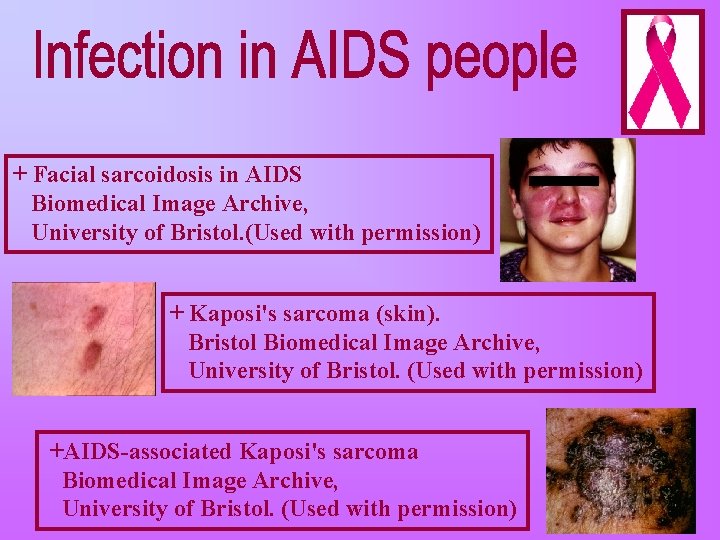
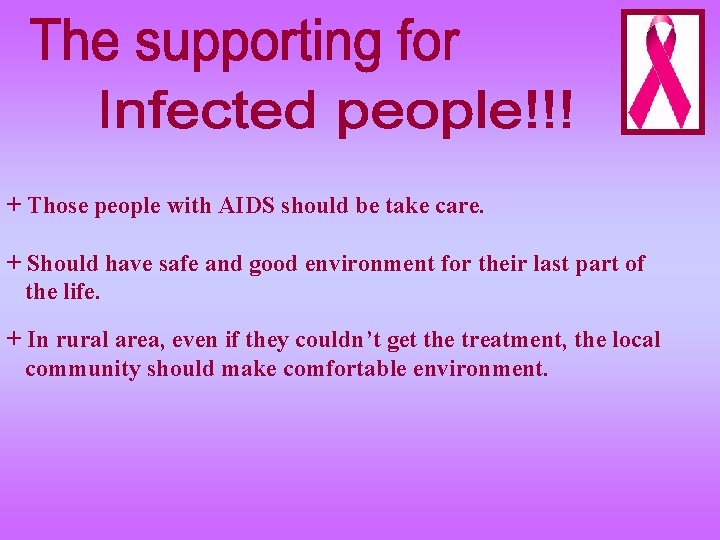
+ Facial sarcoidosis in AIDS Biomedical Image Archive, University of Bristol. (Used with permission) + Kaposi's sarcoma (skin). Bristol Biomedical Image Archive, University of Bristol. (Used with permission) +AIDS-associated Kaposi's sarcoma Biomedical Image Archive, University of Bristol. (Used with permission)
+ Those people with AIDS should be take care. + Should have safe and good environment for their last part of the life. + In rural area, even if they couldn’t get the treatment, the local community should make comfortable environment.
+ What is Depression ? + Depression and HIV Infection !!! + Treatment of Depression in HIV Infection. + Psychotherapy + Pharmacotherapy
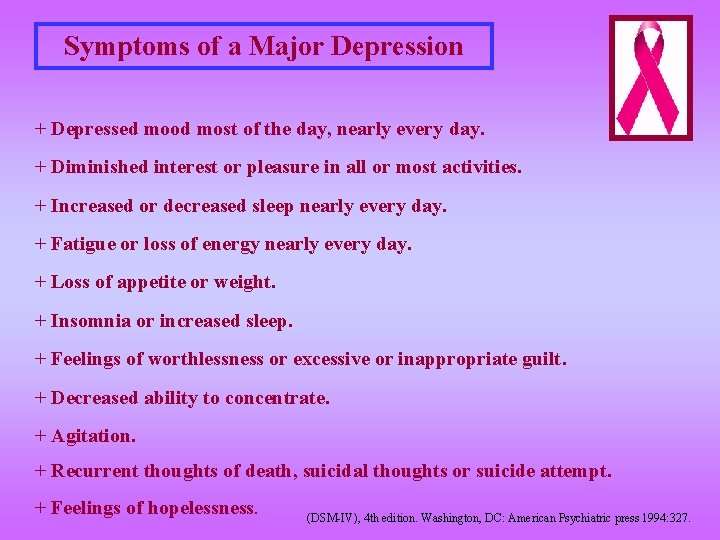
+ The diagnosis of depression is based on a minimal duration of certain groups of symptoms. + A major depressive disorder is diagnosed when one has several of the symptoms.
Symptoms of a Major Depression + Depressed mood most of the day, nearly every day. + Diminished interest or pleasure in all or most activities. + Increased or decreased sleep nearly every day. + Fatigue or loss of energy nearly every day. + Loss of appetite or weight. + Insomnia or increased sleep. + Feelings of worthlessness or excessive or inappropriate guilt. + Decreased ability to concentrate. + Agitation. + Recurrent thoughts of death, suicidal thoughts or suicide attempt. + Feelings of hopelessness. (DSM-IV), 4 th edition. Washington, DC: American Psychiatric press 1994: 327.
+ It appears to be the most common psychiatric disorder found among HIV-infected individuals. + It has a significant effect on quality of life, progression of disability and ability to receive good medical care. Risk factors for Major Depression in HIV + Previous depression or family history of depression. + Alcohol, IV drug or other substance use. + Loss of social supports. + Multiple losses.
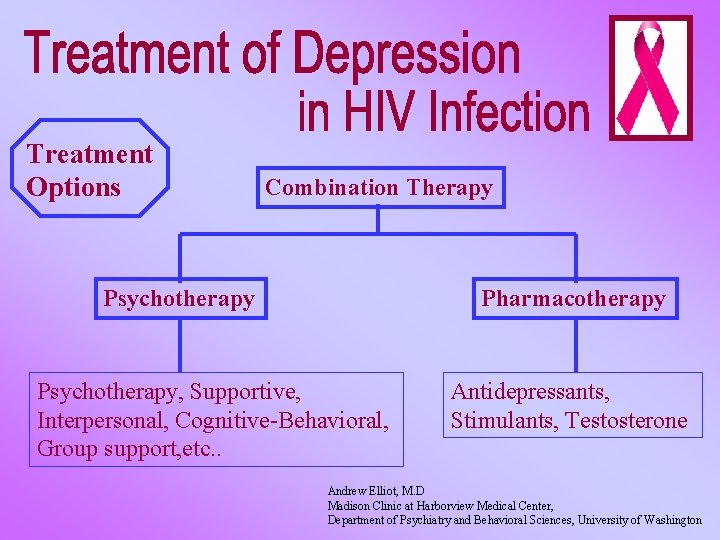
Treatment Options Combination Therapy Psychotherapy Pharmacotherapy Psychotherapy, Supportive, Interpersonal, Cognitive-Behavioral, Group support, etc. . Antidepressants, Stimulants, Testosterone Andrew Elliot, M. D Madison Clinic at Harborview Medical Center, Department of Psychiatry and Behavioral Sciences, University of Washington
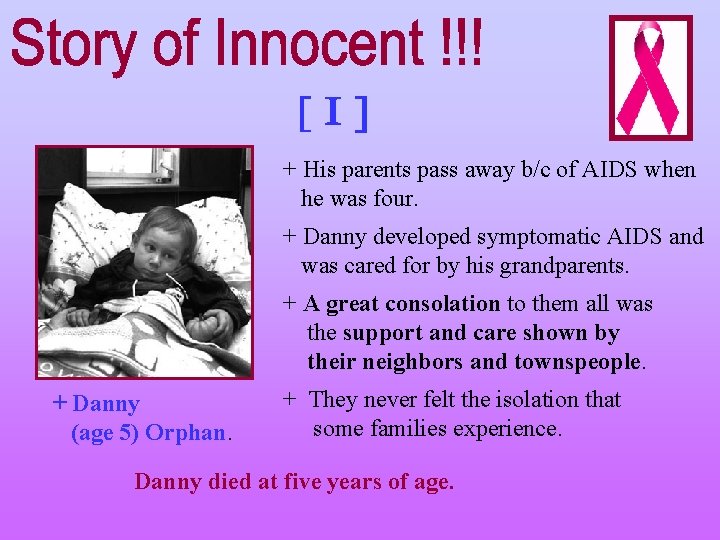
+ His parents pass away b/c of AIDS when he was four. + Danny developed symptomatic AIDS and was cared for by his grandparents. + A great consolation to them all was the support and care shown by their neighbors and townspeople. + Danny (age 5) Orphan. + They never felt the isolation that some families experience. Danny died at five years of age.
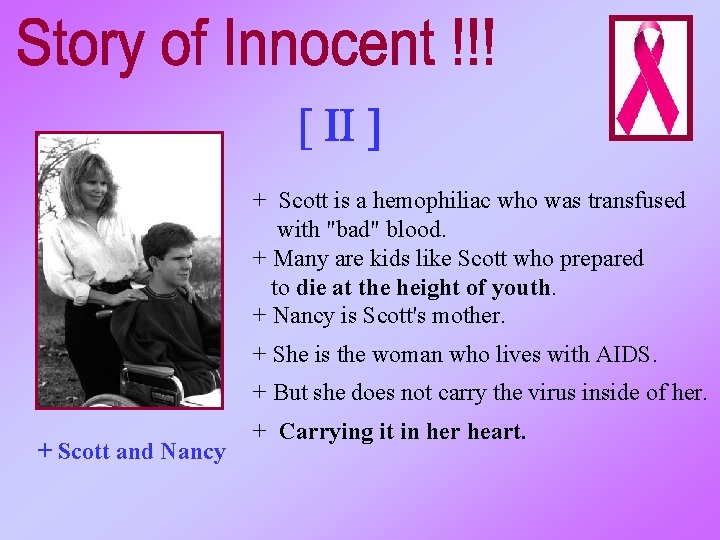
+ Scott is a hemophiliac who was transfused with "bad" blood. + Many are kids like Scott who prepared to die at the height of youth. + Nancy is Scott's mother. + She is the woman who lives with AIDS. + But she does not carry the virus inside of her. + Scott and Nancy + Carrying it in her heart.
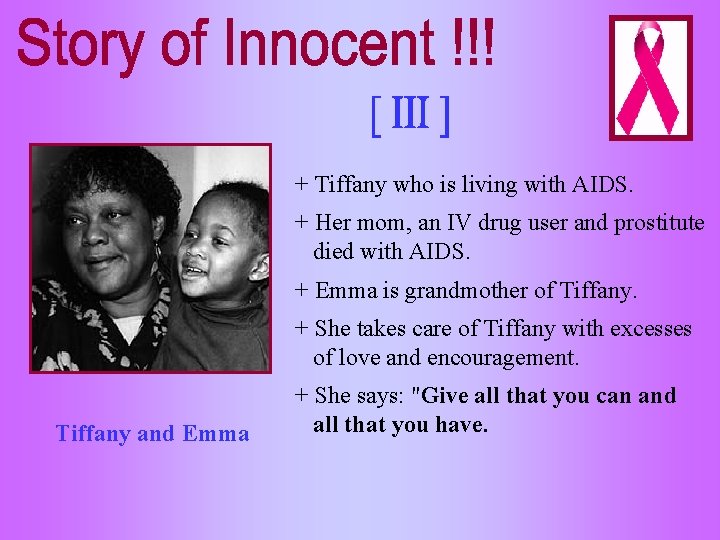
+ Tiffany who is living with AIDS. + Her mom, an IV drug user and prostitute died with AIDS. + Emma is grandmother of Tiffany. + She takes care of Tiffany with excesses of love and encouragement. Tiffany and Emma + She says: "Give all that you can and all that you have.
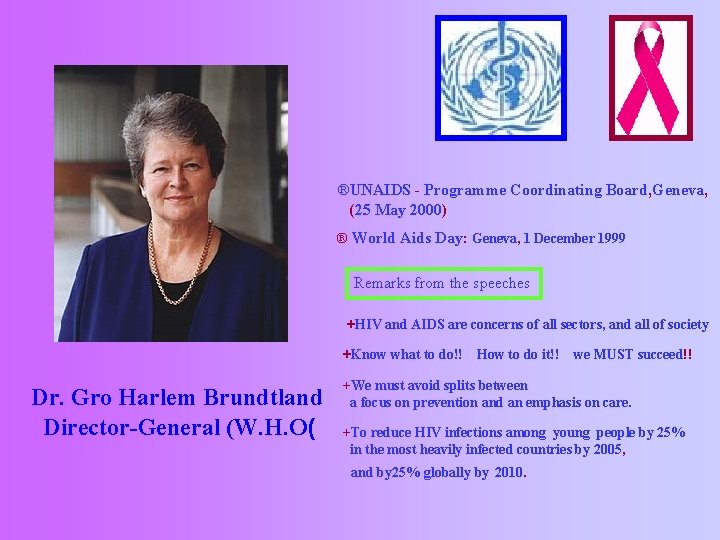
®UNAIDS - Programme Coordinating Board, Geneva, (25 May 2000) ® World Aids Day: Geneva, 1 December 1999 Remarks from the speeches +HIV and AIDS are concerns of all sectors, and all of society +Know what to do!! Dr. Gro Harlem Brundtland Director-General (W. H. O( How to do it!! we MUST succeed!! +We must avoid splits between a focus on prevention and an emphasis on care. +To reduce HIV infections among young people by 25% in the most heavily infected countries by 2005, and by 25% globally by 2010.
1 st December “Every Year” UNAIDS International Theme Listen!!! Learn!!! Live!!!
+ Creating political will and mobilizing resources. + Increasing access to voluntary HIV counselling and testing. + Increasing access to psychosocial support and impact alleviation. + Improving health service. + Increasing access to drugs of special interest to people living with HIV infection. + Countries need to develop plans for care and support as part of their strategic planning at any level(national/district) on HIV/AIDS.
Resources : Family members, representatives of religious communities, health-care providers, public sectors. + Essential for the people living with/affected by HIV. + Association of people living with HIV are a good example. + It can help reduce stigma and other negative consequences of HIV. + An important goal is to support Inclusion-Enabling affected people to live as normal members of Society.
+ Lack of income/become jobless. + An overall reduction in the number of household dependents. + Denial, ostracism and abandonment as not infrequent social responses. How to solve ? + Make donation for those who face the problems. + Government/private banks should give loan with/low interest. + Organizations(like Red Cross, UNAIDS) make some events can support their morality and strength.
Definition : a group of people sharing the same geographic, cultural and economic environment. + In 1997, UNAIDS advocated to develop the Standards for Care and Support in communities. + Health planners and the local community have to collaborate closely. + The goal is to reach the needs and expectations of HIV people. + The community can strongly support for HIV/AIDS people.
Home care Emotional and Social Support + active listening / discussing with the problems. + accompany for social activities e. g. . going to public places Practical and Personal Support + light domestic duties such as cleaning, etc. . + helping with shopping + preparation of meals. + going to medical center/hospital with you.
+ Powerful tool for expanding the response to the epidemic. + Who receive care can break the denial by Local Community. + Can demonstrate that no reason to fear becoming infected through everyday contact. + And also help dispel misguided beliefs about HIV transmission. + Providing diagnosis and treatment helps decrease the rate of spread among HIV negative people. + Infected people can live without discrimination in Community.
Option [I] + AIDS patients should be treat just like everybody. + They should have right to work and have normal life. + Isolating or discrimination to them can make situation worse. + If somebody has AIDS and spread it intentionally, he/she convicted as a murder.
Option [II] + From the point of natural development, AIDS is a very normal phenomena in the history of human. + But the problem is it is becoming as a war between human and nature. + Do our best to fight against it in order to maintain the control. + For AIDS patients, the best way is to treat them properly and make them comfortable, try to lengthen their life span. + In this actual situation around as-good/bad-we know the way to protect our self. + So, Try our best!! That’s the correct attitude of life.
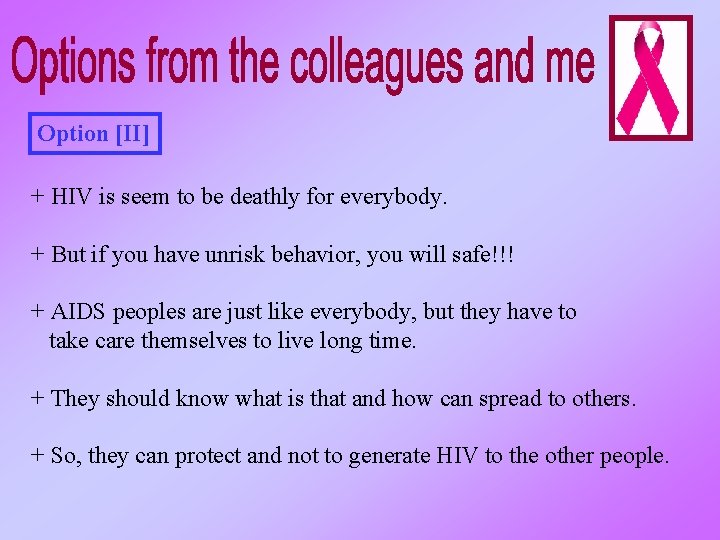
Option [II] + HIV is seem to be deathly for everybody. + But if you have unrisk behavior, you will safe!!! + AIDS peoples are just like everybody, but they have to take care themselves to live long time. + They should know what is that and how can spread to others. + So, they can protect and not to generate HIV to the other people.
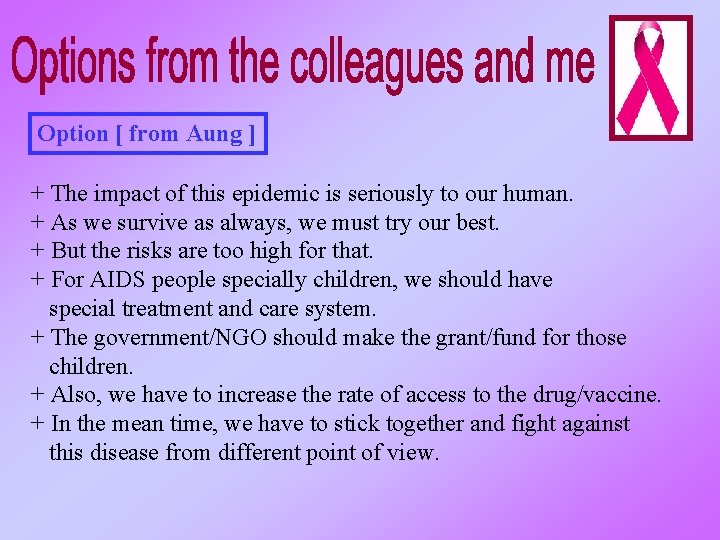
Option [ from Aung ] + The impact of this epidemic is seriously to our human. + As we survive as always, we must try our best. + But the risks are too high for that. + For AIDS people specially children, we should have special treatment and care system. + The government/NGO should make the grant/fund for those children. + Also, we have to increase the rate of access to the drug/vaccine. + In the mean time, we have to stick together and fight against this disease from different point of view.
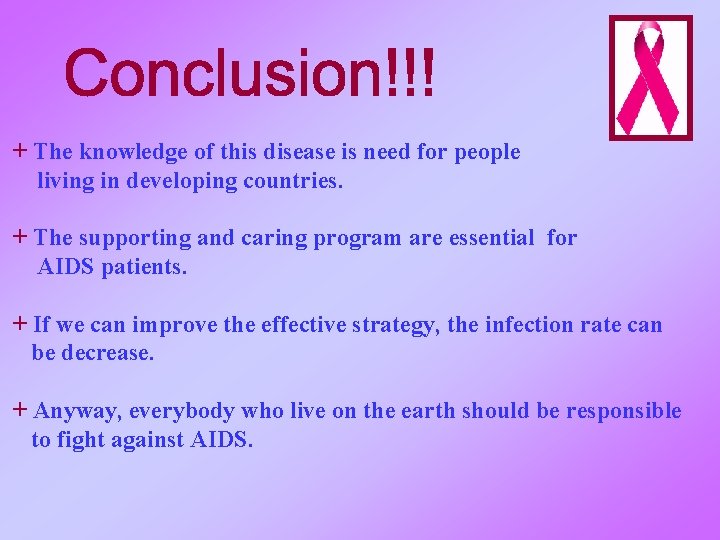
+ The knowledge of this disease is need for people living in developing countries. + The supporting and caring program are essential for AIDS patients. + If we can improve the effective strategy, the infection rate can be decrease. + Anyway, everybody who live on the earth should be responsible to fight against AIDS.
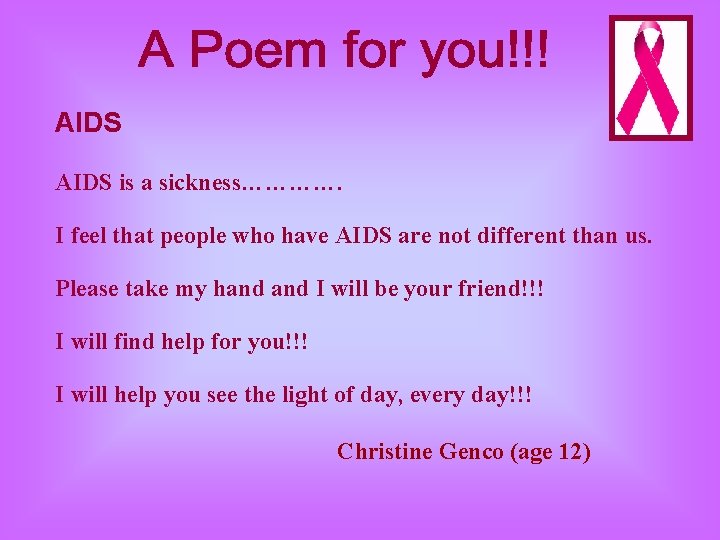
AIDS is a sickness…………. I feel that people who have AIDS are not different than us. Please take my hand I will be your friend!!! I will find help for you!!! I will help you see the light of day, every day!!! Christine Genco (age 12)