
Federation Business School Sustainable Development Goals SDGs as
Federation Business School Sustainable Development Goals (SDGs) as Basis for an Alternative Viable Development Model in Timor-Leste: Planning and Challenges Jerry Courvisanos Federation Business School, Federation University Australia, Ballarat, VIC. and Matias Boavida Department of Public Policy, UNTL, Dili, Timor-Leste 2017 UNTL/VU Biennial Conference, Institute of Diplomatic Studies, Wednesday 5 th July 2017
Sustainable Development (SD) “The essence of sustainable development is to provide for the fundamental needs of humankind in an equitable way without doing violence to the natural systems of life on earth. ” (Kemp and Martens, 2007, p. 5) SDGs: Path to SD is non-optimal and dynamic, with business ventures (& new programs) that embrace: • productive union of mind and nature • linking economic (profit), social (people) and ecological (planet) in business practice • support with local/regional/national community Opportunity and choice about the SD path

SD in five developing countries? • Tunisia: R&D base, with bottom-up SD input • Indonesia: top-down non-SD, with no input from community/entrepreneurs • India: strong role for private and social entrepreneurs, as public policy fails to address SD and cultural divides • China: strong top-down SD, drive to bottom • Bangladesh: women entrepreneurs strong, weak but improving government SD support
SD in Timor-Leste? Late 2015: SDGs Resolution by both the TL Government and then Parliament TL Government has a “roadmap” and the PM’s working group to implement it Medium-term Coordinating Ministry (MECAE) committed to creating SD through private investment and developing non-oil exports in domestic agriculture, community forestry and coffee exports Many donor-sponsored NGOs across agriculture, education, health, and the physical environment
The Roadmap: 2017 Version
Review of the Roadmap (TLSA Conference) SDGs are being ‘harmonised’ with the SDP in a linear approach: On the surface there is “perfectly alignment”, but ignores complexity Top-down process: Lack of input from outside the implementation group, with “big development” SDP approach remaining unaltered No observed transformation towards a diversified fossil fuel disinvestment future SDGs not embedded well into the ministries Some achievements towards SDGs, but heavily constrained by a long series of limitations

Where to from here? Theme: Finding Pathways to Achieve the SDGs What is needed are: “…alternative economic models, vital to the growing global push towards renewable energy, fossil fuel divestment and urgent action on climate change. ” (Ramos-Horta and Mahar, 2016) The 2015 SDGs Resolution by TL Government: Opportunity to build an adjustment mechanism into the SDP, to address growing uncertainties, also introduce stronger renewable energy planning into the SDP. OR reject SDP by a critical mass from civil society with initiative to develop unique SDG economic model
Mechanisms to achieve this? Investment in physical and human capital by… State: Align SDG priorities with State budget expenditure allocations Businesses: Move from “a land of kiosks” to a land of new sustainable innovations Cooperatives: Indigenous “fulidaidai” movement building through community ownership Local culture: Connecting with strong socially and ecologically sustainable customary traditions For SD, what is the right mix of all the above?
Crucial SD Issues 1. Participatory decentralisation 2. Effective (formal and social) learning (for farmers, cooperatives, seasonal workers, nascent entrepreneurs): local-based 3. Financial system that supports eco-innovations 4. Shift from subsistence to sustainable agriculture 5. Localising food production 6. Build value (supply) chain for ‘eco-tourism’ economic model
Crucial SD Issues 6. Build historical tourism for domestic and foreign links to memory of TL’s past (colonial, World War II, occupation resistance and atrocities) 7. Donors to create strong partnerships with local NGOs and local-based small businesses (with foreign experts only on demand of local NGOs) 8. Local State and private base push for sustainable manufacturing with FDI support building on the recently restructured Trade. Invest support and strong EIS regulations
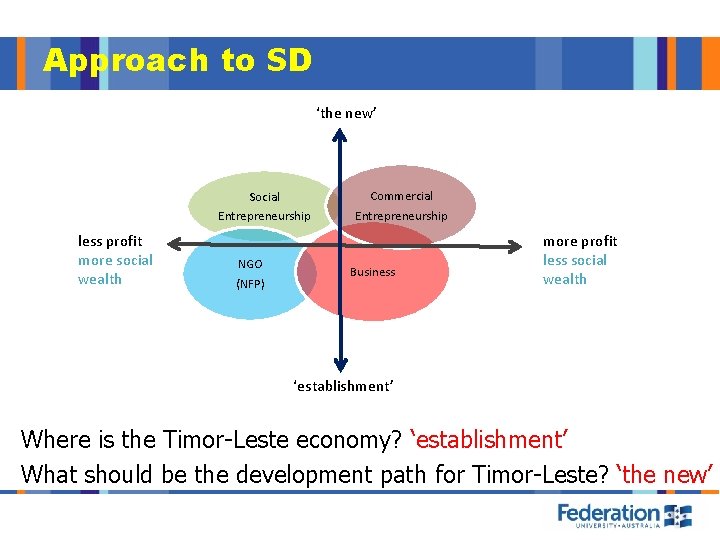
Approach to SD ‘the new’ Social Entrepreneurship less profit more social wealth NGO (NFP) Commercial Entrepreneurship Business more profit less social wealth ‘establishment’ Where is the Timor-Leste economy? ‘establishment’ What should be the development path for Timor-Leste? ‘the new’
The New: Innovation Path with SDGs Innovation path based on two economics traditions: • ‘Creative destruction’ based on a technological driver (in past for TL: Oil), now with Sustainable Development Goals (SDGs), does it shift to ecosustainable technologies and solutions (renewable energy, reuse, recycle with equity)? • Severe crisis (as in TL) the trigger for paradigm shift. • ‘Adaptation mechanism’ – capital investment (infrastructure) and effective demand (build market demand) with effective learning for eco-innovation adaptation; allows for new private sector market power (new entrepreneurs in TL)
SD for TL TL has many SD advantages it can use for innovation: • Pristine clean agricultural system (no chemicals, no pesticides, etc. . ) • Breathtaking natural landscape (land sea) • Survival and resistance to foreign intrusion • Strong self-efficacy, autonomy and endurance against strong forces • Foreign direct investment (FDI) and diaspora return funds can be easily accessed • Goodwill from donors for SD is very deep and sustained
How to build SD markets in TL? Identify SD markets that build on the advantages in the previous slide: • Turn these advantages into competitive strengths • Focus on developing markets where existing skills can be utilised and new skills developed (e. g. coffee, eco-tourism, market gardens, candlenut oil, cassava, sandlewood), all in eco-sustainable ways • Value add processing on markets developed, even if very simple tasks (e. g. tractor hire) • Collaborate with other producers and coordinate in the supply chain (e. g. transport, marketing)
What is needed to support this strategy? • Absorptive capacity – ability of individual or group/ organisation to absorb innovation stimuli (ideas) by… i. acquiring external information ii. assimilate this information in the firm, and iii. exploit it for commercial ends • Well-educated young – from pre-primary to tertiary to be able to function in entrepreneurial environment with ongoing learning for all in the organisation • Sustainable development priority – to build cultural acceptance of the SDGs that drive a niche SDbased economy which is ‘bottom-up’
Government support for SD in TL • Government to support SD (commercial and social) entrepreneurship through: Ø cultural change to SD Ø infrastructure for small business Ø training and social learning experiences Ø finance support (from microfinance to investment in SD growth) • To succeed, SD requires commitment by all • Local participation by nominating SDG targets and local administration (from municipality to suku): Listen, and local communities will embrace SDGs
Space for small-size ventures in TL • Public sector crucial in creating this space and not crowded out by ‘top-down’ high risk big projects • Foreign NGOs to give way to endogenous NGOs who create space for social entrepreneurship (e. g. Raebia took over from USC-Canada to support sustainable farming businesses with local champions) • Vocational education with good skills practice and then add creativity in business (e. g. Centre of Excellence in Entrepreneurship) as a profession
Space created by facilitation Following are critical facilitation roles: 1. Business enterprise/cooperative support providing mentor, advice, idea identification, network contacts and incubation facilities to start-up ventures 2. Financial support to fund entrepreneurs to set up and invest in identified innovations with competitive strength and meets SDGs 3. Clear regulation on business and land tenure rulings to remove institutional uncertainty 4. Build local clusters (systems) with supply chain connections & value added processing…next slide
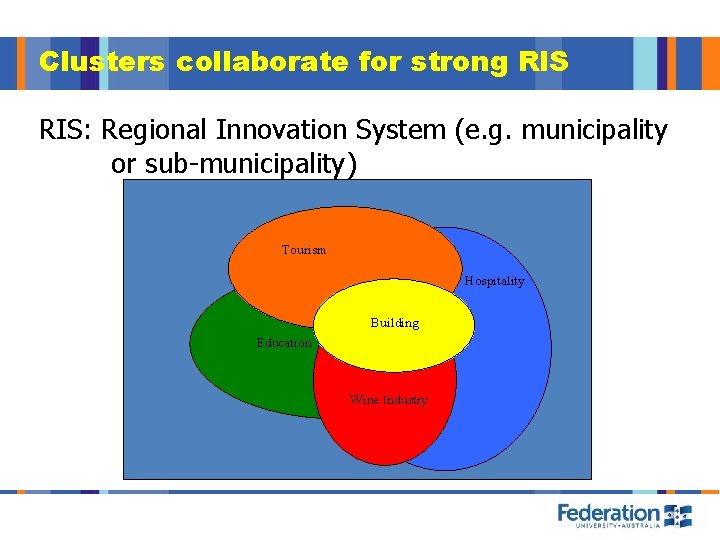
Clusters collaborate for strong RIS: Regional Innovation System (e. g. municipality or sub-municipality) Tourism Hospitality Building Education Wine Industry
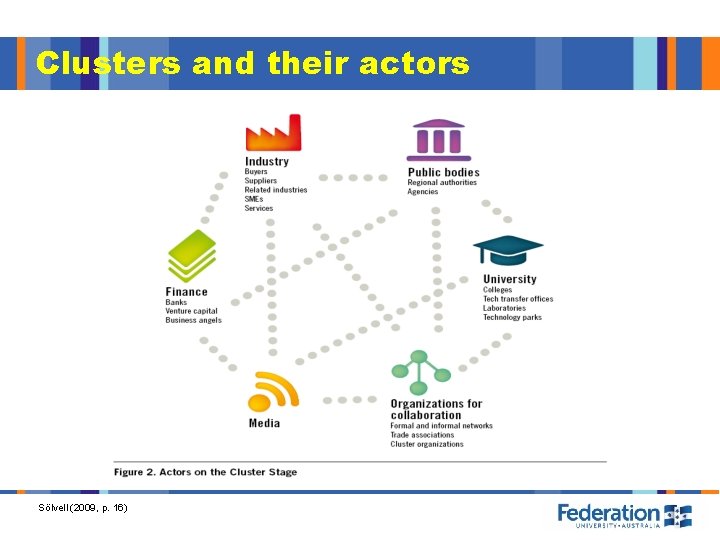
Clusters and their actors Sölvell (2009, p. 16)
Conclusion What unites the country – from bottom to top, west to east, female and male – is a “common civic identity” “…voluntary public identification with and cohesion around a national identity”: integration & participation Ongoing revolution begun by the older generation in terms of “the fight to free the country” and must continue by the younger generation in terms of “the fight to free the people” with the SDGs SDG economic model emerges from public policies combined with niche private sector and cooperative investments to develop new sustainable sectors

Thank you for your attention For more: Full report available by request at email address: j. courvisanos@federation. edu. au
- Slides: 22