Rationalism v Empiricism From where does knowledge come




- Slides: 49
Rationalism –v- Empiricism From where does knowledge come? MRes Philosophy of Knowledge (slides available at http: //cfpm. org/mres)
Introduction to the Po. K Module Rationalism –v- Empiricism. MMUBS Mres Philosophy of Knowledge http: //cfpm. org/mres slide-2
Philosophy is not so much a matter of knowledge, as a skill, that is used in the privacy of your own mind, and as a sort of non-contact combat sport. You have to practice this skill, that means trying arguments, losing a lot of times, realising your mistakes, learning and slowly improving. A Karate Kid of the mind. Rationalism –v- Empiricism. MMUBS Mres Epistemology, Day 2 – seesion 1, http: //cfpm. org/mres slide-3
Some questions for you…. • How do you know that 1+1=2? • How do you know that the earth will exist when you wake up tomorrow? • How do you know that I think? • How do you know that I understand what you say, and not “understand” something different? • Do we know when we know? • Do we know anything really? • Is it not rather silly to say we know nothing? Rationalism –v- Empiricism. MMUBS Mres Epistemology, Day 2 – seesion 1, http: //cfpm. org/mres slide-4
How are you going to demonstrate that you have contributed to what we know in your Ph. D Thesis? • Obtaining knowledge about social phenomena is your job as a Doctoral Student (your contribution to knowledge)… • But obtaining knowledge about social phenomena is very VERY hard… • …and we still do not fully understand what kind of knowledge we can have of this… • …under what circumstances and even… • …if this kind can be useful to anyone else. Rationalism –v- Empiricism. MMUBS Mres Epistemology, Day 2 – seesion 1, http: //cfpm. org/mres slide-5
How philosophy might help you • It will not tell you what knowledge IS… • …nor, indeed, how to get it! • But it will… 1. Inform you about what others have thought about these problems (give you ways of thinking about knowledge) 2. Make you aware of some of the difficulties and assumptions behind knowledge 3. It will prepare you for some of the questions and debates that you will face (give you a feel for the academic ‘lanscape’ you inhabit Rationalism –v- Empiricism. MMUBS Mres Epistemology, Day 2 – seesion 1, http: //cfpm. org/mres slide-6
The End Product… • Is that section of your Thesis which explains/defends your approach to knowledge • Your assignment is to write the first draft of this section • It will be full of guesses and tentative choices, and you will (I hope) change your mind a few times before you finish… • But this part of the MRes is to start you on this journey Rationalism –v- Empiricism. MMUBS Mres Epistemology, Day 2 – seesion 1, http: //cfpm. org/mres slide-7
This is HARD • You can not do this using ‘surface’ methods… • …you will have to think things yourself, questioning what you are told and writing from the understanding you have gained • If you hand in an assignment which is essentially just ‘regurgitating’ bits of text you have read, or references you have noted without questioning them… • I will fail you • But, if you have started to think things out for yourself, have done some reading, show some knowledge then… • You will pass, even if your arguments are wrong, or naïve, or tentative or partial Rationalism –v- Empiricism. MMUBS Mres Epistemology, Day 2 – seesion 1, http: //cfpm. org/mres slide-8
How to do this 1. Don’t worry if you don’t understand at first, if it all seems complex and gobbledegook (a lot is!) 2. Come to ALL the philosophy of knowledge sessions (on time) and actively participate 3. Read papers in your field that touch on philosophy and approach, as well as the set books – Read a bit, think, discuss it with someone, think, read it again or some more, think… 4. Question (in your mind/out loud) what you are told 5. Try to be precise, clear and honest as possible in your own thoughts/arguments 6. Come and discuss your thoughts/worries/plans concerning your assignment with me Rationalism –v- Empiricism. MMUBS Mres Epistemology, Day 2 – seesion 1, http: //cfpm. org/mres slide-9
Some Key Foundational Ideas Rationalism –v- Empiricism. MMUBS Mres Philosophy of Knowledge http: //cfpm. org/mres slide-10
A picture of reasoning we get from Ancient Greece • Reasoning is (largely) a public activity involving rhetoric and debate • An effort to distinguish (and exclude) bad arguments (e. g. identifying “fallacies”) • Good argument results in good decisions • Argument seen to lead from known (i. e. agreed) truths to conclusions… • …which may be new or used to show other beliefs are wrong (or inconsistent) Rationalism –v- Empiricism. MMUBS Mres Philosophy of Knowledge http: //cfpm. org/mres slide-11
This activity is abstracted to “Reason” and “Rationality” • These are ideals – Not necessarily what people actually do – They acquire a normative flavour • Major questions are then: – What is the role of Reason (as opposed to perception, action etc. ) in particular as to its relation to knowledge? – What is Rational (in contrast to irrational)? • Can be seen as a search to escape the contingencies and particularities of the observed world… • …to more general/fundamental/etc. truth Rationalism –v- Empiricism. MMUBS Mres Philosophy of Knowledge http: //cfpm. org/mres slide-12
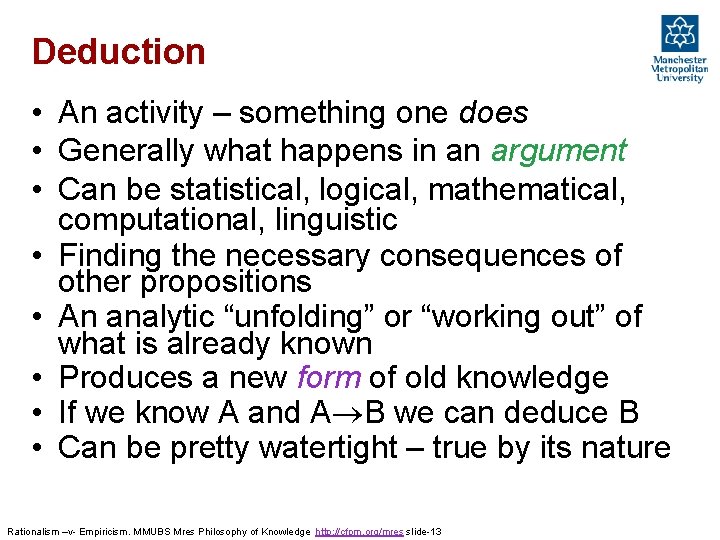
Deduction • An activity – something one does • Generally what happens in an argument • Can be statistical, logical, mathematical, computational, linguistic • Finding the necessary consequences of other propositions • An analytic “unfolding” or “working out” of what is already known • Produces a new form of old knowledge • If we know A and A B we can deduce B • Can be pretty watertight – true by its nature Rationalism –v- Empiricism. MMUBS Mres Philosophy of Knowledge http: //cfpm. org/mres slide-13
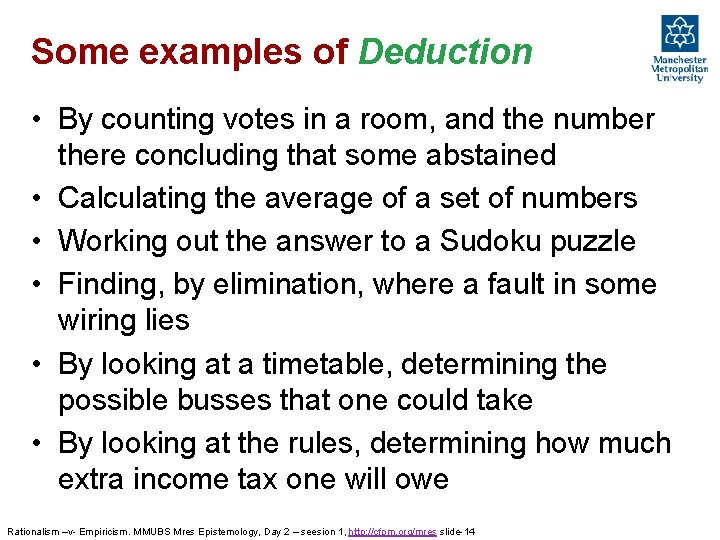
Some examples of Deduction • By counting votes in a room, and the number there concluding that some abstained • Calculating the average of a set of numbers • Working out the answer to a Sudoku puzzle • Finding, by elimination, where a fault in some wiring lies • By looking at a timetable, determining the possible busses that one could take • By looking at the rules, determining how much extra income tax one will owe Rationalism –v- Empiricism. MMUBS Mres Epistemology, Day 2 – seesion 1, http: //cfpm. org/mres slide-14
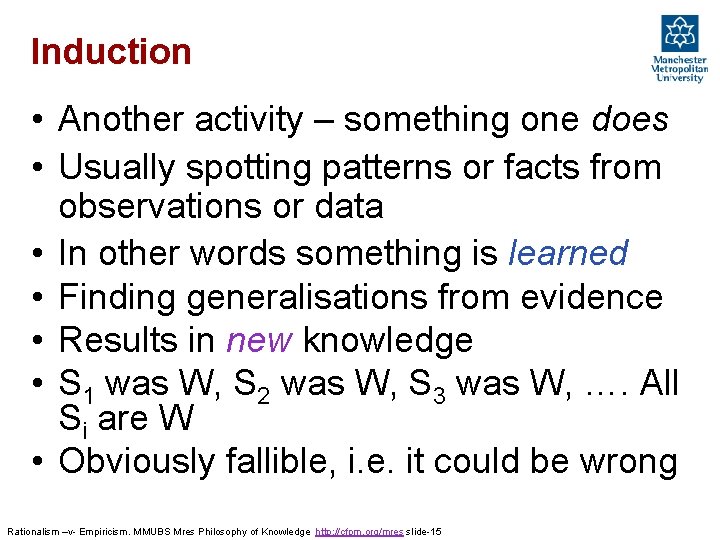
Induction • Another activity – something one does • Usually spotting patterns or facts from observations or data • In other words something is learned • Finding generalisations from evidence • Results in new knowledge • S 1 was W, S 2 was W, S 3 was W, …. All Si are W • Obviously fallible, i. e. it could be wrong Rationalism –v- Empiricism. MMUBS Mres Philosophy of Knowledge http: //cfpm. org/mres slide-15
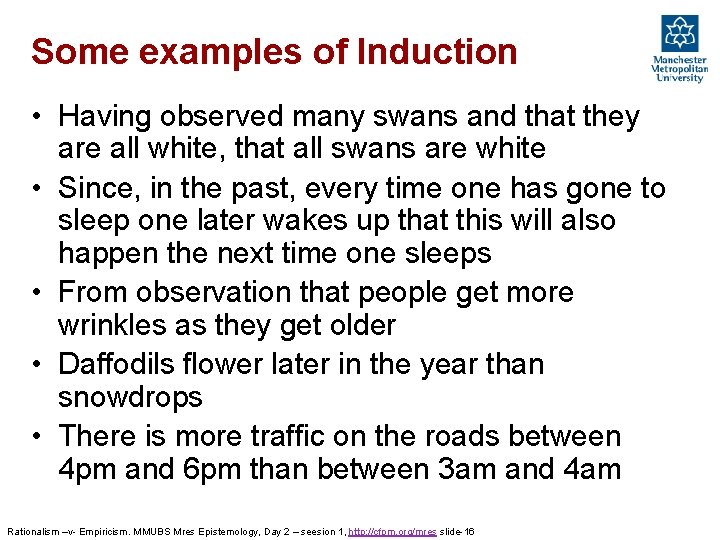
Some examples of Induction • Having observed many swans and that they are all white, that all swans are white • Since, in the past, every time one has gone to sleep one later wakes up that this will also happen the next time one sleeps • From observation that people get more wrinkles as they get older • Daffodils flower later in the year than snowdrops • There is more traffic on the roads between 4 pm and 6 pm than between 3 am and 4 am Rationalism –v- Empiricism. MMUBS Mres Epistemology, Day 2 – seesion 1, http: //cfpm. org/mres slide-16
Exercise on Induction and Deduction • In small groups, choose an example from the sheet • Try and work out – what mix of deduction and induction is being used – how and where each of deduction and induction are applied – whether the conclusions are more deductive or inductive • If you have time pick another one etc. Rationalism –v- Empiricism. MMUBS Mres Philosophy of Knowledge http: //cfpm. org/mres slide-17
The necessary – contingent distinction • Necessary truths – Statements that have to be true – For some reason it is not possible that they could be false – e. g. Sentient beings exist • Contingent truths – Statements that just happen to be true – If things were different they might not have been true – E. g. The UK has a Reigning monarch Rationalism –v- Empiricism. MMUBS Mres Philosophy of Knowledge http: //cfpm. org/mres slide-18
The analytic – synthetic distinction • Analytic truths – True by definition or deduction – Are necessary – Abound in mathematics or logic – e. g. All bachelors are unmarried • Synthetic truths – True of the world – Are contingent – Abound in natural sciences – e. g. The Earth orbits the Sun Rationalism –v- Empiricism. MMUBS Mres Philosophy of Knowledge http: //cfpm. org/mres slide-19
The a priori – a posterior distinction • a priori knowledge – What one knows before taking into account observations or evidence – May include necessary/analytic truths, assumptions, given facts, etc. • a posterior knowledge – What one knows after taking into account observations and evidence – May include laws and explanations of natural or social phenomena Rationalism –v- Empiricism. MMUBS Mres Philosophy of Knowledge http: //cfpm. org/mres slide-20
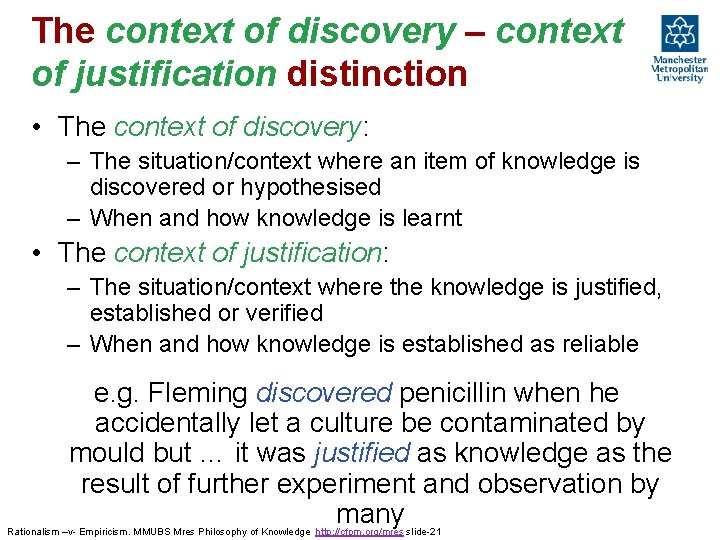
The context of discovery – context of justification distinction • The context of discovery: – The situation/context where an item of knowledge is discovered or hypothesised – When and how knowledge is learnt • The context of justification: – The situation/context where the knowledge is justified, established or verified – When and how knowledge is established as reliable e. g. Fleming discovered penicillin when he accidentally let a culture be contaminated by mould but … it was justified as knowledge as the result of further experiment and observation by many Rationalism –v- Empiricism. MMUBS Mres Philosophy of Knowledge http: //cfpm. org/mres slide-21
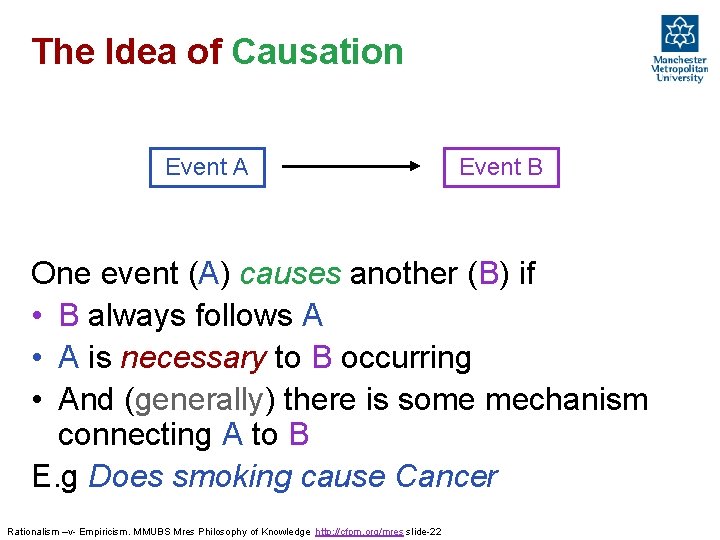
The Idea of Causation Event A Event B One event (A) causes another (B) if • B always follows A • A is necessary to B occurring • And (generally) there is some mechanism connecting A to B E. g Does smoking cause Cancer Rationalism –v- Empiricism. MMUBS Mres Philosophy of Knowledge http: //cfpm. org/mres slide-22
The Rationalist/Empiricist Debate Rationalism –v- Empiricism. MMUBS Mres Philosophy of Knowledge http: //cfpm. org/mres slide-23
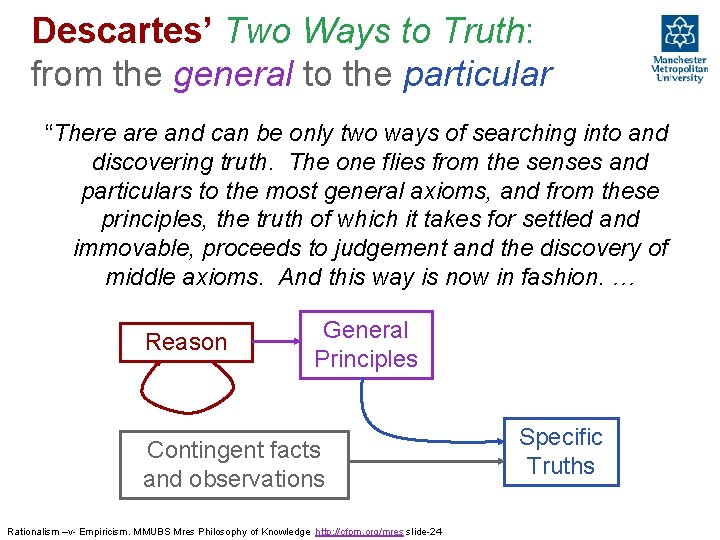
Descartes’ Two Ways to Truth: from the general to the particular “There and can be only two ways of searching into and discovering truth. The one flies from the senses and particulars to the most general axioms, and from these principles, the truth of which it takes for settled and immovable, proceeds to judgement and the discovery of middle axioms. And this way is now in fashion. … Reason General Principles Contingent facts and observations Rationalism –v- Empiricism. MMUBS Mres Philosophy of Knowledge http: //cfpm. org/mres slide-24 Specific Truths
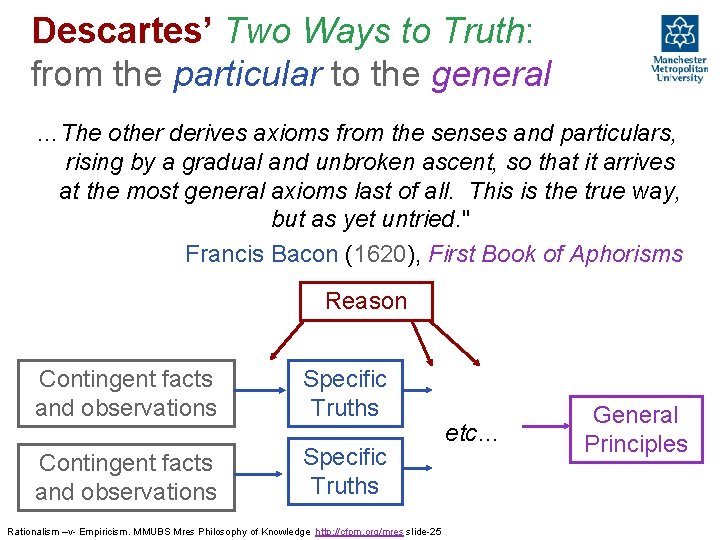
Descartes’ Two Ways to Truth: from the particular to the general …The other derives axioms from the senses and particulars, rising by a gradual and unbroken ascent, so that it arrives at the most general axioms last of all. This is the true way, but as yet untried. " Francis Bacon (1620), First Book of Aphorisms Reason Contingent facts and observations Specific Truths Rationalism –v- Empiricism. MMUBS Mres Philosophy of Knowledge http: //cfpm. org/mres slide-25 etc… General Principles
Rationalism • A Philosophical position – something one believes – about where knowledge comes from • Knowledge arises from reasoning • Is the position that the way to knowledge is from the general to the particular • Requires some general a priori truths which it views as necessary (usually) • Characterised by deduction • The general principles gives meaning to the observations by relating them • E. g. Descartes’ “I think therefore I am” Rationalism –v- Empiricism. MMUBS Mres Philosophy of Knowledge http: //cfpm. org/mres slide-26
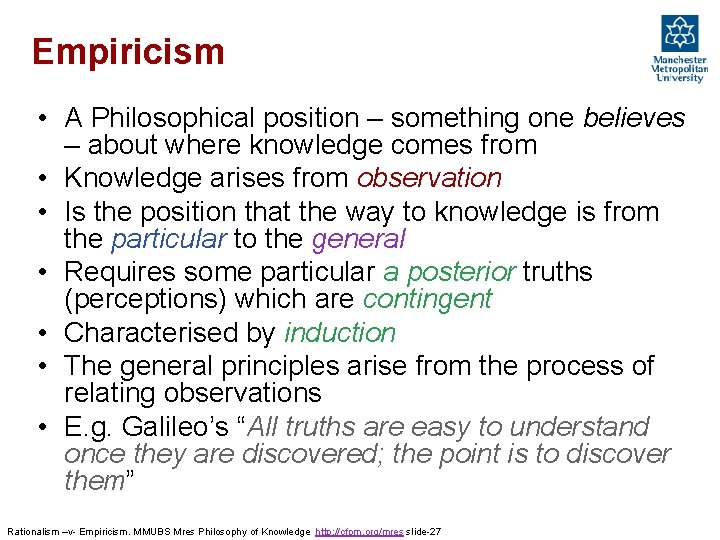
Empiricism • A Philosophical position – something one believes – about where knowledge comes from • Knowledge arises from observation • Is the position that the way to knowledge is from the particular to the general • Requires some particular a posterior truths (perceptions) which are contingent • Characterised by induction • The general principles arise from the process of relating observations • E. g. Galileo’s “All truths are easy to understand once they are discovered; the point is to discover them” Rationalism –v- Empiricism. MMUBS Mres Philosophy of Knowledge http: //cfpm. org/mres slide-27
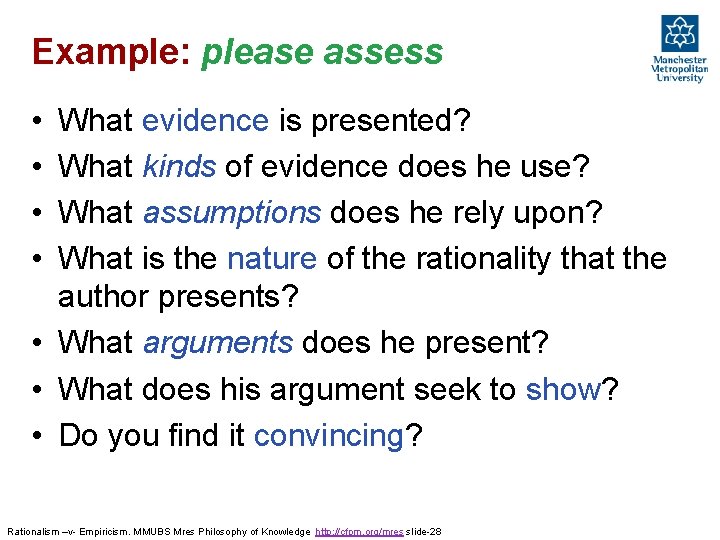
Example: please assess • • What evidence is presented? What kinds of evidence does he use? What assumptions does he rely upon? What is the nature of the rationality that the author presents? • What arguments does he present? • What does his argument seek to show? • Do you find it convincing? Rationalism –v- Empiricism. MMUBS Mres Philosophy of Knowledge http: //cfpm. org/mres slide-28
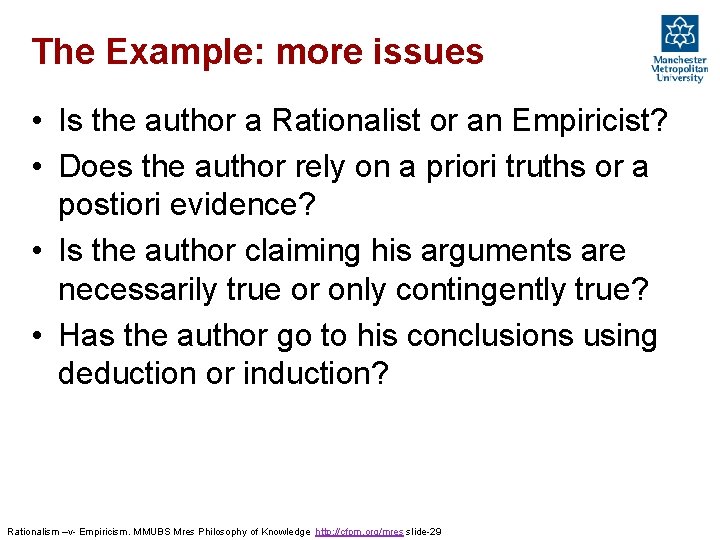
The Example: more issues • Is the author a Rationalist or an Empiricist? • Does the author rely on a priori truths or a postiori evidence? • Is the author claiming his arguments are necessarily true or only contingently true? • Has the author go to his conclusions using deduction or induction? Rationalism –v- Empiricism. MMUBS Mres Philosophy of Knowledge http: //cfpm. org/mres slide-29
An Example of a Rationalist Theory – Rational Choice Theory Rationalism –v- Empiricism. MMUBS Mres Philosophy of Knowledge http: //cfpm. org/mres slide-30
Basic Idea of Rational Choice Theory (RTC) • Humans are (imperfectly) rational • That is, their behaviour can be explained (modelled) by assuming they are basically rational at least as a starting point • The conception of rationality here is a generalisation of economic rationality (constrained optimisation) • E. g. Smith’s “invisible hand” balancing supply and demand via price changes Rationalism –v- Empiricism. MMUBS Mres Philosophy of Knowledge http: //cfpm. org/mres slide-31
Principles of RCT • Resourceful: man can search for and find possibilities, he can learn and be inventive; • Restricted: man is confronted with scarcity and must substitute (choose); • Expecting: man attaches subjective probabilities to (future) events; • Evaluating: man has ordered preferences and evaluates (future) events; • Maximizing: man maximizes (expected) utility when choosing a course of action Rationalism –v- Empiricism. MMUBS Mres Philosophy of Knowledge http: //cfpm. org/mres slide-32
About RCT • The idea is that if you accept those principles, this leads to a picture of enumerating possibilities and choosing the best of these • RCT is a rationalist theory (as well as being about rationality) because… – It does not really have an evidential basis – But rather is defended on the basis of what can be explained on “first principles” • Despite its lack of empirical grounding it has been very influential, since it presents a picture of what rationality “should” be Rationalism –v- Empiricism. MMUBS Mres Epistemology, Day 2 – seesion 1, http: //cfpm. org/mres slide-33
An Example of an Empiricist Theory – Administrative Behaviour Rationalism –v- Empiricism. MMUBS Mres Philosophy of Knowledge http: //cfpm. org/mres slide-34
Its Origin • Herbert Simon attacked RCT (and similar) as being “armchair economics” since it could have been invented sitting in an armchair rather than observing anything • Instead he observed people within offices to see how they made decisions and came to a different hypothesis as a result • He called this “procedural rationality” to contract it with “ideal” (what he called “substantive”) conceptions of rationality (such as RCT) Rationalism –v- Empiricism. MMUBS Mres Epistemology, Day 2 – seesion 1, http: //cfpm. org/mres slide-35
Procedural Rationality (PR) That (within constrained and familiar environments like offices): • People tended to have developed sequences of actions, procedures, that they followed if all was normal • They did this regardless of the existence of “better” alternatives… • …as long as it was “good enough” • That is achieved a minimum threshold in terms of quality (it was “satisfactory”) Rationalism –v- Empiricism. MMUBS Mres Epistemology, Day 2 – seesion 1, http: //cfpm. org/mres slide-36
About PR • It was born from an empiricist approach, coming from observational evidence rather than reasoning from principles • Oddly had far more influence within AI than in the social sciences • Has later been (incorrectly) summarised as “satisficing” – which was the same as RCT but where a search through alternatives was terminated when utility met a given threshold Rationalism –v- Empiricism. MMUBS Mres Epistemology, Day 2 – seesion 1, http: //cfpm. org/mres slide-37
A brief account of some of the arguments Rationalism –v- Empiricism. MMUBS Mres Philosophy of Knowledge http: //cfpm. org/mres slide-38
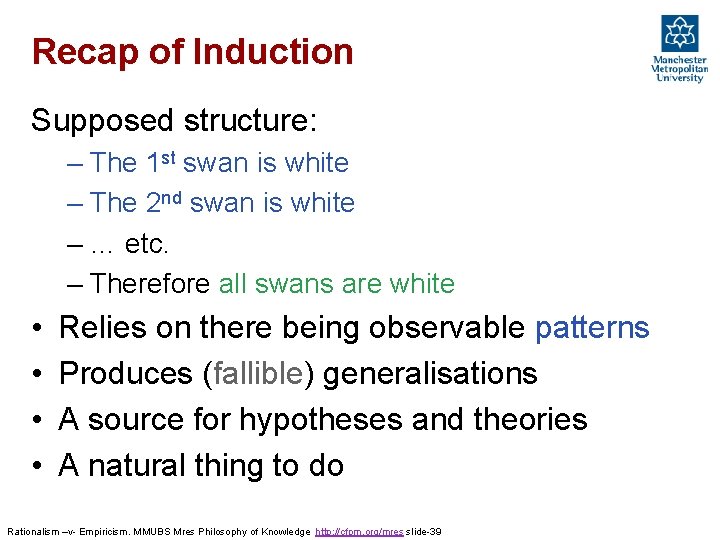
Recap of Induction Supposed structure: – The 1 st swan is white – The 2 nd swan is white – … etc. – Therefore all swans are white • • Relies on there being observable patterns Produces (fallible) generalisations A source for hypotheses and theories A natural thing to do Rationalism –v- Empiricism. MMUBS Mres Philosophy of Knowledge http: //cfpm. org/mres slide-39
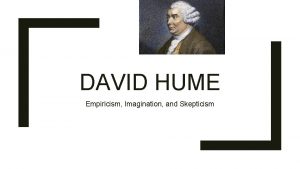
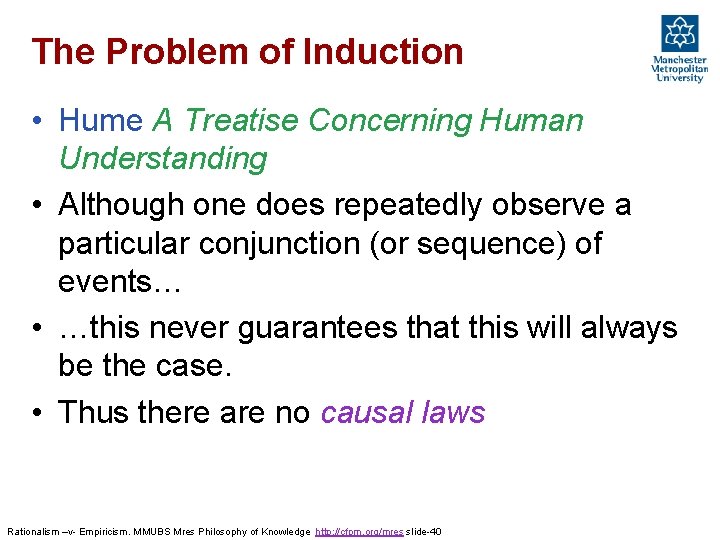
The Problem of Induction • Hume A Treatise Concerning Human Understanding • Although one does repeatedly observe a particular conjunction (or sequence) of events… • …this never guarantees that this will always be the case. • Thus there are no causal laws Rationalism –v- Empiricism. MMUBS Mres Philosophy of Knowledge http: //cfpm. org/mres slide-40
The Inductive Justification of Induction • The argument – Induction worked in case 1 – Induction worked in case 2 – … etc. … – Therefore induction works in all such cases • • A self-referring and self-justifying argument But if it is false it does not justify itself Is it supported by the evidence? What is the scope of the cases? Rationalism –v- Empiricism. MMUBS Mres Philosophy of Knowledge http: //cfpm. org/mres slide-41
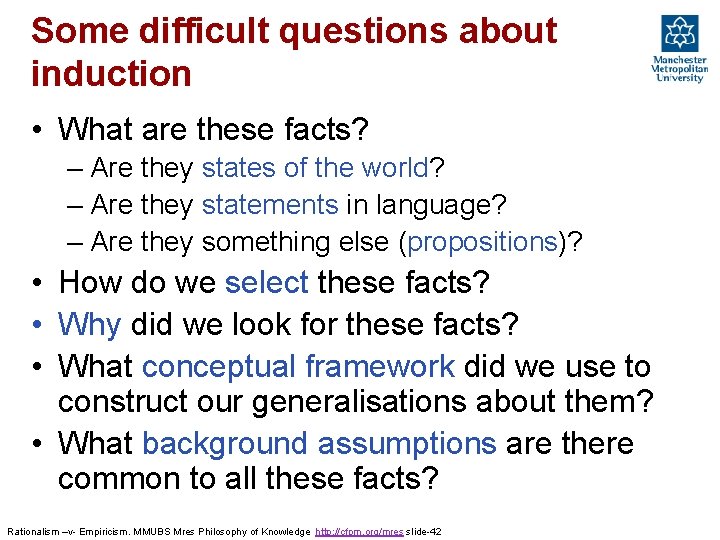
Some difficult questions about induction • What are these facts? – Are they states of the world? – Are they statements in language? – Are they something else (propositions)? • How do we select these facts? • Why did we look for these facts? • What conceptual framework did we use to construct our generalisations about them? • What background assumptions are there common to all these facts? Rationalism –v- Empiricism. MMUBS Mres Philosophy of Knowledge http: //cfpm. org/mres slide-42
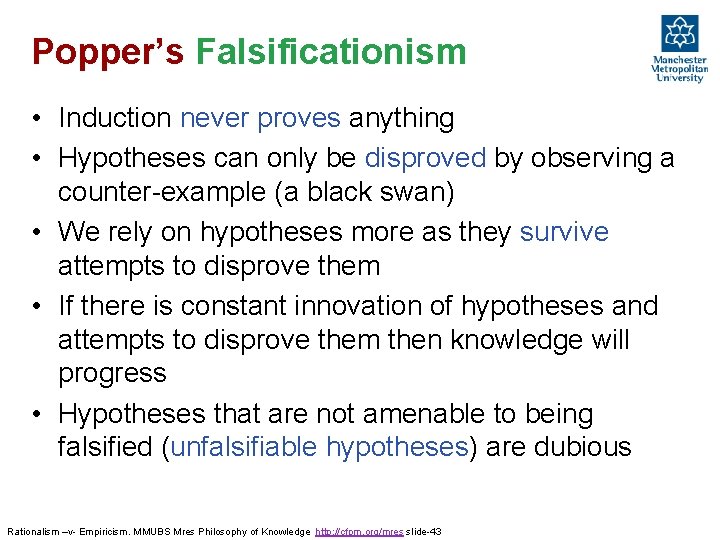
Popper’s Falsificationism • Induction never proves anything • Hypotheses can only be disproved by observing a counter-example (a black swan) • We rely on hypotheses more as they survive attempts to disprove them • If there is constant innovation of hypotheses and attempts to disprove them then knowledge will progress • Hypotheses that are not amenable to being falsified (unfalsifiable hypotheses) are dubious Rationalism –v- Empiricism. MMUBS Mres Philosophy of Knowledge http: //cfpm. org/mres slide-43
Comments on Popper’s Falsificationism • History of science does not fully support it (e. g. Michelson-Morley experiment) • How does one know whether the counterexample shows the main hypothesis is wrong or merely an auxiliary assumption? • Marks a switch from the context of discovery to the context of justification • Results in an evolutionary picture of the development of knowledge (evolutionary epistemology) Rationalism –v- Empiricism. MMUBS Mres Philosophy of Knowledge http: //cfpm. org/mres slide-44
Lakatos’ Core and Protective Belt • Research programs as key entities – These have a core of fundamental frameworks, methods and assumptions that characterises them – And a belt of less fundamental hypotheses, observations, techniques • In the face of counter-examples research programs change things in the belt and preserve the core • Some programs are more successful than others (the “degenerate programs”) Rationalism –v- Empiricism. MMUBS Mres Philosophy of Knowledge http: //cfpm. org/mres slide-45
Exercise: considering programmes For your own field/area of work decide: • What key deductive techniques does it use/rely upon (are there any not used)? • What key inductive techniques does it use/rely upon (are there any not used)? • Do these tend to be used in any particular order, if so what order? • What are the core assumptions/tenants of your field (i. e. if you don’t hold to them you do not really belong in this field)? • Are claims effectively falsifiable, if so how? Rationalism –v- Empiricism. MMUBS Mres Epistemology, Day 2 – seesion 1, http: //cfpm. org/mres slide-46
In the Social Sciences • One is usually dealing with meaningful behaviour • Meaning is (almost always) an a priori given but not always agreed upon • The context (or scope) of the induction or falsification is of great importance • Falsification is difficult since it is easy to adjust the belt to protect any hypotheses • Coherency with other thought often as important (to academics) as evidence Rationalism –v- Empiricism. MMUBS Mres Philosophy of Knowledge http: //cfpm. org/mres slide-47
Summary of Session • Both reason and evidence are needed for good generalisations about the world • But how these are combined is important • When and how to use/mix induction and deduction is still a big issue in all fields • Care and awareness are needed with any a priori assumptions and frameworks… • …although ultimately these are unavoidable • Key decisions are what to do if some evidence seems to conflict with a hypothesis – beware! Rationalism –v- Empiricism. MMUBS Mres Philosophy of Knowledge http: //cfpm. org/mres slide-48
The End Experiment escorts us last His pungent company Will not allow an Axiom An Opportunity Emily Dickinson (1830 -1886) (as usual slides etc. at: http: //cfpm. org/mres) Rationalism –v- Empiricism. MMUBS Mres Philosophy of Knowledge http: //cfpm. org/mres slide-49