
LECTURE 13 EMPIRICISM In Todays Lecture We Will

- Slides: 22
LECTURE 13: EMPIRICISM
In Today’s Lecture We Will: 1. Continue our investigation into the topic of Epistemology 2. Outline and become familiar with the classical theories of empiricism 3. Examine and evaluate a modern theory of Empiricism; John Locke 4. Attempt to examine Locke’s arguments for empiricism TODAY’S LECTURE
CLASSICAL EMPIRICISM
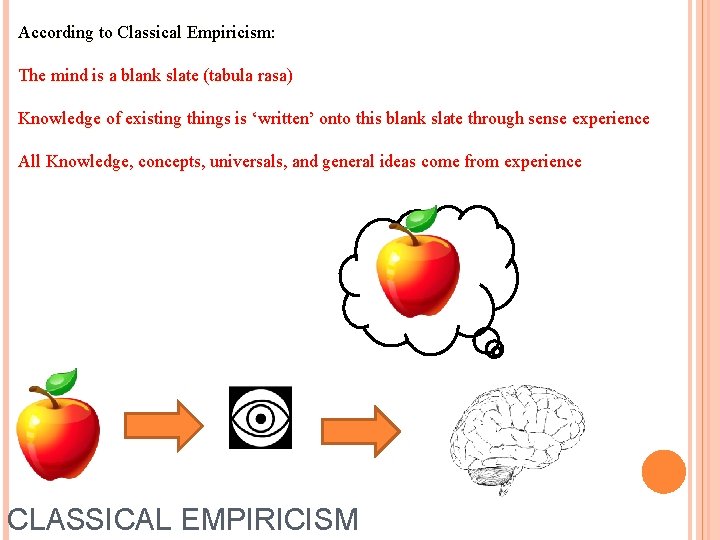
According to Classical Empiricism: The mind is a blank slate (tabula rasa) Knowledge of existing things is ‘written’ onto this blank slate through sense experience All Knowledge, concepts, universals, and general ideas come from experience CLASSICAL EMPIRICISM
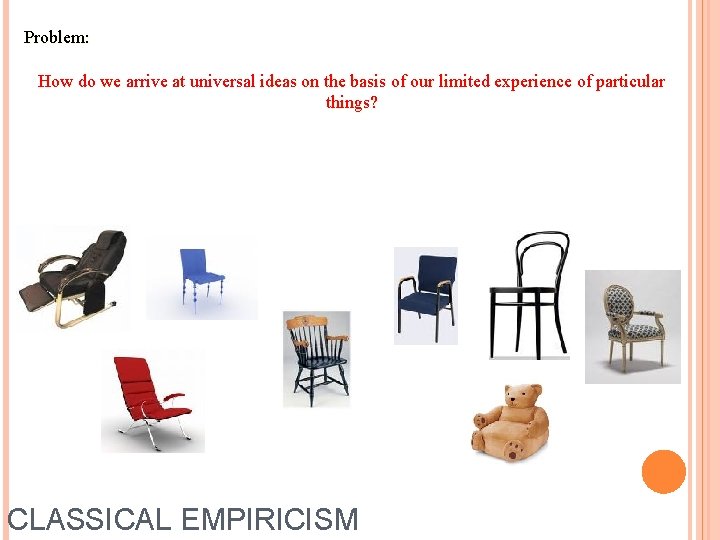
Problem: How do we arrive at universal ideas on the basis of our limited experience of particular things? CLASSICAL EMPIRICISM
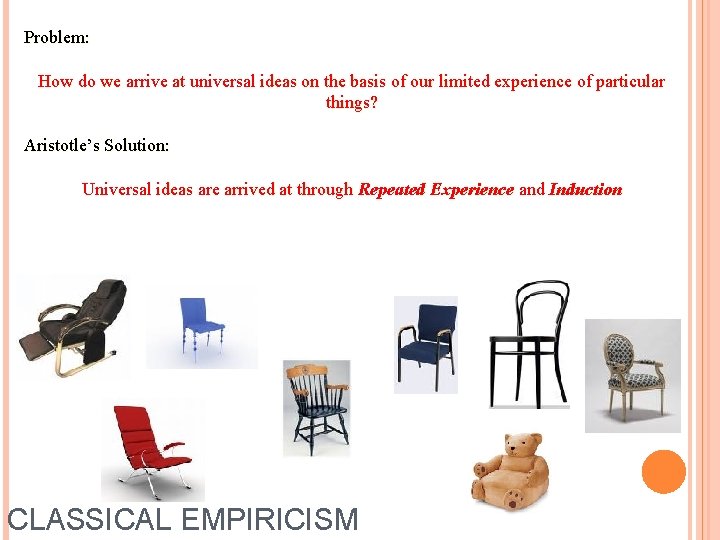
Problem: How do we arrive at universal ideas on the basis of our limited experience of particular things? Aristotle’s Solution: Universal ideas are arrived at through Repeated Experience and Induction CLASSICAL EMPIRICISM
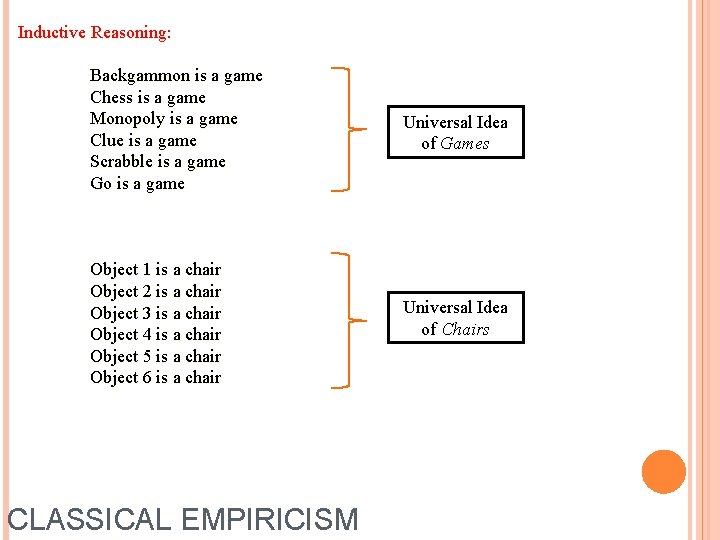
Inductive Reasoning: Backgammon is a game Chess is a game Monopoly is a game Clue is a game Scrabble is a game Go is a game Universal Idea of Games Object 1 is a chair Object 2 is a chair Object 3 is a chair Object 4 is a chair Object 5 is a chair Object 6 is a chair Universal Idea of Chairs CLASSICAL EMPIRICISM
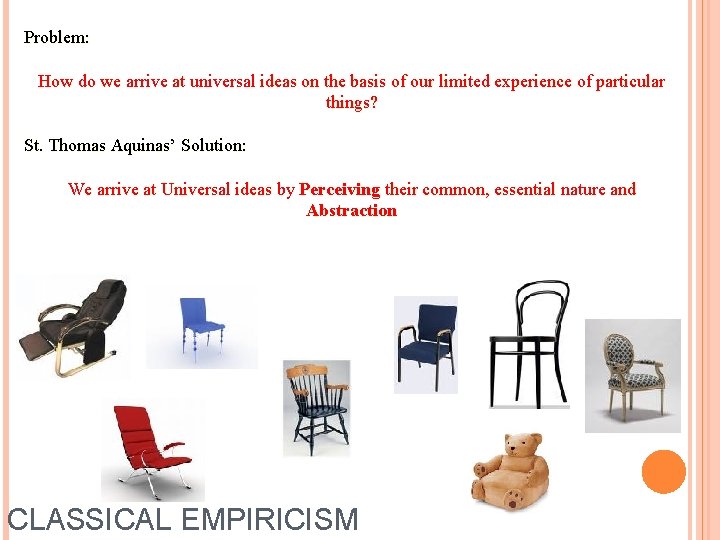
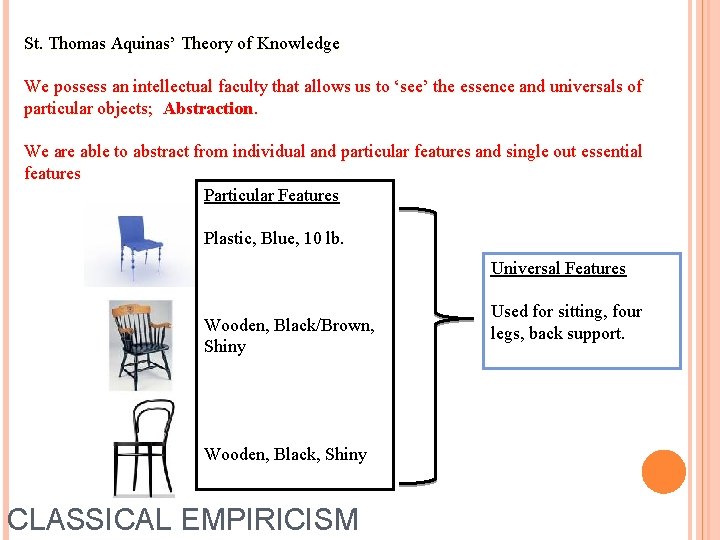
Problem: How do we arrive at universal ideas on the basis of our limited experience of particular things? St. Thomas Aquinas’ Solution: We arrive at Universal ideas by Perceiving their common, essential nature and Abstraction CLASSICAL EMPIRICISM
St. Thomas Aquinas’ Theory of Knowledge We possess an intellectual faculty that allows us to ‘see’ the essence and universals of particular objects; Abstraction. We are able to abstract from individual and particular features and single out essential features Particular Features Plastic, Blue, 10 lb. Universal Features Wooden, Black/Brown, Shiny Wooden, Black, Shiny CLASSICAL EMPIRICISM Used for sitting, four legs, back support.
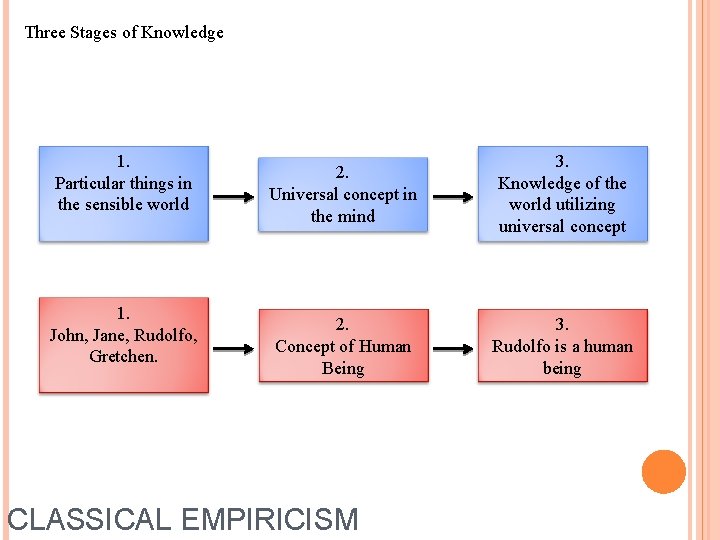
Three Stages of Knowledge 1. Particular things in the sensible world 1. John, Jane, Rudolfo, Gretchen. 2. Universal concept in the mind 3. Knowledge of the world utilizing universal concept 2. Concept of Human Being 3. Rudolfo is a human being CLASSICAL EMPIRICISM
MODERN EMPIRICISM
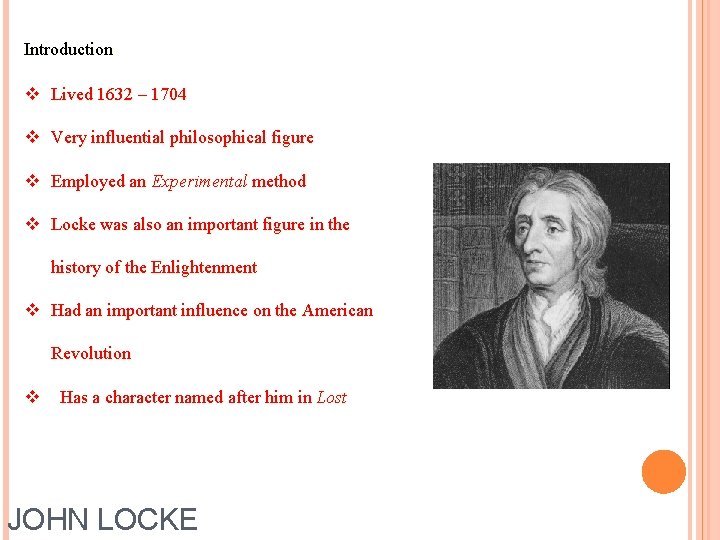
Introduction v Lived 1632 – 1704 v Very influential philosophical figure v Employed an Experimental method v Locke was also an important figure in the history of the Enlightenment v Had an important influence on the American Revolution v Has a character named after him in Lost JOHN LOCKE
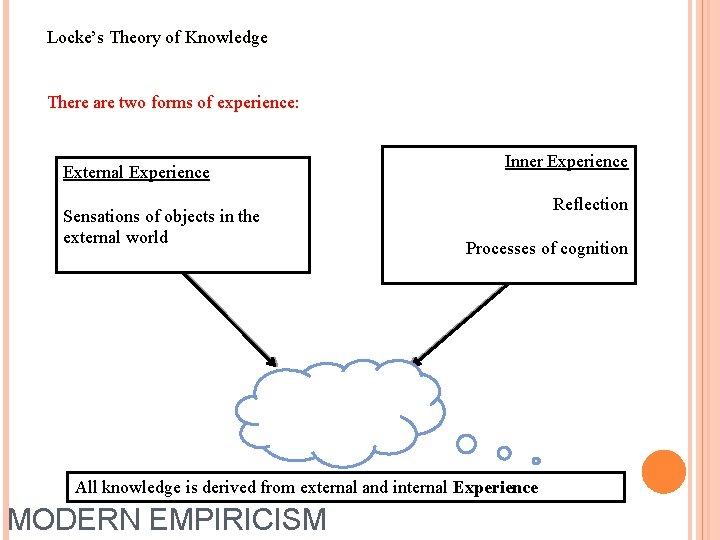
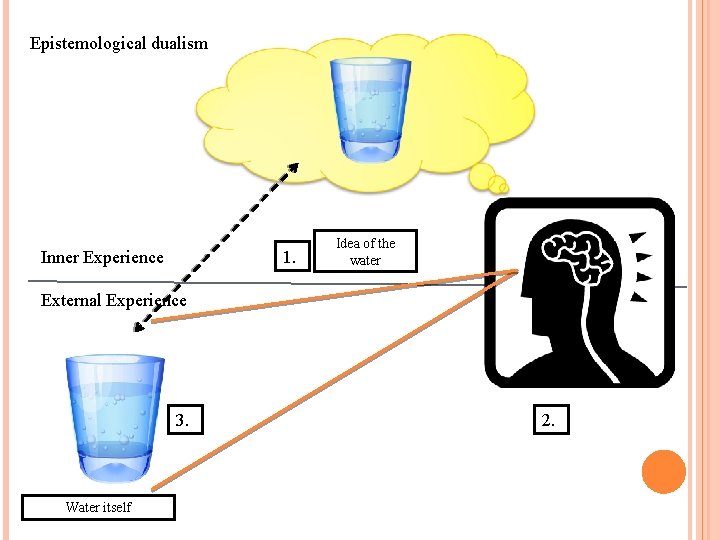
Locke’s Theory of Knowledge There are two forms of experience: External Experience Sensations of objects in the external world Inner Experience Reflection Processes of cognition All knowledge is derived from external and internal Experience MODERN EMPIRICISM
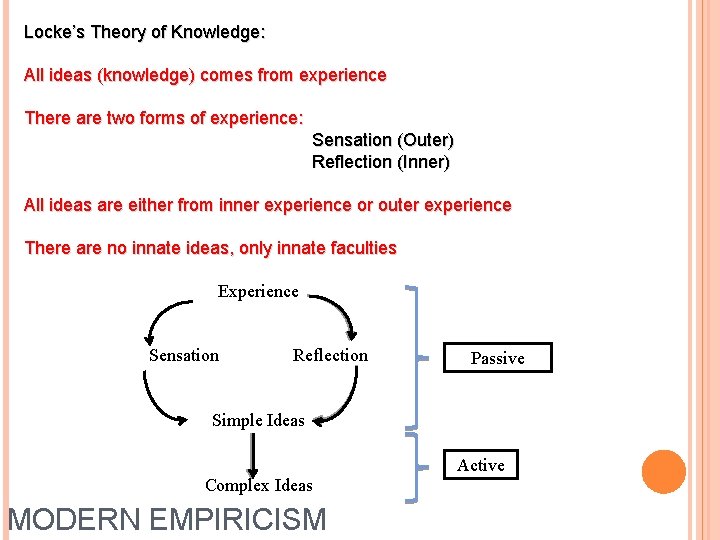
Locke’s Theory of Knowledge: All ideas (knowledge) comes from experience There are two forms of experience: Sensation (Outer) Reflection (Inner) All ideas are either from inner experience or outer experience There are no innate ideas, only innate faculties Experience Sensation Reflection Passive Simple Ideas Active Complex Ideas MODERN EMPIRICISM
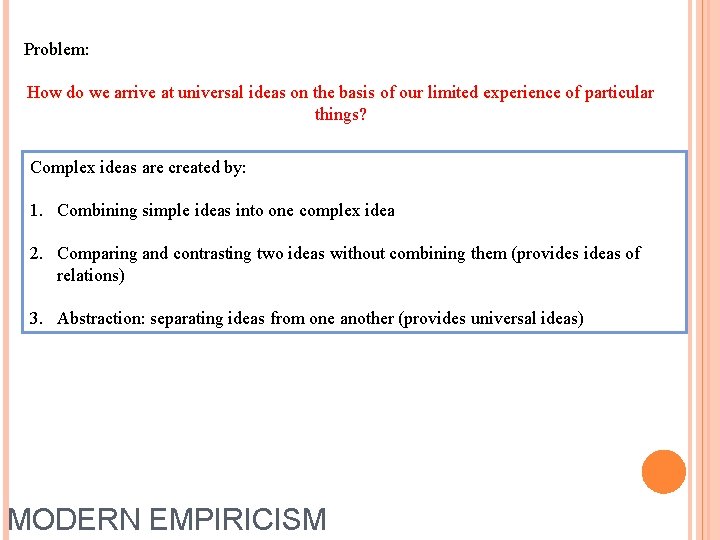
Problem: How do we arrive at universal ideas on the basis of our limited experience of particular things? Complex ideas are created by: 1. Combining simple ideas into one complex idea 2. Comparing and contrasting two ideas without combining them (provides ideas of relations) 3. Abstraction: separating ideas from one another (provides universal ideas) MODERN EMPIRICISM
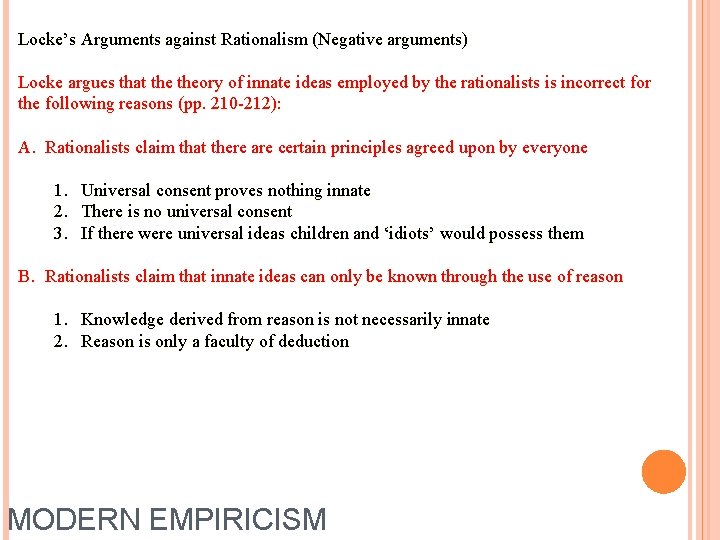
Locke’s Arguments against Rationalism (Negative arguments) Locke argues that theory of innate ideas employed by the rationalists is incorrect for the following reasons (pp. 210 -212): A. Rationalists claim that there are certain principles agreed upon by everyone 1. 2. 3. Universal consent proves nothing innate There is no universal consent If there were universal ideas children and ‘idiots’ would possess them B. Rationalists claim that innate ideas can only be known through the use of reason 1. Knowledge derived from reason is not necessarily innate 2. Reason is only a faculty of deduction MODERN EMPIRICISM
Locke’s Arguments for Empiricism (Positive arguments) (pp. 213 -216) 1. Idea is the object of thinking 2. All ideas come from Sensation or Reflection 3. The objects of sensation one source of ideas 4. The operations of our mind the other source of them 5. All ideas are either from sensation or reflection 6. Observable in children 7. Uncompounded appearance 8. The mind cannot make or destroy ideas 9. Complex ideas are created (by the mind) from simple ones 10. Made voluntary MODERN EMPIRICISM
Epistemological dualism Inner Experience 1. Idea of the water External Experience 3. Water itself 2.
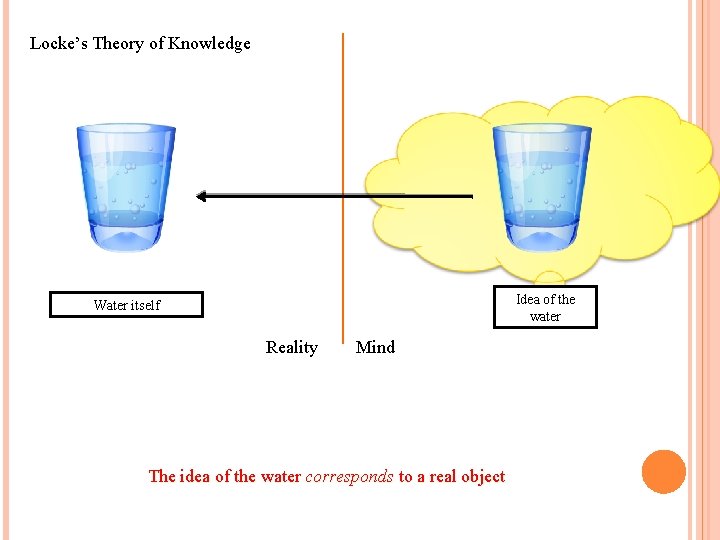
Locke’s Theory of Knowledge Idea of the water Water itself Reality Mind The idea of the water corresponds to a real object
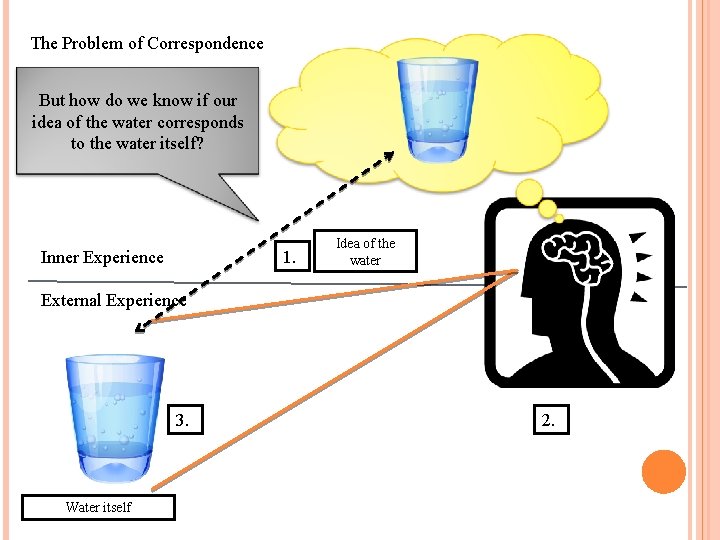
The Problem of Correspondence But how do we know if our idea of the water corresponds to the water itself? Inner Experience 1. Idea of the water External Experience 3. Water itself 2.
The Problem of Correspondence Representational theories of perception maintain that everything we know is an idea in the mind that represents or corresponds to something outside of the mind Problem: How do we know if our ideas of an object accurately correspond to the object itself? All we have are ideas of objects We cannot have knowledge of anything that is not an idea Therefore, we cannot have knowledge of an object apart from an idea Therefore, we can never know if our ideas of water correspond to the water itself MODERN EMPIRICISM
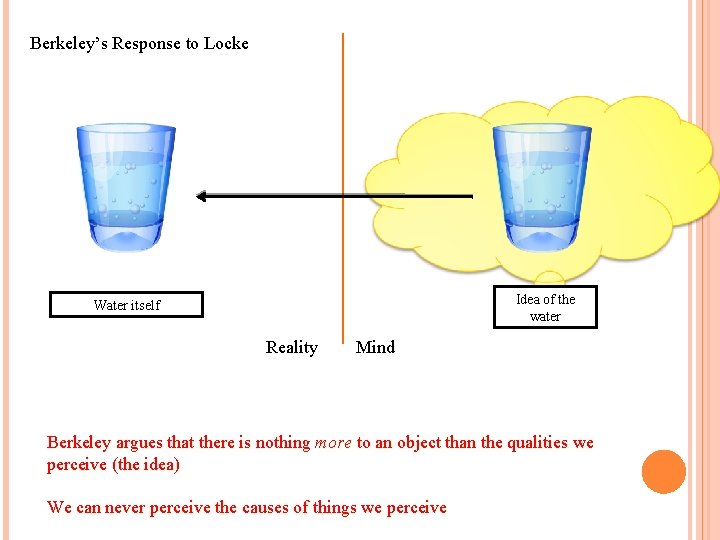
Berkeley’s Response to Locke Idea of the water Water itself Reality Mind Berkeley argues that there is nothing more to an object than the qualities we perceive (the idea) We can never perceive the causes of things we perceive