
Moscow State Institute of International Relations MGIMOUniversity School

- Slides: 70
Moscow State Institute of International Relations (MGIMO-University) School of Government and International Affairs & Alexander Shishkin Department of Philosophy The Basics of Philosophy Part VI The Origins of Sociocentric Philosophy Lecture 15 Kant’s Theory of Knowledge
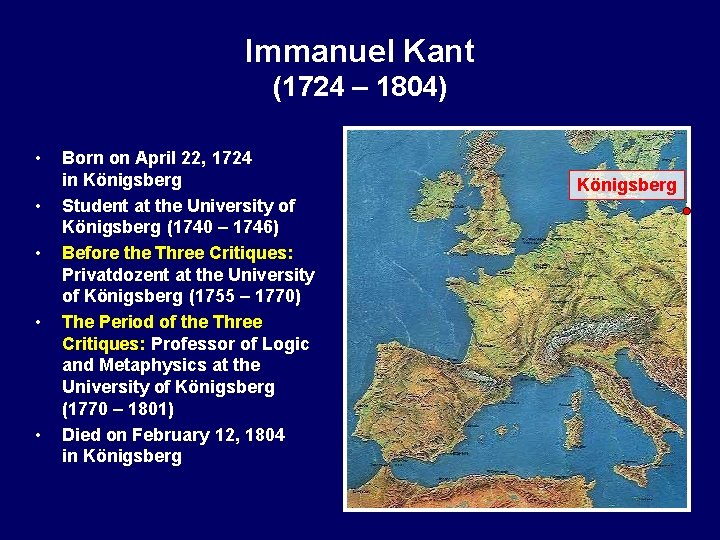
Immanuel Kant (1724 – 1804) • • • Born on April 22, 1724 in Königsberg Student at the University of Königsberg (1740 – 1746) Before the Three Critiques: Privatdozent at the University of Königsberg (1755 – 1770) The Period of the Three Critiques: Professor of Logic and Metaphysics at the University of Königsberg (1770 – 1801) Died on February 12, 1804 in Königsberg
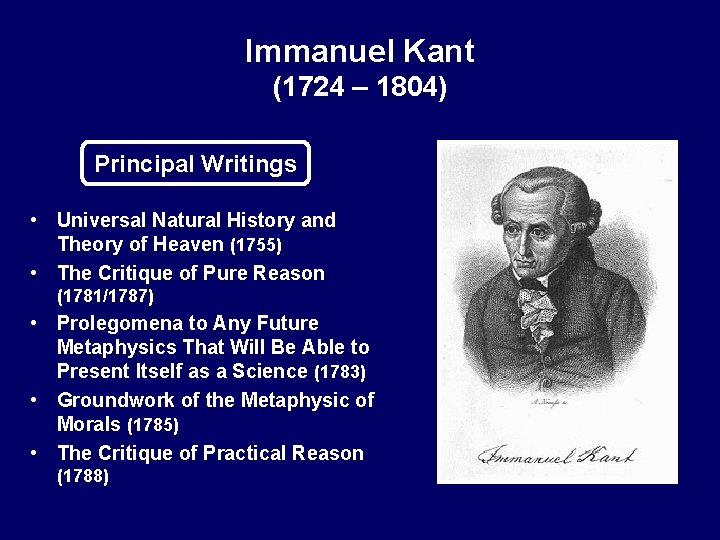
Immanuel Kant (1724 – 1804) Principal Writings • Universal Natural History and Theory of Heaven (1755) • The Critique of Pure Reason (1781/1787) • Prolegomena to Any Future Metaphysics That Will Be Able to Present Itself as a Science (1783) • Groundwork of the Metaphysic of Morals (1785) • The Critique of Practical Reason (1788)
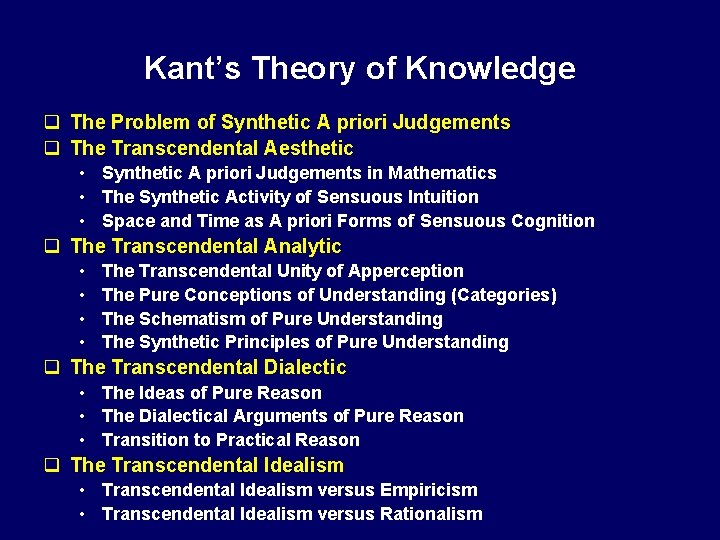
Kant’s Theory of Knowledge q The Problem of Synthetic A priori Judgements q The Transcendental Aesthetic • Synthetic A priori Judgements in Mathematics • The Synthetic Activity of Sensuous Intuition • Space and Time as A priori Forms of Sensuous Cognition q The Transcendental Analytic • • The Transcendental Unity of Apperception The Pure Conceptions of Understanding (Categories) The Schematism of Pure Understanding The Synthetic Principles of Pure Understanding q The Transcendental Dialectic • The Ideas of Pure Reason • The Dialectical Arguments of Pure Reason • Transition to Practical Reason q The Transcendental Idealism • Transcendental Idealism versus Empiricism • Transcendental Idealism versus Rationalism
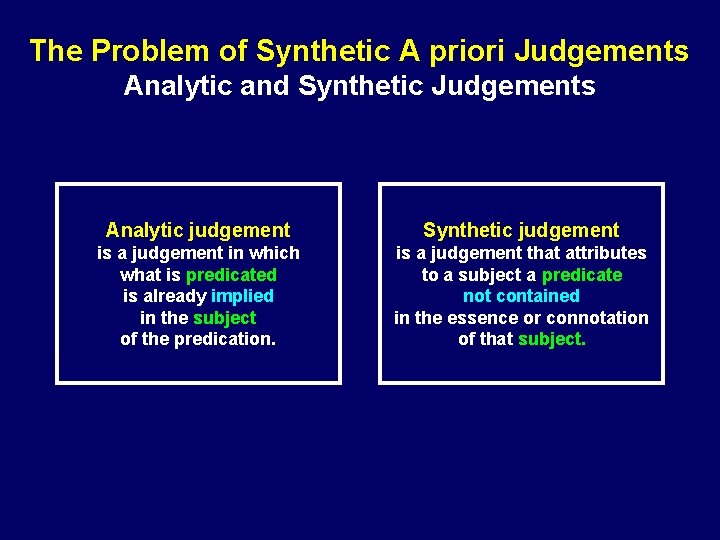
The Problem of Synthetic A priori Judgements Analytic and Synthetic Judgements Analytic judgement Synthetic judgement is a judgement in which what is predicated is already implied in the subject of the predication. is a judgement that attributes to a subject a predicate not contained in the essence or connotation of that subject.
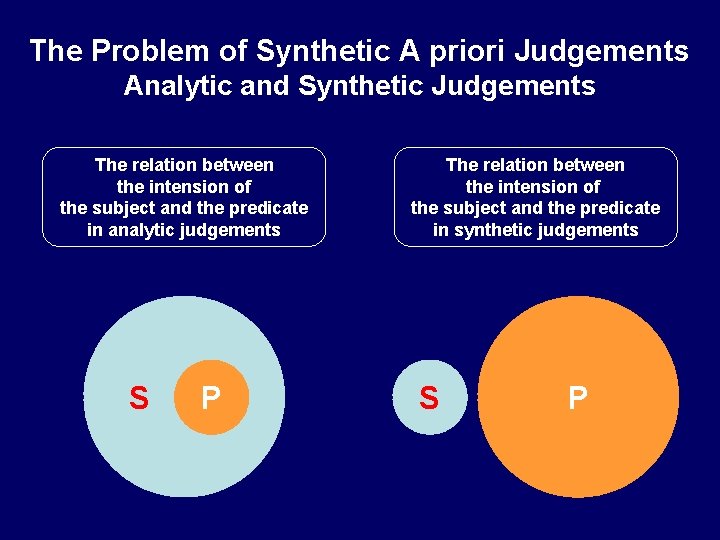
The Problem of Synthetic A priori Judgements Analytic and Synthetic Judgements The relation between the intension of the subject and the predicate in analytic judgements S P The relation between the intension of the subject and the predicate in synthetic judgements S P
The Problem of Synthetic A priori Judgements Analytic and Synthetic Judgements Examples of analytic judgements Examples of synthetic judgements All bodies are extended. Some bodies are heavy. All wholes are greater than any of their parts. Some novels are in two parts. No bachelors are married. Some men are unmarried.
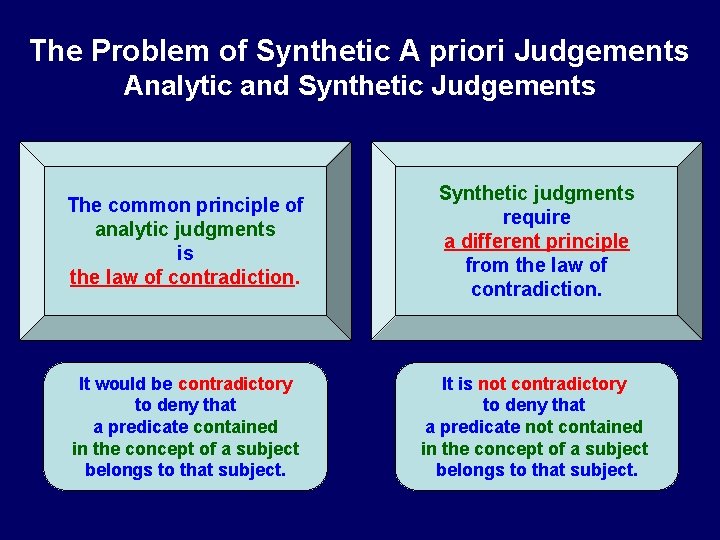
The Problem of Synthetic A priori Judgements Analytic and Synthetic Judgements The common principle of analytic judgments is the law of contradiction. Synthetic judgments require a different principle from the law of contradiction. It would be contradictory to deny that a predicate contained in the concept of a subject belongs to that subject. It is not contradictory to deny that a predicate not contained in the concept of a subject belongs to that subject.
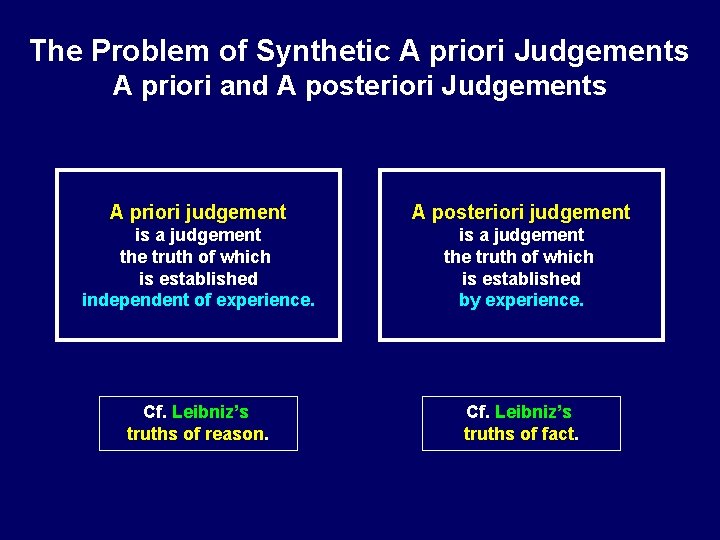
The Problem of Synthetic A priori Judgements A priori and A posteriori Judgements A priori judgement A posteriori judgement is a judgement the truth of which is established independent of experience. is a judgement the truth of which is established by experience. Cf. Leibniz’s truths of reason. Cf. Leibniz’s truths of fact.
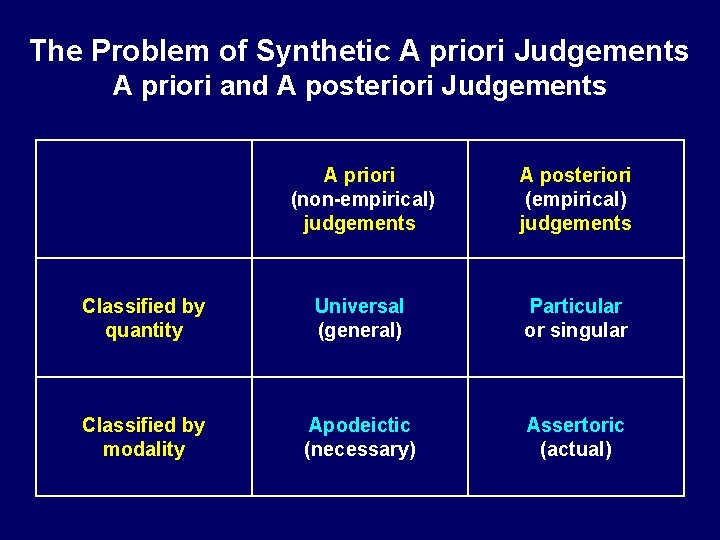
The Problem of Synthetic A priori Judgements A priori and A posteriori Judgements A priori (non-empirical) judgements A posteriori (empirical) judgements Classified by quantity Universal (general) Particular or singular Classified by modality Apodeictic (necessary) Assertoric (actual)
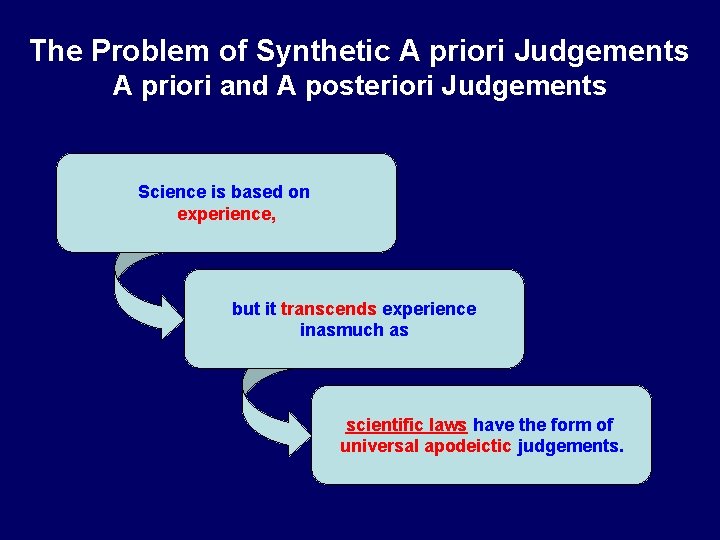
The Problem of Synthetic A priori Judgements A priori and A posteriori Judgements Science is based on experience, but it transcends experience inasmuch as scientific laws have the form of universal apodeictic judgements.
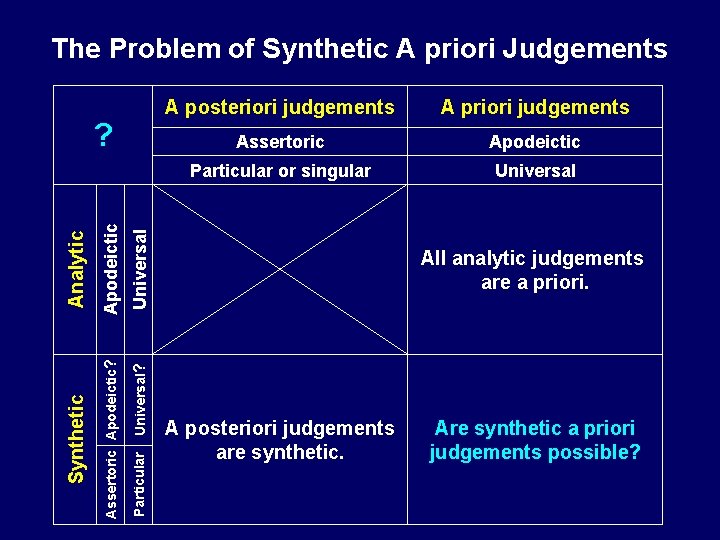
The Problem of Synthetic A priori Judgements Apodeictic Universal Assertoric Apodeictic? Universal? Particular Analytic Synthetic ? A posteriori judgements A priori judgements Assertoric Apodeictic Particular or singular Universal All analytic judgements are a priori. A posteriori judgements are synthetic. Are synthetic a priori judgements possible?
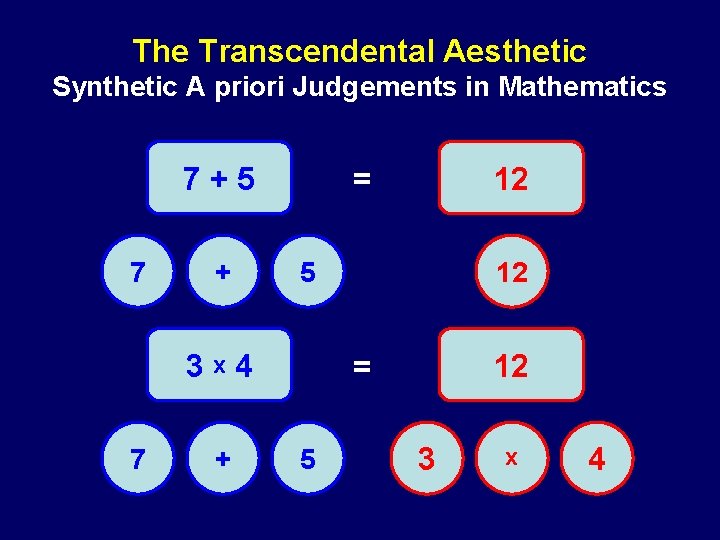
The Transcendental Aesthetic Synthetic A priori Judgements in Mathematics 7+5 7 + 5 3 x 4 7 + 12 = 12 12 = 5 3 x 4
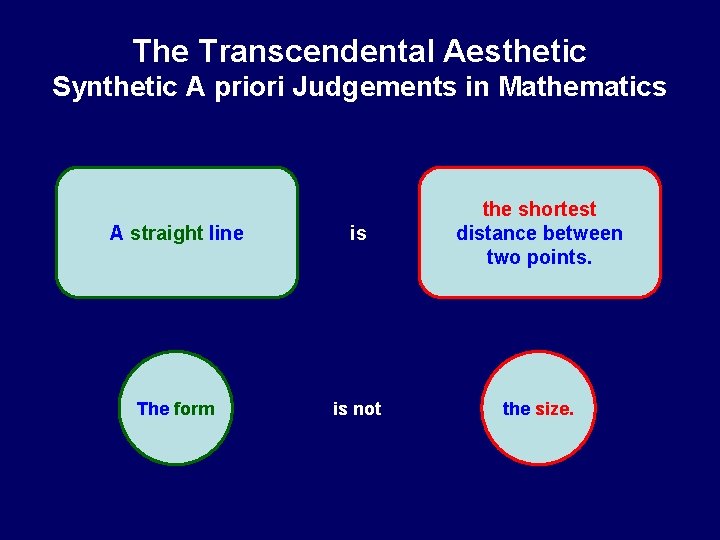
The Transcendental Aesthetic Synthetic A priori Judgements in Mathematics A straight line is the shortest distance between two points. The form is not the size.
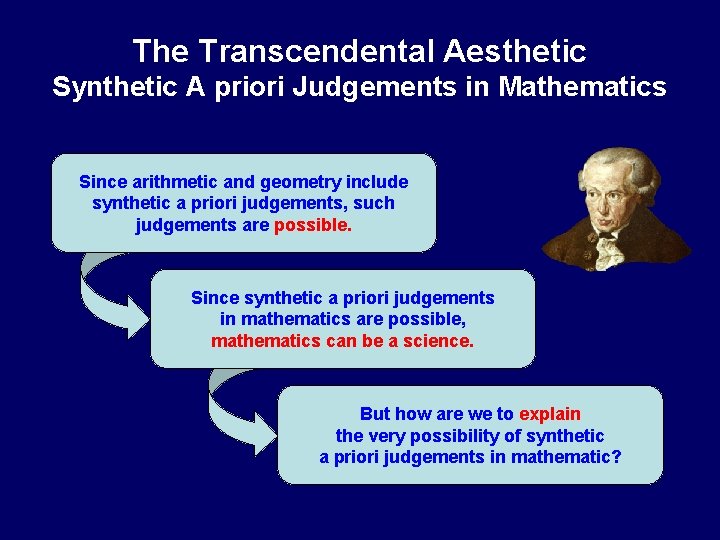
The Transcendental Aesthetic Synthetic A priori Judgements in Mathematics Since arithmetic and geometry include synthetic a priori judgements, such judgements are possible. Since synthetic a priori judgements in mathematics are possible, mathematics can be a science. But how are we to explain the very possibility of synthetic a priori judgements in mathematic?
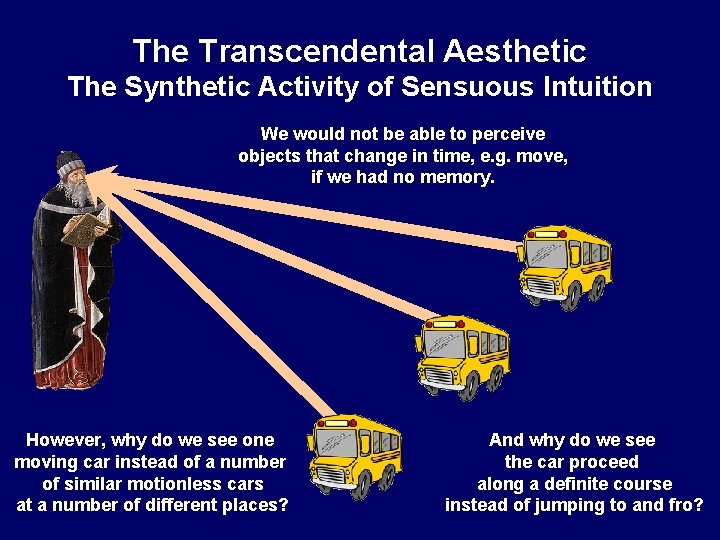
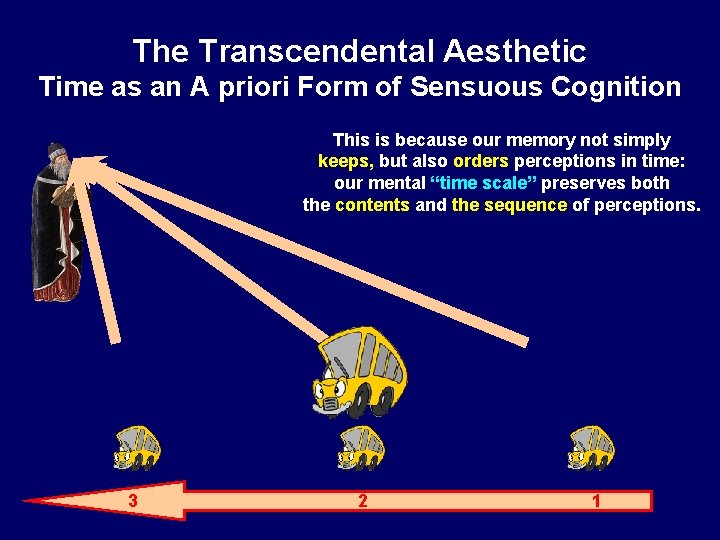
The Transcendental Aesthetic The Synthetic Activity of Sensuous Intuition We would not be able to perceive objects that change in time, e. g. move, if we had no memory. However, why do we see one moving car instead of a number of similar motionless cars at a number of different places? And why do we see the car proceed along a definite course instead of jumping to and fro?
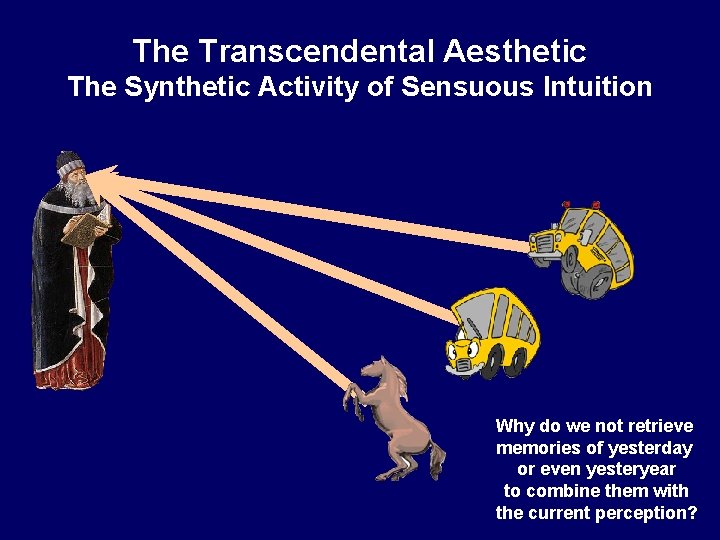
The Transcendental Aesthetic The Synthetic Activity of Sensuous Intuition Why do we not retrieve memories of yesterday or even yesteryear to combine them with the current perception?
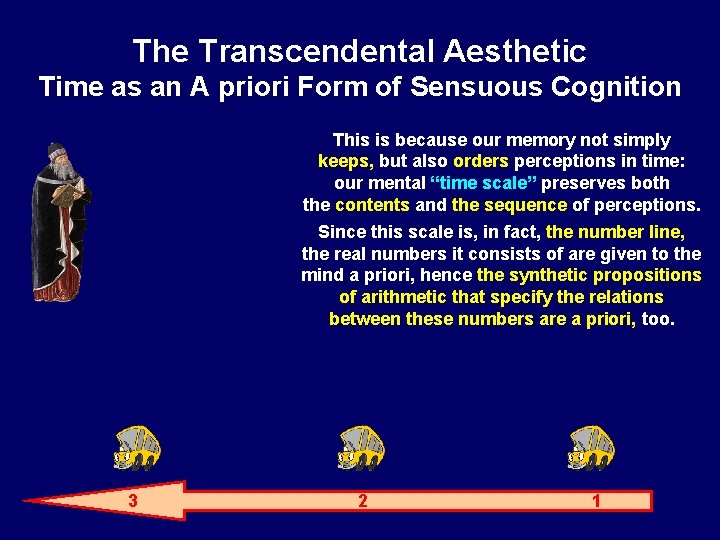
The Transcendental Aesthetic Time as an A priori Form of Sensuous Cognition This is because our memory not simply keeps, but also orders perceptions in time: our mental “time scale” preserves both the contents and the sequence of perceptions. 3 2 1
The Transcendental Aesthetic Time as an A priori Form of Sensuous Cognition This is because our memory not simply keeps, but also orders perceptions in time: our mental “time scale” preserves both the contents and the sequence of perceptions. Since this scale is, in fact, the number line, the real numbers it consists of are given to the mind a priori, hence the synthetic propositions of arithmetic that specify the relations between these numbers are a priori, too. 3 2 1
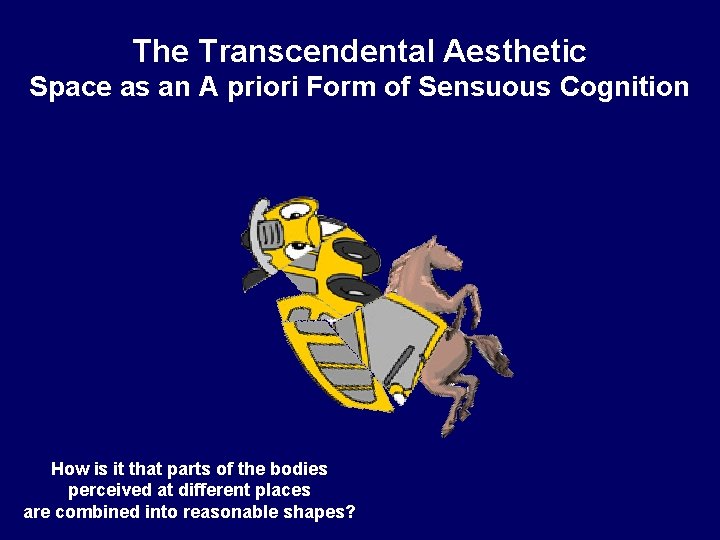
The Transcendental Aesthetic Space as an A priori Form of Sensuous Cognition How is it that parts of the bodies perceived at different places are combined into reasonable shapes?
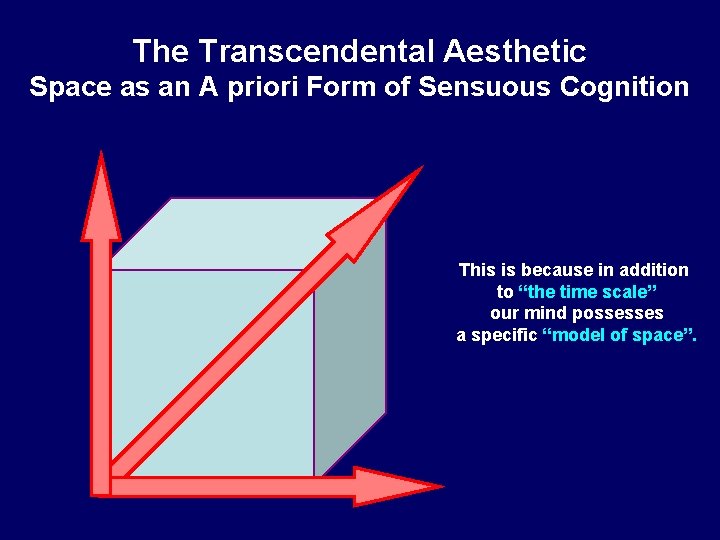
The Transcendental Aesthetic Space as an A priori Form of Sensuous Cognition This is because in addition to “the time scale” our mind possesses a specific “model of space”.
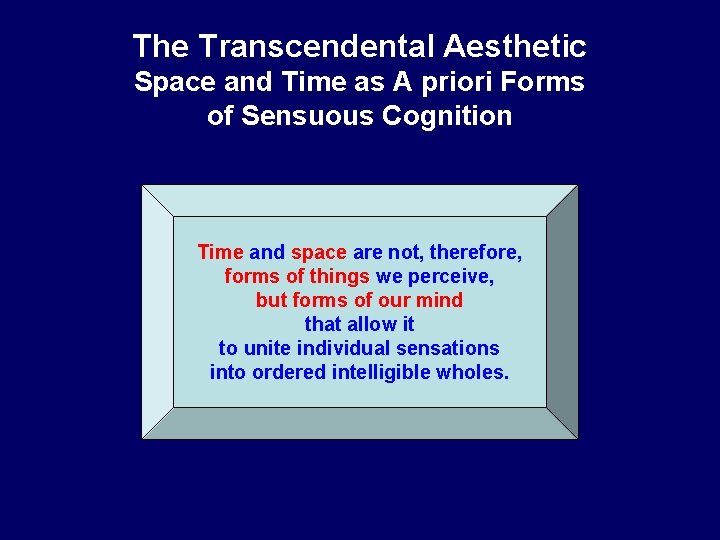
The Transcendental Aesthetic Space and Time as A priori Forms of Sensuous Cognition Time and space are not, therefore, forms of things we perceive, but forms of our mind that allow it to unite individual sensations into ordered intelligible wholes.
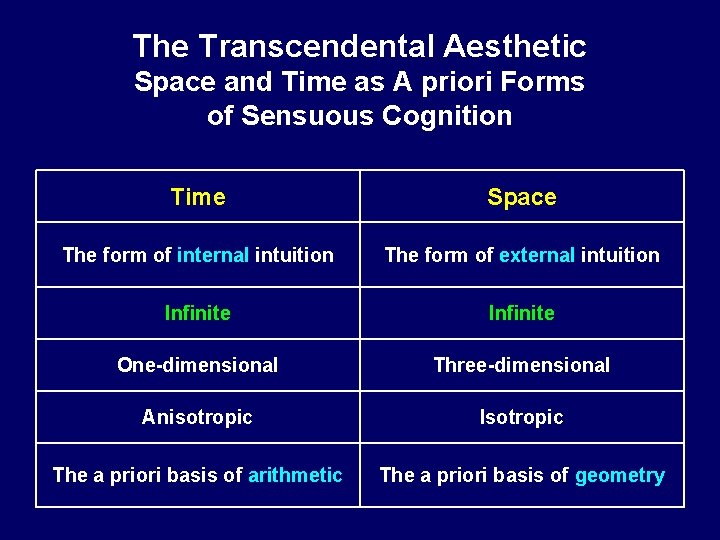
The Transcendental Aesthetic Space and Time as A priori Forms of Sensuous Cognition Time Space The form of internal intuition The form of external intuition Infinite One-dimensional Three-dimensional Anisotropic Isotropic The a priori basis of arithmetic The a priori basis of geometry
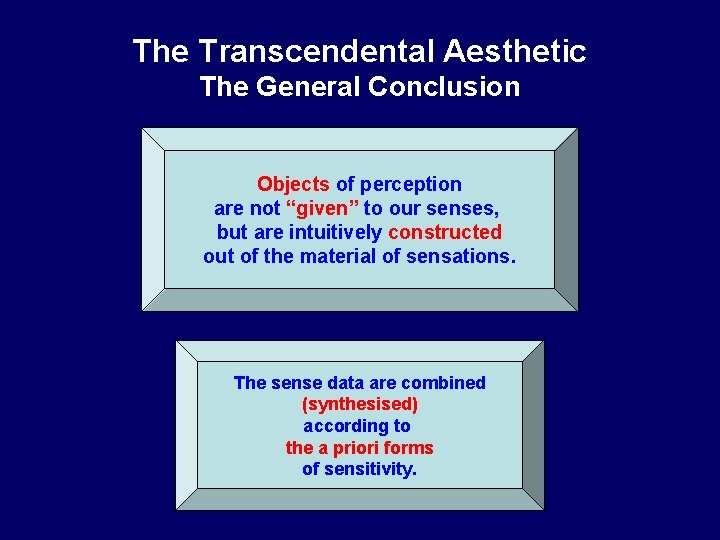
The Transcendental Aesthetic The General Conclusion Objects of perception are not “given” to our senses, but are intuitively constructed out of the material of sensations. The sense data are combined (synthesised) according to the a priori forms of sensitivity.
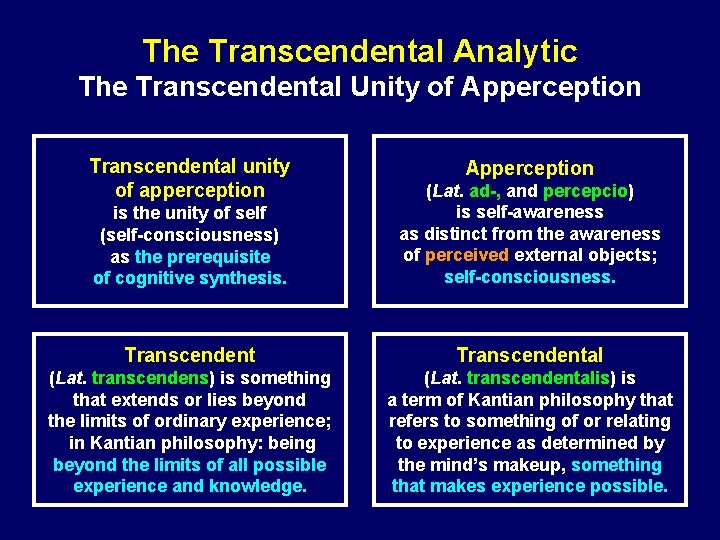
The Transcendental Analytic The Transcendental Unity of Apperception Transcendental unity of apperception Apperception is the unity of self (self-consciousness) as the prerequisite of cognitive synthesis. (Lat. ad-, and percepcio) is self-awareness as distinct from the awareness of perceived external objects; self-consciousness. Transcendental (Lat. transcendens) is something that extends or lies beyond the limits of ordinary experience; in Kantian philosophy: being beyond the limits of all possible experience and knowledge. (Lat. transcendentalis) is a term of Kantian philosophy that refers to something of or relating to experience as determined by the mind’s makeup, something that makes experience possible.
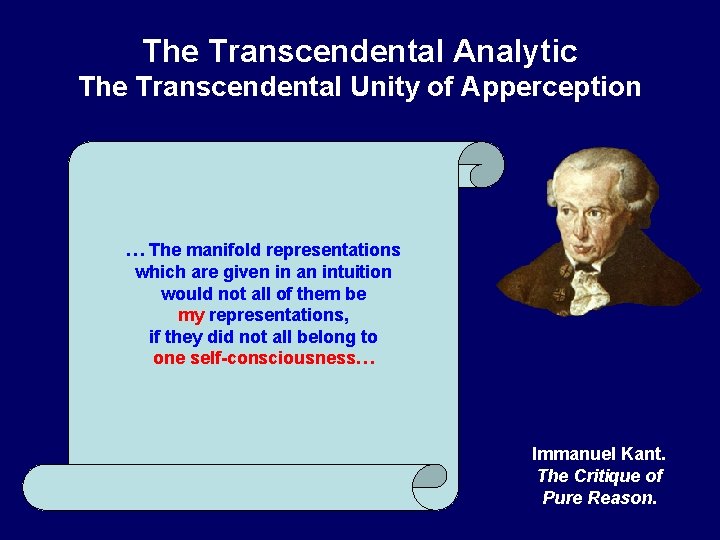
The Transcendental Analytic The Transcendental Unity of Apperception … The manifold representations which are given in an intuition would not all of them be my representations, if they did not all belong to one self-consciousness… Immanuel Kant. The Critique of Pure Reason.
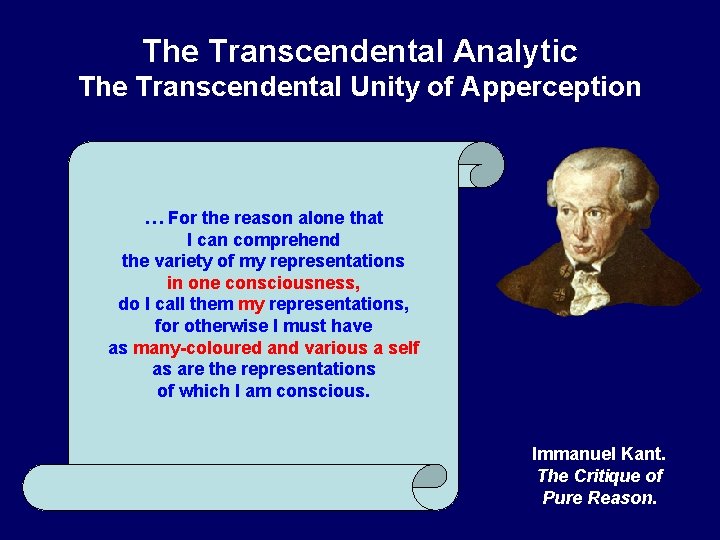
The Transcendental Analytic The Transcendental Unity of Apperception … For the reason alone that I can comprehend the variety of my representations in one consciousness, do I call them my representations, for otherwise I must have as many-coloured and various a self as are the representations of which I am conscious. Immanuel Kant. The Critique of Pure Reason.
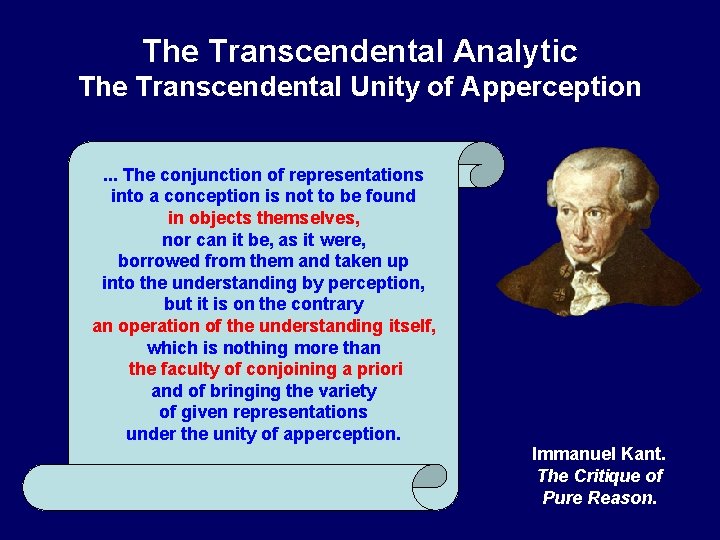
The Transcendental Analytic The Transcendental Unity of Apperception. . . The conjunction of representations into a conception is not to be found in objects themselves, nor can it be, as it were, borrowed from them and taken up into the understanding by perception, but it is on the contrary an operation of the understanding itself, which is nothing more than the faculty of conjoining a priori and of bringing the variety of given representations under the unity of apperception. Immanuel Kant. The Critique of Pure Reason.
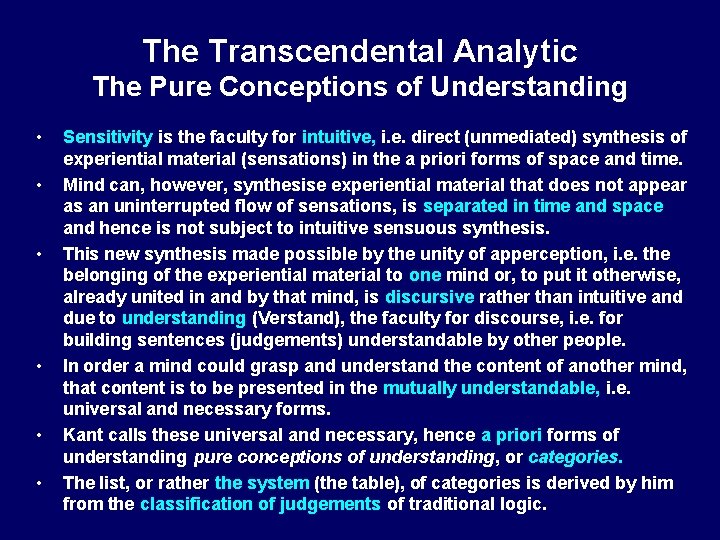
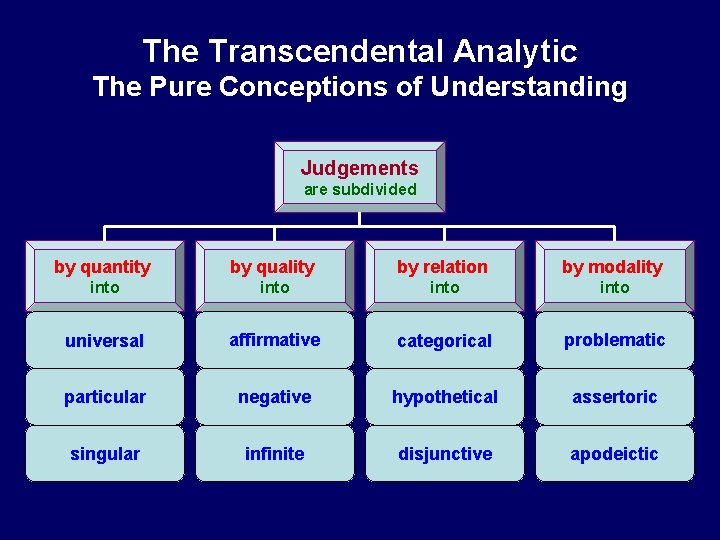
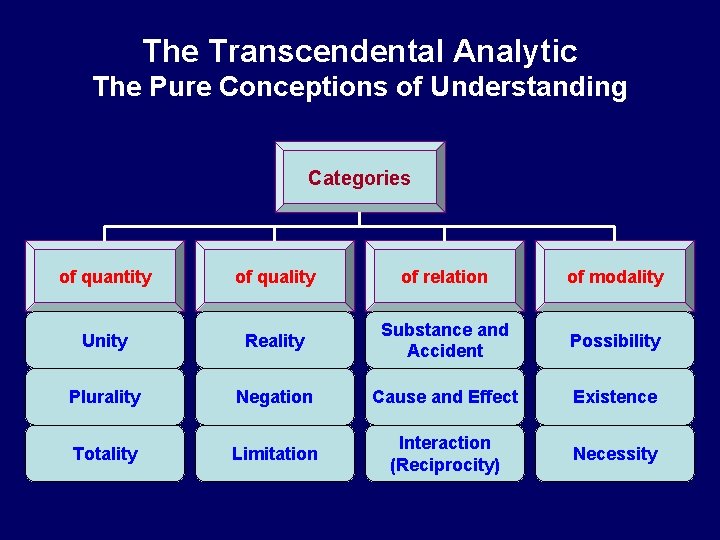
The Transcendental Analytic The Pure Conceptions of Understanding • • • Sensitivity is the faculty for intuitive, i. e. direct (unmediated) synthesis of experiential material (sensations) in the a priori forms of space and time. Mind can, however, synthesise experiential material that does not appear as an uninterrupted flow of sensations, is separated in time and space and hence is not subject to intuitive sensuous synthesis. This new synthesis made possible by the unity of apperception, i. e. the belonging of the experiential material to one mind or, to put it otherwise, already united in and by that mind, is discursive rather than intuitive and due to understanding (Verstand), the faculty for discourse, i. e. for building sentences (judgements) understandable by other people. In order a mind could grasp and understand the content of another mind, that content is to be presented in the mutually understandable, i. e. universal and necessary forms. Kant calls these universal and necessary, hence a priori forms of understanding pure conceptions of understanding, or categories. The list, or rather the system (the table), of categories is derived by him from the classification of judgements of traditional logic.
The Transcendental Analytic The Pure Conceptions of Understanding Judgements are subdivided by quantity by quality by relation by modality into universal affirmative categorical problematic particular negative hypothetical assertoric singular infinite disjunctive apodeictic
The Transcendental Analytic The Pure Conceptions of Understanding Categories of quantity of quality of relation of modality Unity Reality Substance and Accident Possibility Plurality Negation Cause and Effect Existence Totality Limitation Interaction (Reciprocity) Necessity
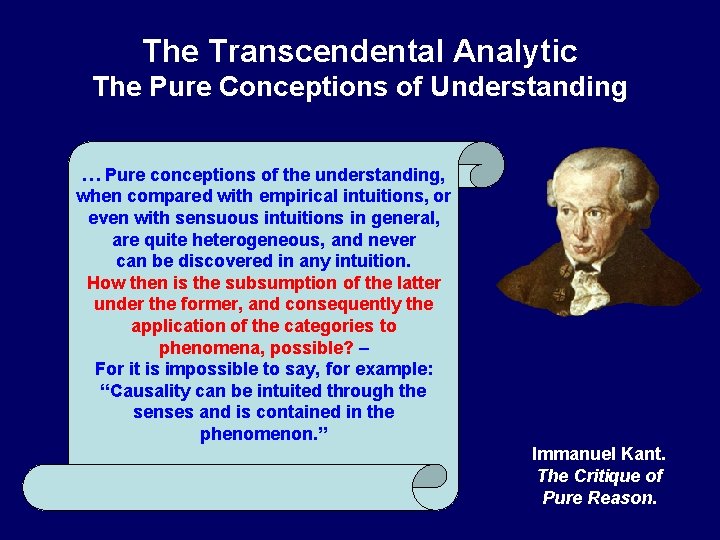
The Transcendental Analytic The Pure Conceptions of Understanding … Pure conceptions of the understanding, when compared with empirical intuitions, or even with sensuous intuitions in general, are quite heterogeneous, and never can be discovered in any intuition. How then is the subsumption of the latter under the former, and consequently the application of the categories to phenomena, possible? – For it is impossible to say, for example: “Causality can be intuited through the senses and is contained in the phenomenon. ” Immanuel Kant. The Critique of Pure Reason.
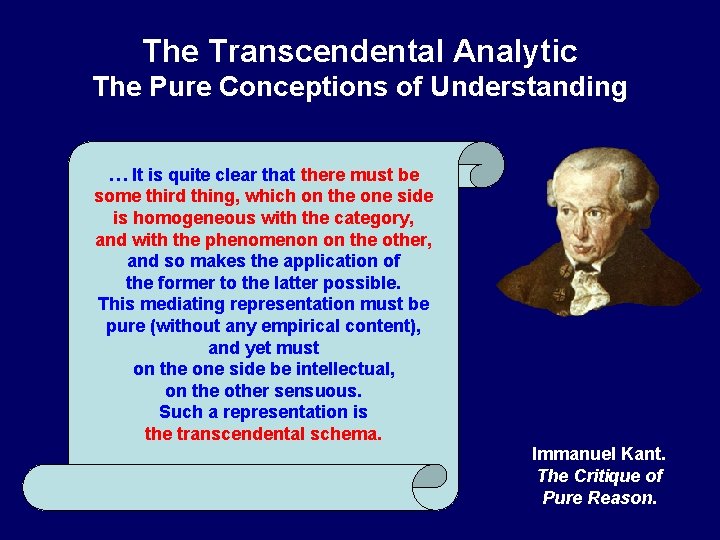
The Transcendental Analytic The Pure Conceptions of Understanding … It is quite clear that there must be some third thing, which on the one side is homogeneous with the category, and with the phenomenon on the other, and so makes the application of the former to the latter possible. This mediating representation must be pure (without any empirical content), and yet must on the one side be intellectual, on the other sensuous. Such a representation is the transcendental schema. Immanuel Kant. The Critique of Pure Reason.
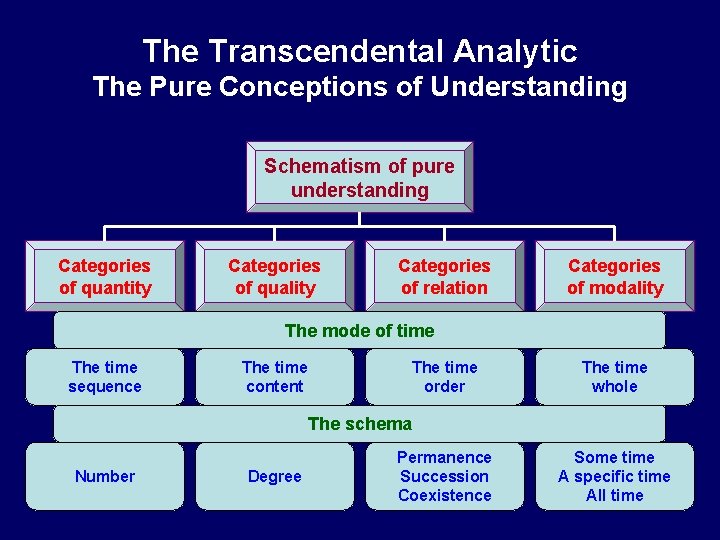
The Transcendental Analytic The Pure Conceptions of Understanding Schematism of pure understanding Categories of quantity Categories of quality Categories of relation Categories of modality The mode of time The time sequence The time content The time order The time whole Permanence Succession Coexistence Some time A specific time All time The schema Number Degree
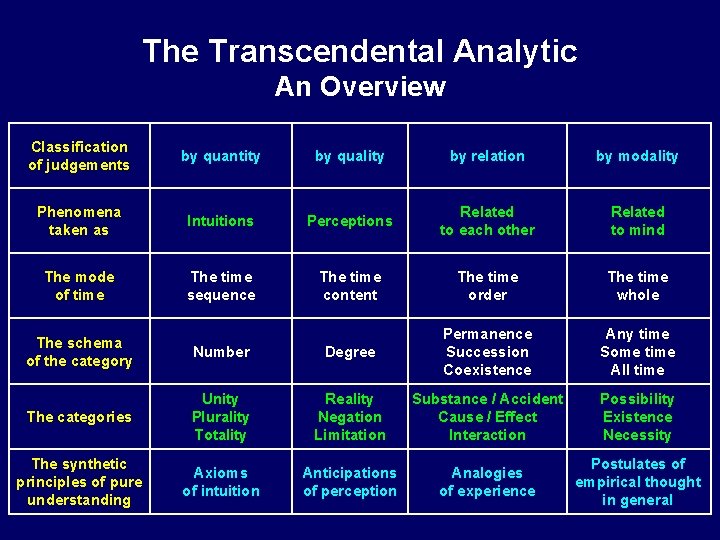
The Transcendental Analytic An Overview Classification of judgements by quantity by quality by relation by modality Phenomena taken as Intuitions Perceptions Related to each other Related to mind The mode of time The time sequence The time content The time order The time whole Any time Some time All time The schema of the category Number Degree Permanence Succession Coexistence The categories Unity Plurality Totality Reality Negation Limitation Substance / Accident Cause / Effect Interaction Possibility Existence Necessity The synthetic principles of pure understanding Axioms of intuition Anticipations of perception Analogies of experience Postulates of empirical thought in general
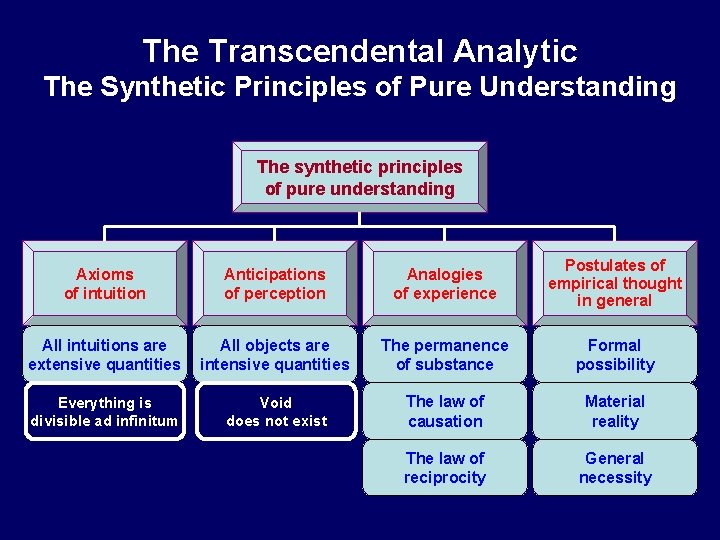
The Transcendental Analytic The Synthetic Principles of Pure Understanding The synthetic principles of pure understanding Axioms of intuition Anticipations of perception Analogies of experience Postulates of empirical thought in general All intuitions are extensive quantities All objects are intensive quantities The permanence of substance Formal possibility Everything is divisible ad infinitum Void does not exist The law of causation Material reality The law of reciprocity General necessity
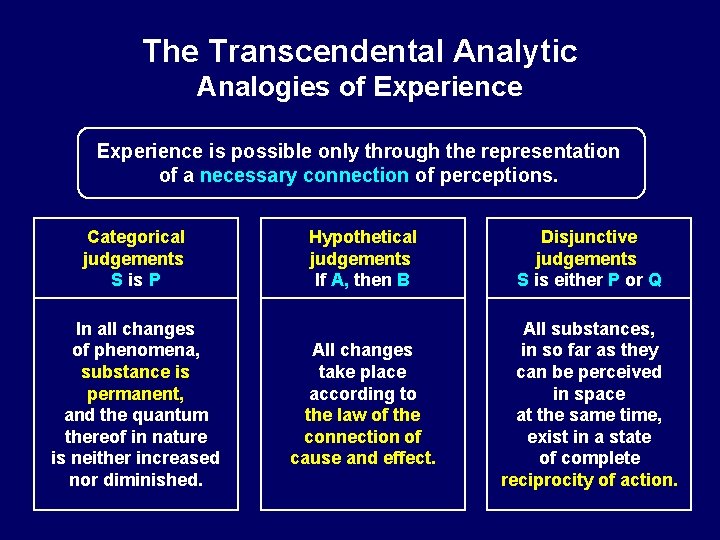
The Transcendental Analytic Analogies of Experience is possible only through the representation of a necessary connection of perceptions. Categorical judgements S is P In all changes of phenomena, substance is permanent, and the quantum thereof in nature is neither increased nor diminished. Hypothetical judgements If A, then B Disjunctive judgements S is either P or Q All changes take place according to the law of the connection of cause and effect. All substances, in so far as they can be perceived in space at the same time, exist in a state of complete reciprocity of action.
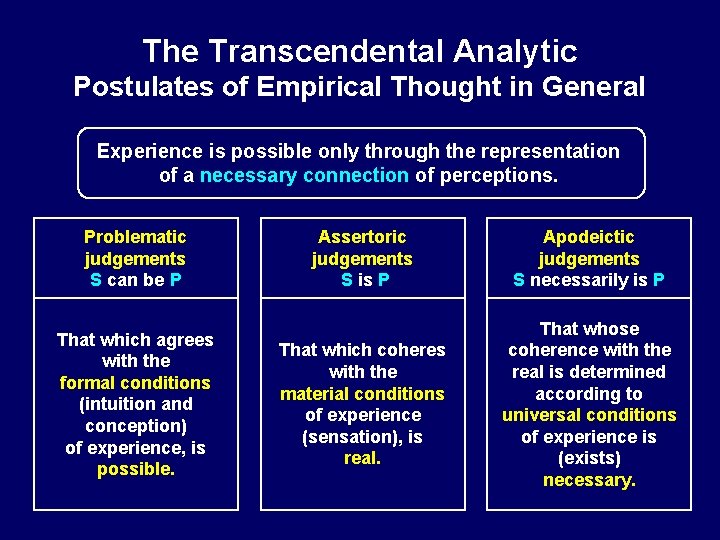
The Transcendental Analytic Postulates of Empirical Thought in General Experience is possible only through the representation of a necessary connection of perceptions. Problematic judgements S can be P That which agrees with the formal conditions (intuition and conception) of experience, is possible. Assertoric judgements S is P Apodeictic judgements S necessarily is P That which coheres with the material conditions of experience (sensation), is real. That whose coherence with the real is determined according to universal conditions of experience is (exists) necessary.
The Transcendental Analytic The General Conclusion The understanding does not derive its laws from, but prescribes them to, nature.
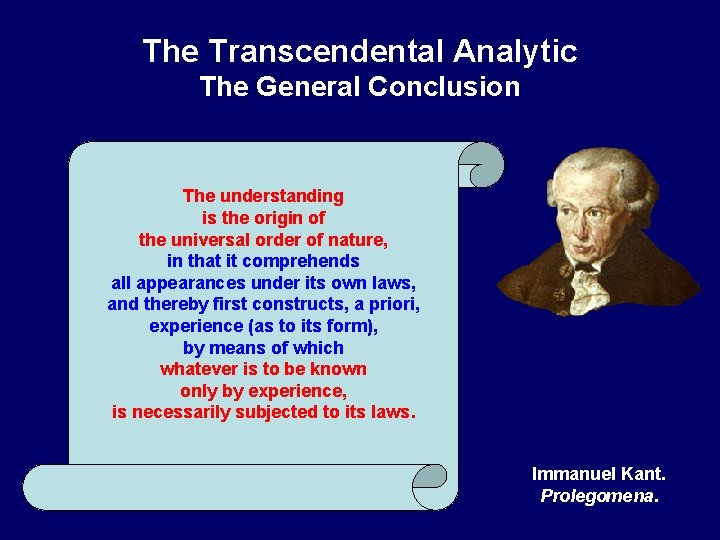
The Transcendental Analytic The General Conclusion The understanding is the origin of the universal order of nature, in that it comprehends all appearances under its own laws, and thereby first constructs, a priori, experience (as to its form), by means of which whatever is to be known only by experience, is necessarily subjected to its laws. Immanuel Kant. Prolegomena.
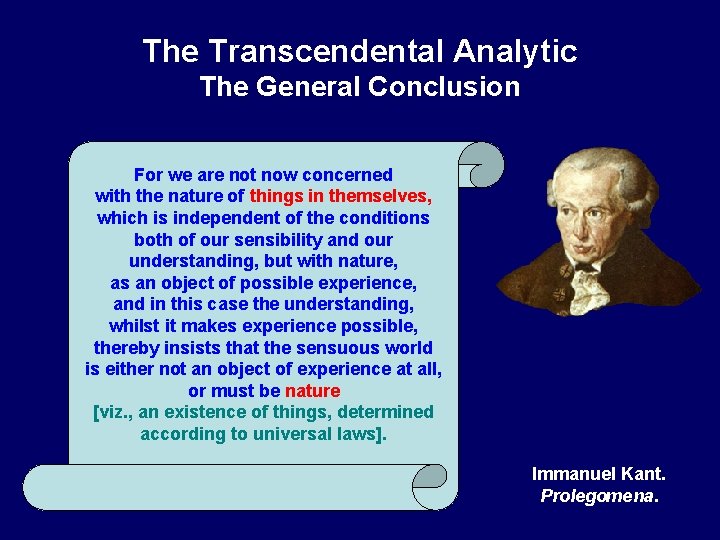
The Transcendental Analytic The General Conclusion For we are not now concerned with the nature of things in themselves, which is independent of the conditions both of our sensibility and our understanding, but with nature, as an object of possible experience, and in this case the understanding, whilst it makes experience possible, thereby insists that the sensuous world is either not an object of experience at all, or must be nature [viz. , an existence of things, determined according to universal laws]. Immanuel Kant. Prolegomena.
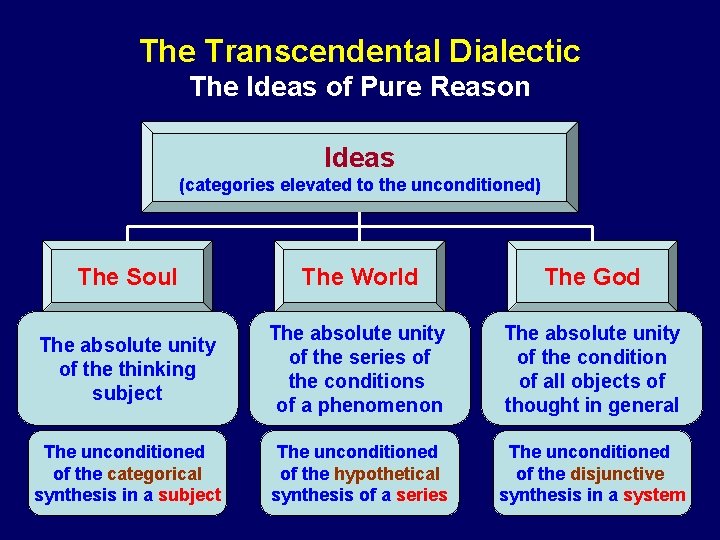
The Transcendental Dialectic The Ideas of Pure Reason Ideas (categories elevated to the unconditioned) The Soul The World The God The absolute unity of the thinking subject The absolute unity of the series of the conditions of a phenomenon The absolute unity of the condition of all objects of thought in general The unconditioned of the categorical synthesis in a subject The unconditioned of the hypothetical synthesis of a series The unconditioned of the disjunctive synthesis in a system
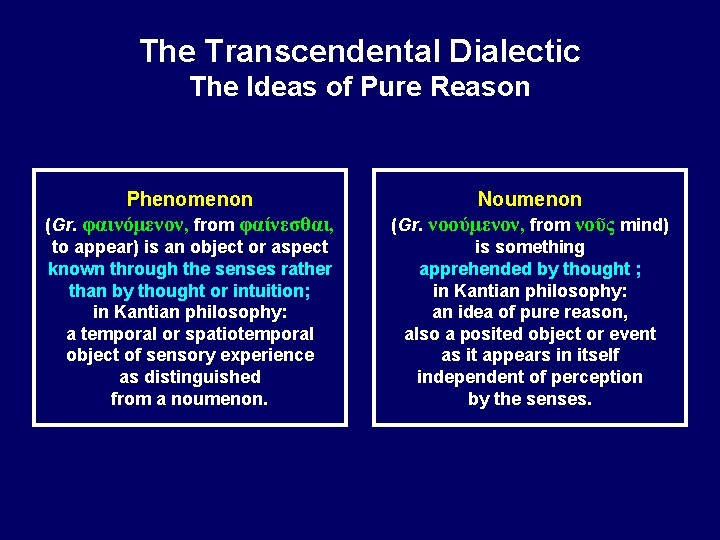
The Transcendental Dialectic The Ideas of Pure Reason Phenomenon Noumenon (Gr. φαινόμενον, from φαίνεσθαι, to appear) is an object or aspect known through the senses rather than by thought or intuition; in Kantian philosophy: a temporal or spatiotemporal object of sensory experience as distinguished from a noumenon. (Gr. νοούμενον, from νοῦς mind) is something apprehended by thought ; in Kantian philosophy: an idea of pure reason, also a posited object or event as it appears in itself independent of perception by the senses.
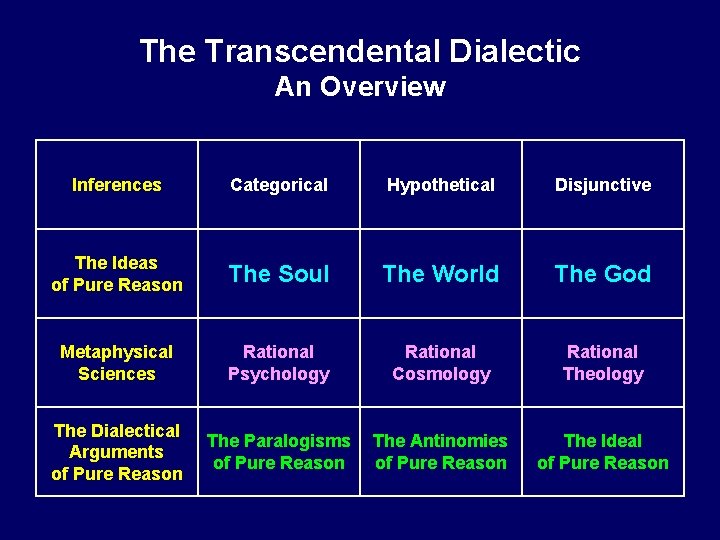
The Transcendental Dialectic An Overview Inferences Categorical Hypothetical Disjunctive The Ideas of Pure Reason The Soul The World The God Metaphysical Sciences Rational Psychology Rational Cosmology Rational Theology The Dialectical Arguments of Pure Reason The Paralogisms of Pure Reason The Antinomies of Pure Reason The Ideal of Pure Reason
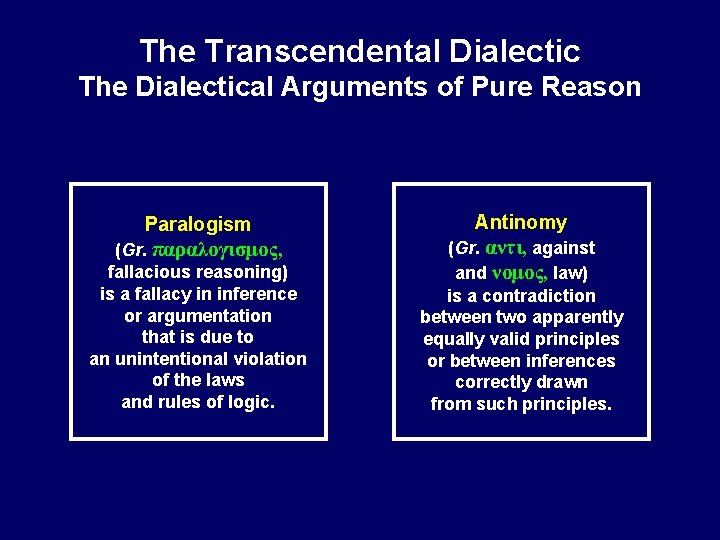
The Transcendental Dialectic The Dialectical Arguments of Pure Reason Paralogism Antinomy (Gr. παραλογισμος, fallacious reasoning) is a fallacy in inference or argumentation that is due to an unintentional violation of the laws and rules of logic. (Gr. αντι, against and νομος, law) is a contradiction between two apparently equally valid principles or between inferences correctly drawn from such principles.
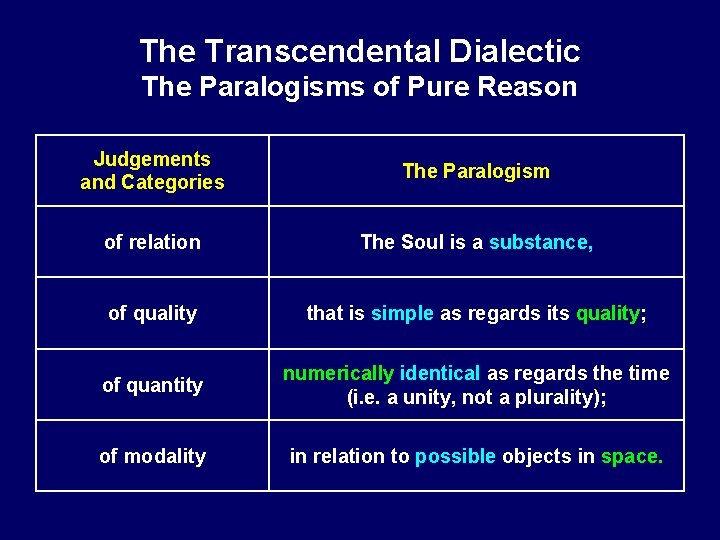
The Transcendental Dialectic The Paralogisms of Pure Reason Judgements and Categories The Paralogism of relation The Soul is a substance, of quality that is simple as regards its quality; of quantity numerically identical as regards the time (i. e. a unity, not a plurality); of modality in relation to possible objects in space.
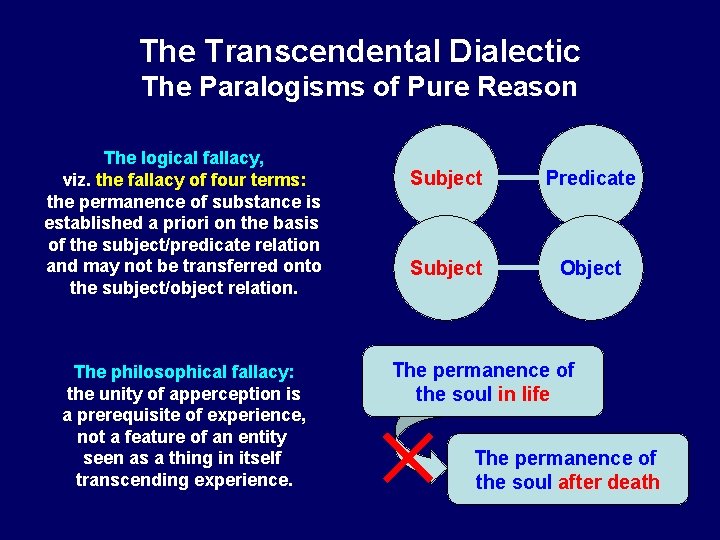
The Transcendental Dialectic The Paralogisms of Pure Reason The logical fallacy, viz. the fallacy of four terms: the permanence of substance is established a priori on the basis of the subject/predicate relation and may not be transferred onto the subject/object relation. The philosophical fallacy: the unity of apperception is a prerequisite of experience, not a feature of an entity seen as a thing in itself transcending experience. Subject Predicate Subject Object The permanence of the soul in life The permanence of the soul after death
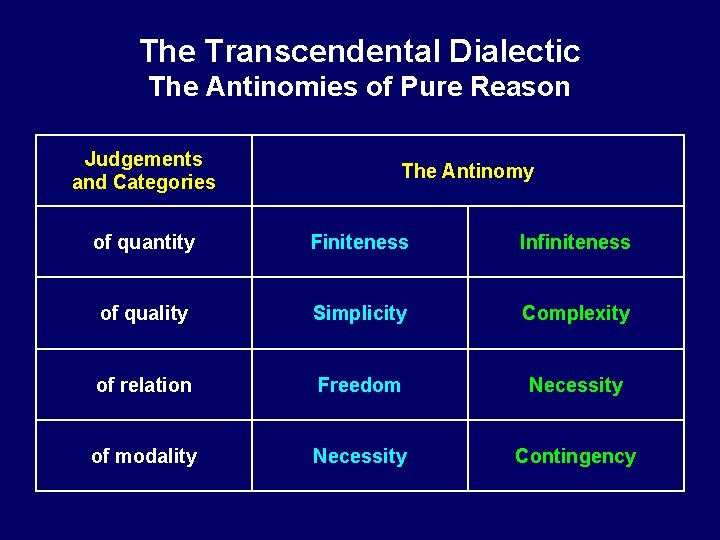
The Transcendental Dialectic The Antinomies of Pure Reason Judgements and Categories The Antinomy of quantity Finiteness Infiniteness of quality Simplicity Complexity of relation Freedom Necessity of modality Necessity Contingency
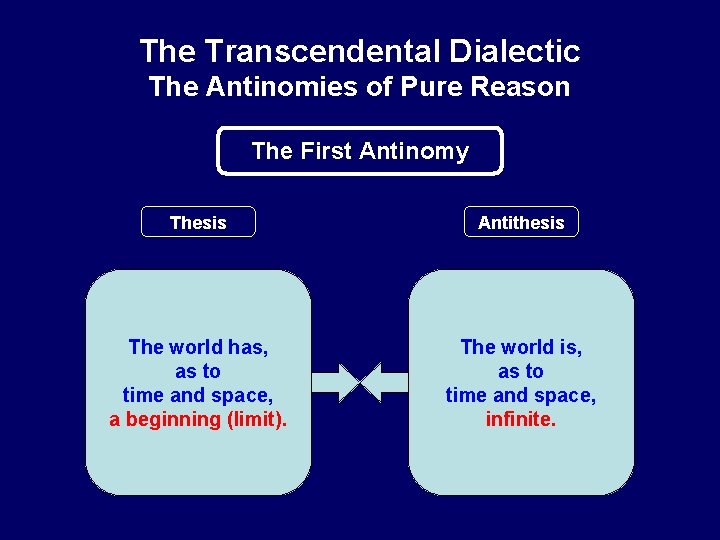
The Transcendental Dialectic The Antinomies of Pure Reason The First Antinomy Thesis Antithesis The world has, as to time and space, a beginning (limit). The world is, as to time and space, infinite.
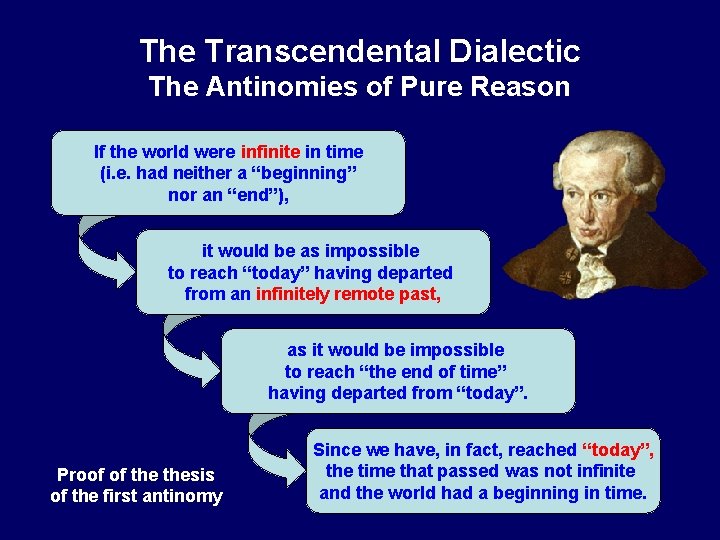
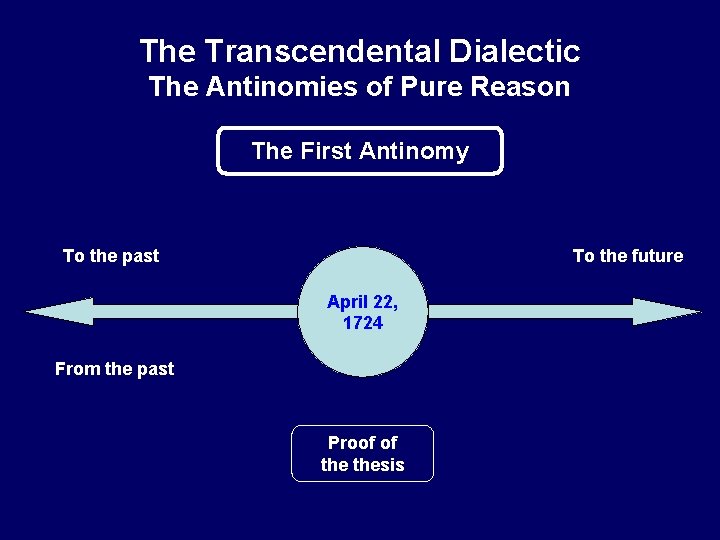
The Transcendental Dialectic The Antinomies of Pure Reason If the world were infinite in time (i. e. had neither a “beginning” nor an “end”), it would be as impossible to reach “today” having departed from an infinitely remote past, as it would be impossible to reach “the end of time” having departed from “today”. Proof of thesis of the first antinomy Since we have, in fact, reached “today”, the time that passed was not infinite and the world had a beginning in time.
The Transcendental Dialectic The Antinomies of Pure Reason The First Antinomy To the past To the future April 22, 1724 From the past Proof of thesis
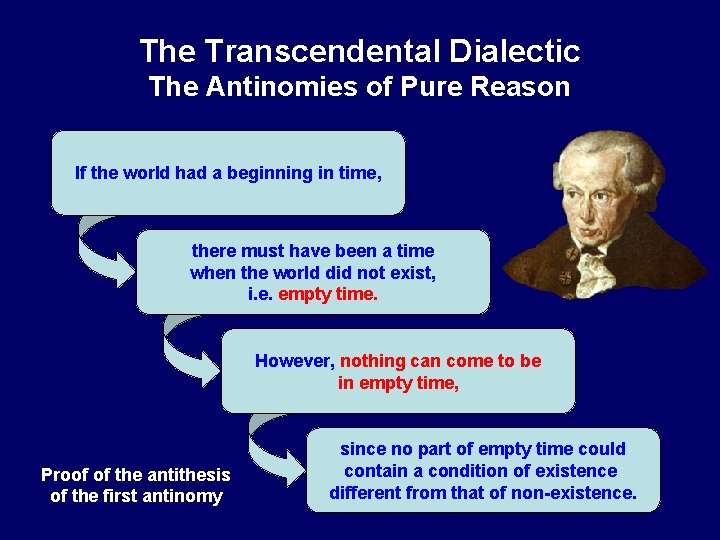
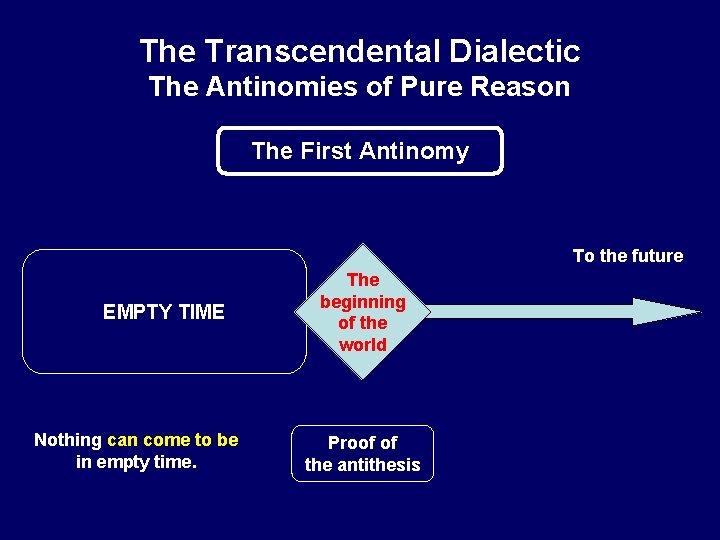
The Transcendental Dialectic The Antinomies of Pure Reason If the world had a beginning in time, there must have been a time when the world did not exist, i. e. empty time. However, nothing can come to be in empty time, Proof of the antithesis of the first antinomy since no part of empty time could contain a condition of existence different from that of non-existence.
The Transcendental Dialectic The Antinomies of Pure Reason The First Antinomy To the future EMPTY TIME Nothing can come to be in empty time. The beginning of the world Proof of the antithesis
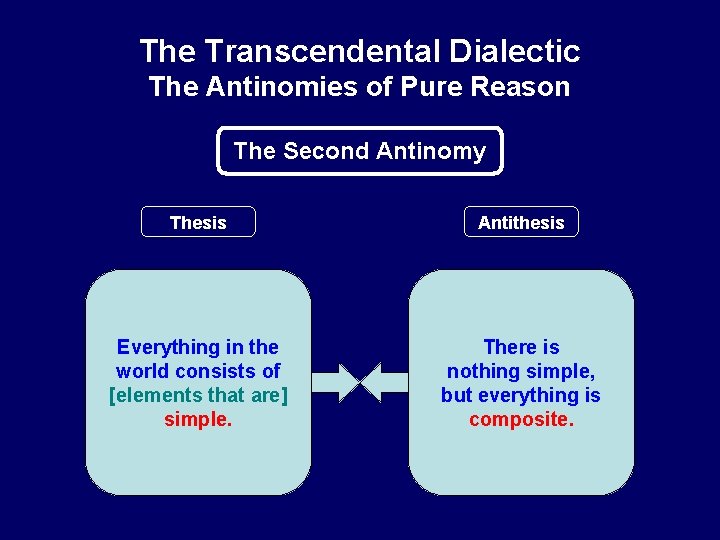
The Transcendental Dialectic The Antinomies of Pure Reason The Second Antinomy Thesis Antithesis Everything in the world consists of [elements that are] simple. There is nothing simple, but everything is composite.
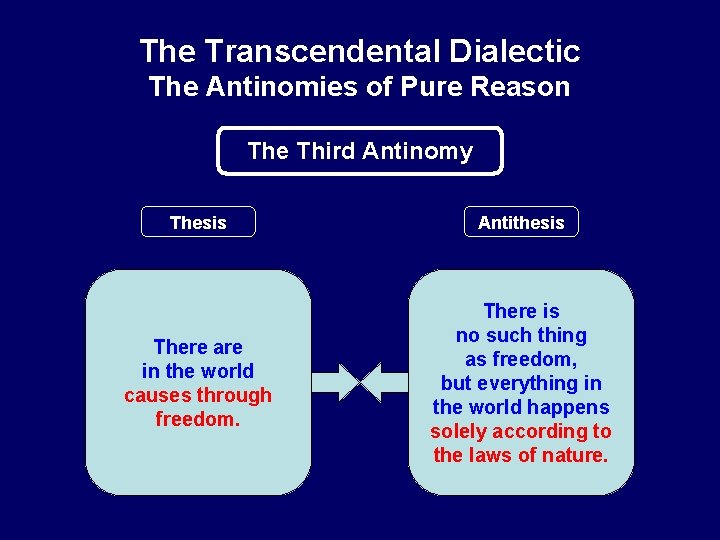
The Transcendental Dialectic The Antinomies of Pure Reason The Third Antinomy Thesis Antithesis There are in the world causes through freedom. There is no such thing as freedom, but everything in the world happens solely according to the laws of nature.
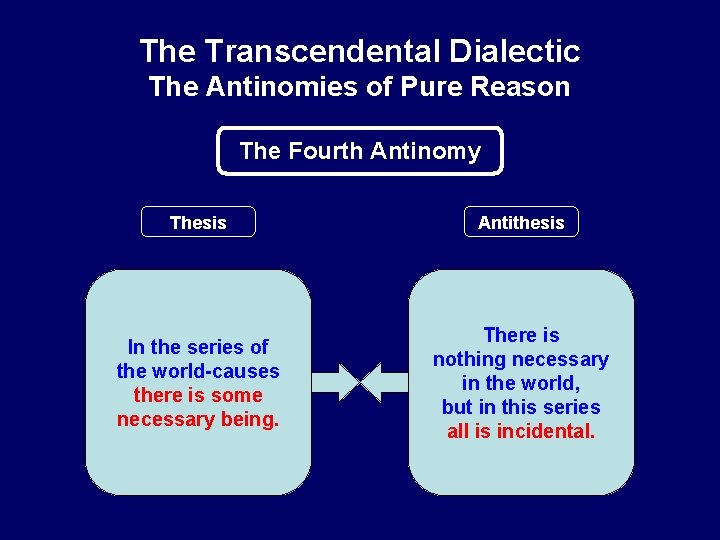
The Transcendental Dialectic The Antinomies of Pure Reason The Fourth Antinomy Thesis Antithesis In the series of the world-causes there is some necessary being. There is nothing necessary in the world, but in this series all is incidental.
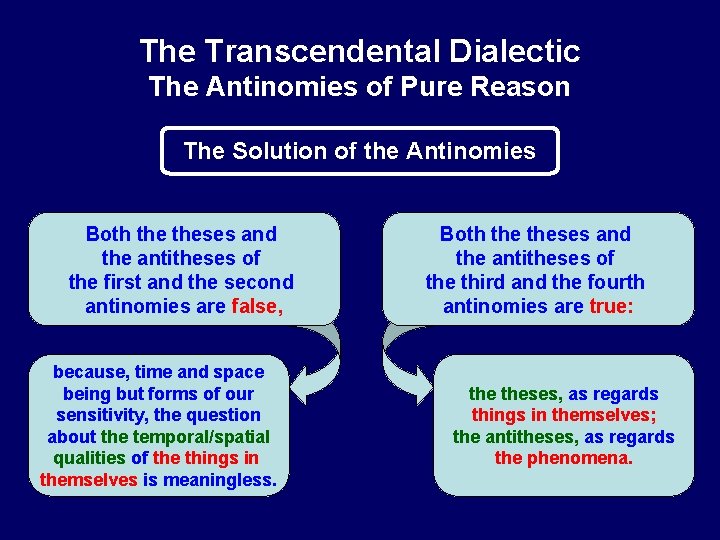
The Transcendental Dialectic The Antinomies of Pure Reason The Solution of the Antinomies Both theses and the antitheses of the first and the second antinomies are false, because, time and space being but forms of our sensitivity, the question about the temporal/spatial qualities of the things in themselves is meaningless. Both theses and the antitheses of the third and the fourth antinomies are true: theses, as regards things in themselves; the antitheses, as regards the phenomena.
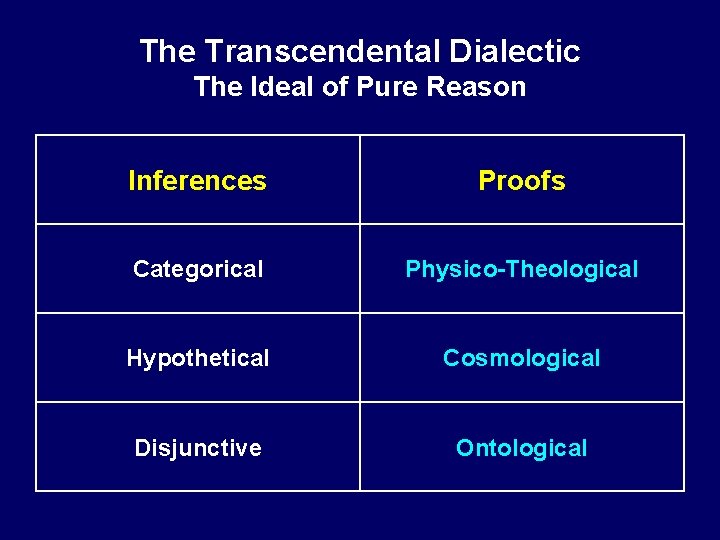
The Transcendental Dialectic The Ideal of Pure Reason Inferences Proofs Categorical Physico-Theological Hypothetical Cosmological Disjunctive Ontological
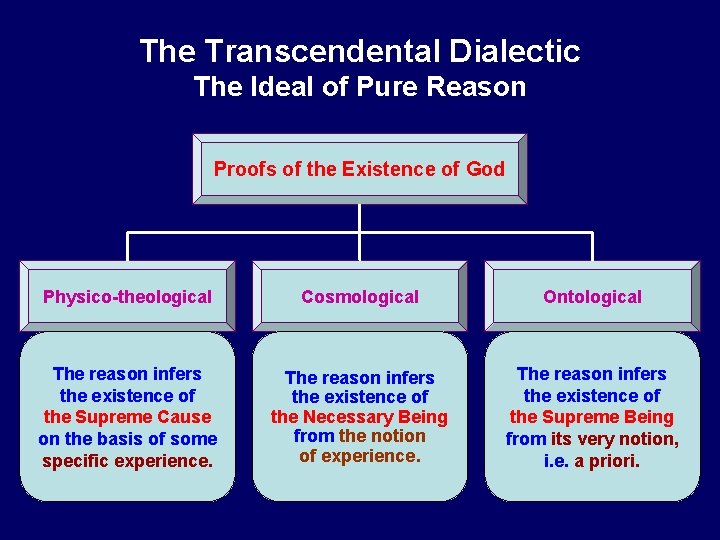
The Transcendental Dialectic The Ideal of Pure Reason Proofs of the Existence of God Physico-theological Cosmological Ontological The reason infers the existence of the Supreme Cause on the basis of some specific experience. The reason infers the existence of the Necessary Being from the notion of experience. The reason infers the existence of the Supreme Being from its very notion, i. e. a priori.
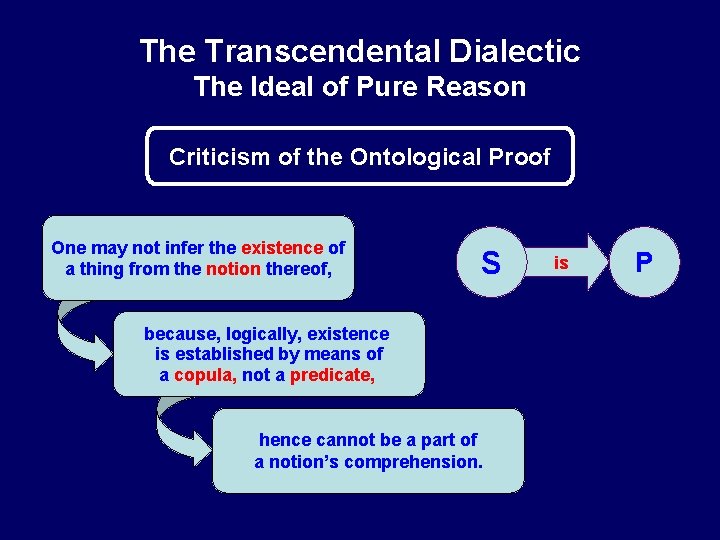
The Transcendental Dialectic The Ideal of Pure Reason Criticism of the Ontological Proof One may not infer the existence of a thing from the notion thereof, S because, logically, existence is established by means of a copula, not a predicate, hence cannot be a part of a notion’s comprehension. is P
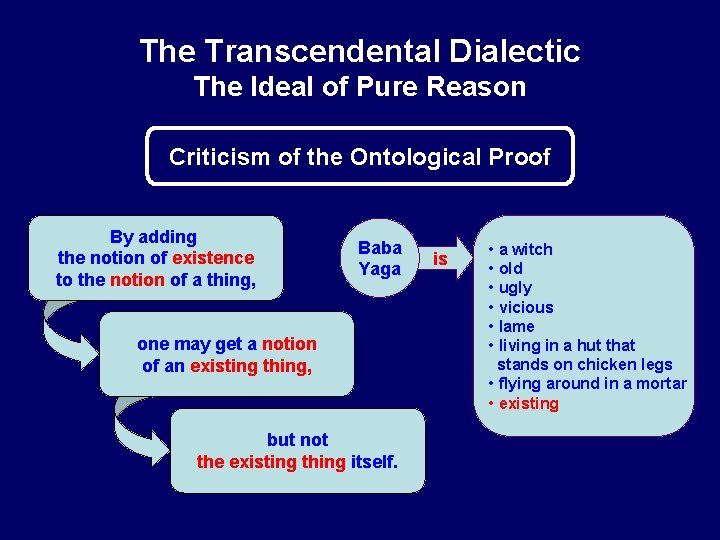
The Transcendental Dialectic The Ideal of Pure Reason Criticism of the Ontological Proof By adding the notion of existence to the notion of a thing, Baba Yaga one may get a notion of an existing thing, but not the existing thing itself. is • a witch • old • ugly • vicious • lame • living in a hut that stands on chicken legs • flying around in a mortar • existing
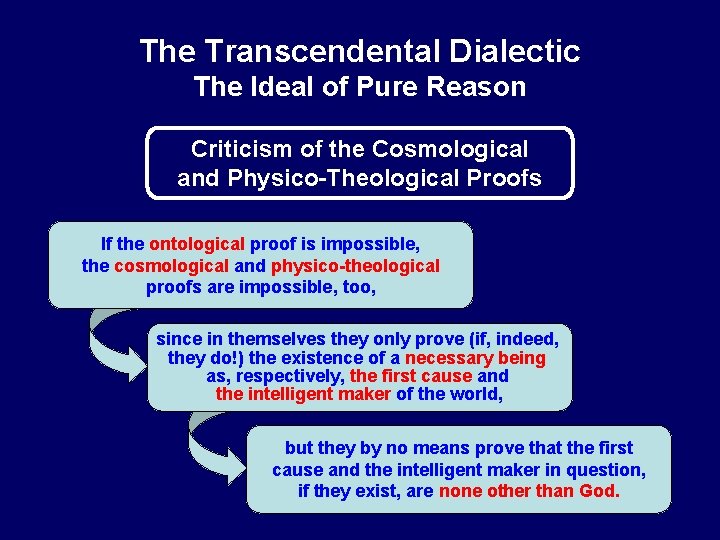
The Transcendental Dialectic The Ideal of Pure Reason Criticism of the Cosmological and Physico-Theological Proofs If the ontological proof is impossible, the cosmological and physico-theological proofs are impossible, too, since in themselves they only prove (if, indeed, they do!) the existence of a necessary being as, respectively, the first cause and the intelligent maker of the world, but they by no means prove that the first cause and the intelligent maker in question, if they exist, are none other than God.
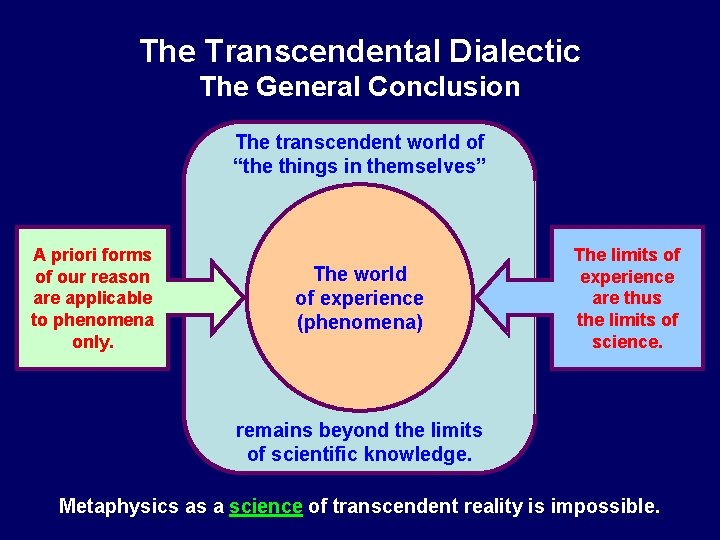
The Transcendental Dialectic The General Conclusion The transcendent world of “the things in themselves” A priori forms of our reason are applicable to phenomena only. The world of experience (phenomena) The limits of experience are thus the limits of science. remains beyond the limits of scientific knowledge. Metaphysics as a science of transcendent reality is impossible.
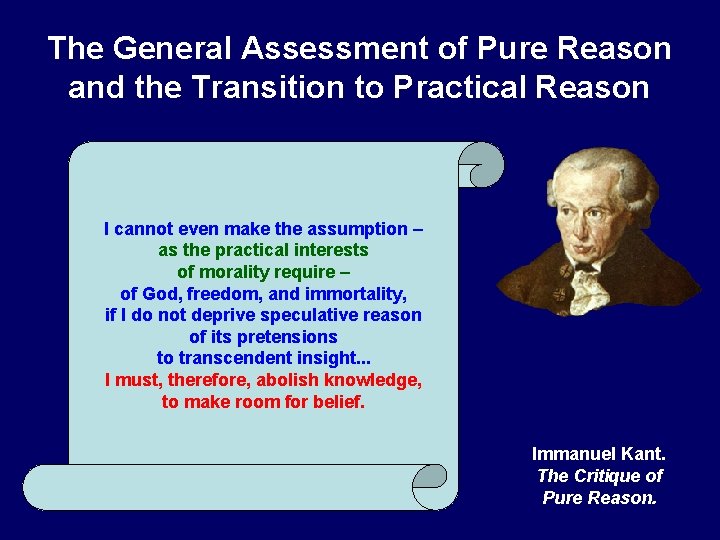
The General Assessment of Pure Reason and the Transition to Practical Reason I cannot even make the assumption – as the practical interests of morality require – of God, freedom, and immortality, if I do not deprive speculative reason of its pretensions to transcendent insight. . . I must, therefore, abolish knowledge, to make room for belief. Immanuel Kant. The Critique of Pure Reason.
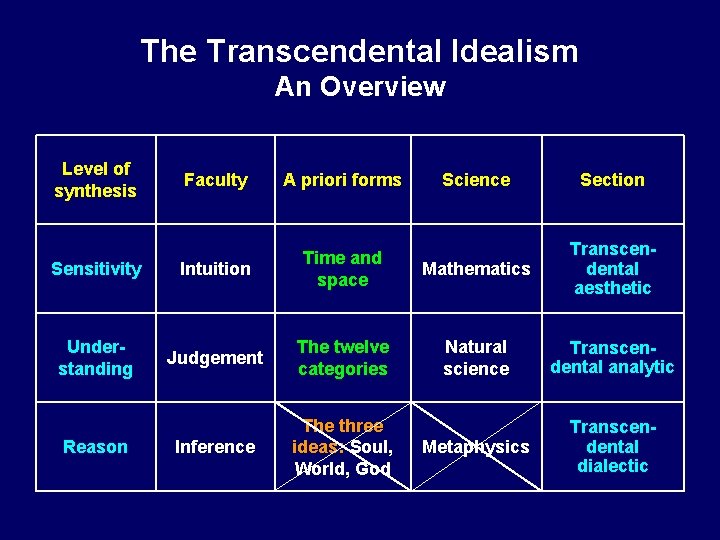
The Transcendental Idealism An Overview Level of synthesis Faculty A priori forms Sensitivity Understanding Reason Science Section Intuition Time and space Mathematics Transcendental aesthetic Judgement The twelve categories Natural science Transcendental analytic Inference The three ideas: Soul, World, God Metaphysics Transcendental dialectic
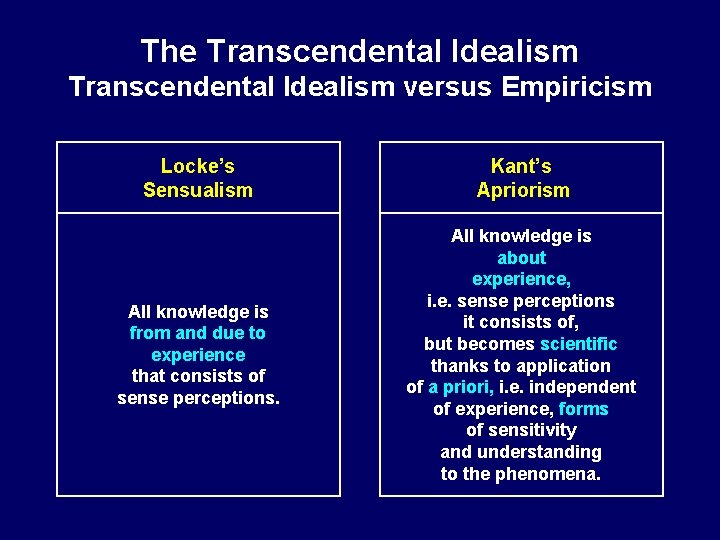
The Transcendental Idealism versus Empiricism Locke’s Sensualism Kant’s Apriorism All knowledge is from and due to experience that consists of sense perceptions. All knowledge is about experience, i. e. sense perceptions it consists of, but becomes scientific thanks to application of a priori, i. e. independent of experience, forms of sensitivity and understanding to the phenomena.
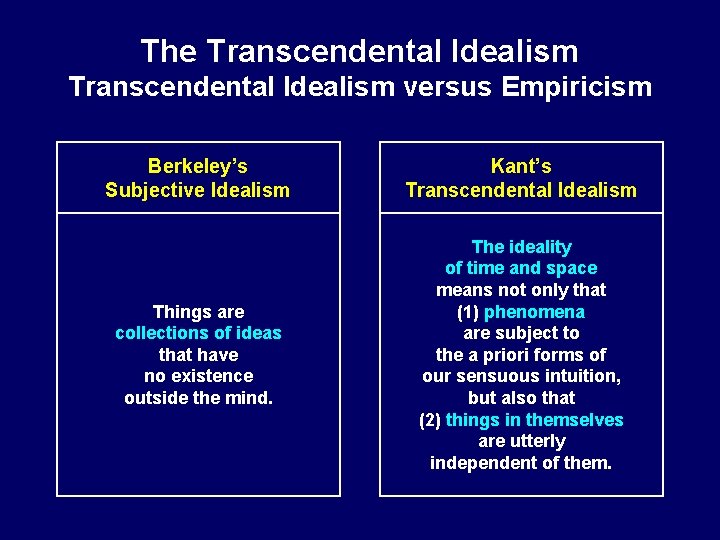
The Transcendental Idealism versus Empiricism Berkeley’s Subjective Idealism Kant’s Transcendental Idealism Things are collections of ideas that have no existence outside the mind. The ideality of time and space means not only that (1) phenomena are subject to the a priori forms of our sensuous intuition, but also that (2) things in themselves are utterly independent of them.
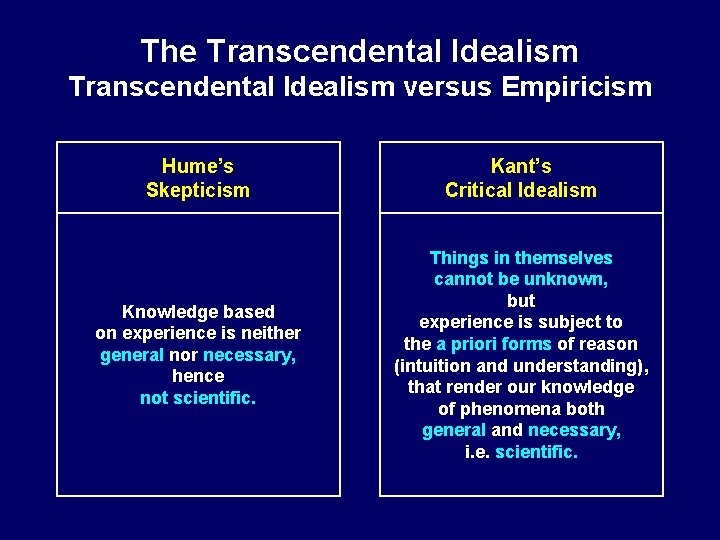
The Transcendental Idealism versus Empiricism Hume’s Skepticism Kant’s Critical Idealism Knowledge based on experience is neither general nor necessary, hence not scientific. Things in themselves cannot be unknown, but experience is subject to the a priori forms of reason (intuition and understanding), that render our knowledge of phenomena both general and necessary, i. e. scientific.
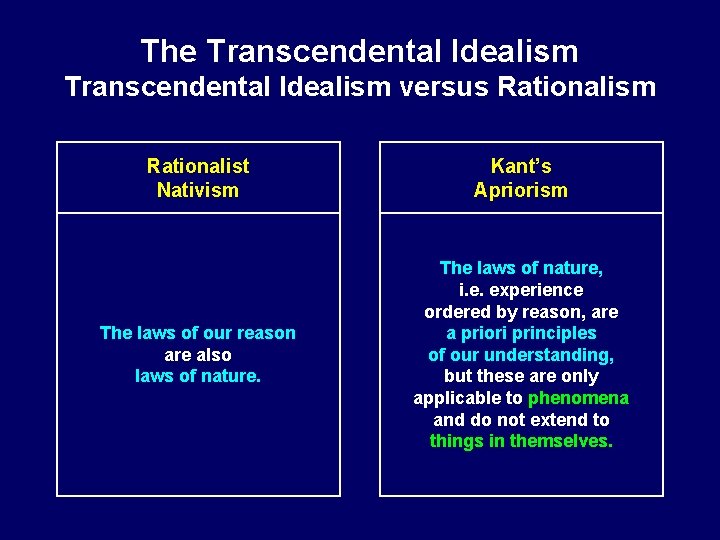
The Transcendental Idealism versus Rationalism Rationalist Nativism Kant’s Apriorism The laws of our reason are also laws of nature. The laws of nature, i. e. experience ordered by reason, are a priori principles of our understanding, but these are only applicable to phenomena and do not extend to things in themselves.
Questions?