Introduction to Sellars and Quine Pete Mandik Chairman



- Slides: 8
Introduction to Sellars and Quine Pete Mandik Chairman, Department of Philosophy Coordinator, Cognitive Science Laboratory William Paterson University, New Jersey USA
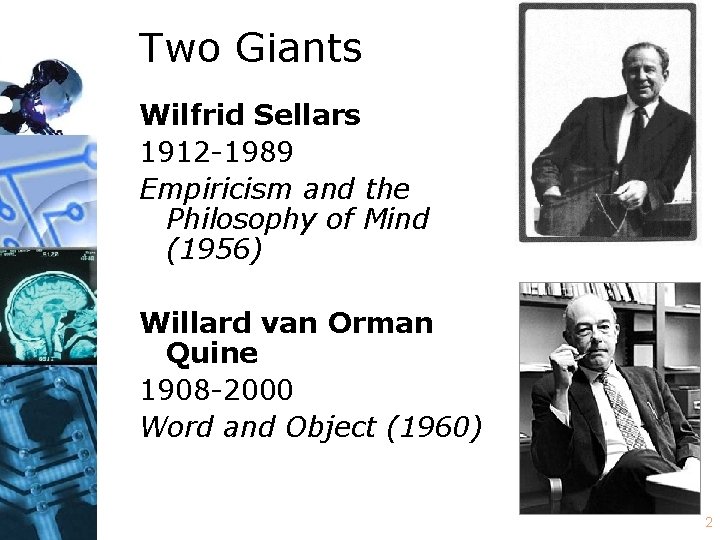
Two Giants Wilfrid Sellars 1912 -1989 Empiricism and the Philosophy of Mind (1956) Willard van Orman Quine 1908 -2000 Word and Object (1960) 2
Sellars and Quine vs. Positivism Both revolutionized analytic philosophy by opposing Logical Positivism aka Logical Empiricism 3
Logical Positivism “…restated the foundationalist epistemology of British empiricism…” (EPM p. 2) Verifiability Principle- All truths are either analytic (logical tautologies) or synthetic (knowable through sensory perception) Sense Datum Theory- Everything known by the senses is reducible to constructions of sense data 4
Quine Attacked the Verifiability Principle by attacking the Analytic/synthetic distinction 5
Sellars Attacked Sense Datum Theory by attacking the “Myth of the Given” and the “bad philosophical habit which the British empiricists took over from Descartes--the habit of asking whether the mind ever succeeds in making unmediated contact with [the] world, and remaining skeptical about the status of knowledge-claims until such contact can be shown to exist” (EPM p. 9) 6
Sellars and the Myth “Intuitions without concepts are blind. ” (EPM p. 3) “All awareness…is a linguistic affair” (EPM p. 4) “Locke, Berkeley, and Hume were wrong in thinking that we are ‘aware…simply by having sensations and images’. ” (ibid. ) “in characterizing an episode or a state as that of knowing, we are not giving an empirical desription of that episode or state; we are placing it in the logical space of reasons, of justifying and being able to justify what one says” (ibid. ) 7
THE END 8