
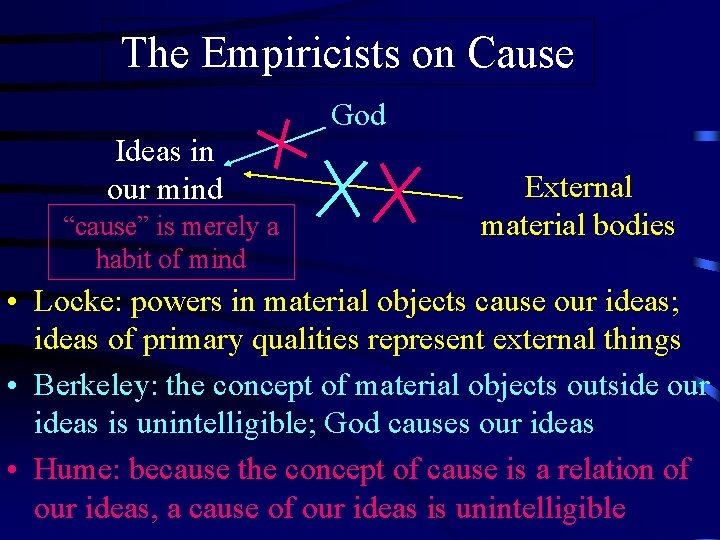
The Empiricists on Cause God Ideas in our
- Slides: 5
The Empiricists on Cause God Ideas in our mind “cause” is merely a habit of mind External material bodies • Locke: powers in material objects cause our ideas; ideas of primary qualities represent external things • Berkeley: the concept of material objects outside our ideas is unintelligible; God causes our ideas • Hume: because the concept of cause is a relation of our ideas, a cause of our ideas is unintelligible
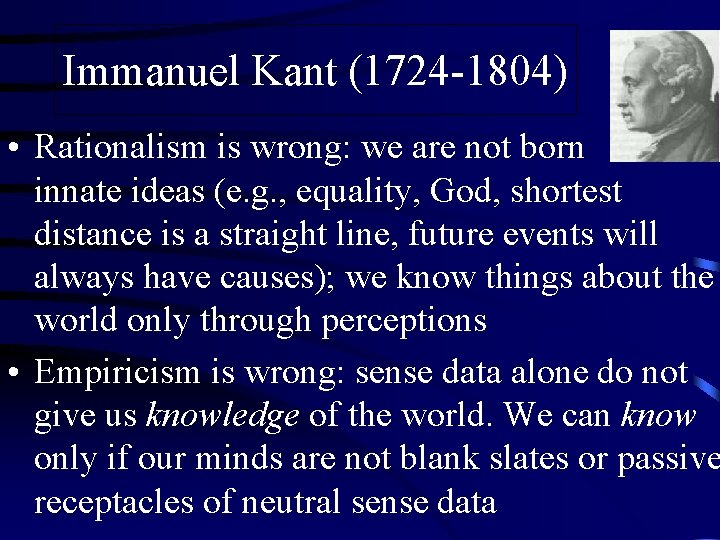
Immanuel Kant (1724 -1804) • Rationalism is wrong: we are not born with innate ideas (e. g. , equality, God, shortest distance is a straight line, future events will always have causes); we know things about the world only through perceptions • Empiricism is wrong: sense data alone do not give us knowledge of the world. We can know only if our minds are not blank slates or passive receptacles of neutral sense data
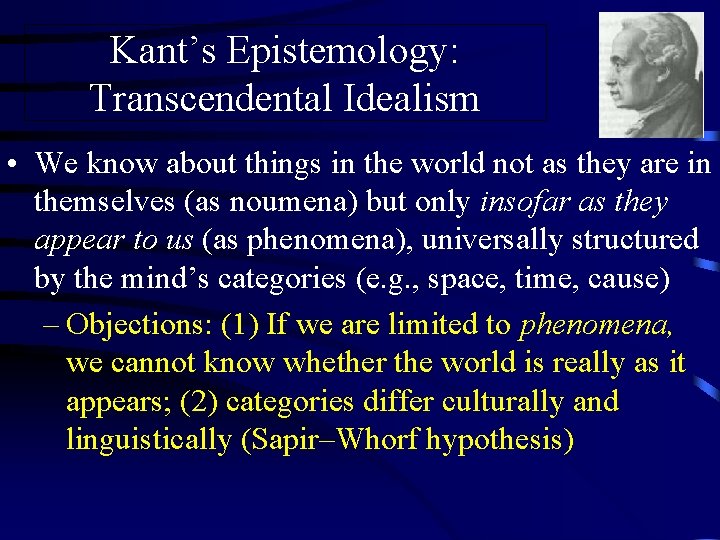
Kant’s Epistemology: Transcendental Idealism • We know about things in the world not as they are in themselves (as noumena) but only insofar as they appear to us (as phenomena), universally structured by the mind’s categories (e. g. , space, time, cause) – Objections: (1) If we are limited to phenomena, we cannot know whether the world is really as it appears; (2) categories differ culturally and linguistically (Sapir–Whorf hypothesis)
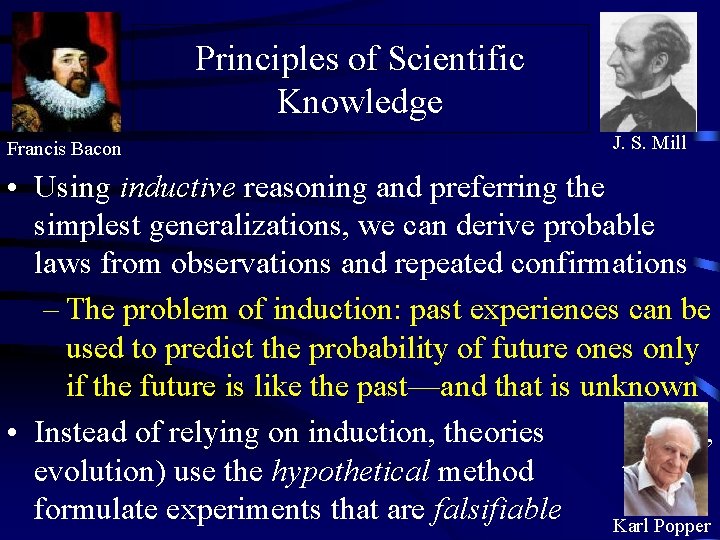
Principles of Scientific Knowledge Francis Bacon J. S. Mill • Using inductive reasoning and preferring the simplest generalizations, we can derive probable laws from observations and repeated confirmations – The problem of induction: past experiences can be used to predict the probability of future ones only if the future is like the past—and that is unknown • Instead of relying on induction, theories (e. g. , evolution) use the hypothetical method to formulate experiments that are falsifiable Karl Popper
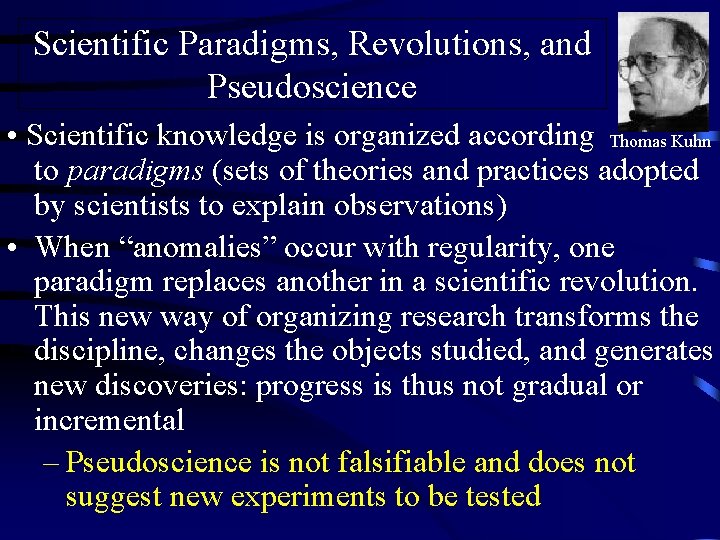
Scientific Paradigms, Revolutions, and Pseudoscience • Scientific knowledge is organized according Thomas Kuhn to paradigms (sets of theories and practices adopted by scientists to explain observations) • When “anomalies” occur with regularity, one paradigm replaces another in a scientific revolution. This new way of organizing research transforms the discipline, changes the objects studied, and generates new discoveries: progress is thus not gradual or incremental – Pseudoscience is not falsifiable and does not suggest new experiments to be tested