PYTSASTR 206 Solar System Formation l Announcements n
- Slides: 37
PYTS/ASTR 206 – Solar System Formation l Announcements n HW 6 due on Thursday w Use Kevin as the TA for this one w Office hours are today 2 -4 pm n HW 6 typo w Question 4 said Neptune’s orbital period was ~165 days! w Should have read ~165 years n TA award nominations w Optional – if you think one of the TAs should get special recognition w Don’t just check the boxes, you need to write a few words about what the TA did that you liked. w Forms and submission box are on the table outside 1
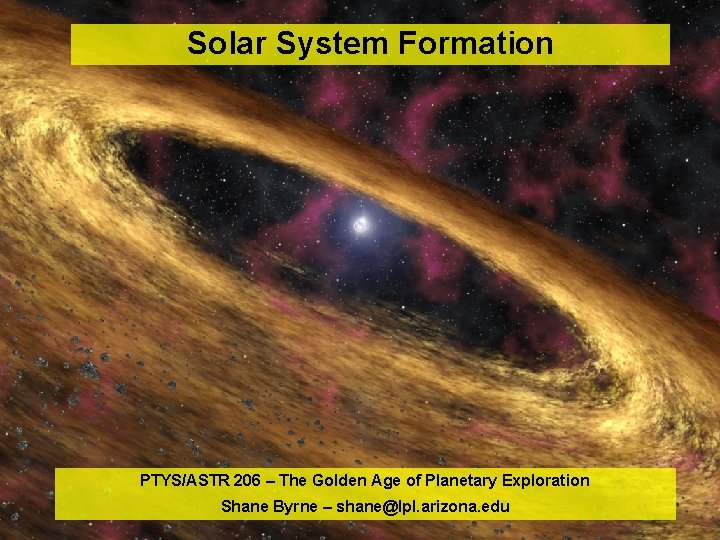
PYTS/ASTR 206 – Solar System Formation PTYS/ASTR 206 – The Golden Age of Planetary Exploration Shane Byrne – shane@lpl. arizona. edu 2
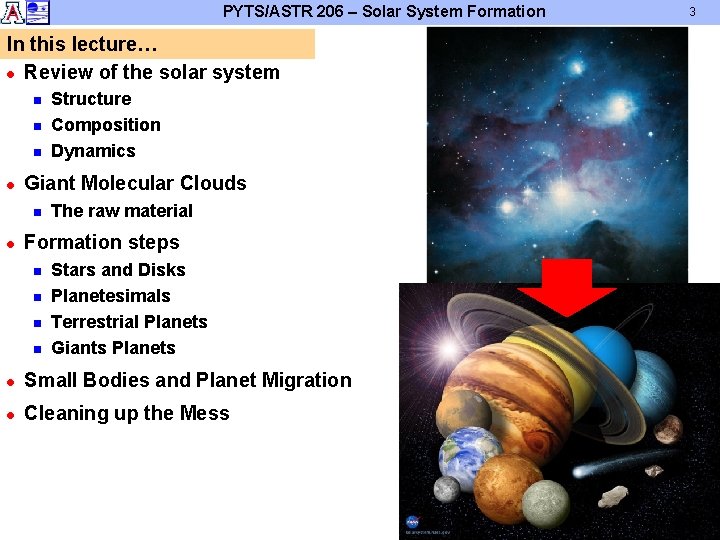
PYTS/ASTR 206 – Solar System Formation In this lecture… l Review of the solar system n n n l Giant Molecular Clouds n l Structure Composition Dynamics The raw material Formation steps n n Stars and Disks Planetesimals Terrestrial Planets Giants Planets l Small Bodies and Planet Migration l Cleaning up the Mess 3
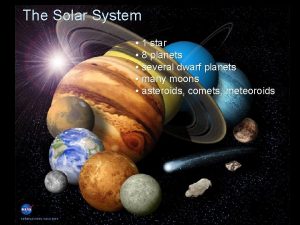
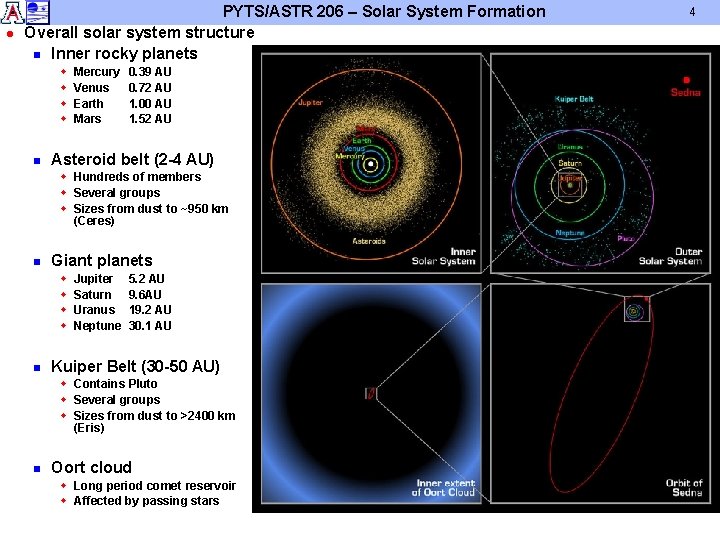
l PYTS/ASTR 206 – Solar System Formation Overall solar system structure n Inner rocky planets w w n Mercury Venus Earth Mars 0. 39 AU 0. 72 AU 1. 00 AU 1. 52 AU Asteroid belt (2 -4 AU) w Hundreds of members w Several groups w Sizes from dust to ~950 km (Ceres) n Giant planets w w n Jupiter Saturn Uranus Neptune 5. 2 AU 9. 6 AU 19. 2 AU 30. 1 AU Kuiper Belt (30 -50 AU) w Contains Pluto w Several groups w Sizes from dust to >2400 km (Eris) n Oort cloud w Long period comet reservoir w Affected by passing stars 4
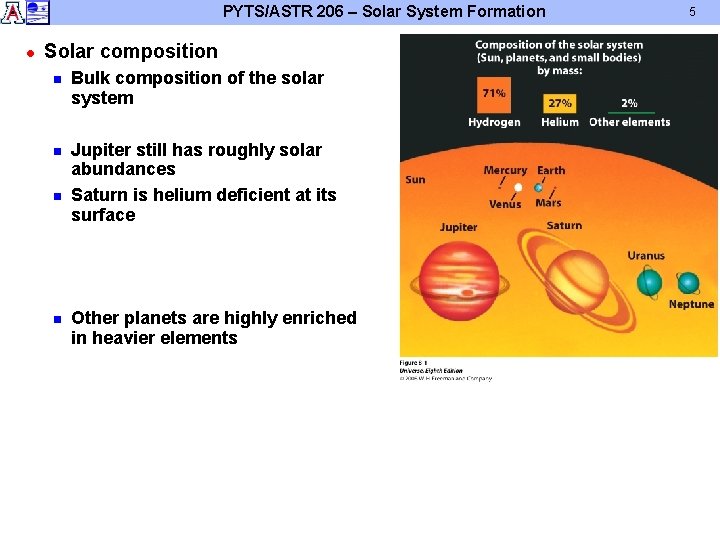
PYTS/ASTR 206 – Solar System Formation l Solar composition n Bulk composition of the solar system n Jupiter still has roughly solar abundances Saturn is helium deficient at its surface n n Other planets are highly enriched in heavier elements 5
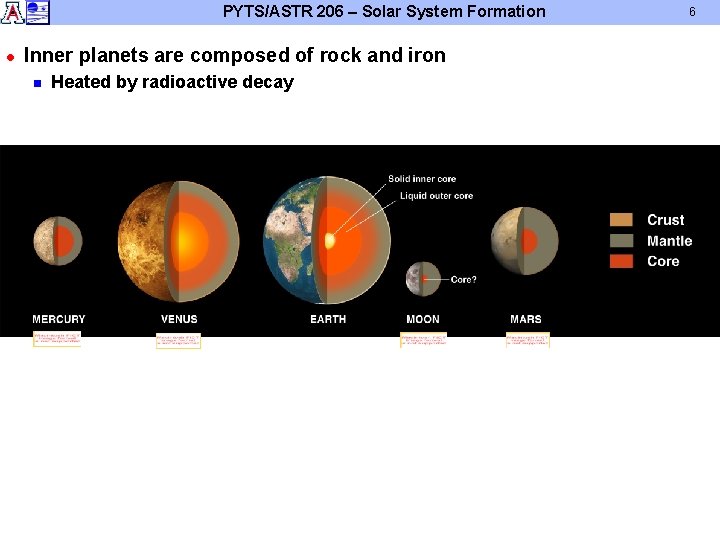
PYTS/ASTR 206 – Solar System Formation l Inner planets are composed of rock and iron n Heated by radioactive decay 6
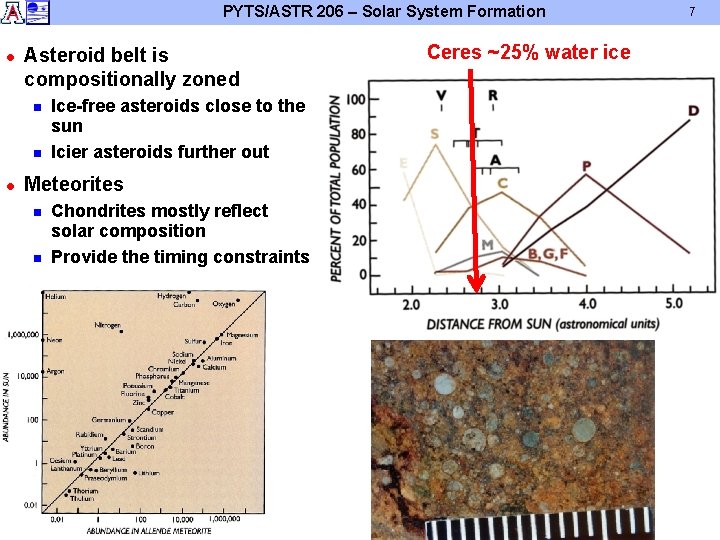
PYTS/ASTR 206 – Solar System Formation l Asteroid belt is compositionally zoned n n l Ice-free asteroids close to the sun Icier asteroids further out Meteorites n n Chondrites mostly reflect solar composition Provide the timing constraints Ceres ~25% water ice 7
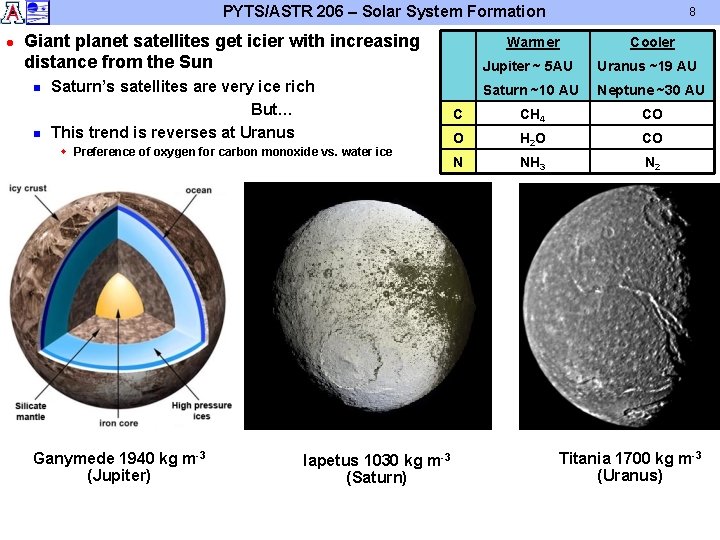
PYTS/ASTR 206 – Solar System Formation l Giant planet satellites get icier with increasing distance from the Sun n n Saturn’s satellites are very ice rich But… This trend is reverses at Uranus w Preference of oxygen for carbon monoxide vs. water ice Ganymede 1940 kg m-3 (Jupiter) Iapetus 1030 kg m-3 (Saturn) 8 Warmer Cooler Jupiter ~ 5 AU Uranus ~19 AU Saturn ~10 AU Neptune ~30 AU C CH 4 CO O H 2 O CO N NH 3 N 2 Titania 1700 kg m-3 (Uranus)
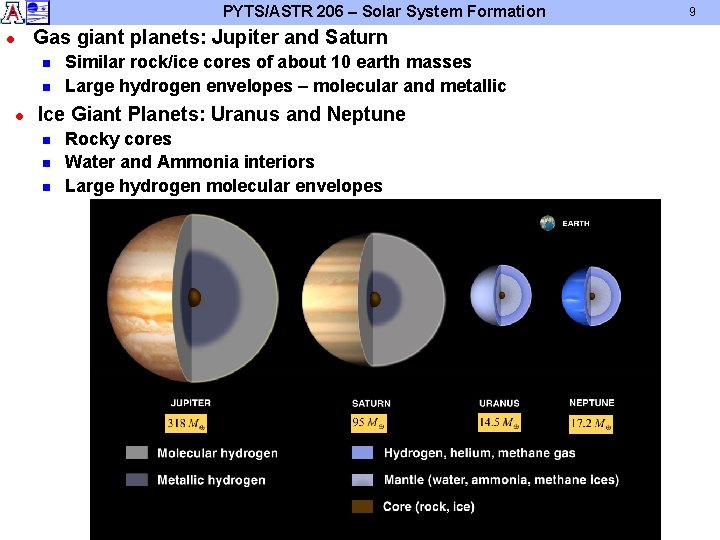
PYTS/ASTR 206 – Solar System Formation l Gas giant planets: Jupiter and Saturn n n l Similar rock/ice cores of about 10 earth masses Large hydrogen envelopes – molecular and metallic Ice Giant Planets: Uranus and Neptune n n n Rocky cores Water and Ammonia interiors Large hydrogen molecular envelopes 9
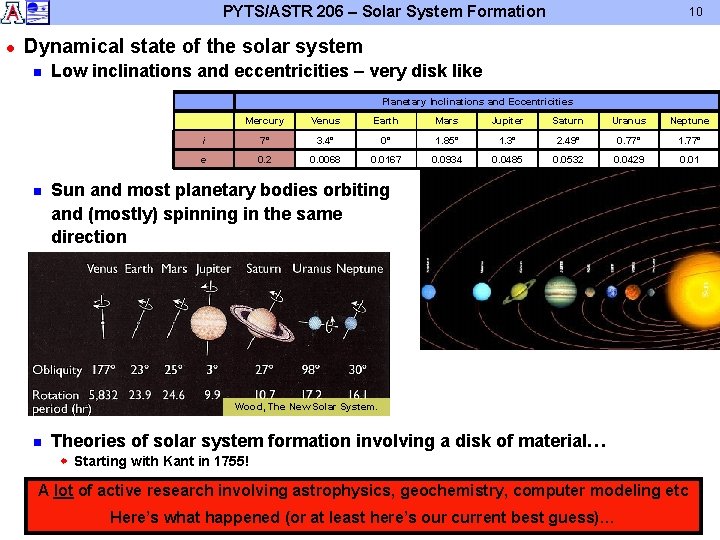
PYTS/ASTR 206 – Solar System Formation l 10 Dynamical state of the solar system n Low inclinations and eccentricities – very disk like Planetary Inclinations and Eccentricities n Mercury Venus Earth Mars Jupiter Saturn Uranus Neptune i 7° 3. 4° 0° 1. 85° 1. 3° 2. 49° 0. 77° 1. 77° e 0. 2 0. 0068 0. 0167 0. 0934 0. 0485 0. 0532 0. 0429 0. 01 Sun and most planetary bodies orbiting and (mostly) spinning in the same direction Wood, The New Solar System. n Theories of solar system formation involving a disk of material… w Starting with Kant in 1755! A lot of active research involving astrophysics, geochemistry, computer modeling etc Here’s what happened (or at least here’s our current best guess)…
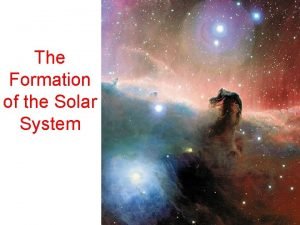
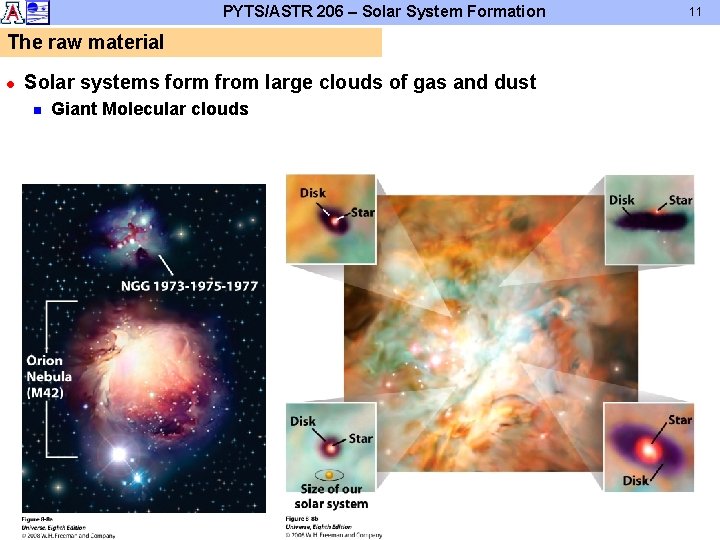
PYTS/ASTR 206 – Solar System Formation The raw material l Solar systems form from large clouds of gas and dust n Giant Molecular clouds 11
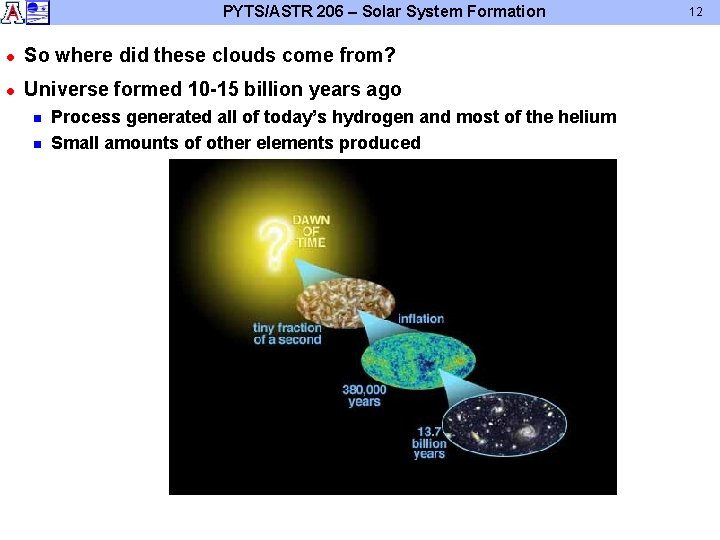
PYTS/ASTR 206 – Solar System Formation l So where did these clouds come from? l Universe formed 10 -15 billion years ago n n Process generated all of today’s hydrogen and most of the helium Small amounts of other elements produced 12
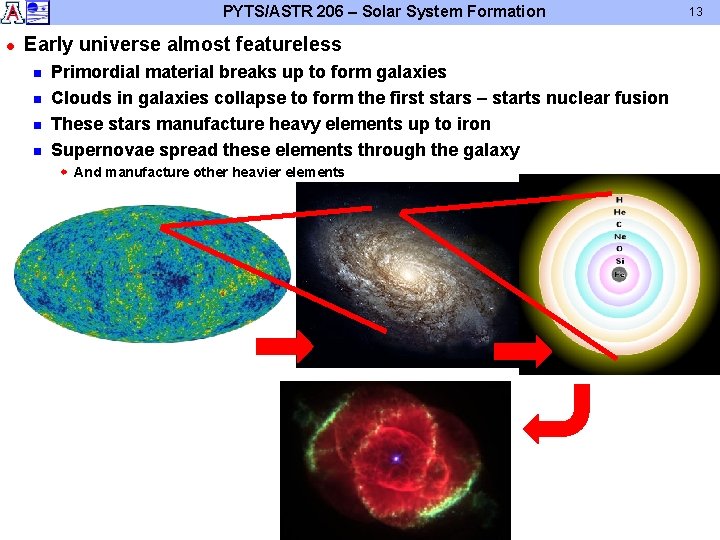
PYTS/ASTR 206 – Solar System Formation l Early universe almost featureless n n Primordial material breaks up to form galaxies Clouds in galaxies collapse to form the first stars – starts nuclear fusion These stars manufacture heavy elements up to iron Supernovae spread these elements through the galaxy w And manufacture other heavier elements 13
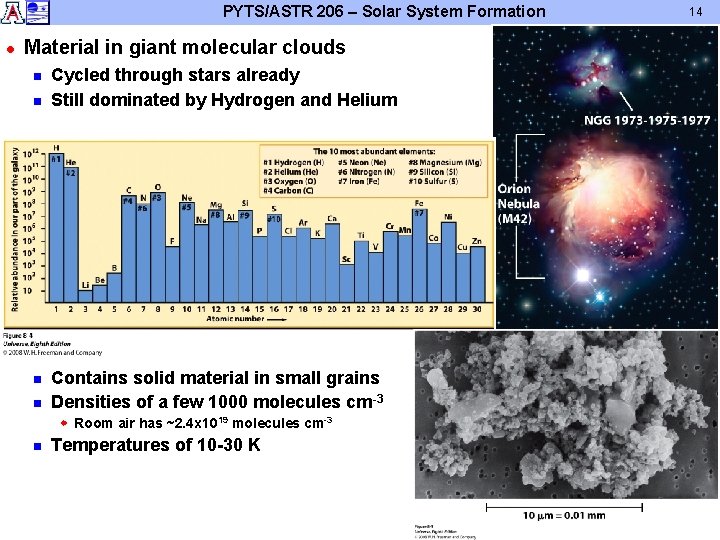
PYTS/ASTR 206 – Solar System Formation l Material in giant molecular clouds n n Cycled through stars already Still dominated by Hydrogen and Helium Contains solid material in small grains Densities of a few 1000 molecules cm-3 w Room air has ~2. 4 x 10¹⁹ molecules cm-3 n Temperatures of 10 -30 K 14
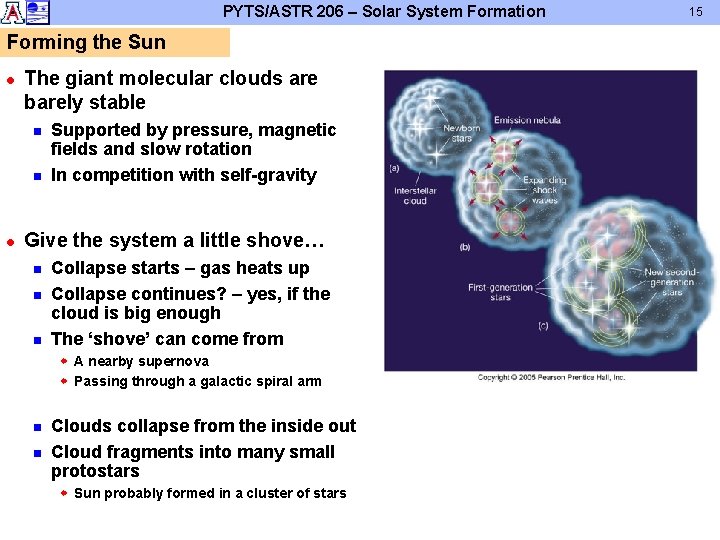
PYTS/ASTR 206 – Solar System Formation Forming the Sun l The giant molecular clouds are barely stable n n l Supported by pressure, magnetic fields and slow rotation In competition with self-gravity Give the system a little shove… n n n Collapse starts – gas heats up Collapse continues? – yes, if the cloud is big enough The ‘shove’ can come from w A nearby supernova w Passing through a galactic spiral arm n n Clouds collapse from the inside out Cloud fragments into many small protostars w Sun probably formed in a cluster of stars 15
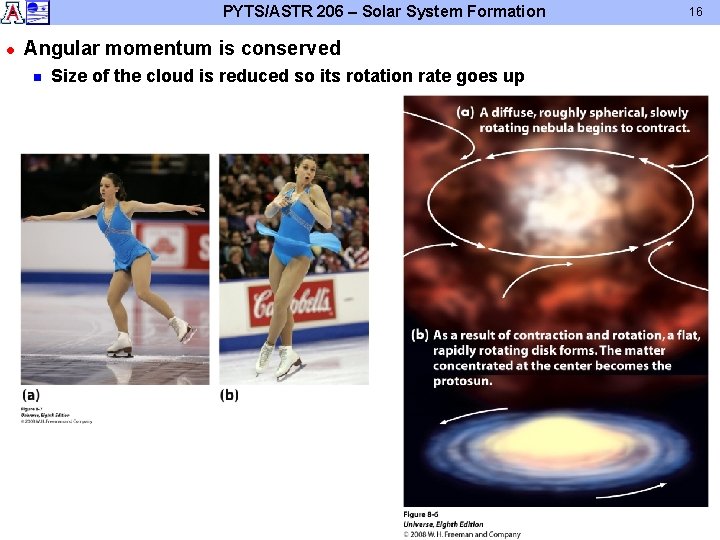
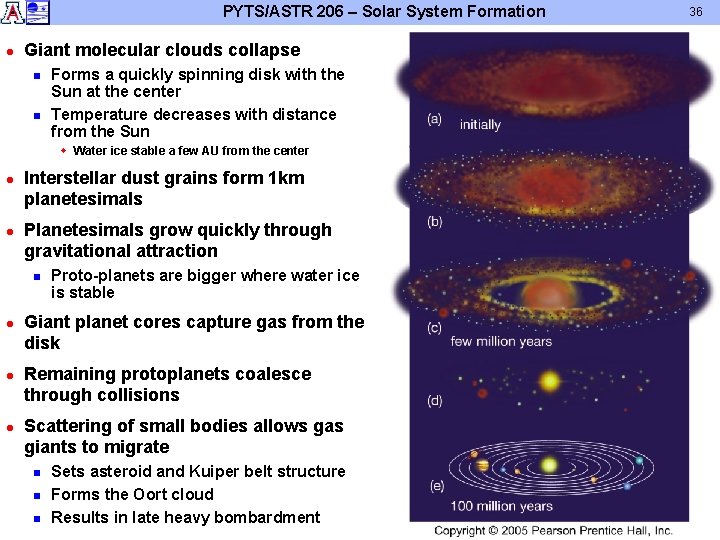
PYTS/ASTR 206 – Solar System Formation l Angular momentum is conserved n Size of the cloud is reduced so its rotation rate goes up 16
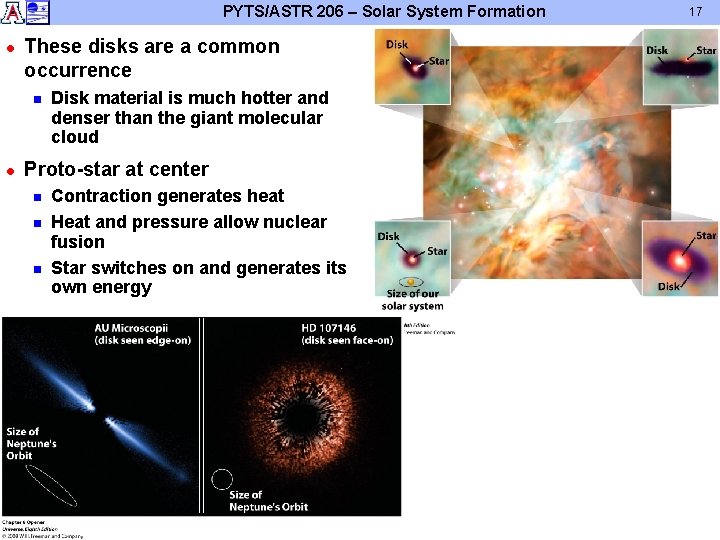
PYTS/ASTR 206 – Solar System Formation l These disks are a common occurrence n l Disk material is much hotter and denser than the giant molecular cloud Proto-star at center n n n Contraction generates heat Heat and pressure allow nuclear fusion Star switches on and generates its own energy 17
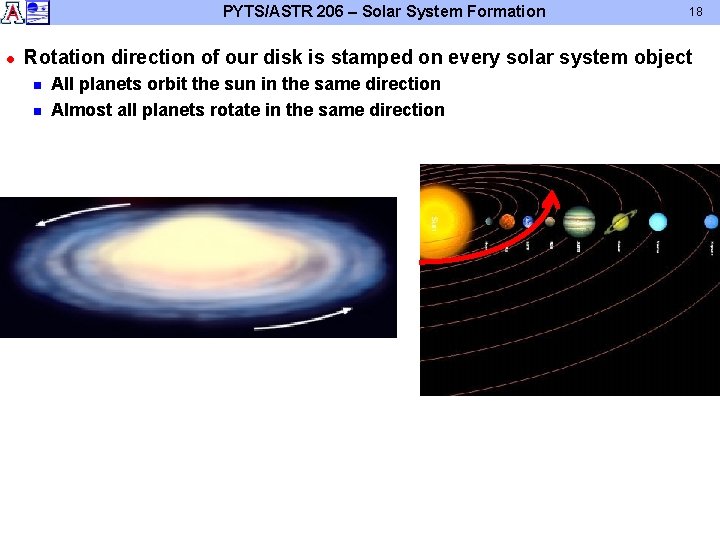
PYTS/ASTR 206 – Solar System Formation l 18 Rotation direction of our disk is stamped on every solar system object n n All planets orbit the sun in the same direction Almost all planets rotate in the same direction
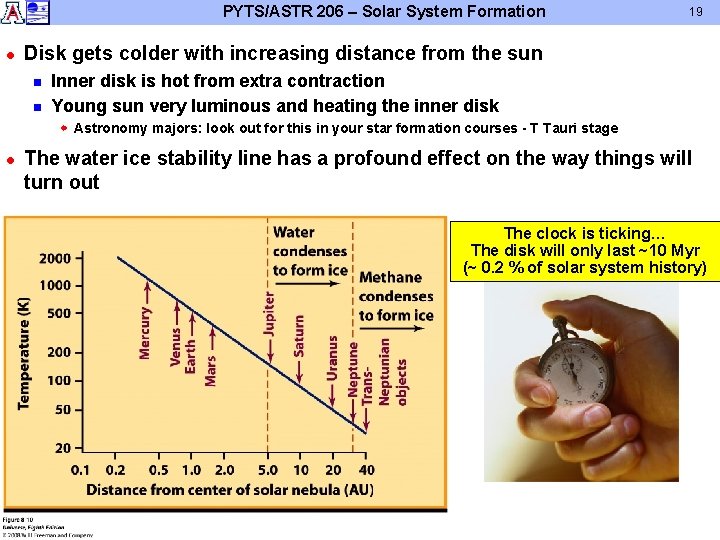
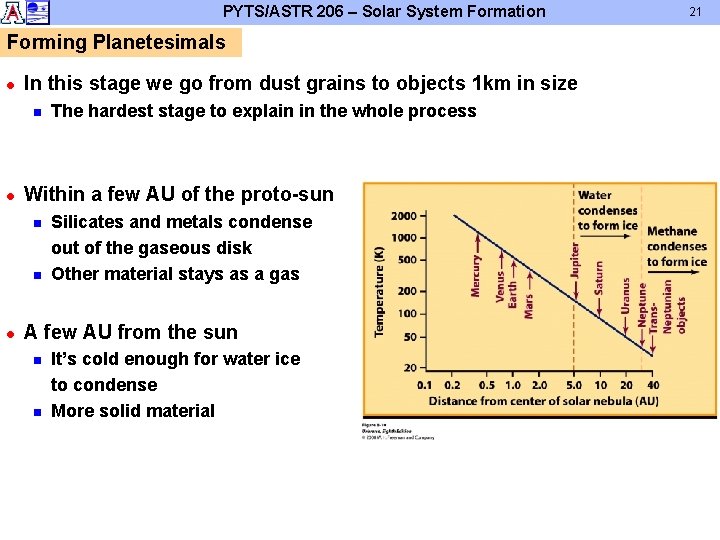
PYTS/ASTR 206 – Solar System Formation l 19 Disk gets colder with increasing distance from the sun n n Inner disk is hot from extra contraction Young sun very luminous and heating the inner disk w Astronomy majors: look out for this in your star formation courses - T Tauri stage l The water ice stability line has a profound effect on the way things will turn out The clock is ticking… The disk will only last ~10 Myr (~ 0. 2 % of solar system history)
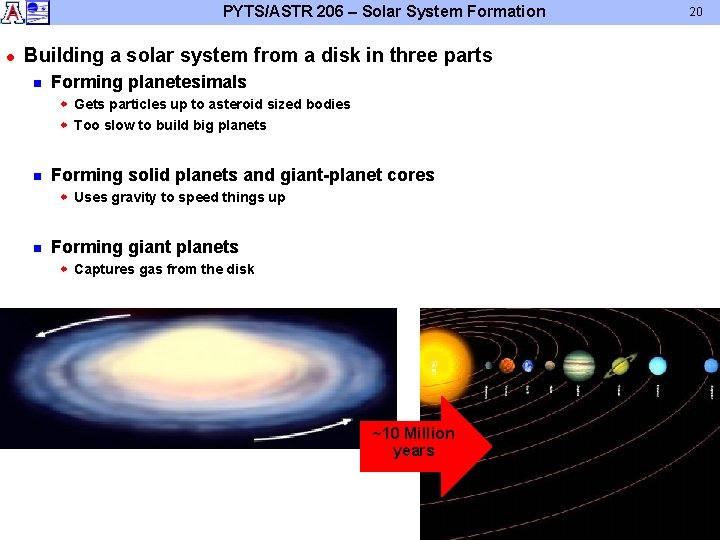
PYTS/ASTR 206 – Solar System Formation l Building a solar system from a disk in three parts n Forming planetesimals w Gets particles up to asteroid sized bodies w Too slow to build big planets n Forming solid planets and giant-planet cores w Uses gravity to speed things up n Forming giant planets w Captures gas from the disk ~10 Million years 20
PYTS/ASTR 206 – Solar System Formation Forming Planetesimals l In this stage we go from dust grains to objects 1 km in size n l Within a few AU of the proto-sun n n l The hardest stage to explain in the whole process Silicates and metals condense out of the gaseous disk Other material stays as a gas A few AU from the sun n n It’s cold enough for water ice to condense More solid material 21
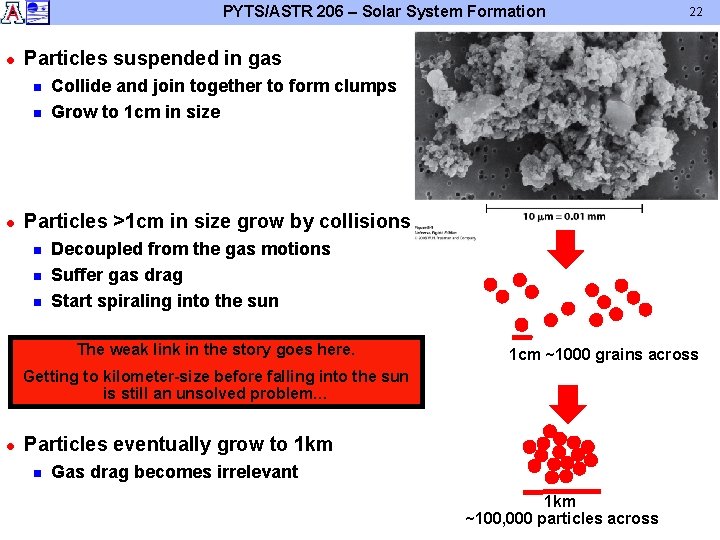
PYTS/ASTR 206 – Solar System Formation l Particles suspended in gas n n l Collide and join together to form clumps Grow to 1 cm in size Particles >1 cm in size grow by collisions n n n Decoupled from the gas motions Suffer gas drag Start spiraling into the sun The weak link in the story goes here. 1 cm ~1000 grains across Getting to kilometer-size before falling into the sun is still an unsolved problem… l 22 Particles eventually grow to 1 km n Gas drag becomes irrelevant 1 km ~100, 000 particles across
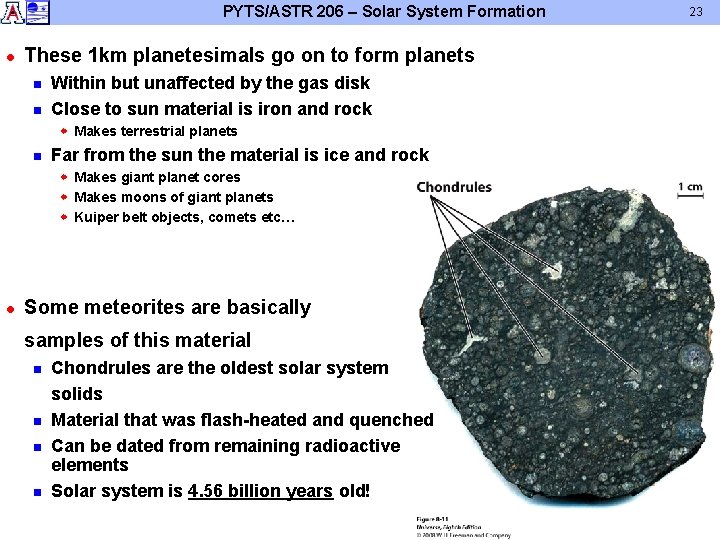
PYTS/ASTR 206 – Solar System Formation l These 1 km planetesimals go on to form planets n n Within but unaffected by the gas disk Close to sun material is iron and rock w Makes terrestrial planets n Far from the sun the material is ice and rock w Makes giant planet cores w Makes moons of giant planets w Kuiper belt objects, comets etc… l Some meteorites are basically samples of this material n n Chondrules are the oldest solar system solids Material that was flash-heated and quenched Can be dated from remaining radioactive elements Solar system is 4. 56 billion years old! 23
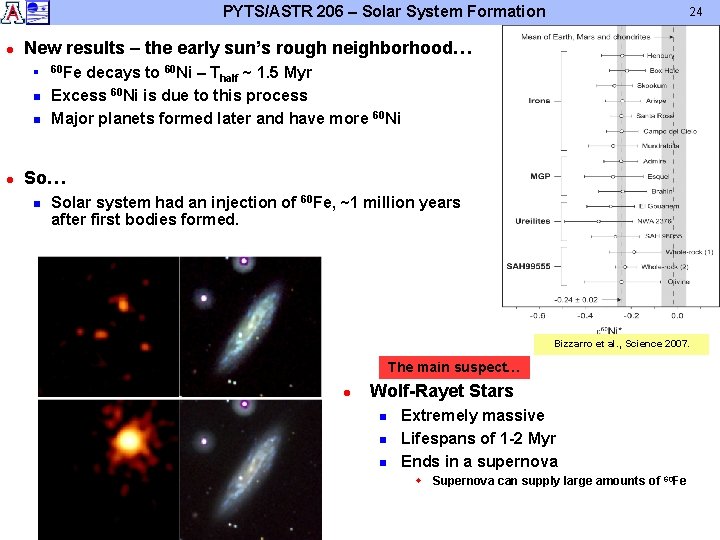
PYTS/ASTR 206 – Solar System Formation l New results – the early sun’s rough neighborhood… n n n l 24 60 Fe decays to 60 Ni – Thalf ~ 1. 5 Myr Excess 60 Ni is due to this process Major planets formed later and have more 60 Ni So… n Solar system had an injection of 60 Fe, ~1 million years after first bodies formed. Bizzarro et al. , Science 2007. The main suspect… l Wolf-Rayet Stars n n n Extremely massive Lifespans of 1 -2 Myr Ends in a supernova w Supernova can supply large amounts of 60 Fe
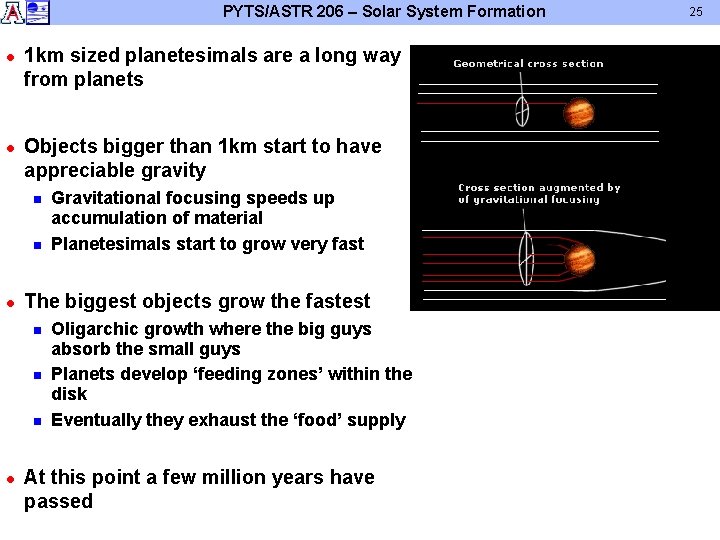
PYTS/ASTR 206 – Solar System Formation l l 1 km sized planetesimals are a long way from planets Objects bigger than 1 km start to have appreciable gravity n n l The biggest objects grow the fastest n n n l Gravitational focusing speeds up accumulation of material Planetesimals start to grow very fast Oligarchic growth where the big guys absorb the small guys Planets develop ‘feeding zones’ within the disk Eventually they exhaust the ‘food’ supply At this point a few million years have passed 25
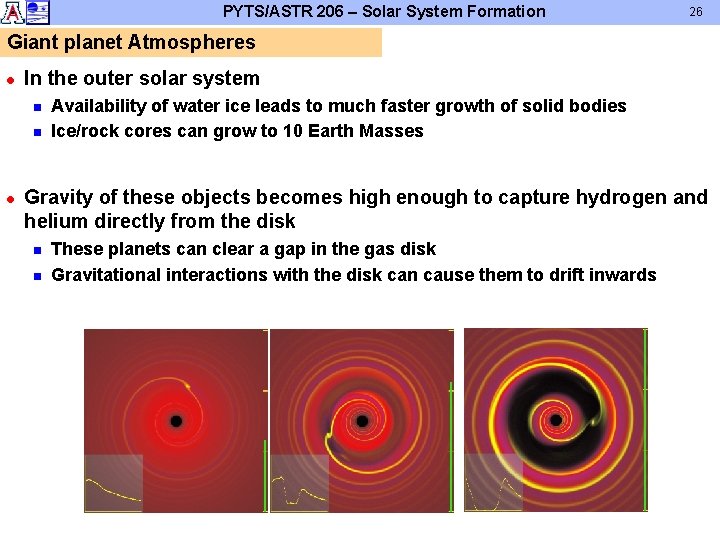
PYTS/ASTR 206 – Solar System Formation 26 Giant planet Atmospheres l In the outer solar system n n l Availability of water ice leads to much faster growth of solid bodies Ice/rock cores can grow to 10 Earth Masses Gravity of these objects becomes high enough to capture hydrogen and helium directly from the disk n n These planets can clear a gap in the gas disk Gravitational interactions with the disk can cause them to drift inwards
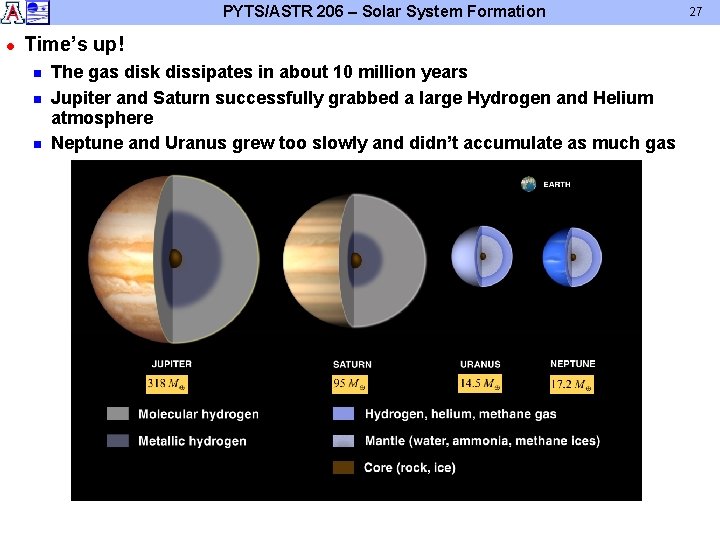
PYTS/ASTR 206 – Solar System Formation l Time’s up! n n n The gas disk dissipates in about 10 million years Jupiter and Saturn successfully grabbed a large Hydrogen and Helium atmosphere Neptune and Uranus grew too slowly and didn’t accumulate as much gas 27
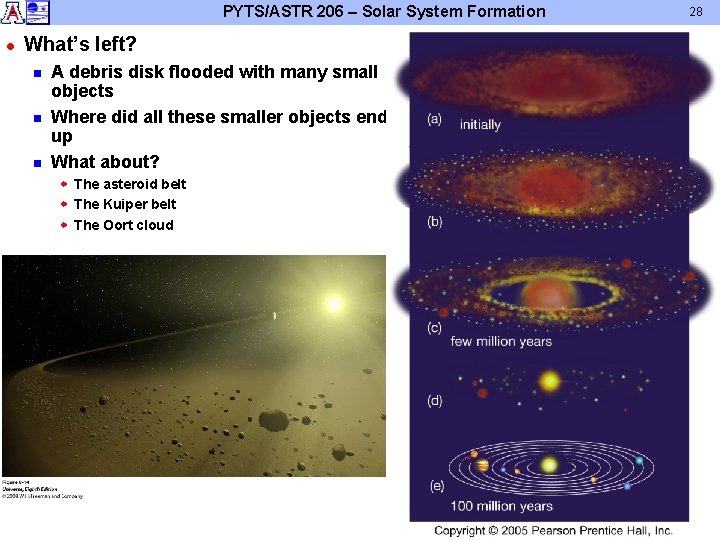
PYTS/ASTR 206 – Solar System Formation l What’s left? n n n A debris disk flooded with many small objects Where did all these smaller objects end up What about? w The asteroid belt w The Kuiper belt w The Oort cloud 28
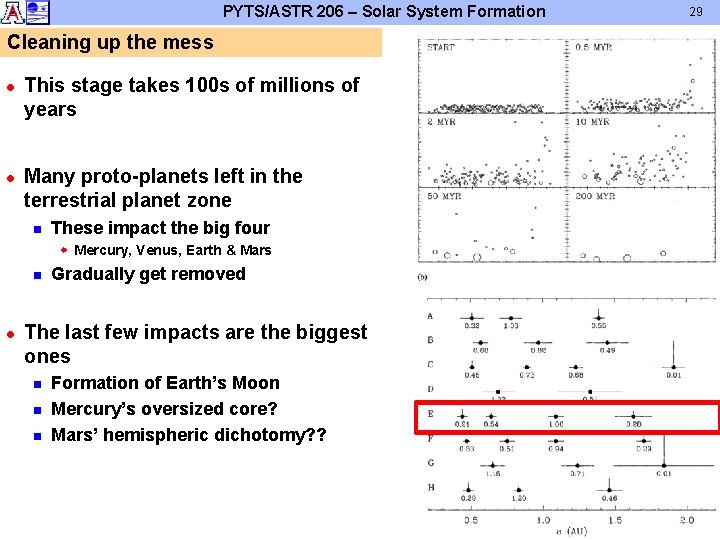
PYTS/ASTR 206 – Solar System Formation Cleaning up the mess l l This stage takes 100 s of millions of years Many proto-planets left in the terrestrial planet zone n These impact the big four w Mercury, Venus, Earth & Mars n l Gradually get removed The last few impacts are the biggest ones n n n Formation of Earth’s Moon Mercury’s oversized core? Mars’ hemispheric dichotomy? ? 29
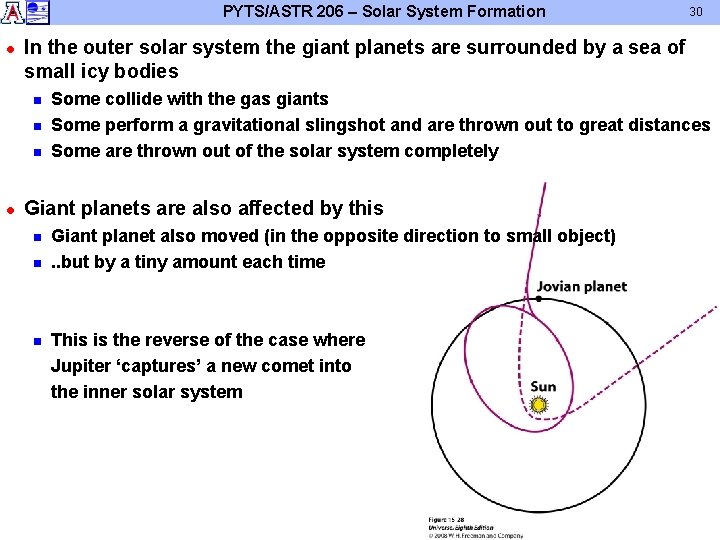
PYTS/ASTR 206 – Solar System Formation l In the outer solar system the giant planets are surrounded by a sea of small icy bodies n n n l 30 Some collide with the gas giants Some perform a gravitational slingshot and are thrown out to great distances Some are thrown out of the solar system completely Giant planets are also affected by this n n n Giant planet also moved (in the opposite direction to small object). . but by a tiny amount each time This is the reverse of the case where Jupiter ‘captures’ a new comet into the inner solar system
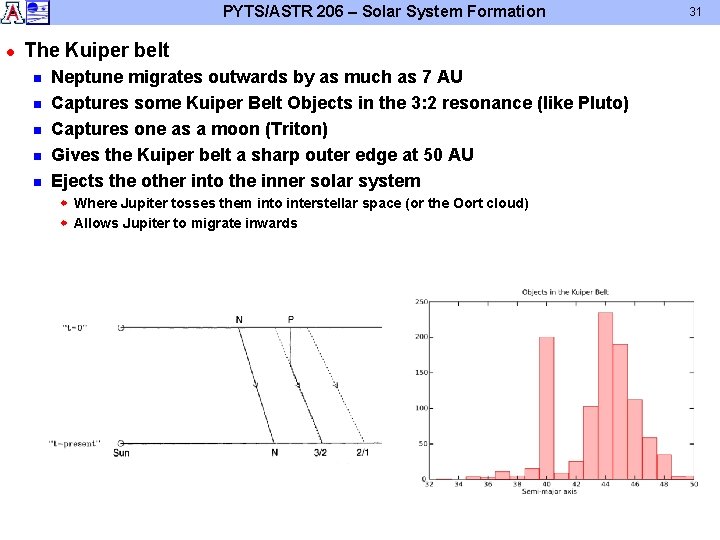
PYTS/ASTR 206 – Solar System Formation l The Kuiper belt n n n Neptune migrates outwards by as much as 7 AU Captures some Kuiper Belt Objects in the 3: 2 resonance (like Pluto) Captures one as a moon (Triton) Gives the Kuiper belt a sharp outer edge at 50 AU Ejects the other into the inner solar system w Where Jupiter tosses them into interstellar space (or the Oort cloud) w Allows Jupiter to migrate inwards 31
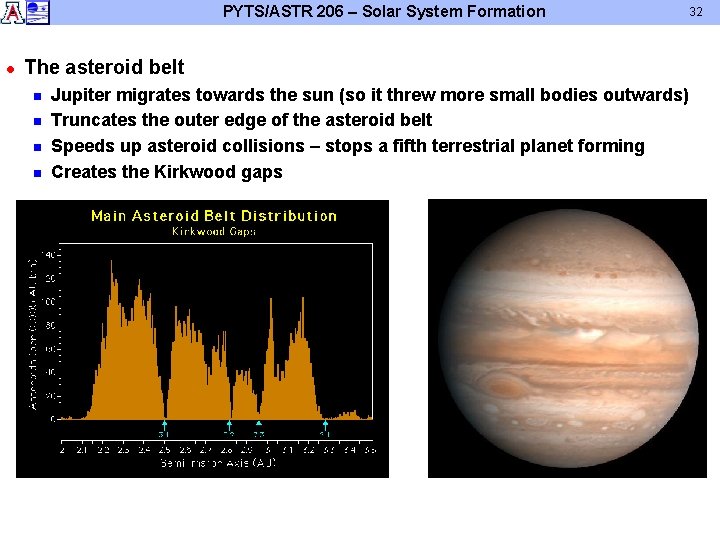
PYTS/ASTR 206 – Solar System Formation l The asteroid belt n n Jupiter migrates towards the sun (so it threw more small bodies outwards) Truncates the outer edge of the asteroid belt Speeds up asteroid collisions – stops a fifth terrestrial planet forming Creates the Kirkwood gaps 32
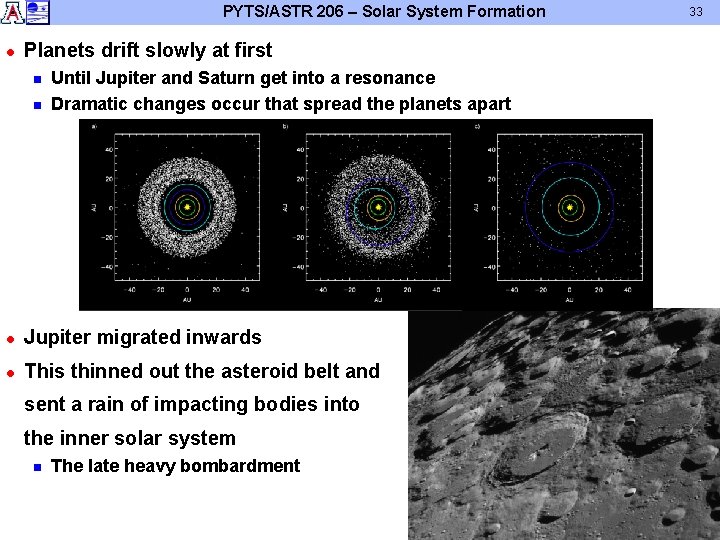
PYTS/ASTR 206 – Solar System Formation l Planets drift slowly at first n n Until Jupiter and Saturn get into a resonance Dramatic changes occur that spread the planets apart l Jupiter migrated inwards l This thinned out the asteroid belt and sent a rain of impacting bodies into the inner solar system n The late heavy bombardment 33
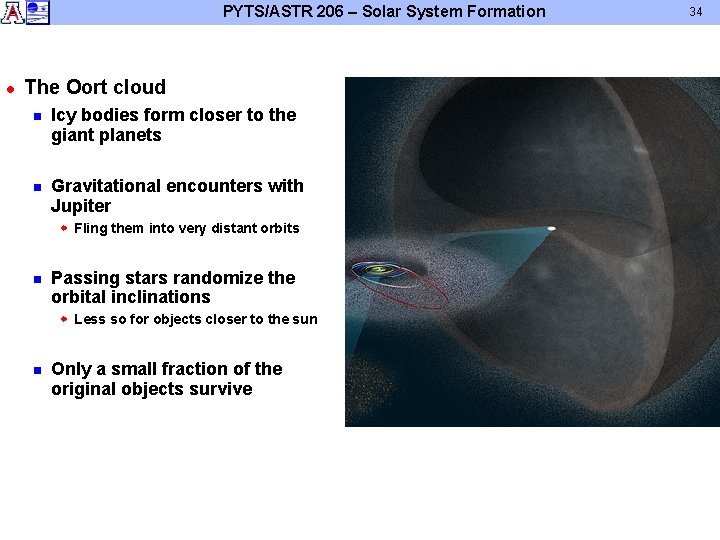
PYTS/ASTR 206 – Solar System Formation l The Oort cloud n Icy bodies form closer to the giant planets n Gravitational encounters with Jupiter w Fling them into very distant orbits n Passing stars randomize the orbital inclinations w Less so for objects closer to the sun n Only a small fraction of the original objects survive 34
PYTS/ASTR 206 – Solar System Formation 35
PYTS/ASTR 206 – Solar System Formation l Giant molecular clouds collapse n n Forms a quickly spinning disk with the Sun at the center Temperature decreases with distance from the Sun w Water ice stable a few AU from the center l l Interstellar dust grains form 1 km planetesimals Planetesimals grow quickly through gravitational attraction n l l l Proto-planets are bigger where water ice is stable Giant planet cores capture gas from the disk Remaining protoplanets coalesce through collisions Scattering of small bodies allows gas giants to migrate n n n Sets asteroid and Kuiper belt structure Forms the Oort cloud Results in late heavy bombardment 36
PYTS/ASTR 206 – Solar System Formation In this lecture… l Giant molecular clouds collapse n n Forms a quickly spinning disk with the Sun at the center Temperature decreases with distance from the Sun w Water ice stable a few AU from the center l Interstellar dust grains form 1 km planetesimals l Planetesimals grow quickly through gravitational attraction n Proto-planets are bigger where water ice is stable l Giant planet cores capture gas from the disk l Remaining protoplanets coalesce through collisions l Scattering of small bodies allows gas giants to migrate n n n Sets asteroid and Kuiper belt structure Forms the Oort cloud Results in late heavy bombardment Next: Extrasolar Planets l Reading l Chapter 8 to revise this lecture l Chapter 8 -7 for next lecture 37