PTT 206 INSTRUMENTATION MEASUREMENT AND CONTROL SEM 2



- Slides: 16
PTT 206 INSTRUMENTATION, MEASUREMENT AND CONTROL SEM 2 (2015/2016) MICROCALORIMETRIC CHARACTERIZATION OF BACTERIAL INOCULA
CONTENT OF LECTURE A. WHAT IS MICROCALORIMETER? B. MAIN TYPES OF CALORIMETER C. THERMODYNAMICS CONSIDERATIONS D. CATABOLIC & ANABOLIC REACTIONS E. MICROCALORIMETRY & BACTERIAL GROWTH F. ADVANTAGES OF CALORIMETRY G. CASE STUDY
A. WHAT IS MICROCALORIMETER? • Calorimetry: the science of measuring the heat of chemical reactions or physical changes. • Microcalorimeter: an instrument that measure heat flow rate (μJ/sec = μW) and cumulative amount of heat (J) consumed or produced at essentially constant temperature in biological process.
B. MAIN TYPES OF CALORIMETER • Based on heat measurement, calorimeters may be divided into two types: 1. Adiabatic Calorimeter 1. 1 Characteristics of Adiabatic Calorimeter: v No heat exchange takes place between calorimetric vessel and its surroundings. v The amount of heat involved or absorbed in an ideal adiabatic calorimeter is equal to the product of the measured temperature change and the heat capacity of the vessel including its content. v Equation: Q = ɛ. ∆T where, Q = heat produced during the experiment (J) ɛ = heat capacity of the calorimetric system
2. Heat Conduction Calorimeter 2. 1 Characteristics of Heat conduction Calorimeter: v Measures heat fluxes (d. Q/dt) in watts. v The heat from the system under study is quantitatively transferred from the vessel in which the reaction takes place through thermophiles to a surrounding heat sink. v The thermophiles consist of a number of thermocouples that create an electrical potential difference (V in volts) over thermophile wall proportional to the temperature differences between the sample vessel and the surrounding heat sink is about 10 -6◦C for microcalorimeters.
C. THERMODYNAMICS CONSIDERATIONS • The heat output accompanying biological reactions depends only on the initial and the final state of system. • In biological systems, reactions can be considered to take place in solutions at both constant volume and pressure, thus, the concepts of energy and enthalpy become interchangeable. • The change in energy content accompanying a reaction is the same as the enthalpy change of the reaction (∆H).
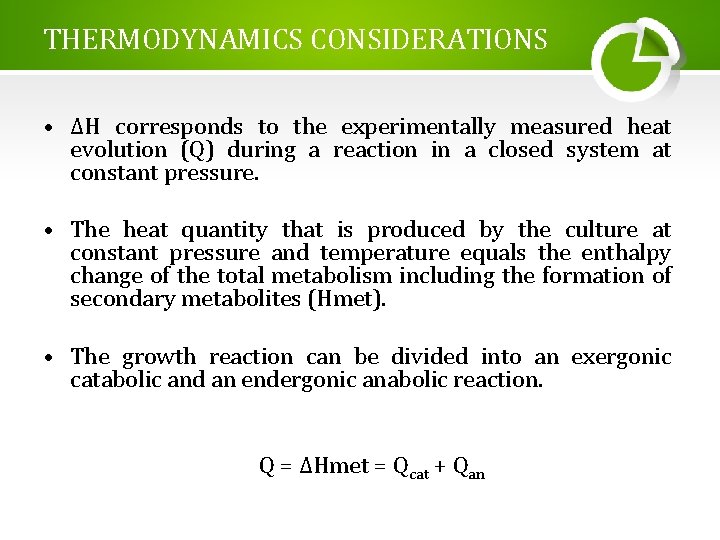
THERMODYNAMICS CONSIDERATIONS • ∆H corresponds to the experimentally measured heat evolution (Q) during a reaction in a closed system at constant pressure. • The heat quantity that is produced by the culture at constant pressure and temperature equals the enthalpy change of the total metabolism including the formation of secondary metabolites (Hmet). • The growth reaction can be divided into an exergonic catabolic and an endergonic anabolic reaction. Q = ∆Hmet = Qcat + Qan
D. CATABOLIC & ANABOLIC REACTIONS • Metabolism: sum of all chemical reactions within a living organism. • Metabolic pathways: a series of chemical reactions in which the product of one reaction is the substrate for the next reaction. • The chemical reactions are catalyzed by enzymes, so the metabolic pathways present in an organism depend on the enzymes in the organism.
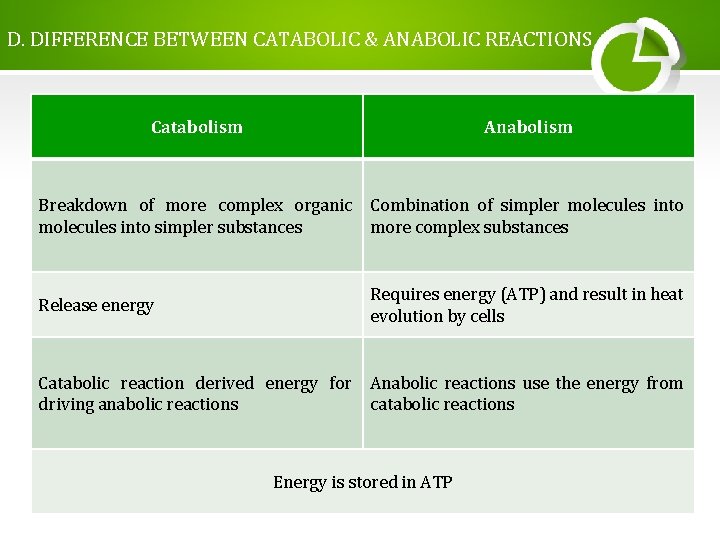
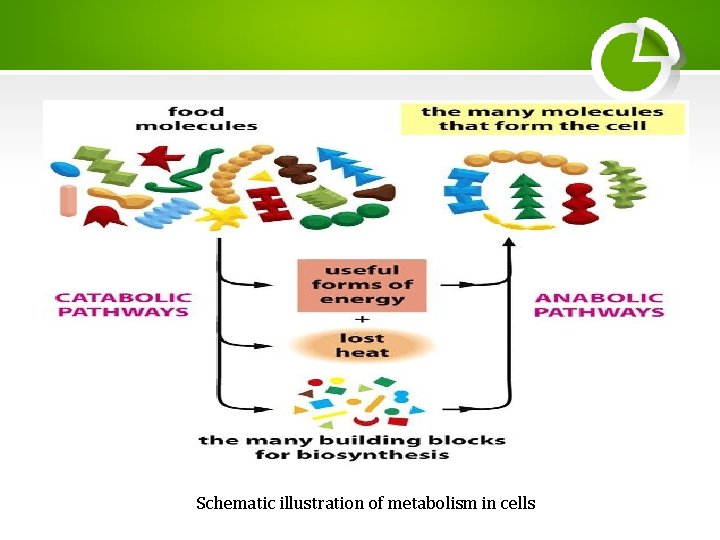
D. DIFFERENCE BETWEEN CATABOLIC & ANABOLIC REACTIONS Catabolism Anabolism Breakdown of more complex organic molecules into simpler substances Combination of simpler molecules into more complex substances Release energy Requires energy (ATP) and result in heat evolution by cells Catabolic reaction derived energy for driving anabolic reactions Anabolic reactions use the energy from catabolic reactions Energy is stored in ATP
Schematic illustration of metabolism in cells
E. MICROCALORIMETRY & BACTERIAL GROWTH • Four reasons drive scientists to study microcalorimetry for inoculum survival: 1. Microcalorimetry measures the total heat production of a bacterial culture (measure biomass and total heat produce from microorganism's activity). 2. By providing data to compute energy balances and efficiencies, microcalorimetry yields more information than the more conventional monitoring methods for bacterial culture. 3. Microcalorimetry monitors bacterial cultures continuously and nondestructively. 4. Microcalorimetric output is reproducible.
F. ADVANTAGES OF CALORIMETRY I. A gross value for a process or sum of processes can be obtained through which unknown and undefined phenomena may be detected. II. Allow a continuous registration of life processes without any disturbance (e. g. the addition of reagents) III. The technique is independent of turbidity or color of the bacterial suspensions.
G. CASE STUDY Materials & Methods ü Wild-type strains of Pseudomonas fluorescens 88 W 1 were grown in a shake culture in a 1 Liter Erlenmeyer flask containing 600 ml King medium B. ü At 28 °C, bacterial numbers were determined every hour by dilution plating on King medium B spread plates. ü The heat production rate was monitored using microcalorimeter (Bioactivity Monitor LKB 2277). ü The voltage signal was recorded by a two-channel recorder (LKB 2210 -002, 1000 m. V). ü The water bath temperature of the microcalorimeter was kept at 25 °C. The culture medium was transferred from the flask through the calorimeter by means of peristaltic pump at a flow rate of 40 m. L/h. ü After calorimetric measurement, the culture medium was discarded. ü To avoid contamination, all tubing was thoroughly washed before each run with: a. Na. Cl. O 10% (20 min), b. sterile distilled water (5 min), c. ethanol 95% (20 min) and d. sterile distilled water (5 min) at a flow rate of 40 m. L/h. ü Culture samples were taken at the outlet tubings of the calorimeter and inoculated onto two separate batches of 250 ml Erlenmeyer flasks containing 100 ml King medium B.
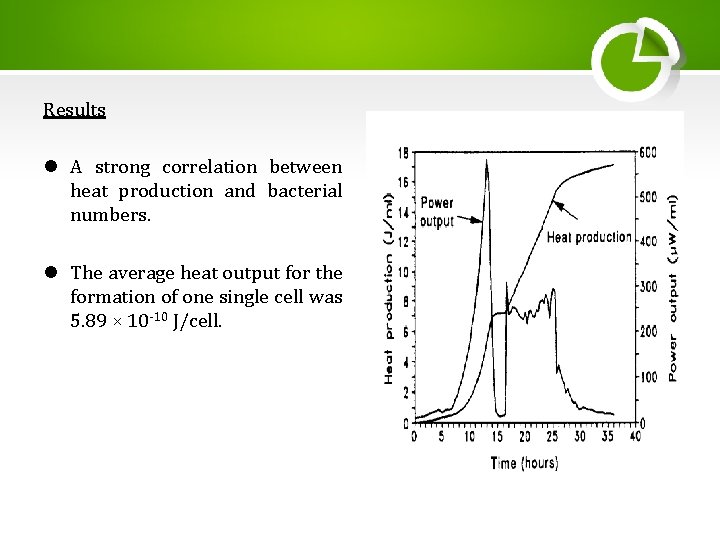
Results l A strong correlation between heat production and bacterial numbers. l The average heat output for the formation of one single cell was 5. 89 × 10 -10 J/cell.
Conclusions l The growth stage of the bacterial cultures at the moment of sampling had an important impact on the duration of the growth lag after inoculation into fresh culture medium. l The two replicate batches yielded similar data, indicating that microcalorimetry can be used as a control variable for reproducible sampling of bacterial cultures and that it is sufficiently sensitive to demonstrate inoculum differences until now unaccounted for.
THANK YOU