Psychiatric Nursing Personality Disorders Chapter 22 S 1

- Slides: 71
Psychiatric Nursing Personality Disorders Chapter 22 S 1
Objectives S Define personality vs. personality disorders S Identify various types of personality disorders 2
Personality S The individual qualities, including habitual behavior patterns, that make a person unique. S It is an ingrained enduring pattern of behaving and relating to self, others, and the environment; it includes perceptions, attitudes, and emotions. S These behaviors and characteristics are consistent across a broad range of situations and do not change easily. S A person usually is not consciously aware of her or his personality
Personality Disorders • Personality traits (features): • Is a set of characteristics possessed by a person that uniquely influences his or her cognitions, emotions, interpersonal orientation, motivation, and behaviors in various situations). • When does personality disorder happen? • When personality traits are inflexible and maladaptive and cause significant functional impairment or distress, they constitute as personality disorders. Set of characteristics that combine to negatively affect your life. S 4
Personality Disorders S Rigid, stereotyped behavior pattern S Persists throughout the person’s life S Pattern of perceiving, thinking, and relating that impairs social or occupational functioning
Personality Traits S Persistent behavioral patterns that do not significantly interfere with one’s life, even though the behaviors may be annoying or frustrating to others
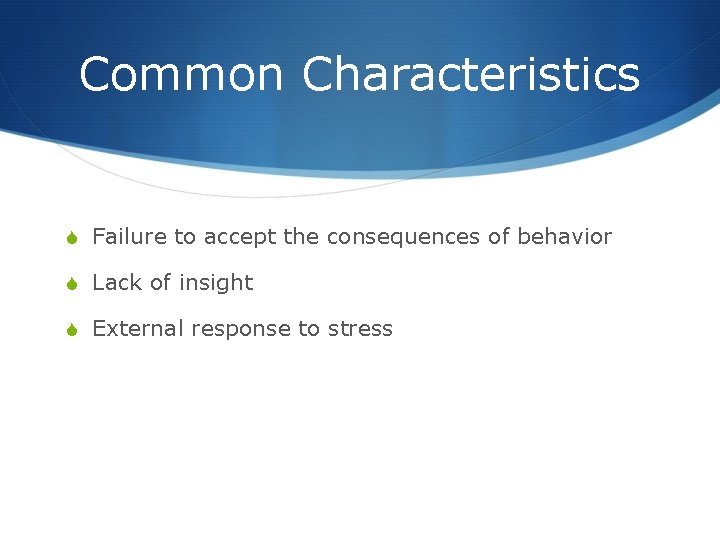
Common Characteristics S Failure to accept the consequences of behavior S Lack of insight S External response to stress
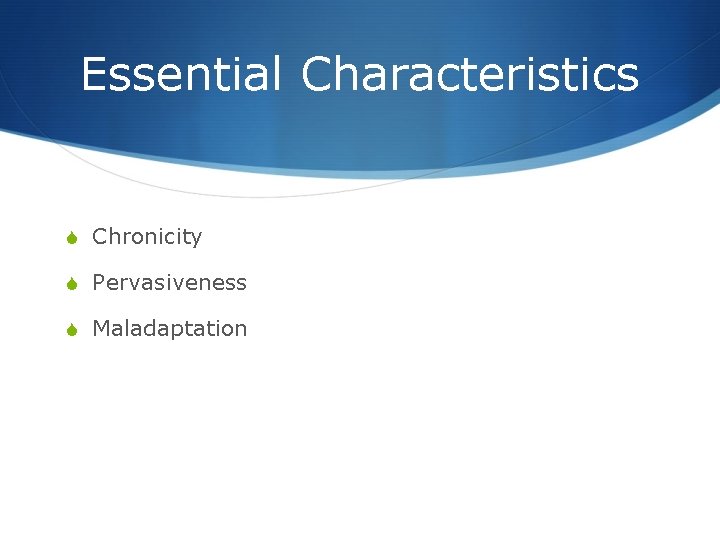
Essential Characteristics S Chronicity S Pervasiveness S Maladaptation
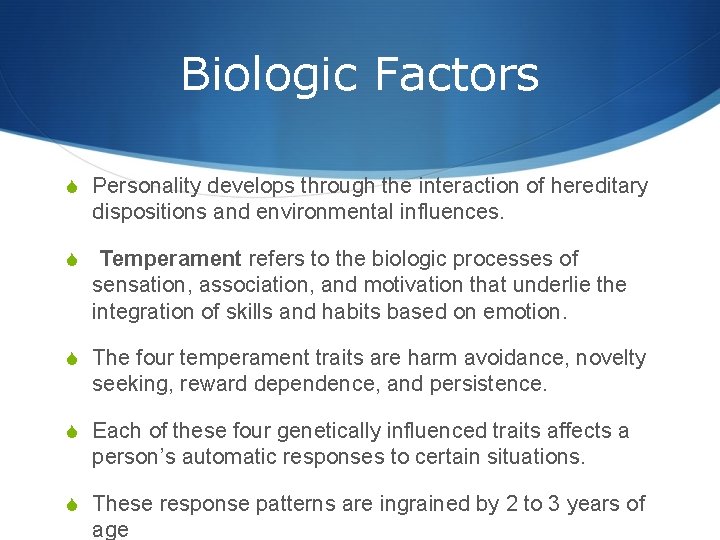
Biologic Factors S Personality develops through the interaction of hereditary dispositions and environmental influences. S Temperament refers to the biologic processes of sensation, association, and motivation that underlie the integration of skills and habits based on emotion. S The four temperament traits are harm avoidance, novelty seeking, reward dependence, and persistence. S Each of these four genetically influenced traits affects a person’s automatic responses to certain situations. S These response patterns are ingrained by 2 to 3 years of age
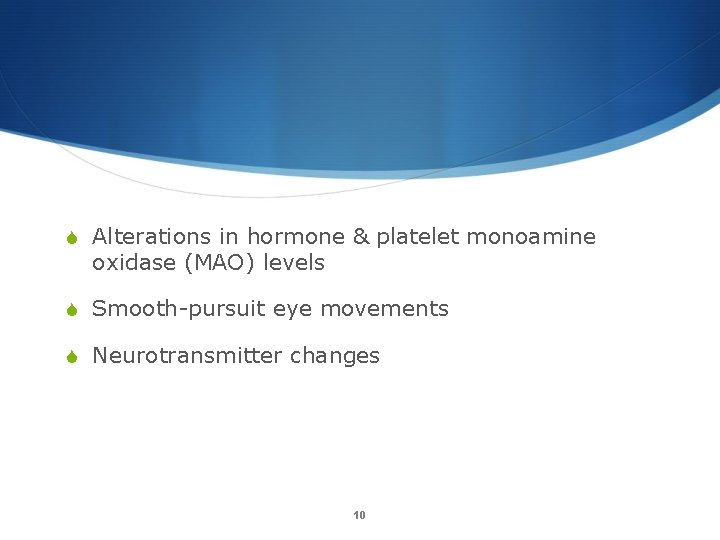
S Alterations in hormone & platelet monoamine oxidase (MAO) levels S Smooth-pursuit eye movements S Neurotransmitter changes 10
Biologic Factors (cont'd) S Electroencephalographic (EEG) changes S Structural brain changes S Diminished blood flow and inflammation
Genetic Factors S Familial tendencies S Cluster B correlated with mood disorders, alcoholism, and somatization S Genetic variation
Psychosocial Factors S Parent-child interactions S Intrapsychic theory S Enmeshment: introduced the concept of enmeshment to describe families where personal boundaries were diffuse, subsystems undifferentiated, and over-concern for others led to a loss of autonomous development S Abandonment
S Identity diffusion refers to a part of the process of a person figuring out who they are. Typically, it is the part of adolescence when a person has not yet fully realized their social identity or defined their personality traits - and they are not actively seeking to. To develop and establish their identity they will need to make a series of choices and commitments. 14
Psychodynamic Theories S Character consists of concepts about the self and the external world. It develops over time as a person comes into contact with people and situations and confronts challenges. Three major character traits have been distinguished: self-directedness, cooperativeness, and self-transcendence. When fully developed, S these character traits define a mature personality 15
Humanistic Theory S Personality disorders are a combination of multiple factors.
Personality disorder S Diagnosis is made when the person exhibits enduring behavioral patterns that deviate from cultural expectations in two or more of the following areas: • Ways of perceiving and interpreting self, other people, and events (cognition) • Range, intensity, lability, and appropriateness of emotional response (affect) • Interpersonal functioning • Ability to control impulses or express behavior at the appropriate time and place 17(impulse control)
S Some people with personality disorders believe their problems stem from others or the world in general; they do not recognize their own behavior as the source of difficulty. S For these reasons, people with personality disorders are difficult to treat, which may be frustrating for the nurse and other caregivers as well as for family and friends. S There also difficulties in diagnosing and treating clients with personality disorders because of similarities and subtle differences between categories or types. Types often overlap, and many people with personality disorders also have coexisting mental illnesses. 18
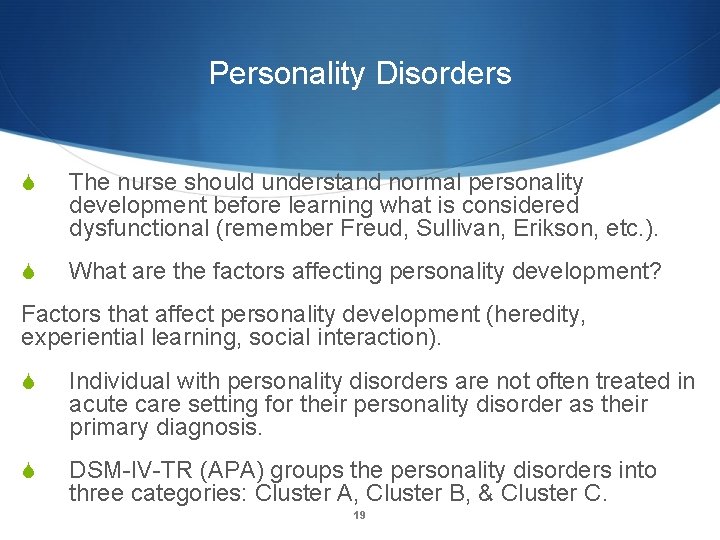
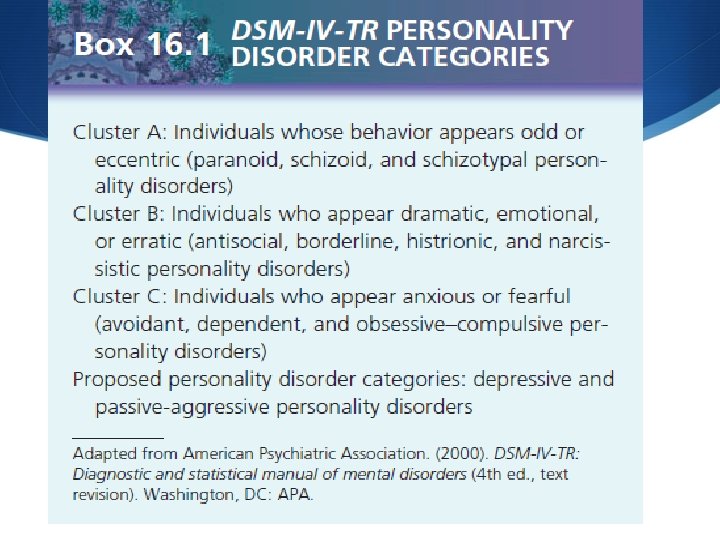
Personality Disorders S The nurse should understand normal personality development before learning what is considered dysfunctional (remember Freud, Sullivan, Erikson, etc. ). S What are the factors affecting personality development? Factors that affect personality development (heredity, experiential learning, social interaction). S Individual with personality disorders are not often treated in acute care setting for their personality disorder as their primary diagnosis. S DSM-IV-TR (APA) groups the personality disorders into three categories: Cluster A, Cluster B, & Cluster C. 19
20
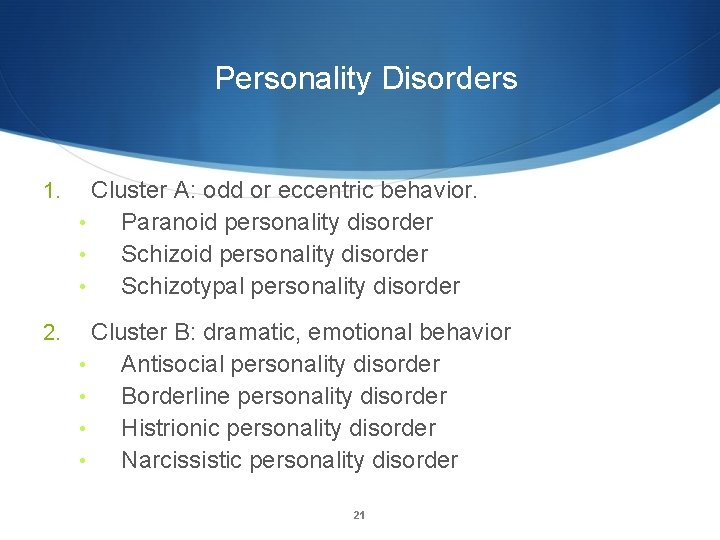
Personality Disorders 1. Cluster A: odd or eccentric behavior. • Paranoid personality disorder • Schizotypal personality disorder 2. Cluster B: dramatic, emotional behavior • Antisocial personality disorder • Borderline personality disorder • Histrionic personality disorder • Narcissistic personality disorder 21
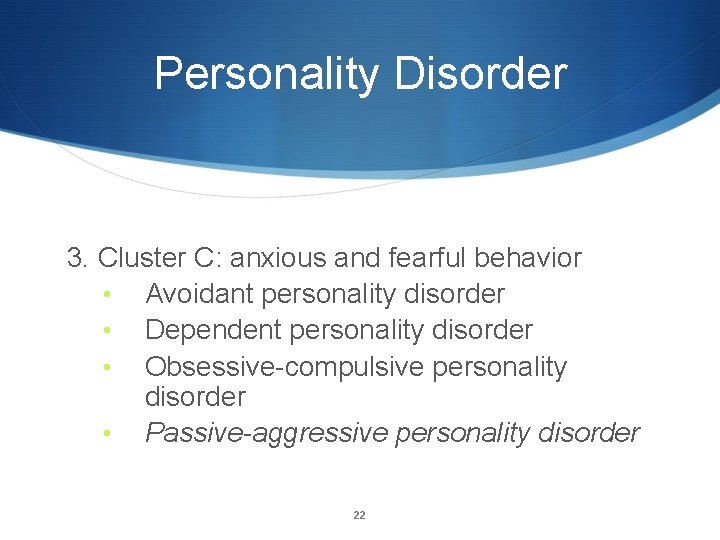
Personality Disorder 3. Cluster C: anxious and fearful behavior • Avoidant personality disorder • Dependent personality disorder • Obsessive-compulsive personality disorder • Passive-aggressive personality disorder 22
1 (A). Paranoid personality disorders S Definition: Pervasive (spreading throughout) distrust and suspiciousness of others such that their motives are interpreted as malevolent, beginning by early adulthood. S Long-standing irrational suspiciousness and mistrust of people. S Prevalence is difficult to establish, because individual with the disorder seldom seek assistance for their problem or require hospitalization. 23
Paranoid personality disorders S When they present for treatment at the insistence of others, they may be able to pull themselves together so their behavior does not appear maladaptive. S More common among men than women 24
Paranoid personality disorders Clinical Picture S Long-standing suspiciousness and mistrust of people, consistently on guard (cautious), hyper-vigilant (very attentive), and ready for any threat. S They appear tense and irritable, (immune) insensitive to the feelings of others, oversensitive and misinterpret events, envious and hostile (unfriendly) to others who are successful. S They trust no one, therefore, they consistently testing the honesty of others. Always feel that others are there to take advantage of them. Perceive the world as 25 harsh and unkind.
Paranoid personality disorders S Paranoid PD: clinical picture continue S Hostile to others who are successful & believe the only reason they are not successful is because they have been treated unfairly. S They are consistently in the defensive. They learned to attack first (aggression and violence). 26
Paranoid personality disorders S Causes: ü Hereditary, ü Parental antagonism (against the children) & harassment (persistent attack of criticism). Due to harsh parental treatment they learned to perceive the world as harsh and unkind. 27
2 (A). Schizoid personality disorders S This disorder characterized by a profound (deep/strong) defect in the ability to perform personal relationships or to respond to others in any meaningful, emotional way. S Prevalence (3 -7. 5% of general population) and does not need primary hospitalization. S Clinical picture S Social withdrawal, discomfort with human interaction, cold and aloof (not emotional). S Prefer to work in isolation, unsociable, little need or desire for emotional ties. 28
2 (A). Schizoid personality disorders Schizoid PD: Clinical Picture continue S In the presence of other they appear shy, anxious, uneasy, inappropriately serious about everything and unable to experience pleasure sometimes. S They are cold and un-empathetic. S Their behavior and conversation exhibit little or no spontaneity (not free/not comfortable). S They don’t display any sexual desire of others. S They don’t like group therapy and they don’t look for treatment. 29
2 (A). Schizoid personality disorders S Cause: ü Hereditary characteristics. ü Early interactional patterns that the person found to be cold and unsatisfying. ü The childhoods of these individuals have often been characterized as bleak (ﻛﺌﻴﺐ offering no excitement), cold, & lacking empathy. ü A child brought up with this type of parenting may become a schizoid adult. 30
3 (A). Schizotypal personality disorders S Described as ‘’latent (potential) schizophrenics’’. Their behavior is odd and eccentric, but not to the level of schizophrenia. 3% of the population has this disorder. They need for social isolation. S Clinical Picture S Aloof and isolated, have bland (flat) and apathetic (no emotions) manner. S They have magical thinking, idea of reference, illusions, and depersonalizations are part of their everyday world. S They show disorders in speech pattern some times. S When they are under stress, they may decompensate and demonstrate psychotic symptoms such as delusional thoughts, hallucination for brief period of time. 31
3 (A). Schizotypal personality disorders Causes: S Heredity: more common among the first degree biological relatives of people with schizophrenia. S They were likely shunned (avoided), ignored, rejected, and humiliated by others resulting in feelings of low self- esteem and marked distrust of personal relations. Having failed to cope with these, they began to withdraw and reduce contact with individuals that evoke (produce) sadness and humiliation. 32
4 (B). Antisocial personality disorders S A pattern of socially irresponsible and guiltless behavior that reflects a disregard for and violation of the rights of others. Clinical Picture: S The person use and manipulate others for personal gain and have a general disregard for the law. S They have difficulty sustaining consistent employment and developing stable relationships. S The prevalence is 3% for men and 1% for women. 33
DSM IV-TR), defines antisocial personality disorder S A) A pervasive pattern of disregard for and violation of the rights of others, occurring since age 15 years, as indicated by three or more of the following: S failure to conform to social norms with respect to lawful behaviors as indicated by repeatedly performing acts that are grounds for arrest; S deception, as indicated by repeatedly lying, use of aliases, or conning others for personal profit or pleasure; S impulsivity or failure to plan ahead 34
S ; irritability and aggressiveness, as indicated by repeated physical fights or assaults; reckless disregard for safety of self or others; S consistent irresponsibility, as indicated by repeated failure to sustain consistent work behavior or honor financial obligations; S lack of remorse, as indicated by being indifferent to or rationalizing having hurt, mistreated, or stolen from another. 35 Dr. Masa'deh
S B) The individual is at least age 18 years. C) There is evidence of conduct disorder with onset before age 15 years. D) The occurrence of antisocial behavior is not exclusively during the course of schizophrenia or a manic episode. 36
5 (B). Borderline personality disorders (emotionally unstable PD) S Characterized by a pattern of intense & chaotic (unorganized) relationships, with affective instability & fluctuating (irregular) attitudes toward other people. S Clinical Picture: S The individuals are impulsive (they don’t think before they act) and self-destructive. S The prevalence is 2 -3% of the population. S Common twice in women than men. 37
Symptoms include S Splitting, Chaos in relationships, Markedly disturbed sense of identity S Intense or uncontrollable emotional triggers S Unstable interpersonal relationships and self-esteem S Concerns about abandonment S Self-damaging behavior S Impulsivity S Frequently accompanied by 38 depression, anxiety, anger, substance abuse or rage
6 (B). Histrionic personality disorders This disorder characterized by colorful, dramatic, and extra emotionality and attention seeking. They have difficulty maintaining long-life relationships & need constant affirmation of approval and acceptance from others. S Clinical Picture S Self-dramatizing, attention-seeking, overly and inappropriately seductive. S People with this disorder often demonstrate what our society tend to admire: to be well liked, successful, popular, attractive, & sociable, however, beneath this is a driven quality, a consuming need for approval or attract attention at all costs. S Failure to evoke the attention results in anxiety. 39
6 (B). Histrionic personality disorders S Clinical Picture continue S Highly distractible and have difficulty in paying attention to the details. S Highly suggestible, strongly dependent, & easily influenced by others. S Interpersonal relationships are superficial S They might have somatic complains and episodes of psychosis may occur during periods of extreme stress. 40
6 (B). Histrionic personality disorders S Causes: S Neurobiological: low basal dopaminergic activity, sympathetic arousal, adrenal hyperactivity, and neurochemical imbalance. S Hereditary. S Learning experiences during childhood (parents are likely to give positive or negative feedback). 41
7 (B). Narcissistic personality disorders S Individual with this disorder have exaggerated sense of self-worth ( ﻏﺮﻭﺭ vanity). They lack empathy and are hypersensitive to the evaluation of others. They believe that they have the right to receive special consideration & their desire is sufficient justification for possessing whatever they seek. S Men more than women S Clinical Picture S Overly self-centered and exploiting others to fulfill their own desires. S Because they view themselves as ‘’superior’’, they believe they are entitled to special rights & privileges. 42
7 (B). Narcissistic personality disorders S Clinical Picture continue S Impaired interpersonal relationships, their mood is usually optimistic, relaxed, cheerful. Mood easily change. S They seek persons who provide them with positive feedback that they require, and who will not ask much in return. S Cause: S Hereditary-parents have narcissism S Parents were demanding perfection and placed unrealistic expectation on the child. 43
8 (C). Avoidant personality disorders S Those are extremely sensitive to rejection, and therefore have socially withdrawn life. Their extreme shyness & fear of rejection lead them to be socially withdrawn. They have feelings of inadequacy. S Equal in men and women S Clinical Picture S Awkward & uncomfortable in social situations S Their speech is usually slow & constrained, with frequent hesitations, fragmentary thought sequences S Often lonely and express feeling of being unwanted 44
8 (C). Avoidant personality disorders Clinical Picture continue S May develop depression, anger, & anxiety at oneself for failing to develop social relations. S They desire to have close relationships but avoid that because of their fear of being rejected. 45
9 (C). Dependent personality disorders S Pervasive and excessive need to be taken care of that leads to fears of separation. Allow others to take decisions, feel helpless when they are alone. Depend on other people to meet their emotional and physical needs. S Clinical Picture S Tolerate miss treatment by others S Cannot be assertive S Lack of self-confidence (posture, voice), passive, they easily be hurt by criticism. 46
9 (C). Dependent personality disorders S Clinical Picture continue S They are overly generous & thoughtful & underplay their S S own attractiveness & achievement. They may appear to others that they are happy and enjoying life but when they are alone they may feel pessimistic and discouraged They let others make their important decisions. They have passive role in their relationships. They feel incapable of caring for themselves. Avoid positions and responsibility & feel anxious when forced into them. 47
9 (C). Dependent personality disorders S Causes: S Hereditary S The problem may o arise when parents become over protective and discourage independent behavior on the part of the child. 48
10 (C). Obsessive-compulsive personality disorders S Those are serious and formal individuals who have difficulty expressing emotions. They are overly disciplined, perfectionist, and preoccupied with rules. The intense fear of making mistakes leads to difficulty with decisions. S More common in men S Clinical Picture S Inflexible and lack of spontaneity, they work patiently at tasks that require accuracy and discipline. S Tend to be polite and formal. 49
10 (C). Obsessive-compulsive personality disorders Clinical Picture continue SConcerned with organization & efficiency“company man” SCommonly use the defense mechanism of reaction formation (presenting the opposite thought). 50
Personality disorders test S http: //www. 16 personalities. com/free-personality-test 51
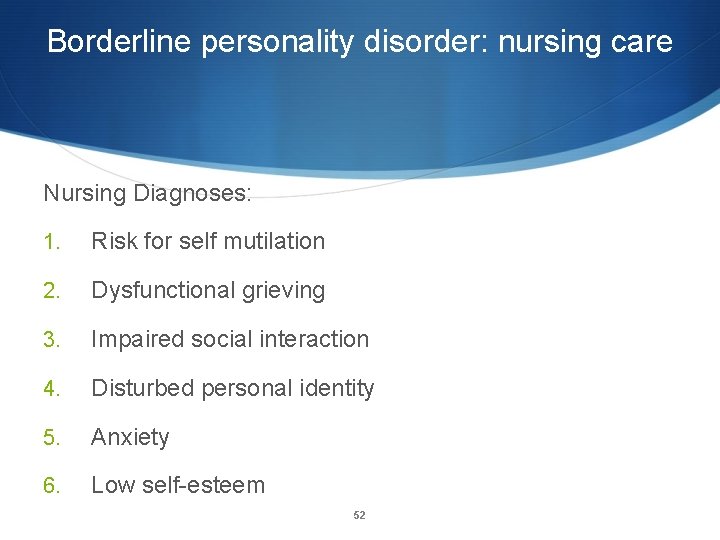
Borderline personality disorder: nursing care Nursing Diagnoses: 1. Risk for self mutilation 2. Dysfunctional grieving 3. Impaired social interaction 4. Disturbed personal identity 5. Anxiety 6. Low self-esteem 52
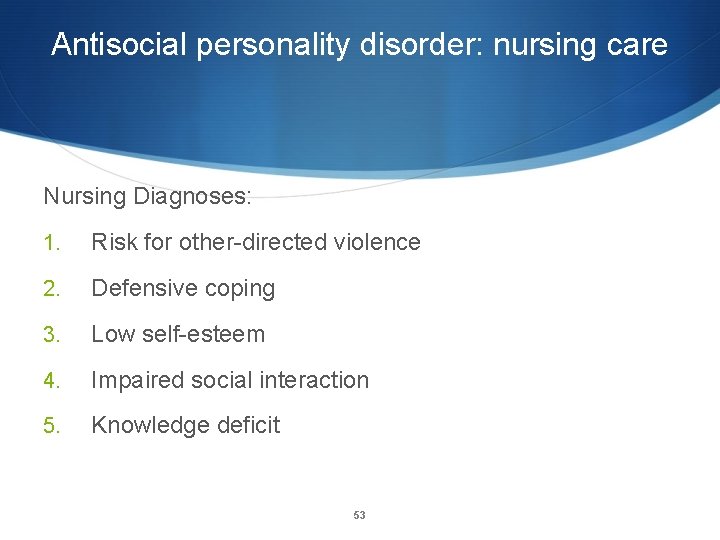
Antisocial personality disorder: nursing care Nursing Diagnoses: 1. Risk for other-directed violence 2. Defensive coping 3. Low self-esteem 4. Impaired social interaction 5. Knowledge deficit 53
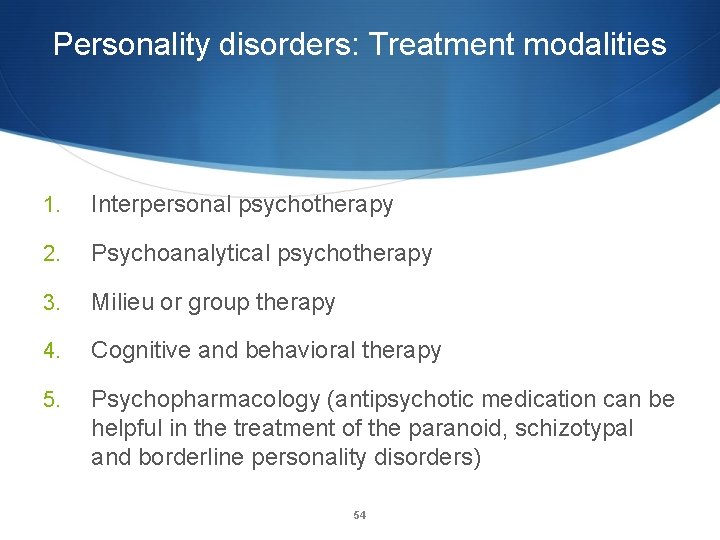
Personality disorders: Treatment modalities 1. Interpersonal psychotherapy 2. Psychoanalytical psychotherapy 3. Milieu or group therapy 4. Cognitive and behavioral therapy 5. Psychopharmacology (antipsychotic medication can be helpful in the treatment of the paranoid, schizotypal and borderline personality disorders) 54
11 (C). Passive-aggressive personality disorders S Pervasive pattern of negativistic attitudes and passive resistance to demands for adequate performance in social and occupational situations. S Some people passively expressing covert regression S Clinical Picture S They feel cheated and unappreciated, life unkind to them while others are having an easy life. 55
11 (C). Passive-aggressive personality disorders Clinical Picture continue S They often switch among the roles of the martyr, affronted, aggrieved, misunderstood, guilt-ridden, sickly, & overworked. ، ﻳﺴﺎﺀ ﻓﻬﻤﻪ ، ﺑﺎﻟﻈﻠﻢ ، ﺑﺎﻹﻫﺎﻧﺔ ، ﺍﻟﺸﻬﻴﺪ ﻏﺚ ، ﺍﻟﺸﻌﻮﺭ ﺑﺎﻟﺬﻧﺐ ﺍﻟﺘﻲ ﺗﻌﺼﻒ ﺑﻬﺎ S Causes: parental attitude. 56
Application of the Nursing Process S Safety S Consistency S Boundary setting S Appropriate self-disclosure
Difficult Behaviors S Manipulation S Narcissism S Impulsiveness
Interventions for Paranoid Personality Disorder S Respect personal space. S Respect client’s preference. S Give feedback based on nonverbal cues. S Provide client with a daily schedule of activities and inform client of changes.
Interventions for Paranoid Personality Disorder (cont'd) S Help client identify adaptive diversionary activities. S Use role-playing. S Use an objective, matter-of-fact approach with client. S Use concrete, specific words rather than global abstractions.
Interventions for the Angry Client S Use a calm, unhurried approach. S Do not touch client indiscriminately. S Respect personal space. S Use active listening skills. S Remain aware of personal feelings.
Interventions for Antisocial Personality Disorder S Use a concerned, matter-of-fact approach. S Set, communicate, and maintain consistent rules and regulations. S Do not argue, bargain, or rationalize.
Interventions for the Antisocial Personality Disorder (cont'd) S Confront inappropriate behaviors. S Do not seek approval or coax; use choices and consequences. S Be alert for flattery or verbal attacks.
Interventions for Manipulative Behavior S Assign one primary staff member. S Maintain realistic limits with enforceable consequences. S Give a rationale for limits and consequences.
Interventions for Manipulative Behavior (cont'd) S Model respect, honesty, openness, and assertiveness. S Confront client each time manipulation occurs.
Interventions for Dependent Personality Disorder S Evaluate client’s ability for self-care. S Avoid doing things the client is capable of doing. S Help client identify assets and liabilities.
Interventions for Dependent Personality Disorder (cont'd) S Emphasize strengths and potential. S Encourage client to take responsibility for own opinions. S Point out when client negates own feelings or opinions.
The Nurse’s Response S Self-awareness S Countertransference : is defined as redirection of a psychotherapist's feelings toward a client S Labels and stigma S Supervision
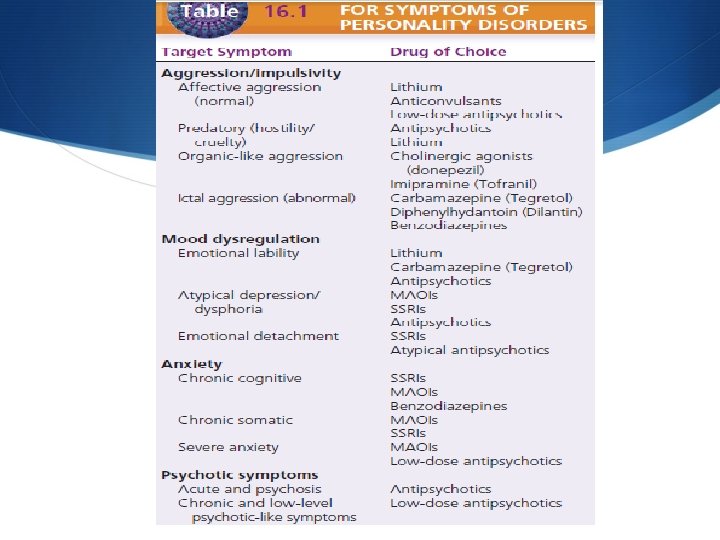
Psychopharmacology S Pharmacologic treatment of clients with personality disorders focuses on the client’s symptoms rather than the particular subtype. S The four symptom categories that underlie personality disorders are cognitive–perceptual distortions, including psychotic symptoms; affective symptoms and mood dysregulation; aggression and behavioral dysfunction; and anxiety. 69
70
THANK YOU 71