PSYC 112 PSYCHOLOGY FOR EVERYDAY LIVING Session 3


- Slides: 38
PSYC 112 PSYCHOLOGY FOR EVERYDAY LIVING Session 3 – Memory Part I Lecturer: Dr. Paul Narh Doku, Dept of Psychology, UG Contact Information: pndoku@ug. edu. gh College of Education School of Continuing and Distance Education 2014/2015 – 2016/2017
Session Overview • From the previous session (session 3) it was understood that memory is the term given to the structures and processes involved in the storage and subsequent retrieval of information. This session will introduce you to how information is processed in the memory system, how information is retrieved from the memory system, reasons why forgetting occurs and how to enhance the human memory. Slide 2
Session Outline The key topics to be covered in the session are as follows: • Topic 1 – Encoding Information into Memory • Topic 2 – Effortful Processing Strategies • Topic 3 – Retrieving Information from Memory • Topic 4 - Forgetting • Topic 5 – Improving the human memory Slide 3
Reading List • Refer to students to relevant text/chapter or reading materials you will make available on Sakai Dr. Richard Boateng, UGBS Slide 4
Topic 1: Encoding Information into Memory College of Education School of Continuing and Distance Education 2014/2015 – 2016/2017
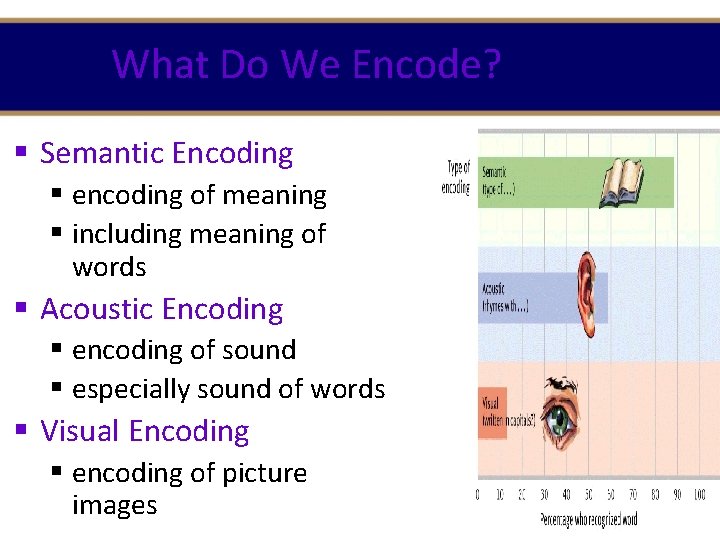
What Do We Encode? § Semantic Encoding § encoding of meaning § including meaning of words § Acoustic Encoding § encoding of sound § especially sound of words § Visual Encoding § encoding of picture images
Types of Processing • Automatic processing: memory processing that occurs subconsciously and does not require attention. Example: How many of you can sing theme song for Gilligan’s Island? How many learned it on purpose? • Effortful processing: memory processing that occurs consciously and requires attention Example: How many of you can name all of the divisions of the nervous system? How many learned it on purpose?
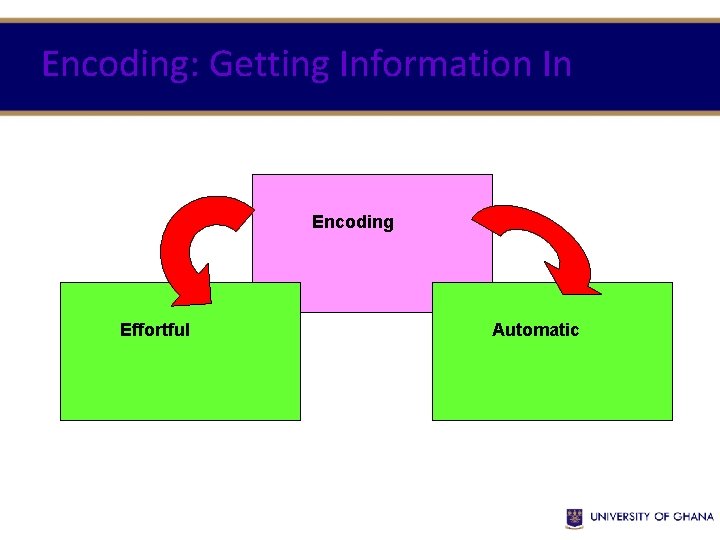
Encoding: Getting Information In Encoding Effortful Automatic
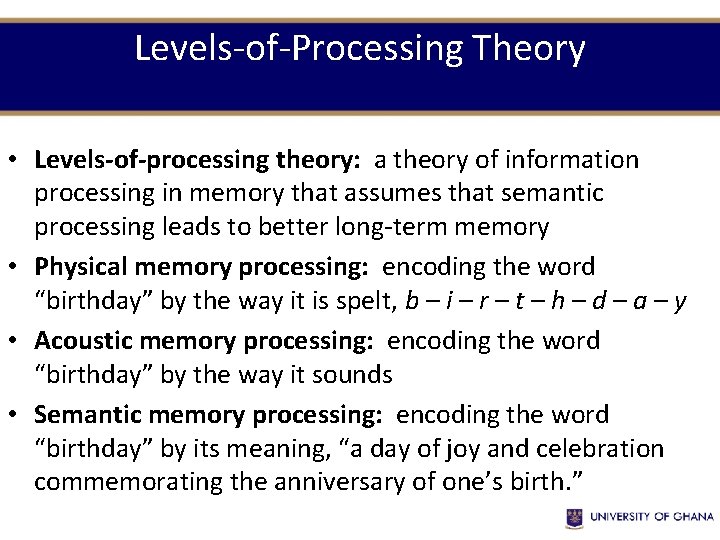
Levels-of-Processing Theory • Levels-of-processing theory: a theory of information processing in memory that assumes that semantic processing leads to better long-term memory • Physical memory processing: encoding the word “birthday” by the way it is spelt, b – i – r – t – h – d – a – y • Acoustic memory processing: encoding the word “birthday” by the way it sounds • Semantic memory processing: encoding the word “birthday” by its meaning, “a day of joy and celebration commemorating the anniversary of one’s birth. ”
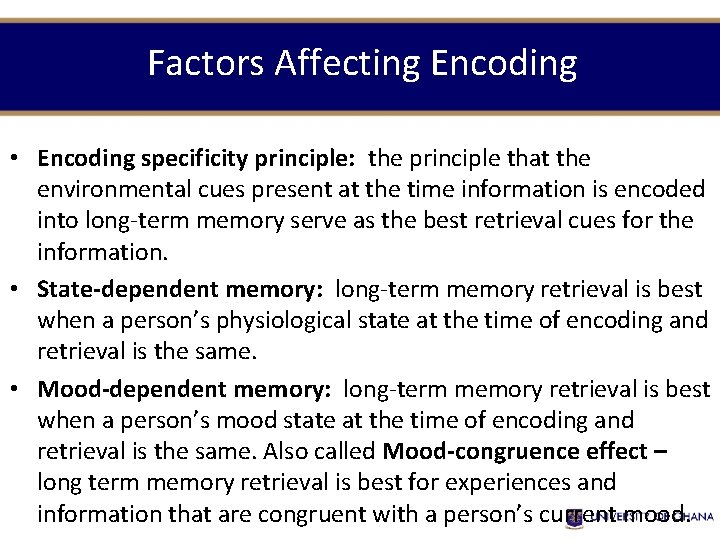
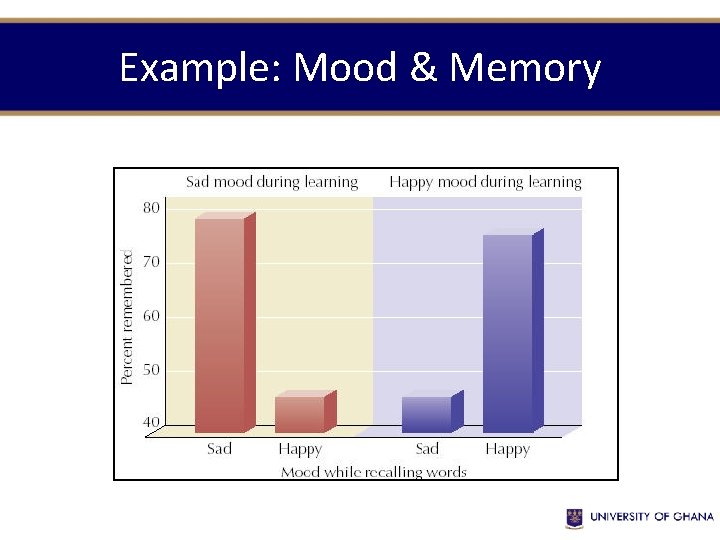
Factors Affecting Encoding • Encoding specificity principle: the principle that the environmental cues present at the time information is encoded into long-term memory serve as the best retrieval cues for the information. • State-dependent memory: long-term memory retrieval is best when a person’s physiological state at the time of encoding and retrieval is the same. • Mood-dependent memory: long-term memory retrieval is best when a person’s mood state at the time of encoding and retrieval is the same. Also called Mood-congruence effect – long term memory retrieval is best for experiences and information that are congruent with a person’s current mood.
Example: Mood & Memory
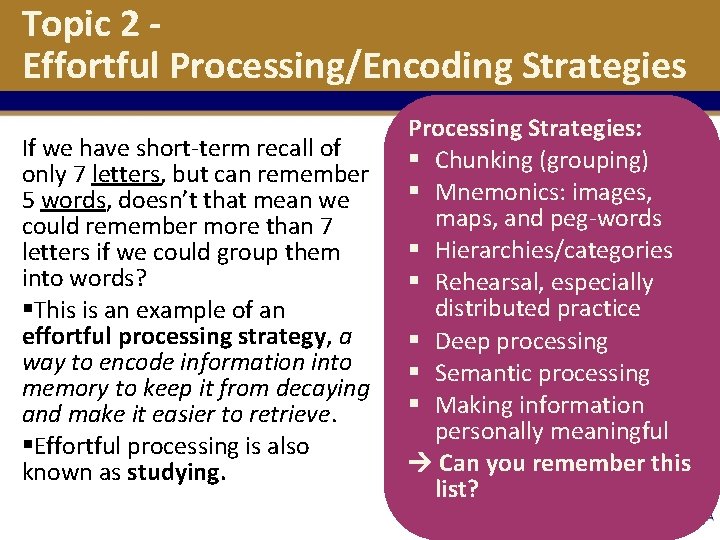
Topic 2 Effortful Processing/Encoding Strategies If we have short-term recall of only 7 letters, but can remember 5 words, doesn’t that mean we could remember more than 7 letters if we could group them into words? §This is an example of an effortful processing strategy, a way to encode information into memory to keep it from decaying and make it easier to retrieve. §Effortful processing is also known as studying. Processing Strategies: § Chunking (grouping) § Mnemonics: images, maps, and peg-words § Hierarchies/categories § Rehearsal, especially distributed practice § Deep processing § Semantic processing § Making information personally meaningful Can you remember this list?
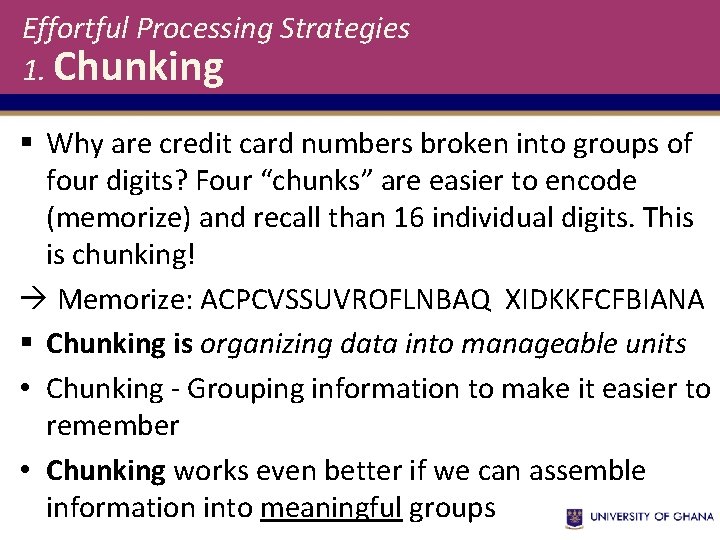
Effortful Processing Strategies 1. Chunking § Why are credit card numbers broken into groups of four digits? Four “chunks” are easier to encode (memorize) and recall than 16 individual digits. This is chunking! Memorize: ACPCVSSUVROFLNBAQ XIDKKFCFBIANA § Chunking is organizing data into manageable units • Chunking - Grouping information to make it easier to remember • Chunking works even better if we can assemble information into meaningful groups
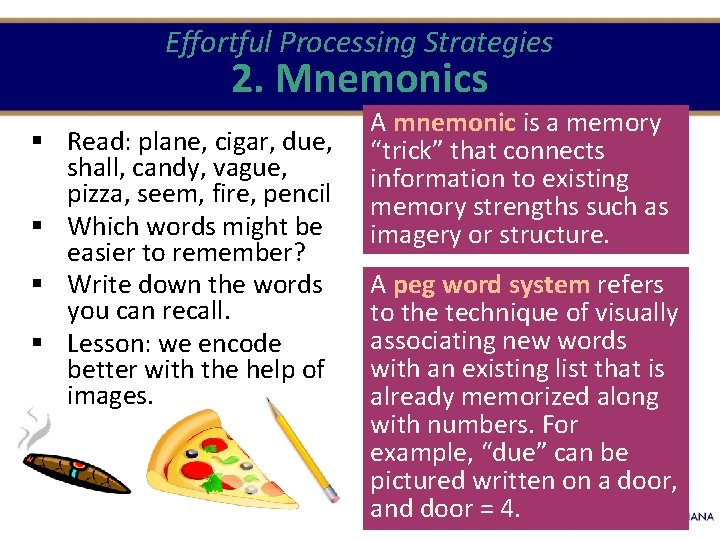
Effortful Processing Strategies 2. Mnemonics § Read: plane, cigar, due, shall, candy, vague, pizza, seem, fire, pencil § Which words might be easier to remember? § Write down the words you can recall. § Lesson: we encode better with the help of images. A mnemonic is a memory “trick” that connects information to existing memory strengths such as imagery or structure. A peg word system refers to the technique of visually associating new words with an existing list that is already memorized along with numbers. For example, “due” can be pictured written on a door, and door = 4.
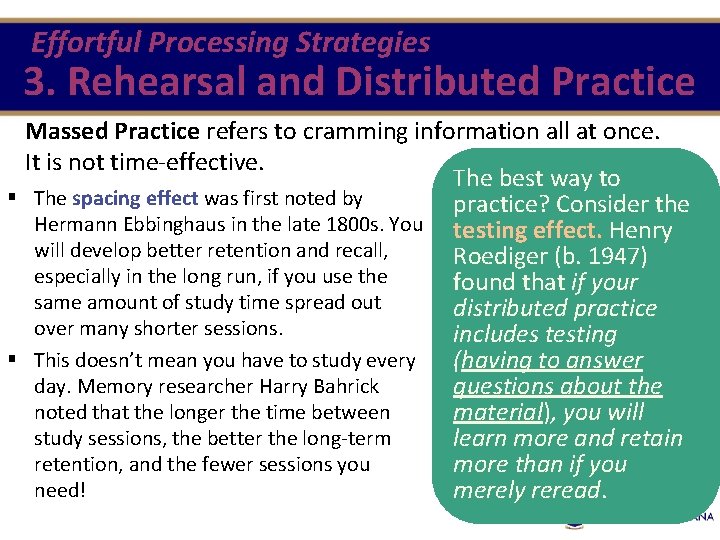
Effortful Processing Strategies 3. Rehearsal and Distributed Practice Massed Practice refers to cramming information all at once. It is not time-effective. The best way to § The spacing effect was first noted by practice? Consider the Hermann Ebbinghaus in the late 1800 s. You testing effect. Henry will develop better retention and recall, Roediger (b. 1947) especially in the long run, if you use the found that if your same amount of study time spread out distributed practice over many shorter sessions. includes testing § This doesn’t mean you have to study every (having to answer day. Memory researcher Harry Bahrick questions about the noted that the longer the time between material), you will study sessions, the better the long-term learn more and retain retention, and the fewer sessions you more than if you need! merely reread.
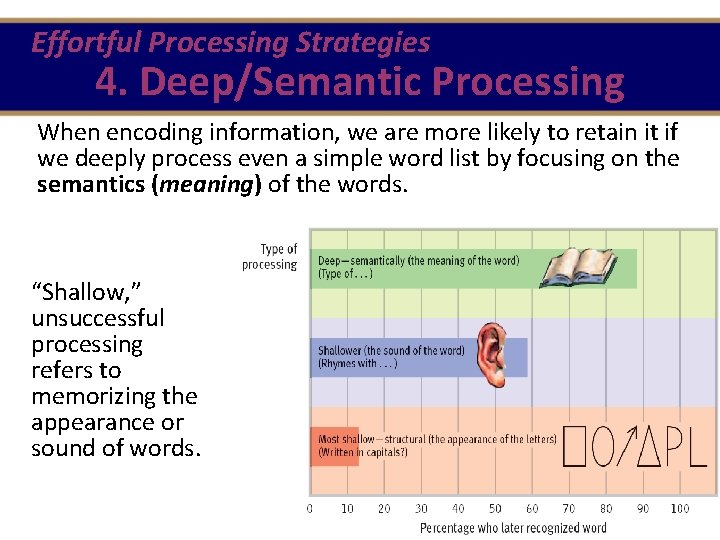
Effortful Processing Strategies 4. Deep/Semantic Processing When encoding information, we are more likely to retain it if we deeply process even a simple word list by focusing on the semantics (meaning) of the words. “Shallow, ” unsuccessful processing refers to memorizing the appearance or sound of words.
Effortful Processing Strategies: 5. Making Information Personally Meaningful § We can memorize a set of instructions more easily if we figure out what they mean rather than seeing them as set of words. § Memorizing meaningful material takes one tenth the effort of memorizing nonsense syllables. § Actors memorize lines (and students memorize poems) more easily by deciding on the feelings and meanings behind the words, so one line flows naturally to the next. § The self-reference effect, relating material to ourselves, aids encoding and retention. § Now try again, but this time, consider how each word relates to you.
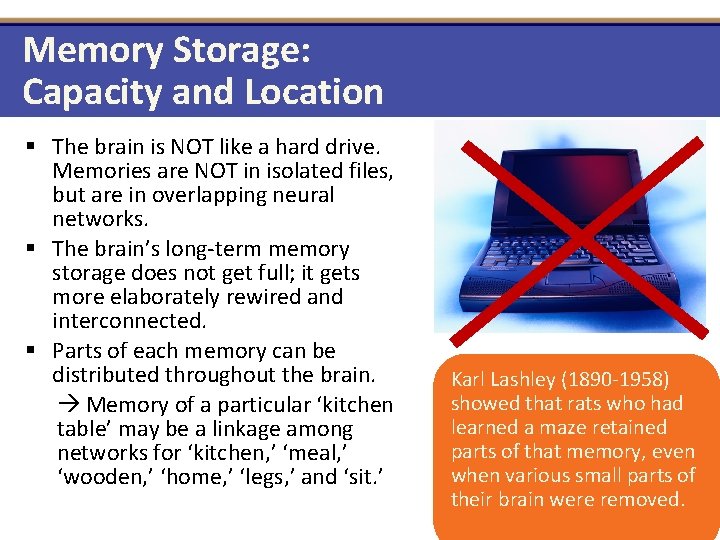
Memory Storage: Capacity and Location § The brain is NOT like a hard drive. Memories are NOT in isolated files, but are in overlapping neural networks. § The brain’s long-term memory storage does not get full; it gets more elaborately rewired and interconnected. § Parts of each memory can be distributed throughout the brain. Memory of a particular ‘kitchen table’ may be a linkage among networks for ‘kitchen, ’ ‘meal, ’ ‘wooden, ’ ‘home, ’ ‘legs, ’ and ‘sit. ’ Karl Lashley (1890 -1958) showed that rats who had learned a maze retained parts of that memory, even when various small parts of their brain were removed.
Topic 3: Retrieving Information from Memory College of Education School of Continuing and Distance Education 2014/2015 – 2016/2017
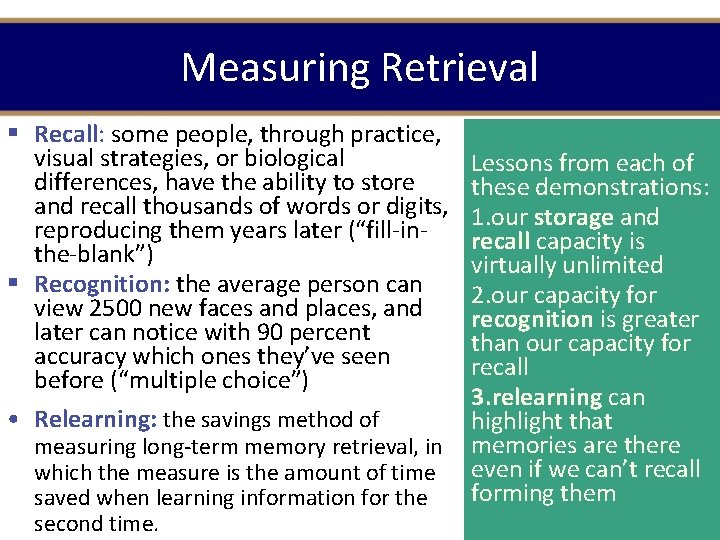
Measuring Retrieval • There are three means of measuring memory retrieval: • Recall: a measure of long-term memory retrieval that requires the reproduction of the information with essentially no retrieval cues. • Recognition: a measure of long-term memory retrieval that only requires the identification of the information in the presence of retrieval cues. • Relearning: the savings method of measuring long-term memory retrieval, in which the measure is the amount of time saved when learning information for the second time.
Measuring Retrieval § Recall: some people, through practice, visual strategies, or biological differences, have the ability to store and recall thousands of words or digits, reproducing them years later (“fill-inthe-blank”) § Recognition: the average person can view 2500 new faces and places, and later can notice with 90 percent accuracy which ones they’ve seen before (“multiple choice”) • Relearning: the savings method of Lessons from each of these demonstrations: 1. our storage and recall capacity is virtually unlimited 2. our capacity for recognition is greater than our capacity for recall 3. relearning can highlight that measuring long-term memory retrieval, in memories are there which the measure is the amount of time even if we can’t recall forming them saved when learning information for the second time.
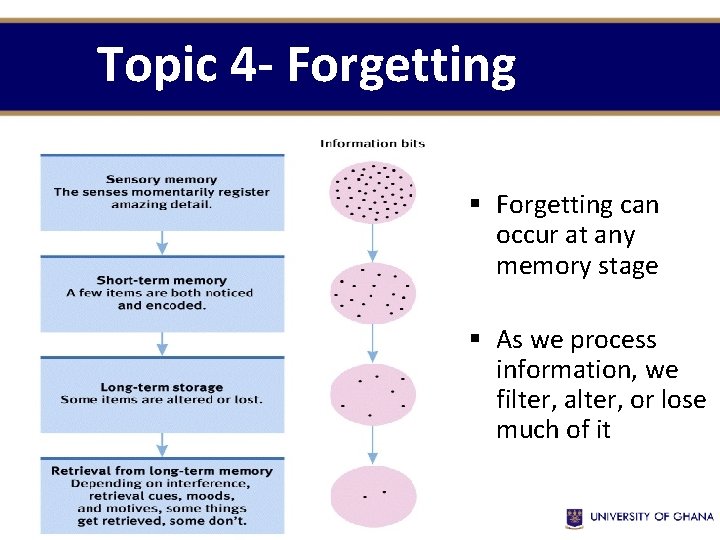
Topic 4 - Forgetting § Forgetting can occur at any memory stage § As we process information, we filter, alter, or lose much of it
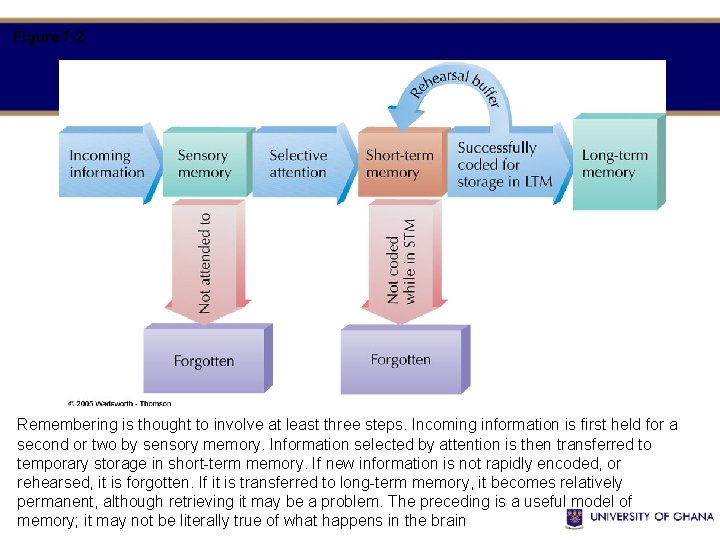
Figure 7. 2 Remembering is thought to involve at least three steps. Incoming information is first held for a second or two by sensory memory. Information selected by attention is then transferred to temporary storage in short-term memory. If new information is not rapidly encoded, or rehearsed, it is forgotten. If it is transferred to long-term memory, it becomes relatively permanent, although retrieving it may be a problem. The preceding is a useful model of memory; it may not be literally true of what happens in the brain
Reasons Why Forgetting Occurs 1. 2. 3. 4. 5. Encoding failure theory Motivated forgetfulness Decay in Storage (Theory of Disuse) Interference Loss of Cues
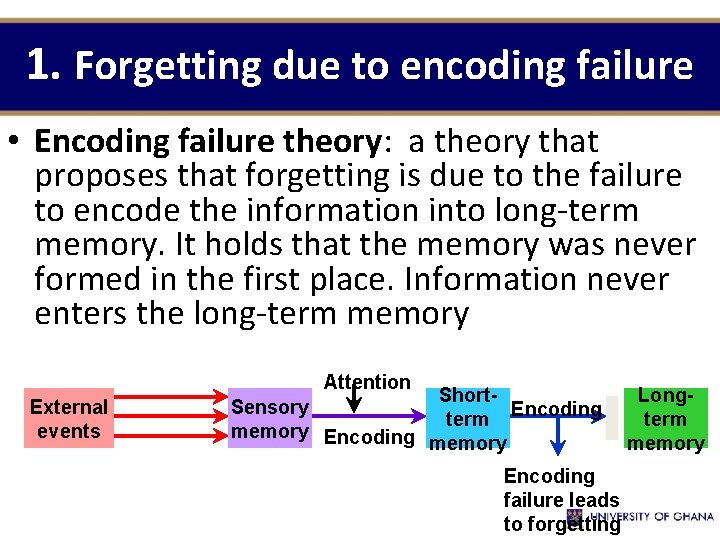
1. Forgetting due to encoding failure • Encoding failure theory: a theory that proposes that forgetting is due to the failure to encode the information into long-term memory. It holds that the memory was never formed in the first place. Information never enters the long-term memory Attention External events Short. Sensory term Encoding memory Encoding failure leads to forgetting Longterm memory
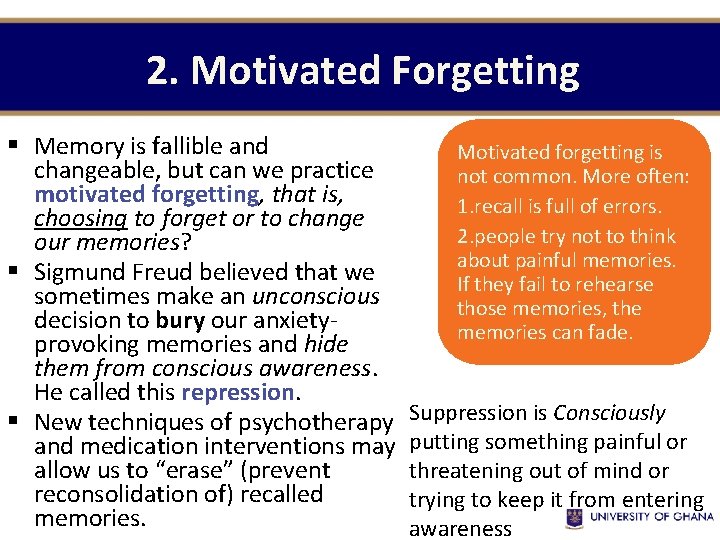
2. Motivated Forgetting § Memory is fallible and Motivated forgetting is changeable, but can we practice not common. More often: motivated forgetting, that is, 1. recall is full of errors. choosing to forget or to change 2. people try not to think our memories? about painful memories. § Sigmund Freud believed that we If they fail to rehearse sometimes make an unconscious those memories, the decision to bury our anxietymemories can fade. provoking memories and hide them from conscious awareness. He called this repression. § New techniques of psychotherapy Suppression is Consciously and medication interventions may putting something painful or threatening out of mind or allow us to “erase” (prevent reconsolidation of) recalled trying to keep it from entering memories. awareness
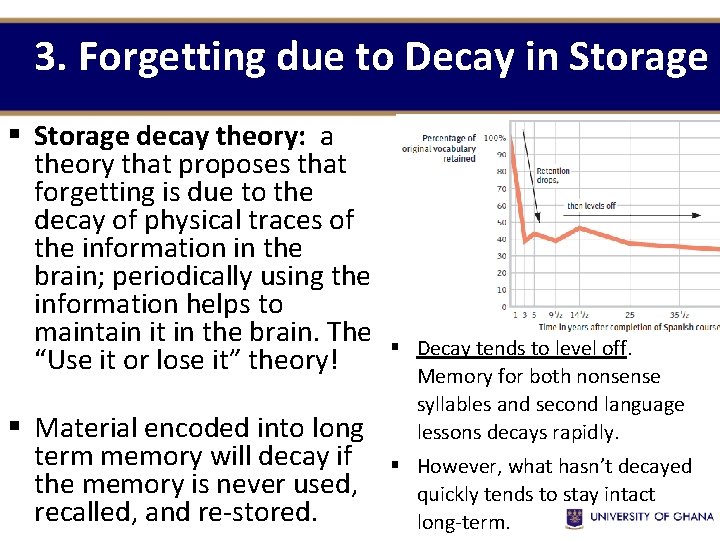
3. Forgetting due to Decay in Storage § Storage decay theory: a theory that proposes that forgetting is due to the decay of physical traces of the information in the brain; periodically using the information helps to maintain it in the brain. The “Use it or lose it” theory! § Material encoded into long term memory will decay if the memory is never used, recalled, and re-stored. § Decay tends to level off. Memory for both nonsense syllables and second language lessons decays rapidly. § However, what hasn’t decayed quickly tends to stay intact long-term.
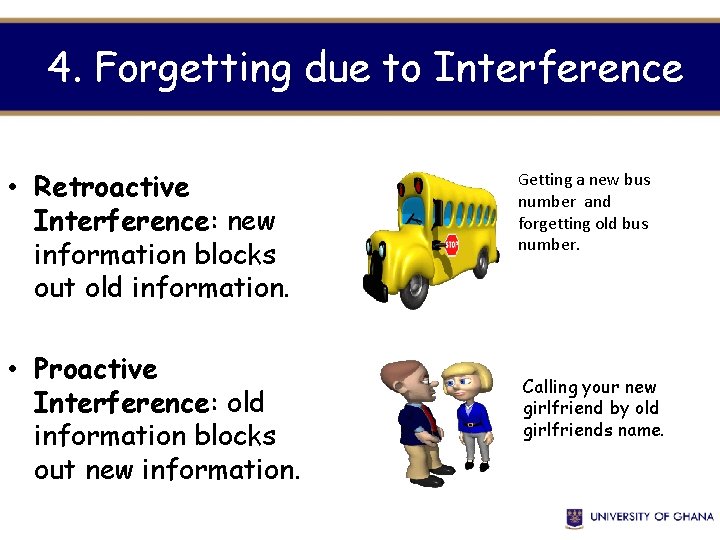
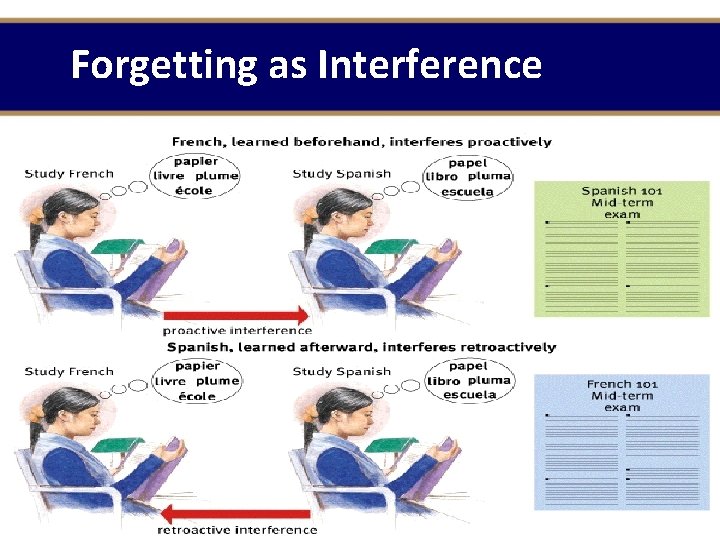
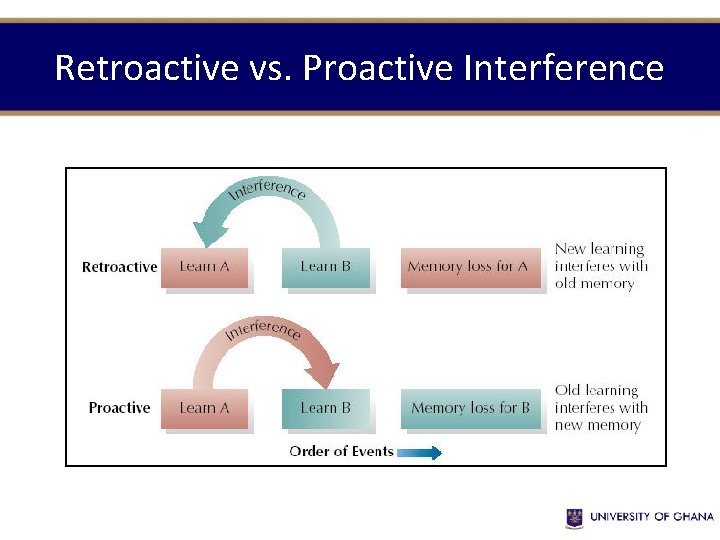
4. Forgetting due to Interference • Retroactive Interference: new information blocks out old information. • Proactive Interference: old information blocks out new information. Getting a new bus number and forgetting old bus number. Calling your new girlfriend by old girlfriends name.
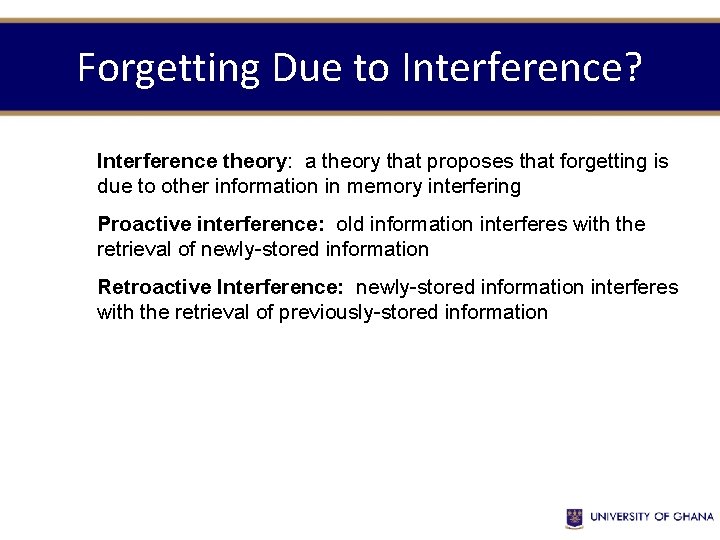
Forgetting Due to Interference? Interference theory: a theory that proposes that forgetting is due to other information in memory interfering Proactive interference: old information interferes with the retrieval of newly-stored information Retroactive Interference: newly-stored information interferes with the retrieval of previously-stored information
Forgetting as Interference
Retroactive vs. Proactive Interference
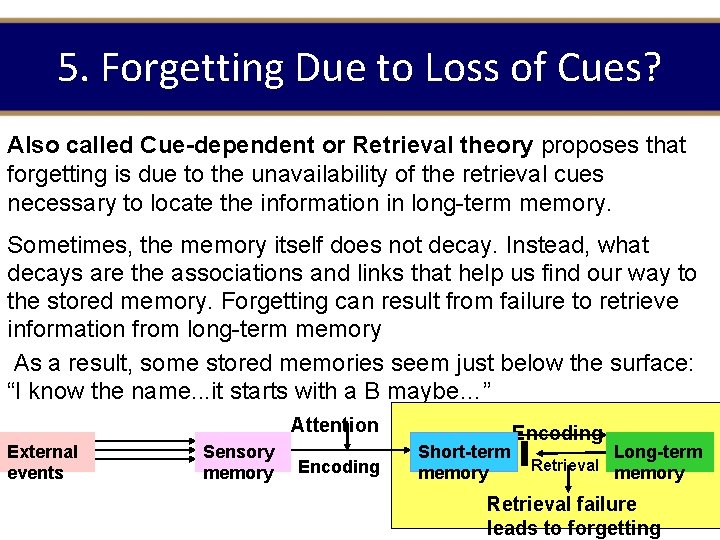
5. Forgetting Due to Loss of Cues? Also called Cue-dependent or Retrieval theory proposes that forgetting is due to the unavailability of the retrieval cues necessary to locate the information in long-term memory. Sometimes, the memory itself does not decay. Instead, what decays are the associations and links that help us find our way to the stored memory. Forgetting can result from failure to retrieve information from long-term memory As a result, some stored memories seem just below the surface: “I know the name. . . it starts with a B maybe…” Attention External events Sensory memory Encoding Short-term memory Encoding Retrieval Long-term memory Retrieval failure leads to forgetting
Topic 5: Improving Memory College of Education School of Continuing and Distance Education 2014/2015 – 2016/2017
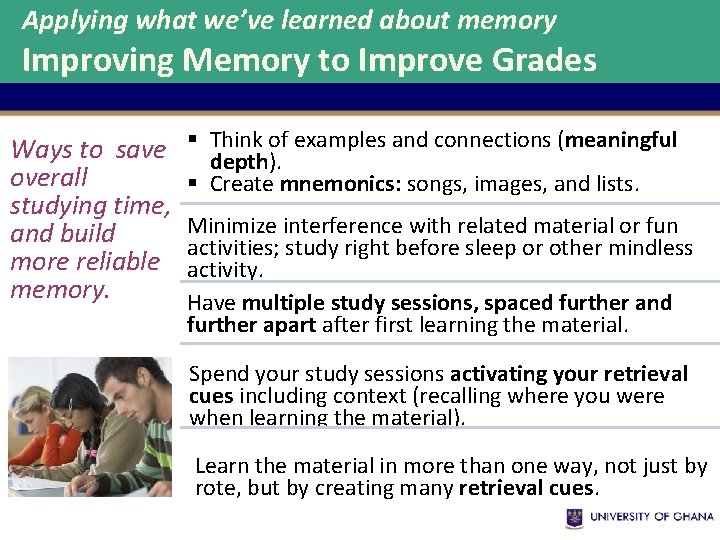
Applying what we’ve learned about memory Improving Memory to Improve Grades Ways to save overall studying time, and build more reliable memory. § Think of examples and connections (meaningful depth). § Create mnemonics: songs, images, and lists. Minimize interference with related material or fun activities; study right before sleep or other mindless activity. Have multiple study sessions, spaced further and further apart after first learning the material. Spend your study sessions activating your retrieval cues including context (recalling where you were when learning the material). Learn the material in more than one way, not just by rote, but by creating many retrieval cues.
Improve Your Memory § Study repeatedly to boost recall § Spend more time rehearsing or actively thinking about the material § Make material personally meaningful § Use mnemonic devices § associate with peg words--something already stored § make up story § chunk--acronyms Test yourself in study sessions: 1) to practice doing retrieval as if taking a test, and 2) to overcome the overconfidence error: the material seems familiar, but can you explain it in your own words?
Improve Your Memory § Activate retrieval cues--mentally recreate situation and mood § Recall events while they are fresh-- before you encounter misinformation § Minimize interference § Test your own knowledge § rehearse § determine what you do not yet know
More Tips for Improving Memory • Pay attention, minimizing distractions • Do not cram for exams – Distributed is better than massed practice • Use elaborative rehearsal • Use overlearning • Use mnemonic devices – Acronyms (APA), acrostics(rhyme or saying) • Remember the major functions of memory: Ellen stopped remembering (encoding, storage, retrieval)
References • Coon, D. and Mitterer, O. J (2013). Introduction to Psychology (13 th ed). Wadsworth Cengage learning. Pp. 241 -268 • Feldman, S. R, Collins, J. E. and Green, M. J (2005). Essentials of understanding psychology (2 nd ed). Mc. Graw. Hill Ryerson. pp. 187 -212 • Kosslyn, M. S, and Rosenberg, R. (2006). Psychology in context. pearson. Pp. 278 -315 • Weiten, W. (2009). Psychology: Themes and variations (8 th ed). cengage learning. Pp. 277 -305 Dr. Richard Boateng, UGBS Slide 38